La Palma (SPC) Airport Guide 2026 — The Island That Fills Up In Winter
La Palma’s airport sits on the east coast 8.8 km and about 13 minutes’ drive south of Santa Cruz de La Palma, and it is far bigger than the island’s reputation suggests: 1,529,974 passengers in 2025, 19th of Spain’s 34 airports. Five out of six of those passengers were flying domestically — this is overwhelmingly an inter-island airport, with Tenerife North alone carrying more than three times the traffic of Madrid. The bus is line 500 to Santa Cruz, run by TILP, and a car is close to compulsory if you are going anywhere else. Spain uses the euro, but the Canaries sit outside the EU VAT area. And the international traffic peaks in January, not August.
Last verified: September 2026.
⚡ 2026 Quick Reference — Key Facts at a Glance
TILP line 500: Airport → Los Cancajos → Santa Cruz de La Palma, about 30 minutes. Aena publishes the operating window as 07:15–22:45 Monday to Saturday and 07:45–22:45 on Sundays and public holidays. The stop is on Floor 0, Arrivals. Information: +34 922 411 924 / +34 922 414 441
There is a direct bus over the ridge — line 301, Santa Cruz – Airport – Hospital – El Paso – Los Llanos, about 63 minutes end to end, which puts the airport roughly 54 minutes from Los Llanos. ⚠️ But since 8 June 2026 it runs three times a day in total: one departure from Los Llanos at 10:35, and two from Santa Cruz at 20:40 and 22:40 on weekdays, 20:10 and 22:40 at weekends and on holidays. Line 300 covers the same corridor far more often but does not call at the airport
Distance-banded on the free stored-value título monedero: up to 10 km €1.50 · up to 20 km €2.40 · over 20 km €2.60. The card costs nothing and can be requested on the bus; top-ups are €10, €20 or €30
Fares are set in the Official Gazette of the Canary Islands no. 59 of 24 March 2023: weekdays 06:00–22:00, minimum €3.85, €1.35/km, plus a €2.10 airport supplement; nights, Sundays and holidays, minimum €4.25 and €1.55/km. On those numbers Santa Cruz works out around €14 by day and Los Llanos around €47. Radio taxi: Villa de Mazo +34 922 440 078, Breña Baja +34 922 440 825
1,529,974 — 19th of 34 Spanish airports. Domestic 1,277,869 · international 252,105. Inter-island flying is the whole business here
Tenerife North 734,233 · Gran Canaria 241,045 · Madrid 192,505 · Tenerife South 49,930 · Frankfurt 36,458 · Düsseldorf 31,136 · Amsterdam 26,993 · Hamburg 26,205 · Barcelona 20,038. Inter-island outweighs mainland Spain by roughly five to one
International passengers by month in 2025: January 31,915 · March 32,824 · June 8,411 · August 12,220 · November 32,963. The foreign season here is WINTER. Domestic traffic stays flat all year at roughly 89,000–127,000 a month
12 at the airport: Binter Canarias · Canaryfly · Condor · Electra Airways · Enter Air · Eurowings · Iberia · Jet2.com · Smartwings · Transavia · TUI Airways · Vueling. Destinations: Tenerife N & S, Gran Canaria, Fuerteventura, Lanzarote, Madrid, Barcelona, Frankfurt, Düsseldorf, Munich, Amsterdam, London Gatwick, Manchester, Prague, Katowice, Wrocław
There is none. Aena’s own service list for La Palma has no lounge category at all, and Priority Pass lists 20 Spanish airports — including Tenerife North, Tenerife South, Gran Canaria, Lanzarote and Fuerteventura — but not La Palma
Euro (€) — Spain is in the eurozone and in Schengen, two separate memberships. ⚠️ But the Canary Islands are outside the EU VAT and excise areas while remaining EU territory inside the EU customs union (European Commission). Local prices are set under the Canaries’ own IGIC, not mainland Spanish VAT
Schengen · EES fully operational since 10 April 2026 · ETIAS is not in operation and no applications are being collected; the fee is fixed at €20. Flights to and from mainland Spain are internal — no passport control
SPC / GCLA · Aena · terminal at 28.622071, −17.752259 · one runway, 18/36, 2,200 × 45 m asphalt, elevation 107 ft. The car park is open 06:00–22:30, with up to two hours’ extension for delayed flights
🏢 1. One Terminal, One Runway, and a Traffic Mix Nobody Expects
La Palma Airport is a single Aena terminal on a shelf of land above the east coast, in the municipality of Villa de Mazo, with one runway — 18/36, 2,200 metres by 45, asphalt — at an elevation of 107 feet. That runway length is the constraint that shapes everything about this airport: it takes narrowbodies comfortably and nothing larger, which is why every route here is either a 45-minute hop to another island or a European narrowbody sector.
Airside is modest and the shop list is short. Aena’s shop list names eight outlets: Canariensis, Hecho en La Palma, Jerónimo, La Pausa, Lavazza, Mahou Sports Bar, Mar de Bruma and a pharmacy — none of them a duty-free store, though a retail directory is not a completeness guarantee. The service list runs to baggage, families, ATMs, post, VAT refunds, information, assistance for passengers with reduced mobility, medical services and defibrillators — a competent regional airport, comprehensively equipped, with nothing to detain you.
One quiet detail worth planning around: the airport car park opens at 06:00 and closes at 22:30, with up to two hours’ grace for delayed flights. On an island where the last Binter rotations run late, that is a real constraint if you were counting on leaving a car overnight without checking.
The traffic mix, which is the interesting part
Most people picture La Palma as a small German-and-British winter-sun island served by a handful of charters. The numbers say something different.
| Year | Total | Domestic | International |
|---|---|---|---|
| 2024 | 1,493,485 | 1,262,411 | 231,074 |
| 2025 | 1,529,974 | 1,277,869 | 252,105 |
Five out of every six passengers here are flying domestically, and in the Canaries “domestic” overwhelmingly means inter-island. The 2024 route figures make the shape unmistakable — these are both-directions totals:
| Route | Passengers (2024) |
|---|---|
| Tenerife North | 734,233 |
| Gran Canaria | 241,045 |
| Madrid | 192,505 |
| Tenerife South | 49,930 |
| Frankfurt | 36,458 |
| Düsseldorf | 31,136 |
| Amsterdam | 26,993 |
| Hamburg | 26,205 |
| Barcelona | 20,038 |
Tenerife North alone carries nearly four times what Madrid carries, and inter-island flying outweighs mainland Spain by roughly five to one. This is, first and last, a Canarian commuter airport — hospital appointments, university terms, government business, family — with a European leisure layer bolted onto the side.
The airlines, and who actually matters
Aena lists 12 airlines: Binter Canarias, Canaryfly, Condor, Electra Airways, Enter Air, Eurowings, Iberia, Jet2.com, Smartwings, Transavia, TUI Airways and Vueling.
The two that matter for most journeys are the two you have probably never heard of. Binter Canarias flies the inter-island network — Tenerife North and South, Gran Canaria, Fuerteventura and Lanzarote — and Canaryfly flies Gran Canaria and Tenerife North. Between them they are the reason this airport moves 1.5 million people. Everything else is one route each: Iberia to Madrid, Vueling to Barcelona, Transavia to Amsterdam, Jet2.com to Manchester, TUI Airways to Gatwick and Manchester, Eurowings to Düsseldorf, Smartwings to Prague, Electra Airways to Katowice, Enter Air to Wrocław, and Condor to Frankfurt, Düsseldorf and Munich.
If you are connecting through another island — and if you are coming from anywhere but Madrid, Barcelona or one of those dozen European cities, you probably are — check the bag rules before you book, because an inter-island connection on a separate ticket is where allowances quietly stop matching. Our baggage fee checker covers it, the Binter Canarias baggage allowance guide has the detail for the inter-island leg, and our flight price checker will tell you whether routing via Tenerife actually saves you anything.
The seasonality is upside down, and it should change how you book
Here is the fact that separates this island from every other Canary destination. These are international passengers by month in 2025:
| Month | International | Month | International |
|---|---|---|---|
| January | 31,915 | July | 12,471 |
| February | 28,992 | August | 12,220 |
| March | 32,824 | September | 11,583 |
| April | 22,466 | October | 17,472 |
| May | 8,984 | November | 32,963 |
| June | 8,411 | December | 31,804 |
November moves four times the foreign traffic that June does. The European market for La Palma is a winter market — Germans, Dutch, Poles, Czechs and Britons coming for mild winter walking weather, not for a beach in August. Meanwhile domestic traffic barely moves: between 89,000 and 127,000 a month, every month, because islanders fly whatever the season.
The practical consequences: fly here in May, June or September and you will find a quieter airport, a thinner European route map and better accommodation prices; fly in January and you are booking into the peak. And 2026 has run at or above 2025 so far, with 124,725 passengers in January, 126,481 in February and 127,158 in March.
🛂 2. Euro, Schengen — and Outside the EU VAT Area
Three separate facts apply here and travellers routinely merge them.
Spain is in the eurozone. The euro is the currency, prices are in euros, cards work everywhere including on the buses, and there is no conversion to think about if you are arriving from another euro country.
Spain is in the Schengen area. A flight from Frankfurt, Amsterdam, Prague or Katowice involves no passport control at either end, and a flight from Madrid, Barcelona or Tenerife is a domestic sector. Schengen and the euro are different memberships that happen to coincide in Spain — plenty of countries are in one and not the other.
And the Canary Islands are outside the EU VAT and excise areas. This is the one nobody expects. The European Commission’s own territorial-status table lists the Canary Islands as EU territory: yes · customs rules apply: yes · VAT rules apply: no · excise rules apply: no. The islands levy their own IGIC instead of mainland Spanish VAT — a different tax with different rates, which you should check with the Agencia Tributaria Canaria rather than assume. The practical effects are that prices for many goods here are genuinely lower than in Madrid, that Aena runs a VAT-refund desk at this airport, and that a flight from La Palma to mainland Spain — internal though it is for passport purposes — crosses a fiscal frontier. Pack alcohol and tobacco with traveller allowances in mind rather than assuming an EU-internal free-for-all.
EES — live since April, and light at this airport
The EU Entry/Exit System (EES) has been fully operational since 10 April 2026, finishing the roll-out that began in October 2025. For non-EU nationals travelling on a short stay of up to 90 days in any 180, the first external-border crossing now registers travel-document data, a facial image and fingerprints; subsequent crossings are a faster biometric match against that record, and the passport stamp is gone.
At La Palma the load is genuinely small. Of 1,529,974 passengers in 2025, only 252,105 were international at all, and most of those were intra-EU — Germany, the Netherlands, Poland, Czechia. The realistic EES queue here is the Jet2.com and TUI Airways traffic from Manchester and Gatwick, and a British passport holder arriving in January on a first trip of the year should expect the enrolment to take a few minutes longer than the stamp used to. In a terminal this size that is an inconvenience, not the hour-long horror stories from the big Mediterranean gateways.
EU, EEA and Swiss citizens are unaffected and are not registered in the system.
ETIAS — status, not a date
ETIAS is not running. No applications are being collected and no one can sell you a valid authorisation — any site offering to “get your ETIAS now” is selling a form-filling service for a system that does not exist yet. When it starts it will apply to visa-exempt non-EU nationals only, and the fee is fixed at €20 by Delegated Regulation (EU) 2025/1411, with under-18s, over-70s and family members of EU citizens exempt. If a third-party site quotes you a start date, treat it as invented until the European Commission publishes one.
🚌 3. Line 500 to Santa Cruz, Line 301 Over the Ridge, and Why You Should Hire a Car
Line 500 — the one that works
TILP — Transportes Insular La Palma — runs line 500 between the airport and Santa Cruz de La Palma via Los Cancajos. The stop is signed on Floor 0 in Arrivals, TILP also keeps a desk in the arrivals hall, and the operator’s own line atlas gives the journey as about 30 minutes: airport → Cancajos ±5 min → Cruce Cancajos ±10 min → Santa Cruz ±30 min.
Aena publishes the operating window as 07:15 to 22:45 Monday to Saturday, and 07:45 to 22:45 on Sundays and public holidays. TILP does not publish a headway on its website, so pull the day’s departures from tilp.es or call +34 922 411 924 before you commit — and note that if your flight lands after about 22:45 the bus is finished for the day.
Line 301 — the Los Llanos answer, with a large asterisk
Los Llanos de Aridane is on the other side of the island, over the Cumbre ridge and through the tunnel, 33 km and about 42 minutes’ drive from the terminal. Most guides tell you there is no bus. That is wrong, but only just.
Line 301 runs Santa Cruz – Airport – Hospital – El Paso – Los Llanos, and TILP times the whole run at about 63 minutes, with the airport reached about 9 minutes out of Santa Cruz. That puts Los Llanos roughly 54 minutes from the airport gate on a single bus with no change — genuinely useful, if the times work.
They mostly do not. From 8 June 2026 line 301 operates three departures a day in total:
| Direction | Weekdays | Saturdays, Sundays & holidays |
|---|---|---|
| Los Llanos → Airport → Santa Cruz | 10:35 only | 10:35 only |
| Santa Cruz → Airport → Los Llanos | 20:40 and 22:40 | 20:10 and 22:40 |
So if you land in the evening and want Los Llanos, the 20:40 or 22:40 out of Santa Cruz passes the airport about nine minutes later and gets you there in under an hour. Any other time, you are changing in Santa Cruz onto line 300 — the frequent Santa Cruz–El Paso–Los Llanos service, about 50 minutes — which does not call at the airport. That is two buses and the better part of an hour and a half.
The fares, and the honest recommendation
TILP fares are banded by distance on a free stored-value card, the título monedero, which you can ask for on the bus and top up in €10, €20 or €30:
| Option | Journey | Time | Price |
|---|---|---|---|
| Bus 500 | Airport → Santa Cruz de La Palma (8.8 km) | ~30 min | €1.50 (up-to-10 km band) |
| Bus 301 | Airport → Los Llanos de Aridane (33 km) | ~54 min | €2.60 (over-20 km band), 2 evening departures |
| Bus 500 + 300 | Airport → Santa Cruz → Los Llanos | ~1h 25m + wait | €1.50 + €2.60 |
| Taxi (day tariff) | Airport → Santa Cruz | ~13 min | ≈ €14 on the published tariff |
| Taxi (day tariff) | Airport → Los Llanos | ~42 min | ≈ €47 on the published tariff |
| Hire car | Anywhere | — | Desks in the terminal; car park 06:00–22:30 |
Those taxi figures are computed from the official Canarian tariff — minimum €3.85, €1.35 per kilometre and a €2.10 airport supplement between 06:00 and 22:00, rising to €4.25 minimum and €1.55 per kilometre at night, on Sundays and on public holidays. They are an estimate from published rates, not a quoted fare. Ask before you set off.
And here is the recommendation, stated plainly: hire a car. The good parts of this island — the Caldera rim, the northern laurel forest, the volcanic south, the observatory road — are at the ends of mountain roads that no bus serves usefully. The bus network is built for islanders commuting between towns, not for a visitor covering the island in a week. Without a car you will see Santa Cruz, Los Cancajos and whichever beach your hotel sits above. With one, you will see the island. On a walking-and-stargazing trip, that is not a marginal difference.
🛋️ 4. No Lounge — and I Checked Properly
La Palma Airport has no lounge, and because “the airport website doesn’t mention one” is not proof of anything, here is exactly what I checked.
Aena’s own service directory for La Palma lists thirteen categories — travel agencies and tour operators, baggage, families, ATMs, post, VAT refunds, information, other services, people with special needs, meetings and work, medical services and defibrillators, arrivals area, departures area. Aena publishes a VIP lounge category at airports that have one. La Palma has no such entry.
Priority Pass — the largest independent lounge network, and the one most likely to sell access at a small airport the operator does not advertise — lists 20 Spanish airports: A Coruña, Alicante, Asturias, Barcelona, Bilbao, Fuerteventura, Gran Canaria, Granada, Ibiza, Lanzarote, Madrid, Málaga, Menorca, Palma de Mallorca, Santiago, Sevilla, Tenerife North, Tenerife South, Valencia and Vigo. Four Canary airports are on that list and La Palma is not.
Two independent sources, one of them a reseller with every commercial reason to list a lounge if one existed. Plan for the departures hall.
What you get instead is a small, calm airside area, free Wi-Fi, and the eight food and retail outlets Aena names — Mahou Sports Bar, La Pausa, Lavazza, Mar de Bruma, Jerónimo, Canariensis, Hecho en La Palma and a pharmacy. For a two-hour wait on a Binter hop that is entirely sufficient. For an early Condor departure to Frankfurt, bring a book.
🍽️ 5. What to Eat, and the One Shop Worth Your Money
The single most useful thing in this terminal is the shop called Hecho en La Palma — “made in La Palma” — because it is a straightforward answer to the souvenir problem. The island’s real products are its wines, its cheeses, almond sweets, palm honey from the Canary date palm, and mojo sauces, red and green. Buy those rather than anything with a volcano printed on it.
Before you get to the airport, eat properly. La Palma’s kitchen is Canarian, not Spanish-mainland: papas arrugadas — small potatoes boiled in heavily salted water until the skins wrinkle — served with mojo picón (red, garlic and paprika, mildly hot) or mojo verde (green, coriander). Queso palmero, the island’s own smoked goat’s cheese, is better here than anywhere it gets exported to. Grilled fish along the coast, vieja in particular, is the thing to order at a seafront restaurant. And the island makes wine on volcanic soil at real altitude — ask for something from Fuencaliente in the south.
In Santa Cruz de La Palma, 8.8 km and about half an hour by bus 500, the old town along Calle O’Daly is where to look. It is a genuinely handsome colonial-era street of balconied houses, and the restaurants along and behind it are where islanders eat.
Two practical notes on money. First, the Canaries’ IGIC is not mainland VAT, so many goods are cheaper here than on the peninsula — which matters more for electronics, spirits and tobacco than for lunch. Second, flying to mainland Spain crosses a fiscal border even though it does not cross a passport one, so allowances apply to what you carry. Aena runs a VAT-refund desk at the airport for the traffic that generates.
💡 6. Walking, Stars, and Getting the Observatory Right
The island’s own tourism board sells La Palma as “La Isla Bonita” — the island of starry skies, ancient forests, beaches and volcanic pools — and for once the marketing is accurate about the priority order. People come here to walk and to look up. Almost nobody comes for a resort.
The observatory, and what is actually open to you
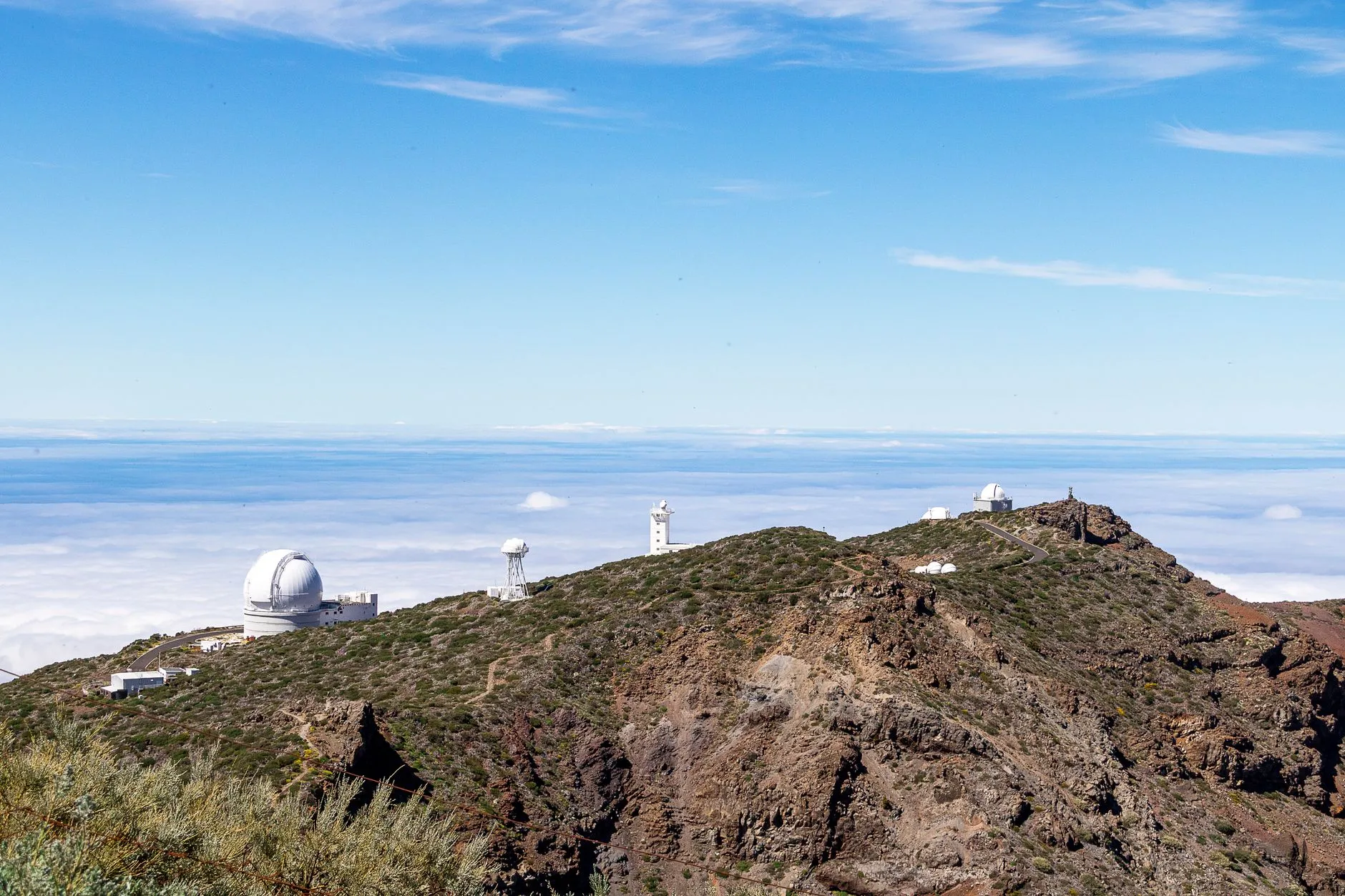
The Roque de los Muchachos Observatory (ORM) sits at 2,396 metres in the municipality of Garafía, on the rim of the Caldera de Taburiente National Park, and the Instituto de Astrofísica de Canarias describes it as one of the largest arrays of telescopes in the world. It is 50.4 km and about 54 minutes’ drive from the airport — a long, steadily climbing mountain road that ends above the cloud layer.
Here is the part to get right. The IAC does welcome the general public to the observatory, but visits require prior authorisation, requested through the IAC’s own procedure. You cannot turn up at the gate expecting to be shown a telescope. What you can do without any booking at all is drive to the summit area and stand there — the road is public, the viewpoints are public, and on a clear afternoon the view down into the Caldera and out across the cloud sea is the single best hour on the island. Sunset from the ridge, then dark, is the reason people fly here in January.
So: book the observatory visit through iac.es well before you travel if you want inside a dome; drive up regardless if you do not. Bring warm clothing — it is 2,400 metres and it is cold after dark even when Santa Cruz is at 22 degrees — and note that the observatory road is not a place to be improvising in the dark on a first night.
The walking
The island climbs from sea level to the observatory ridge at nearly 2,400 metres in the space of a short drive, which is what produces the density of good walking the tourist board leads with. The Caldera de Taburiente National Park is the centrepiece — a vast erosion basin ringed by the summit ridge — and the marked trail network reaches from the volcanic cones of the south to the laurel forest of the north. The official island trail map is published at visitlapalma.es, and it is worth downloading before you fly rather than hunting for a paper copy on arrival.
One honest caveat. This is a live volcanic island with mountain roads and a national park, and local access to individual paths, viewpoints and coastal areas is managed by the Cabildo Insular and can change. Check the current status of any specific trail or beach with the Cabildo or the park authority before you build a day around it — that is ordinary practice on La Palma rather than a warning, and no guide written in advance can substitute for it.
Four things I would tell a friend
- Book in May, June or September if you can. International traffic in June is a quarter of what it is in November. Same island, fewer people, cheaper beds.
- Hire a car at the airport. Two buses serve the airport, one of them three times a day. Everything that makes this island worth the flight is up a mountain road.
- Check the car park hours if you are leaving a car. It runs 06:00 to 22:30 with a two-hour grace period for delays — not 24 hours.
- If you are connecting via Tenerife or Gran Canaria, treat it as two flights. Binter and Canaryfly carry most of this airport’s traffic and their allowances are their own; check them against your long-haul ticket rather than assuming they through-check.
❓ Frequently Asked Questions
📊 2026 Summary Data Table
| Category | Detail |
|---|---|
| Airport | La Palma Airport · SPC / GCLA · operated by Aena · terminal at 28.622071, −17.752259 |
| Location | East coast, 8.8 km / ~13 min south of Santa Cruz de La Palma; Los Cancajos 6.7 km; Los Llanos de Aridane 33 km |
| Passengers 2025 | 1,529,974 — 19th of 34 Spanish airports · domestic 1,277,869 · international 252,105 |
| Passengers 2024 | 1,493,485 · domestic 1,262,411 · international 231,074 |
| Runway | 18/36 · 2,200 m × 45 m · asphalt · lit · elevation 107 ft |
| Airlines (12) | Binter Canarias · Canaryfly · Condor · Electra Airways · Enter Air · Eurowings · Iberia · Jet2.com · Smartwings · Transavia · TUI Airways · Vueling |
| Top routes 2024 | Tenerife North 734,233 · Gran Canaria 241,045 · Madrid 192,505 · Tenerife South 49,930 · Frankfurt 36,458 · Düsseldorf 31,136 · Amsterdam 26,993 · Hamburg 26,205 · Barcelona 20,038 |
| Seasonality | Inverted. International passengers 2025: November 32,963 vs June 8,411. Domestic flat at 89,000–127,000 a month |
| Airport bus | TILP line 500 to Santa Cruz via Los Cancajos, ~30 min, stop on Floor 0 Arrivals · 07:15–22:45 Mon–Sat, 07:45–22:45 Sun/holidays |
| Bus to Los Llanos | TILP line 301, ~54 min from the airport — but only 10:35 from Los Llanos and 20:40 / 22:40 (20:10 / 22:40 weekends) from Santa Cruz since 8 June 2026 |
| Bus fares | €1.50 up to 10 km · €2.40 up to 20 km · €2.60 over 20 km, on the free título monedero card |
| Taxi tariff | Day: minimum €3.85, €1.35/km, +€2.10 airport supplement · night/Sunday/holiday: minimum €4.25, €1.55/km (BOC no. 59, 24 March 2023) |
| Parking | Aena official car park, open 06:00–22:30 with up to 2 hours’ extension for delayed flights |
| Lounge | None. Not in Aena’s service list; not among Priority Pass’s 20 Spanish airports |
| Shops & food | 8 outlets: Canariensis · Hecho en La Palma · Jerónimo · La Pausa · Lavazza · Mahou Sports Bar · Mar de Bruma · pharmacy |
| Currency & tax | Euro. Spain is in the eurozone AND in Schengen. ⚠️ The Canaries are outside the EU VAT and excise areas but inside EU territory and the customs union; local IGIC applies |
| Border | Schengen · EES fully operational since 10 April 2026 · ETIAS not in operation, fee fixed at €20 |
| Observatory | Roque de los Muchachos, 2,396 m, Garafía — 50.4 km / ~54 min from the airport. Public visits welcome but prior authorisation is required via the IAC |