Reus Airport (REU) Airport Guide 2026 — Twenty-Four Routes, None Spanish
Reus Airport sits between the city of Reus and Tarragona on Catalonia’s Costa Daurada, about 10 km from each on Aena’s own reckoning. It handled 1,336,826 passengers in 2025 across a single terminal, and the number that defines it is 24: twenty-four scheduled destinations, operated by eight airlines, and not one of them is in Spain. Fifteen are in the UK. The transport fact that matters is the hourly 22-minute Monbus to Tarragona bus station; the Barcelona coach is a separate, slower, €18.50 proposition. Spain is Schengen and the euro. Behind the airport: PortAventura, Roman Tarragona, the Priorat vineyards and some of the best-value cooking in Catalonia.
Last verified: September 2026.
⚡ 2026 Quick Reference — Key Facts at a Glance
Tarragona bus station in 22 minutes, roughly hourly 07:00–22:00 (published valid 1 Mar – 31 Oct 2026) · Barcelona Sants bus station at a published €18.50 one way / €32.50 return, about 1h30–1h45, roughly 4–6 departures a day each way. Both leave from the platforms in front of arrivals; the Barcelona sheet we could read lapsed on 4 September, so re-check the current one
Operator’s own published price starts at €3.90 per person. Desk in arrivals; return tickets valid 14 days
Airport ↔ Plaça de la Llibertat, calling at the Renfe station and the bus station. Fare not published on a page we could load — see section 3
Reus €25 · Tarragona €32–37 · Salou / PortAventura €34–35 · La Pineda €35 · Cambrils €40 · Camp de Tarragona AVE station €48 · Barcelona El Prat €200. Higher at night, weekends and holidays. Taxi (+34) 977 345 050
REU / LERS — one terminal, operated by Aena. 1,336,826 passengers and 23,251 operations in 2025, and 8 airlines flying 24 destinations in 7 countries — UK, Ireland, Belgium, Netherlands, Germany, France, Portugal. Zero domestic Spanish routes
Euro (€) — Spain is in the eurozone
None. Reus is not on Aena’s list of airports with an open VIP lounge, and not on its Fast Lane list either
Schengen. EES fully operational since 10 April 2026 — and 18 of the 24 destinations here are outside Schengen
Not in operation. The Commission states no applications are being collected; the fee is set at €20
🏢 1. One Terminal, Eight Airlines, and Not a Single Flight to Spain
The first thing to understand about Reus is that it is not a Spanish airport in any practical sense. It is a British airport that happens to be in Catalonia.
Aena’s own destination listing shows 24 destinations operated by 8 companies, and the country filter on that page returns seven entries: the United Kingdom, Ireland, Belgium, the Netherlands, Germany, France and Portugal. Spain is not one of them. There is no Madrid shuttle, no Iberia feed, no Canaries route, nothing to Palma. If you land at Reus and need to get anywhere else in Spain, you do it on the ground.
Break the network down and the concentration is stark:
- Jet2.com — Belfast, Birmingham, Bristol, East Midlands, Edinburgh, Glasgow, Leeds/Bradford, Liverpool, London Gatwick, London Luton, London Stansted, Manchester, Newcastle. Thirteen destinations, all British.
- Ryanair — Birmingham, Brussels Charleroi, Cork, Dublin, Düsseldorf Weeze, East Midlands, Eindhoven, Leeds/Bradford, Liverpool, London Stansted, Manchester, Shannon. Twelve, and the only carrier here with meaningful continental reach.
- easyJet — Belfast, Bristol, Glasgow, London Gatwick, London Luton, Manchester, Newcastle.
- TUI Airways — Aberdeen, Belfast, Birmingham, Bristol, Cardiff, Glasgow, London Gatwick, Manchester, Newcastle.
- TUI fly Belgium — Brussels. Vueling — Paris Orly. Air Nostrum and Enter Air — Porto.
Fifteen of the twenty-four destinations are British airports. Three more are Irish. That leaves six inside the Schengen area, and section 2 explains why that matters at the passport desk.
The practical consequence for you: Reus offers no connections. Every carrier here is point-to-point, there is no interlining worth the name, and if your inbound is late there is no rebooking desk that can put you on a competitor. Treat every Reus flight as a standalone journey. Price it honestly with the aifly flight price checker, because the headline fare on a low-cost route is rarely the fare you pay.
The building, and what 387 kilograms tells you
One terminal, and a runway that has been 2,200 by 45 metres since 1952. Aena has rebuilt the passenger side in stages: a new arrivals building in 2005, a new check-in building in 2008 that merged arrivals, check-in and departures into one structure, a new boarding area in 2010, and terminal expansion works completed in 2021. The result is small, single-level and easy — you can see the whole thing from the door, which is exactly what you want when your flight is at 06:40.
It is also genuinely well run. Aena lists three consecutive ACI Best Airport in Europe awards in the under-2-million-passenger category, for 2022, 2023 and 2024, plus a 2021 award for hygiene measures. Awards like this are usually noise; here they line up with the experience, which is that Reus is quick.
The cargo figure is the tell. In 2025 Reus moved 387 kilograms of freight — not tonnes, kilograms. That is one pallet, once, all year. This airport does exactly one thing: it moves northern Europeans to the Costa Daurada and back.
Alongside the scheduled traffic there is a lot of small-aircraft movement, because the airport hosts the Real Aeroclub de Reus — one of the oldest flying clubs in Spain, whose 1935 landing strip is where the whole airport came from — and CESDA, a pilot training school. That is most of the 23,251 operations against only 1.3 million passengers.
Almost every airline here charges separately for bags, and on a €29 fare the bag is the fare. Read the detail before you get to the gate: Ryanair, Jet2, easyJet, TUI Airways, Vueling and Enter Air, or price them side by side in the aifly baggage fee checker.
🛂 2. Schengen and the Euro — and an Airport Where Most Flights Cross an External Border
Spain is in the Schengen area and Spain uses the euro. Those are two separate memberships and Spain holds both, so there is no internal border check when you arrive from Brussels or Porto, and the cash machine gives you the same currency you left home with if you came from most of the continent.
Then there is the Reus twist. Of this airport’s 24 destinations, 18 are outside the Schengen area — fifteen in the United Kingdom and three in Ireland. Only Brussels, Charleroi, Weeze, Eindhoven, Paris Orly and Porto are internal Schengen flights. At almost every other Spanish airport of this size the border desk is a formality serving a handful of departures. At Reus it is the main event, and it is worth planning around.
Note the Irish distinction, because it catches people out. Ireland is in the European Union but not in Schengen — it runs the Common Travel Area with the UK instead. So Dublin, Cork and Shannon flights are external-border movements for the airport’s purposes, but Irish citizens are EU citizens exercising free movement: they are not registered in the EES. British citizens on the same concourse are.
EES, and what it actually costs you in time
The EU Entry/Exit System became fully operational on 10 April 2026, and the European Commission’s own Smart Borders page states it in those words. It replaces the ink stamp with a digital record: a non-EU national travelling for a short stay has their facial image, fingerprints and travel-document data captured at the first crossing, then a faster biometric check on subsequent crossings while that record stands.
For a UK passport holder flying into Reus, the honest expectation is this. Your first post-EES entry takes noticeably longer than a stamp did, because the enrolment is a supervised process at a kiosk or a desk, not a two-second glance. Later entries are quicker. The problem at Reus is not the per-passenger time, it is the arrival bank: this is a terminal sized for 1.3 million passengers a year in which several British charter and low-cost arrivals can land inside the same half hour on a summer Saturday. If you land between 10:00 and 14:00 on a Saturday in July or August, budget an hour from wheels-down to the bus stop. In February you will walk straight through.
On departure the exit check is also an EES transaction, so the airline’s check-in and gate deadlines are real. Arrive when they tell you to.
ETIAS: status, not a date
ETIAS is not running. The Commission states plainly that “ETIAS is currently not in operation and no applications for travel authorisations are collected at this point”, and that the EU will announce the start date several months before launch. The fee has been fixed at €20 by Commission Delegated Regulation (EU) 2025/1411, with applicants under 18 or over 70 and qualifying family members of EU citizens exempt from the fee — though they will still need an authorisation once it starts.
The practical version: nobody can sell you a valid ETIAS today, because none exist. Any site charging you for a Spanish ETIAS in 2026 is charging you for a form it cannot file. Ignore them, and do not pay €7, €20 or anything else to a third party.
On money: Spain is a card economy and contactless works on buses, in supermarkets and in almost every restaurant on the coast. Two exceptions to keep cash for — a driver-sold bus ticket, and the small inland bars in the Priorat that still have a card minimum. Draw euros from a bank ATM in Reus or Tarragona rather than from a currency desk.
🚌 3. The 22-Minute Bus, the €18.50 Coach, and the Camp de Tarragona Shortcut
There is no railway station at the airport. Everything below is a bus, and the good news is that one of them is genuinely excellent.
To Tarragona — the one you should take
Monbus runs the Reus Airport Bus Transfer to Tarragona bus station, and its published 2026 timetable — valid 1 March to 31 October 2026 — is the best ground-transport product at any airport this size in Spain. Departures from the airport run roughly hourly from 07:00 to 22:00, and the scheduled run to Tarragona’s Estació d’Autobusos is 22 minutes. Coming back, buses leave Tarragona hourly from 07:30 to 22:30 and reach the airport at 52 minutes past.
Twenty-two minutes, sixteen times a day, into the centre of a UNESCO World Heritage city. If Tarragona is your destination, stop reading and take that bus.
To Barcelona — the €18.50 coach, and its limits
Monbus also runs the Reus Airport Bus Transfer to Barcelona, ending at Barcelona Sants bus station, and picking up at the platforms directly in front of the arrivals terminal. The published fare is €18.50 one way and €32.50 return.
Read the timetable before you rely on it. On the operator’s published schedule this is a service of roughly four to six departures a day in each direction, not a shuttle — airport departures spread across the day from late morning to around 22:15, with the run to Sants taking about 1h30 to 1h45. The version published for summer 2026 was marked valid until 4 September, so check catalunya.monbus.es for the current sheet before you plan a connection on it. Missing the last coach at Reus is a €200 taxi, on Aena’s own tariff table.
To Salou, Cambrils, La Pineda and PortAventura
BusPlana (Empresa Plana) is the operator Aena names for these, and it has a desk in the arrivals hall. Its own website publishes the Reus Airport transfer to La Pineda, Salou and Cambrils from €3.90 per person, which makes it the cheapest airport transfer of its kind on this coast by a wide margin. Its conditions are unusually reader-friendly and worth knowing:
- A return ticket is valid for 14 days from the outbound trip.
- Cancellation is free up to 10 days before travel; after that it is 100%.
- A ticket bought for a specific time can be used 24 hours either side, subject to seat availability.
- You can buy on board, but only with cash — book online and show the QR code instead.
- Children under 4 travel free if they do not occupy a seat.
BusPlana also runs the equivalent service from Barcelona El Prat to the same resorts, which is the option to price if your fare into El Prat is much cheaper.
Into Reus city
Reus Transport line 50 connects the airport with Plaça de la Llibertat in the centre of Reus, calling at the Renfe station and the bus station on the way — Aena names the route and the operator’s number, (+34) 977 300 006. Reus Transport does not publish the airport fare on any page we could load this month, so we are not going to invent one: expect a single-digit euro ticket, carry a card and some coins, and confirm on reustransport.cat or by phone. The Camp de Tarragona journey via the ATM integrated contactless card is cheaper again if you are staying a while.
The high-speed rail shortcut nobody mentions
Camp de Tarragona is the high-speed station for this whole region, sitting out in the countryside near Perafort, and from it AVE and Avant trains reach Barcelona Sants in a little over half an hour — far faster than any coach. Aena’s route to it is line 50 into Reus bus station and then an Autocares Plana connection; a taxi direct from the airport is €48 on Aena’s own approximate tariff.
That combination is the sleeper option. If you are two or more people, a €48 taxi to Camp de Tarragona plus high-speed tickets can beat two €18.50 coach seats on both price and time. Check current fares at renfe.com before committing, because the gap between the cheapest advance AVE fare and a walk-up fare is enormous.
Taxis
There is a permanent taxi service for flight arrivals and an information office in the arrivals lobby. Aena publishes approximate fares, and they are useful precisely because they are official:
| Destination | Approximate taxi fare (Aena) |
|---|---|
| Reus | €25 |
| Tarragona | €32–37 |
| Salou / PortAventura | €34–35 |
| La Pineda | €35 |
| Cambrils | €40 |
| Camp de Tarragona AVE station | €48 |
| Barcelona El Prat | €200 |
Aena notes these vary by time of day, weekend and public holiday. Taxi service: (+34) 977 345 050.
| Option | Destination | Price | Time / frequency |
|---|---|---|---|
| Monbus airport transfer | Tarragona bus station | See operator | 22 min, roughly hourly 07:00–22:00 (1 Mar – 31 Oct 2026) |
| Monbus airport transfer | Barcelona Sants bus station | €18.50 single, €32.50 return | ~1h30–1h45, roughly 4–6 a day each way |
| BusPlana | La Pineda, Salou, Cambrils, PortAventura | from €3.90 per person | Desk in arrivals; return valid 14 days |
| Reus Transport line 50 | Reus centre (Plaça de la Llibertat), via Renfe and bus stations | Not published — confirm with the operator | Urban service |
| Taxi + AVE | Barcelona Sants via Camp de Tarragona | €48 taxi + rail fare | Rail leg a little over 30 min |
| Taxi | Anywhere | Aena’s table above | On demand at the rank |
🛋️ 4. No Lounge, No Fast Lane, Seven Places to Spend Money
Reus has no lounge. Aena publishes a list of the airports where a VIP lounge is currently open — nineteen of them, from A Coruña to Vigo — and Reus is not on it. No airline based here sells a premium cabin, so there is no carrier lounge either. If you hold a Priority Pass or a lounge-access credit card, it buys you nothing at this airport.
Reus also has no Fast Lane. Aena sells priority security access at twenty-one Spanish airports and Reus is not among them; the more elaborate Fast Track product exists at only three (Madrid, Barcelona El Prat and Alicante). So there is no way to pay your way past the security queue here. The compensation is that the queue is usually short, because the terminal was rebuilt for exactly this traffic and the airport keeps winning awards for being easy.
What there is: free Wi-Fi, on the Airport Free Wifi Aena network, which you access through a portal using either your email address as a guest or an Aena Club login. It works, and it is not time-limited in the way hotel Wi-Fi usually is.
Retail and catering is seven units in total, which Aena lists as Buy Bye Duty Free, Costa Daurada Duty Free, Exploring the World, Farine, La Pausa, Lavazza and The Market. That is the entire offer, landside and airside combined. It is enough for a coffee, a sandwich and a bottle of something to take home. It is not enough for a three-hour delay, and there is no quiet corner to work in. Bring a book, charge your phone before you arrive, and eat before you come.
🍽️ 5. Vermouth, Calçots and the Best-Value Table in Catalonia
Do not eat at the airport. Eat in Reus, which is a short bus ride away and which most visitors skip entirely on their way to the beach — a mistake, because Reus is a genuine gastronomic town rather than a resort.
Start with vermouth. Reus is the city that made vermouth a Spanish drink: it was the centre of the country’s vermouth industry, built on the brandy and spirits trade that made Reus the second city of Catalonia in the 18th and 19th centuries — the old local boast was “Reus, Paris and London”, naming the three cities that set the price of spirits. There is a Museu del Vermut housed in a former modernista hat factory, and a well-established vermouth route through the bars of the old town. The ritual is fer el vermut: a small glass over ice with a slice of orange and an olive, at around noon, with olives, crisps and tinned seafood on the side. Sunday, before lunch. It is not a cocktail, it is a social institution.
Then the Costa Daurada table:
- Calçots — the long, sweet spring onions grown around Valls, half an hour inland, charred black over vine cuttings, peeled at the table and dipped in romesco. The calçotada runs roughly from late winter into spring; outside that window nobody will serve you one, and anywhere that does is selling you something else.
- Romesco — the Tarragona sauce itself: nyora peppers, almonds, hazelnuts, tomato, garlic, oil, bread. It goes with the onions, with grilled fish and with almost everything else on this coast.
- Xató — an escarole, salt cod, tuna and anchovy salad under a romesco-family sauce, from the coast just north of here.
- Arrossejat and fideuà — the Costa Daurada’s rice and short-noodle dishes, cooked in fish stock and served with allioli. Cambrils, a working fishing port as well as a resort, is where to eat them.
- Avellana de Reus and Siurana olive oil — the protected hazelnut and the DOP olive oil of the Siurana valley. Both make far better souvenirs than duty-free.
Wine is the region’s real strength. The Priorat is a half-hour drive inland and is one of only two appellations in Spain at the top qualified tier — DOQ in Catalan, DOCa in Spanish — alongside Rioja. Its wines are grown on llicorella slate terraces so steep that much of the harvest is still done by hand, and they are expensive for a reason. Ringing it is Montsant, which makes wine in a similar idiom for a fraction of the money and is the smarter buy. Both are within easy reach of a hire car from the airport, and both have cellars that will sell you a case at the door.
💡 6. Insider: When Reus Beats Barcelona, and When It Is a Trap
The blunt version of the Barcelona question
Reus and Girona get sold to British travellers as cheap ways into Barcelona. For Reus this is worse advice than for Girona.
Do the arithmetic. The coach is €18.50 each way, so €37 per person return, and it runs only a handful of times a day, taking about an hour and a half to Sants — plus the wait for a departure that may not line up with your flight at all. For a family of four that is €148 in coach tickets and the better part of six hours of the holiday spent on the A-7. Barcelona El Prat, by contrast, sits on the edge of the city with a metro line, a commuter-rail link and a dedicated airport coach.
So the rule is simple: a Reus fare must beat an El Prat fare by well over €40 a head before it is even level, and it usually does not, because El Prat has an order of magnitude more airlines bidding for your money. Run both through the aifly price checker with the transfer added before you let a booking engine’s “Barcelona (all airports)” toggle decide for you.
But invert that and Reus is superb. If your destination is Salou, Cambrils, La Pineda, PortAventura or Tarragona — and for most people arriving here, it is — then Reus is not a back door to anywhere. It is the front door, it is twenty to forty minutes away, the bus costs from €3.90, and flying into El Prat would add an hour and a half in the wrong direction. Nobody staying in Salou should be flying to Barcelona.
What the Costa Daurada is actually for
PortAventura World, in Salou, is the reason a large share of this airport’s passengers exist. It is one of Europe’s biggest resorts, with a second park, Ferrari Land, alongside the original. BusPlana runs directly there from the terminal and Aena’s approximate taxi fare is €34–35. If you are travelling with children this is the whole trip, and the airport’s route map — Leeds, Liverpool, Newcastle, Cardiff, Aberdeen, Cork — is built around exactly that.
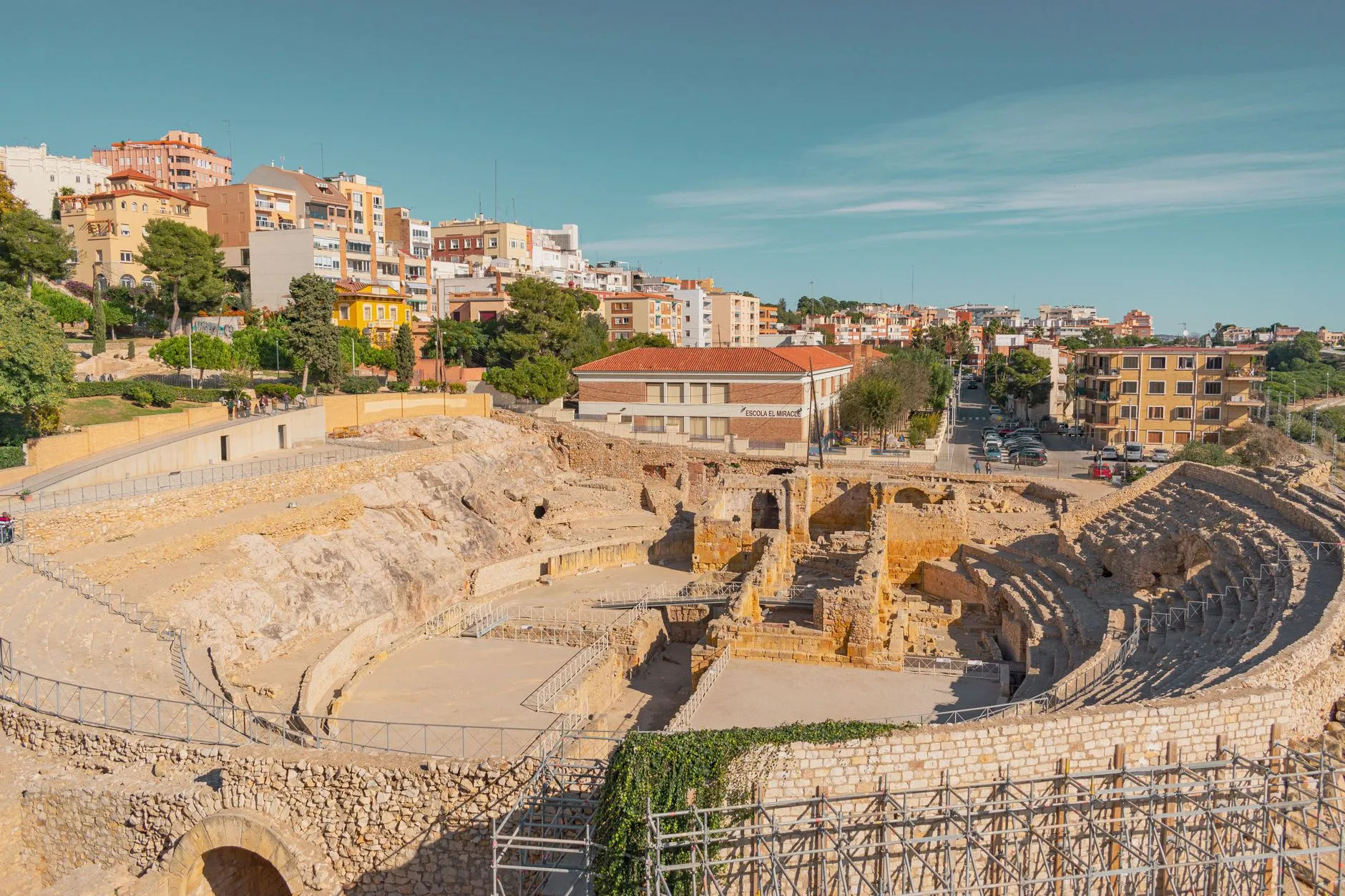
Tarragona is the underrated one. Twenty-two minutes on the bus gets you to a city whose Roman remains — the Archaeological Ensemble of Tárraco — have been on the UNESCO World Heritage list since 2000. What survives is not a fenced-off ruin but a city built through and around its Roman skeleton: the walls, the provincial forum, the circus running under the old town, and an amphitheatre cut into the slope with the Mediterranean directly behind it. That amphitheatre is one of the great sight-lines in Spain and it is a fifteen-minute walk from the bus station. Add the aqueduct outside town and the Arch of Berà on the old Via Augusta if you have a car.
Reus itself deserves an afternoon. Antoni Gaudí was born in June 1852, and Reus and neighbouring Riudoms have argued for a century about which of them can claim the birth; what is certain is that he grew up here, went to school here, and never built a single building in the city. Reus has monetised this with the Gaudí Centre, which is an interpretation centre rather than a Gaudí building, and it is honest about that. The actual architecture is by someone else: Lluís Domènech i Montaner, whose Casa Navàs on the Plaça del Mercadal and the vast Institut Pere Mata on the edge of town are two of the best modernista buildings in Catalonia and are barely visited. The city’s Ruta del Modernisme strings together more than two dozen buildings. Pere Mata in particular — a psychiatric hospital laid out as a series of garden pavilions — is the strangest and most rewarding building in the province.
The honest verdict on this airport
Reus is a small, fast, award-winning terminal with a route map so single-minded it is almost funny: eight airlines, twenty-four destinations, fifteen of them British, none of them Spanish. There is no lounge, no Fast Lane, no rail link, no connections and seven shops. What it does have is a 22-minute hourly bus to a UNESCO Roman city, a €3.90 transfer to the resorts, and a location that puts PortAventura, the Costa Daurada and the Priorat inside an hour.
Fly here for the coast, for Tarragona, for the theme park and for the wine. Do not fly here for Barcelona — that is a €37 return coach ticket and three hours you did not budget for, and El Prat will usually have beaten the fare anyway.
❓ Frequently Asked Questions
📊 2026 Summary Data Table
| Category | Detail |
|---|---|
| IATA / ICAO | REU / LERS |
| Official name | Reus Airport, operated by Aena |
| Location | Between Reus and Tarragona — Aena puts it about 10 km from each. Coordinates for the terminal: 41.14693, 1.153508 |
| Passengers 2025 | 1,336,826, with 23,251 operations and 387 kg of cargo (Aena) |
| Awards | Aena’s own page lists ACI Best Airport in Europe, under 2 million passengers, for 2022, 2023 and 2024, plus Best Hygiene Measures 2021 |
| Terminal | One terminal. New arrivals building 2005, combined check-in building 2008, new boarding area 2010, terminal expansion completed 2021 |
| Runway | 2,200 × 45 m, built 1952 |
| History | Reus Flying Club landing strip 1935 · military until 1998 · low-cost operations from 2003 · first million passengers 2004 |
| Also based here | Real Aeroclub de Reus (one of Spain’s oldest flying clubs) and CESDA pilot school — most of the 23,251 movements |
| Airlines | 8 — Jet2.com · Ryanair · easyJet · TUI Airways · TUI fly Belgium · Vueling · Air Nostrum · Enter Air |
| Destinations | 24 in 7 countries — UK, Ireland, Belgium, Netherlands, Germany, France, Portugal. No domestic Spanish routes |
| Network shape | 15 UK destinations, 3 Irish, 6 Schengen. Point-to-point only; no interlining, no connections |
| Rail at the airport | None. The regional high-speed station is Camp de Tarragona — €48 by taxi on Aena’s table, then a little over 30 min to Barcelona Sants |
| Bus to Tarragona | Monbus, 22 minutes, roughly hourly 07:00–22:00 from the airport (published valid 1 Mar – 31 Oct 2026) |
| Coach to Barcelona | Monbus, €18.50 single / €32.50 return to Barcelona Sants bus station, ~1h30–1h45, roughly 4–6 a day each way |
| Resort buses | BusPlana from €3.90 to La Pineda, Salou, Cambrils and PortAventura. Return valid 14 days; cash only if bought on board; under-4s free without a seat |
| City bus | Reus Transport line 50 to Plaça de la Llibertat via the Renfe and bus stations. Fare not published — (+34) 977 300 006 |
| Taxi | Aena’s approximate fares: Reus €25 · Tarragona €32–37 · Salou/PortAventura €34–35 · La Pineda €35 · Cambrils €40 · Camp de Tarragona €48 · Barcelona El Prat €200. (+34) 977 345 050 |
| Lounge | None — Reus is absent from Aena’s list of open VIP lounges. No Fast Lane either |
| Wi-Fi | Free, on Airport Free Wifi Aena, via email or an Aena Club login |
| Shops and food | Seven units total: Buy Bye Duty Free · Costa Daurada Duty Free · Exploring the World · Farine · La Pausa · Lavazza · The Market |
| Currency / border | Euro (€), Spain in the eurozone · Schengen · EES fully operational since 10 April 2026 · ETIAS not in operation, no applications collected, fee set at €20 |
| Region | PortAventura World and Ferrari Land (Salou) · Tarragona’s Archaeological Ensemble of Tárraco, UNESCO-listed since 2000 · Reus modernisme — Casa Navàs and Institut Pere Mata by Domènech i Montaner · Priorat DOQ and Montsant DO wines · calçots from Valls · vermouth |