Dresden International (DRS) Airport Guide 2026 — The Station Is Under the Terminal
Dresden’s airport sits in Klotzsche, on the northern edge of the city, and its best feature is buried in the basement: the S-Bahn station is inside the terminal building, and the S2 runs from it to Dresden Hauptbahnhof in 21 minutes and Dresden-Neustadt in 14, every half hour, for a €3.60 city single. The terminal itself is a converted GDR aircraft hangar opened in March 2001 and built to handle 3.5 million passengers a year; in 2025 it handled 886,578, which tells you most of what you need to know about queues here. Lufthansa, Eurowings and Swiss fly the scheduled network; Sundair flies the holidays. Germany is in Schengen and in the eurozone.
Last verified: September 2026.
⚡ 2026 Quick Reference — Key Facts at a Glance
Line S2, from the station in the terminal basement. Dresden Hauptbahnhof 21 minutes · Dresden-Neustadt 14 minutes, every 30 minutes. A lift takes you from the platform straight up to the check-in area on the first floor. On Mondays to Fridays the S2 also runs the other way to Heidenau and Pirna
The airport is inside Tarifzone Dresden, so you need a single city ticket: €3.60 full fare, €2.20 reduced, valid a maximum of one hour (VVO tariff in force since 1 April 2026). Two zones is €6.30, the whole VVO network €12.60. Buy from the machine, the VVO app, or the airport information desk, which sells local transport tickets
Routes 77 and 80 stop directly in front of the terminal entrance. 77 connects to the Infineon Nord stop for a tram to the main station; 80 reaches the tram stops on Grenzstraße and Käthe-Kollwitz-Platz
Taxi rank immediately beside the terminal entrance; Avis, Enterprise, Europcar, Hertz and Sixt all have desks inside the building. Driving in: A4 motorway, exit Dresden-Flughafen, on a four-lane approach road, sat-nav Wilhelmine-Reichard-Ring 1, 01109 Dresden. A glass footbridge links the terminal to a multi-storey car park of roughly 1,500 spaces; PK1 and PK2 are the short-stay drop-off car parks
DRS / EDDC, owned by Mitteldeutsche Flughafen AG with Leipzig/Halle. One runway, 04/22, 2,850 × 60 m, cleared for CAT I, CAT II and CAT IIIb all-weather operations. Elevation 754 ft (230 m). Scheduled flight operations run 05:30–23:30
886,578 in 2025, up 0.5% on 2024, on 20,249 aircraft movements (+3.7%). The terminal was built for 3.5 million
Lufthansa — Frankfurt and Munich, several times daily each. Eurowings — Düsseldorf and Palma de Mallorca. Swiss — Zurich. SunExpress and Pegasus — Antalya. Sundair — the leisure network (Burgas, Varna, Kos, Rhodes, Heraklion, Antalya, Sármellék). Nesma Airlines — Hurghada. Corendon Europe — Heraklion. SkyAlps — Bolzano, Wednesdays
Euro. Germany is in the Schengen area and in the eurozone. ATMs from Ostsächsische Sparkasse and Postbank on the arrivals level
One — “The Lounge”. The airport’s lounge page gives the access rules — free for Lufthansa Group Business Class and Gold-and-above status, Priority Pass, LoungeKey, Lounge Pass, OnPass and Global Lounge Network accepted, walk-in €30.00 per person for everyone else — plus a panoramic apron and runway view; its services page places the airport lounge on the arrivals level and says it seats up to 20 people. Breakfast until 11:30, lunch after
Schengen and eurozone. The EU Entry/Exit System became fully operational on 10 April 2026; the airport’s own account says EES went live at Dresden on 4 February 2026. ETIAS is not in operation and no applications are being collected; the fee is set at €20
🏢 1. A GDR Hangar With Five Levels and Three Times Too Much Room
Dresden’s terminal is the most architecturally interesting building of any airport this size in Germany, and the reason is that it was not built as a terminal.
When the new passenger building opened — regular operations began at midnight on 25 March 2001, the last flights having used the old Terminals 1 and 2 the day before — it was a conversion of a former hangar from the GDR aircraft industry. The architects kept the hangar’s bones: the load-bearing steel structure and the distinctive division into a central nave and two side aisles. The middle nave holds the public concourse and services; the aisles hold waiting areas, offices and operational rooms on each level. The material palette is glass, metal and reddish brick, and it works — it reads as a piece of civic architecture rather than a shed with check-in desks.
There are five levels, from the underground S-Bahn platform up to an observation deck which, on a clear day, gives you a view as far as the towers of Schloss Moritzburg. Six air bridges reach the aircraft. The whole project — terminal and railway together — cost DM 320 million, of which DM 194.5 million went on the building and DM 84.3 million on extending the S-Bahn to reach it.
The number that shapes your visit
The terminal was specified for 3.5 million passengers a year. In 2025 Dresden handled 886,578 — about a quarter of what the building was designed to absorb.
That is not a criticism of the airport; it is the German market. Mitteldeutsche Flughafen AG’s own analysis is blunt about it: German air traffic in 2025 was running at roughly 87% of its 2019 level while the European average was about 104%, putting Germany 28th of 31 in the EU ranking, with national aviation tax and air-traffic-control and security charges named as the cause. Domestic and short-haul European routes are where that bites hardest, and a 900,000-passenger regional airport is exactly where you see it.
What it means for you is simple and pleasant. Outside the morning Lufthansa wave, there is essentially no queue at Dresden for anything. Security is quick, the concourse is never full, and the ninety-minutes-before-departure advice you would follow at Frankfurt is over-cautious here. I would still not cut it finer than an hour on a Frankfurt connection, because a missed LH 062 costs you the day.
Getting between the platform and the plane
This is the part worth memorising: from the S-Bahn platform, a lift takes you directly to the check-in area on the first floor. Escalators and lifts also connect the underground station to the arrivals, departures, conference and gallery levels. There is no shuttle, no walkway between buildings, no second terminal. You come up out of the ground and you are at the desks.
Operating hours
Scheduled flights operate between 05:30 and 23:30. That is a real constraint on a late connection: if your inbound is delayed past the window, there is nothing behind it, and Dresden is not an airport with a hotel wave to absorb you. Price the fare and the bag before you commit to a tight itinerary — the aifly flight price checker and the aifly baggage fee checker both cover the carriers here, and Lufthansa’s Light fares are where most of the cost surprises come from.
🛂 2. Schengen, EES Since February, and Why the Euro Part Matters Separately
Germany is in the Schengen area and in the eurozone. Those are two different memberships and travellers routinely conflate them; here they happen to coincide, which makes Dresden one of the easy ones.
Arriving from another Schengen country there is no border check at all. Frankfurt, Munich, Düsseldorf, Zurich, Palma — you walk out. The routes that do cross an external Schengen border are the leisure ones: Antalya, Hurghada, Burgas, Varna, Heraklion, Kos, Rhodes and the one-off charters. And note the two that catch people: Bulgaria is in Schengen, so Burgas and Varna are internal flights, while Türkiye and Egypt are not, so Antalya and Hurghada are external crossings with full passport control.
EES
The EU Entry/Exit System became fully operational on 10 April 2026. The European Commission’s own wording is that “as of 10 April 2026, the EES replaces the stamping of passports allowing the automatic detection of overstayers”. The system started progressively on 12 October 2025 under Regulation (EU) 2025/1534 and reached full operation on that April date.
Dresden Airport gives its own local date: EES went live here on 4 February 2026. The airport’s guidance describes what happens — travel documents are checked at the designated control points, biometric data (a facial image and fingerprints) is collected and stored in a central EU database, and entry and exit times and length of stay are recorded automatically.
Who this affects: non-EU nationals on short stays only. EU, EEA and Swiss citizens are not registered. Practical points the airport publishes and most guides do not:
- Fingerprints are taken from age 12 upwards, but an EES file with passport details and a facial image is created for every non-EU traveller including infants.
- A child listed only in a parent’s passport cannot be registered, because each traveller needs their own travel document. If that describes your family, sort it out before you book, not at the desk.
- Refusing to give biometrics means the registration cannot be completed and you may be refused entry. It is a legal requirement, not an option.
- Your record is held for three years after your last crossing, or up to five if you overstayed.
- The first registration is the slow one; later crossings are much quicker.
At Dresden’s scale this is a small problem. On a single Antalya arrival the border hall handles one aircraft, not six. Build in extra time on your first post-February crossing and then stop worrying about it.
ETIAS
ETIAS is not in operation. The Commission states plainly that it “is currently not in operation and no applications for travel authorisations are collected at this point”, and that the EU “will inform about the specific date for the start of ETIAS several months prior to its launch.”
The fee has been set at €20, replacing the €7 figure that circulated for years. There is nothing to apply for and nothing to pay today. Nobody can sell you a valid ETIAS right now — any site offering one is charging you for a form it cannot file. Existing Schengen visa rules are unchanged.
Money
The euro, which removes the usual regional-airport currency trap entirely. Cards are accepted almost everywhere in Dresden, including on the S-Bahn and the trams, though a few small Neustadt bars still prefer cash and Germany in general is more cash-friendly than its neighbours. Carry €20 in notes and you will never be stuck.
Cash machines in the terminal are on the arrivals level, operated by Ostsächsische Sparkasse and Postbank — both German banks rather than an independent operator, which is the good outcome. If a machine or a card terminal offers to bill you “in your own currency”, decline it; that is dynamic currency conversion and the rate is set by the acquirer, not your bank.
🚌 3. The S2, Two Buses, and What the Ticket Actually Costs
Dresden solved the airport transport problem twenty-five years ago and then stopped needing to think about it, which is why the arrangement is so unfussy.
The S-Bahn
Dresden Airport station sits in the basement of the terminal. Line S2 runs from it into the city every 30 minutes, and the two journey times the airport publishes are:
| From the airport to | Journey | Service |
|---|---|---|
| Dresden-Neustadt | 14 minutes | S2, every 30 min |
| Dresden Hauptbahnhof (for long-distance trains) | 21 minutes | S2, every 30 min |
| Heidenau · Pirna (the other direction) | Onward on the same line | S2, Mondays to Fridays only |
Which of the two Dresden stations you want depends on where you are staying, and most visitors get this wrong. Neustadt is the closer one and it is on the correct side of the Elbe for the bar and restaurant district; the Hauptbahnhof is the one you want for onward long-distance trains to Berlin, Leipzig or Prague, and for the Altstadt hotels. Neustadt is seven minutes and one stop earlier. If you are going out rather than onward, get off there.
The fare
The airport is inside Tarifzone Dresden — Dresdner Verkehrsbetriebe states it explicitly, alongside Pillnitz — which means a plain city single ticket, not an airport surcharge. Under the VVO tariff in force since 1 April 2026:
| Ticket | Reduced | Full |
|---|---|---|
| Single, Tarifzone Dresden, max. 1 hour | €2.20 | €3.60 |
| Single, one other tariff zone, max. 1 hour | €2.10 | €3.30 |
| Two zones, max. 1.5 hours | €4.20 | €6.30 |
| Three zones, max. 2 hours | €6.20 | €9.50 |
| Whole VVO network, max. 4 hours | €8.40 | €12.60 |
€3.60 to the middle of a European city is close to the cheapest airport transfer in Germany, and there is no premium product to be upsold onto. The VVO covers 21 tariff zones with one common tariff across regional trains, S-Bahn, trams, buses and most ferries, so a single ticket carries you across changes. If you would rather not use a machine, the airport information desk sells local transport tickets directly.
Buses, taxis and driving
Bus routes 77 and 80 stop at the terminal entrance. The 77 links to the Infineon Nord stop, where you pick up a tram towards the main station; the 80 reaches the tram stops at Grenzstraße and Käthe-Kollwitz-Platz. Both are genuinely useful for the northern suburbs and essentially pointless if you are heading for the centre — take the train.
The taxi rank is right beside the terminal entrance. The airport does not publish a fixed airport tariff and I am not going to invent one; Dresden taxis are metered, the distance is short, and the S-Bahn is €3.60.
Driving in is easy: the A4 motorway, exit Dresden-Flughafen, then a four-lane approach road. Avis, Enterprise, Europcar, Hertz and Sixt have offices in the terminal building, and the multi-storey car park — roughly 1,500 spaces, reached by a glass footbridge from the terminal — is the long-stay option, with PK1 and PK2 for dropping someone off.
🛋️ 4. One Lounge, Twenty Seats, €30
Dresden has one lounge, and the airport describes it across two of its own pages, so it is worth saying which fact comes from where.
Its dedicated lounge page calls it “The Lounge” and sells the experience: air-conditioned, a range of hot and cold food and drinks, free WLAN, personal workstations, charging for phones and laptops, TV and newspapers, and — the airport’s own selling point — a panoramic view over the apron and the runway. Food service splits at 11:30: breakfast before, lunch after.
Its services page supplies the two numbers the lounge page leaves out: the airport lounge is on the arrivals level, “only a very short distance” from your departure gate, and it is for up to 20 people. That page also states the open-access rule plainly — you can use it as a passenger whatever airline you are flying and whatever your booking class — with flight-status screens inside, an open buffet of hot and cold food, and alcoholic and non-alcoholic drinks.
Read together they describe one room, and the twenty-seat figure is the one to plan around.
Access, which is the part that matters:
- Free for Lufthansa Group Business Class passengers and status customers from Gold level upwards.
- Included for members of Priority Pass, LoungeKey, Lounge Pass, OnPass and Global Lounge Network — a Global Lounge Membership or a day pass can be bought through the Global Lounge Network site.
- €30.00 per person walk-in for everyone else, paid on site, regardless of airline or booking class.
My honest read: at €30 for a 20-seat room, this is a good deal only if you are stuck on a long gap or a delayed Frankfurt connection, and a poor one on a normal Dresden departure — because the terminal is empty anyway and the observation deck is free. If you hold a Priority Pass, use it; the apron view is the best thing in the building. If you are paying cash, sit downstairs and keep the €30.
Be aware of the capacity honestly: twenty seats against a full A320 to Frankfurt is not a lot, and the lounge can and does fill during the morning wave.
🍽️ 5. beDUTYfree, a Food Truck, and Vending Machines With Microwaves
I will be straight about this: Dresden’s airside catering is thin, and you should eat before you arrive.
The airport’s own description of the offer runs to: beDUTYfree, a duty-free shop with a deliberately regional Saxon focus alongside the usual perfume, cosmetics, spirits, tobacco and confectionery; a café operated by BERetail inside the security area doing freshly made coffee, sandwiches and hot snacks; a BERetail counter landside, in the space that used to be “Gate 14”, serving snacks and drinks at lunchtime; a food truck, “Falks BBQ Catering”, parked in front of the terminal; and — genuinely, this is on the official page — vending machines with snacks, drinks and hot meals available round the clock, with microwaves next to them so you can heat the meals yourself. There is also a “Mystery Box” machine selling small surprises.
That is a complete list, and it is a 05:30 departure problem. The vending-and-microwave arrangement is not a joke, though — for an airport where the first flight leaves before most catering staff start, it is a sensible answer, and it is the only hot food available at the extremes of the operating day.
One genuine upside: the airport can trade on Sundays and public holidays, which in Germany is unusual and makes the terminal a real option if you have run out of time to buy anything in the city.
What to actually buy
Take the Saxon angle at beDUTYfree seriously, because Saxony’s specialities travel well and are hard to find elsewhere:
- Dresdner Christstollen — the yeasted fruit loaf with marzipan and a snowfall of icing sugar, the thing Dresden’s Christmas market is named after (Striezel is the old word for it). Sealed, it keeps for months.
- Pulsnitzer Pfefferkuchen — soft spiced gingerbread from the town north-east of the city.
- Meissen porcelain is the region’s other export, and the crossed swords are worth what they cost; the airport shop stocks the accessible end of it.
- Radeberger Pilsner is brewed in Radeberg, just outside the city, and drunk everywhere in it.
If you have an hour in the Altstadt instead, eat Sauerbraten or Quarkkeulchen and skip the terminal entirely.
💡 6. What Dresden Is Actually For
Dresden is one of the very few cities where the case for going is essentially visual, and where a short trip works better than a long one.
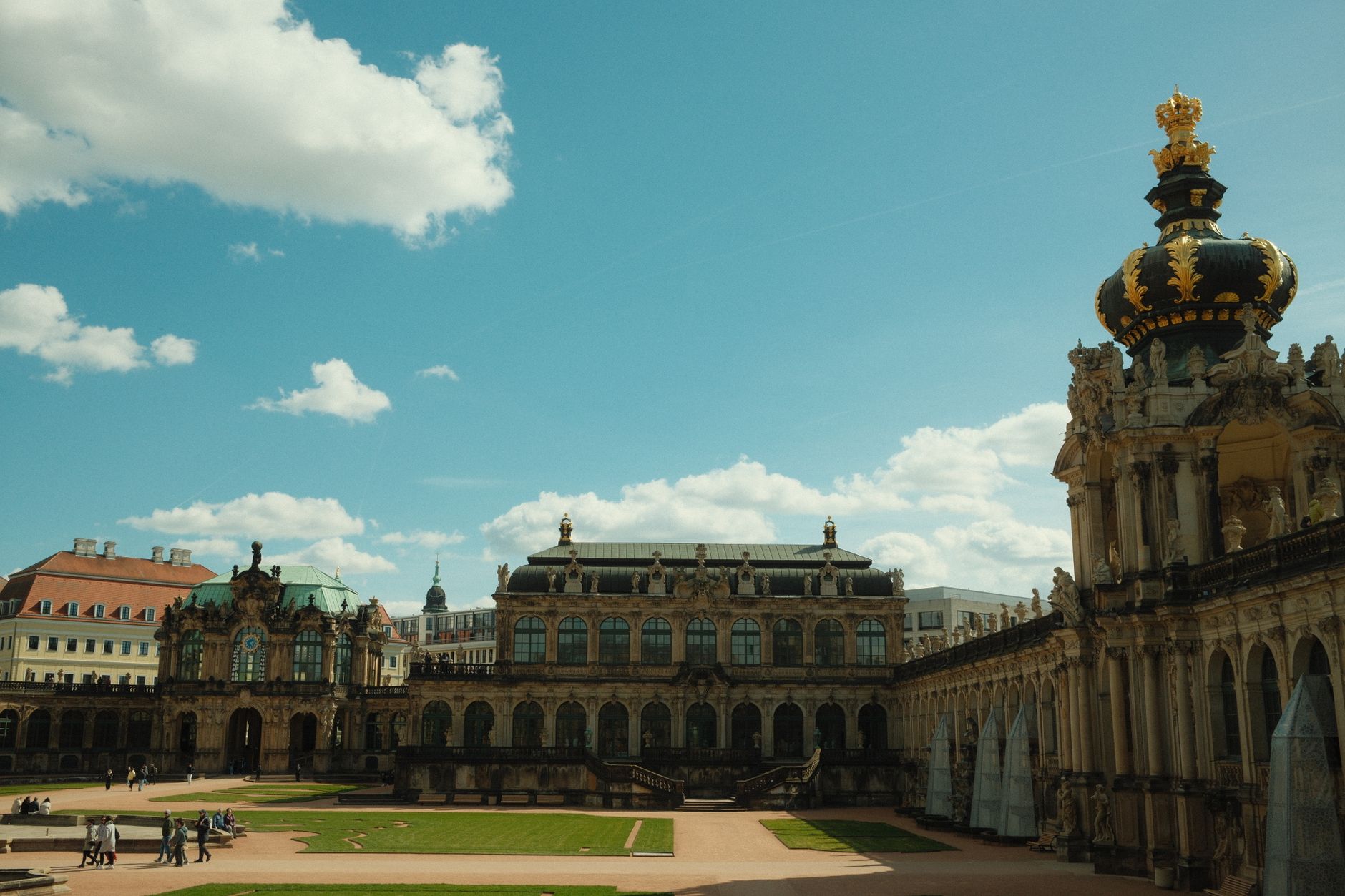
The Altstadt is a reconstruction, and knowing that improves it. The Frauenkirche — rebuilt from the rubble it had been left in for half a century, using thousands of the original blackened stones set back into the new pale sandstone — is the emotional centre, and the mottled façade tells the story without a caption. Around it, the Zwinger with its galleries, the Semperoper, the Residenzschloss and the Fürstenzug procession of Meissen tiles are all inside a ten-minute walk of one another. Two days covers the lot properly.
Cross the river. The Neustadt — the S2’s first Dresden stop, and the one most airport arrivals skip — is where the city actually drinks and eats, and the Kunsthofpassage courtyards are the one piece of contemporary Dresden worth going out of your way for.
The best day trip leaves from the same line you arrived on. The S2 runs from the airport through both Dresden stations and onward to Heidenau and Pirna on weekdays, and Pirna is where the Elbe sandstone country starts. Saxon Switzerland National Park — the Bastei bridge, the Schrammsteine, the Kirnitzsch valley tram that has run since 1898 — is a genuine day out from a city-centre hotel, with Bad Schandau as the national-park station further up the Elbe. It is one VVO ticket zone-counting exercise away, no car needed.
Go in December if the choice is open. The Striezelmarkt on the Altmarkt is Germany’s oldest Christmas market, and Dresden in winter is a different and better city than Dresden in August. Confirm the current dates on the market’s own site before booking; they move a little each year.
Practical judgements
Take Neustadt, not Hauptbahnhof, unless you have an onward train. Seven minutes shorter and the right side of the Elbe for where you probably want to be.
Do not plan a Dresden trip around a winter timetable you have not seen. At the time of writing the airport had published its summer 2026 schedule, valid 23 July to 24 October 2026, with the following winter not yet out. Several of the destinations above are seasonal leisure routes that will not exist in January, and a handful — Tirana, Jersey, Zakynthos, and the Italian dates to Bari, Brindisi, Catania, Lamezia Terme and Naples — are marked in the airport’s own timetable as one-off tourist charters, not services you can book at will. Check the route exists in your month before you build anything on it.
Fly Lufthansa if you need reliability, Sundair if you need a beach. That is a fair summary of Dresden’s network: two hub feeds to Frankfurt and Munich several times a day, Düsseldorf with Eurowings, Zurich with Swiss, and everything else a leisure operation into the Mediterranean, the Aegean, the Black Sea and Egypt. Compare the total including bags — the Lufthansa, Eurowings and SunExpress allowances are not alike, and on a €90 Frankfurt fare a hold bag is a large fraction of the ticket.
Use the observation deck. Five levels up, free, and on a clear day you can see Schloss Moritzburg. Almost nobody does it.
❓ Frequently Asked Questions
📊 2026 Summary Data Table
| Category | Detail |
|---|---|
| Airport | Dresden International (Flughafen Dresden), Klotzsche |
| Codes | DRS (IATA) · EDDC (ICAO) |
| Owner | Mitteldeutsche Flughafen AG, jointly with Leipzig/Halle; ground handling by PortGround |
| Terminal | Opened for regular operation 25 March 2001, converted from a former GDR aircraft hangar; five levels, six air bridges, observation deck. Built for 3.5 million passengers a year |
| Runway | One — 04/22, 2,850 × 60 m, certified CAT I, CAT II, CAT IIIb; elevation 754 ft (230 m) |
| Operating hours | Scheduled flights 05:30 – 23:30 |
| Passengers | 886,578 (2025), +0.5% on 2024; 20,249 aircraft movements, +3.7% |
| Catchment | About 4 million people — Saxony, southern Brandenburg, northern Bohemia, Lower Silesia |
| Airlines | Lufthansa · Eurowings · Swiss · SunExpress · Pegasus · Sundair · Corendon Europe · Nesma Airlines · SkyAlps |
| Main scheduled routes | Frankfurt, Munich (Lufthansa) · Düsseldorf, Palma de Mallorca (Eurowings) · Zurich (Swiss) · Antalya (SunExpress, Pegasus, Sundair) · Bolzano (SkyAlps, Wednesdays) |
| Leisure routes | Burgas, Varna, Kos, Rhodes, Heraklion, Sármellék (Sundair) · Hurghada (Nesma) · Heraklion (Corendon Europe) |
| Train | S2 from the station in the terminal basement — Hauptbahnhof 21 min, Neustadt 14 min, every 30 min; onward to Heidenau and Pirna Mon–Fri |
| Fare | €3.60 single (reduced €2.20), Tarifzone Dresden, max 1 hour — VVO tariff from 1 April 2026 |
| Bus | Routes 77 and 80 from the terminal entrance |
| Car | A4, exit Dresden-Flughafen; Wilhelmine-Reichard-Ring 1, 01109 Dresden; multi-storey car park ≈1,500 spaces, plus PK1/PK2 short-stay |
| Car hire | Avis · Enterprise · Europcar · Hertz · Sixt, all in the terminal |
| Lounge | The Lounge, arrivals level, up to 20 seats. Free on Lufthansa Group Business/Gold+; Priority Pass, LoungeKey, Lounge Pass, OnPass, Global Lounge Network accepted; €30.00 walk-in |
| Food & shops | beDUTYfree (Saxon focus) · BERetail café airside · BERetail counter landside · Falks BBQ food truck outside · 24-hour vending machines with microwaves. Open Sundays and public holidays |
| Currency | Euro — Germany is in Schengen and the eurozone. ATMs (Ostsächsische Sparkasse, Postbank) on the arrivals level |
| Border | Schengen. EES fully operational EU-wide 10 April 2026, live at Dresden since 4 February 2026; biometrics from age 12, facial image for all. ETIAS not in operation, fee set at €20 |