Almería Airport (LEI) Airport Guide 2026 — The €1.05 Bus Into a Desert
Almería Airport sits 8 kilometres east of the city, at the centre of the Bay of Almería, and it moved 801,689 passengers in 2025 through a single terminal. The transport fact that decides your arrival is this: the public bus into town, Surbus line 30, costs €1.05 paid to the driver — one of the cheapest airport buses in Europe, and it runs roughly every 35 minutes. Aena lists 17 airlines flying 26 destinations, nine of them British and six domestic Spanish. Spain is Schengen and the euro. Behind the terminal: the Cabo de Gata-Níjar UNESCO Global Geopark, the Tabernas badlands where the spaghetti westerns were shot, and the greenhouse sea that feeds Europe in winter.
Last verified: September 2026.
⚡ 2026 Quick Reference — Key Facts at a Glance
Surbus line 30, Almería – Aeropuerto – Retamar. A single bought on board is €1.05. Scheduled 25 minutes between the airport and the Gregorio Marañón–La Salle terminus in the city on the operator’s own timetable. Weekday departures from the airport towards Almería run 07:15 to 23:20, roughly every 35 minutes
The same line 30 continues past the airport to El Alquián, Hospital El Toyo and Retamar — the beach strip immediately east of the airport and the doorstep of Cabo de Gata. Airport departures 06:25–22:35 on winter weekdays
The Surbus “Bonobús Ordinario” 10-trip card is €4.45 (about €0.45 a ride) with a free transfer inside one hour, but you must buy it at the Surbus kiosk on Avenida Federico García Lorca and pay a €3 refundable deposit — not practical on arrival, excellent if you are staying
Rank in arrivals. Aena publishes the tariff, not a fare table: Fare 1 (Mon–Fri 06:00–22:00) has a minimum airport fare of €14.72 and €0.91/km; Fare 2 (nights, weekends, holidays) €17.39 and €1.12/km. Each bag over 60 cm adds €0.68. Radio Taxi (+34) 950 222 222 / 950 226 161, Tele Taxi (+34) 950 251 111
LEI / LEAM — one terminal, operated by Aena. 801,689 passengers, 14,076 operations and 82 kg of cargo in 2025. 17 airlines, 26 destinations, 10 countries
9 UK destinations · 6 domestic Spanish · 11 elsewhere in Europe, including an unusual Czech and Polish tail — Prague, Pardubice, Bratislava, Budapest, Katowice, Warsaw
Euro (€) — Spain is in the eurozone
None. Almería does not appear on Aena’s published list of open VIP lounges, and no carrier here sells a lounge either. Aena does sell Fast Lane priority security access at this airport, valid 3 months from purchase
Schengen. The EU Entry/Exit System has been fully operational since 10 April 2026: biometric enrolment on your first crossing, a faster biometric check after that
Not in operation. No applications are being collected. The fee is fixed at €20 by Commission Delegated Regulation (EU) 2025/1411. Nobody can sell you a valid one today
🏢 1. One Terminal, Seventeen Airlines, and a Central European Tail
Almería is a small airport that behaves like two different airports stacked on top of each other, and understanding which one you are using changes how you plan the trip.
The first is a normal Spanish provincial airport. Aena’s live listing gives it 26 destinations flown by 17 airlines, and unlike the pure holiday fields further up the coast, six of those destinations are inside Spain: Iberia to Madrid, Vueling to Barcelona, Binter Canarias to Gran Canaria, and Air Nostrum to Seville, Palma de Mallorca and Melilla — the Spanish city on the North African coast, which from Almería is a short hop rather than an expedition. That domestic spine is the reason Almería stays open and useful in February when the charter airlines have gone home.
The second airport is the leisure operation, and its route map is more interesting than you would guess:
- United Kingdom — nine destinations. easyJet flies Bristol, Liverpool, London Gatwick, London Luton and London Southend; Jet2.com flies Birmingham, Bristol, Leeds/Bradford and Manchester; Ryanair flies London Stansted and Manchester, with Ryanair UK also on Manchester.
- Poland and Czechia — the surprise. Smartwings flies Prague and Pardubice, Smartwings Poland flies Bratislava, Smartwings Hungary flies Budapest, Enter Air flies Katowice and Warsaw, Buzz flies Katowice, and LOT Polish Airlines flies Warsaw. Seven of the twenty-six destinations are in Central Europe. Almería is not marketed as a Central European resort airport, but the schedule says it is one.
- The rest of the continent. Transavia to Rotterdam, Luxair to Luxembourg, TUI fly Belgium to Brussels, Ryanair to Brussels Charleroi, and Air Nostrum to Porto.
Two warnings about that list. First, it is a live snapshot — Aena’s destinations page reflects what is being flown now, and a leisure airport with this many charter and low-cost operators contracts sharply in winter. Check the current list on aena.es before you build a trip around a route you read about in September. Second, there are no connections here. Every carrier at Almería is point-to-point. If your inbound is late, nobody at this airport can rebook you onto a rival. Treat each Almería flight as its own journey, and price it honestly with the aifly flight price checker rather than trusting the headline fare.
The building
One terminal, and a straightforward one. Aena’s own account of the site: the airport opened on 6 February 1968 at El Alquián with a single runway designated 08-26, the passenger terminal was refurbished in 1995, a new cargo terminal opened in 2002, and the new departures building came into operation in 2009. Traffic passed a million passengers around 2000 and has settled below that since.
It is a good small terminal, and there is external recognition for it — Aena’s page lists an ACI award for Best Airport in Europe with fewer than 2 million passengers in 2023, plus two ICA awards for health-and-safety measures and for passenger feedback. In practice that means check-in, security and the gate are all visible from roughly the same spot, and the walk from the door to the aircraft is short.
The cargo figure is the tell about what this place is: 82 kilograms of freight in the whole of 2025. Kilograms. Almería province exports fruit and vegetables to the whole of northern Europe and none of it goes near this airport — it goes by lorry up the A-7. The airport moves people, and nothing else.
Most airlines here charge separately for bags, and on a €35 fare the bag is the fare. Read the rules before you get to the gate: Ryanair, easyJet, Jet2, Vueling, Iberia, Air Nostrum, Binter Canarias, Transavia, LOT, Luxair, Smartwings and Enter Air, or compare them side by side in the aifly baggage fee checker.
🛂 2. Schengen and the Euro — Two Memberships, Both Held
Spain is in the Schengen area and Spain uses the euro. Those are separate memberships and Spain holds both, which is why a flight from Rotterdam or Prague lands here with no passport desk at all, and why the cash machine gives you the same currency you left home with.
The Almería twist is a border desk that is busier than the airport’s size suggests. Of twenty-six destinations, nine are in the United Kingdom — which since Brexit is a third country for these purposes. Add the British share of the traffic to the fact that this terminal was sized for a million passengers a year, and the arrivals hall on a summer Saturday morning is a different building from the one you will meet on a Tuesday in March.
EES: what it actually costs you in time
The EU’s Entry/Exit System has been fully operational since 10 April 2026. It replaces the passport stamp with a digital record. A non-EU national arriving for a short stay has their facial image, fingerprints and travel-document data captured at the first crossing; on later crossings, while that record stands, it is a faster biometric check rather than a fresh enrolment.
For a British passport holder flying into Almería, plan for this honestly. Your first post-EES arrival takes noticeably longer than a stamp did, because enrolment is a supervised process at a kiosk or a desk. Later arrivals are quick. The pinch point at LEI is not the per-passenger time but the arrival bank — a single-terminal airport can take several British and Central European arrivals inside the same half hour. If you land mid-morning on a summer weekend, budget an hour from wheels-down to the bus stop. In winter you will walk straight out.
Departure is also an EES transaction, so the airline’s check-in and gate cut-offs are real numbers, not suggestions.
ETIAS: status, not a date
ETIAS is not running. The European Commission states that it is not in operation and that no applications for travel authorisations are being collected. The fee has been set at €20 by Commission Delegated Regulation (EU) 2025/1411, with applicants under 18 or over 70 and qualifying family members of EU citizens exempt from the fee — though they will still need an authorisation once the system starts.
The practical consequence: nobody can sell you a valid ETIAS today, because none exist. Any site charging you for a Spanish ETIAS in 2026 is charging you for a form it cannot file. Do not pay them anything.
On money: Spain is a card economy and contactless works almost everywhere on the coast. Keep a few coins anyway, for exactly one reason — the line 30 driver sells you a paper ticket, and having €1.05 close to exact is the polite move at 23:00 with a queue behind you.
🚌 3. Line 30: €1.05 Into Almería, and the Places It Does Not Go
There is no railway station at the airport. Almería’s Estación Intermodal, which combines the train and long-distance coach stations, is in the city. Everything below is a bus or a taxi.
The bus, and it is genuinely excellent
Aena names exactly one bus line at this airport: line 30, Almería – Aeropuerto – Retamar, run by Surbus, the Almería city operator, on (+34) 950 170 050.
Two things make it better than almost any comparable airport bus in Spain. The first is the fare. Surbus publishes the Billete Ordinario at €1.05, bought from the driver on the bus. That is the whole price. There is no airport supplement, no premium “airport express” branding, no €8 shuttle: line 30 is an ordinary city bus that happens to call at the terminal.
The second is the frequency. On the winter timetable — which Surbus defines as 1 September to 30 June — weekday buses leave the airport towards Almería roughly every 35 minutes from 07:15 until 23:20, and towards the coast from 06:25 until 22:35. Saturdays thin out after about 14:30 to roughly every 50 minutes; Sundays and public holidays run about every 50 minutes all day, first bus from the airport towards the city at 07:10 and last at 23:00. The scheduled run from the city terminus at Gregorio Marañón–La Salle to the airport is 25 minutes.
The gap to know about: the first weekday departure from the airport towards Almería is 07:15. If you land before that, you are taking a taxi.
If you are staying more than a couple of days, the Bonobús Ordinario is worth the errand — €4.45 for ten trips with a free transfer to a different line inside an hour, against a €3 refundable deposit, sold at the Surbus kiosk on Avenida Federico García Lorca beside the La Salle school. That is roughly 45 cents a ride.
Where line 30 does not go
This is the honest limitation of Almería. The airport sits east of the city, and line 30 runs east–west through it: city one way, El Alquián, Hospital El Toyo and Retamar the other. That eastern end is genuinely useful — El Toyo and Retamar are a modern beach strip a few minutes from the terminal, and they are the closest thing this airport has to a walk-off resort.
But the big resort names on the Almería coast are in the other direction. Aguadulce, Roquetas de Mar and El Ejido are west of the city, and Mojácar is well to the northeast. Aena’s own introduction page lists all of them as destinations the airport serves, which is true in the sense that they are in the province — it is not true in the sense of a bus from the terminal. There is no direct airport bus to any of them. You either change in Almería, take a taxi, or hire a car at the terminal.
Taxis, and how the meter works
There is a rank in arrivals. Aena does not publish a fare table for Almería the way it does for some airports, so we are not going to invent one. What Aena does publish is the tariff itself, and that is more useful than a guess:
| Tariff | When it applies | Minimum airport fare | Per km | Waiting |
|---|---|---|---|---|
| Fare 1 | Monday–Friday 06:00–22:00 | €14.72 | €0.91 | €21.67 |
| Fare 2 | Mon–Fri 22:00–06:00; Saturdays, Sundays and public holidays; Almería Fair; 24 Dec–6 Jan | €17.39 | €1.12 | €27.76 |
Each item of luggage over 60 cm long adds €0.68. Aena’s own advice is worth repeating: make sure the driver starts the meter at the beginning of the journey, and ask for a receipt. Radio Taxi (+34) 950 222 222 and (+34) 950 226 161; Tele Taxi (+34) 950 251 111.
The summary table
| Option | Destination | Price | Time / frequency |
|---|---|---|---|
| Surbus line 30 | Almería city (Gregorio Marañón–La Salle, via the centre) | €1.05 on board | 25 min scheduled; airport departures roughly every 35 min, 07:15–23:20 weekdays |
| Surbus line 30 | El Alquián, Hospital El Toyo, Retamar | €1.05 on board | Airport departures 06:25–22:35 weekdays |
| Surbus Bonobús | Anywhere on the city network | €4.45 / 10 trips + €3 deposit | Kiosk on Avda. Federico García Lorca — buy it in town, not at the airport |
| Taxi | Anywhere | Metered: €14.72 minimum airport fare, €0.91/km (Fare 1) | On demand at the rank |
| Hire car | Roquetas, Mojácar, Cabo de Gata, Tabernas | Varies | Desks at the terminal. The right answer if the region, not the city, is the trip |
🛋️ 4. No Lounge, a Fast Lane, and a Rooftop Terrace
Almería has no lounge. Aena publishes a list of the VIP lounges currently open across its Spanish network — nineteen airports, from A Coruña to Vigo — and Almería is not on it. No airline based here sells a premium cabin, so there is no carrier lounge either. If you hold a Priority Pass or a lounge-access credit card, it buys you nothing at this airport. Plan the wait, don’t plan the lounge.
What Aena does sell here is Fast Lane: priority access to the security checkpoint, bought through Aena’s official VIP services channel, scanned as a QR code at the door alongside your boarding pass, and valid for three months from purchase. Aena also notes that business or associated loyalty-card holders may have it included, so check with your airline before you pay twice. Two honest caveats. First, it speeds up the queue, not the search — you still go through the same screening, and it does not exempt you from the check-in deadlines in your ticket. Second, at an airport this size the security queue is usually short anyway; Fast Lane earns its money on exactly the summer-Saturday morning bank described in section 2, and on very little else.
The rest of the airside offer is small and, unusually, has one thing worth walking to. Aena lists five units in total: Almería Duty Free, BeerCode, TRIB’S, a Pharmacy, and — the one nobody expects at an 800,000-passenger airport — the BeerCode Rooftop Terrace. An outdoor terrace at a southern Spanish airport is a real amenity in a way that a fifth sandwich counter would not be. If your flight is delayed and the weather is doing what Almería weather usually does, that is where to sit.
There is free Wi-Fi throughout, and the general Aena information line is (+34) 91 321 1000.
🍽️ 5. Five Units Airside, and Why You Should Eat in Almería Instead
Five retail and catering units is not a food offer, it is a holding pattern. Have a beer on the roof and eat properly before you come, or after you land — because Almería is one of the best-value places to eat in Spain and almost nobody flying here knows it.
Start with the tapa custom. Almería is one of the Andalusian cities where a drink in a traditional bar still arrives with a tapa at no extra charge, and where the bar, not you, chooses what it is. Order a caña, see what turns up, order another. Three rounds is lunch.
What the province actually produces:
- Gambas rojas de Garrucha — the deep-water red prawns landed at Garrucha on the province’s northern coast, and the single best thing to eat in Almería. Grilled with salt, nothing else. They are expensive and they are worth it.
- Tomate Raf — the ugly, deeply ridged, intensely savoury tomato grown in the Campo de Níjar. Buy them in a market, eat them with olive oil and salt, understand why they cost four times what a supermarket tomato costs.
- Ajo colorao and migas — the two great inland dishes of Almería, one a potato, pepper and fish mash, the other fried semolina or breadcrumbs eaten with whatever is around. Poverty food that turned into the thing people drive out to the Alpujarra for.
- Greenhouse produce. The official Andalusian tourism board describes the Almería economy as based on “tourism and greenhouse crops” and calls the province “the winter orchard of Europe” — which is not a slogan, it is a description. The peppers, cucumbers, courgettes and melons on a northern European supermarket shelf in January were very probably grown within thirty kilometres of the runway you landed on.
- Wine from the Alpujarra. The high, dry country around Laujar de Andarax makes the province’s wine, and it is nothing like the coast — cool nights, altitude, and bottles you will not find outside Andalusia.
If you only have an hour in the city, walk the streets around the Mercado Central and the old town below the Alcazaba, and let the tapas find you.
💡 6. Insider: What This Airport Is Actually For
Almería is a small airport with an unusually good bus and an unusually strange hinterland. Three things are genuinely worth flying here for, and one of them is not the one the tour operators sell.
Cabo de Gata — the reason to come
Cabo de Gata-Níjar is a UNESCO Global Geopark, listed by UNESCO among the 241 global geoparks worldwide, and it is the least developed stretch of Mediterranean coast left in mainland Spain. Volcanic headlands, a handful of small settlements, salt pans with flamingos, and beaches — Mónsul, Los Genoveses, Playa de los Muertos — that look nothing like the rest of the Costa. It is protected, which is why it has never been built on, which is why it is the reason to fly to Almería instead of Málaga.
The airport is the closest one to it by a long way, and line 30’s eastern terminus at Retamar puts you on the edge of it for €1.05. That said, be honest with yourself: Cabo de Gata is a car destination. The beaches are spread along a coast with limited public transport and, in high summer, access restrictions on the most popular ones. Hire the car at the terminal.
Tabernas — Europe’s western desert
Inland and north, the Desierto de Tabernas is the badland that made Almería a film location: eroded gullies, ochre rock and almost no rainfall, close enough to the American southwest that a generation of European directors shot their westerns here rather than in Arizona. The film sets survived. Fort Bravo Texas Hollywood still operates as a working western town — saloon, jail, bank, stables, live shows and cart rides — in the middle of the desert, and it is a straightforward day out with children. Check current admission and show times at fortbravo.org; the site does not publish a fixed price we can quote you.
Almería’s cinema history is not confined to the westerns, and the city runs the Casa del Cine as a museum of it. If you have the slightest interest in film, that plus a morning in Tabernas is the best day in the province.
The city everyone skips
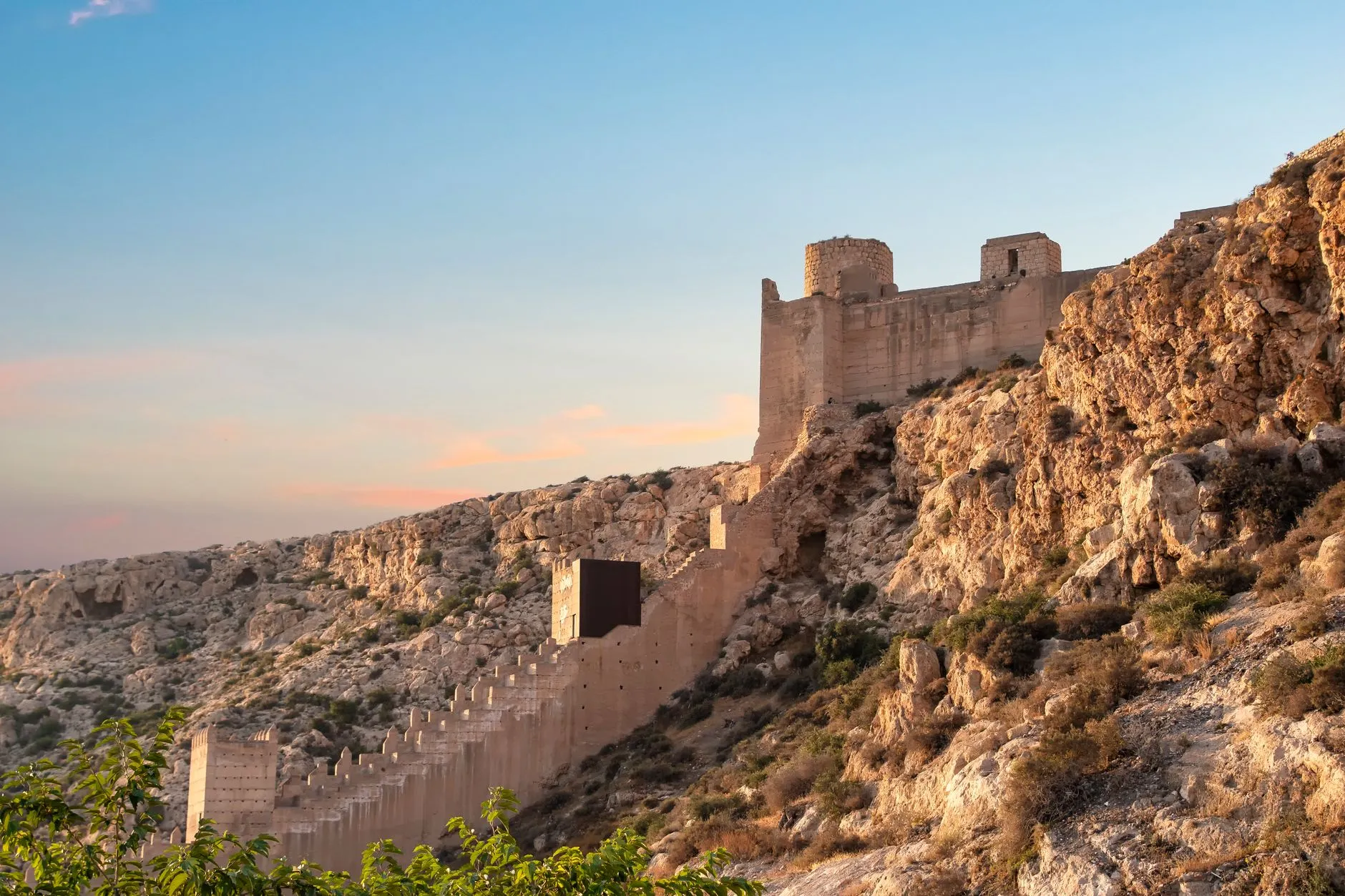
Almería city takes about half a day and repays it. The Alcazaba — the fortress that dominates the skyline — gives what the Andalusian tourism board calls “an extraordinary panoramic view of the city and the port”, and it is one of the great Islamic fortifications of Spain. The Cathedral below it was, in the board’s own words, “built as a fortress to protect the city from pirate attacks”, and it looks it: a church with corner bastions and gun positions, because the sixteenth-century Mediterranean was not a safe place to keep a congregation.
Then the one nobody mentions: the Refugios de la Guerra Civil, the Civil War air-raid shelters tunnelled under the streets of Almería and now open as a guided visit. The Andalusian tourism board lists them among the province’s indispensable sights, and they are — a genuinely sobering hour under a city that was one of the most heavily bombed in Spain.
And the thing you will see from the plane
On approach or departure to the west you will see it: a white sheet stretching from the coast into the hills, kilometre after kilometre, bright enough to read from cruising altitude. That is the greenhouse belt of El Ejido and the Campo de Níjar — the mar de plástico, the plastic sea. It is why this province has money, why it has migrants, why it is politically complicated, and why northern Europe eats salad in February. You do not have to like the look of it, but it is the most honest introduction to Almería available, and you get it free with your window seat.
The verdict
Fly to Almería for Cabo de Gata, for Tabernas, and for a city that is cheaper and more interesting than its reputation. Do not fly here expecting a resort transfer to appear — the only bus is a €1.05 city service that goes east, and the big resorts are west. Hire a car, or accept that your holiday is Almería city and the coast immediately beside the airport. On those terms it is one of the best-value airports in Spain: no lounge, five shops, a rooftop terrace, and a bus fare of one euro five.
❓ Frequently Asked Questions
📊 2026 Summary Data Table
| Category | Detail |
|---|---|
| IATA / ICAO | LEI / LEAM |
| Official name | Almería Airport, operated by Aena |
| Location | 8 km east of Almería, at the centre of the Bay of Almería (Aena) |
| Passengers 2025 | 801,689, with 14,076 flight operations and 82 kg of cargo (Aena) |
| Terminal | One. Passenger terminal refurbished 1995 · cargo terminal 2002 · new departures building opened 2009 |
| Opened | 6 February 1968 at El Alquián; runway designated 08-26 |
| Awards | Aena’s page lists ACI Best Airport in Europe, under 2 million passengers, 2023, plus two ICA awards |
| Airlines | 17 — Air Nostrum · Binter Canarias · Buzz · easyJet · Enter Air · Iberia · Jet2.com · LOT Polish Airlines · Luxair · Ryanair · Ryanair UK · Smartwings · Smartwings Hungary · Smartwings Poland · Transavia · TUI fly Belgium · Vueling |
| Destinations | 26 in 10 countries — 9 UK, 6 domestic Spanish (Madrid, Barcelona, Seville, Palma, Gran Canaria, Melilla), and 11 elsewhere including Prague, Pardubice, Bratislava, Budapest, Katowice, Warsaw, Rotterdam, Luxembourg, Brussels, Charleroi and Porto |
| Network shape | Point-to-point only. No connections, no interlining, no rebooking desk if your inbound is late. Aena’s list is live and contracts in winter |
| Rail at the airport | None. Almería’s Estación Intermodal (rail + long-distance coach) is in the city |
| Bus | Surbus line 30, Almería – Aeropuerto – Retamar. €1.05 on board, 25 min scheduled to the city terminus, roughly every 35 min on weekdays; airport departures towards the city 07:15–23:20. Info (+34) 950 170 050 |
| Cheaper fare | Bonobús Ordinario, €4.45 for 10 trips + €3 refundable deposit, free transfer within 1 hour. Sold at the Surbus kiosk on Avda. Federico García Lorca |
| Buses that do NOT exist | No direct airport bus to Roquetas de Mar, Aguadulce, El Ejido or Mojácar — they are west or northeast; line 30 runs east. Change in Almería, take a taxi, or hire a car |
| Taxi | Metered. Fare 1 (Mon–Fri 06:00–22:00): €14.72 minimum airport fare, €0.91/km. Fare 2 (nights, weekends, holidays): €17.39, €1.12/km. Bags over 60 cm €0.68 each. Radio Taxi (+34) 950 222 222 / 950 226 161 |
| Lounge | None — Almería is absent from Aena’s list of open VIP lounges |
| Fast Lane | Yes, sold by Aena, QR at the security door, valid 3 months. May be included with some business or loyalty cards |
| Shops and food | Five units: Almería Duty Free · BeerCode · TRIB’S · Pharmacy · BeerCode Rooftop Terrace |
| Wi-Fi | Free throughout the terminal |
| Currency / border | Euro (€), Spain in the eurozone · Schengen · EES fully operational since 10 April 2026 · ETIAS not in operation, no applications collected, fee set at €20 |
| Region | Cabo de Gata-Níjar UNESCO Global Geopark · Desierto de Tabernas and the western film sets (Fort Bravo Texas Hollywood) · Almería’s Alcazaba, fortress Cathedral and Refugios de la Guerra Civil · Casa del Cine · the greenhouse belt — Andalusia’s tourism board calls the province “the winter orchard of Europe” |