Alicante–Elche Miguel Hernández Airport (ALC) — Airport Guide 2026
Alicante handled 18.38 million passengers in 2024 — a record — and tracked higher through 2025; easyJet reopened a full base here in 2026, joining Ryanair’s eighteen based aircraft in what is, by passenger volume, one of the busiest leisure airports in Spain.
Quick Reference
Aeropuerto de Alicante-Elche Miguel Hernández
ALC / LEAL
~10 km southwest of Alicante city, near Elche
C-6 (TAM) — ~€4.60, ~20 min, every 20 min, 24-hour service
Renfe station → Plaza de los Luceros (TRAM interchange) → Plaza Puerta del Mar
ALSA direct to Benidorm, Dénia, Jávea, Murcia
~€20–25, ~15 min
Euro (€)
Yes — EES live since 10 Apr 2026; ETIAS pending
Sala VIP Costa Blanca / Salón Ifach — Priority Pass / Amex, ~04:00–23:00
One passenger terminal, opened 2011
Ryanair, easyJet (base), Jet2, Vueling, TUI, Norwegian
Late spring–October; busiest June–September
✈️ One Terminal, Eighteen Million Passengers
The single terminal, opened in 2011, handles the entire operation — 18-plus million annual passengers and counting. The layout is conventional: landside check-in, the C-6 bus stop and ALSA coach bays outside, security, then a long airside spine of shops, bars and the lounge.
The building manages the volume reasonably well for most of the year. It does not manage it well on summer Saturday and Sunday mornings, when British, Dutch, Scandinavian and German charter and low-cost traffic peaks simultaneously. Security queues in those windows are genuinely long.
⚠️ Summer security: arrive earlier than you think
The airport publishes a two-hour check-in minimum. On a Saturday morning in July or August, treat that as a floor, not a target. The queue at security builds fast and does not move fast. A 2.5-hour buffer is not overcautious.
Most arrivals are heading directly to the coast rather than into Alicante city, which shapes the transport options below — Benidorm, Torrevieja and the northern resorts draw the bulk of the traffic.
🛂 Border & Visa: EES Is Live, ETIAS Is Not
Spain is in the Schengen Area, so flights arriving from other Schengen countries clear with no passport control. For the large number of non-EU arrivals at ALC — predominantly British, given Jet2’s presence and the package trade — the picture changed in 2026.
🔵 EES: Live Since 10 April 2026
The Entry/Exit System became fully operational at Schengen external borders on 10 April 2026, following a phased rollout from October 2025. It replaces the manual passport stamp with a biometric record — facial image and fingerprints — used to enforce the 90-days-in-any-180 short-stay limit. A non-EU traveller’s first entry of a 180-day cycle takes longer while the biometric record is created. Post-Brexit, UK passport holders are non-EU visitors and are subject to EES.
⚠️ UK travellers: EES is not a formality
Your first Schengen entry in any 180-day window requires biometric registration. At ALC, which handles a high volume of UK arrivals, that queue is worth allowing extra time for. Subsequent entries in the same cycle are faster once your record exists.
🟡 ETIAS: with no announced launch date, Not Yet Required
The European Travel Information and Authorisation System — the paid online pre-authorisation for visa-exempt non-EU visitors (UK, US, Canadian, Australian and others) — is separate from EES and not yet live. The EU has not set a start date and says it will announce one several months in advance. Until it launches, a valid passport is sufficient to board a flight to Alicante.
| Passport | Visa for short stay? | EES applies? | ETIAS once live? |
|---|---|---|---|
| EU / EEA / Swiss | No | No | No |
| UK | No (≤90/180 days) | Yes | Yes |
| USA / Canada / Australia / NZ | No (≤90/180 days) | Yes | Yes |
| Japan / South Korea / Singapore | No (≤90/180 days) | Yes | Yes |
| India / China / South Africa | Yes — Schengen visa required | Yes (recorded at entry) | N/A while visa required |
🚌 Getting In: the C-6, the TRAM Connection & the Costa Blanca Coaches
There is no rail or tram station at the airport. The Alicante TRAM network does not reach ALC. The C-6 bus is the practical surface transport into the city; ALSA coaches cover the resort coast.
🚍 C-6 Bus — Into Alicante City
The C-6, run by the municipal operator TAM, leaves from outside arrivals and takes around 20 minutes into the centre for approximately €4.60 single — buy the ticket from the driver. It runs every 20 minutes and operates around the clock, which makes it usable for late departures and early morning arrivals. The route hits three stops worth knowing:
- Renfe main station — useful if you’re connecting onward by intercity rail
- Plaza de los Luceros — where the Alicante TRAM (lines L1–L5) connects, covering the city’s beaches and the coast north toward Benidorm
- Plaza Puerta del Mar — by the marina and old town; as close to the Explanada de España as the bus gets
🚍 C-6 Bus — €4.60, 24 hours
Buy from the driver; no app, no card machine on board. If you plan to continue on the TRAM from Luceros, that fare is separate. The bus runs every 20 minutes; the night service is roughly hourly.
🏖️ ALSA Coaches — Direct to the Resorts
ALSA runs intercity coaches from the airport directly to Benidorm, Dénia, Jávea and Murcia. If you’re heading to the northern Costa Blanca, these coaches mean you do not need to transit through Alicante city at all. Frequencies vary by season; check ALSA schedules before travelling rather than assuming they match the flight timetable.
🚕 Taxis
The official taxi rank is outside arrivals; expect roughly €20–25 into the city centre, around 15 minutes in normal traffic. Use the rank. Do not negotiate with anyone approaching you inside the terminal.
🛋️ The Lounge: Sala VIP Costa Blanca
The airport has one airside lounge: the Sala VIP Costa Blanca, also signed as the Salón Ifach. It is on the ground floor near gates C45–C46, open daily from approximately 04:00 to 23:00 — broad hours that cover the early-morning charter departures that dominate ALC’s schedule.
🛋️ Sala VIP Costa Blanca — Priority Pass / Amex, ~€30 pre-book
Accepts Priority Pass and American Express, both subject to capacity. In peak summer, the lounge fills. If you hold a card that covers access, pre-booking online for around €30 guarantees entry and is worth it on a busy Saturday morning when the alternative is a packed gate area. The offer — coffee, soft drinks, wine, beer, light buffet — is a standard Spanish airport lounge, not a reason to reroute your travel.
The value here is a guaranteed seat away from a crowded terminal, not the food. On a quiet October Tuesday, the lounge is fine without pre-booking; on a July Saturday, the capacity constraint is real.
🍽️ Food Before You Fly: Turrón, Arroz a Banda & What to Carry Home
Alicante province has a coherent food identity, and the airport’s retail zone reflects at least part of it.
🍬 Turrón — buy it here, not at the destination
Turrón, the almond-and-honey nougat produced in Jijona (about 30 km inland), is sold at the airport in both styles: soft Jijona and hard Alicante. It is the obvious edible souvenir from this province. It clears EU customs without issue, as does sealed wine.
The local kitchen beyond turrón runs on rice — this is Valencian-Alicante territory. The dish to know is arroz a banda (rice cooked separately in fish stock, rather than with the fish), a regional staple distinct from Valencia-style paella. You will not find the best version of it at the airport, but you will find it easily in Alicante city on a layover. Salazones — salt-cured fish, a Costa Blanca speciality — are worth trying if you are eating in the city. The local wine is Monastrell red from the Alicante DO: robust, not subtle. For non-alcoholic options, horchata — the chufa (tiger-nut) milk that is the regional soft drink — is available in the city and worth having in the heat.
Turrón and sealed wine move through EU customs with no issue. Salazones in sealed packaging also travel fine.
💡 Insider: Alicante City & the Layover Calculation
Alicante is a functional, mid-sized Spanish city whose reputation has been colonised by its proximity to Benidorm and the package trade. The city itself is less interesting to argue about than to visit — it is compact and the distances between its two or three worthwhile things are short.
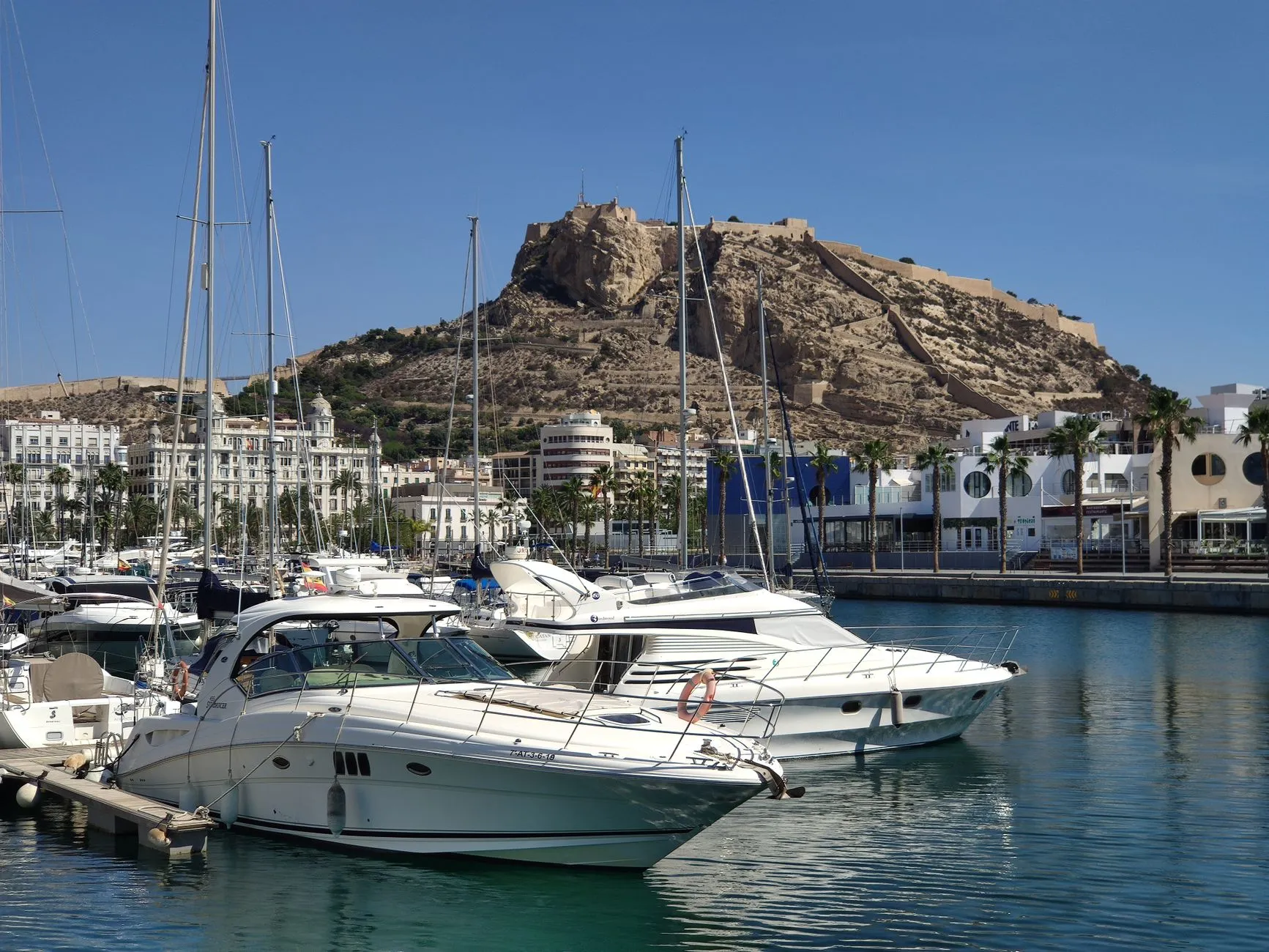
The seafront piece is the Explanada de España, a palm-lined promenade paved with approximately six million marble tiles in red, cream and black, arranged in a wave pattern, running beside the marina. It is, genuinely, one of the better-maintained promenades in southern Spain — not because the tiles are remarkable but because the scale is right and the marina view earns it. Above the city, the Castillo de Santa Bárbara occupies the top of Mount Benacantil. The lift, cut through the rock near Postiguet beach, makes the ascent practical and bypasses what would otherwise be a steep climb. The view over the bay from the castle is the best in Alicante. The Barrio de Santa Cruz, the old quarter on the hill below the castle, is a grid of tiled, flower-hung lanes — worth the walk if you have time, not worth special effort if you do not.
⏱️ Layover Math: What’s Actually Viable
The C-6 bus takes about 20 minutes each way, which sets the floor on any city visit.
- 4-hour layover: comfortable. Roughly 1.5 hours in the city — enough for the Explanada, the lift up to Santa Bárbara, and a drink — with a 90-minute return buffer (longer in summer when the security queue is at its worst). This works.
- 3-hour layover: tight, but viable in shoulder season. A walk along the marina and the Explanada is achievable; the castle is tight. In summer, with security queues and the possibility of the C-6 running slow, the margins compress to uncomfortable.
- Under 3 hours: stay in the terminal.
💡 Benidorm and Elche are not layover destinations
Benidorm is a coach trip, not a layover. Elche — closer to the airport than Alicante, and UNESCO-listed for its palm groves — is an interesting half-day in its own right but requires the same calculation: it needs time you probably do not have on a typical connection.
🧭 Practical Notes
- Bus ticket: bought from the driver on the C-6; keep it for the duration of the ride. TRAM tickets at Luceros are purchased separately at the platform.
- Cash vs. bureau de change: draw euros from a bank ATM rather than the airport exchange desk. Cards are accepted almost everywhere, including ALSA coaches.
- Reduced-mobility assistance: free under EU rules; must be requested through your airline at least 48 hours before departure. The meeting point is signed in the terminal.
- Night and runway works: Alicante has periodically run overnight runway maintenance with associated schedule disruption. If you hold a very late or very early flight, reconfirm the departure status close to travel.
❓ FAQ
📊 At a Glance — ALC 2026
| Feature | Current Data (2026) |
|---|---|
| Official name | Aeropuerto de Alicante-Elche Miguel Hernández |
| IATA / ICAO | ALC / LEAL |
| Location | ~10 km southwest of Alicante city, near Elche |
| Passengers (2024) | 18.38 million (record; 2025 tracked higher) |
| Terminals | 1 (opened 2011) |
| Train / tram to centre | None — TRAM connects at Plaza de los Luceros in the city |
| Bus to centre | C-6 (TAM) — ~€4.60, ~20 min, every 20 min, 24-hour service |
| Coaches | ALSA direct to Benidorm, Dénia, Jávea, Murcia |
| Taxi to centre | ~€20–25, ~15 min |
| Currency | Euro (€) |
| Schengen | Yes — EES live 10 Apr 2026; ETIAS expected, date not announced |
| Lounge | Sala VIP Costa Blanca / Salón Ifach — Priority Pass / Amex, ~04:00–23:00 |
| Dominant carriers | Ryanair (18 based aircraft), easyJet (base reopened 2026), Jet2, Vueling, TUI, Norwegian |
| 2026 change | easyJet reopened its Alicante base |
| Best layover move | C-6 to Explanada de España + Santa Bárbara castle lift — viable at 4 hr+, tight at 3 hr |
🌍 Planning the trip? Read our The Costa Blanca travel guide — best time to go, where to stay, and how to get around.