Oulu Airport (OUL) — Airport Guide 2026
Quick Reference
Oulu Airport
OUL / EFOU
Oulu, North Ostrobothnia, Finland
About 13–15 km southwest of central Oulu
One terminal; the third-busiest airport in Finland
545,034 passengers (−6.0%); mostly domestic Helsinki traffic
Finnair dominant on Helsinki; Norwegian and seasonal others
Finland — Schengen and euro; EES live since 10 April 2026, ETIAS expected, date not announced
Euro (€) — the only Nordic country that uses it
Bus 8 €5.80 (~20–30 min, every ~15 min); taxi ~€32–41; no rail at the airport
Hailuoto Lounge (check Priority Pass / pay-per-use access)
🛫 1. What Oulu Airport is
Oulu is the main airport for north-central Finland — the tech-and-university city on the Gulf of Bothnia, well south of the Lapland everyone pictures when they think of the Finnish north. It is the third-busiest airport in the country, but that ranking flatters its size: this is a quiet regional field whose traffic is overwhelmingly the domestic shuttle down to Helsinki, with a thin international layer on top.
The reason to pay attention in 2026 is the city, not the airport. Oulu is a European Capital of Culture this year, sharing the title with the wider region, so the place is hosting a programme of events and seeing more visitors than usual — and this airport is how most of them arrive. That is the genuine recent change here: a normally low-key northern city in the spotlight for twelve months.
The airport’s own numbers tell a soberer story. Traffic was about 545,000 in 2025, down around 6% on the year and still roughly half the 1.1 million it saw in 2019, a slow recovery that owes a lot to the closure of Russian airspace and Finnair’s pull-back from the Asian routes that airspace once fed. So while the Capital of Culture year lifts the city, the flight network here is modest — built around Helsinki, with limited direct international choice.
For a passenger that means a simple read: Oulu is a domestic-shuttle airport with a handful of seasonal and Nordic links, and for most journeys beyond Finland you connect through Helsinki. You come here to reach Oulu and its region, not to transit.
The Capital of Culture year does change the booking picture a little. Demand for flights and beds is higher than a normal Oulu year, especially around the bigger events, so the cheap fares and the central hotels go earlier than they would otherwise — worth booking ahead if your dates are tied to something on the programme. Outside the event peaks the city is its usual quiet self, and shoulder-season travel is both cheaper and calmer.
🚌 2. Getting into Oulu — bus 8, no airport rail
The airport sits about 13–15 km southwest of the city, and the transport is straightforward and cheap.
Bus line 8 runs between the airport and the city centre for €5.80 (less for children), taking roughly 20 to 30 minutes and leaving about every 15 minutes through the day. It ends near Oulu’s central bus and railway stations, which is where you pick up trains onward across Finland. Buy the ticket from the driver or the local transport app; for most arrivals this is the obvious choice over a taxi.
There is no railway at the airport itself — the train station is in the city, reached by that same bus 8 — so if you are heading onward by rail, the sequence is bus into Oulu first. A taxi from the rank runs roughly €32 to €41 into the centre and takes under 20 minutes, which is convenient for a late arrival or a group with luggage but hard to justify against a €5.80 bus that runs every quarter of an hour.
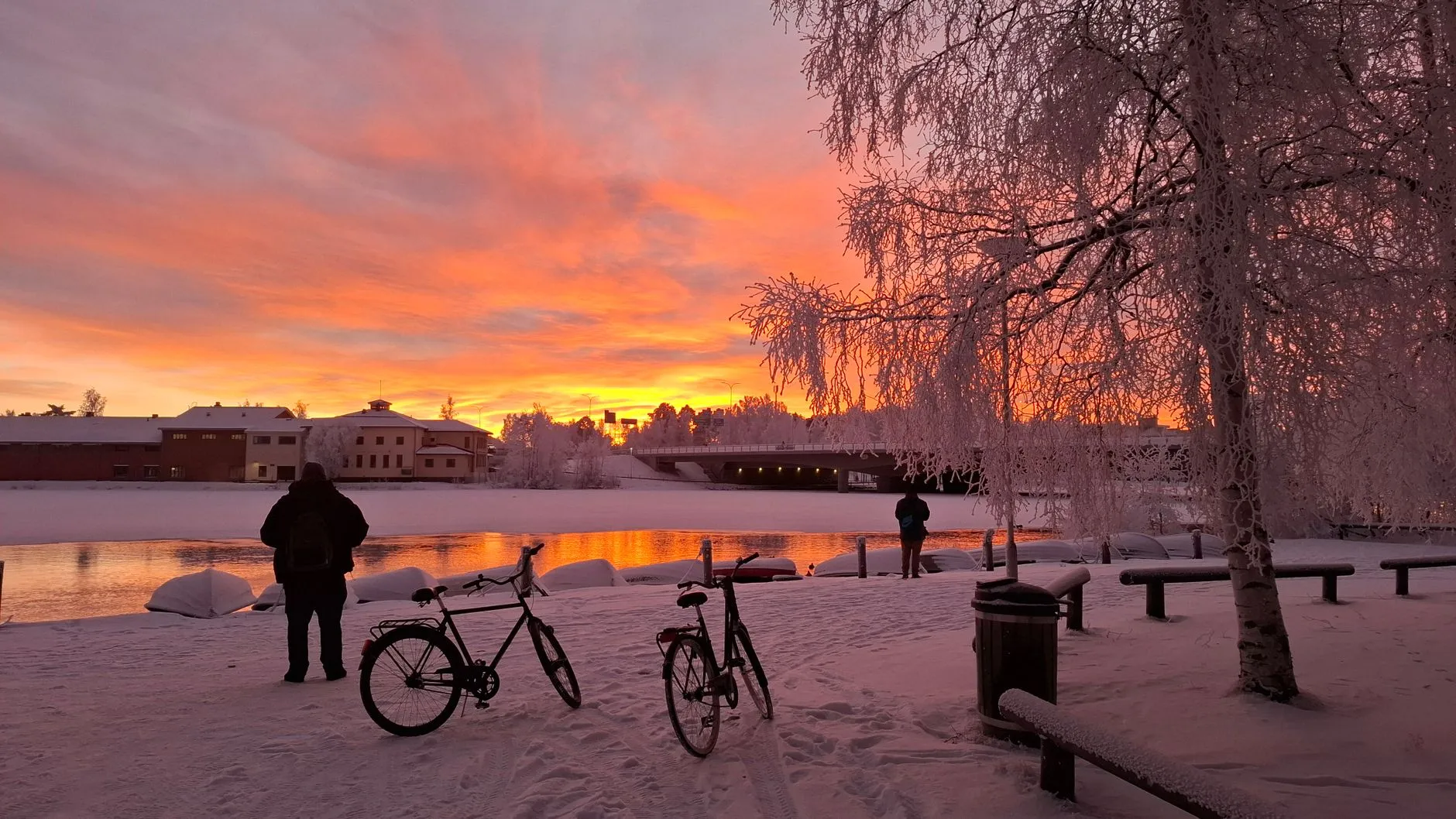
A winter caveat worth heeding: this is a properly cold, snowy part of the world from roughly November to March, and while Finnish airports and roads handle it far better than most, fog and heavy snow can still delay flights and slow the run into town. Build a little slack into a winter trip, dress for the cold the moment you step outside the terminal, and do not count on a tight onward connection in January.
For getting around once you are in Oulu, the surprise is the bicycle. The city is one of the world’s leading winter-cycling places, with a dense network of maintained paths used year-round, even in deep snow, and bike hire is easy in the warmer months. It is a genuinely good way to see a flat, compact city built around the water.
🛬 3. The terminal and the lounge
One terminal handles everything, and it is a small, calm Finnish building — quick to cross, with short walks and little drama. It has its busy spells around the Helsinki departure banks, when the business travellers cluster, but it rarely feels stretched, and ninety minutes before a flight is comfortable, less for a domestic hop.
Food and shopping are modest but decent in the Finnish way — proper coffee, a cinnamon bun, a café rather than a food court. It is fine for a short wait; do not plan a meal around it.
The flow is the orderly Nordic kind, with self-service bag drop and a security line that moves quickly. Boarding the regional aircraft is often a short walk across the apron rather than a jet bridge, which in a Finnish winter means a brisk cold dash, so keep a coat to hand rather than packed in the hold. None of it is stressful; this is an easy airport to use.
The airport has a lounge, the Hailuoto Lounge, named after the marine island off the coast and themed on it. Access terms for ordinary travellers vary — it may take Priority Pass or comparable cards and offer pay-per-use entry — so check your programme’s current terms before relying on it rather than assuming. For a small northern airport, having a lounge at all is more than many of its peers manage.
🛂 4. The border: Finland, Schengen, and the euro
Finland is in the EU and the Schengen Area, and unlike its Nordic neighbours it uses the euro — Sweden, Norway and Denmark all keep their own kronor, but Finland does not, which is worth knowing if you are hopping between them.
Because Finland is in Schengen, arriving from elsewhere in the zone means no passport control at all, which covers most of Oulu’s traffic. Arriving from outside it, such as a UK or other non-Schengen flight, you now meet the EU’s EES biometric system, live since 10 April 2026; ETIAS, the pre-travel authorisation, is expected to follow, with no launch date announced. Visa-exempt visitors from the UK, US, Canada, Australia and many other countries get up to 90 days in any 180.
Practically, the euro and Finland’s near-cashless habits make spending easy: cards and contactless work for the bus, the coffee and almost everything else, and you rarely need notes. EU and Nordic nationals move freely, and there is no separate currency to change as there would be across the border in Sweden or Norway.
On prices, set expectations: Finland is not cheap, and a coffee, a beer or a restaurant meal costs more than most visitors are used to. The consolation is that service is included and tipping is not expected — the price on the menu is what you pay — so you do not add a tip on top of an already high bill. Budget for the baseline and you will not be caught out.
🎸 5. The reason to come: Oulu, tech city and culture capital
Oulu is easy to misjudge from the map. It looks like a stop on the way to Lapland, but it is a substantial city in its own right — a technology and university hub sometimes called the Silicon Valley of the North, built on a wireless and electronics industry that grew up around Nokia, and young because of its big student population. The 2026 Capital of Culture year is the moment it steps forward, with a programme spread across the city and the region through the whole year.
The everyday city is walkable and on the water. The Market Square and its old wooden storehouses sit by the harbour, watched over by the Toripolliisi, a rotund bronze market-policeman that is the city’s unofficial mascot; the Pikisaari island keeps the oldest wooden houses; and Nallikari, on the Baltic shore, is a beach in summer and a snowscape in winter. The city’s quirk worth knowing is the Air Guitar World Championships, held in Oulu each August since the 1990s — a genuinely odd, genuinely fun festival where people compete at playing an instrument that is not there, and the single most Oulu thing on the calendar.
If you have longer and a car, the coast rewards a detour. Hailuoto — the island the airport lounge is named after — lies off the shore southwest of the city, reached by a free ferry, and it is a flat, quiet place of dunes, birdlife and old fishing hamlets that locals use as a weekend escape. It is not a headline sight, but it is the kind of low-key Bothnian coast that explains why people who live here like it.
One honest distinction, because people get it wrong: Oulu is not Lapland. It sits just south of the Arctic Circle, so you can see the northern lights on a clear winter night and the winters are properly snowy, but the Santa-and-huskies Lapland of the brochures is further north — for that you fly to Rovaniemi or Kittilä, not here. Come to Oulu for the city, the culture year and the coast, and treat the aurora as a winter bonus rather than the main event.
When you come matters as much as where you go this far north. Summer brings the long Nordic days, near-midnight light and a city that lives outdoors on the water; deep winter brings snow, short dark days and the chance of aurora, with the Capital of Culture programme running across both. The shoulder months either side are quieter and cheaper, but for the white-night summer or the snow-and-lights winter, those are the seasons that show Oulu at its most distinctive.
There is no separate aifly Oulu guide, so this is the orientation: the Market Square and the harbour, a bike along the water, Nallikari for the shore, and whatever the Capital of Culture programme is staging while you are in town. The food worth seeking is Finnish and northern — fresh fish from the Bothnian coast, rye breads, the cloudberries and lingonberries of the region — and what is worth carrying home is Finnish design, good coffee or the local berry liqueurs rather than an airport trinket.
❓ 6. FAQ
📋 7. At a glance
| Item | Detail |
|---|---|
| Airport | Oulu (OUL / EFOU), ~13–15 km from central Oulu |
| Terminal | One terminal; third-busiest in Finland; arrive ~90 min for an international flight |
| 2025 traffic | 545,034 passengers (−6.0%); mostly domestic Helsinki traffic |
| Carriers | Finnair (Helsinki shuttle) dominant; Norwegian + seasonal Nordic/European |
| To the city | Bus 8 €5.80 (~20–30 min, every ~15 min) to the bus/railway stations |
| Taxi | ~€32–41, under 20 minutes |
| Rail | None at the airport; Oulu’s station is in the city, reached by bus 8 |
| Border | Finland; Schengen; euro; EES live since 10 April 2026; ETIAS expected, date not announced |
| Currency | Euro (€) — the only Nordic country to use it; heavily cashless |
| Lounge | Hailuoto Lounge (check Priority Pass / pay-per-use) |
| Worth your time | Oulu’s Capital of Culture 2026 year, the Market Square and harbour, Nallikari, the Air Guitar Championships |
🔗 8. Explore More
- Helsinki Airport (HEL) guide — the national hub the Oulu shuttle connects to, and the change point for almost any international journey
- Oslo Airport (OSL) guide — a direct Nordic link from Oulu, for onward Norway
- Stockholm Arlanda (ARN) guide — the other big Nordic hub within easy reach