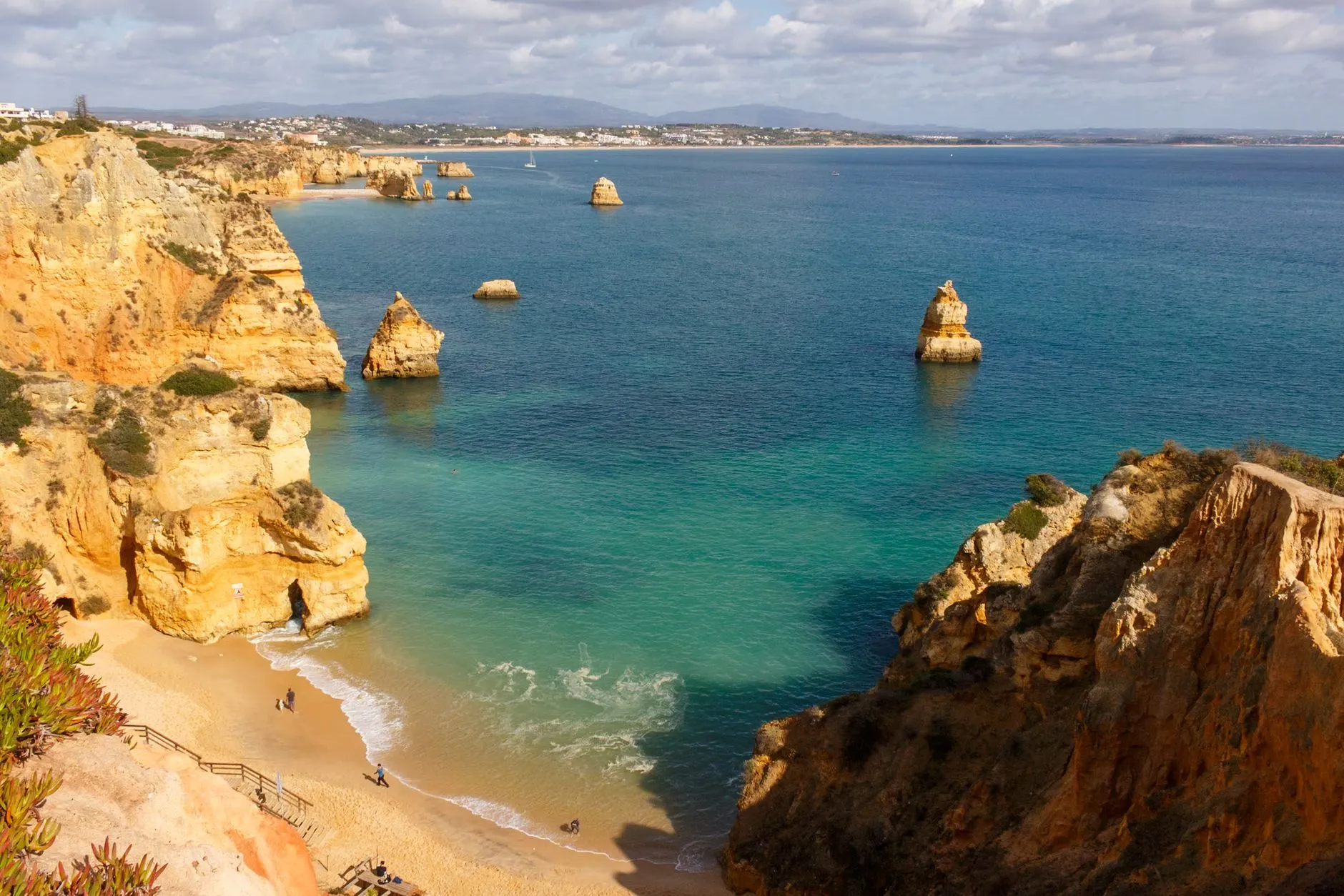
The Algarve — Complete Travel Guide 2026
Portugal’s sun-baked southern coast is 150 kilometres of ochre cliffs, hidden coves and some of the cheapest flights in Europe — but “the Algarve” is really three different holidays wearing the same name, and the single biggest mistake is treating it as one place. Get the choice between west, centre and east right and it’s one of the best-value escapes on the continent; get it wrong and you’ll spend the week in someone else’s holiday.
Quick Reference
Southern Portugal, Atlantic coast
Faro (FAO) — the only airport; serves the whole region
Euro (EUR)
Portuguese (English widely spoken on the coast)
Schengen / EU — EES live since April 2026, ETIAS expected, date not announced
May–June & September–October (skip August)
Golden cliffs, hidden coves, the Benagil cave, year-round sun
West (Lagos), central (Carvoeiro/Albufeira), or east (Tavira) — pick one
Editor’s Note: There Is No Such Thing as “The Algarve”
Here is the thing the brochures won’t tell you: the Algarve people argue about over dinner is not a single destination. It’s a coastline that changes character every 40 kilometres, and where you land determines what kind of trip you have.
The west (around Lagos and Sagres) is dramatic — towering cliffs, surf beaches, end-of-Europe wildness, and a younger, scruffier energy. The centre (Albufeira, Carvoeiro, Vilamoura, Portimão) is the postcard Algarve: golden cove beaches, resort infrastructure, water parks, and — depending on the town — either family-friendly polish or a strip of British bars selling full English breakfasts. The east (Tavira, Olhão, the Ria Formosa) is the Algarve the Portuguese kept for themselves: flat, lagoon-fringed, slow, and still recognisably Portugal rather than a tan factory.
The one decision that matters: choose your base by which Algarve you want, not by which hotel has the best photos. A family wanting beach-and-waterpark days should be central. A couple wanting cliffs, sunsets and surf should be west. Anyone chasing the “real Portugal” — markets, tiled towns, grilled fish at a plastic table — should go east to Tavira. Trying to “do all three” from one base means hours in a hire car you didn’t budget for.
The good news: almost everyone arrives through one small airport (Faro), and the flights are absurdly cheap — we track fares from across Europe landing here for the price of a nice dinner. The skill is in everything after you collect your bag.
Should You Go? Who the Algarve Is — and Isn’t — For
Go if you want reliable sun (300+ days a year), spectacular cliff-and-cove scenery, cheap flights, fresh seafood, and a coast that works as well for a lazy beach week as for hiking, surfing or golf. It is one of Europe’s most dependable warm-weather destinations and one of its best-value — especially outside July and August.
Think twice if you’re picturing untouched, undiscovered Portugal. Parts of the central Algarve — chiefly the Albufeira “Strip” — are mass-tourism at full volume: neon bars, sports screens, and English breakfasts. That’s a feature for some travellers and a horror for others. The trick is knowing it’s confined to specific zones and entirely avoidable.
Reality check on the beaches: the famous cliff coves (Marinha, Camilo, Benagil) are stunning and small, and in July–August they fill by mid-morning. The Algarve’s beauty is real; so are the crowds at its most-photographed 500 metres. The fix is timing and spreading out — both covered below.
Getting There — Faro Airport & the Real Transfer Cost
Every Algarve trip starts at Faro Airport (FAO), a single mid-sized airport on the eastern-central coast that handles the entire region. The flights themselves are the bargain of the trip — across a typical year we track hundreds of fares to Faro from more than 50 European cities, with the cheapest UK, Portuguese and budget-hub routes landing for €22–45 return in the shoulder season. The full live picture is at the bottom of this guide.
The harder question is the 30–90 minutes after you land. Your options, honestly ranked:
- Hire a car — the right call for most trips, and essential if you’re basing in the west (Lagos/Sagres) or want the inland villages, the wild west coast, or the quieter coves. Rental desks are in the arrivals hall. Book ahead for July–August; the cheap cars sell out and walk-up rates are brutal.
- Shared transfer — €12–15 per person, booked from the kiosks in arrivals or online in advance. The best-value door-to-door option if you’re not renting.
- Aerobus (line 56) — about €8 to Albufeira, continuing to Lagoa, Portimão and Lagos. Runs roughly 7 times a day in summer (May–Oct) but drops to just two journeys each way in winter — check the timetable before you rely on it.
- Private transfer — from around €42 booked ahead, up to ~€44 in peak season. Worth it for families or late arrivals.
- Taxi / Uber / Bolt — apps work at Faro; a metered taxi to Albufeira runs €50–60. Bolt/Uber are usually cheaper than the rank.
- Train — there is no station at the airport. You’d bus into Faro city first, then pick up the regional line. Fine if Faro or a train-town (Albufeira, Portimão, Lagos) is your base; pointless otherwise.
Skip the airport money-change desk. Portugal is on the euro and almost entirely card-friendly — tap your phone for the bus, the transfer, the lot. Pull a little cash from a bank ATM (Multibanco) in town if you want it for a beach café, and ignore any standalone “Euronet”-style machine that offers to “convert” the charge — always choose to be charged in euros.
The Three Algarves — and Where to Base Yourself
Pick one base. The coast looks small on a map; in a hire car in August traffic it isn’t.
West Algarve — Lagos & Sagres. The most scenic stretch: sandstone cliffs, the iconic coves of Ponta da Piedade, surf beaches, and Europe’s literal southwestern tip at Cabo de São Vicente. Lagos is the hub — historic, walkable, good nightlife without being a strip, and an easy base for the best beaches. Sagres, further out, is windswept, surfy and end-of-the-world quiet. Base here for drama, sunsets and surf; you’ll want a car.
Central Algarve — Carvoeiro, Albufeira, Vilamoura, Portimão. The classic cove-beach Algarve and the most resort-developed. Carvoeiro is the pick of the smaller central towns — a former fishing village cascading to the sea, walkable, and the gateway to Marinha, Benagil and the Seven Hanging Valleys. Albufeira is the biggest, liveliest resort: the Old Town is genuinely pleasant; the “Strip” (Areias de São João) is full-volume party tourism — know which you’re booking. Vilamoura is the polished marina-and-golf option; Portimão/Praia da Rocha is high-rise beach city. Base here for family beach days, infrastructure and the headline coves.
East Algarve — Tavira, Olhão & the Ria Formosa. Flatter, calmer, and the most authentically Portuguese. Tavira is widely considered the prettiest town in the Algarve — tiled façades, a Roman bridge, island beaches reached by ferry, and no high-rises. Olhão is a working fishing town with the region’s best market. The beaches here are on barrier islands inside the Ria Formosa lagoon — you take a short boat to reach them, which keeps them blissfully uncrowded. Base here for slow days, real Portugal and lagoon swimming; less good if you want nightlife or the famous cliffs (those are central/west).
The Beaches — and How to Actually Enjoy Them
The Algarve’s cliff-backed coves are the reason most people come, and they live up to it. The catch is that the three or four most famous are also small, and fame plus small equals crowds. Here’s how to do it without the disappointment.
- Praia da Marinha — the cover-star: golden cliffs, sea stacks and arches around a sheltered cove, regularly named among Europe’s finest. Access is a steep descent from the clifftop, which thins the crowds — but the free car park holds just 32 cars and fills within an hour or two of sunrise in summer. Arrive at opening or come late afternoon.
- Benagil Cave — the famous domed sea cave with the hole in the roof. It can only be reached from the water — kayak, SUP or boat tour from Benagil beach or Carvoeiro. Walking to it is not a thing; the clifftop above has a viewpoint but you can’t get inside on foot. Go early; the cave is a conveyor belt by midday.
- Praia do Camilo (Lagos) — a tiny twin-cove reached by a much-photographed wooden staircase between cliffs. Sculptural and gorgeous; the sand is minimal and fills fast.
- Praia da Falésia (near Albufeira) — the antidote to the crowded coves: a vast beach beneath terracotta-and-ochre cliffs that runs for kilometres. Because it’s so long, it never feels packed — walk 10 minutes from the access point even in August and you’ll have space. The pick for a relaxed full beach day.
- Praia Dona Ana & Ponta da Piedade (Lagos) — postcard cove plus the cliff-and-grotto headland best seen by boat tour or kayak at golden hour.
- Tonel & Beliche (Sagres) — the surf beaches; raw Atlantic, big swells, dramatic cliffs.
- Ria Formosa island beaches (east) — Ilha de Tavira, Ilha da Armona, Ilha Deserta: long, calm, warm-water barrier-island beaches reached by short ferries. The Algarve’s secret to a quiet beach day in high summer.
The trail that beats the crowds: the Percurso dos Sete Vales Suspensos (Seven Hanging Valleys) runs ~7 km of clifftop between Praia da Marinha and Praia de Vale Centeanes, past arches, caves and the Benagil viewpoint. Do it early morning and you’ll see the best of the central coast on foot, before the beaches below fill up.
When to Visit — Month by Month
The Algarve’s superpower is its weather: 300-plus sunny days and a swimmable shoulder season most of Europe can only dream of. But when you go changes the trip — and the price — enormously.
- May–June — the sweet spot. Warm (low-to-mid 20s °C), long days, the sea warming up, wildflowers, and crowds still manageable. June is arguably the single best month.
- July–August — peak: 28–35 °C, the warmest sea, and everything at maximum — crowds, prices, traffic, and the cove car parks full by 9am. Fine if school holidays force your hand; if not, August is the month to skip — heat, crowds and prices all peak together.
- September–October — the connoisseur’s choice. The sea is at its warmest after a summer of heating, crowds thin out, prices ease (lodging can be ~30% cheaper than peak), and the light is gorgeous. September is many regulars’ favourite month full stop.
- November–March — the off-season secret. Mild (often 15–18 °C and sunny), cheap, and quiet, with golf, hiking, almond blossom and empty clifftops — though many beach restaurants and some hotels close, the sea is cold, and the Aerobus runs a skeleton timetable. A genuinely pleasant winter-sun bolthole if you don’t need to swim.
Plan around the heat, not the calendar. If you can only travel in summer, base in the east (Tavira/Ria Formosa) where the island beaches absorb crowds, hit the famous central coves at dawn, and treat the middle of the day as siesta time. The Algarve in August is wonderful if you stop fighting the timetable.
Beyond the Beach — Day Trips & the Inland Algarve
Most people never leave the sand, which is their loss — the Algarve’s interior and edges are some of its best days out.
- Ria Formosa Natural Park (east) — a protected lagoon of channels, sandbanks and barrier islands. Boat or SUP tours glide past flamingos, seahorses and oyster beds to beaches with no road access. One of the great half-days in southern Portugal.
- Silves — the Moorish capital of the Algarve, crowned by a huge red-sandstone castle above a sleepy town of cobbled lanes, an old cathedral and orange groves. A proper history fix, 20 minutes inland from the central coast.
- Serra de Monchique — the forested mountain range behind the coast, cooler and green, topped by Mount Fóia (902 m) with views across the whole Algarve to the sea. Caldas de Monchique is a tiny Roman-era thermal spa village in the foothills; the hills are also where small producers still hand-distil medronho (strawberry-tree brandy).
- Sagres & Cabo de São Vicente — the windswept southwest tip of mainland Europe: clifftop fortress, lighthouse, raw Atlantic and the best sunset on the coast (bring a jacket — it’s always windier than you expect).
- The west coast / Costa Vicentina — over the corner into the Parque Natural do Sudoeste Alentejano e Costa Vicentina: wild, surf-battered, Brittany-like coast and the Rota Vicentina trail network. Deserted beaches, dramatic walks, no resorts. A different Portugal entirely — and a car is essential to reach it.
- Seville (Spain) — a long but very doable day trip from the eastern Algarve (~2.5–3 hours by car/coach over the border). Wildly different city; a great change of scene from a Tavira or Faro base.
What to Eat — Cataplana, Piri-Piri & the Sardine
Algarvian food is Atlantic-simple and seafood-led, and eating well here is mostly about where you sit, not what you spend.
- Cataplana — the regional icon, named for the hinged copper pan it’s cooked in: two clamshell halves clamp shut and steam-cook fish, shellfish, pork and vegetables in their own juices. Served for two, theatrically opened at the table. The dish to order at least once.
- Frango piri-piri — the Algarve’s benchmark grilled chicken, flattened and marinated with chilli, garlic, paprika and lemon, then charred over coals. The spiritual home is Guia (near Albufeira), whose “frango da Guia” is a pilgrimage in itself.
- Sardinhas assadas — charcoal-grilled sardines, salt-crusted, on thick bread, at their best in summer. Portimão throws a whole Festa da Sardinha for them in August.
- The seafood — clams (in cataplana or à Bulhão Pato, with garlic and coriander), razor clams, percebes (gooseneck barnacles), oysters from the Ria Formosa, fresh fish by the kilo at the marisqueira.
- Medronho & dom rodrigo — finish with the fiery mountain brandy or the sweet egg-and-almond dom rodrigo. The Algarve’s almond and fig sweets are everywhere.
Eat where the menu has no pictures. The fastest way to a mediocre, overpriced meal is the beachfront terrace with a laminated photo-menu in six languages. Walk two streets back from the seafront — or eat in the market towns (Olhão, Tavira, Loulé) — and you’ll pay half as much for twice the fish. In Olhão, eat at the market.
Getting Around — Car vs Train vs Bus
- Car — the honest answer for most trips. The best coves, the west coast, Sagres, Monchique and the inland villages are awkward-to-impossible without one. Roads are good and distances short; parking at the famous beaches is the only real friction (arrive early).
- Train — Linha do Algarve — the regional line runs along the coast from Lagos in the west to Vila Real de Santo António on the Spanish border, stopping at Portimão, Silves, Albufeira (station is out of town), Faro, Tavira and more. Cheap, scenic and stress-free for town-to-town hops if your plans follow the line. It does not serve the airport or the cliff beaches.
- Buses — regional buses connect the towns but thin out badly at weekends and in winter, and some routes don’t run on Sundays at all. Workable for the main resort towns; frustrating for anything off the spine.
The combo that works without a car: base in a train-line town (Lagos or Tavira), use the Linha do Algarve for day trips along the coast, and book the occasional boat tour or organised excursion for the coves and the Ria Formosa. You’ll miss the wild west coast — but you’ll skip the August parking wars entirely.
Where to Stay — By Area & Budget
The Algarve has the full range, but match the area to your trip first (see “The Three Algarves” above), then the budget.
- Budget (~€40–80 / night): guesthouses and residenciais in the towns — Lagos old town, Tavira, Olhão, Silves. Best value off-season and in the east. Hostels in Lagos for the young/surf crowd.
- Mid-range (~€90–180 / night): the sweet spot — town hotels, aparthotels and well-run resorts in Carvoeiro, Lagos, Albufeira Old Town and Tavira. A self-catering apartment is often the smartest family option.
- Splurge (€250+ / night): the marina-and-golf resorts around Vilamoura, Quinta do Lago and Vale do Lobo (the “Golden Triangle”), and clifftop design hotels near Carvoeiro and Lagos.
Avoid booking blind on the “Strip.” A cheap Albufeira deal can put you in the middle of Areias de São João, where the party runs till dawn. If you want Albufeira, book the Old Town or the quieter Olhos de Água end — and read the reviews for the word “noise.”
Costs & Budget — What You’ll Actually Spend
The Algarve is one of Western Europe’s better-value coasts, especially outside peak season.
- The flight is the cheap part: shoulder-season returns to Faro run €22–60 from many European cities (live data below).
- A pastel de nata and coffee: ~€2–3. A beer: €2–3 in a town, more on the seafront.
- A proper seafood lunch with wine, two streets back from the beach: ~€20–30 a head. Cataplana for two: ~€40–55.
- A hire car: from ~€25–40/day off-season, far more in August — book early.
- Daily budget (mid-range, per person): roughly €70–110 outside peak, more in July–August. The Algarve rewards the shoulder-season traveller twice over — cheaper and quieter.
Practical Information
- Border & entry: the Algarve is in Portugal — Schengen and the euro. Non-EU visitors (UK, US, etc.) get short-stay visa-free access, but the EU’s Entry/Exit System (EES) has been live since April 2026, so first arrivals now register fingerprints and a photo at the border — expect occasional queues at Faro on busy summer days. ETIAS, the pre-travel authorisation, is expected to begin on a date that has not been announced — check whether it applies before you fly. EU/EEA/Swiss nationals are unaffected.
- Money: euro; cards and contactless accepted almost everywhere. Use bank (Multibanco) ATMs; always choose to be charged in euros.
- Language: Portuguese, with English very widely spoken on the coast. A bom dia and obrigado/obrigada go a long way.
- Safety: the Algarve is very safe. The real hazards are the sun (it’s stronger than it feels — the Atlantic breeze hides it) and the sea: many west-coast and exposed beaches have strong currents and big surf; swim at flagged, lifeguarded beaches and respect the flags.
- Water & tipping: tap water is safe to drink. Tipping is modest — round up or leave 5–10% for good service; it’s appreciated, not expected.
- Connectivity: EU roaming applies for EU SIMs; good 4G/5G across the coast. Local prepaid SIMs (MEO, Vodafone, NOS) are cheap if you need data.
Frequently Asked Questions
Cheapest Flights to the Algarve
We have tracked 628 fares to the Algarve from 53 cities. As of June 2026, here is what a good price looked like from each — the lowest fare we recorded, and a “great-deal” benchmark to judge a quote against. These are tracked observations, not live prices: by the time you read this they will have moved, so treat them as a yardstick, not a quote.
| From | Lowest fare we tracked | Great-deal benchmark |
|---|---|---|
| East Midlands (EMA) | €22 | €33 |
| London (STN) | €23 | €33 |
| Glasgow Prestwick (PIK) | €24 | €34 |
| Porto (OPO) | €24 | €35 |
| Charleroi (CRL) | €31 | €45 |
| Bergamo (BGY) | €43 | €62 |
| Lyon (LYS) | €45 | €64 |
| Weeze (NRN) | €46 | €65 |
| Eindhoven (EIN) | €53 | €76 |
| Katowice (KTW) | €62 | €89 |
| Lisbon (LIS) | €68 | €97 |
| Frankfurt Hahn (HHN) | €69 | €99 |
| Zurich (ZRH) | €85 | €121 |
| Bologna (BLQ) | €85 | €121 |
Recent deals we have posted to the Algarve:
- Nantes to Faro, Portugal from €68
- Madrid to Faro, Portugal from €27
- Birmingham to Faro, Portugal from £51
- Marseille to Faro, Portugal from €42
- Toulouse to Faro, Portugal from €33
- Barcelona to Faro, Portugal from €40
- Cork to Faro, Portugal from €43
- Nantes to Faro, Portugal from €56
These are fares aifly tracked to this destination, not live quotes — they have changed since and several of the deals above may have expired. Browse current flight deals →