Cancún & the Riviera Maya — Complete Travel Guide 2026
The Riviera Maya is really five or six completely different holidays sharing one airport, and the single most common mistake is booking the wrong one. Cancún’s Hotel Zone is a wall of glass towers and swim-up bars; Tulum is overpriced jungle-boho with a sargassum problem; Playa del Carmen is the practical middle; and the islands are another planet again. Pick your base before you pick your dates — and in 2026, check the seaweed forecast before you do either.
Quick Reference
Caribbean coast of the Yucatán Peninsula, Quintana Roo, Mexico
Cancún International (CUN) — the busiest in Latin America
Mexican peso (MXN); US dollars widely accepted but you’ll lose on the rate
Spanish; English spoken throughout the tourist corridor
Mexico — entry is a digital tourist permit issued on arrival; visa-free for most Western visitors
January–March (dry, low sargassum, before spring break peaks)
Caribbean beaches, cenotes, Maya ruins, the Mesoamerican reef, all-inclusives
Cancún Hotel Zone, Playa del Carmen, Tulum, Puerto Morelos, or an island
Editor’s Note: Decide What Trip You Actually Want
There is no single “Cancún.” The coast runs roughly 130 km from Cancún down past Tulum, and a taxi from end to end takes well over two hours in traffic. Along it sit half a dozen towns with wildly different personalities and price tags, and the brochures blur them all into one turquoise smear.
Be honest with yourself about which of these you are:
- You want a self-contained resort, swim-up bars, and zero logistics → Cancún Hotel Zone or an all-inclusive on the mainland.
- You want walkable nightlife, restaurants, dive shops, and a base for day trips → Playa del Carmen.
- You want the Instagram aesthetic, beach clubs, and you’ve budgeted for it → Tulum, eyes open about the cost and the seaweed.
- You want quiet, sand streets, no cars, and a hammock → Holbox or Isla Mujeres.
- You’re here for the reef → Cozumel.
Getting this right is 80% of whether you’ll love the trip. Get it wrong and you’ll spend the week either bored in a resort you didn’t want or stuck in shuttle vans chasing the place you should have booked.
Should You Go? Who It’s For — and Who It Isn’t
This coast is built for the beach-and-margarita crowd, families who want a pool and a kids’ club, divers, couples after a photogenic week, and spring breakers who know exactly what they signed up for. The infrastructure is genuinely excellent: clean water in the resorts, English everywhere, easy day trips, world-class snorkeling.
It is not for you if you want an “undiscovered” authentic Mexico — that’s not what this is, and pretending otherwise will only annoy you. It’s heavily developed, heavily American-facing, and the Hotel Zone has the cultural texture of an airport duty-free. If you came for colonial cities, mezcal bars, and street life, you want Oaxaca or Mérida (Mérida, incidentally, is an easy add-on from here). It’s also a poor choice if you’re chasing a sargassum-free beach holiday in summer without a backup plan — read the beaches section before you book a July week on the Tulum mainland.
Getting There: CUN Airport & the Transfer Reality
CUN is enormous, efficient, and a gauntlet. Two things to know before you walk out of customs.
First: the digital entry permit. Mexico no longer hands out the paper FMM tourist card at Cancún. The process is now digital — the immigration officer issues your permit electronically when you’re processed at the booth and sets your allowed stay (often less than the old automatic 180 days, so glance at what you’re given). There’s no separate online form you must complete before flying for a standard tourist arrival by air. Keep your boarding pass and accommodation details handy in case you’re asked.
Second: the taxi scam. This is the region’s least-loved feature. Uber is still not allowed to operate inside Cancún Airport in 2026, taxi fares are unregulated, and the touts start the moment you clear customs — including official-looking “taxi” and “tour” desks inside the terminal that quote two to three times the going rate, plus people in fake uniforms steering you toward expensive vans. Your sane options:
- ADO bus — the cheapest and most reliable. Around €13–€15 USD, ticket desks in every terminal (buy as you exit customs; popular departures sell out). Direct, no stops, drops you at the downtown bus stations: ~25 minutes to Cancún Centro, ~1h15 to Playa del Carmen’s terminal (a 5-minute walk from Fifth Avenue). For Cancún Centro, Playa, or Tulum without a hotel transfer, this is the answer.
- Pre-booked private shuttle — fixed price, door to door, from roughly €75–€85 per vehicle to Playa (cheaper per head with a group). Book online before you land so no one negotiates with you at the curb.
- Resort transfer — many all-inclusives include or sell one; usually the easiest if you’re going straight to a Hotel Zone property.
⚠️ Never negotiate a taxi at the airport curb or trust an in-terminal “official taxi” desk. Fares are unregulated and tourists routinely pay 2–3× the fair price. Book a shuttle online before arrival or walk to the ADO bus desk — and ignore anyone who tells you “the next bus is in an hour” or “there are no more buses.” That’s the pitch, not the truth.
Where to Base: The Honest Rundown
Cancún Hotel Zone (Zona Hotelera) — the iconic strip: a thin barrier island of big-brand all-inclusives, malls, clubs, and a long white beach. Convenient, polished, and soulless. It’s the right call if you want a resort cocoon and a short transfer, and it’s where spring break happens. Cancún downtown (El Centro) is the opposite — where locals live, where the food is real and a third of the price, and where you’ll find genuine value if you don’t need to fall out of bed onto the sand.
Puerto Morelos — a small fishing town between Cancún and Playa, with a sleepy square, a great protected reef just offshore, and a fraction of the noise. The sleeper pick for people who want calm without going full island.
Playa del Carmen — the practical hub and, for most independent travellers, the smart base. Walkable, with Fifth Avenue (La Quinta) for restaurants and bars, ferries to Cozumel from the pier, dive shops, and the full range of accommodation from €75 hostels to €320 boutiques. Beaches are free and swimmable, and it’s the best launchpad for day trips up and down the coast.
Puerto Aventuras / Akumal — quieter resort-and-marina territory mid-coast; Akumal (“place of turtles”) is the headline draw for shore snorkeling with sea turtles.
Tulum — two Tulums, really: the scruffy pueblo (town, more affordable) inland, and the beach zone, a single jungle road lined with eco-chic boutique hotels and beach clubs. The aesthetic is real and so is the markup — beach-zone boutiques run roughly €170–€420 a night and the showpiece properties go €750–€1850+. Beach clubs charge a €37–€110 per-person minimum spend, €140–€190 at the top end. And here’s the catch nobody puts in the photos: Tulum’s beach faces straight into the sargassum drift, so from roughly April to October it’s regularly the worst-hit stretch on the whole coast. The “eco” branding is largely marketing — the jungle hotels draw from the same aquifer they’re straining. Go in if you want it, but go in clear-eyed.
The islands — Cozumel for diving, Isla Mujeres for an easy car-free beach day or overnight, Holbox for the true switch-off. More on each below.
The Beaches — and the Sargassum Truth
The water here is the real thing: warm, clear, that absurd Caribbean turquoise. The problem is the seaweed.
Sargassum is brown pelagic seaweed that drifts in from the Atlantic, piles up on east-facing Caribbean beaches, and rots into a sulfur smell. It’s a genuine, recurring issue — not a one-off. The season runs roughly April to October, peaking June–August, with the coast generally clearing by November. And 2026 is forecast to be one of the worst years on record — University of South Florida monitoring has flagged record Atlantic biomass, and through summer 2026 nearly half of Riviera Maya beaches have been under heavy “red alert” conditions at times. Resorts rake the sand daily and deploy offshore barriers, but on a bad week even that loses.
Where to escape it:
- Isla Mujeres — Playa Norte: consistently the cleanest beach near Cancún, sheltered by its geography. The single best bet for clean sand close to the airport.
- Cozumel (west coast): the channel between the island and the mainland pushes sargassum away from the western beaches and dive sites, which stay clear even during bad mainland events.
- Holbox: on the Gulf side, north of the peninsula — largely escapes the Caribbean sargassum entirely.
The mainland Caribbean beaches — Cancún Hotel Zone, Playa, Akumal, Tulum — all sit in the drift path, Tulum worst of all. If you’re travelling in summer 2026 and a clean swimming beach is non-negotiable, base on an island, or go in winter. The howisthesargassum.com forecast maps are the tool locals actually check.
⚠️ In summer 2026, do not assume a mainland Caribbean beach will be clean. Sargassum is forecast at record levels. If a clear beach matters, base on Isla Mujeres, Cozumel, or Holbox — or travel December–April when the coast is reliably clear.
Cenotes & Maya Ruins
This is what makes the region more than a beach. Skipping the cenotes and ruins to stay by the pool is the trip’s biggest waste.
Cenotes are freshwater sinkholes in the limestone, fed by the underground river system, ranging from open swimming holes to cathedral-like caverns. The good ones near Tulum:
- Gran Cenote (4 km from Tulum) — the popular one: a big open pool linked by a tunnel to a stalactite chamber, with turtles. ~500 MXN (~€27).
- Dos Ojos (“two eyes”) — twin caverns famous for cave diving and snorkeling; ~200–350 MXN.
- Ik Kil — the dramatic circular sinkhole with vines spilling from the rim, 3 km from Chichén Itzá, so it pairs with the ruins. ~180 MXN.
Cenote etiquette is strict and enforced: chemical sunscreen is banned statewide to protect the water — bring biodegradable mineral sunscreen or just wear a rash guard, and rinse at the entrance shower before entering. No glass, no food in the water, no smoking. Most don’t take cards — bring small bills. Go early; by midday the popular ones fill up and the magic drains out with the quiet.
⚠️ Chemical sunscreen is illegal in cenotes (and at the turtle sites) — fines up to ~3,000 MXN. Buy reef-safe mineral sunscreen before you go, or skip it and wear a UV rash guard. You’ll be made to shower before entering.
The ruins — choose by what you want, not by fame:
- Chichén Itzá — the Wonder-of-the-World pyramid, genuinely magnificent, and a zoo. 6,000+ visitors a day, you can’t climb it (climbing’s been closed for years), and adult entry is now around 700 MXN total. Worth it, but go at opening or you’ll be photographing the back of someone’s head.
- Cobá — jungle site, less crowded, great for hiking and biking the forest paths; the climb here was suspended for conservation in late 2024, so don’t go expecting to summit the pyramid. ~195 MXN.
- Ek Balam — quieter than all of them, the best-preserved stucco art in the region, and in 2026 one of the only major pyramids you can still climb. That alone makes it the connoisseur’s pick. ~500–700 MXN with the local bracelet.
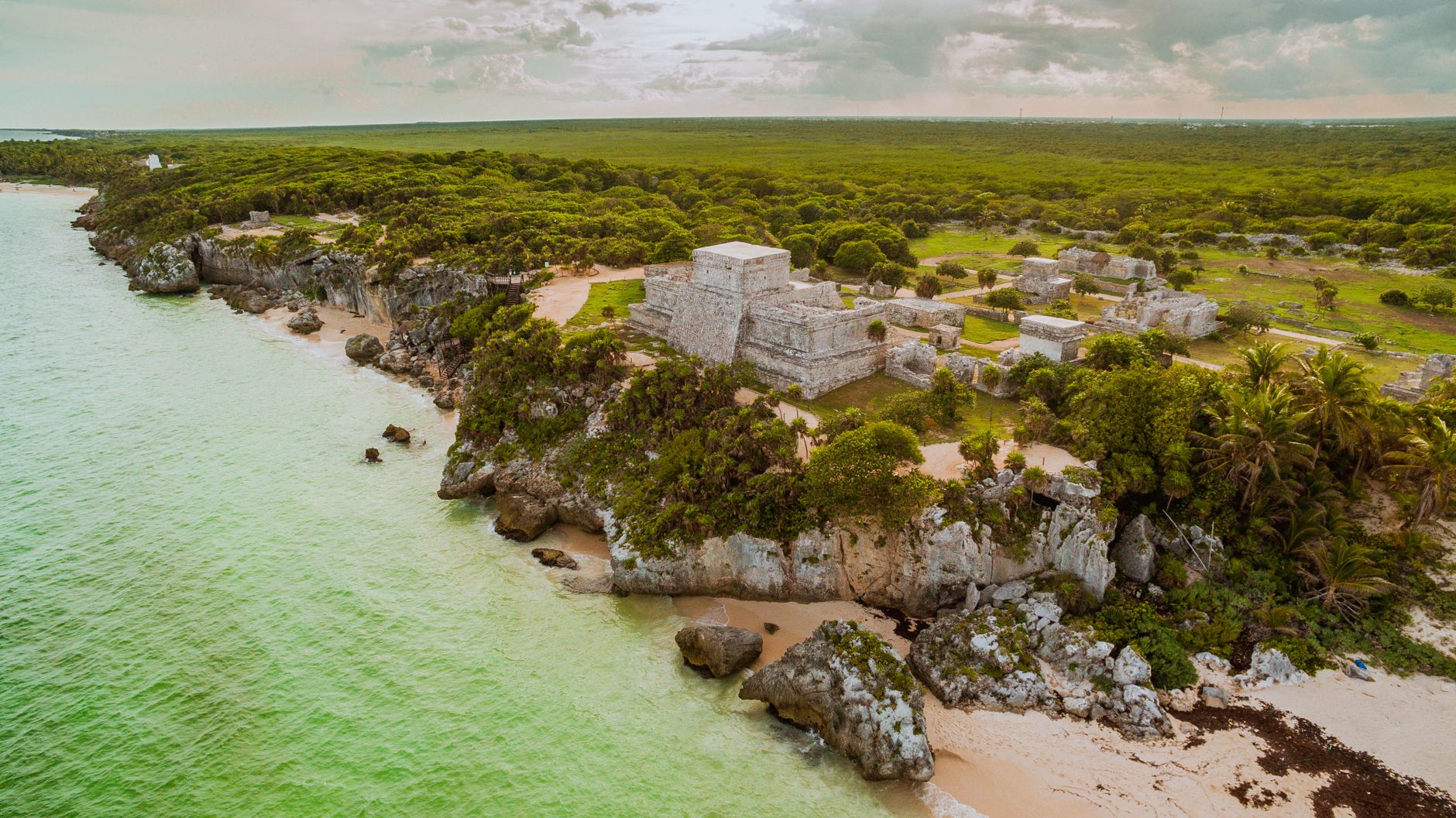
- Tulum ruins — small and not historically major, but unbeatable as a setting: Maya temples on a cliff over the Caribbean. ~515 MXN with the park bracelet. Best at opening, before the cruise crowds and the heat.
The smart combo for most people: Chichén Itzá at opening + Ik Kil cenote to cool off, or Ek Balam (climb it) + Cobá for far fewer crowds.
The Islands: Cozumel, Isla Mujeres, Holbox
Cozumel — a proper island a 45-minute ferry from Playa del Carmen, and one of the world’s top dive destinations, sitting on the Palancar section of the Mesoamerican reef. Wall dives, drift dives, current-fed visibility — divers structure whole trips around it, and the west-coast sites stay clear even in bad sargassum years. If you don’t dive it’s pleasant but less essential; if you do, it’s the headline.
Isla Mujeres — the easy one: a short, frequent ferry from Cancún (around 540 MXN return), a tiny car-free-feeling island you get around by golf cart, and Playa Norte, the cleanest swimmable beach in the area. Doable as a day trip, better as an overnight once the day-trippers leave.
Holbox — the real escape. A long sandbar island on the Gulf side, reached by a ferry from Chiquilá (~20–25 minutes, a couple of companies running it). No cars — golf carts and sand streets. It’s flat, slow, barefoot, with flamingos, bioluminescence on dark nights, and whale sharks offshore June–September. Swimming alongside the world’s biggest fish is the signature experience (shared boat tours run roughly 3,300 MXN / €150 USD plus a small marine-park fee). Holbox is also, conveniently, the most reliable sargassum refuge. The trade-off: it takes effort to reach (drive or bus to Chiquilá, then ferry), and that’s exactly why it stays unspoiled.
When to Visit: Month by Month
The year splits into dry (December–April) and wet (May–November), overlaid with three things that matter more than rain: sargassum, hurricanes, and spring break.
- December–January — peak season. Best weather, coolest evenings (pack a light layer), no sargassum, holiday crowds, highest prices. Book 3–4 months ahead.
- February–March — the sweet spot for weather and clean beaches: dry, warm, low seaweed. But mid-March into early April is US spring break, which turns the Cancún Hotel Zone into a party zone. Playa, Tulum, and Puerto Morelos stay calmer.
- April — lovely early in the month, good value after spring break clears; sargassum starts creeping back toward month-end.
- May–August — hot, humid, rainy-season afternoon showers, and peak sargassum (worst June–August, record-bad in 2026). This is also whale shark season (June–September) off Holbox/Isla Mujeres, the one big reason to come in summer. Base on an island if you’re here now.
- September–October — the quietest and cheapest, but the heart of hurricane season (officially June–November, peak Sep–Oct) and still some sargassum. Real bargains, real risk; consider travel insurance.
- November — underrated. Weather settling, coast generally clearing of seaweed, crowds and prices below peak. Along with May, the smartest value window.
Best overall: late January through March if you want guaranteed conditions; May or November if you want most of the upside without peak prices.
What to Eat: Real Yucatecan Food vs the Buffet
The single biggest food upgrade you can make is leaving the resort. All-inclusive buffets are fine and forgettable; the actual cuisine of the Yucatán is one of Mexico’s great regional kitchens, and it’s cheap.
What to order:
- Cochinita pibil — the dish. Pork marinated in achiote and sour orange, wrapped in banana leaf and slow-roasted until it falls apart, piled into tacos or tortas with pickled red onion. Order it.
- Panuchos & salbutes — fried tortillas (panuchos stuffed with refried black beans) topped with turkey or chicken, avocado, pickled onion. Street-stall classics.
- Poc chuc — pork marinated in sour orange and grilled.
- Marquesitas — the street dessert: a crispy rolled crepe filled with Edam cheese and Nutella or cajeta. Sounds wrong, tastes right.
- Ceviche and aguachile on the coast; sopa de lima (lime-turkey soup) for something lighter.
Where to actually find it: head to Cancún downtown (El Centro) — the markets and stalls around Parque de las Palapas, Mercado 23, and Mercado 28, where tacos run 25–35 MXN and a plate of panuchos is ~60 MXN, prices that make the Hotel Zone look like a robbery. In Playa del Carmen, skip the Fifth Avenue tourist menus and hit the Municipal Market and the side-street loncherías a block or two off La Quinta. The rule everywhere: the further you walk from the beachfront and the tourist strip, the better and cheaper the food gets.
💡 Eat one dinner in Cancún’s downtown El Centro and you’ll understand the markup you’re paying everywhere else. A full plate of authentic Yucatecan food at Mercado 23 or around Parque de las Palapas costs a few dollars — and beats the resort buffet outright.
Getting Around
The coast is a single highway (307) with everything strung along it, so moving around is easy and cheap if you know the options.
- ADO buses — the backbone. Clean, air-conditioned, reliable long-distance coaches linking the airport, Cancún, Playa del Carmen, Tulum, and inland to Mérida and Valladolid. Cheap, bookable online or at the station. For town-to-town hops this is your default.
- Colectivos — shared white vans running fixed routes (especially Playa ↔ Tulum), flagged down on the highway. Dirt cheap (a few dollars), frequent, used by everyone, and the locals’ way to cover the mid-coast. They drop you on the highway, not at your door.
- Ferries — Playa del Carmen → Cozumel (~45 min, from the central pier), Cancún → Isla Mujeres (~540 MXN return), Chiquilá → Holbox (~20–25 min). Buy at the dock; check the last return time.
- Car hire — worth it for cenote-and-ruins freedom and reaching the quieter spots on your own schedule. Watch for the rental-insurance upsell scam (mandatory third-party liability is legit, but agents push expensive add-ons hard), and decline anything you don’t understand. Drive defensively; topes (speed bumps) are everywhere.
- Taxis — fine within towns but always agree the fare before you get in (no meters); they’re the expensive way to cover distance.
The Tren Maya (Maya Train) in 2026: the big new infrastructure story, and the honest verdict is “useful for some trips, not a magic carpet.” The full passenger line is operational, running 34 stations over ~1,550 km around the peninsula. The relevant stretch for visitors links Cancún ↔ Playa del Carmen ↔ Tulum and inland toward Valladolid/Chichén Itzá and Mérida. The catch: along the Caribbean corridor it runs only about three times a day in each direction, the stations are often set inland away from town centres (Cancún’s is at the airport; you still need onward transport), and the line runs through jungle, not along the coast — so no sea views. For Cancún–Tulum it’s roughly 400 MXN (~€22) one way. It’s a genuinely good option for the longer inland legs (a comfortable, scenic run to Mérida or toward Chichén Itzá) and a reasonable Cancún–Tulum alternative if the timetable fits your day — but for short coastal hops the ADO bus and colectivos are still more frequent and more convenient. Check the current schedule on the official site (trenmaya.gob.mx) before building a day around it.
Where to Stay, by Base & Budget
- All-inclusive (Cancún Hotel Zone, Riviera Maya resort strips) — the path of least resistance: food, drinks, pool, beach, kids’ club, one price. Quality ranges from package-tour cheap to genuinely luxurious. Best for families and anyone who wants to switch their brain off.
- Boutique (Playa del Carmen, Tulum, Puerto Morelos) — Playa’s boutiques (€110–€320) get you walkable town life; Tulum’s beach-zone boutiques (€170–€420 showpieces far higher) get you the aesthetic and the markup.
- Budget & hostels (Playa del Carmen, Tulum pueblo, Holbox, Isla Mujeres) — Playa has the best hostel scene and cheap guesthouses from ~€28–€75; Tulum town (not the beach) is far more affordable than the beach road; the islands have characterful small guesthouses.
- Islands — Holbox and Isla Mujeres skew toward small guesthouses and mid-range boutiques rather than mega-resorts, which is the point.
A useful 2026 wrinkle: with sargassum cutting into demand, some Caribbean beachfront hotels have been discounting through the bad-seaweed months — if you’re flexible on the beach situation, summer rates can be a genuine bargain.
Costs & Budget
This is mid-range Mexico with a tourist premium baked into the beach strip and a much cheaper reality just inland.
- Street/local food: tacos 25–40 MXN; a filling market meal a few dollars.
- Mid-range restaurant dinner: 250–500 MXN a head; Tulum beach-club and Fifth-Avenue tourist spots far more.
- Cenotes: ~150–650 MXN each (~€8–€35).
- Ruins: Cobá ~195 MXN; Chichén Itzá / Ek Balam ~700 MXN; Tulum ~515 MXN.
- Eco-parks (Xcaret, Xel-Há, Xplor): the priciest single-day spend — Xcaret basic admission runs well over €120 USD, the Plus (with food/drink) over €160–€190 similar for Xel-Há and Xplor. Polished, family-friendly, and expensive; book online for the discounts (often 20%+ for multiple parks) rather than at the gate. Worth it for families; skippable if you’d rather DIY cenotes and reefs for a fraction of the cost.
- Ferries: Cozumel and Holbox a few dollars; Isla Mujeres ~540 MXN return.
- Tipping: expected. 10–15% in restaurants (check it’s not already added), 20–50 MXN for housekeeping per day, a little for tour guides and bag handlers. Tips are a real part of service workers’ income here.
The Visitax (state visitor tax — see below) is a fixed extra of roughly €14 USD per person.
Practical Information
Entry (2026): Most Western tourists (US, Canada, UK, EU, Australia) need no advance visa for stays up to 180 days. The paper FMM tourist card is gone at Cancún — your tourist permit is now issued digitally on arrival by the immigration officer, who sets your permitted length of stay. There’s no standard pre-flight form to fill for an air arrival; just have your passport (valid for your stay), return ticket, and accommodation address ready.
⚠️ The Quintana Roo Visitax is a real, mandatory state tax — but only the official site is legit. It’s ~283 MXN / ~€14 USD per person (all ages), paid online at visitax.gob.mx any time before you fly home; you get a QR code that’s scanned on departure. Countless lookalike sites overcharge — use the .gob.mx official portal only, and ignore “Visitax desks” that materialize at the airport.
Currency: Mexican peso. USD is accepted in tourist zones but at a poor rate and often with change in pesos — pay in pesos where you can, carry small bills (cenotes, colectivos, markets are cash), and use ATMs attached to actual banks (Santander, BBVA, HSBC) rather than the standalone machines that gouge on fees.
Safety: Quintana Roo carries a US State Department Level 2 “exercise increased caution” advisory — the same level as France, Italy, and the UK. The tourist corridor is heavily policed (National Guard and tourism police patrol the Hotel Zone and main strips), and the headline-grabbing cartel violence of early 2026 was over a thousand miles away on the Pacific side; Quintana Roo authorities confirmed airports, ports, and tourism running normally. Use normal city sense: don’t get involved with drugs (most tourist-zone trouble is dealing-related and late-night), don’t wander unfamiliar neighborhoods alone after dark, keep your group together, use registered transport. It’s not a war zone; it’s a busy tourist region where the same precautions you’d take in any big city apply.
⚠️ Don’t drink the tap water. Stick to bottled or filtered water (resorts and good hotels provide it) for drinking and brushing teeth. It’s the single most common way visitors ruin a few days here.
Connectivity: widespread Wi-Fi and good 4G/5G in the corridor (Holbox is patchier — that’s a feature). A local eSIM (Telcel has the best coverage) or a travel eSIM is cheap and worth it for maps, ride apps in town, and ferry/bus schedules.
Frequently Asked Questions
Cheapest Flights to Cancún & the Riviera Maya
We have tracked 1,191 fares to Cancún & the Riviera Maya from 71 cities. As of June 2026, here is what a good price looked like from each — the lowest fare we recorded, and a “great-deal” benchmark to judge a quote against. These are tracked observations, not live prices: by the time you read this they will have moved, so treat them as a yardstick, not a quote.
| From | Lowest fare we tracked | Great-deal benchmark |
|---|---|---|
| Sandefjord Torp (TRF) | €319 | €456 |
| Copenhagen (CPH) | €321 | €459 |
| Amsterdam (AMS) | €330 | €471 |
| Gothenburg (GOT) | €351 | €502 |
| Dublin (DUB) | €371 | €530 |
| Cologne (CGN) | €378 | €540 |
| Oslo (OSL) | €381 | €544 |
| Madrid (MAD) | €393 | €561 |
| Prague (PRG) | €404 | €577 |
| Dusseldorf (DUS) | €421 | €601 |
| Warsaw (WMI) | €429 | €613 |
Recent deals we have posted to Cancún & the Riviera Maya:
- Zürich to Cancún, Mexico from CHF 540
- Prague to Cancún, Mexico from €576
- Venice to Cancun, Mexico from €570
- Denver to Cancún, Mexico from $195
- Vienna to Cancún, Mexico from €567
- Glasgow to Cancun, Mexico from £400
- Berlin to Cancún, Mexico from €538
- Budapest to Cancún, Mexico from €538
- London to Cancun, Mexico from £410
- London to Cancun, Mexico from £471
These are fares aifly tracked to this destination, not live quotes — they have changed since and several of the deals above may have expired. Browse current flight deals →