Armenia — Complete Travel Guide 2026
Armenia is the most underrated country in this corner of the world, and the easiest to fall hard for. This is the planet’s first Christian nation — it adopted the faith as a state religion in 301 AD, before Rome did — and the proof is everywhere: monasteries hewn into rock faces, carved into gorges, perched on cliff edges under the white cone of Mt Ararat, the holy mountain that sits just over a closed border in Turkey and breaks every Armenian heart a little. It’s a land of stone and altitude and deep time, of a unique alphabet and an unbroken culture that has survived empires, earthquakes and a genocide. It’s also brandy that Churchill drank by the case, wine older than the pyramids, apricots that taste like sunlight, and a welcome so warm it borders on aggressive. Come for a long weekend and you’ll wish you’d booked two weeks.
Quick Reference
The South Caucasus — high, mountainous and landlocked, wedged between Turkey, Georgia, Azerbaijan and Iran; an ancient land in the shadow of Mt Ararat
Yerevan Zvartnots (EVN), the main hub 15 km west of the capital; Gyumri Shirak (LWN), a small secondary in the north
Armenian dram (AMD) — roughly 420 to the euro; cheap, cash-friendly, ATMs everywhere
Armenian — its own ancient 38-letter alphabet, unlike anything else; Russian is widely understood; English is growing fast in Yerevan
Visa-free for up to 180 days per year for US, UK, EU, Canadian, Australian, New Zealand, Japanese and South Korean passports — no visa, no e-visa, just a stamp
May–June and September–October for everything; high summer for the mountains and Lake Sevan; late September–October for the wine harvest
The world’s first Christian nation, cliff-clinging monasteries, Mt Ararat, 6,000-year-old wine, brandy, and ferocious hospitality
Yerevan, full stop — you day-trip the entire country from the capital, with maybe a night in Dilijan or the wine south
Editor’s Note — small, deep, and gloriously off the radar
Here’s the honest pitch: Armenia is small, soulful, and almost no one you know has been. It’s about the size of Belgium, you can drive across it in a day, and yet it punches so far above its weight that a week feels short. This is not a beach country (it’s landlocked and high) and it is not a nightlife country (though Yerevan’s café and wine-bar scene will surprise you). What it is is one of the great history-and-landscape trips left in the wider Europe-adjacent world — monasteries, mountains, gorges, lakes and a culture that goes back to the Bronze Age and means it.
The genius of an Armenia trip is its geometry. You base in Yerevan — a buzzing, walkable, café-saturated pink city — and you radiate out. Almost everything worth seeing is a feasible day-trip from the capital: Khor Virap under Ararat is forty minutes away, Geghard and Garni an hour, Lake Sevan ninety minutes, even far-flung Tatev is doable in a long day. You don’t pack and repack your bags every night like you would in a bigger country; you come home each evening to the same wine bar. That hub-and-spoke model is what makes Armenia so easy and so rewarding, and it’s why I’d tell almost anyone to base in Yerevan and only sleep elsewhere if they specifically want a night in alpine Dilijan or the wine villages of the south.
💡 Hire a car with a driver, not a tour bus. The single best decision on an Armenia trip is splitting a day with a driver — roughly €60–90 for a full day to a region’s monasteries, shared between you it’s nothing. You set the pace, linger where you want, skip the gift-shop stops, and have someone who knows which khachkar-carved church is worth the bumpy road. It transforms the trip.
Should You Go? Who it’s for — and isn’t
Armenia is for the traveller who’d rather stand alone in a 9th-century monastery than queue for a museum — the person genuinely moved by old churches, raw mountain scenery, and a living ancient culture. It’s superb for history lovers (this is foundational Christian heritage, and you’ll often have the great monuments to yourself), for hikers and landscape people (the Caucasus is wild, green and high, with serious trails), for wine and food obsessives (you are standing in the cradle of winemaking), and for anyone doing a Caucasus loop who’d be mad to skip it on the way to or from Georgia.
It’s also for the value-conscious. Armenia is dirt cheap by European standards — a great guesthouse, a feast of a dinner, and a bottle of local wine for the price of a single mediocre meal back home.
Who it’s not for: anyone after sun-and-sand (there is none), package-resort ease (it doesn’t exist here — this is independent travel), or a hard-charging party scene (Yerevan has bars and good ones, but it’s wine and conversation, not clubs-till-dawn). It’s also not for travellers who need everything in polished English and on a schedule — Armenia is friendly and safe but it’s a country you have to engage with, where the marshrutka has no timetable and the best monastery is down an unmarked road. Lean into that and it gives back tenfold.
Getting There & Around — EVN, marshrutkas & the day-trip model
Almost everyone arrives at Yerevan Zvartnots (EVN), the modern main airport 15 km west of the city. The good news for 2026 is that getting here from Europe has never been cheaper or easier. FlyOne Armenia is now the biggest carrier at Zvartnots, with a fast-growing European network (including a new Yerevan–Amsterdam route from April 2026). Wizz Air has gone all-in on Armenia, basing aircraft here and opening a string of budget routes across Europe — this is your cheap-seat lifeline, with the first-ever direct UK and Netherlands links landing in 2026. Pegasus runs year-round via Istanbul Sabiha (a handy cheap one-stop from much of Europe), and full-service options include Qatar Airways via Doha (the smooth long-haul connector), plus regional carriers and Aeroflot from the Russian market. There are now around 40 airlines serving EVN to over a hundred destinations — a transformation from a few years ago.
The other classic way in is overland from Georgia. A marshrutka or shared taxi from Tbilisi to Yerevan takes roughly six hours over the mountains, and a Caucasus combo — flying into Tbilisi, out of Yerevan, or vice versa — is one of the best two-country trips going. The northern monasteries of Haghpat and Sanahin sit right on that route, so the drive itself is a sightseeing day.
From the airport into the city, an official taxi is about €8–12 (insist on a meter or agree the fare first), or the cheap #201 bus runs to the centre. Once in Yerevan you’ll barely need transport — it’s walkable and taxis (use the Yandex or gg apps) cost a euro or two across town.
For the country itself, you’ve got three ways to move:
- Marshrutkas — the battered shared minibuses that are Armenia’s circulatory system. They leave when full from city bus stations, cost almost nothing (a couple of euros even for long hauls), and go almost everywhere. They’re cheap and authentic but have no fixed timetable, get crowded, and can make a multi-monastery day genuinely painful. Great for point-to-point between towns; frustrating for ticking off scattered sites.
- A car with a driver — the sweet spot for the sightseeing days, as above. €60–90 buys a full day to a whole region’s worth of monasteries.
- Self-drive — possible and liberating, roads to the main sites are fine, but mountain driving, occasional rough tracks and assertive local style mean it’s not for the nervous. Manual cars are the norm; bring your licence.
⚠️ You cannot enter Azerbaijan, and you can’t cross into Turkey, from Armenia. Both land borders are closed (see Practicalities). Plan your Caucasus routing through Georgia — it’s the open door, north to Tbilisi — or simply fly in and out of Yerevan. This catches people out, so build it into your itinerary from the start.
Yerevan — the pink city
Yerevan is one of the world’s oldest continuously inhabited cities — founded in 782 BC as the fortress of Erebuni, which makes it older than Rome — but it wears its age lightly. The city you walk today is largely a 20th-century creation, rebuilt to a grand plan by the architect Alexander Tamanyan, and it’s built almost entirely from local volcanic tuff in shades of pink, rose and apricot, which is why Yerevan glows at sunset. It’s a genuinely lovely place to base, with a café culture, leafy boulevards and an easy, sociable evening rhythm. For the full deep dive, see our Yerevan city guide — here’s the orientation.
The heart is Republic Square, Tamanyan’s monumental ensemble of tuff buildings ringing a great oval, with a musical-fountain show on summer nights and the History Museum on one flank. From there the city’s spine runs up to the Cascade — a vast, sculpture-studded limestone stairway climbing the hillside, with the Cafesjian art collection set into its terraces and, from the top, the killer view: Yerevan spread below and Mt Ararat floating on the horizon, snow-capped and impossibly close, on a clear morning. Come early for the cleanest Ararat view; haze builds through the day.
Two museums anchor any visit. The Matenadaran is the national repository of ancient manuscripts — thousands of illuminated medieval Armenian codices, a treasury of a civilisation that put enormous value on the written word, and a quietly astonishing place. And up on a hill across the city, Tsitsernakaberd, the Armenian Genocide Memorial and museum, is essential and best approached with gravity: a stark cleft of twelve basalt slabs around an eternal flame, and a museum below that lays out the 1915 catastrophe with unflinching clarity. It is not a cheerful stop, but understanding it is understanding Armenia (more in the history section below).
Then there’s the drink. Yerevan’s brandy houses — Ararat (the ArArAt brand) and Noy — offer tours and tastings of the apricot-country cognac that Armenia is famous for, the spirit Stalin reportedly sent Churchill by the case. And the city’s wine-and-café scene has exploded: the bars and natural-wine spots along and around Saryan Street (now nicknamed “wine street”) are where modern Yerevan drinks, and they’re as good as anything in a far bigger capital. Spend an evening there and you’ll understand why people come for the monasteries and end up loving the city.
💡 Chase Ararat at dawn. The holy mountain — Armenia’s national symbol, painted on everything, yet stranded across a closed Turkish border — is most often clear in the early morning before haze sets in. From the top of the Cascade, or out at Khor Virap, an early start is the difference between a postcard and a grey smudge.
The Monasteries & Mt Ararat — Armenia’s soul
If Armenia has a single defining sight, it’s the monastery — and they are extraordinary, scattered across gorges and cliffs and ridgelines, mostly free to enter, often nearly empty. These are the day-trips that justify the whole trip, and a cluster of them sit within easy reach of Yerevan.
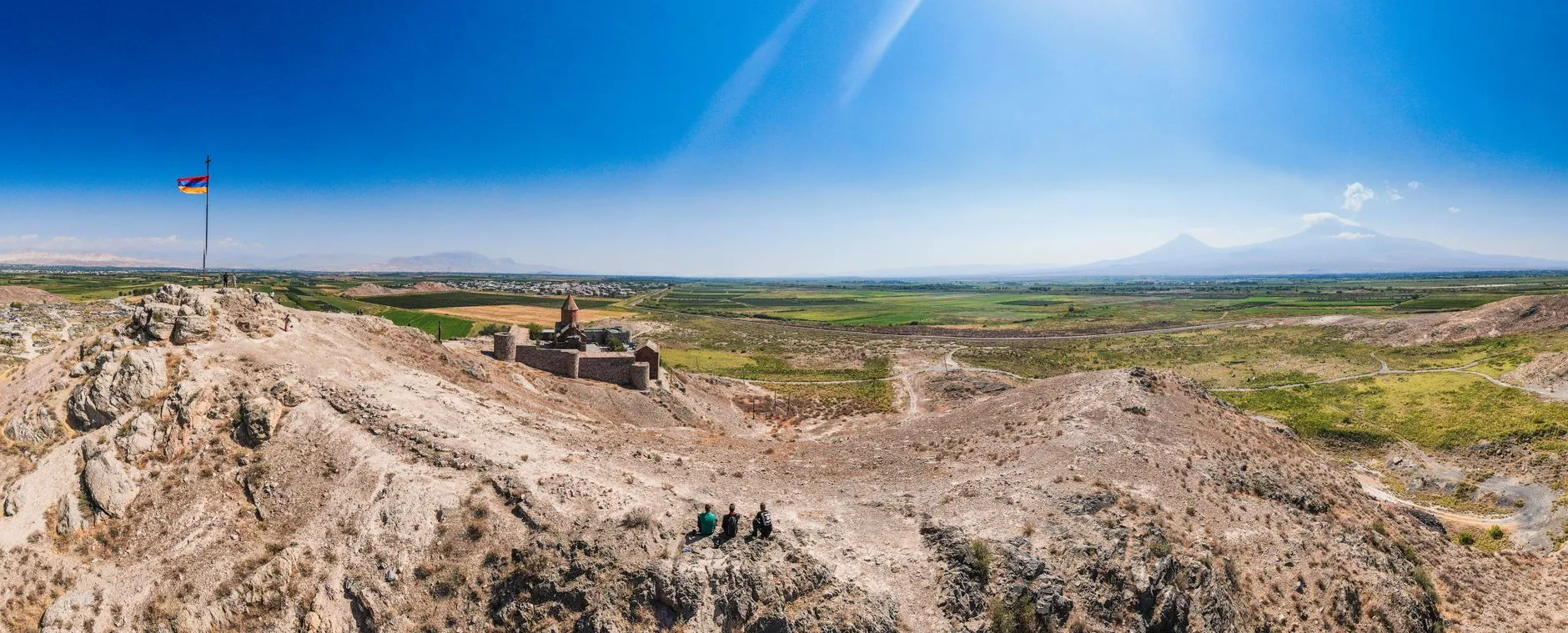
Khor Virap is the icon: a working monastery on a low hill pressed right against the Turkish border, with Mt Ararat rising directly behind it in the most photographed view in the country. This is where, by tradition, Gregory the Illuminator was imprisoned in a pit for thirteen years before converting the king and the nation to Christianity in 301 AD — you can climb down into the pit itself. Forty minutes from Yerevan, unmissable, and best at dawn for the mountain.
East of the city, two more form a classic pairing. Geghard is a UNESCO-listed monastery partly carved out of the living rock of a cliff — chambers, chapels and a spring hewn directly into the mountain, dim and dripping and acoustically magical (if a vocal group is singing in the rock-cut church when you arrive, stop and listen). A few minutes down the gorge, Garni breaks the pattern entirely: a 1st-century Greco-Roman colonnaded pagan temple, the only one left standing in the former Soviet space, perched dramatically above a canyon of hexagonal basalt columns called the “Symphony of the Stones.” Geghard and Garni together make the easiest, most rewarding half-day from Yerevan.
Then the far-flung greats. Tatev, deep in the southern mountains, is a stunning 9th-century monastery on a spur above the Vorotan gorge — and you reach it on the Wings of Tatev, the longest reversible cable car in the world at 5.7 km, a glorious sixteen-minute glide over the canyon (the ride is a destination in itself; about €11 return). Noravank, on the way south, glows red-gold in its narrow cliff-walled canyon and has a famous, vertiginous external staircase up a church facade. And in the far north, near the Georgian border, the twin UNESCO monasteries of Haghpat and Sanahin are medieval masterpieces of Armenian architecture, perfect to fold into the overland Tbilisi route.
💡 One monastery is a photo; three is a pilgrimage. Don’t over-schedule — cramming five monasteries into a day turns wonders into a blur. Pick a region (Geghard/Garni one day; Khor Virap/Noravank/Areni another; Tatev as its own long day) and let each place breathe. Bring small cash for candles and the occasional modest entry.
Lake Sevan & the North — Dilijan, Lori & the forests
Northern Armenia is the green, cool, lake-and-forest half of the country, and the antidote if you’ve had your fill of stone and sun.
Lake Sevan is the giant — one of the largest high-altitude lakes on earth, sitting at nearly 1,900 m, a vast blue inland sea ringed by mountains about 90 minutes from Yerevan. In summer Armenians decamp here to swim (the water’s bracing but does warm up), eat lake trout and kebab by the shore, and climb the steps to Sevanavank, a pair of 9th-century churches on a peninsula with a sweeping lake panorama. It’s busy and a bit kitschy in peak summer and serene in the shoulders; either way the view from Sevanavank is worth the stop.
Beyond the lake lies Dilijan, Armenia’s “little Switzerland” — a leafy spa-and-forest town in the Tavush mountains, all alpine air, hiking trails and a restored old quarter on Sharambeyan Street. It’s the country’s gentlest, greenest corner, a popular weekend bolthole, and home to the international UWC Dilijan college which has given the town a cosmopolitan edge. Nearby, Haghartsin monastery sits in a beautiful forest clearing — a serene, tree-framed 13th-century complex that’s one of the most photogenic in the country. Dilijan is the one place outside Yerevan and the wine south I’d genuinely suggest sleeping a night.
Further north, the province of Lori is deep canyon country — dramatic gorges, the historic spa town of Stepanavan, and the great UNESCO monasteries of Haghpat and Sanahin perched above the Debed canyon, right on the road to Georgia. If you’re doing the overland Caucasus route, Lori’s monuments are your reward for the drive.
The South — Syunik & Vayots Dzor wine country
The drive south from Yerevan toward Tatev is one of the great road trips in the Caucasus, and it runs straight through the cradle of wine.
Vayots Dzor is Armenia’s premier wine region, centred on the village of Areni — and this is no marketing line. In a cave just outside Areni, archaeologists uncovered the Areni-1 winery: a grape press, fermentation vats and drinking vessels dated to around 4100 BC, making it the oldest known winemaking facility on earth, some 6,100 years old. You can visit the Areni-1 cave itself, and far more rewardingly, taste the modern revival: the indigenous Areni grape makes Armenia’s signature elegant red, and a clutch of excellent wineries around the village (and the bigger Areni Wine Festival each October) pour it for a few euros a tasting. Stop, taste, buy a bottle for tonight — you are drinking from the deepest roots of the craft anywhere.
The same southern run takes in Noravank in its red canyon (above), and pushes on into the province of Syunik for the headliner: Tatev monastery and the world-record Wings of Tatev cable car, soaring over the dramatic Vorotan gorge. The landscapes down here are bigger and emptier than the rest of the country — high passes, raw mountains, deep canyons — and the villages feel a world away from buzzing Yerevan. It’s a long day-trip from the capital or, better, a one-night loop with a stop in the wine villages on the way.
💡 Build a wine day around Areni. Pair the Areni-1 cave (the world’s oldest winery, genuinely moving for wine lovers), a tasting or two at the village wineries, lunch with a local family, and Noravank’s glowing canyon — it’s one of the best single days in the country, and a driver makes it effortless.
The Genocide & the History You Should Understand
You cannot understand Armenia, or read a room here, without grasping a few things about its past — and one of them must be handled with care and respect.
The first Christian nation. In 301 AD Armenia became the first state in the world to adopt Christianity as its official religion, converted (by tradition) by St Gregory the Illuminator after his release from the pit at Khor Virap. That deep, foundational faith is the thread running through everything you’ll see — the monasteries, the carved khachkar cross-stones, the unique alphabet (created around 405 AD by the monk Mesrop Mashtots specifically so scripture could be written in Armenian). This is one of the oldest continuous Christian cultures on earth, and it has defined Armenian identity through every conquest since.
The Armenian Genocide of 1915. This is the central trauma of the modern nation, and it deserves to be stated plainly and soberly. Beginning in 1915, the Ottoman government carried out the systematic deportation and mass murder of its Armenian population; an estimated 1.5 million Armenians were killed, and the survivors scattered into a global diaspora that still vastly outnumbers Armenia’s own population. The events are commemorated every 24 April, and the memorial at Tsitsernakaberd in Yerevan is where the nation grieves. For Armenians this is not distant history — it shapes politics, identity, the diaspora, and the fraught relationship with Turkey to this day. Approach the memorial and the subject with the gravity they warrant; it is one of the most affecting things you will do in the country.
The Soviet century. Armenia spent most of the 20th century as a Soviet republic, which is why you’ll see Russian spoken everywhere, Soviet-modernist architecture alongside the tuff, and a deep, complicated relationship with Russia. Independence came in 1991 with the collapse of the USSR, and the country has been finding its own path — and untangling those old ties — ever since.
Food & Wine — the cradle of winemaking, on a plate
Armenian food is generous, ingredient-driven and built for sharing, and eating here is half the trip.
The foundation is lavash, the thin, blistered flatbread baked against the walls of a clay tonir oven — so central to the culture that it’s on the UNESCO intangible-heritage list. It comes with everything and wraps everything. The national obsession is khorovats, Armenian barbecue — pork, lamb, chicken or whole vegetables grilled over vine cuttings, served sizzling with lavash, herbs and pickles; a khorovats spread with a group is the quintessential Armenian meal. Add dolma (vine or cabbage leaves stuffed with spiced meat and rice), khash (a hardcore winter tripe broth, more a ritual than a dish), harissa (a slow-cooked wheat-and-meat porridge), spas (a tangy yoghurt soup), and an endless table of fresh herbs, cheeses, tomatoes and the legendary Armenian apricots and other fruit that the country is rightly proud of.
But the headline is the drink. You are in the birthplace of winemaking — the Areni-1 cave proved Armenians were pressing grapes 6,100 years ago — and the modern wine revival is one of the most exciting in the world, built on indigenous grapes like the elegant red Areni and the crisp white Voskehat. Tastings cost a few euros; bottles to take home are a bargain. Alongside the wine sits the other national spirit, Armenian brandy (the apricot-country “cognac” that made Yerevan’s Ararat and Noy houses famous), and the clear fruit oghi (vodka/moonshine) that a host will inevitably pour. Meals here run supra-style when there’s hospitality involved — a groaning table, endless toasts, and a determination to overfeed you that you simply cannot win. Surrender to it.
Costs & Money — exceptional value
Armenia is one of the best-value destinations within a short flight of Europe, and that’s a genuine reason to come. The dram works hard in your favour, and prices off the tourist-tat track are low.
A rough daily on-the-ground budget, excluding flights:
- Backpacker / budget: ~€25–35/day — hostels and family guesthouses, marshrutkas, market food and local cafés. Eat where Armenians eat and food can run €10–15/day.
- Mid-range: ~€50–90/day — a comfortable Yerevan guesthouse or boutique hotel, a hire-car-with-driver day or two, restaurant dinners with wine, and the paid sights.
- Comfortable: ~€120+/day — the better hotels, private drivers most days, the nicer restaurants and tastings. Even “splashing out” here is cheap by Western standards.
A sense of individual prices: a clean Yerevan guesthouse room runs roughly €25–45 a night; a full khorovats dinner for two with wine, around €20–30; a marshrutka between towns, a euro or two; the Wings of Tatev cable car about €11 return; a wine tasting a few euros; a full day with a car and driver around €60–90. Tipping is modest and appreciated — round up, or leave about 10% in restaurants. Cash is king for marshrutkas, markets, small guesthouses and rural sites; cards are fine in Yerevan restaurants and shops, and ATMs are plentiful. The dram is freely convertible, so you can withdraw on arrival without fuss.
⚠️ Carry cash outside Yerevan. The capital is card-friendly, but the moment you head to the monasteries, the wine villages or anywhere on a marshrutka, it’s a cash economy. Pull dram from an ATM in the city before a day-trip — rural villages and roadside churches won’t take your card.
Practical Information
Entry & visa: for most Western tourists — US, UK, all EU states, Canada, Australia, New Zealand, Japan and South Korea — Armenia is visa-free for up to 180 days within a one-year period. No advance visa, no e-visa for ordinary tourism, no invitation: you simply get a stamp on arrival. Your passport should be valid for the duration of your stay. It’s one of the most generous and hassle-free entry regimes anywhere — but as always, confirm your own nationality’s terms before you fly, since some non-Western passports do need an e-visa.
Safety: Armenia is one of the safest countries you can visit — violent crime against tourists is very rare, and walking Yerevan late at night feels completely relaxed. Petty theft is low; the main hazards are ordinary travel ones (mountain roads, assertive driving). The honest caveat is geopolitical, not street-level: the eastern border regions adjacent to Azerbaijan can be tense, and Western governments advise against travel to those specific frontier strips — well away from any normal monastery-and-wine itinerary. The whole tourist heartland — Yerevan, the monasteries, Sevan, Dilijan, the wine south, Tatev — is calm and welcoming.
The closed borders & Nagorno-Karabakh. Two facts to understand plainly. First, Armenia’s borders with Turkey and Azerbaijan are both closed — you cannot cross either, which is why all overland travel routes through Georgia to the north, and why most visitors simply fly into Yerevan. Second, the long Nagorno-Karabakh conflict reached its end in September 2023, when an Azerbaijani offensive led to the dissolution of the breakaway Armenian region and the flight of virtually its entire ethnic-Armenian population — over 100,000 people — into Armenia proper; the region is no longer Armenian-populated or accessible from Armenia. In August 2025, Armenia and Azerbaijan signed a US-brokered peace framework aimed at normalising relations and eventually reopening transport links. None of this affects travel within Armenia itself, which is entirely safe and open — but it’s the backdrop to the country you’re visiting, and worth understanding soberly.
Connectivity & SIMs: cheap local SIMs (Ucom, Team/Viva-MTS) with generous data are easy to buy at the airport or in town with your passport — far better than roaming, and coverage is good even around the monasteries. Yerevan has fast, widespread Wi-Fi, and a growing digital-nomad scene has settled in — co-working spaces, long-stay flats and café-laptop culture have all taken root, helped by the 180-day stay and the low cost of living.
Getting around (recap): marshrutkas for cheap town-to-town hops, a car-with-driver for the sightseeing days, self-drive if you’re confident on mountain roads. There’s no useful intercity rail to speak of for tourists; the road network does the work.
Language: Armenian is the language, written in its own beautiful and entirely unique alphabet — you won’t decode signs, but transliteration and English are increasingly common in Yerevan. Russian is widely understood across all generations and is the practical fallback; English is now common among younger people and in the tourist trade. A few words of Armenian (shnorhakalutyun, thank you) earn enormous goodwill.
When to Go
Armenia has a sharp continental climate — hot summers, cold snowy winters — and altitude that varies the rules by region.
May–June: the all-round sweet spot. The countryside is green and wildflowered, the monasteries are glorious, temperatures are warm but not scorching, and the high country has shaken off the snow. Prime time for a first trip.
July–August: hot in Yerevan and the lowlands (mid-30s°C), but this is when the mountains and Lake Sevan come into their own — cool air, swimmable lake, alpine hiking in Dilijan and the high south. Base your summer trip around altitude and water and you’ll be glad of the heat.
September–October: arguably the very best window. The summer heat breaks, the light turns golden, and the wine harvest brings the Areni festival and the vineyards alive. October especially is magic for the south, the colours, and the cool, clear monastery days.
November–March: cold and often snowy, quiet and cheap, with short days — the off-season. Yerevan stays atmospheric (cosy wine bars, fewer crowds, the brandy houses), and there’s even modest skiing at Tsaghkadzor, but mountain roads and remote monasteries can be snowbound. For most travellers, aim for the May–June or September–October shoulders and you’ll catch Armenia at its best.
Frequently Asked Questions
Cheapest Flights to Armenia
We have tracked 5,211 fares to Armenia from 139 cities. As of June 2026, here is what a good price looked like from each — the lowest fare we recorded, and a “great-deal” benchmark to judge a quote against. These are tracked observations, not live prices: by the time you read this they will have moved, so treat them as a yardstick, not a quote.
| From | Lowest fare we tracked | Great-deal benchmark |
|---|---|---|
| Bucharest (OTP) | €26 | €37 |
| Rhodes (RHO) | €29 | €63 |
| Bari (BRI) | €29 | €42 |
| Memmingen (FMM) | €34 | €48 |
| Naples (NAP) | €36 | €52 |
| Venice (VCE) | €39 | €56 |
| Rome (FCO) | €41 | €58 |
| Charleroi (CRL) | €43 | €61 |
| Hamburg (HAM) | €45 | €64 |
| Prague (PRG) | €46 | €66 |
| Paris (BVA) | €52 | €75 |
| Eindhoven (EIN) | €52 | €75 |
| Milan (MXP) | €54 | €77 |
| Dortmund (DTM) | €61 | €87 |
Recent deals we have posted to Armenia:
These are fares aifly tracked to this destination, not live quotes — they have changed since and several of the deals above may have expired. Browse current flight deals →