Yerevan — The Complete City Guide 2026
One of the world’s oldest continuously inhabited cities — Erebuni fortress founded 782 BC. The first Christian nation since 301 CE (Etchmiadzin UNESCO 2000). Republic Square laid out by Alexander Tamanian’s 1924 master plan in pink-and-yellow tufa stone. The Tsitsernakaberd Armenian Genocide Memorial (opened 29 November 1967). The Cascade Complex with Cafesjian Center (opened 2009). Mount Ararat (5,137 m) visible from the city, in Turkey since the 1921 Treaty of Kars. Areni-1 cave: the world’s oldest known winery (6,100 years).
AMD 8,000–200,000/day budget
Continental: -7 to 33°C; 325 mm annual rain
Armenian dram (֏) — €1 ≈ AMD 420
Visa-free 180 days for EU/UK/US/CA/AU/NZ
111th Genocide anniversary 24 April 2026
Editor’s Note — three Yerevans around one pink-tuff square
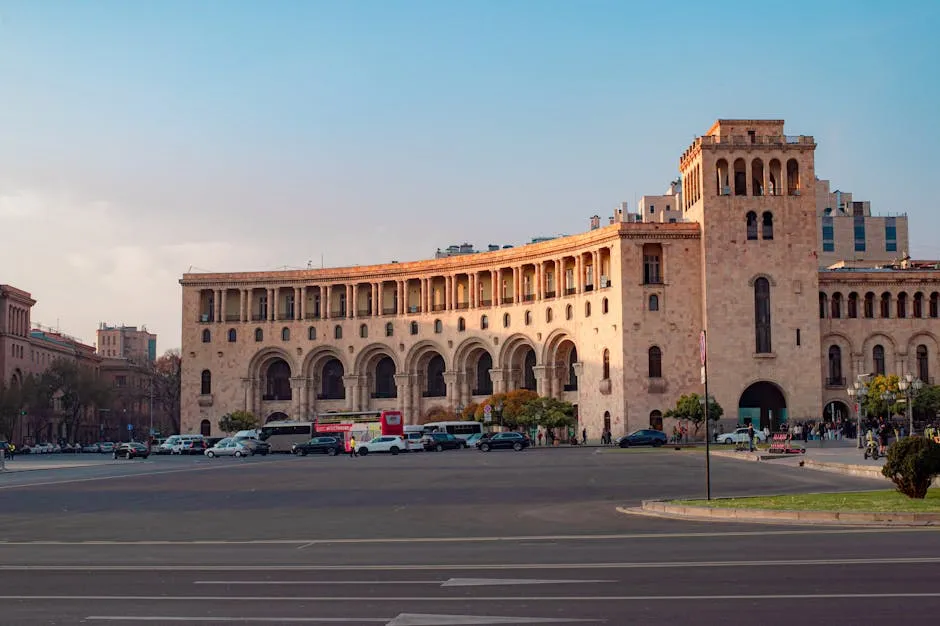
Stand at the centre of Republic Square in Yerevan at 21:00 on a summer evening. The 3.5-hectare oval-and-trapezoidal plaza around you was laid out in 1924 under the master plan of Alexander Tamanian (1878–1936), a Russian-trained Armenian architect who was given the brief, after the 1920 Sovietisation of Armenia, to convert a small provincial Persian-Russian colonial town of approximately 30,000 people into the capital of a socialist republic. The six monumental buildings encircling you — the History Museum and National Gallery on the eastern side, the Government House to the north, the former Trade Unions building, the Marriott Armenia (formerly the Hotel Armenia, built 1958), the Ministry of Foreign Affairs and the Ministry of Energy — are clad in pink and yellow tufa stone, a porous volcanic rock quarried from local Armenian deposits that gives Yerevan its working warm colour register. Tamanian designed them between 1924 and 1936 (he died before seeing the finished square); construction continued under his successors into the 1950s. At twilight in summer the Singing Fountains in the central pool perform a 30-minute light-and-music programme that draws several thousand spectators nightly — locals and tourists in mixed numbers, the working civic gathering of the city.
The honest opening for Yerevan is the same square, because it holds three Yerevans in one stone.
The first Yerevan is ancient. The city was founded — by tradition and by carbon-confirmed inscription — in 782 BC by the Urartian king Argishti I, who built the fortress of Erebuni atop the 65-metre Arin Berd hill on what is now the south-eastern edge of the modern city. Yerevan’s name is etymologically derived from Erebuni. The fortress was the strategic post overlooking the Ararat Plain. From 782 BC onwards Yerevan has been one of the world’s continuously inhabited cities — through Achaemenid Persian rule, Hellenistic kingdoms, Roman protectorate, Arab caliphate, Seljuk and Mongol invasions, the Ottoman-Persian wars over the 16th–18th centuries, Russian conquest in 1827, and the modern republic. In 301 CE — the traditional date, with scholarly alternatives ranging 284 to 325 — the Armenian kingdom under King Trdat (Tiridates III) adopted Christianity as the state religion, becoming the first nation to do so. The patriarch Gregory the Illuminator founded Etchmiadzin Cathedral (20 km west of Yerevan, UNESCO World Heritage since 2000) at the traditional date of 303 CE, where it remains the Mother See of the Armenian Apostolic Church — the working Vatican of Armenia.
The second Yerevan is the Tamanian-Soviet pink-tuff capital. After the 1920 Sovietisation, Tamanian’s master plan reorganised the working town around a radial geometry centred on Republic Square, with Mashtots Avenue (the working north-south spine), the Cascade staircase axis ascending north, and Saryan Street (the working wine-festival street today). The pink and yellow tufa cladding became regulation. The History Museum of Armenia (built 1959 on the square), the Mesrop Mashtots Institute of Ancient Manuscripts (Matenadaran) at the head of Mashtots Avenue (1957–1959, designed by Mark Grigoryan), and the Cascade Complex (idea 1924, construction begun 1971, first phase 1980, halted by the 1988 earthquake + 1991 USSR collapse, completed 2002–2009 through Gerard L. Cafesjian’s $128 million reconstruction) are the working Soviet-Tamanian-period monuments. Most foundational to the city’s modern identity: the Tsitsernakaberd Armenian Genocide Memorial Complex on a hill above the western edge of Yerevan, opened on 29 November 1967, the 44-metre stele and circular eternal-flame pit that commemorate the 1.5 million Armenians who died in the 1915–1923 Armenian Genocide at the hands of the Ottoman Empire. The Armenian Genocide Museum-Institute (AGMI) on the same site opened 1995 on the 80th anniversary. Annual remembrance on 24 April — the anniversary of the 24 April 1915 arrest of 240 Armenian intellectuals in Constantinople that marks the working start of the genocide. In 2026 Armenia marks the 111th anniversary.
The third Yerevan is independent and unresolved. Armenia declared independence on 21 September 1991 following the December 1988 Spitak earthquake (25,000 dead, 130 km north of Yerevan; the international relief response was itself a working moment in late-Soviet history) and the eight months of refusal to accept Soviet authority. The First Nagorno-Karabakh War (1988–1994) ended in Armenian control of Nagorno-Karabakh + seven adjacent Azerbaijani districts. The Velvet Revolution of April–May 2018 — led by parliamentarian-journalist Nikol Pashinyan, with mass non-violent demonstrations under the #MerzhirSerzhin (“Reject Serzh”) hashtag — toppled the ruling Republican Party and brought Pashinyan to power as Prime Minister on 8 May 2018 (59–42 parliamentary vote). The Second Nagorno-Karabakh War of 27 September – 10 November 2020 ended with Armenia ceding substantial territory back to Azerbaijan after 44 days of fighting and approximately 3,800 Armenian military deaths. On 19–20 September 2023, Azerbaijan launched a one-day military offensive that ended with the surrender and dissolution of the self-declared Republic of Artsakh. Beginning 24 September 2023, 100,400 ethnic Armenians — 99 % of the remaining population of Nagorno-Karabakh — fled the territory through the Lachin Corridor, arriving in Armenia via the Kornidzor border post. The Republic of Artsakh formally dissolved on 1 January 2024. Approximately half of the refugees settled in Yerevan; another 30 % settled in the surrounding region. PM Pashinyan has characterised the events as ethnic cleansing; Azerbaijan rejects that characterisation. The exodus is the working most recent chapter of the city’s modern history.
And then there is the mountain. Mount Ararat (5,137 metres) is visible from Yerevan on clear days, the working visual anchor on every postcard, the symbol on the flag of the First Republic of Armenia (1918–1920), the imagery in the Armenian Genocide Memorial, the name of the brandy company. It is in Turkey — has been since the 1921 Treaty of Kars and 1921 Treaty of Moscow under which Soviet Russia ceded the Ararat region to the new Turkish Republic. The closest a Yerevan resident gets to Ararat is the working view from the city, or from Khor Virap Monastery 40 km south where the mountain dominates the southern horizon. The unresolved geography of the mountain is the working unresolved geography of Armenia.
These three Yerevans coexist within a city of approximately 1.1 million people, arranged around Tamanian’s pink-tuff geometry. The Tsitsernakaberd memorial is 25 minutes on foot west of Republic Square; the Cascade ascends to the north; Mashtots Avenue runs through the centre; the Mother Armenia statue (1967, replacing a Stalin statue removed 1962) looks out over the working city from Victory Park to the east. An honest version of Yerevan takes the layering seriously — including the parts that are heavier than the brandy-and-cascade tourism brochure tells you, and including the parts (the Karabakh refugees in the working coffee shops; the closed Turkey border 35 km west; the Russia question; the EU question) that visitors will encounter at street level if they pay attention.
The pages that follow take Yerevan piece by piece. The brandy is excellent. So is the lavash. The history is heavier than either.
Why Yerevan now
Armenia operates visa-free entry for 180 days for EU, UK, US, Canadian, Australian, New Zealand, Japanese, and Korean passports (and 113 other nationalities). No e-visa is required for these passports; just show up at EVN with a valid passport. The 180-day allowance is unusually generous — most comparable European destinations limit to 90 days within 180. For non-exempt nationalities, an e-visa at evisa.mfa.am is AMD 3,000 (~$8 USD) for a 21-day single entry or AMD 15,000 (~$38) for 120-day single entry. Standard processing 3 business days; allow 10–14 days in peak periods.
Yerevan is one of Europe’s most-underrated capital cities for Western visitors. The Caucasus circuit (Yerevan + Tbilisi + Baku) has been increasingly written up by European travel media since 2018; the working result is that Yerevan now sees substantial Western tourist arrivals between May and October. The city is materially cheaper than Tbilisi (approximately 15–25 % cheaper) and substantially cheaper than EU capitals. Working anchors that justify the visit: the deepest Christian heritage in the world (since 301 CE), one of the world’s oldest continuously inhabited cities (Erebuni 782 BC), the Armenian Genocide Memorial as a serious history-tourism anchor, the Cafesjian Center for the Arts (modern sculpture inside the Cascade), the world’s oldest known winery (Areni-1 cave, 6,100 years old, day-trip-accessible at Vayots Dzor Province 110 km south), and the working Armenian cuisine (lavash bread — UNESCO Intangible Cultural Heritage 2014; dolma — UNESCO 2017 with Azerbaijan, Iran, Turkey).
The 2026 specifics worth noting: Yerevan Wine Days at the 10th-anniversary edition runs 5–7 June 2026 (Friday-Saturday-Sunday) on the working Saryan-Tumanyan-Moskovyan street intersection, daily 16:00–22:30, with approximately 100 wineries and 250 partner restaurants; Armenia marks the 111th anniversary of the Armenian Genocide on 24 April 2026 with the working Tsitsernakaberd commemoration; the Republic of Artsakh has been formally dissolved since 1 January 2024, and ~100,000 Karabakh-Armenian refugees are integrated into Armenia’s working economy and society; Armenia has frozen its CSTO membership and is diversifying toward EU and India relations. Michelin does not publish a guide for Armenia as of May 2026 — there are no Michelin-starred restaurants in Yerevan.
Getting there
Zvartnots International Airport (EVN)
EVN sits approximately 12 km west of central Yerevan. Single integrated terminal (the older Soviet-era circular Terminal 1 is closed to passenger traffic; a 2011-opened new terminal handles all flights). Operator: Armenia International Airports under a concession.
Long-haul connections: Direct flights from Moscow (Aeroflot, S7), Paris CDG (Air France), Vienna (Austrian, Wizz Air), Frankfurt (Lufthansa, FlyOne), Athens (Aegean), Rome (ITA Airways), Warsaw (LOT), Doha (Qatar Airways), Dubai (Emirates, flydubai, FlyOne), Sharjah (Air Arabia), Tehran (Mahan Air), Tel Aviv (verify current status given political situation), Beirut (Middle East Airlines), Istanbul (Pegasus, AJet — note Turkey-Armenia direct flights resumed in 2022 after decades of suspension; verify continued operation), Tbilisi (FlyOne, multiple daily). Low-cost European connections via Wizz Air to multiple European bases. The working European visitor typically arrives via one-stop through Vienna, Warsaw, Frankfurt, or Istanbul.
Long-haul from US / Asia: No direct routes as of May 2026; standard one-stop via Frankfurt, Vienna, Paris, Doha, Dubai, or Moscow.
Airport bus: Route 201 (Tashir Pizza / Erebuni Plaza / Republic Square direction) and Route 18 (city centre) operate from outside the airport terminal. AMD 300 (~€0.70). 35–50 minutes to central Yerevan depending on traffic and bus frequency (every 30–60 minutes).
Taxi: Flat-rate prepaid taxi from EVN to central Yerevan is AMD 5,000–7,000 (~€12–17). Working app-based taxis (Yandex Go, GG, Bolt) typically AMD 3,000–5,000 (~€7–12).
Editor’s tip: Yandex Go and GG are the working app-based taxi answers; both have English-language interfaces. Avoid touts outside the terminal who quote in dollars or euros — they routinely charge 3–5× the working AMD rate. Pre-book through the apps before exiting customs.
Bus and shared taxi (regional)
Marshrutka (shared-taxi minibus) connects Yerevan to Tbilisi (~6 hours, AMD 8,000–10,000, multiple daily departures from Kilikia bus station), Tehran (~22 hours, infrequent), Stepanakert (no longer operating since the September 2023 Artsakh dissolution), and rural Armenian destinations.
Train
The Yerevan railway connects to Tbilisi (overnight train, approximately 12 hours, AMD 11,000–25,000 depending on class) and Batumi (Black Sea, summer-only service via Tbilisi). The working train service is operated by South Caucasus Railway. No direct rail to Turkey or Iran.
Border crossings
- Yerevan → Tbilisi by road: 4–5 hours, multiple daily marshrutkas
- Yerevan → Iran (Meghri border): ~10 hours by road, infrequent buses
- Yerevan → Azerbaijan / Turkey: borders closed since the early 1990s; no direct overland crossing as of May 2026
12 attractions worth your time
1. Republic Square (Hraparak)
Address: Republic Square, central Yerevan
Hours: Open 24/7; Singing Fountains May to October 21:00–23:00 (verify current 2026 summer schedule)
Cost: Free
Allow: 1.5 hours (more with the Singing Fountains performance)
The working Tamanian-Soviet centrepiece of Yerevan, laid out in the 1924 master plan and built between the 1920s and 1950s. 3.5 hectares of oval and trapezoidal plaza; six monumental pink-and-yellow tufa-clad buildings around it (History Museum + National Gallery + Government House + Marriott Armenia + Ministry of Foreign Affairs + Ministry of Energy). The central mosaic patterns reference traditional Armenian carpet designs. The Singing Fountains in the central pool perform a 30-minute synchronised water-and-music-and-light programme nightly during the summer season — the working civic anchor of Yerevan summer evenings.
Editor’s tip: Arrive at 20:45 in summer to claim a seat on the History Museum steps before the 21:00 fountain start. The performance attracts thousands; the architectural-acoustic register of Tamanian’s plaza is the working frame. Daytime visits are the working architectural anchor; evening visits are the working civic experience.
Pro Tip: The History Museum of Armenia on the eastern side of the square holds the Erebuni-period archaeology, medieval manuscripts, and the working timeline of Armenian state history; combine with Republic Square in a morning-and-evening pair.
2. Tsitsernakaberd Armenian Genocide Memorial Complex + Museum-Institute (AGMI)
Address: Tsitsernakaberd Hill, west of central Yerevan (3 km from Republic Square)
Hours: Memorial complex 24/7; museum Tuesday-Sunday 10:00–17:00, closed Mondays
Cost: Free (museum); donations appreciated
Allow: 2.5–3 hours including the walk through the museum
The 1967-completed Armenian Genocide Memorial Complex sits on the hilltop above the western edge of Yerevan. The 44-metre concrete stele symbolises the spiritual rebirth of the Armenian nation; alongside it the 12 inward-tilting basalt slabs surround an eternal flame that has burned continuously since the 29 November 1967 opening. The 100-metre memorial wall lists the names of the destroyed Western Armenian provinces. The Armenian Genocide Museum-Institute (AGMI) opened on 24 April 1995 (80th anniversary) — substantial archival displays cover the 1915–1923 events, the 24 April 1915 arrest of 240 Armenian intellectuals in Constantinople (the working starting point of the deportations), the death marches into the Syrian desert, the working survivor testimonies, and the long arc of international genocide recognition. Tours available in Armenian, Russian, English, French, German.
Editor’s tip: Allow at least 90 minutes in the museum. The working visit is heavy and meaningful; it is also the working anchor for understanding Yerevan’s contemporary political and cultural register. The walk from central Yerevan takes 35 minutes uphill through Hayasn Park; consider a taxi (AMD 1,500–2,500) and walk back.
Pro Tip: Visit on 24 April — Armenian Genocide Remembrance Day — if your travel dates align. Hundreds of thousands of Armenians make the working pilgrimage to lay flowers at the eternal flame. The atmosphere is genuinely moving, the working civic register of the year. In 2026 the date is the 111th anniversary.
3. Cascade Complex + Cafesjian Center for the Arts
Address: Tamanyan Street, north of central Yerevan
Hours: Outdoor cascade 24/7; Cafesjian Center exhibitions Tuesday-Sunday 10:00–17:00 (verify current 2026 hours)
Cost: Outdoor cascade free; museum entry AMD 1,500–2,500 (verify current 2026 rate)
Allow: 2–3 hours
The 572-stair, 302-metre, 5-level pink-and-grey limestone cascade ascending the hillside north of central Yerevan, with the Cafesjian Center for the Arts sculpture museum embedded inside. The idea originated in Tamanian’s 1924 master plan to connect the lower city with the working Kanaker hills. Construction began 1971 under architects Jim Torosyan, Aslan Mkhitaryan, and Sargis Gurzadyan; first phase completed 1980; halted by the 1988 Spitak earthquake and the 1991 USSR collapse. American-Armenian philanthropist Gerard L. Cafesjian donated $128 million between 2002 and 2009 to complete the reconstruction; the Cafesjian Center for the Arts museum (modern sculpture, glass, contemporary art) opened November 2009, designed by New York architect David Hotson.
Editor’s tip: Take the working escalators inside the Cascade structure for the ascent, then walk the stair-and-terrace circuits back down. The view from the top covers the working central Yerevan with Mount Ararat on the southern horizon on clear days. The cascade’s outdoor sculptures — including the working Black Cat (Fernando Botero), the Reclining Figure (Lynn Chadwick), the Smoking Woman (Botero) — are the working art-walk of the city.
Pro Tip: Combine the Cascade with Cafesjian Center exhibitions inside the cascade structure (working interior galleries on multiple levels) and with Mother Armenia statue at Victory Park further north (the working Soviet-era 22-metre statue on the next hilltop north).
4. Matenadaran (Mesrop Mashtots Institute of Ancient Manuscripts)
Address: 53 Mesrop Mashtots Avenue, at the northern end of the working avenue
Hours: Tuesday-Saturday 10:00–17:00; Sunday 10:00–16:00; closed Mondays
Cost: AMD 1,500 adult (verify current rate); guided English-language tour AMD 5,000 extra
Allow: 2 hours
The research institute and museum of ancient Armenian manuscripts, founded in 1959 in a working Mark Grigoryan-designed pink-tuff building at the top of Mashtots Avenue. The collection holds approximately 17,000 ancient manuscripts — Armenian language and translation works in religion, philosophy, history, law, medicine, mathematics, music, alchemy — making it one of the largest repositories of medieval manuscripts in the world. The institute is named after Mesrop Mashtots (c. 362–440 CE), the working invention of the Armenian alphabet in 405 CE. The displayed working anchors include the Echmiadzin Gospels (989 CE; one of the earliest illuminated Armenian manuscripts), the Sermons of Mush (one of the largest surviving Armenian manuscripts at 28 kg, traditionally credited to one of the working survival narratives of Armenian manuscripts during the genocide), and a large collection of working translations of classical Greek philosophy preserved in Armenian when the original Greek manuscripts were lost.
Editor’s tip: The English-language guided tour is materially worth the supplement — the working manuscript explanations are dense and require working interpretive context. The exterior pink-tuff building is itself a working Tamanian-period architectural anchor.
5. ARARAT Brandy Factory (Yerevan Brandy Company)
Address: 2 Admiral Isakov Avenue, Yerevan (on the western bank of the Hrazdan River, opposite the Marriott)
Hours: Tuesday-Sunday 11:00–18:00; closed Mondays (verify current 2026 schedule)
Cost: Standard tour and tasting AMD 4,500 (~€10.70); Flavors AMD 7,500; Advanced AMD 10,000
Allow: 1.5–2 hours
The Yerevan Brandy Company was founded in 1887 by Russian-Armenian merchant Nerses Tairyan, who established the working distillery at the foot of the Erebuni hill. The brand became internationally known under Soviet ownership in the 20th century — Winston Churchill is documented as a regular customer of ARARAT brandy from the 1940s onwards (the Yalta Conference 1945 detail; verify the working Stalin-Churchill brandy gift anecdote against the company’s own archival sources). The factory tour includes the working ageing cellars, the working production process, and a tasting flight with three tiers (Three Stars + Ani 7-year-old / Ani 7-year-old + Apricot + Coffee / Akhtamar 10-year-old + Nairi 20-year-old + Vaspurakan 15-year-old). The factory occupies a working hilltop site with views over the working Hrazdan canyon.
Editor’s tip: Book the working Advanced tier if you intend to compare aged brandies; the working middle tier covers the working Armenian brandy register adequately for first-time tasters. The tour is conducted in English daily.
Pro Tip: The NOY Brandy Factory on the eastern bank of the Hrazdan (opposite ARARAT) — formerly the Yerevan Wine Trust, then the Ararat Brandy Trust, working since 1877 — is a working alternative offering competing brandies plus its own historical tour. The two factories on opposite banks of the Hrazdan canyon are the working working-pair of the Yerevan brandy tradition; an enthusiast can do both in one day.
6. Erebuni Fortress + Museum
Address: 38 Erebuni Street, south-eastern edge of Yerevan
Hours: Tuesday-Sunday 10:00–17:00; closed Mondays
Cost: AMD 1,500 adult (verify current rate)
Allow: 2 hours
The 782 BC Urartian fortress that gives Yerevan its name and its working 2,800+ years of continuous habitation. King Argishti I (r. ~785–753 BC) built the fortress on the 65-metre Arin Berd hill. The surviving foundations — palace, temple to Khaldi (the working chief Urartian deity), royal assembly hall, storerooms — are the working visible Urartian architecture in the modern city. The site museum at the base of the hill (built 1968, designed by Shmavon Azatyan) displays the original cuneiform inscription that documents the founding (“The God Khaldi has commanded Argishti, son of Menua, to build this powerful fortress, and to call it Erebuni for the glory of the country of Biainili and the awe of the country’s enemies”), bronze working weapons and ceremonial objects, and reconstructions of the working temple frescoes.
Editor’s tip: Erebuni is the working anchor for understanding Yerevan’s pre-Soviet, pre-Christian history. The hilltop view covers the working southern Yerevan with Mount Ararat on the horizon. Combine with a Persian-era and medieval-era museum visit (the History Museum of Armenia on Republic Square) for the working full pre-modern Armenian timeline.
7. Vernissage Weekend Market
Address: Hanrapetutyan Street, between Khanjyan and Buzand streets, central Yerevan
Hours: Saturday and Sunday 09:00–17:00; smaller midweek operations
Cost: Free entry
Allow: 1.5–2 hours
The working open-air flea market and craft bazaar of central Yerevan — operating since the 1980s with hundreds of working vendors selling Armenian carpets, vintage books and Soviet ephemera, hand-cut khachkar (cross-stone) miniatures, jewelry, dukhabors and traditional musical instruments, bronze and copperware, ARARAT brandy at retail prices, working antique silverware. The market is heavily working — vendors expect bargaining. Prices typically AMD 2,000–25,000 for working anchor items.
Editor’s tip: Saturday is the working busier day; Sunday is calmer. The working carpet vendors are concentrated at the northern end (Khanjyan Street side); the working silver and jewelry vendors at the centre; the working books and ephemera at the southern end (Buzand Street side). Bargaining is expected — the working starting price is typically 30–60 % above the working closing price.
Pro Tip: Customs regulations require export permits for antique carpets older than 50 years and antique silver / icons; for the working modern reproductions, no permit is needed. Verify the working customs rule at evnairport.am before purchasing significant items.
8. Saint Gregory the Illuminator Cathedral
Address: 41 Tigran Mets Avenue, central Yerevan
Hours: Daily 09:00–19:00 (services Sunday morning + religious holidays)
Cost: Free
Allow: 45 minutes
The largest cathedral of the Armenian Apostolic Church, opened 23 September 2001 to mark the 1,700th anniversary of Armenian Christianity (301–2001). The cathedral is a working contemporary interpretation of medieval Armenian church architecture; the design by Stepan Kyurkchyan. The interior holds relics of Saint Gregory the Illuminator (the working patron saint of Armenian Christianity, the founder of the Armenian Apostolic Church under King Trdat in 301 CE). The cathedral complex occupies a large plaza in central Yerevan with the cathedral as the working anchor + a smaller chapel and a working education centre.
Editor’s tip: The cathedral is genuinely contemporary architecture (2001) executed in working medieval Armenian register — the working result is contested by traditionalists who consider it pastiche. Visit at the working Sunday morning Liturgy (10:00) for the working musical and ritual experience.
9. Mother Armenia + Victory Park
Address: Azatutyan Avenue, on Haghtanak Park (Victory Park) hill north of central Yerevan
Hours: Park open 24/7; Mother Armenia statue base / Museum of Military History Tuesday-Sunday 10:00–17:00
Cost: Park free; museum AMD 1,500 (verify current rate)
Allow: 1.5 hours including the working park walk
The 22-metre Mother Armenia statue stands atop a 30-metre pedestal on Victory Park hill, the working tallest monument visible from central Yerevan. The current statue was installed in 1967; it replaced a 17-metre Stalin statue that had stood on the same pedestal from 1950 to 1962. The statue depicts a woman holding a sword and shield — the working symbolic guardian of the city. The pedestal base houses the Museum of Military History of Armenia with displays on World War II Armenian soldiers, the Karabakh conflicts, and the working Armenian military tradition. The surrounding Victory Park (named after the World War II Victory) holds Soviet-era memorials, a working amusement park, and the Bagrationi Restaurant with panoramic city views.
Editor’s tip: The walk from central Yerevan up to Victory Park takes 25 minutes via the Cascade; consider taking the Cascade up and walking back down. The view from the statue base is the working panoramic Yerevan with Mount Ararat in the distance.
10. Sergei Parajanov Museum
Address: 15-16 Dzoragyugh Street, western Yerevan (in the Dzoragyugh ethnographic-village area on the Hrazdan canyon western rim)
Hours: Daily 10:30–17:00; closed Mondays
Cost: AMD 1,500 adult (verify current rate)
Allow: 1.5 hours
The working museum of Sergei Parajanov (1924–1990), the Georgian-Armenian-Ukrainian filmmaker behind The Colour of Pomegranates (1969) — widely cited among the most-important films of the 20th century — and Ashik Kerib (1988). Parajanov spent four years in Soviet prisons (1973–1977) on charges that working scholars characterise as politically-motivated; his work was banned across substantial portions of his career. The museum holds Parajanov’s working personal collages, working drawings, costumes, and the working ephemera of his eccentric working personality. The architecture is a working traditional Armenian courtyard house, restored 1991 immediately after his death.
Editor’s tip: The museum is the working most-rewarding small museum in Yerevan. Parajanov’s collages — assembled from Soviet ephemera, magazine cuttings, dried flowers, and broken glass — are the working anchor of the visit and the working bridge to understanding 20th-century Armenian visual culture.
11. History Museum of Armenia
Address: Republic Square (eastern side of the working plaza)
Hours: Tuesday-Sunday 11:00–18:00; closed Mondays
Cost: AMD 2,000 adult; AMD 5,000 with audio guide (verify current rates)
Allow: 2.5–3 hours
The working national history museum on Republic Square, sharing the working pink-tuff building with the National Gallery of Armenia. The collection covers approximately 400,000 working artefacts from Urartian period (Erebuni 8th century BCE) through Hellenistic, Roman, medieval Armenian kingdoms (the Bagratunis 9th–11th centuries, the working Cilician Kingdom 11th–14th centuries), Mongol and Persian and Ottoman periods, the working First Republic of Armenia 1918–1920, and Soviet and post-Soviet Armenia. The working anchor exhibits include the Areni-1 cave artefacts (the world’s oldest known leather shoe at 5,500 years; one of the working preserved working items from the world’s oldest known winery 6,100 years ago), the working bronze working chariots from Lchashen (Urartian period), the Khachkar (cross-stone) gallery, and the working Bagratuni-period architectural fragments.
Editor’s tip: The English-language signage is uneven; the working audio guide is the working answer for non-Armenian / non-Russian visitors. Combine with the National Gallery of Armenia (same building) which holds the working Western and Russian art collection of Armenia.
12. Blue Mosque (Persian Mosque)
Address: 12 Mesrop Mashtots Avenue, central Yerevan
Hours: Daily 10:00–18:00 (closed during prayer times)
Cost: Free
Allow: 45 minutes
The 1766-built Persian-period mosque — the working only operating mosque in Armenia as of May 2026. Built during the working Persian (Khanate of Yerevan) era; reconstructed and reopened in 1996–1998 under Iranian government funding and design. The blue-tiled portico and dome are the working architectural anchor of pre-Russian Yerevan; the working interior includes Iranian-style miharab and dome. The mosque is part of the working diplomatic-cultural relationship between Armenia and Iran (Armenia is the rare working post-Soviet republic to maintain materially friendly relations with Iran).
Editor’s tip: The mosque is the working under-visited heritage anchor — most tourists skip it. The working architectural register is materially distinct from the Armenian Apostolic churches that dominate the rest of the city’s religious architecture. Photography is permitted in the courtyard but not during prayer times.
Neighbourhoods at a glance
Kentron (the central district) — Republic Square + downtown
The working tourist anchor of Yerevan. Republic Square, the History Museum, the National Gallery, Mashtots Avenue (the working north-south spine), the Cascade Complex, the Cafesjian Center for the Arts, Saryan Street (the working wine-festival street), Tumanyan Street (the working restaurant district), the Vernissage market, and the working international-tier hotel cluster are all here. Approximately 3 sq km of working downtown. Walkable end-to-end in 25 minutes.
Northern Avenue (Hyusisayin Poghota)
The working pedestrian-only commercial avenue connecting Republic Square (south) to Cascade Complex (north), 1 km long. Lined with mid-tier and luxury working international shops, restaurants, cafés. The working Yerevan equivalent of Champs-Élysées at a smaller scale; opened in stages 2007–2010.
Cascade District (Tumanyan-Saryan-Moskovyan)
The working bar-and-restaurant strip immediately west of the Cascade complex. Saryan Street is the working wine bar street; Tumanyan Street is the working restaurant street (Lavash, Sherep, several international restaurants); Moskovyan Street is the working coffee street. The working Yerevan Wine Days festival operates here every June.
Arabkir + the Northern Districts
The working Soviet-era residential expansion to the north of Cascade. The working Marriott Armenia (Republic Square) is the working southern hotel anchor; the working Tufenkian Historic Yerevan Hotel is in the working Arabkir area. Approximately 25 minutes by Yandex Go from Republic Square to the working Arabkir tier.
Erebuni District
The working south-eastern district anchored on the Erebuni Fortress + Museum + the working ARARAT Brandy Factory (Erebuni Hill, opposite the Hrazdan canyon). Working residential + light-industrial; the working anchor for the working ancient-and-brandy half-day visit.
Dzoragyugh + the Hrazdan Canyon Western Rim
The working Hrazdan canyon ethnographic district on the western rim, anchored on the Sergei Parajanov Museum + the working Children’s Park + working old Armenian courtyard houses. Materially under-touristed.
Tsaghkadzor + the Mountain Resort (50 km north)
The working ski-and-mountain resort north of Yerevan. The working winter skiing destination (December–March) and the working summer mountain-air destination. 50 km / 1 hour by marshrutka from Yerevan.
Where to stay by budget
The honest sorting: stay in central Kentron for a first visit — Republic Square area, Mashtots Avenue, or Northern Avenue. Yerevan’s compactness means most other neighbourhoods are within 15 minutes by Yandex Go.
Budget (AMD 8,000–25,000 per night / €19–60)
- Envoy Hostel Yerevan (Mashtots Avenue area) — the working backpacker anchor; dorm beds from AMD 5,000, private rooms from AMD 15,000
- Cinque Hostel — central, working modern hostel
- Galaxy Hostel — working budget option
- Airbnb apartments in central Kentron — working from AMD 15,000 (~€36) nightly off-peak
- Budget guest houses (Marlen, Republika, Hostel Yerevan) — verify current operational status
Mid-range (AMD 25,000–60,000 per night / €60–143)
- Tufenkian Historic Yerevan Hotel (8 Hanrapetutyan Street) — the working heritage anchor with Armenian-traditional working interiors; the working mid-range traveller’s first choice
- Imperial Palace Hotel (Karen Demirchyan area) — central, working mid-luxury
- Best Western Plus Congress Hotel — Tsitsernakaberd area, modern
- Multi Grand Hotel — Mashtots Avenue area
- Diamond House Hotel — central Kentron
High-end (AMD 60,000–150,000 per night / €143–357)
- Marriott Armenia Hotel Yerevan (1 Amiryan Street, on Republic Square) — built 1958 as the Hotel Armenia, rebranded under Marriott; the working colonial-era grand-luxury anchor. The largest hotel on Republic Square.
- The Alexander, a Luxury Collection Hotel Yerevan (3-5 Abovyan Street) — 114-room luxury anchor, the working first international luxury hotel in the historic centre of Yerevan. Five restaurants including Gabriel’s Bar & Lounge, Italiano Ristorante (top floor), Tufenkian Kharpert (ground floor Armenian). Approximately 12 km from EVN airport.
- Hyatt Place Yerevan — central, modern business-luxury
- Yerevan Mariotti Hotel — older luxury anchor, central
- The Republica Hotel Yerevan — boutique mid-luxury
Luxury (AMD 150,000+ per night / €357+)
- The Alexander Presidential Suites — the working highest tier of the Marriott Luxury Collection
- Marriott Armenia presidential — Republic Square premium suites
No major new luxury hotel openings have been confirmed in Yerevan for calendar-year 2026 (against the IHG, Marriott, Hyatt, Accor opening calendars as of May 2026); verify against operator pages before booking.
Editor’s tip: The Marriott Armenia (1958-built, on Republic Square) is the working colonial-era heritage choice; The Alexander Luxury Collection is the working modern-luxury alternative. The Tufenkian Historic Yerevan Hotel is the working heritage-interior mid-range choice. For first-visit budget travellers, Envoy Hostel is the working hostel anchor.
Where to eat — Armenian, the working oldest cuisine
Armenian cuisine (the working register)
Armenian cuisine is wheat-and-meat-based, with mountain herbs, walnuts, pomegranates, apricots, and Mediterranean-Middle Eastern overlaps. Working flavour anchors: lavash (UNESCO Intangible Cultural Heritage 2014, the working tandoor-baked flatbread that is the staple bread of every Armenian table), khorovats (Armenian BBQ, working summer-and-celebration tradition), dolma (UNESCO 2017 with Azerbaijan, Iran, Turkey — stuffed grape or cabbage leaves), kufta (working ground-meat patties), harissa (the working slow-cooked wheat-and-meat porridge, the working winter staple), basturma (the working dried-cured beef, intensely spiced), gata (the working sweet bread), soujouk (working dried sausage). Working drinks: tan (yoghurt-and-salt-water working refreshment), kvass (Soviet-era fermented bread drink), Armenian wine (the world’s oldest documented winemaking tradition, working 6,100 years), and ARARAT brandy.
Named Armenian restaurants
- Lavash Restaurant (21 Tumanyan Street) — opened 2 April 2017; farm-to-table Armenian cuisine; the working anchor of the modern Armenian-restaurant register. First-floor tandoor with working bread-baking demonstration. AMD 8,000–15,000 per person.
- Sherep Restaurant (1 Amiryan Street, next to Republic Square, in the working Tamanian-designed pink building) — modern Armenian + international, open kitchen, the working contemporary-fine-dining anchor. Has hosted Michelin chefs from multiple countries. AMD 10,000–20,000.
- Dolmama (10 Pushkin Street) — established 1998; the working signature tolma anchor; traditional Eastern Armenian register with creative working twists; the working anchor for visiting diplomats and the working celebrity-traveller circuit. AMD 12,000–25,000.
- Tavern Yerevan / Tun Armani — multiple branches; the working rustic-traditional Armenian register with live folk music and Armenian-courtyard interior. AMD 6,000–12,000.
- Old Yerevan Tavern — historical-Armenian-meal register, central; the working tourist-anchor traditional restaurant.
- Caucasus Tavern (the working multi-branch chain) — pan-Caucasus (Armenian + Georgian + Azerbaijani) menu, the working comparative-cuisine register. AMD 5,000–10,000.
Bread and snacks
- Lavash at any neighbourhood bakery — AMD 200–500 per sheet
- Gata sweet bread — AMD 500–1,500 per piece
- Basturma sandwich — AMD 1,500–3,500 at central street vendors
- Khachapuri (Georgian cheese-bread, widely available in Yerevan) — AMD 2,000–4,500
Street food and quick meals
- Anteb Restaurant (Mashtots Avenue) — the working anchor Armenian-Lebanese street-food restaurant
- GUM Market (central, west of Republic Square) — the working covered food market with hot-cooked dolma, harissa, working spice and dried-fruit anchors. The working anchor for genuine Yerevan working food culture (open-air vendors, working bargaining, working sample-tasting).
- Pizza chains (Pizza Mia + Tashir Pizza) — working modern fast-food
Vegan and international
- GreenBean Café — multiple branches; the working vegan and vegetarian anchor
- Ravo — central, vegan
- Khachapuri & Wine — Georgian working restaurant in central Yerevan
Coffee culture
Yerevan has an active café culture inherited from the working Soviet period and updated since 2018.
- Coffeshop chain (multiple central branches) — the working modern Armenian chain
- Calumet Ethnic Lounge Bar — the working alternative-coffee anchor
- Achajour (working independent coffee, central)
- Lumen Café (working contemporary coffee, central)
Drinking — brandy, wine, the working Armenian register
Brandy (the working signature)
Armenian brandy is the working signature spirit. ARARAT (Yerevan Brandy Company, founded 1887) is the working flagship brand; NOY (Yerevan Wine Trust, founded 1877) is the working competitor on the opposite bank of the Hrazdan canyon. Working tasting tiers:
- ARARAT Three Stars (3-year-old, the working young brandy) — AMD 6,000–12,000 per bottle in shops
- ARARAT Ani (7-year-old) — AMD 12,000–20,000
- ARARAT Akhtamar (10-year-old) — AMD 18,000–30,000
- ARARAT Vaspurakan (15-year-old, working premium) — AMD 28,000–45,000
- ARARAT Nairi (20-year-old, working ultra-premium) — AMD 50,000–80,000
- ARARAT Erebuni (older premiums, occasional limited release) — AMD 70,000–150,000
Working tasting at the ARARAT factory: AMD 4,500 standard / 7,500 flavours / 10,000 advanced tier (see attraction #5).
Wine (the working oldest)
Areni-1 cave winery in Vayots Dzor Province, 110 km south of Yerevan, holds the world’s oldest known wine-production facility (6,100 years old). Modern Armenian wine production has been substantially revived since 2010, with working anchors at:
- Areni Wine Festival at the Areni village, held every October (verify 2026 date)
- Karas Wines — large modern producer
- Voskeni Wines — working anchor
- Trinity Canyon Vineyards — central
- ArmAs Estate — Vayots Dzor working
- Yerevan Wine Days (5–7 June 2026, 10th anniversary) — the working festival on Saryan-Tumanyan-Moskovyan street intersection, 16:00–22:30 daily, ~100 wineries + 250 partners. Free entry, AMD 4,500–9,000 for the working tasting glass.
Beer
Armenian beer is modest. Kotayk (the working lager) and Kilikia (the working competitor) are widely available; AMD 500–1,200 per bottle. The working independent craft-beer scene is small but growing.
Coffee and tea
Armenian coffee (the working Turkish/Greek-style finely-ground coffee with cardamom) is the working coffee culture; the working modern espresso scene has developed since 2015.
Bars and nightlife
- Calumet Ethnic Lounge Bar (central, working multi-room cocktail bar)
- Saryan Street wine bars — multiple working anchors operating year-round
- In Vino Wine Bar — the working anchor wine bar with Armenian + European wine list
- Bourbon Street — central, working bar
- Mojito Yerevan — central, working cocktail bar with rooftop in summer
Getting around
Metro (Yerevan Metro)
A single-line metro runs north-south through central Yerevan with 10 stations from Charbakh (south) to Barekamutyun (north). Fare AMD 100 per ride (~€0.24). Operating 06:30–23:00 daily. The working anchor stations for visitors: Republic Square, Yeritasardakan (close to Cascade), Marshal Baghramyan (close to Marriott Armenia), and Sasuntsi David (close to railway station).
Marshrutka (shared minibus)
Working dense network across the city — AMD 100 (~€0.24) per ride flat fare. The working Yerevan transit anchor; the working route-numbers are posted in Armenian and Russian on the vehicle windscreens. English-language interface limited.
Yandex Go, GG, Bolt (app-based taxi)
All three work in Yerevan with English-language interfaces. Working short downtown rides AMD 800–2,500; EVN-to-downtown AMD 3,000–5,000; cross-city AMD 1,500–3,500. The working answer for most visitor transit.
Walking
Central Kentron is deeply walkable — Republic Square to Cascade is 25 minutes on foot via Northern Avenue. The pink-tuff architecture rewards working walking. Working summer evenings are the working walking register.
Bicycle
Limited bicycle infrastructure as of May 2026. The working answer is occasional rental via Yerevan City Bike (verify current operator status); not recommended for cross-city transit due to working road conditions.
What does not work
- Self-drive car — Yerevan traffic and working road conditions are not friendly to foreign drivers; the working alternative is to hire a car with driver via Yandex Go or to book a working private-driver day trip
- Long-distance bus for visitors — train or hired car is the working answer for Tbilisi or rural Armenian destinations
When to visit
Best months: May, June, September, October. Mild temperatures (15–28°C daytime), low precipitation, working clear skies, the working tourist-season anchors (Yerevan Wine Days 5–7 June 2026; the working Tsitsernakaberd commemoration 24 April annually).
Avoid (peak heat): July, August. Daytime highs 33–38°C with occasional 40°C+ peaks. The working summer is materially uncomfortable for sustained outdoor walking and tourism. Hotel rates do not materially drop in summer (visitors continue to arrive); the working approach is to schedule outdoor sightseeing for early morning + late evening.
Avoid (deep winter): December, January, February. Cold (-7°C average lows; occasional sub -15°C), snow, working road-closure risk on day trips. The working winter advantage is the ski resort at Tsaghkadzor; the working winter disadvantage is the cold-and-grey Yerevan urban experience.
Shoulder months: March, April, November. Working warming or cooling, working low tourist density, working bargain hotel rates. March is also the working pre-Genocide-anniversary atmosphere; November is the working post-foliage cold-and-clear register.
Festivals worth planning around
- Armenian Genocide Remembrance Day — 24 April 2026 (111th anniversary). The working national civic-mourning day; Tsitsernakaberd is the anchor; many businesses close.
- Yerevan Wine Days 2026 — 5–7 June 2026 (10th anniversary edition). The working summer-festival anchor on Saryan-Tumanyan-Moskovyan streets. ~100 wineries, daily 16:00–22:30, free entry, AMD 4,500–9,000 working tasting glass.
- Yerevan Beer Fest — early August (verify 2026 dates)
- Areni Wine Festival — early October at Areni village (verify 2026 specific date)
- Sharakan (Medieval Music) Festival — June, multiple working venues
- Yerevan International Film Festival (Golden Apricot) — July, the working anchor film festival of the South Caucasus
- Independence Day — 21 September annually
- Republic of Artsakh Day of Remembrance — increasingly observed since the 2023 dissolution; verify the working 2026 date
Month-by-month weather
| Month | Avg low | Avg high | Notes |
|---|---|---|---|
| January | -7°C | 3°C | Deep winter — cold, snow |
| February | -5°C | 6°C | Late winter; cold continuing |
| March | 1°C | 12°C | Working warming — shoulder |
| April | 6°C | 19°C | Best — mild, dry; Genocide anniversary 24 April |
| May | 12°C | 25°C | Best — pleasant, dry; spring |
| June | 16°C | 30°C | Best — Yerevan Wine Days 5-7 June |
| July | 19°C | 33°C | Peak heat — avoid outdoor midday |
| August | 19°C | 33°C | Peak heat continues |
| September | 15°C | 28°C | Best — clearing, cooling |
| October | 9°C | 21°C | Best — autumn anchor |
| November | 3°C | 12°C | Working cooling — shoulder |
| December | -3°C | 5°C | Winter onset; snow |
Annual precipitation ~325 mm (concentrated April–June). The working summer is the working dry-hot register; the working winter is the working cold-snow register. Yerevan’s climate is materially continental — large day-night and summer-winter swings.
Daily budget breakdown
Backpacker — AMD 8,000–18,000 per person per day (€19–43)
- Envoy Hostel dorm bed AMD 5,000
- Three meals (street food + lavash sandwich + AMD 2,500 dinner) AMD 4,000–6,000
- Metro + marshrutka AMD 300–500
- One paid attraction (Matenadaran AMD 1,500 or Erebuni AMD 1,500) AMD 0–1,500
Mid-range — AMD 25,000–55,000 per person per day (€60–131)
- Tufenkian Historic single AMD 25,000–40,000
- Three meals (café breakfast + restaurant lunch + Sherep / Lavash dinner) AMD 8,000–15,000
- Yandex Go + metro AMD 1,500–3,000
- Two to three paid attractions (Matenadaran + Cafesjian + ARARAT factory tour) AMD 5,000–10,000
- One Saryan Street wine bar evening AMD 3,000–6,000
Luxury — AMD 80,000–200,000+ per person per day (€190–476+)
- Alexander Luxury Collection or Marriott Armenia AMD 80,000–180,000
- Three meals including one Dolmama or Sherep dinner AMD 15,000–35,000
- Private driver / guide AMD 25,000–60,000 per day
- Multiple attractions + Garni/Geghard/Khor Virap day trip
The defining single-day-trip outlay: Garni + Geghard + Khor Virap combined day trip (private taxi with driver, ~9 hours) approximately AMD 25,000–40,000 (~€60–95) for the working full-day vehicle. Areni / Noravank day trip (further south, full day) approximately AMD 35,000–55,000. Lake Sevan day trip approximately AMD 18,000–30,000.
Sample itineraries
Two days — the working compressed visit
Day 1: Central Kentron
– 09:30 — Republic Square + History Museum of Armenia
– 12:30 — Lunch at Lavash Restaurant (Tumanyan Street)
– 14:30 — Matenadaran (manuscript museum)
– 17:00 — Walk down Northern Avenue
– 19:00 — Cascade Complex + Cafesjian Center
– 21:00 — Singing Fountains at Republic Square (May–October)
Day 2: History + Genocide + Brandy
– 09:30 — Tsitsernakaberd Armenian Genocide Memorial + Museum (allow 2.5 hours)
– 13:30 — Lunch in central Kentron
– 15:00 — ARARAT Brandy Factory tour (book ahead)
– 17:30 — Vernissage Market (if Saturday or Sunday) OR Saint Gregory the Illuminator Cathedral
– 19:30 — Dinner at Sherep Restaurant
Three days — the right basic visit
Day 1: Central Kentron as Day 1 above
Day 2: History + Genocide + Brandy as Day 2 above
Day 3: Garni + Geghard + Khor Virap day trip (9 hours; private taxi or organised tour)
Four to five days — including Areni / Noravank + Lake Sevan
Add Areni-1 cave + Noravank Monastery (full day) and Lake Sevan + Sevanavank Monastery (full day) as separate excursions.
Six to seven days — Yerevan + Tatev + Dilijan
Add Tatev Monastery (full overnight to the south, 240 km from Yerevan, requires the working Wings of Tatev cable car) and Dilijan (mountain town in the working forested north, 100 km from Yerevan) as 2–3 day extensions.
Ten days — Caucasus circuit
Add Tbilisi, Georgia (4–5 hours by marshrutka or overnight train) for 3 days, with Yerevan as the southern anchor.
Best Day Under €15
Total: AMD 6,000 (€14.29) — verified against May 2026 exchange rates.
- Breakfast: lavash + cheese + tomatoes + coffee at a Mashtots Avenue café — AMD 1,200
- Republic Square + History Museum interior walk-around (no museum entry; free exterior) — AMD 0
- Mid-morning Armenian coffee + gata at GUM Market — AMD 800
- Walk Mashtots Avenue to Matenadaran (free; visit exterior only for the working architectural anchor) — AMD 0
- Lunch: GUM Market dolma + lavash + tan — AMD 1,500
- Walk to Cascade Complex; ascend via outdoor stairs (free); visit Cafesjian outdoor sculptures (free) — AMD 0
- Mid-afternoon coffee at a Saryan Street café — AMD 800
- Walk to Tsitsernakaberd Genocide Memorial (free entry; the working civic anchor) — AMD 0
- Walk back via Hayasn Park — Yandex Go back to centre — AMD 1,000
- Dinner: Caucasus Tavern Armenian dishes + lavash + beer — AMD 700
If you add a paid attraction (Matenadaran AMD 1,500 or ARARAT factory tour AMD 4,500), the working day rises to €17.86 or €25 respectively. For the working Tsitsernakaberd-and-Cascade-anchored free-attraction day, the working under-€15 day is genuinely achievable.
On the budget leaderboard: Cairo $3.50 · Bogotá $6 · Kuala Lumpur €8.50 · Ahmedabad €11.79 · Kolkata €11.95 · Munich €12 · San Salvador €13 · Yerevan €14.29 · Bangalore €15 · Chongqing €20.85 · Tbilisi/Chengdu/Shenzhen/Xi’an €25 · Fiji €29 · Washington €30 · Nicosia €32.60 · Halifax €35.85 · Sicily/Corsica €35–40 · Maldives $50.
Yerevan is one of Europe’s cheapest capital cities — materially cheaper than Tbilisi and substantially cheaper than EU capitals. The under-€15 working day is achievable; the under-€10 day is also achievable if you skip the wine-bar evening and rely on GUM Market street food.
Hot, snowy, and off-season plans
The 38°C summer day (July–August)
Skip outdoor attractions between 12:00 and 17:00. The working summer day:
– Early morning (07:00–11:00) — Republic Square + History Museum exterior; Cascade ascent before heat
– Midday (12:00–17:00) — History Museum interior + Matenadaran (air-conditioned); ARARAT Brandy Factory ageing cellars (cool); air-conditioned café working escape; hotel pool
– Evening (17:30 onwards) — Saryan Street wine bars + Sherep dinner + Singing Fountains 21:00
The deep-winter day (December–February)
Indoor anchors prioritised: History Museum, Matenadaran, Cafesjian Center, AGMI Museum at Tsitsernakaberd, working Soviet-era cafés. Day trips reduced — Garni + Geghard can be done in winter with snow chains; Lake Sevan is dramatic in winter; Tatev cable car operational year-round.
The 24 April Genocide Remembrance window
The week of 24 April carries the working specific civic register. Tsitsernakaberd is filled with mourners laying flowers throughout the day. The working commercial activity in central Yerevan substantially reduces on 24 April. Most museums remain open; some restaurants close. The working visitor approach: visit Tsitsernakaberd on 24 April for the working civic experience; do not schedule the brandy factory tour or the Singing Fountains on the working anniversary itself.
The post-2023 refugee context
Roughly 100,000 Armenian refugees from Nagorno-Karabakh settled in Armenia after September 2023 (approximately half in Yerevan). Visitors to Yerevan in 2026 will encounter visible signs of the working refugee integration — Karabakh-region working accents in restaurants and shops, occasional working protests at parliament, working refugee-aid organisations. The working visitor approach: aware engagement rather than performed concern. Working aid organisations (Hope and Help, Areguni Foundation; verify current operational status) accept working visitor donations and offer working interpretive tours of refugee-housing areas.
Day trips
Garni Temple + Geghard Monastery (UNESCO 2000)
Distance: Garni 26 km / 30 min from Yerevan; Geghard additional 8 km / 10 min from Garni
Cost: Garni AMD 1,500 entry, Geghard free; private taxi from Yerevan AMD 25,000–35,000 for the full Garni-Geghard pair; organised tour AMD 15,000–30,000 per person
Allow: Full day (6–9 hours including travel and lunch)
Garni Temple is the only Hellenistic-Roman temple in Armenia — built circa 1st century CE during the working Roman-Parthian rule of Armenia; rebuilt 1969–1975 after the working 17th century earthquake collapse. The pagan-period temple sits on a cliff edge above the working Azat River Gorge. Geghard Monastery (“Monastery of the Spear” — by tradition the working location where the spear that pierced Christ’s side was kept) is partly cut into the working solid rock face — the working 12th–13th century rock-cut chapels and ritual spaces. UNESCO World Heritage Site since 2000 (Monastery of Geghard and the Upper Azat Valley).
Editor’s tip: The Garni-Geghard pair is the working anchor day trip from Yerevan. Most organised tours combine these two with Khor Virap Monastery (1.5 hours south of Yerevan, the working closest viewpoint to Mount Ararat across the Turkey border) for a working 9-hour day-trip. The marshrutka to Garni costs AMD 500 (~€1.20) one way; the working budget day-trip is to combine marshrutka + walking.
Pro Tip: Garni Symphony of Stones (the working basalt-column gorge below Garni Temple) is a working 30-minute walk from the temple — the working geological anchor. Combine with Garni Temple in the same morning.
Khor Virap Monastery + Mount Ararat View
Distance: 40 km south of Yerevan
Cost: Free entry; combined day-trip with Garni/Geghard AMD 25,000–40,000 private taxi
Allow: Half-day; combine with Garni-Geghard for full day
Khor Virap (“Deep Pit”) is the working 17th-century monastery built atop the pit where Saint Gregory the Illuminator was traditionally imprisoned for 13 years by King Trdat III before the working 301 CE conversion of Armenia to Christianity. The monastery sits 6 km from the Turkey border at the foot of Mount Ararat — the working closest viewpoint to Ararat from Armenia. The mountain’s iconic twin peaks dominate the working southern horizon.
Editor’s tip: Visit on a working clear morning for the Mount Ararat view — afternoons routinely produce haze. The pit (Khor Virap proper) is accessible via a working ladder descent; the working religious site is meaningful for working pilgrims and visitors alike.
Etchmiadzin Cathedral (UNESCO 2000)
Distance: 20 km west of Yerevan
Cost: Free
Allow: 3–4 hours
The Mother See of Holy Etchmiadzin — the working Vatican of the Armenian Apostolic Church. The cathedral was built 301–303 CE (traditional date) by Saint Gregory the Illuminator immediately after the working 301 conversion, making it one of the earliest Christian cathedrals in the world. The current building reflects working 5th–10th century reconstructions. UNESCO World Heritage Site since 2000 (Cathedral and Churches of Echmiatsin and the Archaeological Site of Zvartnots).
Editor’s tip: Combine with Zvartnots Cathedral ruins (13 km from Yerevan, working 7th-century circular cathedral ruins, also UNESCO 2000) — the working pair forms the working “first Christian-state architecture” day-trip half-day. The working visit is significant for working Christian heritage tourists.
Lake Sevan + Sevanavank Monastery
Distance: 70 km / 1 hour from Yerevan
Cost: Free
Allow: Full day
Lake Sevan is the working largest freshwater lake in the Caucasus (1,242 sq km, elevation 1,900 metres) — the working summer-swimming and weekend-getaway anchor for Yerevan residents. Sevanavank Monastery is the working 9th-century monastery on a working peninsula on the lake’s western shore. Working summer working temperature is 22–26°C (materially cooler than Yerevan’s working summer); the working winter sees the lake partially frozen.
Editor’s tip: Visit in May–September for the working beach experience; visit Sevanavank year-round for the working architectural anchor.
Areni-1 Cave Winery + Noravank Monastery
Distance: 110 km south of Yerevan (Vayots Dzor Province)
Cost: Areni-1 cave AMD 1,500; Noravank free; private taxi day trip AMD 40,000–60,000
Allow: Full day (10–11 hours)
Areni-1 cave is the working world’s oldest known winery — 6,100-year-old wine-production facility discovered in 2007. Noravank Monastery is the working 13th-century monastery in the working red-cliff Amaghu Gorge — among the working most-photographed Armenian monasteries. The working Areni village hosts the annual Areni Wine Festival in early October.
Tatev Monastery + Wings of Tatev Cable Car
Distance: 240 km south of Yerevan
Cost: Tatev free; Wings of Tatev cable car AMD 7,000 (one of the world’s longest reversible aerial cable cars per the Guinness World Records — 5.7 km)
Allow: Full day from Yerevan minimum; better as an overnight
The working 9th-century Tatev Monastery sits on a working basalt plateau above the working Vorotan River gorge in southern Armenia (Syunik Province). The Wings of Tatev cable car (opened 2010) crosses the gorge at 320 metres above the river — the working longest reversible aerial cable car in the world per the Guinness World Records (5.7 km). The monastery hosted the working medieval Tatev University (working 14th-century centre of Armenian learning).
Safety and practical concerns
Crime
Yerevan is generally safe for foreign visitors — the working violent-crime rate is materially low. Petty crime concentrated at the working tourist clusters (Republic Square evening Singing Fountains crowds, Vernissage market, working bus and metro stations). The working Armenian security apparatus is moderate; the working Yandex Go and Bolt app-based taxis are the working safe-transit answer at night.
Political context — the working post-2023 register
Armenia is at peace but in a working strategic-realignment phase. Working CSTO membership frozen 2024; working relations with Russia substantially cooled; working diversification toward EU + India + France + US. The working 2026 visitor will encounter visible signs of the post-2023 Karabakh refugee integration but no working active conflict in Armenia proper. The closed Turkey and Azerbaijan borders remain working closed; the working Iran and Georgia borders remain working open.
Weather hazards
- Winter cold and snow (December–February) — Yerevan winters reach -15°C+; day trips to Garni/Geghard require working winter tyres or chains
- Summer heat (July–August) — 33–38°C with occasional 40°C+ peaks; the working heat is materially uncomfortable for outdoor walking
- Earthquakes — Armenia is in a working seismic zone (the working 1988 Spitak earthquake killed 25,000 people 130 km north of Yerevan); the working seismic activity remains; major earthquakes are infrequent but not impossible
Border-area considerations
The working closed Turkey border (Aragats / Margara crossings) and the working closed Azerbaijan border (no operational crossings) are not accessible to working tourists. The working Iran border at Meghri (south) is working open for visitors with the working Iran visa; the working Georgia border at Bagratashen / Sadakhlo (north) is the working active visitor crossing.
Cell coverage and connectivity
Strong 4G/5G across central Yerevan and the working tourist day-trip destinations. Visitors can buy an Armenian SIM (UCom, Beeline, Viva-MTS) at EVN airport with the working passport registration; working data plans approximately AMD 3,000–8,000 per month with 5–20 GB. WhatsApp, Telegram, Google Maps, Yandex Go, Bolt all working normally — Armenia is not behind any firewall.
Cashless
Card payments accepted at most working tourist-tier establishments; the working independent restaurants, marshrutkas, and street vendors are cash-only. ATMs widely available; working withdrawal limits typically AMD 200,000–400,000 per transaction. The working Armenian dram is the working sole accepted currency outside diplomatic-banking working circles.
Language
Armenian (Eastern Armenian with the working Mesrop Mashtots alphabet from 405 CE) is the working dominant language; Russian is universally understood by working older generations (Soviet-era education); English is working dominant in the working tourist-tier service economy. The working older taxi drivers and street vendors may not speak English — Yandex Go’s English interface is the working answer.
Tipping
10 % at restaurants is the working standard if no service charge is included; the working service charge is increasingly common at the working international-tier restaurants. Round-up at taxis (Yandex Go and Bolt prefer the working app-based round-up). Hotel porters AMD 500–1,500 per bag. The working Armenian tipping standard is materially lower than the Canadian or US standards.
Health
The working medical care in Yerevan is materially good at the working international-tier private hospitals (Erebuni Medical Center, Astghik Medical Center, Nairi Medical Center). The working public-sector care is mixed. Travel insurance is the working essential.
Visa and entry
Visa-free 180 days (for most Western passports)
EU, UK, US, Canadian, Australian, New Zealand, Japanese, Korean, Singaporean passports and 113 countries total enjoy visa-free entry for up to 180 days in any 365-day period. No application required; just show up at EVN with a valid passport (with at least 6 months remaining). The 180-day allowance is materially more generous than the working 90-day standard of most European destinations.
E-visa (for non-exempt nationalities)
Available at evisa.mfa.am (the official Armenian government portal — not third-party sites that charge markups):
- 21-day single-entry: AMD 3,000 (~$8 USD)
- 120-day single-entry: AMD 15,000 (~$38 USD)
- Standard processing 3 business days; allow 10–14 days in peak periods
Required documents: scanned passport biodata page, recent photo, flight tickets, hotel reservation, valid credit card.
Temporary residency permit waiver (1 January – 1 July 2026)
A working temporary visa exemption applies to travellers holding valid residence permits from US, EU Member States, Schengen Area, UAE, Bahrain, Qatar, Saudi Arabia, Kuwait, Oman — they can enter Armenia visa-free for up to 180 days within a one-year period regardless of nationality, provided their residence permit has at least 6 months remaining at entry.
Arrival formalities
Immigration at EVN is efficient. Working passport stamp on arrival; no working entry form. Customs declarations for cash over the working AMD 10,000,000 (~$24,000) equivalent. The working visitor should print the e-visa approval (if applicable); no other documentation required for the visa-free entries.
Hidden Yerevan
GUM Market (the working covered food market)
Address: 31 Movses Khorenatsi Street, central Yerevan
Hours: Daily 09:00–19:00
Cost: Free entry
The working covered food market with dolma, harissa, lavash, basturma, dried fruits, spices, working pickled vegetables, working honey. Materially less tourist-developed than the Vernissage but the working anchor for Yerevan food culture. The vendors expect bargaining; the working sample tastings are routine.
Cafesjian Center Outdoor Sculpture Park (free)
The outdoor sculpture garden surrounding the Cascade holds approximately 30 working sculptures including the Fernando Botero Black Cat, the Lynn Chadwick Reclining Figure, the Botero Smoking Woman, and a working Robert Indiana “LOVE” sculpture. All open-air, all free — the working alternative to the paid Cafesjian Center interior galleries.
The working Aram Khachaturian House-Museum
Address: 3 Zarobyan Street, central Yerevan
Hours: Tuesday-Sunday 11:00–17:00; closed Mondays
Cost: AMD 1,500 (verify current)
The working Aram Khachaturian (1903–1978) house-museum. Khachaturian — the working Armenian-Soviet composer of the Sabre Dance (1942 ballet Gayane) — is among Armenia’s most-internationally-recognised cultural figures. The museum holds his working manuscripts, working personal effects, and the working historical context of his career.
Komitas Pantheon
Address: Arshakuniats Avenue, south-western Yerevan
Hours: Daily 09:00–17:00
Cost: Free
The working national pantheon — the working burial site of Armenia’s most-significant cultural figures including Aram Khachaturian (composer), Sergei Parajanov (filmmaker), Hovhannes Tumanyan (poet), Avetik Isahakyan (poet), and Komitas (1869–1935; the working composer-priest who collected and preserved 4,000+ traditional Armenian folk songs and is credited with re-anchoring Armenian musical identity in the late 19th-early 20th centuries; his post-1915 mental breakdown after witnessing the working Genocide is among the working anchored personal histories of the genocide).
Tsitsernakaberd Park (the Hayasn Park)
The 125-hectare park surrounding the Genocide Memorial — open free at all hours. The working anchor is the memorial complex; the working secondary anchor is the working Memorial Wall of Genocide Recognition with engraved declarations of working international recognition of the Armenian Genocide (Pope Francis 2015 + US Congress 2019 + multiple European parliaments).
Vanadzor + Stepanavan (further north day trip)
Distance: 130 km / 2 hours north of Yerevan
Cost: Free
The working Lori Province towns of Vanadzor and Stepanavan — the working post-1988 earthquake-reconstruction working towns. Vanadzor is Armenia’s third-largest city; Stepanavan is the working forested mountain anchor with the Lori Berd medieval fortress.
Romantic Yerevan
The romantic register here is the working Saryan-Street wine bar evening, the working Cascade-and-Republic-Square twilight, and the working Garni-Geghard day-trip morning.
- Saryan Street wine bars at twilight (the working evening anchor; In Vino is the working wine-list anchor)
- Cascade Complex top terrace at sunset (the working panoramic working with Mount Ararat on the southern horizon)
- Sherep Restaurant in the working Tamanian pink building (the working contemporary fine-dining romantic anchor)
- Dolmama dinner (the working historical-fine-dining anchor)
- Republic Square Singing Fountains at 21:00 in summer (the working civic-public-art evening)
- Garni Temple at dawn (the working pre-tourist working sunrise anchor; private driver required)
- Areni / Noravank in autumn foliage (the working red-cliff October anchor)
With kids
Yerevan is a workable family destination with the working seasonal caveats.
Working family attractions:
– Cascade Complex outdoor sculptures — children love the working art-walk
– Republic Square Singing Fountains — working summer evenings, family-friendly
– Erebuni Fortress hilltop — children with working interest in ancient history (8+)
– History Museum of Armenia — multi-room, the working Areni-1 shoe exhibit fascinates children
– Children’s Park in central Kentron — working playground, working amusement
– Lake Sevan day trip — working summer swimming
– Garni gorge and Symphony of Stones — working geological anchor, child-friendly walking
Less family-friendly:
– Tsitsernakaberd Genocide Memorial — appropriate for children 12+ with context; the working museum content is genuinely heavy
– ARARAT Brandy Factory — adults-only working tour; children can wait in the working café area
– Saryan Street late-night wine bars — adults-only
What’s new in 2026
-
Yerevan Wine Days 10th anniversary edition — 5–7 June 2026 on Saryan-Tumanyan-Moskovyan streets. Approximately 100 wineries, 250 partner restaurants. Daily 16:00–22:30. Free entry, AMD 4,500–9,000 for the working tasting glass.
-
111th anniversary of the Armenian Genocide — 24 April 2026 at Tsitsernakaberd.
-
Temporary residency-permit visa waiver — 1 January to 1 July 2026 for holders of US/EU/Schengen/UAE/Bahrain/Qatar/Saudi/Kuwait/Oman residence permits, regardless of nationality, valid 180 days.
-
Republic of Artsakh formally dissolved 1 January 2024 — the working post-dissolution political-social context applies to the 2026 visit. Approximately half of the ~100,000 Karabakh refugees from September 2023 settled in Yerevan.
-
Michelin Guide Armenia — does NOT publish for Armenia as of May 2026. No Yerevan restaurant holds an official Michelin star. The working fine-dining anchors (Lavash, Sherep, Dolmama, Tavern Yerevan) operate at high standards without official designation.
-
CSTO membership frozen since 2024 — Armenia continues working diplomatic realignment toward EU + India + France + US + Iran working relationships.
-
Direct Turkey-Armenia flights — Pegasus + AJet resumed direct Istanbul-Yerevan flights in 2022 after decades of suspension; verify continued operation in 2026 against current airline schedules.
-
Wings of Tatev cable car continues working operations as one of the world’s longest reversible aerial cable cars per the Guinness World Records.
FAQ
How many days do I need in Yerevan?
Two days is the minimum for the city: Day 1 covering central Kentron (Republic Square + History Museum + Matenadaran + Cascade + Northern Avenue + Singing Fountains) and Day 2 covering history + brandy (Tsitsernakaberd Genocide Memorial + ARARAT Brandy Factory + Vernissage if a weekend). Three days lets you add Garni + Geghard + Khor Virap as a full day trip (the working UNESCO + Mount Ararat view). Four to five days lets you add Areni-1 cave + Noravank Monastery + Lake Sevan. Six to seven days lets you add Tatev Monastery (with Wings of Tatev cable car) and a Tbilisi extension. Yerevan is one of Europe’s most-underrated capital cities; three to four days is the right anchor for a first visit.
Do I need a visa for Yerevan in 2026?
EU citizens, UK, US, Canadian, Australian, NZ, Japanese, Korean passports: NO visa required, visa-free entry for 180 days within any 365-day period (113 visa-exempt countries total). Just show up at EVN with a valid passport (6+ months remaining). For non-exempt nationalities, an e-visa is available at the official portal evisa.mfa.am: AMD 3,000 (~$8 USD) for 21-day single entry; AMD 15,000 (~$38) for 120-day single entry; processing 3 business days. From 1 January to 1 July 2026, a temporary residency-permit waiver allows holders of valid US/EU/Schengen/UAE/Bahrain/Qatar/Saudi/Kuwait/Oman residence permits to enter visa-free regardless of nationality. The 180-day allowance is materially more generous than most European destinations.
Is Yerevan safe to visit in 2026?
Yes. Violent crime is materially low; the working concerns are petty theft at Republic Square evening crowds and the Vernissage market. The working political-historical context: Armenia is at peace following the September 2023 Azerbaijani offensive that dissolved the Republic of Artsakh; ~100,000 Karabakh refugees settled in Armenia (about half in Yerevan). The closed Turkey and Azerbaijan borders are inaccessible to tourists; Iran and Georgia borders remain open. CSTO membership has been frozen since 2024 with Armenia diversifying relations toward EU/India/France/US. The 1988 Spitak earthquake context: Armenia is in a seismic zone but major earthquakes are infrequent. Recreational drug laws are strict; alcohol is freely available.
How much does a Yerevan trip cost?
A backpacker week runs AMD 8,000-18,000 per person per day (€19-43). A mid-range week runs AMD 25,000-55,000 per day (€60-131). A luxury week runs AMD 80,000-200,000+ per day (€190-476+). The currency is the Armenian dram (AMD); May 2026 rate approximately €1 = AMD 420 / $1 = AMD 390. Yerevan is one of Europe’s cheapest capital cities — materially cheaper than Tbilisi and substantially cheaper than EU capitals. The working biggest single-day-trip outlay is the Garni-Geghard-Khor Virap private taxi (AMD 25,000-40,000). The under-€15 working day is achievable; the working ARARAT Brandy Factory tour costs AMD 4,500-10,000 depending on the tasting tier.
What is the best time to visit Yerevan?
May, June, September, October. Mild temperatures (15-28°C), low precipitation, working clear skies. Yerevan Wine Days falls 5-7 June 2026 (10th anniversary, 100 wineries on Saryan-Tumanyan-Moskovyan streets). The Armenian Genocide Remembrance Day on 24 April is the year’s defining civic event at Tsitsernakaberd (in 2026, the 111th anniversary). Avoid July-August (33-38°C peaks, occasional 40°C+) and December-February (-7°C to -15°C, snow). The October post-festival shoulder is materially excellent for foliage at Areni and Noravank.
How do I get from EVN airport to the city?
Multiple working options. Yandex Go or Bolt (app-based taxi): AMD 3,000-5,000 to central Yerevan, 15-25 minutes — the working answer for most travellers. Prepaid taxi from the rank: AMD 5,000-7,000. Airport bus Route 201 or 18: AMD 300 (~€0.70), 35-50 minutes. EVN sits 12 km west of central Yerevan. Avoid touts outside the terminal who quote in dollars or euros — they routinely charge 3-5× the working AMD rate. Pre-book Yandex Go from inside the terminal.
Does Yerevan have any Michelin-starred restaurants?
No. The Michelin Guide does not publish a guide for Armenia as of May 2026 — no restaurant in Yerevan holds an official Michelin star. The working fine-dining anchors operate at high standards without official designation: Lavash (21 Tumanyan Street, opened 2017, farm-to-table Armenian, the working modern Armenian-restaurant anchor); Sherep (next to Republic Square in the working Tamanian-designed pink building, open kitchen, has hosted Michelin chefs from multiple countries); Dolmama (established 1998, the working signature tolma anchor); Tavern Yerevan (the working traditional-with-folk-music register). For a working Michelin-rated experience in the broader region, Tbilisi 5 hours away does not have Michelin coverage either; the closest Michelin coverage is the Quebec edition (released May 2026) which is one transatlantic flight away.
What is the Armenian Genocide and the Tsitsernakaberd Memorial?
The Armenian Genocide was the systematic destruction of approximately 1.5 million Armenians by the Ottoman Empire between 1915 and 1923. The working starting point: on 24 April 1915, Ottoman authorities arrested 240 Armenian intellectuals in Constantinople and deported them east — commemorated annually as Armenian Genocide Remembrance Day. Scholarly estimates of the death toll range from 664,000 to 1.5 million. The Tsitsernakaberd Armenian Genocide Memorial Complex opened on 29 November 1967 on a hill above the western edge of Yerevan: a 44-metre concrete stele and a circular eternal flame surrounded by 12 inward-tilting basalt slabs. The Armenian Genocide Museum-Institute (AGMI) on the same site opened on 24 April 1995 (80th anniversary). In 2026 Armenia marks the 111th anniversary of the events. The memorial is open 24/7, the museum Tuesday-Sunday 10:00-17:00, both free.
When did Armenia become Christian?
Armenia adopted Christianity as its state religion in 301 CE (the traditional date; scholarly alternatives range 284-325), making it the first nation to do so. King Trdat (Tiridates III) was converted by Gregory the Illuminator, who became the first head of the Armenian Apostolic Church. Etchmiadzin Cathedral, founded by Gregory between 301 and 303 CE, remains the Mother See of the Armenian Apostolic Church and is the working spiritual centre of Armenia. UNESCO inscribed Etchmiadzin Cathedral plus the churches of St. Hripsime, St. Gayane, Shoghakat, and the Zvartnots Cathedral ruins on the World Heritage List in 2000. Etchmiadzin is 20 km west of Yerevan, easily accessible as a half-day trip.
What’s the deal with Mount Ararat?
Mount Ararat (5,137 m) is the working visual anchor on every Armenian postcard, the symbol on the Armenian flag from the 1918-1920 First Republic, the imagery on the Armenian Genocide Memorial, and the name of the brandy company. It is in Turkey, has been since the 1921 Treaty of Kars under which Soviet Russia ceded the Ararat region to the new Turkish Republic. Armenians cannot easily visit Ararat (the Turkey-Armenia border has been closed since 1993). The closest a Yerevan visitor gets to Ararat is the view from the city on clear days, or from Khor Virap Monastery 40 km south where the mountain dominates the southern horizon 6 km across the border. The unresolved geography of the mountain is the working unresolved geography of modern Armenia.
Where is the world’s oldest known winery?
The Areni-1 cave winery, discovered in 2007 in the Areni village of Vayots Dzor Province (110 km south of Yerevan), holds the world’s oldest known wine-production facility — a grape press, fermentation jars, and drinking bowl dating to approximately 6,100 years ago. The wine was apparently used for ceremonial purposes, probably for funeral ceremonies, since the cave was also an important cemetery site. The cave is accessible to visitors (AMD 1,500 entry), typically combined with Noravank Monastery as a full-day excursion from Yerevan. Modern Armenian wine production has been substantially revived since 2010; the annual Yerevan Wine Days festival (5-7 June 2026, 10th anniversary edition) showcases approximately 100 wineries on the Saryan-Tumanyan-Moskovyan street intersection.
What happened with Nagorno-Karabakh in 2023?
On 19-20 September 2023, Azerbaijan launched a one-day military offensive that ended with the surrender of the self-declared Republic of Artsakh (Nagorno-Karabakh) and the disbandment of its armed forces. Beginning 24 September 2023, 100,400 ethnic Armenians — 99% of the remaining population of Nagorno-Karabakh — fled the territory through the Lachin Corridor, arriving in Armenia via the Kornidzor border post in Syunik Province. The Republic of Artsakh formally dissolved on 1 January 2024. Approximately half of the refugees settled in Yerevan, with another 30% in the surrounding region. PM Nikol Pashinyan characterised the events as ethnic cleansing; Azerbaijan rejected that characterisation. International aid pledges included Iran (50 tons), UK (£1 million), and EU (€5 million). The 2026 visitor to Yerevan will encounter visible signs of refugee integration but no active conflict in Armenia proper.
Can I do day trips from Yerevan?
Yes. Garni Temple (only Hellenistic-Roman temple in Armenia) + Geghard Monastery (UNESCO 2000) + Khor Virap Monastery (Mount Ararat view) make a combined 9-hour full day from Yerevan (AMD 25,000-40,000 private taxi). Etchmiadzin Cathedral (UNESCO 2000) + Zvartnots Cathedral ruins (UNESCO 2000) are 20 and 13 km west respectively, a working half-day. Lake Sevan (1,242 sq km freshwater lake, 70 km north-east, summer-swimming and Sevanavank Monastery) is a working full day. Areni-1 cave winery (world’s oldest known) + Noravank Monastery (110 km south) is a working 10-hour day trip. Tatev Monastery + Wings of Tatev cable car (240 km south, the world’s longest reversible aerial cable car per the Guinness World Records) requires a working overnight extension.
How does Yerevan combine with other destinations?
By road or air. Tbilisi, Georgia: 4-5 hours by marshrutka or overnight train (the working natural Caucasus circuit pair). Tehran, Iran: ~22 hours by infrequent bus or a flight via Mahan Air. Direct flights from Yerevan to Istanbul (Pegasus, AJet — verify 2026 continuation), Vienna, Paris, Frankfurt, Doha, Dubai, Moscow. The natural pairings: Yerevan + Tbilisi (the working South Caucasus pair, 7-10 days); Yerevan + Iran (the working Persian-Caucasus extension, requires Iranian visa); Yerevan + Tatev + Areni + Etchmiadzin + Garni (the working full-Armenia circuit, 7-10 days). Yerevan is the natural anchor for any Armenian itinerary.
Explore More AiFly Guides
City guides: Tbilisi, Georgia · Yerevan, Armenia · Bangalore, India · Ahmedabad, India · Kolkata, India · Chengdu, China · Shenzhen, China · Xi’an, China · Chongqing, China · Ulaanbaatar, Mongolia · Halifax, Canada · Washington, D.C. · San Salvador, El Salvador
Island guides: Seychelles · Cape Verde · Maldives · Fiji · Crete · Cyprus · Corfu · Mykonos · Naxos · Zakynthos · Rhodes · Santorini · Sicily · Sardinia · Corsica · Malta
🌍 See the bigger picture: our Armenia travel guide covers regions, when to go, and getting around.
Cheapest Flights to Yerevan
We track flight deals to Yerevan from 4 cities worldwide. Here are the best recent fares:
Prices are based on recent deals and may no longer be available. Browse all flight deals