Nepal — Complete Travel Guide 2026
Nepal squeezes the most dramatic landscape on the planet into a country the size of England. Within a few hours’ walk of each other sit subtropical jungle full of rhinos and the highest mountains humans have ever stood on. This is the roof of the world — Everest, the Annapurna amphitheatre, eight eight-thousanders — and it remains, by some distance, the greatest trekking destination on earth. But it’s also a chaotic, soulful, intense place of medieval Durbar Squares, butter-lamp-lit monasteries and a religion that blends Hindu and Buddhist so thoroughly you stop trying to tell them apart. Come for the mountains. Stay for the slowness. And give it more time than you think you need.
Quick Reference
The Himalaya — landlocked between India and Tibet/China, home to eight of the world’s fourteen 8,000-metre peaks, Everest included
Kathmandu Tribhuvan (KTM) — the only real international gateway; Pokhara (PKR) & Bhairahawa/Gautam Buddha (BWA) exist but international service is thin and on-again-off-again; Lukla (LUA), the notorious STOL cliff-strip for Everest treks
Nepalese rupee (NPR) — soft currency; get most of it on arrival, carry cash on the trail
Nepali (official); English is widely spoken in tourism and near-universal among trekking guides
Visa-on-arrival at KTM (or e-visa) for almost everyone — ~$30/15 days, $50/30 days, $125/90 days; bring clean USD cash
Oct–Nov is the prime trekking and clear-mountain season; Mar–Apr is spring and rhododendron season; Jun–Sept is the monsoon (skip the high trails)
Everest, the Annapurnas, the greatest teahouse trekking on earth, medieval temple-cities, and a deeply layered Hindu-Buddhist culture
Kathmandu for culture and logistics; Pokhara for lakeside calm and the Annapurna treks; the trail itself for the actual point of the trip
Editor’s Note — the mountains are the point, and so is the patience
Let’s not be coy about why people come to Nepal: the trekking. It is the world’s number-one trekking destination and that is not marketing — it’s a function of geography no other country can fake. You walk for days through villages that haven’t changed their shape in centuries, sleeping in teahouses, eating dal bhat, climbing toward walls of ice that make you genuinely emotional. Nothing in Patagonia or the Alps or the Rockies operates at this scale or with this hospitality. If you have any appetite for walking, Nepal will be one of the best things you ever do.
But here’s the honest other half. Kathmandu is not pretty in the conventional sense — it’s loud, dusty, snarled with traffic, and the winter air pollution is genuinely bad. The altitude on the big treks is not a backdrop; it is a real and recurring killer, and tourists die of it every year because they rushed. And Nepal runs on its own clock — flights to Lukla and Pokhara cancel for weather, buses crawl over broken roads, power and Wi-Fi come and go. The travellers who have a miserable time here are the ones who treated it like a tight European city-break. The ones who fall in love built in buffer days, slowed down, and let the place set the pace.
⚠️ Build in buffer days — they’re not optional. Domestic flights (especially Lukla and Pokhara) routinely cancel for weather, and a closed Lukla strip has stranded trekkers for days. Never book your international flight home for the day after your trek “ends.” Leave two or three days of slack. People miss intercontinental flights over this constantly.
So the right frame for a Nepal trip is: pick one big experience (a trek), give it room to breathe, and surround it with the culture — the temple-cities of the Kathmandu Valley, the calm of Pokhara, maybe the jungle of Chitwan. Do that and Nepal goes from a bucket-list tick to the trip you measure other trips against.
Should You Go? Who it’s for — and isn’t
Nepal is for trekkers and mountain-lovers above all — anyone who’ll happily walk six hours a day for a week to stand below Everest or Annapurna. It’s for the spiritually curious, drawn to the stupas and gompas and the deep, living religiosity of the place. It’s for the adventurous and the patient — people who can roll with a cancelled flight, a power cut and a twelve-hour bus, and find it part of the texture rather than a disaster. And it’s superb for budget travellers: once you’re past the permits and the flights, daily life here is astonishingly cheap.
It rewards anyone willing to go slow. The travellers who get the most out of Nepal are the ones who don’t try to “do” it — who pick one trek and one valley and sink in, rather than sprinting between three.
Who it’s not for: the luxury-beach crowd (there is no beach — Nepal is landlocked) and anyone wanting glossy resort comfort with the tap always running and the road always smooth. It’s not for the seriously time-poor — a meaningful trek plus acclimatisation plus weather buffer eats a minimum of two weeks, and trying to compress Everest Base Camp into a long weekend is how people get altitude sickness or miss their flight home. And it’s not a place to come if you want guaranteed schedules; the mountains and the weather make the rules here, not the timetable.
💡 No trek? Nepal still works — just calibrate. You don’t have to walk for two weeks. The Kathmandu Valley temple-cities, lakeside Pokhara, a Chitwan jungle safari and a short Poon Hill or Nagarkot day-walk make a rich, gentle 8–10 days with big mountain views and no real altitude. The hardcore trek is the headline, not the only show.
Getting There & Around — KTM, the domestic flights & the long roads
Almost everyone arrives at Kathmandu Tribhuvan International (KTM) — Nepal’s only airport with a serious international network, and a famously chaotic single-runway operation hemmed in by hills. There are no direct long-haul flights from Europe or North America; you connect, and the obvious hubs are the Gulf and India. Qatar Airways (via Doha), Turkish Airlines (via Istanbul), Etihad (Abu Dhabi), flydubai and Emirates-adjacent routings (Dubai), and Air India / IndiGo (Delhi) carry most Western travellers. Add Thai, Malaysia Airlines, China Southern and others from the east. From Europe, the cheapest sweet spots are usually the Gulf carriers in shoulder season; the route is long (two legs, often 14–18 hours of total travel) so a sane layover beats the cheapest punishing connection.
Pokhara International (PKR) and Bhairahawa / Gautam Buddha (BWA) both opened with grand international ambitions and have mostly underdelivered — the China-financed Pokhara airport became a national white-elephant story, sitting nearly empty of scheduled international flights for years (flydubai is launching the first daily Dubai service only in late 2026), and Bhairahawa’s international flights have run irregularly for want of passengers. Treat both as primarily domestic airports for now; don’t build a trip around an international flight into either until you’ve confirmed it’s actually operating.
Domestic flights are how you reach the mountains fast. The two that matter most: Pokhara (a quick hop from Kathmandu, the gateway to the Annapurna treks) and Lukla (the heart-stopping STOL strip that launches the Everest treks). The catch is weather. In peak season Lukla flights often shift to Ramechhap (Manthali) — a grinding 4–5 hour pre-dawn drive from Kathmandu — to ease congestion, and both Lukla and Pokhara legs cancel routinely when the cloud comes in. A Lukla round-trip runs roughly €185–240; a Kathmandu–Pokhara hop around €60–110.
By road, Nepal is slow and beautiful and exhausting. The highways are narrow, winding and often rough; a journey that looks like 200 km can take eight to twelve hours. Tourist buses (Kathmandu–Pokhara–Chitwan is the classic circuit) are cheap and reasonably comfortable; the daytime scenery is genuinely lovely; and you should mentally double any duration you’re quoted. This is precisely why you build in buffer days.
⚠️ The Lukla flight is the single biggest logistical wildcard. It runs to a 527-metre sloping cliff-strip with no go-around, weather closes it for days at a stretch, and high-season departures often move to Ramechhap with a brutal pre-dawn road transfer. Pad your schedule, and consider the (pricey) helicopter option as a backup if you’re truly time-constrained.
Trekking — the heart of Nepal
This is why you came, even if you tell yourself it’s for the temples. Nepal invented the comfortable long-distance mountain trek: a network of teahouses — family-run lodges strung along the trails — means you walk all day with a daypack and arrive each evening to a bed, a hot meal and a wood stove. You don’t camp, you don’t carry a tent, and you can do world-class high-altitude walking with no technical climbing at all. Nothing else on earth offers this combination of scale, infrastructure and hospitality.
The big three to know:
Everest Base Camp (EBC) is the headline — 12 to 14 days from Lukla up the Khumbu, through Namche Bazaar, Tengboche monastery and the high Sherpa country, to the base camp and the Kala Patthar viewpoint at 5,545 m. You don’t summit anything; you walk to the foot of the highest mountain on earth and it is overwhelming. It’s hard (long days, real altitude) but non-technical, and it is the trek most people mean when they say they’re “going trekking in Nepal.”
The Annapurna treks are the other giant, launched from Pokhara. The classic Annapurna Circuit loops over the 5,416 m Thorong La pass (roads have shortened it, but it’s still spectacular); Annapurna Base Camp (ABC) climbs into a glacial amphitheatre ringed by peaks in 7–10 days; and the short, glorious Poon Hill / Ghorepani trek (4–5 days, topping out around 3,200 m) delivers a sunrise over the entire Annapurna and Dhaulagiri massif with very little altitude risk — the best low-commitment trek in the country.
The shorter options matter more than people admit. Langtang (a week, close to Kathmandu, deeply rebuilt and worth supporting after the 2015 earthquake devastated the valley) and the Poon Hill circuit are perfect first treks — real mountains, real teahouses, real culture, far less altitude and time. You do not have to do EBC to have a profound trek.
Permits and the guide rule are the bureaucratic part. The old paper TIMS card has largely been superseded — in 2026 the Annapurna and Everest regions verify conservation-area permits at checkpoints rather than TIMS, while TIMS still applies in Langtang, Manaslu and the far west. You’ll buy region-specific permits: ACAP (Annapurna Conservation Area, ~€20) for the Annapurnas; the Sagarmatha National Park permit (NPR 3,000, ~€20) plus the Khumbu Pasang Lhamu Rural Municipality fee (NPR 2,000, ~€14) for Everest. Restricted areas (Upper Mustang, Manaslu, Tsum) need special permits and a registered agency.
The mandatory-guide rule is the change everyone asks about. Nepal officially banned solo (independent) trekking from April 2023, requiring a licensed guide on most routes. In practice enforcement varies by region: the Everest/Khumbu local government does require trekkers to use a guide, while the Annapurna region has been looser about it — but the rule is on the books nationally and is increasingly enforced, so plan to trek with a licensed guide. Honestly, you should anyway: a good guide handles permits, teahouses, the Lukla logistics, the language and — critically — your acclimatisation, and a porter (who carries your main pack) transforms the experience. Reckon on roughly €30–45/day for a guide and €20–30/day for a porter, often booked as a porter-guide combo.
⚠️ Altitude is the real danger, not the difficulty. EBC and the high Annapurna passes climb well above 5,000 m, and Acute Mountain Sickness can kill trekkers who ascend too fast — fit young people included. The non-negotiables: a slow, guided itinerary with acclimatisation days (Namche, Manang), never ascending fast with a headache, descending immediately if symptoms worsen, and travel insurance that explicitly covers helicopter evacuation. People die on these trails every season, almost always from rushing.
A realistic EBC ballpark, all-in through a reputable local agency — permits, Lukla flights, teahouses, meals, a licensed guide and a porter — lands around €1,150–1,700 for the standard 12–14 days, before international flights and tips. Annapurna treks run cheaper (no expensive Lukla flight). You can do it for less independently in the Annapurnas, more with upscale lodges or a helicopter return, but those are honest middle numbers.
The Kathmandu Valley — the medieval heart
Before or after the mountains, the Kathmandu Valley is one of the densest concentrations of living heritage in Asia, and it deserves more than the day most trekkers give it. Three former royal cities sit within the valley, each with a Durbar Square — a stacked ensemble of pagoda temples, palaces and courtyards — and they are not museums; they’re working public spaces full of vendors, pigeons, sadhus and prayer.
Kathmandu Durbar Square is the chaotic, central one, home to the Kumari Ghar — the residence of the living goddess, a young girl venerated as a deity who appears at her window. Patan (Lalitpur), just across the river, has arguably the finest and best-preserved square, a jewel-box of Newari craftsmanship and a superb museum. Bhaktapur is the showstopper — a largely traffic-free medieval town of brick and woodcarving, the most atmospheric of the three, worth an overnight to see it empty in the early morning.
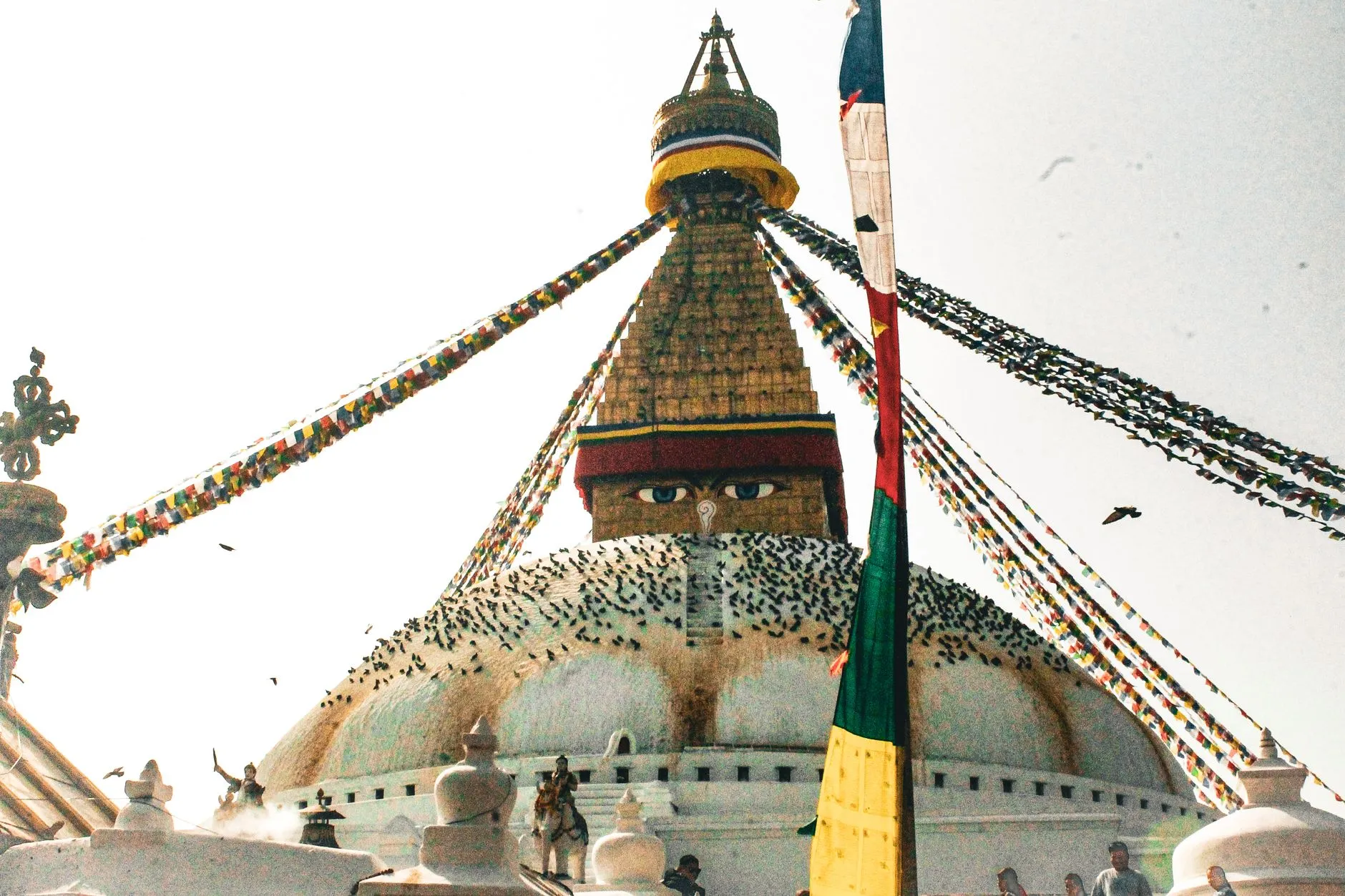
Then the great religious sites. Boudhanath is one of the largest stupas in the world — a vast white dome ringed by Tibetan monasteries, where pilgrims circle clockwise spinning prayer wheels at dusk; it’s the spiritual centre of Nepal’s Tibetan-Buddhist community and the most moving place in the valley. Swayambhunath, the “Monkey Temple,” crowns a hill over the city with its painted Buddha eyes and resident macaques. And Pashupatinath, on the Bagmati River, is Nepal’s holiest Hindu temple and an active open-air cremation ground — a confronting, profound place that asks for respect and discretion with your camera.
The valley still wears the 2015 earthquake, which killed thousands and toppled monuments across these squares. Reconstruction has come a long way — most major temples are rebuilt or rebuilding — but you’ll see scaffolding and gaps, and your entry fees fund the work. Thamel, finally, is the traveller hub: a warren of trekking-gear shops, bookshops, bars, cafés and agencies, equal parts useful and overwhelming, where you’ll sort your permits and your last samosas.
💡 Give Bhaktapur a night, not an afternoon. The valley’s most beautiful old town empties of day-trippers by evening; staying over means you get the squares, the potters’ courtyards and the dawn light almost to yourself. It’s the single best “non-trek” experience in Nepal.
Pokhara — the lakeside exhale
If Kathmandu is the intense, dusty engine of the trip, Pokhara is the deep breath. Strung along Phewa Lake beneath a wall of Himalayan peaks — the fishtail spire of Machhapuchhre and the Annapurna range rising almost straight from the lakeshore — it’s Nepal’s relaxation capital and the launchpad for the Annapurna treks. The Lakeside strip is all cafés, rooftop bars, boat hire and trekking shops; you can paddle a wooden boat out to the island temple, rent a bicycle, or just sit with a coffee and the most casual Himalayan view in the country.
It’s also Nepal’s adventure-sports hub. Paragliding off Sarangkot — tandem flights soaring over the lake with the Annapurnas as a backdrop — is world-renowned and surprisingly affordable (around €70–90). There’s zip-lining, ultralight flights, and the dawn pilgrimage up to Sarangkot or the Peace Pagoda for sunrise on the mountains.
But Pokhara’s real role is as the gateway. Nearly every Annapurna trek — the Circuit, ABC, Poon Hill — starts with a drive or short flight from here, and most trekkers spend a comfortable day or two in Pokhara either side of the trail, sorting permits, eating well and recovering. Even with no trek at all, two nights of lakeside calm with mountain views is one of the easiest pleasures in Nepal.
Chitwan & the Terai — the other Nepal
Drop off the Himalayan stage and Nepal has a second, totally different face: the Terai, the steamy subtropical lowland strip along the Indian border, flat and green and a world away from the snow. The centrepiece is Chitwan National Park, a UNESCO-listed expanse of grassland and sal forest that is one of the best places in Asia to see big wildlife — the greater one-horned rhinoceros (Chitwan’s conservation success story, with a thriving population), wild elephants, gharial crocodiles, sloth bears, and a small, elusive number of Bengal tigers.
You explore by jeep safari, by canoe down the Rapti River, and on guided walks; the once-common elephant-back safaris have largely and rightly been phased out on welfare grounds. The gateway village of Sauraha is set up for travellers, with riverside lodges and a relaxed, hot, humid pace. It slots neatly into the classic Kathmandu–Pokhara–Chitwan loop and offers a complete change of scene — jungle, big animals and warmth — between the mountains and the temples. Tharu culture, the indigenous people of the Terai, adds another layer: village walks, the famous Tharu stick dance, and a distinct lowland way of life.
Culture & Spirituality — Hindu, Buddhist, and gloriously blurred
Nepal is the only Hindu-majority country to sit shoulder to shoulder with Tibetan Buddhism, and the two have braided so tightly that the same shrine is often holy to both. Prayer flags fade over Hindu temples; Buddhist stupas draw Hindu pilgrims; festivals overlap. Understanding this blend is most of what makes Nepal feel deep rather than just scenic.
Lumbini, down in the Terai, is the birthplace of the Buddha — a UNESCO World Heritage site and major pilgrimage destination, with the Maya Devi temple marking the spot and a sprawling monastic zone of temples built by Buddhist nations worldwide. It’s a serene, slightly remote detour, profound for the spiritually inclined.
The festivals are extraordinary if your timing lines up. Dashain (Sept–Oct), the biggest, is a fifteen-day national homecoming of family, blessings and feasting. Tihar (the festival of lights, Oct–Nov) garlands the country in marigolds and oil lamps and even honours dogs and crows on its appointed days — it’s Nepal’s most beautiful festival. And the Kumari, the living goddess of Kathmandu — a prepubescent girl selected and venerated as a deity until she comes of age — is one of the world’s genuinely singular living traditions.
A word on mountain ethics and respect: this is a religious society. Walk clockwise around stupas and mani walls, dress modestly at temples and in villages, ask before photographing people (and never at cremation grounds), remove shoes where required, and treat the Sherpa and Tibetan communities whose home the high trails are with the deference you’d want for your own. It costs nothing and it’s the difference between being a guest and being a nuisance.
What to Eat & Drink
You will eat a great deal of dal bhat, and you will come to love it. The national dish — lentil soup, rice, a vegetable curry, pickles, sometimes a meat or greens — is the engine of the entire trekking economy, served twice a day in every teahouse, endlessly refillable, balanced and clean. “Dal bhat power, 24 hour,” the guides say, and on the trail it really is the perfect fuel.
The other staple you’ll crave is momos — Tibetan-Nepali dumplings, steamed or fried, stuffed with buffalo, chicken or veg and dipped in fiery tomato-sesame achar. They’re the national snack and they’re brilliant. Beyond those, seek out Newari cuisine in the Kathmandu Valley — the rich, complex food of the valley’s indigenous people, built around bara (lentil patties), choila (spiced grilled meat), yomari and beaten rice, often eaten with the local rice liquor; it’s the most interesting food in the country and badly underexplored by visitors. The Tibetan influence runs through the hills: thukpa (noodle soup), tingmo bread, and butter tea. And thakali food — the cuisine of the Annapurna’s Thak Khola — is the best version of the dal-bhat set meal you’ll eat.
Drink the sweet, milky, spiced masala chai everywhere; it’s the social glue. Coffee has arrived in force in Kathmandu and Pokhara cafés. Alcohol is available and relaxed (this isn’t a dry country) — local lagers like Gorkha and Everest, and the homemade millet/rice brews tongba and raksi in the hills — but go very easy on it at altitude, where it hits hard and worsens AMS.
⚠️ Be careful with food and water hygiene, especially on the trail. Stomach upsets are the most common traveller ailment here. Drink only treated or bottled water (and refill/treat rather than buying endless plastic on the trek), eat freshly cooked hot food, and go vegetarian on the high trails where meat has been carried up unrefrigerated for days — the guides do, and so should you.
Costs & Money — cheap day-to-day, but the trek adds up
Nepal is one of the cheapest countries you can travel well in — once you’re moving on the ground. A plate of dal bhat is €2–4, a momo plate €1.50–3, a guesthouse bed in Thamel or Lakeside €8–20, a city dinner with a beer under €10, a local bus fare a euro or two. Daily living costs are genuinely tiny.
The expense in Nepal isn’t daily life — it’s the trek infrastructure: the permits, the domestic flights, and the guide-and-porter the law now expects. Those stack up fast, which is why a budget shoestring traveller and a trekker can both be in Nepal and spend wildly different amounts.
Rough daily budgets, excluding international flights:
- Backpacker / non-trek: ~€20–30/day — cheap guesthouses, local food, buses, the valley sights. Nepal off the trail is one of the best-value countries in Asia.
- Standard trekker (on the trail): ~€30–55/day in teahouse costs (bed, dal bhat, tea, charging and Wi-Fi fees climb with altitude) — plus your guide/porter day rates and the one-off permits and flights.
- Comfortable / lodge-and-tours: ~€60–120/day — better hotels in the cities, private transfers, upscale trekking lodges, a Chitwan safari package.
On the trek specifically, remember prices rise with altitude — a bottle of water or a chocolate bar that’s cheap in Lukla costs several times more at Gorakshep, because everything is carried up by porter or yak. Tipping the trek crew is expected and important: budget roughly €8–12/day for a guide and €6–10/day for a porter, given as a lump sum at the end, on top of their wages — this is real income for them, not a courtesy.
💡 Carry cash on the trail — ATMs vanish above the trailheads. There are reliable ATMs in Kathmandu, Pokhara and a few big trail towns like Namche Bazaar, but once you’re high there’s nothing. Withdraw enough rupees before you start, carry it in small notes for teahouse bills and tips, and keep an emergency USD reserve.
Practical Information
Entry & visa: Almost all nationalities get a visa on arrival at KTM (and at land borders), or can apply for an e-visa in advance. Standard tourist fees in 2026 are about $30 for 15 days, $50 for 30 days and $125 for 90 days (≈ €28 / €46 / €116). Pay in clean USD cash to be safe, though cards and other currencies are usually accepted; bring a passport photo. Indians need no visa at all; SAARC nationals get a free 30-day visa once a year. Your passport must be valid six months beyond entry. It’s a genuine non-event for the big Western markets.
Altitude & AMS — read this twice. Acute Mountain Sickness is the single biggest danger in Nepal and it does not care how fit you are. Above ~2,500–3,000 m, ascend slowly, take the built-in acclimatisation days (Namche, Manang), drink lots of water, avoid alcohol, and learn the warning signs — headache, nausea, dizziness, breathlessness at rest. The two life-threatening forms (HACE and HAPE) require immediate descent, and helicopter evacuation if you can’t walk down. Never push higher with worsening symptoms to “make the schedule.” This is what kills trekkers every year.
Travel insurance: non-negotiable, and it must explicitly cover high-altitude trekking and helicopter evacuation up to the altitude you’ll reach (state EBC’s ~5,545 m if relevant). Standard travel policies often exclude trekking above a certain altitude — read the small print, or buy a specialist trekking policy. A heli evac you’re not insured for can cost five figures.
The guide rule: plan to trek with a licensed guide — solo independent trekking was officially banned in 2023 and enforcement is tightening, especially in the Everest region. Book through a registered Nepali agency; it also handles your permits, logistics and safety.
The monsoon: June–September brings heavy rain, leeches, landslides, washed-out roads, flight cancellations and cloud that hides the mountains. It’s the worst time for the classic treks (rain-shadow areas like Mustang are the exception). Aim for the dry, clear post-monsoon (Oct–Nov) or spring (Mar–Apr) windows.
Earthquake reality: Nepal sits on a major fault and had a devastating quake in 2015. It’s not a reason to stay away, but know that buildings and trails in some areas are still rebuilt or rebuilding, and basic earthquake awareness is sensible.
Connectivity: buy a cheap local SIM (Ncell or Nepal Telecom) at the airport or in town with your passport — far better than roaming, with decent coverage in the cities and surprising (if patchy) reach on the popular trails. Teahouses sell Wi-Fi and charging by the hour at altitude.
Health: see a travel clinic before you go (routine vaccines plus consider hepatitis A, typhoid; the Terai has some malaria/dengue risk). Carry a basic kit, water treatment, and discuss Diamox (acetazolamide) for altitude with a doctor.
When to Go — season by season
Nepal has two great windows and two to avoid, and the mountains make the call.
October–November: the prime season, and the one to aim for. Post-monsoon skies are at their clearest — the most reliable mountain views of the year — the trails are dry, the temperatures are comfortable, and the festivals (Dashain, Tihar) light up the country. It’s also the busiest and priciest; book trekking logistics ahead.
March–April: the spring window and the second-best time. The rhododendron forests bloom spectacularly on the mid-altitude trails, temperatures are pleasant, and it’s the main mountaineering-expedition season. Views can be a touch hazier than autumn, but it’s a wonderful time to trek.
December–February: cold but clear and quiet. The lower treks (Poon Hill, lower Annapurna, the valley sights) are perfectly doable with the right gear, the high passes get snowed in and some high teahouses close, and the cities are crisp but Kathmandu’s winter pollution can be grim. Great for crowd-free Durbar Squares and Chitwan; pack serious warmth for any altitude.
June–September (monsoon): the time to skip for the classic Himalaya. Rain, leeches, landslides, grounded flights and hidden mountains. The exception is the rain-shadow north — Upper Mustang and Dolpo stay dry and become the season’s destinations — and the lowlands are simply hot and wet. For most first-time visitors, don’t come for the trekking now.
Frequently Asked Questions
Cheapest Flights to Nepal
We have tracked 182 fares to Nepal from 67 cities. As of June 2026, here is what a good price looked like from each — the lowest fare we recorded, and a “great-deal” benchmark to judge a quote against. These are tracked observations, not live prices: by the time you read this they will have moved, so treat them as a yardstick, not a quote.
| From | Lowest fare we tracked | Great-deal benchmark |
|---|---|---|
| Istanbul (IST) | €260 | €371 |
Recent deals we have posted to Nepal:
- Cairns to Kathmandu, Nepal from A$1057
- Athens to Kathmandu, Nepal from €492
- Cheap Flights Dubai to Kathmandu 2026 — From 300 EUR
- Cheap Flights Doha to Kathmandu 2026 — From 300 EUR
- Cheap Flights Delhi to Kathmandu 2026 — From 300 EUR
- Cheap Flights Bangkok to Kathmandu 2026 — From 300 EUR
These are fares aifly tracked to this destination, not live quotes — they have changed since and several of the deals above may have expired. Browse current flight deals →