Kazakhstan — Complete Travel Guide 2026
Forget every Borat joke you’ve ever heard, because Kazakhstan is the great under-the-radar nature destination of the decade. Within an hour of leaving downtown Almaty you can be standing under snow-capped Tien Shan peaks, riding a cable car to a glacier, or gazing at a turquoise alpine lake — and you’ll do it without the crowds that would choke the same scenery in the Alps or the Rockies. It’s a country the size of Western Europe, easy to enter visa-free, modern and safe in the cities, surreal and empty everywhere else. The draw isn’t a checklist of sights. It’s the mountains, the steppe and the sense of having a vast, spectacular country almost to yourself.
Quick Reference
Central Asia — the world’s largest landlocked country and the ninth-largest overall, sprawling across steppe, mountains, desert and the Caspian, wedged between Russia and China
Almaty (ALA) — the biggest city and the main gateway; Astana (NQZ) — the capital; Shymkent (CIT) — the southern hub
Kazakhstani tenge (KZT); cards work everywhere in the cities, cash for the countryside
Kazakh and Russian (both widely spoken); English is growing fast among young city-dwellers but thin elsewhere
Visa-free for most Western tourists for up to 30 days per entry — no visa, no e-visa, no advance paperwork
May–June and September–October are the all-rounders; July–August for the high mountains and lakes; the winter is genuinely brutal
The Tien Shan mountains on Almaty’s doorstep, Charyn Canyon, the futuristic capital, endless steppe, eagle hunters and the Silk Road
Almaty for the mountains and the nature trips; Astana for the architecture; most people give Almaty the lion’s share
Editor’s Note — it’s the mountains, not the museums
Let’s clear the air. Kazakhstan’s global image was hijacked by a comedy character, and the country has spent two decades being underestimated because of it. The reality is one of the most surprising places you can fly to: a confident, modernising, oil-rich nation the ninth-largest on Earth, with a glittering steppe capital, a leafy mountain metropolis, and some of the best accessible alpine scenery in Asia.
Here’s the thing first-timers get wrong: they come looking for “sights” — old towns, headline monuments, the kind of dense cultural circuit you’d do in Uzbekistan next door. Kazakhstan isn’t really that country. Its Silk Road heritage is real but thinner and more scattered, the historic cities were mostly rebuilt or built from scratch, and you can “do” the main museums of Almaty and Astana in a couple of mornings. If you measure a trip by ticked-off monuments, you’ll come away faintly puzzled.
Measure it by landscape instead and it soars. The headline is Almaty and the wall of the Tien Shan that rises straight out of the southern suburbs — a 30-minute drive turns city into ski resort, glacier and alpine lake. Add the day-trips east of the city — Charyn Canyon, the Kolsai and Kaindy lakes, the singing dunes of Altyn-Emel — and you have a nature destination that genuinely rivals the famous ones, minus the crowds and the price. The steppe itself, that endless grass-and-sky emptiness, is the other half of the soul of the place. Astana is worth two days as a sci-fi spectacle. But plan your trip around Almaty and its mountains, give the nature the time, and Kazakhstan stops being a curiosity and becomes one of the best-value adventure trips on the map.
💡 Spend most of your time in and around Almaty. It’s the gateway to everything that makes the country special — the mountains, the canyons, the lakes. A week split mostly Almaty-and-around, with a two-day side-trip to Astana, is the trip that delivers. Don’t burn half your time crossing the steppe just to see another capital.
Should You Go? Who it’s for — and isn’t
Kazakhstan is for the traveller who’s done the obvious places and wants somewhere that still feels like a discovery. If you love mountains, hiking, big empty landscapes and a hint of frontier, you’ll be in heaven — the Tien Shan, the canyons and the lakes are world-class and almost unknown. It’s brilliant for adventure and photography, for road-trippers, for anyone who’d rather hike to a hidden lake than queue for a cathedral, and for travellers who like the idea of Central Asia but want one of its easier, more modern entry points (visa-free, safe cities, good infrastructure, a real café and food scene).
It’s also a strong pick for value-conscious long-haul travellers: once you’re there, costs are low to moderate by Western standards, and the entry hassle is essentially zero.
Who it’s not for: anyone after a dense, monument-by-monument cultural tour — go to Uzbekistan for that (and many people pair the two). It’s not for beach-and-resort holidaymakers; there’s no coast worth the name. It’s not really a budget-backpacker bargain in the way Southeast Asia is — the country is huge, distances are punishing, and getting between regions eats time and money (you’ll fly domestically or settle in for very long drives). And if you need everything in English and a polished tourist machine, parts of Kazakhstan will feel raw — a little Russian, a little patience and a willingness to hire a driver go a long way.
Getting There — ALA, NQZ & who flies in
Two airports do almost all the heavy lifting, and which you pick shapes the trip. Almaty (ALA) is the country’s main gateway, the busiest airport, and the right choice for almost every first visit — it puts you next to the mountains and all the great nature trips. Astana (NQZ), in the capital up north on the steppe, is the second hub and handy if the futuristic capital is your priority or you’re connecting onward. Shymkent (CIT) in the south is mainly a domestic and regional gateway, useful for the Silk Road circuit around Turkestan.
The good news on carriers: Air Astana, the flag carrier, is a genuinely well-regarded full-service airline (modern fleet, good service, Star Alliance-adjacent connections) and flies a wide network from Almaty and Astana to Europe, the Gulf, India, China, Southeast Asia and beyond. Its low-cost sister FlyArystan handles cheap domestic and regional routes. From Europe, Turkish Airlines is the workhorse connection via Istanbul (to both ALA and NQZ, year-round), Wizz Air runs budget flights from several European cities, and Pegasus, Lufthansa, KLM and the Gulf carriers (Emirates, Qatar, flydubai) all serve the country. There’s no shortage of one-stop routings from Western Europe; non-stops are growing as Kazakhstan pushes to become a Eurasian aviation hub, but most Western travellers will connect through Istanbul, a Gulf hub, or Frankfurt/Amsterdam.
Domestic flights are how you cover the real distances — Almaty to Astana is a 90-minute hop on Air Astana, FlyArystan, SCAT or Vietjet Qazaqstan, and flying beats the alternative (it’s roughly 1,000 km by road or an overnight train). FlyArystan keeps internal fares low; a one-way Almaty–Astana often runs around €40–70 if you book ahead.
💡 Fly into Almaty unless you have a reason not to. It’s the mountains, the food, the café culture and the launchpad for every great day-trip. Treat Astana as a one- or two-day add-on reached by a cheap domestic flight, not as your base.
Getting Around — the distances, the trains & a car with a driver
The single biggest thing to grasp about Kazakhstan is scale. This is a country bigger than all of Western Europe with a population smaller than the Netherlands’ — the emptiness between places is the defining experience, and it means you do not casually “drive between regions.” Pick a couple of zones and go deep, rather than trying to crisscross the map.
For the long internal hops — Almaty to Astana, or down to Shymkent — domestic flights are the sane choice (cheap, frequent, an hour or two versus a day on the road). For the romantic option, the trains are good: the rail network is extensive and inexpensive, and an overnight sleeper between Almaty and Astana (or onward to Shymkent/Turkestan) is a genuine slice of Kazakh life — share a compartment, drink tea, watch the steppe roll past. Book a kupe (4-berth) compartment for comfort. It’s slow (Almaty–Astana is roughly 12–20 hours depending on the service) but cheap and atmospheric.
Around Almaty city, you’ve got a clean modern metro (one line, but useful), cheap buses, and ride-hailing via Yandex Go (the local Uber-equivalent) that is dirt-cheap and the easiest way to get anywhere — a cross-town ride is a euro or two. Use it relentlessly. Astana works the same way.
For the mountain and canyon trips, the honest recommendation is to hire a car with a driver (or join a small-group tour) rather than self-drive. The destinations are 2–5 hours out on roads that get rough toward the trailheads, the lakes sit near the Kyrgyz border with passport checks, and a local driver who knows the route and the weather is worth every tenge. A full-day private car-and-driver for a Charyn or Big Almaty Lake run typically costs in the region of €70–120 for the vehicle (split across a group, it’s cheap); organised group day-tours run roughly €40–80 per person including pickup, entrance fees and lunch. Self-driving is possible and rentals exist, but Kazakh driving is assertive, signage leans Cyrillic, and the savings rarely justify the stress.
⚠️ Carry your physical passport on any trip toward the Kolsai/Kaindy lakes. They sit in a border zone near Kyrgyzstan and there can be document checks on the road — a copy or a photo on your phone won’t cut it. Keep the original on you.
Almaty & the Mountains — the headline
Almaty is one of the most likeable cities in Central Asia and the reason most people come — a green, low-rise, tree-shaded former capital backed by a sheer wall of snow peaks. It has the country’s best food, its best cafés and nightlife, leafy boulevards, Soviet-modernist landmarks, and an easy, cosmopolitan buzz. But the city itself is the warm-up. The act is the Tien Shan, which rises out of the southern edge of town so abruptly that you can be at a glacier within an hour of breakfast.
Start with Medeu, the world’s highest-altitude Olympic-size ice-skating rink, set in a mountain gorge 15 km above the city — worth the trip for the setting alone, and a place to skate in winter. From Medeu, a road and a cable car climb on to Shymbulak (Chimbulak), Central Asia’s premier ski resort: a genuinely good mountain with modern lifts, runs from late November into April, and — in summer — gondola rides up to alpine meadows and ridge-top views over the city and the peaks. A Shymbulak winter day lift pass runs around €30–45; the summer cable car up for the views is cheaper. Even non-skiers should ride up.
Higher and wilder is Big Almaty Lake, a startlingly turquoise glacial reservoir cradled by 3,000-metre peaks, about an hour’s drive (plus a checkpoint) above the city. It’s the postcard shot of the Almaty mountains — milky blue water against snow and pine — and a half-day trip with a driver. (Access can be restricted at times as it sits in a protected watershed; check current rules, and don’t swim — it’s a drinking reservoir.) Above town to the north, Kök-Töbe hill, reached by a cable car from the centre, gives the easy panoramic view, a small fairground, and — a curiosity — a statue of the Beatles.
Back in the city, give a morning to the Green Bazaar (Zelyony Bazar) — a riot of horse sausage, dried fruit, Korean salads, honey and spices that’s the best single window onto how Kazakhstan eats — and to Panfilov Park with its candy-coloured Zenkov Cathedral, one of the world’s tallest wooden buildings, built without a single nail. Then do what locals do: sit in a café (Almaty’s coffee scene is excellent and improbably hip), eat well, and use the city as the comfortable base it is between mountain runs.
💡 Build your Almaty days around the weather. The mountains can be cloud-socked one day and crystalline the next. Keep the Big Almaty Lake / Shymbulak high-mountain trips flexible, and slot the city, the bazaar and the cafés into the grey days.
The Northern Tien Shan — Charyn Canyon, the lakes & the singing dunes
This is the cluster of day- and multi-day trips east of Almaty that turns a good trip into a great one — and it’s the real reason serious travellers come to Kazakhstan.
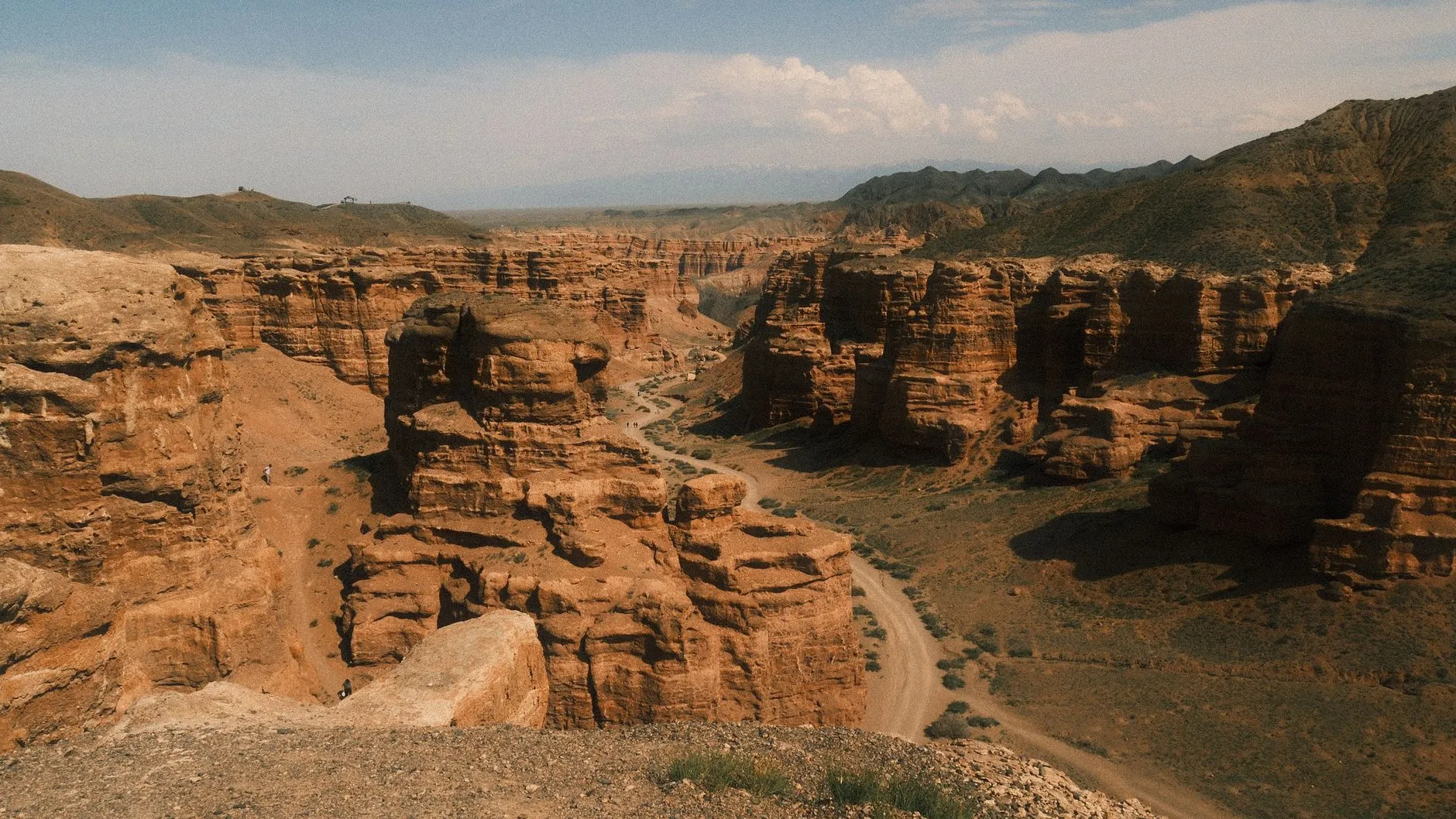
Charyn Canyon, about three hours east, is the “Grand Canyon of Central Asia” — a 150-metre-deep gorge of red sandstone towers carved by the Charyn River, with the celebrated Valley of the Castles as its centrepiece: a 2-km trail winding between fluted rust-coloured pinnacles down to the river. It’s smaller than its Arizona namesake but genuinely spectacular, walkable, and an easy long-day-trip from Almaty (a group tour runs around €40–60 with transport and entry). Go for golden hour if you can; the rock glows.
Beyond it, near the Kyrgyz border, sit the two lakes everyone photographs. The Kolsai Lakes are a chain of three deep-green alpine lakes stepping up a forested valley — the lowest is reachable by road, the upper two by a stiff hike or horseback, and you can overnight in the lakeside village of Saty. Nearby is the otherworldly Lake Kaindy, the “sunken forest”: an earthquake in 1911 dammed a valley and drowned a spruce forest, whose bleafless trunks still spear up out of impossibly clear teal water like masts. The bumpy track in usually needs a 4WD or a local UAZ transfer. Charyn + the two lakes are often bundled into a single epic 17-hour day-trip, but they’re far better as a 2-day tour with a night near the lakes — the day version is a brutal amount of driving.
Further out, Altyn-Emel National Park holds the Singing Dunes — a 150-metre-high dune that hums and booms in the wind when the sand slides — plus rainbow-striped chalk hills and ancient burial mounds, deep in the steppe; it’s a 2-day expedition with a proper operator. And if you want a gentler dose, Kaindy and Kolsai alone make a fine standalone overnight. However you slice it, this eastern cluster is the heart of a Kazakhstan nature trip — give it three or four days.
⚠️ Don’t try to cram Charyn, Kolsai and Kaindy into one day unless you love a minibus. The “all three in a day” tours are 16–17 hours, much of it driving rough roads in the dark. Do the 2-day version, sleep near the lakes, and you’ll actually enjoy them.
Astana — the steppe capital from a sci-fi film
Fly north and you land in one of the strangest, most ambitious cities on the planet. Astana (renamed Nur-Sultan for a few years, then back to Astana) was a windswept provincial town on the bare steppe until it was declared the capital in 1997 and money — oil money — rained down on a blank canvas. The result is a built-from-nothing capital of wild, futuristic, sometimes preposterous architecture, a 21st-century Brasília on the frozen plains, designed in part by global starchitects like Norman Foster.
The signature is the Bayterek Tower, a 97-metre white-and-gold structure shaped like a poplar tree cradling a golden egg — ride up for the view and the city’s founding myth. Foster’s Khan Shatyr is a vast, leaning translucent “tent” — the world’s largest — housing a shopping mall complete with an indoor beach with sand flown in from the Maldives. There’s the pyramidal Palace of Peace and Reconciliation (Foster again), the Nur-Astana Mosque, the disc-shaped Nur Alem sphere left over from Expo 2017 (now a future-energy museum), and a whole boulevard of gleaming ministries, opera houses and towers that look like nothing else on Earth.
It’s a fascinating, slightly surreal two days — equal parts genuine spectacle and “did they really build that.” Wander the Nurzhol Boulevard axis from Bayterek to the presidential palace, see the contrast between the showpiece left bank and the older Soviet right bank across the Ishim River, and bundle up if it’s winter — Astana is one of the coldest capital cities in the world, regularly hitting −30°C and below. As a base it’s thinner than Almaty (less nature, less soul), but as a spectacle it’s unmissable.
The South & the Silk Road — Turkestan, Shymkent & the Aral tragedy
For travellers who want the historic, Silk Road side of Central Asia, the south delivers the country’s best of it. Turkestan is the spiritual heart: its Mausoleum of Khoja Ahmed Yasawi, a magnificent unfinished Timurid monument from the late 1300s — soaring portal, ribbed turquoise dome, intricate tilework — is Kazakhstan’s most important historic building and a UNESCO World Heritage Site. It’s a major pilgrimage destination, and the surrounding old town has been heavily (some say over-) restored into a polished heritage zone with a new tourist complex. It’s the one place in Kazakhstan that feels like the Silk Road cities of Uzbekistan.
Shymkent, the country’s third city, is the gritty, fast-growing southern hub and the practical base for the region — a real working Kazakh-Uzbek border city with a good bazaar and proper southern hospitality, more interesting as a slice of life than a sightseeing stop. Reach Turkestan from here by road or take the train down from Almaty.
Far to the west, in a remote corner few tourists reach, lies one of the planet’s great cautionary tales: the Aral Sea. Soviet irrigation schemes diverted the rivers feeding it, and the world’s fourth-largest lake collapsed into desert within a generation — stranding rusting fishing boats in the sand miles from any water around the town of Aralsk. It’s a haunting, hard-to-reach pilgrimage for the curious (a long way from anywhere, best on a dedicated multi-day trip), and a sobering counterpoint to the gleam of Astana.
The Steppe & the Nomadic Heritage
To understand Kazakhstan you have to understand that until barely a century ago the Kazakhs were nomads — horse-riding pastoralists who moved with the seasons across this ocean of grass, living in felt yurts, measuring wealth in livestock, and navigating by the stars. Soviet collectivisation and forced settlement shattered that life in the brutal famines of the 1930s, but its spirit is woven through everything: the food, the hospitality, the reverence for horses, and the deep cultural pull of the open steppe.
You feel it most out in the emptiness — on the long drives, the train crossings, the nights under a colossal sky. But you can also seek it directly. The Kazakh horse culture is everywhere (and on every plate — see below). The great surviving spectacle is the eagle hunters (berkutchi) — horsemen, more associated with the Kazakh communities of the Altai and western Mongolia but practised in eastern Kazakhstan too, who hunt with trained golden eagles; demonstrations and festivals can be arranged. Scattered across the steppe are kurgans — Bronze and Iron Age burial mounds, including the spectacular gold-laden “Golden Man” tombs that gave the country one of its national symbols (the original treasures are in the museums of Almaty and Astana). Spending a night in a yurt camp, watching a horse-games display, or simply standing in the silence of the grass is the closest you’ll get to the country’s nomadic soul.
What to Eat & Drink
Kazakh cuisine is exactly what a nomadic, meat-and-dairy culture produces — hearty, carnivorous, warming, and built for a cold climate — overlaid with strong Russian, Uzbek, Korean and Uyghur influences that make the cities surprisingly varied.
The national dish is beshbarmak — literally “five fingers,” because you traditionally eat it by hand — boiled horse or mutton with flat squares of pasta and onion broth, served from a communal platter and eaten at every celebration. It’s the dish to try once for the culture, even if it’s an acquired taste. Horse meat is a genuine delicacy here, not a gimmick: look for kazy (horse sausage) and shubat (fermented camel’s milk) and, the famous one, kumys (qymyz) — fermented mare’s milk, slightly fizzy, sour and mildly alcoholic, the ancient drink of the steppe. (Try a small glass; it’s an experience.)
Beyond the nomadic core, the cities eat well and broadly: plov (the Uzbek-style rice-and-lamb pilaf), manti (steamed dumplings), lagman (hand-pulled Uyghur noodles), samsa (flaky baked meat pastries), shashlik off the grill, and — a delicious surprise — excellent Korean food, the legacy of the Koryo-saram, Koreans deported to Kazakhstan by Stalin, whose carrot salads and kuksi are now bazaar staples. The bazaars (Almaty’s Green Bazaar above all) are the best, cheapest, most atmospheric place to graze. Tea — black, milky, endless — is the social lubricant; vodka and good Kazakh beer flow in the cities; and the wine scene around Almaty’s foothill vineyards is quietly improving. A hearty local meal of plov or shashlik runs €4–8; a sit-down restaurant dinner with drinks, €15–25.
Costs & Money
Kazakhstan is moderately priced — not the dirt-cheap of Southeast Asia, but solid value for a country this size and this comfortable. Your euro stretches well in restaurants, transport and everyday life; the splurge items are domestic flights and quality tours, which is where the budget goes.
A rough daily on-the-ground budget (excluding international flights):
- Budget: ~€30–45/day — hostels and simple guesthouses, bazaar food and cheap canteens (stolovaya), ride-hailing and trains, the odd group day-tour.
- Mid-range: ~€60–110/day — comfortable hotels, restaurant meals, a private driver or organised tours for the nature trips, the occasional domestic flight.
- Comfortable: €130+/day — good city hotels, private guides and cars, internal flights, no compromises.
A sense of individual prices: a decent Almaty hotel room €50–90 a night (less in Astana off-season, more for the smart places); a beshbarmak or plov dinner €4–8; a city coffee €2–3; a Yandex Go ride across town €1–3; a Charyn Canyon group day-tour €40–60; a full-day private car-and-driver €70–120; a Shymbulak winter lift pass €30–45; a one-way Almaty–Astana domestic flight €40–70.
Money mechanics: the tenge is the only currency you’ll use. Cards (Visa/Mastercard) are accepted almost everywhere in Almaty and Astana — restaurants, shops, even small cafés — and contactless is normal; ATMs are plentiful in cities. Carry cash for the countryside, bazaars, small towns and drivers, where cards thin out fast. Tipping is light and not deeply ingrained — round up or leave ~10% in nicer restaurants, and it’s appreciated rather than expected.
Practical Information
Entry & visa: most Western tourists — UK, EU, US, Canada, Australia, plus Japan and South Korea and many others (around 50 nationalities) — enter visa-free for up to 30 days per visit, with no visa, e-visa or advance paperwork; you simply get a stamp on arrival with a passport valid at least six months. Note a ceiling on the visa-free regime: total stay shouldn’t exceed 90 days within any 180-day period. If you’ll stay longer than 30 days in one go, you need to register with the migration police. Always confirm your own nationality’s terms before flying, but for the major Western markets it’s a non-event.
Registration: the old Soviet-style hassle of registering your stay is now largely automatic — for short visits, your entry is logged at the border and hotels report your stay, so the great majority of tourists need do nothing. (If you’re staying in private accommodation for a long period, registration may fall on you or your host — but a normal hotel-based trip under 30 days is hands-off.)
Safety: Kazakhstan is very safe for travellers. Violent crime against tourists is rare, the cities are orderly, and the main risks are the mundane ones — petty theft in crowded bazaars, taxi overcharging (use Yandex Go to skip the haggle), and the genuine hazards of high mountains and remote driving (weather, altitude, rough roads). Use a registered driver, watch the mountain weather, and you’re on very solid ground. Western advisories typically sit at the equivalent of “normal/increased caution” — check your own before you go.
Language: Kazakh and Russian are both everywhere; Russian remains the lingua franca in the cities and is hugely useful — a few words, or a translation app, smooth the way enormously. English is rising fast among young urbanites and in the tourism trade, but thins out in the countryside. Cyrillic signage is the norm; a translation app’s camera is your friend.
Climate & seasons: this is an extreme continental climate — short, hot summers and savagely cold winters. Almaty is milder (mountains for shelter) but the steppe and Astana plunge to −30°C and below, with biting wind, from December to February. Summers are warm to hot (Almaty pleasant, the south and steppe baking). Pack for the season you’re in — and for the mountains, pack layers year-round; it can snow on the high passes in summer.
Connectivity: cheap local SIM cards (Beeline, Kcell, Tele2/Altel) with generous data are easy to buy with your passport at the airport or in town — far better value than roaming, and essential for Yandex Go and maps. Wi-Fi is standard in city hotels and cafés.
When to Go
Kazakhstan’s seasons swing hard, and the right month depends on what you’re chasing.
May–June: the sweet spot for most trips. The steppe greens up and bursts with wildflowers, the mountains are accessible as the snow retreats, temperatures are pleasant, and the lakes are filling. Late June opens the high country.
July–August: high-mountain and lake season, and the time to be up at Kolsai, Kaindy and Big Almaty Lake — the alpine trails are open and the high water is at its most vivid blue. The cities and southern steppe can be hot, but the mountains are glorious. Peak for nature, so book tours ahead.
September–October: arguably the most beautiful window — golden autumn colour in the canyons and foothills, comfortable temperatures, thinning crowds, and Charyn Canyon at its photogenic best. A superb time to come, especially for photographers.
November–April: winter, and a genuinely different trip. It’s ski season at Shymbulak, skating at Medeu, and a snow-blanketed steppe — atmospheric, cheap, and crowd-free, but brutally cold (Astana is one of the world’s coldest capitals). The mountain lakes and canyons become hard or impossible to reach; this is a season for the slopes, the cities and a hardy traveller, not for the headline nature circuit.
In short: come May–June or September–October for the all-round trip, July–August for the high lakes, and winter only if you’re here to ski or you actively want the deep freeze.
Frequently Asked Questions
Cheapest Flights to Kazakhstan
We have tracked 156 fares to Kazakhstan from 47 cities. As of June 2026, here is what a good price looked like from each — the lowest fare we recorded, and a “great-deal” benchmark to judge a quote against. These are tracked observations, not live prices: by the time you read this they will have moved, so treat them as a yardstick, not a quote.
| From | Lowest fare we tracked | Great-deal benchmark |
|---|---|---|
| Batumi (BUS) | €243 | €347 |
| Tbilisi (TBS) | €256 | €366 |
| Baku (GYD) | €282 | €403 |
| Salzburg (SZG) | €326 | €465 |
| Bergamo (BGY) | €517 | €738 |
Recent deals we have posted to Kazakhstan:
- Riga to Astana, Kazakhstan from €337
- Warsaw to Astana, Kazakhstan from €477
- Copenhagen to Astana, Kazakhstan from €524
- Prague to Astana, Kazakhstan from €368
- Milan to Astana from €401
- Warsaw to Astana, Kazakhstan from zł1668
- Frankfurt to Astana, Kazakhstan from €350
These are fares aifly tracked to this destination, not live quotes — they have changed since and several of the deals above may have expired. Browse current flight deals →