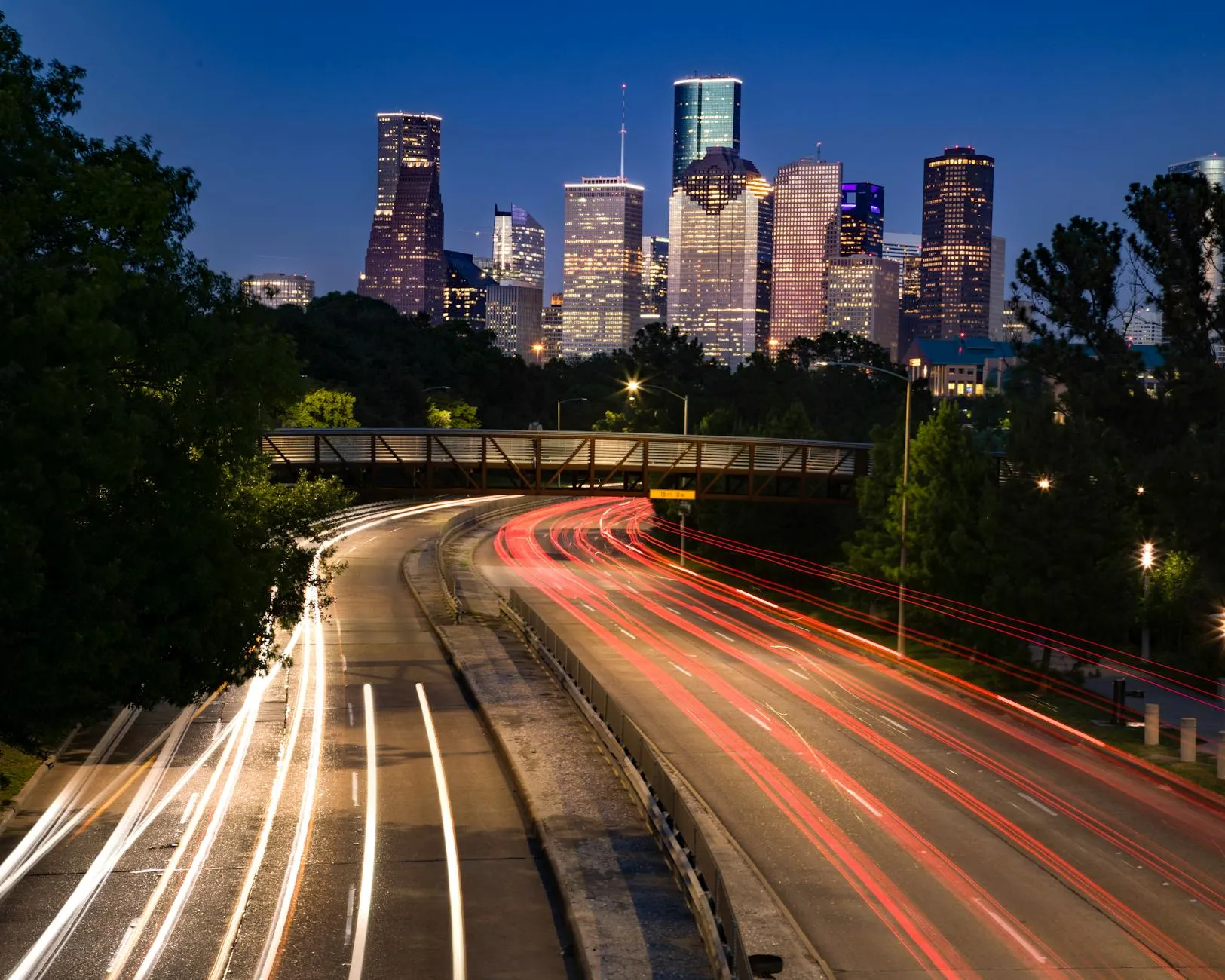
Houston George Bush Intercontinental (IAH) — The Complete 2026 Airport Guide
Houston has two airports and they are not interchangeable. IAH — George Bush Intercontinental — is the big international one, United’s mega-hub and the main gateway to Latin America, sitting about 35 km north of downtown. Hobby (HOU) is the small one 15 km south where Southwest lives. Book the wrong one and you have a very expensive cross-city taxi and a missed flight. Get IAH right — the terminal, the Skyway, the fact that there is barely any public transit — and it is a smooth, if sprawling, place to fly.
Last verified: July 2026. Fares, terminal assignments and US entry rules change often — confirm the specifics on your ticket and at official signage before you travel.
Quick reference
| Detail | What you need to know |
|---|---|
| Airport | George Bush Intercontinental Airport, IATA IAH — Houston’s international gateway; about 48 million passengers in 2025 (~12 million international) |
| Not to be confused with | Hobby (HOU) — Houston’s second airport, ~15 km south of downtown, Southwest’s base. IAH and HOU are on opposite sides of the city |
| Location | About 32–35 km (~21 miles) north of downtown Houston; 25–40 minutes by road depending on traffic |
| Terminals | A, B, C, D, E — all linked airside by the Skyway train and landside by the Subway train. United dominates C (domestic) and E (international); D handles foreign carriers |
| Into downtown | Uber/Lyft ~$44 · taxi flat fare ~$55–58 · METRO bus 500 Direct $4.50 or 102 (local) $1.25. No train link |
| Entry (US) | Visa-waiver travellers need an approved ESTA before flying. Global Entry / APC kiosks / Mobile Passport Control speed the queue on arrival |
| Watch out for | Turning up at Hobby by mistake · the airside/landside train split · re-clearing security after US customs on an onward domestic leg |
First, the trap: IAH is not Hobby
This is the single most expensive mistake at Houston, so it goes first. The city has two commercial airports on opposite sides of town, and their three-letter codes look nothing alike, which lulls people into not checking.
- IAH — George Bush Intercontinental: the large one, about 35 km north of downtown. Five terminals, United’s global hub, and essentially all of Houston’s long-haul and international flying. If you are flying to or from Europe, Asia, or most of Latin America, you are at IAH.
- HOU — William P. Hobby: the small, older one, about 15 km south of downtown. A single main terminal, and the home of Southwest Airlines plus Southwest’s international leisure routes to Mexico and the Caribbean. United does not hub here.
The two are roughly 50 km and 45–70 minutes apart by road across the whole metro area. A taxi between them runs well over $60. If your itinerary or a connecting friend’s says “Houston,” confirm the airport code on the ticket — IAH or HOU — not just the city. Southwest passengers in particular default to Hobby; everyone else is almost always at Bush.
The terminals: A, B, C, D, E — and the big rebuild
IAH is a United fortress hub and a major Star Alliance gateway, especially into Mexico, Central America and South America. That shapes the whole layout: most of what you’ll use is United metal, and international arrivals funnel through the east end of the airport.
- Terminals A & B — mostly domestic. United and United Express operate here alongside other US carriers; Terminal B has been the focus of United’s own separate multi-billion-dollar redevelopment.
- Terminal C — United’s main domestic terminal, roughly 30 gates across two concourses. If you’re connecting United domestic-to-domestic, you’ll likely live here.
- Terminal D — the traditional international terminal for foreign carriers (Lufthansa, Air France, KLM, British Airways, Emirates, Latin American airlines and more).
- Terminal E — United’s international hub, handling most of its long-haul departures and arrivals. US customs and immigration for arriving international passengers is on the lower level of the D/E complex.
The IAH Terminal Redevelopment Program (ITRP) — what’s actually open
IAH has spent years rebuilding its international facilities under the roughly $1.4 billion Terminal Redevelopment Program, and by 2026 most of it is finished — but the branding is ahead of the bricks, so here’s the honest state of play:
- The Terminal D refresh was completed in 2023.
- The Terminal D-West Pier opened on 22 October 2024 — a large new concourse with six wide-body-capable gates (D1–D6) that flex into more narrow-body positions. This is the modern face of the international operation.
- The new International Central Processor — the consolidated ticketing hall and a large TSA security checkpoint at the Terminal E end — opened in early 2026. As of March 2026, airlines began moving international check-in from Terminal D over to Terminal E to concentrate it in the new processor.
- The whole consolidated international complex is being branded the Mickey Leland International Terminal (after the late Houston congressman). Treat this as the umbrella name for the combined D/E international operation rather than a single new building you walk into — the pieces have opened in stages, and final consolidation was still bedding in through 2026.
Getting between terminals: Skyway vs Subway
IAH’s terminals are spread out, and there are two free trains that connect them. The trick almost nobody explains: one runs airside, one runs landside, and you need to pick the right one for whether you’ve passed security.
- Skyway — the elevated automated train, running post-security (airside). This is the one connecting passengers use to move between gates without re-clearing security. It links Terminals A, B, C and D/E, departs roughly every 2 minutes, and takes about 4 minutes end to end (Terminal A to D/E).
- Subway — the underground train, running pre-security (landside). Use it if you haven’t gone through security yet, or need to reach the Airport Marriott. It serves A, B, C, D/E and the hotel, runs about every 3 minutes, and operates roughly 3:30 a.m. to 12:30 a.m.
Note the naming history, because old signs and old guides confuse people: the airside Skyway was formerly called TerminaLink, and the underground line the “Inter-Terminal Train,” both renamed in 2015. So if you remember “TerminaLink,” that’s today’s elevated Skyway — not the underground one. A landside inter-terminal ground shuttle also exists for accessibility and off-hours coverage, but the two trains are what you’ll normally use.
Simple version: already through security and changing planes? Skyway. Still landside — arriving, checking in, or hotel-bound? Subway.
Getting into Houston — and why it’s mostly a car town
Be honest with yourself here: Houston has no rail link to IAH and only a couple of buses, so unless you’re on a tight budget with time to spare, most people take a ride-hail or taxi. Here’s the real comparison for the ~35 km trip to downtown:
| Option | Price | Time to downtown | Verdict |
|---|---|---|---|
| Uber / Lyft | ~$44 typical (surges to $80+ in peaks/weather) | ~30–45 min | The default for most travellers; pick-up at designated ride-app zones |
| Taxi | Flat zone fare ~$55–58 to downtown (+ tip) | ~30–45 min | Fixed price, no surge — good for late arrivals or a group with bags |
| METRO 500 (IAH Downtown Direct) | $4.50 | Nonstop to downtown (George R. Brown Convention Center) | Best value if the timing works; every ~30 min, roughly 5:30 a.m.–8 p.m.; from Terminal E, Level 2, door E201 |
| METRO 102 (Bush IAH, local) | $1.25 (cash, exact change) | ~50–90 min, many stops | Cheapest, but slow and multi-stop; from the bus stop on Terminal C baggage-claim level |
Two buses, two very different services. The 500 IAH Downtown Direct is the newer nonstop — $4.50, straight to the convention-centre area of downtown, and the sensible public-transport pick if it lines up with your flight. The older Route 102 is a genuine local bus: only $1.25, but it winds through dozens of stops and can take an hour and a half, so it’s really for the budget-first, time-rich traveller. Neither runs true 24 hours, so a late-night arrival means a car.
US entry: ESTA, Global Entry, APC and Mobile Passport
IAH is a major first port of entry into the United States, so the immigration hall on the lower level of the D/E complex can be busy when several wide-bodies land together. Sort your paperwork before you fly and use the fast lanes on the ground.
- ESTA (Visa Waiver Program). If you hold an EU, UK or other Visa Waiver Program passport, you must have an approved ESTA before you board — apply online in advance on the official esta.cbp.dhs.gov site (not a lookalike). It’s an authorisation to travel, not a guarantee of entry; other nationalities need a US visa.
- Global Entry. The trusted-traveller programme lets eligible members skip the main queue at dedicated kiosks. IAH is one of the airports offering Enrolment on Arrival, so approved applicants can complete the interview during CBP processing when they land, rather than booking a separate appointment.
- Automated Passport Control (APC). Free self-service kiosks, no pre-registration, open to US citizens, many returning residents and eligible visitors — you scan your passport and answer the customs questions at the machine, which usually beats the manned booths.
- Mobile Passport Control (MPC). A free CBP app that lets you submit your details in advance and use a faster line. It’s available at IAH and currently aimed at US citizens and Canadian visitors (with eligibility gradually expanding) — check the app for your case. It does not replace your passport or ESTA.
No EES or ETIAS here — those are European systems. For the US, the two things that actually save time are (1) an approved ESTA or visa sorted well before departure, and (2) using APC, MPC or Global Entry rather than joining the general line.
Lounges
As a United hub, IAH is heavy on United Clubs and light on the credit-card lounges you find at some US airports — plan around what your ticket and cards actually get you.
- United Clubs — several locations across the hub: Terminal A (near gate A9), Terminal C (two clubs, near C1 and near C33) and Terminal E (between gates E11 and E12). Access is for United premium-cabin and Star Alliance eligible passengers or Club members; the Terminal B club has been closed during redevelopment. United has also announced a huge new flagship lounge for IAH — set to be one of the largest airline lounges in the country — though check whether it has opened before counting on it.
- Priority Pass — your best independent options are in the international terminal: the Air France Lounge and KLM Crown Lounge (in the Terminal D area) accept Priority Pass, as does Minute Suites for a nap or a quiet workspace. Availability can be capped at busy times, so it’s not guaranteed walk-in.
If you’re flying international business or first on a partner airline, you’ll generally be directed to that carrier’s contract lounge — confirm the current location at check-in, since the D-to-E consolidation has moved some facilities around.
Connections and minimum times
Because IAH is a connecting hub, the layout is built for transfers — but the US customs rule catches international arrivals every day.
- Domestic to domestic (e.g. United C to United C or B): straightforward. The airside Skyway moves you between terminals without leaving security. Allow around 45–60 minutes and you’ll usually be fine.
- International arrival then onward domestic: this is the one to respect. Every passenger arriving from abroad must clear US immigration and customs at IAH, even if just connecting — collect checked bags, pass customs, re-drop the bags, and go back through TSA security before your next flight. That’s a lot of steps; give it a comfortable buffer.
- Domestic to international: change to the D/E end via Skyway; simpler than the reverse, but factor in the walk and any hall change from the terminal consolidation.
Treat any published minimum connection time as a floor, not a target. For an international-to-domestic connection with a customs re-check, more time is always better — a first US entry with bag reclaim can eat an hour on its own if the hall is busy.
Food, Wi-Fi and practicalities
Food: the new Terminal D-West pier and the redeveloped international areas brought a much better spread of sit-down and grab-and-go options than IAH had a decade ago, and Terminal C has solid choices for the United domestic crowd. As a Texas airport, look for local barbecue and Tex-Mex over the generic chains — a proper meal runs roughly $15–25, and grab-and-go noticeably less.
Wi-Fi: free wireless is available across the terminals — connect to the airport network and accept the terms; no time limit for basic browsing.
Getting around inside: the airport is large and spread across five terminals, so leave time to walk plus ride the Skyway between them. Follow the terminal letter on your boarding pass rather than habit — the ITRP work has shifted where some check-in and gates sit.
Money: the US runs on cards and contactless almost everywhere, so you rarely need cash — the one exception at IAH is Route 102, which wants exact-change cash. ATMs are in the terminals if you need them; skip the currency-exchange booths’ poor rates and use a bank card.
Frequently asked questions
Is IAH the same as Hobby airport?+
No. Houston has two airports on opposite sides of the city. IAH (George Bush Intercontinental) is the large international hub about 35 km north of downtown — United’s base and where nearly all long-haul and international flights operate. HOU (William P. Hobby) is the smaller airport about 15 km south, home to Southwest Airlines. They’re around 45–70 minutes apart by road, so always check the three-letter code on your ticket, not just “Houston.”
How many terminals does IAH have and how are they connected?+
Five: Terminals A, B, C, D and E. They’re linked by two free trains — the Skyway, an elevated airside (post-security) train that connecting passengers use to change terminals without re-clearing security, and the Subway, an underground landside (pre-security) train that also reaches the Airport Marriott. Skyway runs about every 2 minutes; Subway roughly every 3 minutes, from around 3:30 a.m. to 12:30 a.m.
What’s the difference between the Skyway and the Subway at IAH?+
The Skyway is elevated and runs airside (inside security) — use it when you’re already through security and changing planes. The Subway runs underground and landside (outside security) — use it when you haven’t passed security yet or are heading to the hotel. Confusingly, the airside Skyway was previously called “TerminaLink,” so if you remember that name it’s today’s elevated line, not the underground one.
Is the IAH Terminal Redevelopment finished, and where do I check in?+
Most of it is done. The Terminal D refresh (2023) and the new Terminal D-West pier (opened October 2024) are complete, and the new International Central Processor opened in early 2026, with airlines consolidating international check-in into Terminal E from around March 2026. The combined international complex is branded the Mickey Leland International Terminal. Because check-in has been moving from D to E, confirm your departure terminal on your boarding pass rather than relying on a previous trip.
How do I get from IAH to downtown Houston, and is there a train?+
There’s no rail link. Most people take Uber/Lyft (typically around $44, 30–45 minutes) or a taxi (flat fare roughly $55–58). On a budget, METRO’s Route 500 IAH Downtown Direct is a $4.50 nonstop from Terminal E, and the local Route 102 is just $1.25 but slow and multi-stop. Neither bus runs 24 hours, so late arrivals should plan on a car.
Do I need an ESTA to fly into Houston IAH?+
If you hold a Visa Waiver Program passport (most EU countries, the UK and others), yes — you must have an approved ESTA before you board, applied for online in advance on the official CBP site. Travellers from non-waiver countries need a US visa instead. An ESTA authorises travel but doesn’t guarantee entry; the final decision is made by the CBP officer on arrival.
How can I speed up US immigration at IAH?+
Use the fast lanes. Global Entry members get dedicated kiosks (and IAH offers Enrolment on Arrival). Automated Passport Control kiosks are free and need no pre-registration. The Mobile Passport Control app also lets eligible travellers — currently US citizens and Canadian visitors, with eligibility expanding — submit details in advance for a quicker line. None of these replaces your passport or ESTA.
How much time do I need to connect at IAH if I’m arriving from abroad?+
More than you’d think. Even connecting passengers arriving internationally must clear US immigration and customs at IAH, reclaim checked bags, re-drop them, and pass back through TSA security before the onward flight. Domestic-to-domestic connections via the airside Skyway are quick (allow ~45–60 minutes), but for an international-to-domestic connection with the customs re-check, give yourself a generous buffer well beyond any stated minimum.
At a glance
| Codes | IAH / KIAH — George Bush Intercontinental Airport, Houston |
| Terminals | A, B, C, D, E · airside Skyway train + landside Subway train connect all five |
| Hub | United Airlines (Star Alliance); major Latin America gateway |
| Not Hobby | HOU (Southwest) is ~15 km south of downtown; IAH is ~35 km north — opposite sides |
| Fastest downtown | Uber/Lyft ~$44 or taxi ~$55–58, 30–45 min |
| Cheapest downtown | METRO 500 Direct $4.50 (from Terminal E) or Route 102 $1.25 (slow) |
| Entry | ESTA/visa before flying; Global Entry, APC kiosks and Mobile Passport Control on arrival |
| Wi-Fi | Free across the terminals |
Before you fly
- 📊 Check what a good fare to Houston looks like — our price-check tool shows the typical deal range so you know a bargain when you see one.
- 🧳 Baggage checker — confirm your airline’s carry-on and checked allowance before you pack, especially if you’re connecting and re-dropping bags after US customs.
- 🛬 Confirm the airport code on your ticket — IAH (Bush) or HOU (Hobby) — before you book a ride or leave for the airport.
- 🎫 Sort your ESTA or visa early and check your departure terminal on the boarding pass — international check-in has been moving from D to E.
🧭 Planning the trip? Use our price-check tool to see what a good fare into Houston really costs before you book.