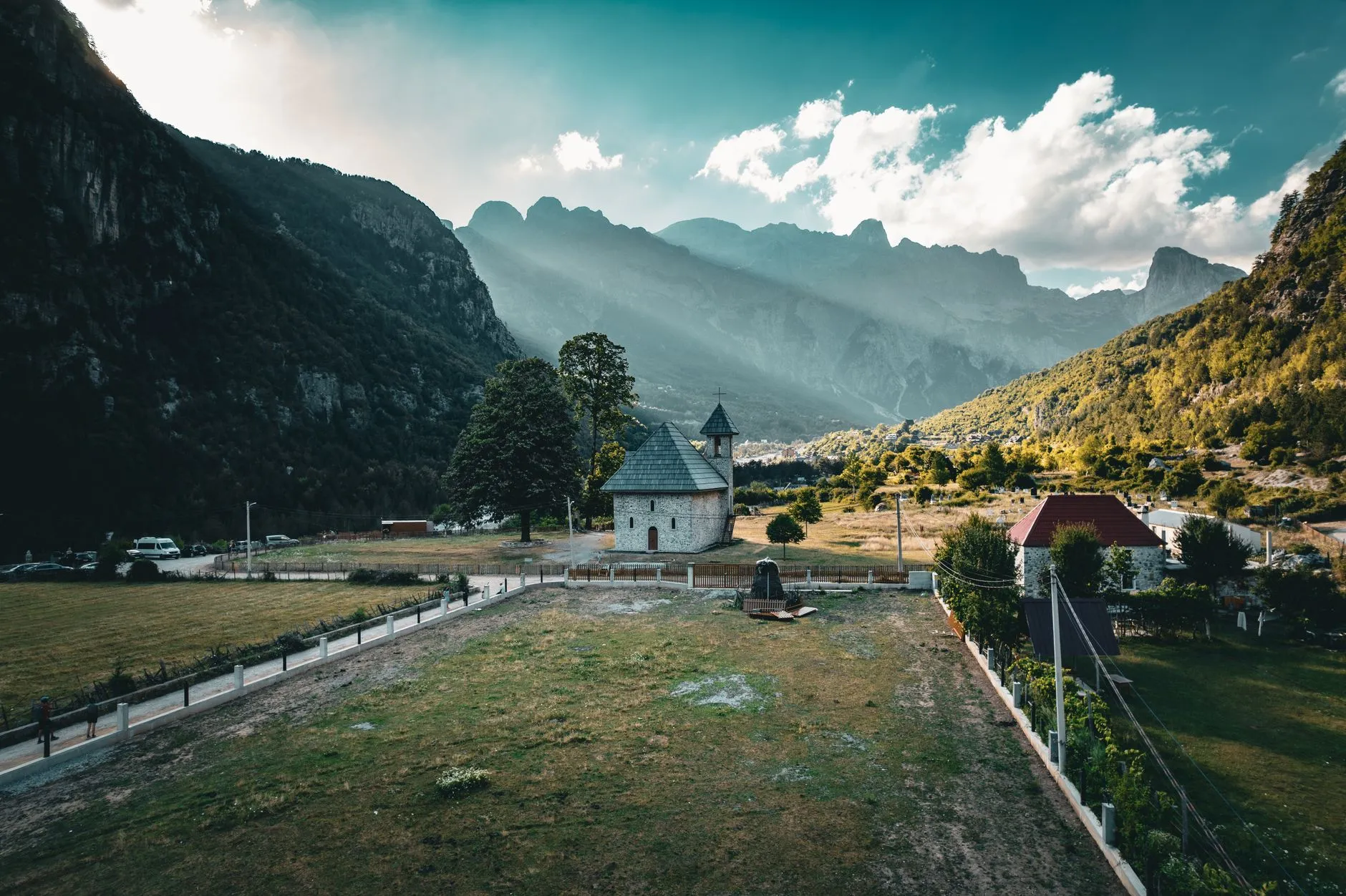
Albania — Complete Travel Guide 2026
Albania is the last genuinely cheap stretch of Mediterranean coast in Europe, and the secret is escaping fast. The same Ionian water that costs you a €120 sunbed and a €9 beer on a Croatian island will, four hours’ drive south, run the same impossible turquoise off a beach where the guesthouse is €40 and the grilled fish is €10. That’s the pitch. But Albania is also the wild Accursed Mountains, two UNESCO Ottoman towns frozen in stone, the ancient Greco-Roman city of Butrint half-sunk in a lagoon, and 170,000 mushroom-shaped bunkers left by Europe’s most paranoid dictator. Come for the cheap coast — but the country behind it is the real reason to go now, before everyone else does.
Quick Reference
The Western Balkans, on the Adriatic and Ionian seas — across the strait from the heel of Italy, bordering Greece, Montenegro, Kosovo and North Macedonia
Tirana (TIA) is the only major international airport; the new Vlorë airport is still grounded; many also fly into Corfu (Greece) or Podgorica (Montenegro) and cross over
Albanian lek (ALL) — euros are widely accepted on the coast, but you’ll get a poor walk-in rate; pay in lek
Albanian (Shqip); Italian and English widely understood; Greek in the deep south
Visa-free for most Western tourists — 90 days for EU/UK/Canada/Australia, a generous 365 days for US citizens; no advance visa or e-visa for ordinary tourism
June–September for the beaches; May and late September–October the sweet spots; the Alps are walkable June–September only
The turquoise Albanian Riviera, the Accursed Mountains, Ottoman stone towns, ancient Butrint, 170,000 concrete bunkers and Europe’s best-value coast
Tirana for culture; Saranda or Himara for the Riviera; Berat or Gjirokastër for the Ottoman heart; Theth or Valbona for the Alps — most people do two or three
Editor’s Note — go nowish
Here is the honest state of play in 2026: Albania is the Mediterranean’s last bargain, it is no longer a secret, and it is changing faster than almost any country in Europe. Five years ago you could have the Riviera nearly to yourself in August. You can’t anymore — Ksamil in peak season is busy, built-up and beach-clubbed, and the prices have crept. But “crept” is relative. The Albanian Riviera is still running at roughly half what the equivalent Croatian or Greek coast charges, the food is cheaper still, and the moment you step ten kilometres inland or off-season the old Albania — empty, cheap, startlingly beautiful — is right there.
The infrastructure is catching up but it isn’t there yet, and that’s the trade. New highways have transformed the drive south (the SH8 coastal road, the new tunnels) but the mountain roads are still rough, the furgon minibus system is gloriously informal, and Albanian drivers treat lane markings as a suggestion. You are early. That means real value and real discovery, and it also means a bit of grit — a country mid-transformation, half polished and half raw.
My advice: go nowish, not “someday.” The Vlorë airport that was supposed to open the southern coast to direct charters is still grounded (more on that below), which is buying the Riviera a couple more quiet-ish years before the floodgates. Once that airport flies, the south changes for good. This is the window.
⚠️ The Riviera is no longer empty in August. If you want the turquoise-empty-cove fantasy, go in late May, June or — best of all — September and early October, not the mid-July to mid-August crush. Ksamil and Dhërmi in peak summer are lovely but loud, beach-clubbed and fully booked.
Should You Go? Who it’s for — and isn’t
Albania is for the value-traveller who wants a proper Mediterranean coast without the proper Mediterranean prices, and who’ll trade a little polish for a lot of beauty and a fraction of the cost. It’s superb for adventurous beach-seekers (the Ionian water genuinely rivals Greece), for hikers (the Theth–Valbona trek and the Komani ferry are world-class and still cheap), for road-trippers (a self-driven coast-and-mountains loop is one of the best in Europe), for history travellers (Ottoman Berat and Gjirokastër, ancient Butrint, the bunker-and-communism story) and for anyone who likes being somewhere before it’s overrun.
It’s also for budget travellers full stop. Few coastlines this beautiful, this close to Western Europe, stretch a euro this far — a Riviera guesthouse for €40, a seafood dinner for €15, a furgon across the country for €10, an espresso served by a serious barista for under a euro.
Who it’s not for: anyone who needs everything smooth and frictionless. The roads are rough in the mountains, the buses don’t run on a clean timetable, much of the country is cash-only, and the rental-car experience involves aggressive drivers and goats. It’s not for the luxury crowd looking for a developed five-star resort coast (a handful exist; this is not the Côte d’Azur). And it’s not the place for a hassle-free public-transport-only trip if you want to see the wild bits — to reach the best of Albania you really do want a car or a tour.
Getting There & Around — TIA, the budget airlines, the ferries & the car
Tirana (TIA) is the only major airport, and it has quietly become one of the cheapest in the Balkans to fly into, because the two big ultra-low-cost carriers are in a fare war over it. Wizz Air runs its single largest base in the world out of Tirana — fifteen aircraft for the summer 2026 peak, hundreds of weekly departures, dozens of European cities, Italy above all. Ryanair is basing a fourth aircraft at TIA for summer 2026 and opening a swathe of new routes (Dublin, Milan Malpensa, Memmingen and more) to take its network past forty destinations. Add Air Albania, the flag carrier, plus the usual full-service suspects, and you can reach Tirana cheaply from across the continent — especially Italy, the UK, Germany and the rest of Western Europe. Shoulder-season fares are some of the best-value short-haul flights in Europe right now.
The new Vlorë International Airport — the one meant to land charters straight onto the southern Riviera with a 3,200-metre runway — is not operating in 2026. The runway is essentially built and a certification flight happened in 2025, but a shareholder legal dispute and pending certification mean no commercial flights this year; the opening has slipped repeatedly. For now, assume you’re flying into Tirana.
If you’re heading for the Riviera, the smart non-flying options are the ferries. The classic is the 30-minute hop from Corfu (Greece) to Saranda — up to a dozen daily summer crossings with Ionian Seaways and Finikas Lines, around €25–30 one-way, dropping you straight onto the southern coast (a brilliant move if you find a cheap flight into Corfu). There are also car-and-passenger ferries from Italy — Bari, Brindisi, Ancona and Trieste across to Durrës and (seasonally) Vlorë — the overnight Italy crossing being a great way to bring your own car.
On the ground, the local system is the furgon — informal shared minibuses that leave when full from a loose “station” (often just a street corner or car park), no timetable, no booking, cash only, dirt cheap (a few euros between towns). They’re the authentic Albanian way to move and they work, if you’re relaxed about departure times. There are some bigger intercity coaches too, and one limited, slow railway you can ignore as a tourist.
But the real recommendation is a rental car. To see the best of Albania — the coastal road, the mountain villages, the inland towns on your own schedule — a hire car (from any Tirana agency, drive on the right, automatics scarce so book early) transforms the trip. The new coastal highways are excellent; the mountain roads to Theth, the high passes and the back country are rough, narrow and slow but doable in a normal car with care. Just know what you’re signing up for: Albanian driving is assertive, overtaking is a national sport, and a goat in the road is a genuine hazard.
💡 Fly Corfu, ferry to Saranda. If a Tirana fare is steep, check flights into Corfu (Greece) and take the €25–30 ferry across to Saranda — it’s 30 minutes and drops you right on the Riviera, often cheaper and faster than flying to Tirana and driving four hours south.
Tirana — the colourful capital
Most people give Tirana a day or two on the way through, and that’s about right — it’s not a grand old European capital, it’s a young, scruffy, surprisingly fun one, and it wears its strange history on its sleeve. The centrepiece is Skanderbeg Square, a vast pedestrian plaza named for the 15th-century national hero who held off the Ottomans, ringed by the Et’hem Bey Mosque, the clock tower, the opera and the National History Museum with its giant socialist-realist mosaic. After communism, a mayor (the painter Edi Rama, now prime minister) literally had the city’s grey apartment blocks painted in wild colours and patterns as urban therapy — and Tirana has been splashily, defiantly colourful ever since.
The thing you must do is Bunk’Art — the dictator Enver Hoxha’s enormous secret nuclear bunkers, repurposed into a pair of brilliant museums. Bunk’Art 1, a five-storey, hundreds-of-room bunker on the edge of town, is a deep, immersive reckoning with the Hoxha dictatorship and the country’s WWII-to-communism history. Bunk’Art 2, a smaller central bunker, focuses on the secret police, surveillance and political persecution. Pair either with the chilling House of Leaves (the former secret-police surveillance HQ, now a museum of spying and informants) for the full, unflinching picture of one of the 20th century’s most isolated and repressive regimes. This communist reckoning is what makes Tirana more than a stopover.
For the lighter side, the Blloku district — once the sealed-off compound where the communist elite lived, now Tirana’s hippest quarter — is wall-to-wall bars, third-wave coffee, restaurants and nightlife. And on a clear day, take the Dajti Ekspres cable car up Mount Dajti for a 15-minute ride to sweeping views over the city and the plain, a cooler-air escape with restaurants and walking trails at the top.
💡 Do Bunk’Art 1 properly. It’s a fair way out (take a taxi or the dedicated bus from near Skanderbeg Square) and it deserves two or three unhurried hours — it’s a genuinely powerful museum, not a photo-op. Pair it another day with the central Bunk’Art 2 and House of Leaves.
The Albanian Riviera & Ionian coast — the headline
This is why most people come, and it earns the hype. The Riviera is the southwestern Ionian stretch where the coast road climbs over the Llogara Pass and drops to a string of beaches and coves whose water runs a turquoise-to-deep-blue that genuinely stands beside anything in Greece or Croatia — at, still, roughly half the price.
Ksamil, at the very south near the Greek border, is the postcard: a cluster of tiny islets in shallow, dazzling, almost Caribbean-clear water, nicknamed “the Albanian Maldives.” It’s the most beautiful single spot on the coast and also the most developed — in peak summer it’s wall-to-wall beach clubs, sunbeds and crowds, the water packed with pedalos. Stunning, but go early in the day or out of high season for the dream version. A beach-club lounger here runs roughly €10–20 a day in season.
Saranda is the Riviera’s main town and transport hub — the Corfu ferry port, a long palm-lined promenade, busy and not especially pretty but a practical, lively base with the cheapest beds and good onward links. Himara is the more characterful mid-Riviera base — a relaxed town with a pretty old quarter on the hill, good beaches in walking distance and a less frantic feel than the southern hotspots. Dhërmi is the chic-bohemian one — a clutch of gorgeous pebble beaches under dramatic mountains, summer beach-club party energy, and a beautiful old stone village up the slope. And Gjipe is the secret reward: a hidden beach at the mouth of a canyon, reachable only by a hike or a boat, where the wild coast still feels wild — go for the Albania the resorts haven’t reached yet.
Anchoring the south is Butrint, one of the Mediterranean’s great ancient sites and a UNESCO World Heritage gem too often skipped for the beach. Set on a wooded peninsula in a lagoon near Saranda, it’s a layered Greek, Roman, Byzantine, Venetian and Ottoman city — a stunning 3rd-century BC Greek theatre, Roman baths and mosaics, a baptistery, a Venetian fortress on the hill — wrapped in birdsong and water, and astonishingly atmospheric. Entry is around 1,000 lek (~€10), open daily; give it a half-day, and don’t leave the Riviera without it.
⚠️ Ksamil’s “Maldives” reputation comes with August reality. The water really is that colour, but in peak season the beaches are packed and beach-clubbed and the little islets crowded. For the empty-turquoise version, come in June or September, or visit early morning before the day-trippers arrive.
Berat & Gjirokastër — the Ottoman heart
Inland, two UNESCO-listed Ottoman towns are the cultural soul of the country, and both are easy, beautiful detours off the coast-or-Tirana route.
Berat is the “city of a thousand windows” — a hillside of white Ottoman houses stacked up the slope, their rows of large wooden windows staring down over the Osum river, beneath a still-inhabited medieval castle quarter (the Kala) where families have lived inside the fortress walls for centuries. Wander the cobbled Mangalem and Gorica quarters on either side of the river, climb to the castle for the Onufri icon museum and the views, and stay a night in a restored Ottoman guesthouse — it’s one of the prettiest towns in the Balkans and a fraction of the cost of an equivalent in Italy or Greece.
Gjirokastër, in the south near the Riviera, is the “stone city” — a steep, slate-roofed Ottoman town of grey stone houses and a vast hilltop castle, the birthplace of both dictator Enver Hoxha and the novelist Ismail Kadare. Its fortified tower-houses, the great bazaar, the Cold War US spy plane parked in the castle, and the surrounding sights (the Blue Eye spring, ancient Antigonea) make it a worthy one- or two-night base, and it’s perfectly placed to combine with the southern coast.
And on the way north toward Tirana, detour to Krujë — the mountain stronghold of Skanderbeg himself, with a reconstructed castle, a museum to the national hero, and a charming old Ottoman bazaar selling antiques, carpets and copperware. It’s the easiest culture day-trip from the capital.
💡 Sleep in an Ottoman guesthouse, don’t just day-trip. Berat and Gjirokastër are at their most magical at dusk and dawn, when the day-trippers have gone and the stone glows — and a restored old house with breakfast on a terrace runs €40–60. Staying over is the whole point.
The Albanian Alps — the Accursed Mountains
The far north is a different planet: the Bjeshkët e Nemuna, the “Accursed Mountains,” a dramatic alpine world of glacial valleys, stone tower-houses, highland guesthouses and one of Europe’s great hikes — and the reason serious travellers fall hard for Albania.
The classic circuit starts with the Komani Lake ferry, routinely called one of the most beautiful boat journeys in the world: a slow passage through a flooded river gorge of sheer cliffs and emerald water, like a budget Norwegian fjord. The logistics are wonderfully old-school — a furgon leaves Shkodër around 6:30 in the morning to meet the ferry, which sails about 9am from Koman to Fierza in roughly two and a half hours, foot passenger ticket about €6–7 — and it deposits you in the heart of the mountains for onward transport up to Valbona.
From there comes the famous Valbona-to-Theth trek (or Theth-to-Valbona, either direction) — a roughly 6-to-8-hour mountain hike over the Valbona Pass, around 1,000 metres of climb, between two of Albania’s most spectacular valleys. It’s well-trodden and well-marked, doable by any reasonably fit walker in good summer weather, and it links the two great Alpine villages. Theth, the more famous, sits in a bowl of peaks with its iconic stone church, the Blue Eye of Theth (a separate, gorgeous spring hike) and the Grunas waterfall; Valbona is wilder and quieter. Both run on a warm highland guesthouse culture — family-run bujtina serving home-cooked mountain food and beds for €30–50 half-board, the heart of the experience.
This is also the country of the kulla, the fortified stone tower-houses, and of the Kanun — the centuries-old highland code of customary law that, among much else, governed the infamous tradition of gjakmarrja (blood feuds). It’s a real and serious part of northern Albanian history, woven into Kadare’s novels and the architecture of those tower-houses; treat the subject with respect, not as folklore tourism. Note hard: the Alps are a summer-only destination — the passes are snowbound and the guesthouses largely closed outside roughly June to September.
⚠️ The Alps shut down outside summer. The Theth and Valbona guesthouses, the trek and the high roads are realistically June–September only; the passes are snowbound and villages emptied the rest of the year. Don’t plan a spring or autumn-shoulder mountain trip without checking that anything’s open.
The Central Coast, the Bunkers & Beyond
Between Tirana and the Riviera, and out on its own, lie the sights that fill in the picture of Albania.
Durrës, the country’s second city and main port, is the Adriatic beach city — a long sandy strip that’s the domestic summer favourite (busier and less pretty than the Ionian Riviera, but home to a large Roman amphitheatre and the Italy ferries). It’s more a transit-and-history stop than a Riviera rival.
The bunkers are everywhere, and they’re the defining strange image of the country. Enver Hoxha, convinced the whole world — East and West alike — was about to invade tiny isolated Albania, had something like 170,000 concrete bunkers built across the country in the 1970s and 80s, one for every few citizens, from mountain passes to beaches to back gardens. Most still squat where they were poured: mushroom-domed pillboxes on hillsides, half-buried on beaches, repurposed as cafés, storerooms and homes. You will see them constantly, and they tell the whole story of the paranoid regime in concrete. (The Tirana Bunk’Art museums are inside two of the biggest.)
Two more inland gems are worth the detour. Apollonia, near Fier, is a vast and atmospheric ancient Greek and Roman city — once a major centre where the young Octavian (the future Augustus) studied — now an evocative, lightly-visited ruin field of temples, a theatre and a monastery, scattered across green hills. And the Blue Eye (Syri i Kaltër), near Saranda, is the country’s most famous natural spring — a deep, almost luminous blue-and-turquoise pool bubbling up from an unmeasured depth, freezing cold and surreally vivid, an easy and popular stop on the southern circuit.
Food & Drink — the Ottoman-Italian crossover
Albanian food is the underrated crossover cuisine of the Balkans — Ottoman and Mediterranean at the base, with a heavy, delicious Italian overlay along the coast and an excellent café culture to match. It’s fresh, generous, meat- and dairy-forward inland, and seafood-driven on the Riviera, and it’s cheap.
The everyday staple is byrek — flaky filo pastry filled with cheese, spinach, meat or pumpkin, the great street snack and breakfast, often under a euro. The national dish to seek out is tavë kosi — lamb (or veal) baked in a tangy egg-and-yogurt custard, rich and unique to Albania. Look also for fërgesë (a baked pepper, tomato and cottage-cheese dish from Tirana), grilled meats (qofte, suxhuk, lamb), and the dolmas, stuffed vegetables and grilled-vegetable salads that show the Ottoman roots. On the Riviera, eat fresh seafood straight off the boat — grilled fish, mussels, octopus — at a fraction of Greek or Italian coast prices (a seafood dinner runs €12–18). Local cheeses, olives and oil are superb.
To drink: raki is the homemade grape spirit poured everywhere as a welcome and a digestif — strong, often farm-made, refuse it at your social peril. Albanian wine is improving and worth trying (look for native grapes like Kallmet and Shesh). And the coffee is a revelation — Albania has, per capita, one of the densest café cultures on earth, the Italian influence runs deep, and a properly pulled espresso or macchiato served by a serious barista costs under a euro. The café is the centre of Albanian social life; lean into it.
Costs & Money — the Med’s best value
Albania is, flatly, the best-value coastline in Europe — and that’s the headline reason to go now. Everything off the absolute peak-season Ksamil sunbed is cheap by Western European standards, and your money goes further here than in Greece, Croatia, Italy or Montenegro.
A rough daily on-the-ground budget (excluding flights):
- Backpacker / budget: ~€30–45/day — hostels and cheap guesthouses, furgons, street food and casual local restaurants.
- Mid-range: ~€55–90/day — a nice guesthouse or small hotel, restaurant meals, a hire-car day or a tour, paid sites.
- Comfortable: ~€110+/day — better hotels, a car throughout, a beach club, seafood dinners out.
Sense of individual prices: a Riviera guesthouse runs €40–60 a night (more in peak Ksamil August); a seafood dinner €12–18; a byrek or a coffee under €1; a furgon between towns a few euros; the Komani ferry about €6–7; Butrint entry around €10; a Ksamil beach-club lounger €10–20. Tipping is light and appreciated — round up, leave ~10% for good restaurant service. ATMs are common in towns (watch for high own-bank withdrawal fees; some local banks charge less); withdraw lek, and carry cash because furgons, guesthouses, markets and small towns are largely cash-only.
⚠️ Euros on the coast, but pay in lek. Hotels and restaurants on the Riviera will take euros, but they apply a poor walk-in rate — you lose money every time. Withdraw Albanian lek from an ATM and pay in lek, especially anywhere informal or inland, where euros aren’t useful at all.
Practical Information
Entry & visa: most Western tourists enter visa-free with no advance paperwork — EU, UK, Canadian and Australian passport holders get 90 days (within any 180-day period for some), and US citizens get a generous 365 days (after which you must spend 90 days outside before re-entering to reset). EU and Schengen nationals can even enter on a national ID card; everyone else needs a passport (valid at least three months, six recommended). There’s no entry fee and no online pre-registration for ordinary tourism. Confirm your own nationality’s exact terms before flying.
Safety: Albania is one of the safer countries in Europe to travel, and the old 1990s “mafia / lawless” reputation is badly out of date. Violent crime against tourists is rare, the people are famously hospitable, and the heavily-touristed coast, Tirana and the Alps are all very safe. The honest, minor caveats: petty theft and pickpocketing in crowded spots, assertive driving and rough roads (the genuine biggest risk to a visitor), and the usual care with taxi overcharging. Solo women travellers generally report Albania as comfortable and welcoming. Check your government’s current advisory, but the realistic picture is reassuringly calm.
Driving: worth its own honest note. The new coastal highways are good; the mountain roads are narrow, rough and slow; and Albanian drivers are aggressive overtakers. It’s entirely doable and the freedom is worth it, but drive defensively, don’t rush the mountain sections, expect livestock, and don’t attempt the high passes in a low car after rain. Police checkpoints are routine and polite.
The furgon system: to repeat — shared minibuses, leave when full, no real timetable, cash only, very cheap, depart from a loose “station” you may need to ask locals to find. Embrace the informality or hire a car.
Connectivity: cheap local SIMs (Vodafone, One/Telekom, Albtelecom) with generous data are easy to buy at the airport or in town with your passport — far better value than roaming, and coverage is good even in much of the mountains. Wi-Fi is standard in hotels, guesthouses and cafés.
Money & cash: lek is the currency; carry cash; ATMs are in all towns but scarce in mountain villages, so stock up before heading into the Alps.
When to Go
Albania runs two seasons at once — a sun coast and an alpine north — and they don’t perfectly overlap.
May: a lovely, underrated window — the coast warming up and uncrowded, the inland towns at their greenest, prices low, though the sea is still bracing for swimming and the high Alps still have snow on the passes.
June–September: beach season and the only real Alps season together. The Ionian water is warm and gorgeous, the Riviera is in full swing, the mountains are open and walkable. The catch is mid-July to mid-August: the coast (Ksamil especially) gets genuinely crowded and pricey, and the lowlands and cities are hot. June and early September are the sweet spots inside this window.
Late September–October: arguably the best of all for the coast. The sea is still warm, the Riviera empties and softens, prices drop, and the inland towns are perfect. Note the high Alps wind down through September — by October the mountain guesthouses and trek are mostly closing.
November–April: the off-season. The coast is quiet and mild (too cool to swim), the inland Ottoman towns are atmospheric and crowd-free and cheap, and Tirana carries on as a city break — but the Alps are shut, the mountain roads can be snowbound, and many Riviera businesses close entirely. Good for culture-on-a-budget, not for beaches or mountains.
Frequently Asked Questions
Cheapest Flights to Albania
We have tracked 940 fares to Albania from 66 cities. As of June 2026, here is what a good price looked like from each — the lowest fare we recorded, and a “great-deal” benchmark to judge a quote against. These are tracked observations, not live prices: by the time you read this they will have moved, so treat them as a yardstick, not a quote.
| From | Lowest fare we tracked | Great-deal benchmark |
|---|---|---|
| Bergamo (BGY) | €19 | €27 |
| Bratislava (BTS) | €20 | €29 |
| Rome Ciampino (CIA) | €20 | €29 |
| Prague (PRG) | €29 | €41 |
| Sofia (SOF) | €29 | €46 |
| Bucharest (OTP) | €30 | €43 |
| Barcelona (BCN) | €34 | €48 |
| Katowice (KTW) | €36 | €145 |
| Billund (BLL) | €36 | €52 |
| Nice (NCE) | €38 | €54 |
| Eindhoven (EIN) | €38 | €54 |
| Krakow (KRK) | €41 | €149 |
| Gdansk (GDN) | €42 | €148 |
| Stuttgart (STR) | €42 | €60 |
Recent deals we have posted to Albania:
- Naples to Tirana, Albania from €26
- Bologna to Tirana, Albania from €27
- Charleroi to Tirana, Albania from €29
- Genoa to Tirana, Albania from €31
- Verona to Tirana, Albania from €27
- Pisa to Tirana, Albania from €26
- Bologna to Tirana, Albania from €38
- Bergamo to Tirana, Albania from €28
- Catania to Tirana, Albania from €28
- Rome Ciampino to Tirana, Albania from €43
These are fares aifly tracked to this destination, not live quotes — they have changed since and several of the deals above may have expired. Browse current flight deals →