Andalusia — Complete Travel Guide 2026
Andalusia is where the rest of the world’s idea of Spain actually comes from — the flamenco and the bullrings, the orange trees and the white villages, the tapas and the olé. It’s also the part of Spain that spent nearly eight centuries under Moorish rule, and the legacy is the most beautiful architecture in the country: the Alhambra crowning Granada, the Mezquita’s forest of arches in Córdoba, the Alcázar gardens of Seville. Layer onto that a 1,000-kilometre coastline (one side Mediterranean, one side wild Atlantic), a mountain range you can ski in winter, the oldest city in Western Europe, and sherry country — and you have a region most people badly underestimate as “the place the Costa del Sol is.” It is so much more than that, and the heat dictates everything, so let’s start with the strategy.
Quick Reference
Southern Spain — the Moorish heart of the country, spanning the Mediterranean and Atlantic coasts and the sierras in between
Málaga–Costa del Sol (AGP) — the main gateway; Seville (SVQ); Granada (GRX); Jerez (XRY); Gibraltar (GIB) is right on the border
Euro (€) — Spain is in the eurozone; cards accepted almost everywhere, carry a little cash for village bars
Spanish, with a thick, consonant-dropping Andalusian accent; English in the tourist cities and the Costa
Spain is in the EU and the Schengen Area — EES has applied to non-EU arrivals since April 2026; ETIAS expected, date not announced (see Practicalities). Euro.
April–June and September–October are ideal; spring brings the great festivals; July–August inland (Seville, Córdoba) is brutally hot — base on the coast or aim for shoulder season
The Alhambra, Moorish palaces, flamenco, white hill villages, tapas, sherry, jamón ibérico, and the most quintessentially “Spanish” Spain there is
Seville for culture and the south-west; Granada for the Alhambra and the Sierra Nevada; Málaga for the coast and museums — most people pick one and day-trip by train
Editor’s Note — base in one city, and don’t fight the heat
Here’s the mistake nearly everyone makes: they try to “do Andalusia” in a week — Seville, Granada, Córdoba, Ronda, the Costa — renting a car and hauling their suitcase from hotel to hotel every two nights. They spend half the trip in transit, arrive everywhere tired, and never actually settle into a single Andalusian city the way you should. Don’t do that.
The smarter play, and the one this region is practically built for, is to base in one city and day-trip out by train. Andalusia’s high-speed AVE rail network is superb and the cities are close together: from Seville you can be in Córdoba in 45 minutes; Granada and Málaga are a couple of hours by rail; the whole golden triangle of Seville–Córdoba–Granada is doable as day-trips. You keep one hotel, one base, one rhythm — and you skip the car entirely until you actually need it (for the white villages and the coast, which trains don’t reach well).
The second hard truth: the heat runs the show. Seville and Córdoba are the hottest cities in mainland Europe — 40°C+ is normal in July and August, and “sightseeing” at 3pm in August Córdoba is genuinely miserable. The Andalusians solved this centuries ago with the siesta and a life lived after dark; copy them. In summer, do the monuments at opening time, vanish indoors or to the coast at midday, and come alive again at 9pm when the city does. Better still, come in spring or autumn — April-to-June and September-to-October are the sweet spot, with the bonus that spring is festival season.
And one more opinion you should hear up front: the Costa del Sol is not Andalusia’s soul. Marbella and Torremolinos are perfectly fine in their way, but the high-rise resort coast is the least interesting, least Andalusian thing in the region. If your image of southern Spain is the sunbed strip, you’ve got it backwards — the soul is inland and in the white villages, and the best coast is the wild Atlantic one west of Tarifa that nobody flies in for.
⚠️ Don’t try to see it all in a week. Two cities done properly beats five cities done from a car window. Pick a base (Seville or Granada), day-trip the neighbours by AVE, and add a few nights of white villages or coast only if you have ten days-plus. Andalusia rewards depth, not a checklist.
Should You Go? Who it’s for — and isn’t
Andalusia is for the traveller who wants the whole Spanish fantasy in one region: Moorish palaces, flamenco in a dim Triana bar, tapas crawls, hill towns clinging to cliffs, and a beach to finish. It’s superb for first-time visitors to Spain (this is the postcard, delivered), for history and architecture lovers (the Islamic heritage here is the finest in Europe), for foodies (tapas culture at its source, plus sherry and jamón), and for anyone who likes a destination with genuine atmosphere and life rather than a sanitised resort.
It’s also outstanding value for Western Europe. Spain is far cheaper than France, Italy or the UK once you’re on the ground — a proper menú del día lunch for €13–15, tapas and a glass of wine for a few euros, world-class monuments for under €20. Families do well here (warm sea, beaches, easy logistics, kids welcome late into the evening), and so do couples and culture-hunters.
Who it’s not for: anyone who can’t handle heat should avoid the inland cities in July–August full stop — it’s not a minor inconvenience, it’s debilitating. Anyone after a purely “off the beaten path” trip will find Seville, Granada and the Alhambra heavily touristed (book ahead and go early). And if your idea of a holiday is an all-inclusive behind a wristband, the Costa del Sol will oblige but you’ll have flown to one of Europe’s richest cultural regions to see a buffet — go inland.
Getting There & Around — AGP, SVQ, GRX, XRY and the brilliant AVE
Four airports serve Andalusia, and the one you fly into shapes your trip. Málaga–Costa del Sol (AGP) is the big one — the busiest airport in the region by far, with the widest European budget and full-service network (Ryanair, easyJet, Vueling, Jet2, British Airways, Lufthansa and dozens more), a fast rail link into Málaga city and onward AVE connections. It’s the default gateway whether you’re heading to the coast, Granada, or even Seville. Seville (SVQ) is the natural arrival for the culture trip and the west — well connected to European cities and a short bus/taxi from the centre. Granada (GRX) is smaller, with a more limited route map, but lands you closest to the Alhambra. Jerez (XRY) is the little sherry-country airport, useful for Cádiz and the Costa de la Luz, currently rebuilding its route network after Ryanair’s 2025 base closure. And Gibraltar (GIB), just over the British border, is a quirky alternative for the far south and the Campo de Gibraltar.
Once you’re here, the star of the show is the AVE high-speed rail network — and using it instead of a car between cities is the single best decision you’ll make. Madrid–Seville (the line that started Spanish high-speed rail in 1992) is 2h20; Madrid–Málaga is also around 2h20; Madrid–Granada runs about 3h15–3h35. Within Andalusia, Seville–Córdoba is just 45 minutes, Seville–Málaga and Seville–Granada around 2h40, and — the genuinely new bit — there’s now a direct high-speed Granada–Málaga service (via a recently completed link near Antequera that cut out the old transfer), running a handful of daily trains and turning a once-fiddly journey into a clean ~1h30 ride. Trains are comfortable, punctual, drop you in the city centre (no airport-to-town faff), and you can work or watch the olive groves roll by. Renfe runs the AVE plus its budget AVLO brand, and private operators Ouigo and Iryo compete on some routes — keeping fares low if you book a few weeks ahead, when Renfe prices like an airline (Seville–Granada for €30-odd early, near double on the day).
When do you actually need a car?
For the white villages and the rural sierras, and for the coast at your own pace — those places trains don’t reach, and a hire car (cheap from any airport, drive on the right) transforms them. But for the city-to-city legs the train beats driving every time: no parking nightmare, no tolls, faster, and you arrive relaxed. The honest rule: train between the cities, car only for the countryside and coast — and book the AVE a few weeks out (direct on the Renfe site or a rail app), when fares are cheapest.
Seville — orange blossom, the Alcázar and flamenco’s home
If you do one Andalusian city properly, make it Seville. It is the regional capital and the most intoxicating city in the south — a place of orange-tree-lined plazas, Mudéjar palaces, river-bank flamenco, and a spring so fragrant with azahar (orange blossom) that the whole city smells of it in March and April.
The headline sight is the Real Alcázar, a working royal palace and the oldest still in use in Europe — a breathtaking complex of Moorish and Mudéjar courtyards, tiled halls and lush sunken gardens (and, for Game of Thrones fans, the Water Gardens of Dorne). Book it online in advance; it sells out, and the queue without a ticket is brutal. Across the square stands the Cathedral — the largest Gothic cathedral in the world, holding Columbus’s tomb — and its bell tower, La Giralda, a former minaret you climb by ramp (built for horsemen) for the best view in the city. Then there’s the Plaza de España, the absurdly grand 1929 semicircle of bridges, tiled alcoves and a canal, one of the most photogenic spots in Spain.
Cross the river to Triana, the old gypsy and ceramic quarter and the cradle of Seville flamenco — this is where to find a real tablao or, better, a small peña (flamenco club) for the raw, unpolished article rather than a dinner-show version. Spend your evenings tapas-hopping through Santa Cruz and Alfalfa, and if your timing is right, witness the two great spectacles: Semana Santa (Holy Week, 29 March–5 April 2026 in 2026), when hooded brotherhoods carry towering pasos through packed streets, and the Feria de Abril (21–26 April 2026), a week of flamenco dresses, horses, sherry and dancing in a tented fairground that is the most Sevillano thing imaginable.
There’s far more to Seville than fits here — the Metropol Parasol “mushrooms,” the bullring, the riverside, the food scene — so for the deep dive, see our full Seville city guide.
⚠️ Seville in July and August is an oven. Routinely 40°C+, and the city visibly empties at midday. If you must come in high summer, do the Alcázar and Cathedral at opening, retreat for siesta, and come out after 9pm. Spring (with the festivals) or autumn is vastly more pleasant.
Granada — the Alhambra, free tapas and the Sierra Nevada
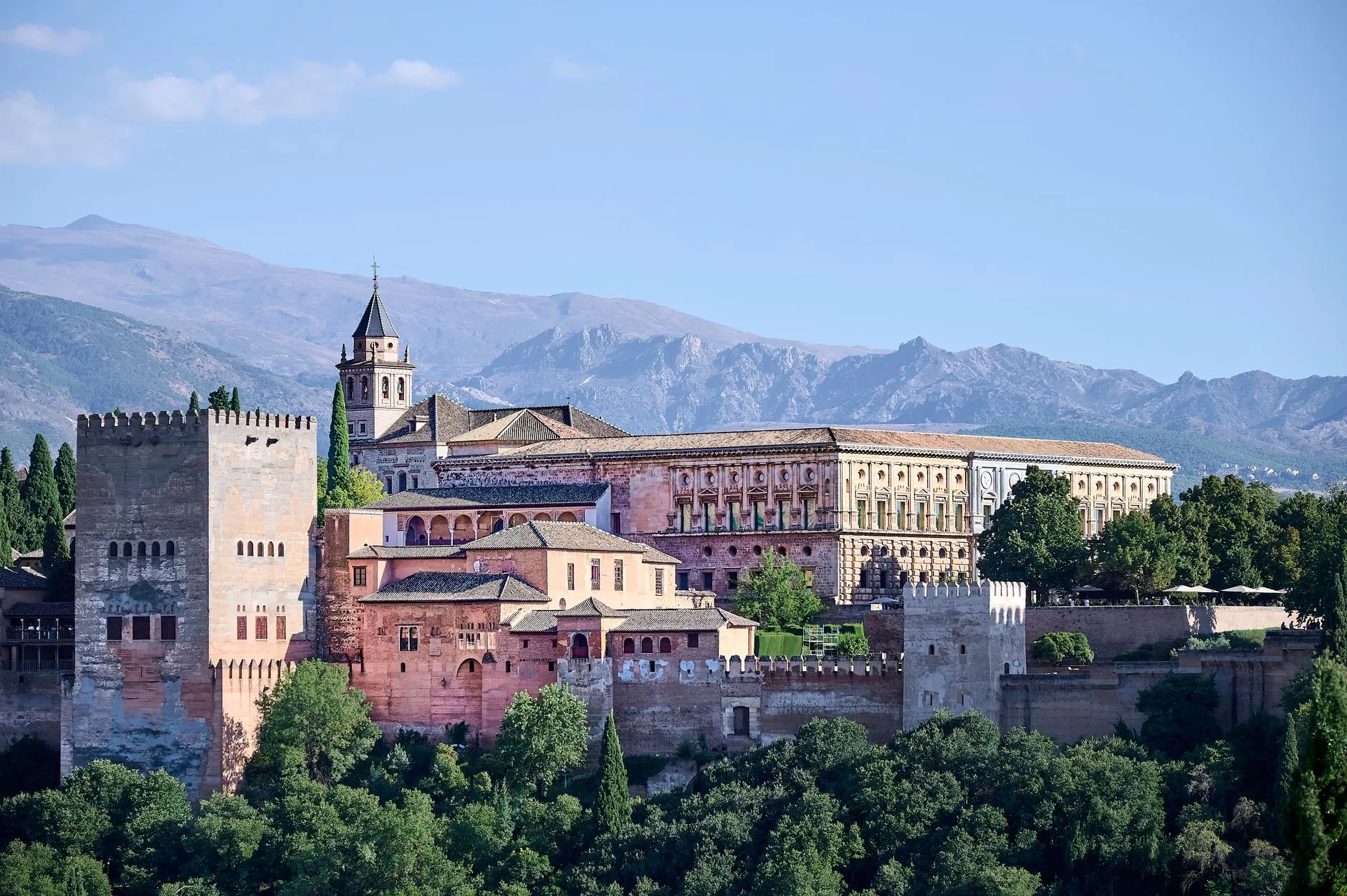
Granada is the other essential, and for many the single most magical place in Spain — because of the Alhambra, the hilltop Nasrid palace-fortress that is the crowning achievement of Moorish architecture in Europe. The Nasrid Palaces are a dream of carved stucco, honeycombed ceilings, reflecting pools and the impossibly delicate Court of the Lions; the Generalife gardens above are all water and roses; and the whole thing sits framed against the snow-capped Sierra Nevada. It is, simply, one of the great buildings of the world.
The Alhambra is the one ticket you must book months ahead. Daily visitor numbers are strictly capped, the general ticket (around €18–19) sells out weeks in advance in high season, and — crucially — your ticket gives a timed entry slot for the Nasrid Palaces that you cannot miss. Buy only from the official site (tickets.alhambra-patronato.es); third-party resellers charge a premium, and you’ll need your passport or ID to enter (tickets are nominative). If general tickets are sold out, look at the night visits or guided-tour allocations. Do not turn up hoping to buy on the day — you’ll be disappointed.
Beyond the Alhambra, Granada is the most atmospheric small city in Andalusia. The Albaicín is the old Moorish quarter — a tangle of steep white lanes climbing the opposite hill, with the Mirador de San Nicolás offering the postcard sunset view of the Alhambra glowing against the mountains. Below it, Sacromonte is the cave-dwelling Roma quarter and a home of zambra flamenco. And Granada keeps one glorious tradition the rest of Spain has mostly abandoned: free tapas with every drink. Order a beer or wine for €2.50–3 and a plate of food arrives free; do three bars and you’ve eaten dinner for the price of the drinks. It’s the best-value eating in Spain. Add the Sierra Nevada — mainland Spain’s highest peaks, with a ski resort 45 minutes from the city (you can genuinely ski in the morning and be on the coast by afternoon in spring) — and Granada earns more than the day-trip most people give it.
💡 Book the Alhambra the moment your dates are firm. Months ahead in spring and summer, not days. The general ticket is ~€18–19 on the official site; the timed Nasrid Palaces slot is unmissable. If it’s sold out, try the night visit or a reputable guided tour with its own allocation — but never a same-day gamble.
Córdoba — the Mezquita, the patios and the Roman bridge
Córdoba was, a thousand years ago, the largest and most cultured city in Europe — the dazzling capital of Moorish al-Andalus — and its monument is unlike anything else on earth. The Mezquita-Catedral is a vast 8th–10th-century mosque, a hypnotic forest of 850-plus red-and-white double arches receding in every direction — into the centre of which the Christians later dropped an entire Renaissance cathedral, leaving you to walk from Islamic Spain into baroque Spain in a single step. It’s surreal, controversial and unmissable, and Córdoba is an easy 45-minute AVE hop from Seville, making it the perfect day-trip (though it deserves an overnight).
Around the Mezquita lies the Judería, the old Jewish quarter — a maze of whitewashed lanes, flower-filled courtyards and the famous Calleja de las Flores. And Córdoba’s signature is the patio: its private courtyards are a UNESCO-listed living tradition, and during the Fiesta de los Patios (4–17 May 2026) residents throw them open, dripping with geraniums, along marked walking routes — one of the loveliest things in the Andalusian calendar, though the city is busy and hot then, so book early. Time the visit for early May if you can (gentlest weather, the festival on) but never midsummer, when Córdoba is the hottest city in Spain. As a 45-minute AVE hop from Seville, you can see the Mezquita, the Judería and the Roman Bridge at dusk — looking back at the floodlit mosque, one of the south’s great views — and be back for dinner.
Málaga — the underrated city, not just an airport
Most people think of Málaga as the place you land before going somewhere else. That’s a mistake — Málaga has quietly become one of the most enjoyable city breaks in Spain, and it deserves a couple of days in its own right.
Picasso was born here, and the Museo Picasso Málaga in a fine old palace is the anchor of a genuinely rich art scene that now includes a branch of the Centre Pompidou (in a glass cube on the port), the Carmen Thyssen museum of Spanish painting, and the Collection of the Russian Museum. The Moorish Alcazaba fortress and the Roman theatre below it sit stacked right in the centre; above them the Gibralfaro castle gives sweeping bay views. The old town is a handsome tangle of tapas bars and the cathedral nicknamed La Manquita (“the one-armed lady,” for its unfinished second tower). And the revamped port and Muelle Uno promenade, plus the city beaches a short walk from the centre, mean you can pair culture with a swim and a plate of espetos (sardines grilled on a spit over driftwood — a Málaga institution) at a beachside chiringuito.
Málaga is also the most practical hub in the region: the airport with the best connections, a fast rail line, AVE links to Madrid and Córdoba, the new direct train to Granada, and the obvious launchpad for the Costa del Sol and the white villages to the west.
💡 Give Málaga a night or two — don’t just transit it. The Picasso and Pompidou museums, the Alcazaba-and-Roman-theatre stack in the centre, the revamped port and a beach-front espetos lunch make it a proper city break, and it’s the easiest base for both the coast and a white-villages day-trip.
The Costa del Sol & the coast — resorts, and the wild Atlantic side
Andalusia has two coasts with two completely different characters, and knowing the difference saves your trip.
The Costa del Sol is the famous one — the developed Mediterranean strip running west from Málaga through Torremolinos, Benalmádena, Fuengirola and Marbella. Be honest about what it is: a sun-and-sea resort coast, heavily built up, popular with package and expat crowds, reliably warm and well-serviced but light on Andalusian soul. Marbella does glitz (Puerto Banús yachts and designer boutiques) and has a genuinely pretty old town behind the glamour; the rest is more workaday holiday-flat territory. The one Costa town that’s truly worth the trip on its own merits is Nerja, at the eastern end — a cliff-top town with the famous Balcón de Europa viewpoint, prehistoric caves, and a more characterful old core. If you want a resort base with easy beach days and city day-trips, the Costa works; just don’t mistake it for the real region.
The coast you should actually seek out is the Costa de la Luz — the wild Atlantic shore of Cádiz province, west of Gibraltar. This is a different world: huge windswept beaches, white fishing towns, fierce levante winds, and almost no high-rise. Tarifa, at the southern tip where the Atlantic meets the Mediterranean (and Africa is visible across the strait), is Europe’s kitesurfing and windsurfing capital — a young, bohemian, surf-town vibe. Bolonia has a glorious dune-backed beach and a remarkably complete Roman town (Baelo Claudia) right behind it. Conil de la Frontera and Zahara de los Atunes are laid-back white villages with miles of golden sand and superb fresh tuna. It’s harder to reach (you’ll want a car), windier, and far less developed — which is exactly the point. This is the coast Andalusians themselves go to.
⚠️ The Costa del Sol is not the highlight of Andalusia — manage expectations. It’s a fine, easy beach base, but if you came for the “real” south, weight your trip toward the cities and the white villages, and if you want a great beach, drive west to the wilder Costa de la Luz around Tarifa and Conil rather than the Costa del Sol high-rises.
The White Villages & Ronda — pueblos blancos and the gorge
Inland from the coast, scattered across the sierras of Cádiz and Málaga, are the pueblos blancos — the white villages — and they are pure Andalusian magic: clusters of whitewashed, red-tiled houses tumbling down hillsides, many topped by a Moorish castle, linked by a scenic driving route through dramatic mountain country. This is the Andalusia of the imagination, and it’s where a hire car finally earns its keep, because the public-transport links are thin.
The undisputed star is Ronda, perched on a cliff and split by El Tajo, a 100-metre-deep gorge spanned by the breathtaking 18th-century Puente Nuevo bridge — one of the most photographed views in Spain. Ronda also has Spain’s oldest bullring and a pretty old town, and it’s reachable by train, so it makes a feasible (if early-start) day-trip from Málaga or the coast, or a worthy overnight. Beyond Ronda, the classic white-village route loops through Grazalema (in a stunning natural park, one of the rainiest spots in Spain, all the greener for it), Zahara de la Sierra (clinging to a crag above a turquoise reservoir), Setenil de las Bodegas (where houses are built into and under an overhanging rock cliff), and Arcos de la Frontera (a dramatic clifftop old town). A day or two driving this loop, stopping for ventas (country inns) and viewpoints, is many travellers’ favourite part of the whole trip.
💡 Rent a car for the white villages — it’s the one part you can’t do by train. Base a couple of nights in Ronda or Arcos and loop the pueblos blancos at your own pace. The drives themselves are the attraction; allow time to stop at every viewpoint, and fuel up before you head into the sierra.
Cádiz & Jerez — the oldest city, sherry and horses
The south-west corner is its own distinct Andalusia, and one of the most rewarding. Cádiz is, by many reckonings, the oldest continuously inhabited city in Western Europe — founded by the Phoenicians around 3,000 years ago — and it’s a salty, sun-bleached, gloriously unpretentious port almost entirely surrounded by sea. Crammed onto a narrow peninsula, its old town is a warren of golden-stone lanes, leafy plazas, a magnificent domed cathedral, sandy city beaches, and the best fresh seafood in the region. It’s also the home of Spain’s wildest Carnival (February), a riotous, satirical, costumed two weeks that rivals anything in the country.
Just inland, Jerez de la Frontera is the capital of three great Andalusian institutions. First, sherry (the word is an English corruption of “Jerez”): the great bodegas — González Byass (Tío Pepe), Lustau, Sandeman — offer tours and tastings of fino, manzanilla, amontillado, oloroso and sweet Pedro Ximénez, an education in a wine most people drastically underrate. Second, horses: the Royal Andalusian School of Equestrian Art stages its famous “dancing horses” show. And third, flamenco — Jerez is one of the genuine cradles of the art, with a deeper, rawer, less touristy scene than Seville’s. Add the sherry-triangle town of Sanlúcar de Barrameda (manzanilla, beach horse-races, langoustines) and you have a corner of Andalusia built entirely around the good life.
Food & Drink — tapas at the source, sherry, and the free-plate trick
Andalusia is where tapas culture lives most intensely, and eating here is half the reason to come. The ritual is simple: small plates, shared, bar to bar, with a drink — you don’t sit down to one big meal, you crawl, ordering a couple of tapas and a glass at each stop and moving on. A tapa runs €2.50–4, a ración (a full plate) €8–14, and a glass of wine or a caña (small beer) €2–3. It’s social, cheap and endlessly varied.
The regional dishes are distinct and brilliant. Pescaíto frito — assorted small fish and seafood flash-fried in a light flour coating — is the Cádiz and coast staple, eaten from a paper cone. Salmorejo, Córdoba’s thick, chilled tomato-and-bread cream topped with jamón and egg, is the superior cousin of gazpacho and the perfect antidote to the heat. Jamón ibérico, the great cured ham, comes from the dehesa oak pastures of the sierra (Jabugo in Huelva makes the most prized) — order ibérico de bellota if you want the acorn-fed best. On the coast, espetos (sardines grilled on a spit over a beach fire) are a Málaga rite. Look also for tortillitas de camarones (lacy shrimp fritters), rabo de toro (oxtail stew, big in Córdoba), berenjenas con miel (fried aubergine drizzled with cane honey), and the gambas and clams of the Atlantic coast.
To drink: sherry, properly understood, is one of the world’s great wines and Andalusia is the only place that makes it — a crisp, bone-dry fino or manzanilla served cold is the ideal tapas partner, nothing like the sweet stuff your grandmother kept. Beyond that, cold local beer (Cruzcampo, Alhambra), tinto de verano (the locals’ lighter, smarter answer to sangria), and strong coffee. And remember Granada’s gift to the budget traveller: order a drink, get a free tapa — three bars, three ~€3 drinks, three free plates and you’ve had dinner for under €10. It’s the one place in Spain where the old custom survives in full; elsewhere you pay, but tapas are still cheap and the menú del día (fixed three-course lunch with wine, €13–16) is the best-value sit-down meal in the country.
Costs & Money — euro, affordable, and the menú del día
Andalusia is one of the best-value regions in Western Europe — noticeably cheaper than northern Spain, and a different world from France or the UK. Spain uses the euro, cards are accepted nearly everywhere (contactless is universal), and you only need a little cash for the smallest village bars and markets.
A rough daily on-the-ground budget, excluding flights and accommodation:
- Budget: ~€40–60/day — hostel or cheap pensión, tapas and menús del día, public transport, a couple of paid sights. Eat where the locals do and food drops to €20–25/day.
- Mid-range: ~€80–130/day — a comfortable hotel or boutique stay, restaurant dinners, a few monuments, the odd AVE day-trip or hire-car day.
- Comfortable: €150+/day — better hotels, fine dining, guided tours, sherry tastings.
For individual prices: a menú del día lunch (three courses + wine) is €13–16 and the smart way to eat well cheaply; tapas are €2.50–4 each, a caña €2–3, a coffee €1.50–2. Major monuments are a bargain — the Alhambra ~€18–19, the Alcázar of Seville ~€15, the Mezquita ~€13 (most sites run €8–18). An AVE Seville–Córdoba day-trip is €20–30 return booked ahead. Hotels span the range — a Costa del Sol resort or Seville boutique is €90–150 a night in season, a simple pensión €40–70. Tipping is modest: round up or leave 5–10% for good service.
Practicalities — heat strategy, siesta timing, festivals and the EU border
The summer heat strategy. Inland Andalusia (Seville, Córdoba) is the hottest part of mainland Europe — plan around it. In July–August, sightsee at opening, hydrate constantly, retreat indoors or to a pool/coast at midday, and re-emerge after 8–9pm when the cities come back to life. Many businesses still observe a siesta-era afternoon closure (roughly 2–5pm), so don’t expect lunch much after 4pm; dinner, by contrast, starts late — 9pm is normal, and a 7pm reservation marks you as a tourist.
Festival booking. The great spring events — Seville’s Semana Santa (29 March–5 April 2026) and Feria de Abril (21–26 April 2026), and Córdoba’s Patios festival (4–17 May 2026) — pack the cities and send hotel prices soaring. They’re magnificent, but book accommodation months ahead and expect crowds, road closures and a city running on festival time.
The EU/Schengen border (current rules). Spain is in the EU and the Schengen Area, and the rules changed in 2026. The Entry/Exit System (EES) has applied since April 2026 — non-EU visitors (UK, US, Canada, Australia and others) crossing a Schengen external border now have their passport, fingerprints and photo registered biometrically instead of getting a stamp; expect automated kiosks at the airport on arrival, and a little extra time at busy periods. ETIAS, the separate travel authorisation for visa-exempt visitors, is expected, with no date announced, with a transition before it’s mandatory (roughly spring 2027) — so as of mid-2026 you do not yet need it, but check before travelling later in the year. Both apply only to non-EU arrivals from outside Schengen; fly in from another EU/Schengen country and there’s nothing extra to do, and EU/EEA/Swiss citizens are unaffected. The currency throughout is the euro, and standard 90-days-in-180 visa-free entry continues for the major Western markets.
Safety and language. Andalusia is very safe; the main risk is petty theft (pickpocketing in crowded Seville, Granada and Málaga) — normal city sense covers it. Tap water is safe to drink throughout. Spanish is the language, with a heavy Andalusian accent that swallows consonants and s sounds, but English works fine in the tourist cities, and pharmacies (farmacias, green cross) handle minor ailments.
When to Go — seasons and the great festivals
Andalusia has a long, generous season, but the timing genuinely matters here because of the heat and the festival calendar.
March–June is the prime window and the region at its best. Spring brings perfect temperatures, the orange blossom in Seville (March–April), and the headline festivals — Semana Santa, the Feria de Abril, the Córdoba Patios. The countryside and white villages are green, the coast is warming, the inland cities still comfortable. April and May are hard to beat; June is hot but very pleasant.
July–August is high summer: blazing heat inland (40°C+ in Seville and Córdoba — genuinely tough for sightseeing), packed and pricey on the coast where the sea is warmest (~24–26°C). If you come now, base on the coast and treat the cities as early-morning-only excursions. Beach season, not culture season.
September–October is the other sweet spot — arguably the best of all. The sea stays warm into October, crowds thin, prices ease, and the inland cities become bearable again. October especially is superb for doing the whole region.
November–March is the quiet, cheap, crowd-free season — mild in the cities and on the coast (too cool for swimming), cold and snowy up in the Sierra Nevada (ski season roughly December–April — you can ski in the morning and reach the coast by afternoon). Cádiz’s wild Carnival lights up February. A lovely time to see the monuments without the crush; the trade-off is shorter days and the odd rainy spell.
Frequently Asked Questions
Cheapest Flights to Andalusia
We have tracked 373 fares to Andalusia from 52 cities. As of June 2026, here is what a good price looked like from each — the lowest fare we recorded, and a “great-deal” benchmark to judge a quote against. These are tracked observations, not live prices: by the time you read this they will have moved, so treat them as a yardstick, not a quote.
| From | Lowest fare we tracked | Great-deal benchmark |
|---|---|---|
| Porto (OPO) | €29 | €41 |
| Lisbon (LIS) | €31 | €44 |
| Gdansk (GDN) | €41 | €58 |
| Bucharest (OTP) | €54 | €77 |
| Hanover (HAJ) | €55 | €78 |
| Cologne (CGN) | €70 | €100 |
| Riga (RIX) | €79 | €113 |
| Billund (BLL) | €88 | €125 |
| Katowice (KTW) | €103 | €147 |
| Marseille (MRS) | €134 | €191 |
| Innsbruck (INN) | €163 | €233 |
Recent deals we have posted to Andalusia:
- Tunis to Seville, Spain from €180
- Tunis, Tunisia to Seville from €220
- Cork to Málaga, Spain from €60
- Amsterdam to Málaga, Spain from €59
- Billund to Málaga, Spain from €91
- Copenhagen to Málaga, Spain from €55
- Prague to Málaga, Spain from €82
- Bordeaux to Málaga, Spain from €55
- Prague to Málaga, Spain from €91
- Cheap Flights Madrid to Malaga 2026 — From 300 EUR
These are fares aifly tracked to this destination, not live quotes — they have changed since and several of the deals above may have expired. Browse current flight deals →