Argentina — Complete Travel Guide 2026
Argentina is not a country you “do” — it is two or three epic trips bolted onto one of the world’s great cities, separated by distances that would swallow whole nations elsewhere, and you have to choose which one you came for.
Quick Reference
Southern South America, stretching ~3,700 km from the subtropical north to the sub-Antarctic tip of Tierra del Fuego
Buenos Aires Ezeiza (EZE, international) and Aeroparque (AEP, domestic); regional hubs at El Calafate (FTE), Ushuaia (USH), Bariloche (BRC), Mendoza (MDZ), Iguazú (IGR), Salta (SLA)
Argentine peso (ARS). Roughly €1 ≈ 1,650 pesos in early 2026 — but verify the day you go; it moves
Spanish (Argentine Spanish — vos not tú, the soft “sh” for ll and y). English is patchy outside hotels and Palermo
Visa-free 90 days for UK, EU, US, Canada, Australia and ~80 other nationalities. Passport valid 6 months. Travel medical insurance now required
Patagonia: November–March (narrow window). Northwest & Mendoza: spring/autumn. Iguazú: shoulder months. Buenos Aires: year-round
Patagonia’s glaciers and granite, Malbec, the asado, tango, Iguazú, football, the painted desert of the Northwest
Buenos Aires as the hub, then pick ONE epic region per visit: Patagonia, or Mendoza-and-the-Northwest, or Iguazú
Editor’s Note: Argentina Is Two Trips, Not One
I have watched too many people make the same mistake with Argentina, and I want to save you from it. They land in Buenos Aires with ten days and a list — the glacier, the wine, the waterfall, the painted desert, a tango show, a steak — and they spend the trip in airports and on shuttle buses, arriving everywhere exhausted and leaving everywhere too soon. They go home having seen Argentina the way you’d see a film by watching the trailer six times.
Here is the thing the map doesn’t tell you until you’re standing in it: Argentina is the eighth-largest country on earth. The flight from Buenos Aires south to El Calafate is over three hours — and you’re still not at the bottom. Iguazú is two hours north in a different climate entirely, dripping subtropical. Salta and the high desert are two hours northwest and a vertical mile up. These are not day trips from one another. They are separate holidays that happen to share a flag.
So the single most useful decision you can make about Argentina is a subtractive one. Pick Patagonia (the glaciers, the granite, the end of the world) or the wine-and-desert axis (Mendoza’s Malbec and the technicolour Northwest) or Iguazú — and orbit Buenos Aires around it. Do one of those things properly and you will come home thrilled. Try to do all of them and you will come home tired.
The rule that fixes 90% of bad Argentina trips: one region, done slowly, plus Buenos Aires. Save the others for next time — and there will be a next time, because nobody comes to Argentina once.
Should You Go? Who Argentina Is For — and Who Should Wait
Argentina is for the traveller who finds the journey as much the point as the destination. It rewards people who like a long lunch, a longer dinner, an empty trail, a big sky. It is extraordinary for hikers, for anyone who loves wine and meat without apology, for landscape obsessives, and for romantics who want a city that stays up until four in the morning and means it.
It is a harder sell if you are short on time, short on patience for logistics, or short on budget — because here is the honest headline of 2026: Argentina is no longer cheap. For a decade it was the great bargain of South America, a place where a strong foreign currency went absurdly far. That era is over. Under President Milei the peso has been stabilised and, in dollar terms, made expensive; foreign tourist arrivals fell more than 20% year-on-year as Argentina priced itself level with Europe. A good steak dinner with a bottle of Malbec in Palermo can run €35–50 a head. A glacier excursion is €120–200. You are not getting a discount on the world here anymore — you’re paying roughly what you’d pay at home, for things you can’t get at home.
It’s also a poor fit if you need everything to run on time and in English. Domestic flights get cancelled and rescheduled. Strikes happen. Spanish helps enormously. And the distances mean that flexibility isn’t optional — it’s the entry fee. Don’t come for under a week: ten days is the realistic minimum for Buenos Aires plus one region, two weeks is comfortable, and three weeks lets you pair two regions without sprinting.
The Money Situation in 2026: What Actually Changed
For years the first thing any guide told you about Argentina was the “blue dollar” — the parallel black-market exchange rate that paid foreigners nearly double the official rate for physical US dollars. The advice was gospel: bring a brick of crisp, large-denomination cash, change it in a back-room cueva, and laugh at anyone paying by card. In 2026, throw that advice out. It is the most important thing to understand about the country, and it has completely flipped.
In April 2025 the Milei government lifted most of Argentina’s currency controls, backed by a large IMF agreement. The result is that the famous gap collapsed. The official rate, the MEP (financial) rate, and the blue/street rate have converged — as of early 2026 they sit within a few percent of one another, all hovering around 1,430–1,460 pesos to the US dollar. The 50–80% arbitrage that made Argentina feel half-price is essentially gone.
What this means for you in practice is genuinely good news, even if it costs you money:
- Just use your card. A foreign Visa or Mastercard, charged in pesos, is now settled at the MEP rate — which is currently the best everyday rate available to a tourist and effectively the same as the street rate, with none of the risk of carrying cash or the hassle of finding an honest cueva. Tap and go. This is the single biggest change from the old playbook.
- You no longer need a wad of physical dollars. The reason to carry cash USD has largely evaporated. Bring a modest emergency reserve in clean dollar or euro notes — useful for the rare cash-only place, a remote estancia, or a tip — but you do not need to be a walking ATM.
- Avoid local-currency ATM withdrawals where you can. Argentine ATMs hit you with steep fixed fees and low withdrawal caps, so the official rate they give is undermined by charges. Card payments beat them.
The new cardinal rule: pay by card, keep a little cash USD/EUR for emergencies, and stop hunting for a magic rate — it no longer exists. If you want to nerd out, the dólar cripto (stablecoin) rate occasionally beats the rest by a whisker, but the convenience of just tapping a card wins for almost everyone.
The flip side of stability is cost. A stronger, controlled peso means Argentina is expensive in hard currency now — which is exactly why your card rate matters less than it used to. You’re paying a fair rate for things that are simply pricier than they were.
Getting There & Around: The Long Haul and the Continental Distances
There’s no sugar-coating the approach from Europe: it’s a long-haul slog. Direct flights from Madrid, Rome, Paris, Frankfurt and London run 13–14 hours to Buenos Aires Ezeiza (EZE); via São Paulo, Madrid or a Gulf hub adds more. From North America it’s an overnight from Miami, New York, Houston or Atlanta. There’s no way around it — Argentina is far, the flight is the price of admission, and you’ll cross only one or two time zones, so jet lag is mercifully mild even if the seat time isn’t.
The bigger logistical truth is what happens after you land, and it’s the thing first-timers consistently underestimate. Between regions, fly. Do not bus. The romantic image of an Argentine road trip is real for short hops, but the long-distance numbers are brutal: Buenos Aires to El Calafate by bus is well over a day; to Bariloche, 18–22 hours; to Salta, around 20; to Iguazú, 16-plus. The overnight cama (bed) buses are genuinely comfortable — reclining seats, meals, a glass of wine — and worth doing once for a medium hop to feel the country roll by. But spend your precious days on a bus between far regions and you’ve handed your holiday to the highway.
The domestic flight network does the heavy lifting. Aerolíneas Argentinas is the flag carrier with the widest reach; Flybondi and JetSmart are the low-cost challengers and can be very cheap if you book ahead, with the usual LCC catches (bags cost extra, schedules shift). Reckon on €80–200 one-way for the main tourist routes, more in peak season.
The Aeroparque trap. International flights use Ezeiza (EZE), but almost all domestic flights leave from Aeroparque (AEP), a small airport right inside Buenos Aires — a different airport, a 45-minute cross-city transfer apart. Never book a same-day international arrival into a domestic connection without a generous buffer; build in a night in Buenos Aires between them.
Within a region, hiring a car is liberating in the Northwest, the Lake District and the wine country, where the joy is in the driving. In Patagonia’s far south, organised transfers and small tour operators usually make more sense than a rental, given the distances between the few towns.
Buenos Aires: Start Here, Briefly
Buenos Aires deserves its own guide — and it has one: read our Buenos Aires city guide for the neighbourhoods, the parrillas, the tango and the practicalities in depth. For the purposes of this guide, treat the capital as your hinge: the place you land, recover, eat magnificently, and from which every region radiates.
Give it two or three days at the start and, ideally, a final night at the end. Walk the cemetery in Recoleta where Evita is buried, drink coffee in a café that hasn’t changed its furniture since 1920, eat your first proper bife de chorizo, and stay out far too late in Palermo, where the restaurants don’t fill until ten and the bars run till dawn. Don’t over-plan it — Buenos Aires is a city for wandering, and its great pleasure is how European it looks and how thoroughly Argentine it feels. Then catch your flight south, or north, or to the wine, and let the country open up.
Patagonia, Part One: El Calafate & the Perito Moreno Glacier
If you do one thing in Patagonia, do this. The Perito Moreno glacier, an hour and a half by road from the lakeside town of El Calafate, is the rare natural wonder that over-delivers on its own hype. It is roughly five kilometres wide and rears up some 70 metres above the milky water of Lago Argentino — a wall of cracked, electric-blue ice that, unlike most of the world’s glaciers, is not visibly retreating. You stand on a network of steel boardwalks (pasarelas) built into the cliff opposite, and you wait.
And then it happens: with a crack like a rifle shot that rolls across the lake a half-second after your eyes register the movement, a tower of ice the size of a building shears off the face and collapses into the water. The crowd gasps every single time. I have stood there for two hours and not wanted to leave. It is one of the few sights on earth that justifies the long, expensive haul to reach it.
The boardwalks alone are extraordinary and accessible to anyone — flat, well-built, no fitness required. But if you can, get on the ice. The Minitrekking excursion straps crampons to your boots for an hour or two walking the glacier’s surface among the blue crevasses; the longer, tougher Big Ice trek goes deeper for the fit and ambitious. Either turns a viewing into an experience.
Skip the rushed day-trip if you can help it. The package excursions that bus you from the boardwalks straight back to a coach are the way most people see Perito Moreno, and they leave too soon. Give the glacier a full, unhurried day — the calving is unpredictable, and the magic is in waiting for it.
El Calafate itself is a functional, slightly touristy gateway town, pleasant enough for a steak and a Patagonian craft beer but not a destination in its own right. Use it as a base, eat well, and look up at the southern sky.
Patagonia, Part Two: El Chaltén & Fitz Roy
Three hours’ drive north of El Calafate, at the end of a road that runs out into the mountains, sits El Chaltén — a scruffy, wind-blasted little town that bills itself, accurately, as the trekking capital of Argentina. It exists for one reason: to put you at the foot of Mount Fitz Roy, the 3,405-metre granite spire that snags clouds on its summit and appears on the logo of a certain outdoor-clothing brand. On the rare windless dawn when the rock catches the first light and turns the colour of hot coals, it is one of the most beautiful things you will ever see.
What makes El Chaltén genuinely special — and rare in a country that’s grown pricey — is that the hiking is free and you do it yourself. No permits, no guides, no fees. You walk out of town directly onto the trails. The classic is Laguna de los Tres, a roughly 20-kilometre round-trip day hike that climbs steeply at the end to a glacial lake directly beneath Fitz Roy’s wall — demanding but achievable for anyone reasonably fit, and the single best day’s walking in Argentine Patagonia. Gentler options abound: Laguna Torre for a flatter route toward the needle of Cerro Torre, or Loma del Pliegue Tumbado for the wide panorama.
The catch is the weather, and it is a real one. Patagonia’s wind is a force of nature — relentless, theatrical, occasionally knock-you-flat. Fitz Roy spends much of its life hidden in cloud. Build in spare days. Plan three or four nights in El Chaltén, not one (and book accommodation well ahead — the town is small, pricey and fills up), so that when the sky finally clears — and it will, for an hour or a morning — you’re there to walk into it.
Patagonia, Part Three: Bariloche, the Lakes & Ushuaia
Patagonia is vast enough to contain two more entirely different moods, and which you choose depends on your taste.
Bariloche and the Lake District, in northern Patagonia, are the soft, alpine, chocolate-box version — and I mean that almost literally, because Bariloche is famous for its Swiss-style chocolate shops. Set on the enormous Nahuel Huapi lake under forested peaks, it’s a place of turquoise water, log cabins, craft beer, and the gorgeous Circuito Chico drive that loops past viewpoints and lake beaches. In the southern winter (June–August) it becomes Argentina’s main ski resort at Cerro Catedral. It’s the most accessible, family-friendly slice of Patagonia, a couple of hours’ flight from Buenos Aires, and a lovely contrast to the austere south — though it lacks the jaw-drop of the glaciers.
Ushuaia, by contrast, is fin del mundo — the end of the world, the southernmost city on earth, wedged between the Beagle Channel and the snow-streaked peaks of Tierra del Fuego. It’s bracing, frontier-flavoured, and worth it for the sheer romance of being there: a boat trip down the Beagle Channel past sea lions and lighthouses, a hike in the Tierra del Fuego national park, the old prison-museum. For many travellers, though, Ushuaia’s real purpose is as the launch port for Antarctica cruises — the overwhelming majority of which leave from here. If Antarctica isn’t on your itinerary, Ushuaia is a wonderful add-on but not, on its own, a reason to fly to the bottom of the continent.
Don’t try to combine all three Patagonias in one trip unless you have two weeks for the region alone. El Calafate + El Chaltén is the dream pairing for a first visit — the glacier and the granite, an easy transfer apart. Add Ushuaia only if you’ve time, or Bariloche only if you want the gentler version. Each extra stop is another flight and another two days.
Mendoza & the Wine Country: Malbec at the Foot of the Andes
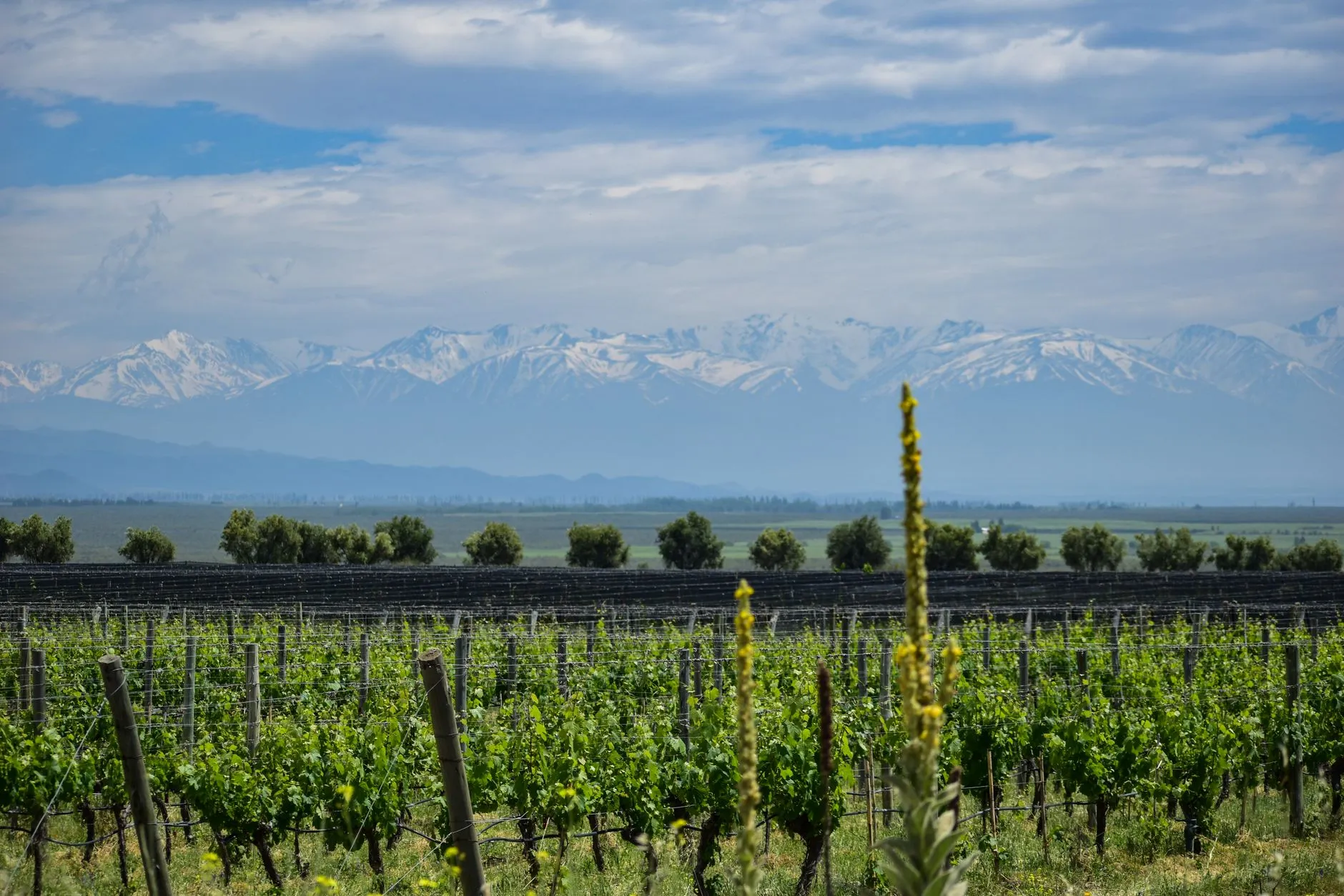
If Patagonia is the trip for the legs, Mendoza is the trip for the palate — and it’s where I’d send a first-timer who isn’t a hiker. This is the engine room of Argentine wine: roughly three-quarters of the country’s vineyards lie around Mendoza, and the country grows the lion’s share of the world’s Malbec, the inky, plummy red that Argentina took from obscurity in France and made its national signature.
What elevates Mendoza above other wine regions is the backdrop. The vines run right up to the foot of the Andes, with Aconcagua — at 6,961 metres, the highest peak outside Asia — looming on the horizon, often snow-capped above the green rows. You taste Malbec on a sun-drenched terrace with that wall of rock in the distance, and it ruins other wine countries for you a little.
Don’t waste your time only in Maipú, the closest sub-region to the city, where the “bike-and-wine” tours can feel like a hot, dusty pub crawl on two wheels. The good stuff is in Luján de Cuyo (the heartland of old-vine Malbec) and, above all, the Uco Valley — higher, cooler, more dramatic, an hour or so south, where the most ambitious modern bodegas have built temples to wine against the mountains. Hire a driver or join a small-group tour (you will be drinking; do not drive yourself), book your wineries in advance — many require reservations — and structure the day around one long bodega lunch: a multi-course tasting menu paired with the estate’s wines, on a terrace, in the sun. It’s €60–120 a head and worth every cent. It is, for my money, one of the great meals you can eat anywhere.
The Mendoza bodega lunch is transcendent; the city of Mendoza is merely fine. Stay in the wine country itself — a lodge in the Uco Valley or among the Luján vines — rather than in the city centre, and you’ll spend your evenings under the Andes instead of in traffic.
Harvest (vendimia), roughly February to April, is the region’s high-energy season, crowned by the big Vendimia festival; spring (October–December) is the prettiest. Either beats the dead of winter.
Iguazú Falls: The One Day-Trip Worth the Detour
Some natural wonders shrink when you finally see them. Iguazú does the opposite. The largest waterfall system in the world by some measures, it’s a two-and-a-half-kilometre crescent of 275 individual cascades thundering through subtropical jungle on the border with Brazil — and the noise, the spray, the butterflies, the rainbows and the sheer violence of the water reduce most people to stunned, grinning silence.
It’s a genuine logistical outlier in Argentina: two hours north of Buenos Aires by air, in a wet, green, tropical climate that feels like another country. You’ll fly into Puerto Iguazú and you’ll need at least a full day at the park, ideally a night either side.
A point of strategy that matters: the Argentine side and the Brazilian side are different experiences, and the Argentine side is the immersive one. Argentina holds about 80% of the falls and lets you walk out over and among them on a network of catwalks, culminating at the Garganta del Diablo (Devil’s Throat), a horseshoe abyss where the river simply disappears into roaring white nothing — you stand on a platform at the lip, soaked, deafened, and slightly terrified. The Brazilian side, a short hop across the border, gives you the grand panoramic view — the postcard. If you have two days and don’t mind the border crossing, do both; if you have one, do the Argentine side without hesitation. (Check current visa rules for hopping into Brazil for your nationality before you go.)
Time it for the shoulder months. Iguazú is hot, crowded and steamy at the December–February peak. The cooler shoulder periods — roughly March–May and August–September — give comfortable temperatures, strong water flow and thinner crowds. Avoid the Argentine and Brazilian school holidays, when the catwalks become a conga line.
The Northwest: Salta, Jujuy & the Painted Desert
This is Argentina’s most underrated region, and the one I’d press on any second-time visitor — the corner of the country that looks least like the European-flavoured pampas and most like the high Andean altiplano of Bolivia and Peru, all adobe villages, llamas, cactus and rock the colours of a bruised sunset.
Base yourself in Salta, a handsome colonial city with one of Argentina’s prettiest plazas and a genuinely worthwhile museum of high-altitude Inca archaeology. From there the landscape detonates into colour. Head north into Jujuy and the Quebrada de Humahuaca, a UNESCO-listed canyon that has been a trade route for ten thousand years: the village of Purmamarca sits beneath the Cerro de los Siete Colores (the Hill of Seven Colours), striped pink, ochre, green and violet; Tilcara has a pre-Inca hilltop fortress; and the staggering Serranía de Hornocal above Humahuaca is a jagged wall of fourteen-colour rock that looks computer-generated. Out west, the blinding white Salinas Grandes salt flats spread to the horizon at over 3,400 metres.
South of Salta, the other direction, runs the Quebrada de las Conchas to Cafayate, the high-desert wine town famous for crisp, floral Torrontés white — a worthy, sun-soaked counterpoint to Mendoza’s reds.
Two honest cautions. First, altitude: much of this is over 3,000 metres, and the salt flats and high passes go higher; take the first day slow, go easy on the wine until you’ve acclimatised. Second, distances again — this is a region for a hired car or a few well-chosen tours, not for ticking off in an afternoon.
The Quebrada’s colours are one of the few sights that genuinely look better in person than in the photos — the scale and the desert light don’t fit in a frame. Give the Northwest four or five days and a set of wheels; it’s the part of Argentina people come home most surprised by.
The Asado & the Malbec: How Argentina Eats
You cannot understand Argentina without understanding its relationship with meat and fire, which is less a cuisine than a creed. The asado — the Argentine barbecue — is the centre of social life: a slow, smoky, hours-long ritual where the asador tends cuts over wood embers and nobody is in any hurry. If you get invited to a home asado, cancel your other plans. It is the most authentically Argentine thing you can do.
In restaurants, the temple is the parrilla (grill house). Order a bife de chorizo (sirloin) or an ojo de bife (ribeye), order it jugoso (rare) or a punto (medium), and pair it with a glass of Malbec without overthinking it. Start, if you’re brave, with the parrillada mixed grill — which will include offal, blood sausage (morcilla) and sweetbreads (mollejas, genuinely delicious, don’t flinch). Slather everything in chimichurri. A serious steak dinner with a good bottle runs €30–50 a head; it is the meal people fly here for.
Beyond the grill: empanadas (the baked Northwestern ones from Salta are the best in the country), provoleta (a whole disc of grilled provolone), milanesa (breaded cutlet, comfort food incarnate), and dulce de leche smeared on, in or over everything sweet — including the alfajor, the national biscuit. Argentines also drink mate, the bitter green herbal tea passed around a shared gourd, with near-religious devotion; you’ll see people carrying their gourd and thermos everywhere.
Eat dinner late and don’t fight it. Argentine restaurants barely stir before 9pm and fill at 10. If you turn up at 7 you’ll dine alone among the waiters setting up. Adjust your clock, have a late-afternoon coffee and a medialuna (croissant) to bridge the gap, and lean into the rhythm.
A note for vegetarians: it’s improved hugely, and Buenos Aires and the wine country now have excellent meat-free options — but in a small-town parrilla in the Northwest, your choices narrow fast. Plan accordingly.
When to Go: The Flipped Seasons and Patagonia’s Narrow Window
The first thing to internalise: the seasons are upside down. Summer in Argentina is roughly December to February; winter is June to August. A European or North American winter escape lands you in the Argentine high summer — which is glorious for Patagonia and grim for Iguazú and Buenos Aires, which swelter.
The country is so long that there’s no single “best time,” only a best time per region:
- Patagonia has a genuinely narrow window. The trekking and glacier season runs roughly November to March, with the reliable months December–February; the shoulders of late October/November and March–April bring fewer crowds, autumn colour and still-workable weather, but by May the far south is shutting down and getting bitterly cold and dark. Outside that window, Patagonia is largely off the table for the casual visitor. This is the constraint that should anchor your whole trip if Patagonia is the goal.
- Mendoza and the Northwest are best in spring (October–December) or autumn (March–May) — comfortable temperatures, the Mendoza harvest in Feb–April, the desert at its most photogenic. High summer is hot; deep winter is cold at altitude but clear.
- Iguazú is good much of the year but best in the shoulder months (roughly March–May and August–September) — full water, bearable heat, fewer crowds.
- Buenos Aires works year-round; spring (October–November) and autumn (March–April) are loveliest, summer is hot and many locals flee to the coast, winter is mild and grey but perfectly walkable.
If Patagonia is your priority, then, the calendar makes your decision for you: come between November and March, and build the rest of the itinerary around the far south’s short summer.
Overrated: What to Skip
A guide that only tells you what’s wonderful isn’t being honest with you. Here’s where to spend your scepticism.
The tango dinner show. The big touristy cena con show in a theatre — fixed menu, sequined dancers, a busload of visitors — is the inauthentic version of one of the world’s great art forms. Skip it. If tango moves you, go to a genuine milonga (a real social dance hall) and watch porteños dance for themselves, or catch a serious stage production. The dinner show is tango as theme-park.
Caminito and La Boca, beyond a photo stop. The brightly painted lane in La Boca is the most photographed spot in Buenos Aires and one of the least rewarding — a small, crowded, slightly hustly tourist set-piece surrounded by a neighbourhood you’re told not to wander. Snap your picture, see the Boca Juniors stadium if you love football, and don’t linger.
The single-day, fly-in-fly-out glacier or Iguazú dash. These wonders punish hurry. A rushed half-day at Perito Moreno or a one-day Iguazú smash-and-grab technically lets you tick the box, but you’ll feel the box, not the place. Slow down or save it.
Trying to “see it all.” The cardinal sin, worth repeating: an itinerary that strings the glacier, the wine, the falls and the desert across ten days is a tour of Argentine airports.
What’s genuinely transcendent, and worth rearranging a trip for: the Perito Moreno calving; Fitz Roy at dawn from Laguna de los Tres; a long lunch at an Uco Valley bodega; the Devil’s Throat at Iguazú; and the colours of the Quebrada de Humahuaca. Build your trip around one or two of those, not around a checklist.
Costs & Practical Essentials
The cost reality, plainly. Argentina in 2026 is a mid-to-upper-priced destination, not a bargain. Rough daily budgets: budget (hostels, buses, cheap eats) €45–75; mid-range (3–4 star hotels, the odd excursion, good dinners) €110–165; comfortable/luxury €280 and up. A 4-star hotel runs around €110/night in high season, €60–70 in low. Domestic flights €80–200 one-way. A steak dinner with wine €30–50; a bodega lunch €60–120. Patagonian excursions €120–200. Budget up, not down.
Paying. As above — card first (MEP rate, the best you’ll get), a small cash USD/EUR float for emergencies, minimal local-ATM use. Notify your bank you’re travelling. Carry some peso cash for taxis, markets and small towns.
Insurance. Argentina now formally requires inbound travellers to hold travel medical insurance covering treatment, hospitalisation and repatriation for the length of the stay (the rule came in during mid-2025; enforcement in 2026 is real but inconsistent, and airlines have been told to check at boarding). Beyond the rule, the distances and the trekking make good cover a genuinely sensible buy — get it regardless.
Entry. Visa-free 90 days for UK, EU, US, Canadian, Australian and most Western passports; passport valid 6 months; you may be asked for onward travel and proof of funds. The 90 days is extendable once at the immigration office for a fee.
Health & altitude. No special vaccines for the main routes (check yellow-fever advice if combining with the far north or Iguazú region). The Northwest’s altitude is the real health note — pace yourself above 3,000 m.
Connectivity & language. A local or e-SIM is cheap and useful; Wi-Fi is widespread in cities, patchy in Patagonia. Learn some Spanish — even basic phrases transform the trip, as English thins out fast beyond hotels and the capital.
Pack for two climates and four seasons in one suitcase. A Patagonia-and-Buenos-Aires trip means windproof shells, layers and proper hiking boots and a nice dinner outfit for the city. Add the Northwest or Iguazú and you’re packing for high desert and subtropical jungle too. Argentina’s range is the whole point — and the whole packing problem.
Frequently Asked Questions
Cheapest Flights to Argentina
We have tracked 224 fares to Argentina from 42 cities. As of June 2026, here is what a good price looked like from each — the lowest fare we recorded, and a “great-deal” benchmark to judge a quote against. These are tracked observations, not live prices: by the time you read this they will have moved, so treat them as a yardstick, not a quote.
| From | Lowest fare we tracked | Great-deal benchmark |
|---|---|---|
| Athens (ATH) | €522 | €746 |
| Shannon (SNN) | €525 | €750 |
| Luxembourg (LUX) | €542 | €775 |
| TSR (TSR) | €596 | €851 |
Recent deals we have posted to Argentina:
- Vienna to Buenos Aires, Argentina from €721
- London to Buenos Aires, Argentina from £741
- Los Angeles to Buenos Aires, Argentina from $636
- Madrid to Buenos Aires, Argentina from €755
- Athens to Buenos Aires, Argentina from €746
- Cheap Flights New York to Buenos Aires 2026 — From 300 EUR
- Cheap Flights Miami to Buenos Aires 2026 — From 300 EUR
- Cheap Flights Madrid to Buenos Aires 2026 — From 300 EUR
- Cheap Flights London to Buenos Aires 2026 — From 300 EUR
These are fares aifly tracked to this destination, not live quotes — they have changed since and several of the deals above may have expired. Browse current flight deals →