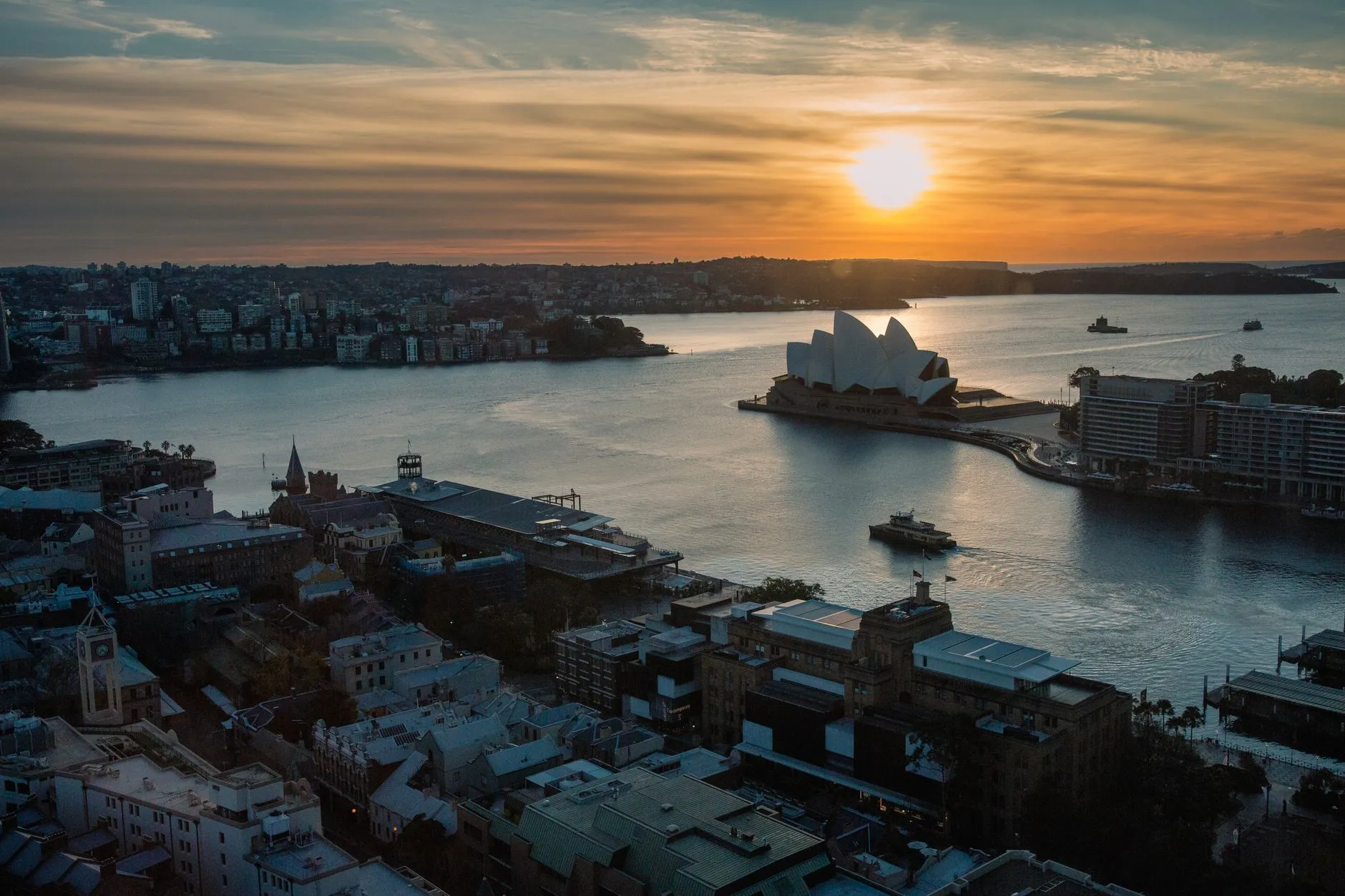
Australia — Complete Travel Guide 2026
Australia is the trip people most underestimate the size of. They look at one map, see a single country, and book two weeks to “do Australia” — and then spend a third of that holiday in airports and on the wrong side of a three-hour time difference, wondering why they feel like they’ve seen everything and nothing. The truth is harder and better: this is a continent the size of mainland Europe with the population of a mid-sized country, and the only way to travel it well is to stop trying to see it all. Choose one Australia. Go slow. Let the place be as big as it actually is.
Quick Reference
Southern Hemisphere; an island continent between the Indian and Pacific Oceans, southeast of Asia
Sydney (SYD), Melbourne (MEL), Brisbane (BNE), Perth (PER), plus Cairns (CNS), Adelaide (ADL), Gold Coast (OOL)
Australian dollar (AUD, A$); roughly €1 ≈ A$1.63 in mid-2026 (A$1 ≈ €0.61)
English
No visa-free entry. UK & EU passports: free eVisitor (subclass 651) online; US/Canada/Japan/Singapore and a few others: ETA (subclass 601), ~A$20 charge, via the Australian ETA app. Arrange before you fly.
Sep–Nov & Mar–May overall; May–Oct for the Red Centre and the reef; Dec–Feb only if you want a southern-city summer (and a hot, wet tropical north to avoid)
The Great Barrier Reef, Uluru, the Sydney Opera House, endless coastline, world-class coffee and wine, and distances that humble first-time visitors
Don’t. Base in two or three places — and pick a single region rather than “Australia”
Editor’s Note: Australia Is the Size of Europe — Plan Accordingly
Let me put a number on the thing everyone gets wrong. The flight from Sydney to Perth is about five hours — longer than London to Cairo. Driving from Cairns down the Queensland coast to Brisbane is roughly Paris to Rome, and that’s a single state on a single coastline, with the rest of the country still to go. Lay Australia over Europe and Perth sits in Portugal, Brisbane somewhere past Moscow.
I labour the point because it’s the single decision that makes or breaks a first trip. The instinct — Sydney, then the reef, then Uluru, then Melbourne, maybe Tasmania, all in fourteen days — looks reasonable on a screen and is brutal in practice. Each of those legs is a three-to-five-hour internal flight, an airport transfer, a check-in, a new hotel. Do five of them in two weeks and you have built yourself a tour of Australian terminals.
The rule I’d tattoo on every itinerary: for every internal flight you add, subtract a full day of actual holiday. Two flights is fine. Four is a logistics exercise. Five and you are not on holiday, you are commuting.
The good news is that the cure is pleasant. Australia rewards depth absurdly well: spend a week on one stretch of coast, or three days genuinely in the desert rather than overnight, and the country opens up in a way the highlight-reel version never will. Three weeks is the comfortable minimum from Europe; two weeks works only if you’re ruthless about scope. One week is a city break with a long-haul flight attached — fine, but know that’s what you’re buying.
Should You Go? Who It’s For — and Who It Isn’t
Australia is for you if you have time (three weeks ideally, two at a push), you don’t mind a long and expensive journey to get there, and you like your travel spacious rather than dense. It rewards road-trippers, divers and snorkellers, wine and food people, anyone drawn to genuinely empty landscapes, and families who want safe, easy, English-speaking adventure with the world’s best beaches thrown in. It’s superb for a milestone trip — the honeymoon, the career break, the once-in-a-decade holiday.
It’s a harder sell if you have only a week or ten days and are flying from Europe; the maths simply doesn’t work, and you’d get more for your money and jet-lag tolerance in Asia. It’s also not the place for travellers who want medieval old towns, dense layers of human history, and a new country every few days. Australia’s depth is in landscape and lifestyle, not in cobblestones. And if your budget is tight, be honest with yourself early: this is one of the more expensive destinations on earth right now. A blunt filter: if you can’t give it at least 14 nights on the ground, save Australia for a year when you can — it is too far and too costly to rush, and rushing it is the most common regret I hear.
Getting There: The Brutal Haul from Europe
There is no soft way to say it: from Europe, Australia is roughly 22 to 24 hours of total travel, almost always with one stop. The classic routings funnel through a single hub — Singapore, Dubai, Doha, Hong Kong, or Bangkok — and the leg that breaks people is the second one, the eight-to-nine-hour run down from Asia into the desert dawn over the Outback.
A few things genuinely help. Break the journey — a two-or-three-night stop in Singapore or Dubai on the way out turns one savage day into two civilised ones and resets your body clock before the main event; it’s the single best trick for arriving human. Fly into the closest gateway for your plans rather than reflexively into Sydney — if your trip is the west or the wine country, flying into Perth or Adelaide can save a domestic hop. And Perth’s non-stop link to London (a Boeing 787, around 17 hours) is the shortest single sector between the continents, worth knowing if the west is on your list.
The headline news travellers keep asking about — Qantas’s “Project Sunrise” non-stop Sydney–London flight — is real but not yet flying. It’s scheduled to launch in October 2027 on a purpose-built Airbus A350, at around 22 hours nose-to-tail, which will be the longest scheduled flight in the world. For a 2026 trip, plan on one stop and don’t wait for it. Whatever the routing, Australia sits eight to eleven hours ahead of Europe and the eastbound flight is the harder one — plan a slow first day on arrival and book nothing important for day one.
Entry: There Is No Visa-Free Australia
This trips up more travellers than anything else, so read it carefully: Australia has no visa-free entry for anyone. Every visitor — including babies, including a 24-hour transit if you’re leaving the airport — needs an electronic travel authority granted before boarding. You cannot turn up and sort it on arrival. Which one you need depends on your passport.
UK and EU passport holders (and most of Europe — 36 eligible countries) use the eVisitor, subclass 651. It is genuinely free, you apply online through the Australian government’s ImmiAccount system, and it grants stays of up to three months per visit with multiple entries inside a twelve-month validity. Despite Brexit, British passports remain firmly on the eVisitor list. Apply at least a few days before you fly; most approvals come through quickly, but don’t book a flight assuming an instant yes.
US, Canadian, Japanese, Singaporean and a handful of other passport holders use the Electronic Travel Authority, subclass 601 instead. It does the same job — three months per visit, multiple entries over a year — but it carries a service charge of around A$20 (roughly €12) and, since 2022, it can only be applied for through the official Australian ETA app on your phone. Not a website, not a travel agent: the app.
Two scam traps to sidestep. First, you’ll find dozens of third-party “visa service” sites charging €40–80 to do what the government does for free (eVisitor) or for A$20 (ETA). Use ImmiAccount or the official ETA app directly. Second: the eVisitor and ETA are visitor permits only — you cannot work on them, and the three-month limit is per visit, not per year, so a long stay needs planning.
Getting Around: You’ll Fly More Than You Drive
Here’s the thing that surprises Europeans: in Australia you fly between cities and drive within regions. There is no high-speed rail knitting the country together — the celebrated long-distance trains (the Ghan to the Red Centre, the Indian Pacific across the Nullarbor) are bucket-list journeys in their own right, not practical transport. For Sydney to Cairns or Melbourne to Perth, you fly, and the domestic market — Qantas, Virgin Australia, Jetstar — is busy and reasonably priced if you book ahead.
Within a region, the car is king, and self-driving is where Australia becomes magic. The roads are good, the distances between fuel stops long, and a hire car unlocks the coastal drives, wine valleys and hinterland that no tour bus reaches at your pace. Drive on the left, watch for kangaroos at dawn and dusk — genuinely the main road hazard, not the snakes — and respect the scale: “just down the road” in the Outback can mean two hours.
Don’t try to drive the whole coast. The romantic notion of driving Sydney to Cairns is 2,400-odd kilometres of highway, much of it unremarkable, eating days you’d rather spend in the water. Fly the long haul; drive the good bits — the Great Ocean Road, the Gold Coast hinterland, Tasmania, the southwest of WA.
City public transport is good and tourist-friendly (Sydney’s ferries are a genuine sightseeing bargain, Melbourne’s trams are free in the central grid). But the second you want to leave the city limits, you’ll want wheels.
Pick One Trip: The Three Australias
This is the most useful section in this guide, so here it is plainly. For a first visit of two to three weeks, force yourself to choose one of three trips — trying to blend them is the airport-tour mistake in disguise.
Trip one — the East Coast Classic. Sydney, then north to the Great Barrier Reef via Cairns or the Whitsundays, with the beaches, rainforest and reef towns of Queensland in between. This is the postcard Australia, the easiest to organise, the best for first-timers and families, and the one most people should do. Two to three weeks of city, coast and coral.
Trip two — Red Centre plus one city. Fly into Melbourne or Sydney, do the city properly, then fly to Uluru and give the desert three or four full days — not an overnight. Add Kakadu or the Top End if you have time. This is the trip for people who came for the landscape and the silence rather than the surf, and it’s the one that changes how you think about the country.
Trip three — go deep on a single state. Pick Tasmania, or the southwest of Western Australia, or the wine-and-coast loop of South Australia and Victoria, and spend the whole trip there with a car. This is the connoisseur’s Australia — slower, less obvious, and often the most satisfying for a returning visitor.
Mix at most two of these, never three. A common, workable hybrid: ten days East Coast plus four days Uluru. What doesn’t work is Sydney + reef + Uluru + Melbourne + Tasmania in a fortnight. Every veteran of that itinerary I’ve met describes it the same way — a blur.
The Two Big Cities: Sydney Briefly, Melbourne at Length
Sydney needs little selling and I’ll keep it short, because we have a full Sydney city guide that covers it properly. The headlines: the harbour really is that good, and the best way to see it is the cheapest — the public ferry to Manly beats any paid harbour cruise. Climb or at least walk the Harbour Bridge, swim at Bondi but walk the coastal path to quieter Bronte and Coogee, and give an afternoon to the inner-city neighbourhoods (Surry Hills, Newtown) where the city actually lives rather than the tourist waterfront.
Two or three nights is plenty for most people. Sydney is the obvious arrival city and a great front door, but it’s also the most expensive base in the country, and I’d rather spend that budget further afield. Get the harbour, the beaches, one good dinner, and move on.
If Sydney is the showpiece, Melbourne is the city I actually want to spend time in — and a lot of Australians quietly agree. There’s no single famous monument, which is the point. Melbourne is a city of laneways, coffee, bars hidden behind unmarked doors, sport as religion, and the best food scene in the country. You don’t tick it off; you live in it for a few days.
Spend your time on foot in the central grid and its laneways (Hosier Lane’s street art, the basement bars off Flinders Lane), eat your way through the multicultural neighbourhoods — Vietnamese in Richmond, Greek on the city’s edges, the legendary Queen Victoria Market — and drink the coffee, which is a genuinely world-leading scene and not a cliché. Use Melbourne as a base, too: the Great Ocean Road, the Yarra Valley wineries, and the penguins of Phillip Island are all day-trip or overnight distance. One local warning: Melbourne genuinely does “four seasons in one day,” so pack a layer and a light rain shell even in summer — and know the city is at its most charming in the cool, moody shoulder months anyway.
The Great Barrier Reef: Which Access Is Actually Worth It
First, the honest part, because you deserve it before you spend a long-haul flight on it. The reef is under real pressure: it has now suffered its sixth mass bleaching since 2016, including back-to-back events in 2024 and 2025, and a major survey to mid-2025 found nearly half the reefs studied had lost coral cover, driven mainly by ocean heat. This is not spin — the reef is a damaged ecosystem and it is changing.
And yet — it is still absolutely worth seeing, and in places it remains breathtaking. The reef is a 2,300-kilometre system, not a single site; the bleaching is patchy, the outer reef is healthier than the inshore reefs, and a good operator takes you to vivid sections with abundant fish. If anything, the threat is an argument to go now, with eyes open, and to choose operators who reinvest in the reef. Just calibrate expectations: this is a wild, stressed natural wonder, not an aquarium.
Where you access it matters enormously:
Cairns is the workhorse gateway — the cheapest, with 15-plus daily operators and the most choice. It’s where most people go, and a full-day outer-reef trip (snorkel or dive, gear and lunch included) runs roughly A$180–280 (about €110–170). The catch: Cairns itself has no beach worth the name (just a man-made lagoon) and the closest reef is a fair boat ride out.
Port Douglas, an hour north, is my preferred base. It’s smaller and prettier, it sits closer to the spectacular outer Agincourt ribbon reefs, and it pairs the reef with the Daintree — the oldest rainforest on earth, where you can be in coral one day and walking through ferns and cassowaries the next. It costs a little more; it’s worth it.
The Whitsundays, further south, are a different proposition: 74 islands, the famous swirling white silica of Whitehaven Beach, and reef access combined with sailing and island-hopping. If you want the reef plus island beach time and don’t mind it being less of a deep-dive into coral, this is the dreamy choice.
Skip the day-trip-from-a-cruise-ship version of the reef if you can. The crowded pontoon platforms are convenient and they’re better than nothing, but a small-group trip with a good outer-reef operator — fewer people, healthier coral, a guide who actually knows the site — is a different and far better experience. The reef rewards effort.
One practical note that doubles as a safety one: the warm months (roughly November to May) are stinger season, when box jellyfish and irukandji make open-water swimming risky along the tropical coast. You’ll wear a full “stinger suit” on reef trips then, and beach swimming is restricted to netted enclosures. For the reef, May to October is the sweet spot anyway — warm enough to swim, best underwater visibility, and outside stinger season.
Uluru and the Red Centre: A Three-Day Commitment, Not a Day Trip
Uluru is the trip people most want to compress, and the one that punishes compression most. Let me be clear: it is not a day trip, it is not a quick add-on, and the “fly in, see the rock, fly out” version is a waste of a long journey. Give the Red Centre three days minimum, four if you can.
The logistics: you fly to Ayers Rock (Connellan) Airport, code AYQ, direct from Sydney, Melbourne, Brisbane or Cairns — there’s no realistic way to do it by road on a normal trip. The airport is a 20-minute drive from Yulara, the resort town that is the only place to stay, about 20 minutes from the rock itself. Everything funnels through Ayers Rock Resort, which has a monopoly and prices to match; book early.
What you actually do across those days: walk the 10-kilometre base loop at dawn (the colour and the quiet are the whole point — and don’t think of climbing it; the rock is sacred and the climb has rightly been banned since 2019). Spend a half-day at Kata Tjuta, the cluster of domes 40 minutes west that locals will tell you is the more dramatic walk. See the rock at both sunrise and sunset on different days — the light is genuinely different and genuinely the experience. And give an evening to Field of Light, Bruce Munro’s installation of 50,000 solar stems glowing across the desert floor, or the Sounds of Silence dinner under the Milky Way — touristy, yes, and worth every cent.
The desert is, counter-intuitively, a winter destination: May to September is the time to go, with days of 20–30°C, almost no rain, and ideal walking weather. The catch is the nights, which drop near or below freezing — pack a proper warm layer, which first-timers never expect to need in the Australian desert. Summer here is brutal, 40°C-plus heat that closes the walks by mid-morning.
A word on respect: Uluru and Kata Tjuta are living Aboriginal cultural sites, owned and co-managed by the Anangu people. There are sections you’re asked not to photograph, the climb is closed for good reason, and the cultural experiences — guided walks, the Cultural Centre — are the part most visitors say stays with them. Treat it as a place of meaning, not a backdrop.
The Drives and the Wild Coasts: Great Ocean Road, Byron, the West, and Tasmania
Beyond the big-ticket sites, this is where Australia turns into the country people fall in love with. A few that earn their place:
The Great Ocean Road (Victoria) is the classic, and it lives up to it: roughly 240 kilometres of cliff-edge coast from Torquay west, past surf beaches and rainforest to the Twelve Apostles, the limestone stacks rising out of the Southern Ocean. Don’t do it as a single brutal day trip from Melbourne, which is how the bus tours sell it — give it two days, stay overnight in Apollo Bay or Port Campbell, and drive it westbound for the best light and the safest pull-offs.
Byron Bay and the northern New South Wales coast are the bohemian, beachy, slightly-too-popular heart of the east coast — superb beaches, the iconic Cape Byron lighthouse walk to the most easterly point of the mainland, and a wellness-and-surf culture that’s either your thing or very much not. Just north, the Gold Coast is brash high-rise beach Australia (Surfers Paradise) wrapped around a surprisingly lush hinterland of rainforest and waterfalls — skip the theme parks, head inland.
Western Australia and Perth are the trip nobody plans and everybody who does it raves about. Perth is sunny, relaxed and isolated; Rottnest Island offshore has the famously photogenic quokkas; Margaret River a few hours south pairs world-class wineries with a wild surf coast; and far up the coast, Ningaloo Reef offers what the Great Barrier Reef can’t — swimming with whale sharks straight off a fringing reef you reach from the beach. The west is a whole trip in itself, and the one I’d send a returning visitor to.
Tasmania deserves its own holiday: cool, green, mountainous and food-obsessed, with Cradle Mountain and the southwest wilderness, the convict history of Port Arthur, and in Hobart the extraordinary, irreverent MONA (the Museum of Old and New Art), reason enough to fly down on its own. Hire a car, give it a week, and don’t expect tropical weather — this is the cool end of the country.
If I had to send a first-timer to exactly one of these, it’s the Great Ocean Road paired with a couple of nights in the wine country. If I had to send a second-timer, it’s Western Australia or Tasmania — the two places that feel like a different country and that most visitors never reach.
Food, Wine and the Coffee Obsession
Australia’s food story is one of its genuine, underrated joys, and it runs on three things: immigration, ingredients, and coffee. Decades of migration — Italian, Greek, Vietnamese, Lebanese, Chinese, and lately a wave from across Asia — have given the cities a casual, produce-led food culture that punches far above what most Europeans expect. There’s no heavy national cuisine; instead, brilliant Vietnamese in Melbourne, superb modern seafood in Sydney, and a brunch culture that is, frankly, the best in the world.
The coffee is not hype: the flat white is an Australian-and-Kiwi invention, the café standard is astonishingly high, and even a small-town roadside espresso will usually shame what you’d get in much of Europe. Order a flat white and skip the chains.
The wine is world-class and refreshingly accessible: the Barossa Valley and McLaren Vale in South Australia for big reds, the Yarra Valley outside Melbourne and the Hunter Valley north of Sydney for cooler-climate styles, and Margaret River in the west for elegant cabernet and chardonnay. Cellar-door tastings are relaxed and often free or cheap, and a day touring a region (with a designated driver or small-group tour — drink-driving limits are strict and enforced) is one of the best-value pleasures going.
Eat where the locals brunch, not where the harbour view is. The waterfront tourist restaurants in Sydney and Cairns are where you overpay for the worst version of Australian food. The good stuff is in the inner suburbs — Surry Hills, Fitzroy, the night markets — and it’s cheaper too.
One thing to know: tipping is not expected in Australia. Staff are paid a proper minimum wage, prices are what you pay, and a tip is a genuine extra for great service, not an obligation — which quietly takes the edge off the cost.
Money: Australia Is Expensive — The Honest Math
There’s no kind way to frame this: Australia is one of the more expensive destinations in the world right now, and it will be the thing you most have to plan around. The flight alone is a major cost from Europe, and on the ground, prices land somewhere between “pricey Western European city” and “Scandinavia,” depending on where you are.
Concrete numbers, mid-2026, with €1 ≈ A$1.63: a flat white runs about A$5–6 (€3–3.70); a casual café lunch A$20–28 (€12–17); a mid-range dinner with a drink A$50–70 a head (€30–43); a pint of craft beer A$12–15 (€7–9). A double room in a decent mid-range hotel is comfortably A$200–300 a night (€120–185) in the cities and more in peak season; a reef day-trip A$180–280 (€110–170); a hire car maybe A$60–90 a day (€37–55) before fuel. Ayers Rock Resort and the remote regions carry a premium on everything because there’s no competition.
The budget goes on internal flights and accommodation, not meals — so the single biggest saving lever is taking fewer internal hops (back to that core rule) and staying longer in fewer places. Self-catering apartments, the cheap and excellent supermarket food, BYO-wine restaurants (“bring your own,” with a small corkage), and the free or near-free big-ticket experiences — beaches, coastal walks, the Sydney ferries, national parks — keep it sane.
The honest planning figure: outside the flight, budget around €150–250 per person per day for a comfortable mid-range trip — more in the cities and the Red Centre, less if you self-cater. It’s not a cheap holiday. It is, done right, one you’ll remember for a decade — which is the trade.
When to Go: The Flipped, Fractured Seasons
Two things to get straight. First, the seasons are reversed — December to February is summer, June to August is winter. Second, and more important, Australia is too big to have one “best time”; the right month depends entirely on which Australia you’ve chosen.
The tropical north (Cairns, the reef, the Top End, Darwin) has two seasons, wet and dry, not four. The dry season, roughly May to October, is the time to go: warm, sunny, low humidity, best reef visibility, and outside the dangerous stinger season. The wet (November to April) brings heat, humidity, monsoon downpours and jellyfish — avoid it for the reef.
The Red Centre and the desert are, counter-intuitively, a winter destination: May to September for walkable 20–30°C days, with cold nights. The southern summer roasts it.
The southern cities and south coast (Sydney, Melbourne, the Great Ocean Road, Tasmania, the wine regions) are at their best in the shoulder seasons — spring (Sep–Nov) and autumn (Mar–May) — mild, uncrowded, ideal for driving and wine country. Summer is beach-and-festival season but hot and busy; winter is cool and quiet (and genuinely cold in Tasmania and the alps).
The planner’s sweet spot: if you’re combining the reef and a southern city, aim for the shoulder months at either end — late April–May or September–October. That window gives you a workable dry-season reef and pleasant southern weather, dodging both the tropical wet and the southern peak-summer crowds and prices. It’s the closest thing Australia has to an all-rounder season.
A note on crowds: the Australian school summer holidays (mid-December to late January) and Easter are the busiest and priciest weeks, especially on the coast and at Uluru. Avoid them if you can.
Overrated: What I’d Skip
Some sacred cows, and where I’d spend the time instead.
Surfers Paradise / the high-rise Gold Coast strip. A wall of towers over a decent beach, with a theme-park-and-nightclub culture that isn’t most travellers’ Australia. Skip the strip; head into the Gold Coast hinterland rainforest, or up to Byron, instead.
The crowded reef pontoon day-trips. Convenient, but the big platform tours pack hundreds of people onto worn, inshore-ish sections of reef. Pay a bit more for a small-group outer-reef operator and the experience transforms.
“Doing” Uluru in a flying overnight. A one-night Uluru visit is the classic false economy — commit three days or leave it for a trip when you can.
Driving the entire east coast. Romantic on paper, mostly highway in practice; fly the long legs and drive only the genuinely scenic stretches.
Cairns city itself as a destination. It’s a functional reef-launch town with no real beach — fine for a night, but don’t linger. Base in Port Douglas or get out to the islands.
And one thing that is not overrated, contrary to the cynics: the Sydney Opera House. Yes, it’s the obvious shot. It’s also genuinely one of the great buildings of the twentieth century, and seeing it from the water on a ferry at dusk is worth doing without irony.
Staying Safe: Sun, Surf, and the Wildlife You Actually Worry About
Australia’s fearsome reputation is mostly theatre, but the real risks aren’t the ones the memes obsess over. Here’s the honest ranking.
The sun is the genuine danger, and the one tourists underestimate. Australia has the world’s harshest UV — the ozone, the latitude, the clear air — and a pale European can burn badly in under fifteen minutes in summer. “Slip, slop, slap” is a national mantra for a reason: cover up, wear a high-factor sunscreen and reapply it, wear a hat, and respect the midday sun. This will affect your trip far more than any animal.
The surf and the water come next. Australian beaches have powerful rips that catch strong swimmers every year. The rule is simple and lifesaving: swim only at beaches patrolled by surf lifesavers, and stay between the red-and-yellow flags. Caught in a rip, don’t fight it — float, signal, and let it carry you out before swimming parallel to shore. In the tropical north, heed the stinger warnings (November–May).
The wildlife, proportionately. Yes, there are snakes, spiders, sharks and saltwater crocodiles — take them seriously where they live, but keep perspective: snakebites are rare and almost never fatal with prompt treatment, and the famous spiders kill essentially no one anymore. The one to genuinely respect is the saltwater crocodile in the far north — Queensland’s tropical coast, the Top End, the Kimberley: obey the “no swimming — crocodiles” signs absolutely and never assume a remote waterway is safe. Away from croc country, the real hazard is mundane — kangaroos on the road at dawn and dusk — so drive cautiously then and avoid rural roads at night.
The sensible traveller’s summary: sunscreen, swim between the flags, respect croc signs in the north, and slow down on rural roads at dusk. Do those four things and Australia is one of the safest, easiest places on earth to travel — clean water, excellent healthcare, low crime, an outdoors built for visitors.
Bring a Type I plug adapter (230V) and travel insurance that covers your activities — diving in particular. And sort your ETA or eVisitor before you leave home, not at the airport.
Frequently Asked Questions
Cheapest Flights to Australia
We have tracked 4,519 fares to Australia from 180 cities. As of June 2026, here is what a good price looked like from each — the lowest fare we recorded, and a “great-deal” benchmark to judge a quote against. These are tracked observations, not live prices: by the time you read this they will have moved, so treat them as a yardstick, not a quote.
| From | Lowest fare we tracked | Great-deal benchmark |
|---|---|---|
| Istanbul (SAW) | €483 | €690 |
| Athens (ATH) | €524 | €748 |
| Istanbul (IST) | €536 | €1112 |
| Dublin (DUB) | €568 | €812 |
| Budapest (BUD) | €577 | €824 |
| Vienna (VIE) | €581 | €830 |
| Copenhagen (CPH) | €584 | €834 |
| Geneva (GVA) | €584 | €835 |
| Rome (FCO) | €584 | €835 |
| Milan (MXP) | €589 | €868 |
| Barcelona (BCN) | €599 | €856 |
| Helsinki (HEL) | €619 | €884 |
| Marseille (MRS) | €633 | €904 |
| Malaga (AGP) | €645 | €922 |
Recent deals we have posted to Australia:
- Los Angeles to Brisbane, Australia from $699
- Dublin to Brisbane, Australia from €730
- Frankfurt to Brisbane, Australia from €740
- Los Angeles to Brisbane, Australia from $951
- London to Sydney, Australia from £800
- Frankfurt to Sydney, Australia from €705
- Seoul to Perth, Australia from $350
- Seoul, South Korea to Perth, Australia from $446
- Bangkok, Thailand to Perth, Australia from $294
- Jakarta, Indonesia to Perth, Australia from $243
These are fares aifly tracked to this destination, not live quotes — they have changed since and several of the deals above may have expired. Browse current flight deals →