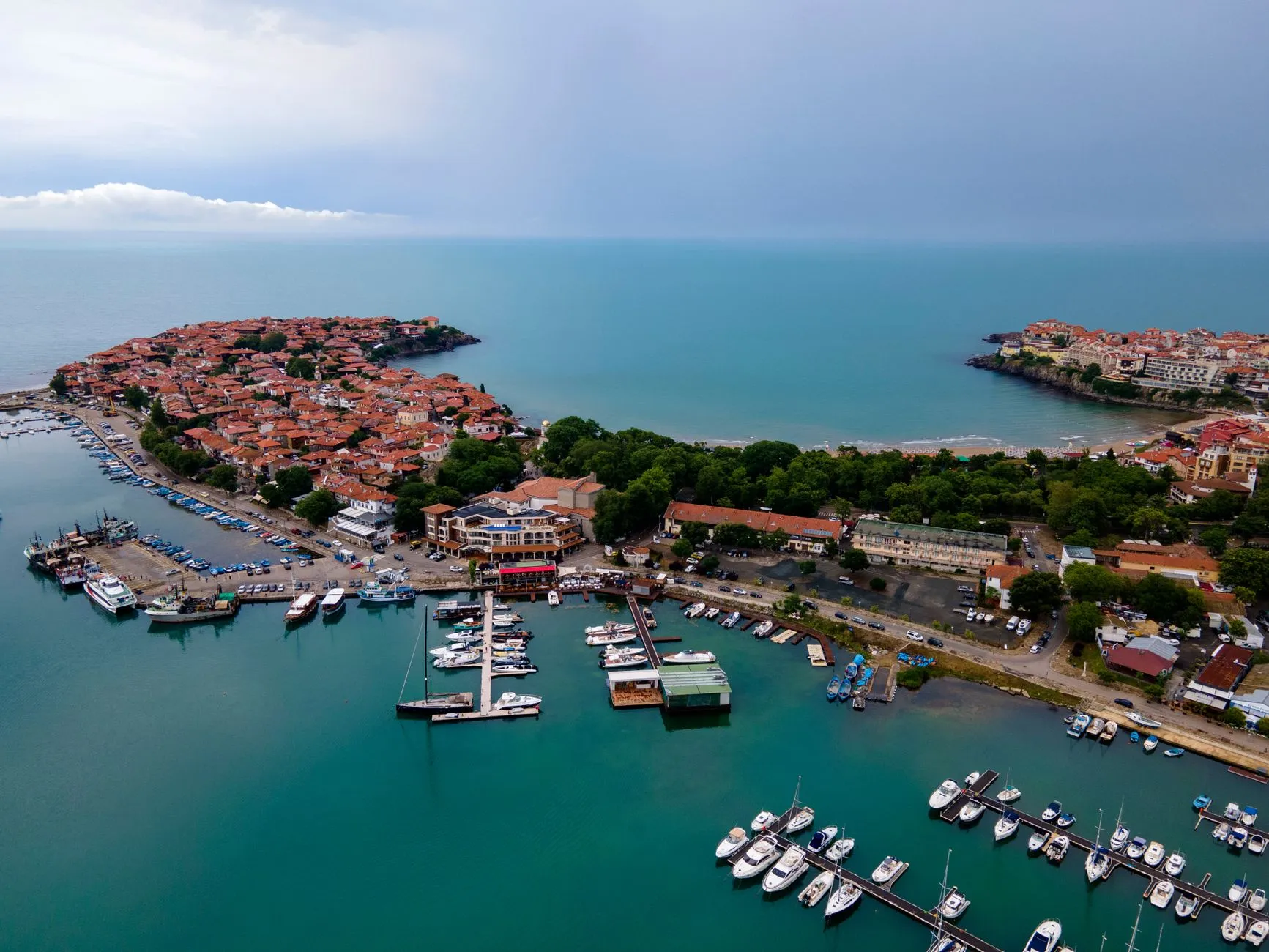
The Bulgarian Black Sea Coast — Complete Travel Guide 2026
Bulgaria’s Black Sea coast is the bargain that splits the room: on one stretch you get Sunny Beach and Golden Sands — vast, cheap, neon mega-resorts where a pint costs less than €2 and the sangria is sold by the bucket — and a few kilometres away you get Nesebar and Sozopol, two cobbled, sea-girdled old towns so lovely they’d be heaving with cruise crowds anywhere else in Europe. The trick to a good trip here is knowing which Bulgaria you’re booking, because the photos for both come up under the same search — and getting that wrong is the single biggest mistake people make.
Quick Reference
Eastern Bulgaria, ~378 km of Black Sea coast from Romania to Turkey
Varna (VAR) in the north, Burgas (BOJ) in the south — both small, seasonal, package-charter heavy
Euro (€)** — Bulgaria joined the euro on 1 January 2026; the lev is gone
Bulgarian (Cyrillic alphabet); English widely understood in the resorts, less so off the strip
Full Schengen member — no routine internal border checks; EES live, ETIAS expected, date not announced
Mid-June and September for warm sea + sane crowds; July–August for peak heat and chaos
Europe’s cheapest mainstream beach holiday, mega-resorts, and two genuinely beautiful UNESCO-grade old towns
Nesebar/Sozopol for charm, Sunny Beach for nightlife, Golden Sands/Albena for families, Sinemorets for wild quiet
Editor’s Note: The One Decision That Makes or Breaks This Trip
Forget agonising over hotels first. The decision that actually determines whether you love or loathe this coast is two-pronged: north or south, and mega-resort or old town.
North means Varna and the resorts strung above it — Golden Sands, Albena, St Constantine & Helena — plus day-trip gems like Balchik’s palace and the cliffs of Cape Kaliakra. South means Burgas and its orbit: the monster party resort of Sunny Beach, but also the two old towns (Nesebar and Sozopol) and the genuinely wild beaches near the Turkish border. The north feels a touch more grown-up and forested; the south has the better culture and the better wild south, but also the loudest, tackiest resort on the whole coast.
The second axis matters more. If you book a tower-block all-inclusive in the middle of Sunny Beach expecting “the Bulgarian Riviera,” you’ll spend a week dodging timeshare touts and £6 cocktail-bucket hawkers and wonder why everyone raves about this coast. If you instead base yourself in an old-town guesthouse in Sozopol or a quiet apartment near Nesebar’s peninsula, you’ll get one of Europe’s best-value coastal holidays. The resorts and the beautiful bits are not the same place — and the package-holiday machine is very good at blurring that. My honest steer: come for the old towns and the wild south, treat the mega-resorts as something you dip into, not sleep in.
Insider tip: The most photographed images of “the Bulgarian coast” — stone houses tumbling to the sea, red roofs, churches on a headland — are Nesebar and Sozopol, NOT Sunny Beach or Golden Sands. If those pictures sold you the trip, book your bed in the old town, not the resort strip.
Should You Go? Who It’s For — And Who It Isn’t
This coast is built for value beach holidays, full stop. If your priorities are reliable summer sun, a wide sandy beach, cheap food and drink, and a holiday that costs a fraction of Spain, Italy or Croatia, Bulgaria delivers harder than almost anywhere in Europe. It’s a standout for families (shallow, gently shelving sand at the big resorts; cheap kids’ meals; Albena in particular is car-free and pram-friendly) and for groups on a budget who want sun by day and a riotous strip by night.
It also rewards a quieter, more curious traveller far more than its reputation suggests. Culture-seekers and couples who’d normally never touch a package resort can have a wonderful time here if they base in Sozopol, Nesebar’s old town, or the south coast and use a car — the history is real (Thracian, Greek, Roman, Byzantine, Bulgarian Revival), the old towns are genuinely atmospheric, and the wild south near Sinemorets is properly beautiful.
Who it isn’t for: anyone expecting polish and design-led sophistication. This is not the Amalfi Coast. The big resorts are functional concrete, the service can be brusque, and the worst of Sunny Beach is genuinely grim — overpriced strip bars, aggressive touts, pickpockets working the crowds. Foodies wanting fine dining will be underwhelmed (though they’ll eat very well and very cheaply on simple grilled fare). And if you can’t drive, you’ll be stuck — the loveliest bits (Kaliakra, the back beaches, the cliff villages) are effectively car-only.
Getting There: Varna & Burgas Airports, and Which One You Actually Want
There are two coastal airports, and choosing the right one saves you a long, expensive transfer. Both are small, seasonal, and dominated by summer charter and budget flights from the UK, Germany, Poland and Scandinavia. (Out of season, service thins dramatically and you may have to route via Sofia and drive or fly on.)
Varna Airport (VAR) is the gateway to the north: Golden Sands is ~20–30 minutes away, St Constantine & Helena and Varna city are minutes, Albena ~40 minutes, Balchik beyond. From Varna airport, the bus 409 runs every ~15 minutes through the city centre and on to Golden Sands (~50 min end to end) for around €0.50 — astonishing value. A taxi to Golden Sands is roughly €25–28 / 30 minutes.
Burgas Airport (BOJ) serves the south: Sunny Beach and Nesebar are ~25–30 km / 30 minutes away, Pomorie closer still, Sozopol ~35 km south. Pre-booked shared shuttles run a few euros; a private taxi/transfer to Sunny Beach is modest. Burgas city centre itself is a short, cheap bus or taxi ride.
The cardinal sin is flying into one and staying near the other. Varna airport to Sunny Beach (or vice versa) is a ~100 km slog that private transfers will happily sell you for around €80 — a painful start to a cheap holiday. Match the airport to your base: north resort → Varna; Sunny Beach/Nesebar/Sozopol → Burgas.
Caution: At both airports, ignore the freelance drivers who approach you in arrivals. Use the official taxi rank (Varna’s airport taxis are metered) or, better, a pre-booked transfer or the public bus. The classic scam is an “agreed” fare that quietly triples by the time you reach the hotel.
North or South? An Honest Character Map
The North (around Varna). The headline resort is Golden Sands (Zlatni Pyasatsi) — a long, wide, clean arc of fine sand backed by a wall of hotels and a forested national park rising behind. It’s lively but not feral: think water sports, family hotels, a decent spread of bars, but nothing like Sunny Beach’s round-the-clock mania. Just up the coast, Albena is the family pick — a self-contained, largely car-free resort with one of the gentlest beaches on the coast and a calm, contained feel that parents love. St Constantine & Helena, between Varna and Golden Sands, is the oldest resort on the coast, leafier, spa-focused and quieter. And Varna itself is a real, working third city — a long sea garden (Primorski Park), a good archaeological museum (home to the world’s oldest worked gold), Roman thermae, and proper restaurants and nightlife that aren’t aimed solely at tourists. The north’s day trips are some of the best on the coast: Balchik, with Queen Marie of Romania’s eccentric little palace and its gorgeous terraced botanical gardens, and Cape Kaliakra, a dramatic red-rock headland knifing two kilometres into the sea, with cliffs, ruins, dolphins offshore, and the Aladzha rock monastery nearby.
The South (around Burgas). This is where the coast gets both worse and better. Sunny Beach (Slanchev Bryag) is the largest resort in Bulgaria and the loudest party destination in the country — an 8 km wall of high-rises and a famously cheap, famously chaotic strip. It’s brilliant value and genuinely fun if that’s what you want (stag and hen groups, 20-somethings, cheap everything); it’s a misery if it isn’t. But the south also holds the two best things on the entire coast. Nesebar, on its own little peninsula moments from Sunny Beach, is a UNESCO World Heritage town of 40-odd medieval churches and timber Revival houses on cobbled lanes — over 3,000 years of history packed onto a rock. And Sozopol, south of Burgas, is the artsy, laid-back old-town alternative: 7th-century-BC Greek Apollonia, stone-and-timber houses, a summer arts festival (Apollonia), and a far mellower vibe than anything up north. Beyond it lie the quiet spots — Pomorie (salt, mud spa, wine), Ahtopol and Sinemorets and the wild Strandzha coast.
The honest summary: north for a balanced family beach holiday and the best day trips; south for the best culture, the best wild beaches — and the worst resort. Prices across both are similar and uniformly low; character is the real difference.
The Beaches
The selling point is genuine: long, wide, fine-sand beaches, gently shelving, with warm-ish shallow water — exactly what families and casual swimmers want. The resort beaches (Golden Sands, Sunny Beach, Albena) are the widest and best-serviced, with Blue Flag stretches, lifeguards, and rows of sunbeds. Sunny Beach’s strand runs ~8 km and reaches 100 m wide in places.
The catch is the commercial beach economy. Vast central sections of the resort beaches are carpeted in paid sunbeds and parasols (typically €5–10 for a set per day), and the free zones can be crowded and scrappier in July–August. There are usually free public sections — walk to the ends of the resort beach, where it’s cheaper and calmer.
Away from the mega-resorts, the beaches get lovelier and emptier. In the south, Sozopol’s town beaches and nearby Kavatsi and Smokinya are good, and as you push toward the Turkish border the coast turns wild: Veleka (where the river meets the sea at Sinemorets, a freshwater-saltwater mix backed by Strandzha forest) and Silistar are among the most beautiful and undeveloped beaches in the country — soft sand, clear water, almost no infrastructure. In the north, the Kamchia reserve and the cliffs around Kaliakra and Bolata offer dramatic, undeveloped scenery rather than sunbed strips.
Tip: Black Sea water is calm and warm-ish but not Mediterranean-blue clear, and June can still be brisk (~21 °C). For the warmest, clearest swimming go in late July through early September, when the sea hits 24–26 °C.
The Old Towns — Nesebar & Sozopol (The Real Reason to Come)
If you do one thing on this coast beyond lying on sand, make it the old towns. They are the antidote to everything off-putting about the resorts.
Nesebar is the showstopper. The “Pearl of the Black Sea” sits on a tiny peninsula tethered to the mainland by a thread of an isthmus, and its old town — a UNESCO World Heritage Site since 1983 — is an open-air museum of around forty medieval Orthodox churches in varying states of ruin and restoration, Byzantine brick-and-stone facades, and wooden Bulgarian Revival houses leaning over cobbled lanes. It’s beautiful early and late in the day; at midday in August it’s mobbed (it’s a ten-minute hop from Sunny Beach, so the whole resort pours in). Go at breakfast or for the sunset, eat in the back streets rather than the harbour-front tourist traps, and it’s magical.
Sozopol is Nesebar’s quieter, artier cousin, south of Burgas. Founded as the Greek colony of Apollonia in the 7th century BC, its old town is a warren of the same stone-ground-floor, timber-overhang Revival houses, but with a far more relaxed, bohemian feel — galleries, little courtyards, a working fishing harbour, and the Apollonia arts festival each summer (concerts, theatre and exhibitions, usually late August/September). It has real beaches attached, unlike Nesebar, which makes it a genuine base rather than just a day trip.
The wild south is the third act. Beyond Sozopol the coast empties out toward the Turkish border: Ahtopol (a sleepy little town), Sinemorets (barely 200 residents, set in Strandzha Nature Park, with the stunning Veleka and Butamyata beaches), and Silistar — wild sand, cliffs, river mouths, dense forest, and the kind of quiet you cannot find at the resorts. Strandzha Nature Park itself is the largest protected area in Bulgaria, full of trails, birdlife, ancient Thracian sites and tiny traditional villages. This is the coast at its most authentic — but you need a car to reach it properly.
Insider tip: Visit Nesebar at sunrise or stay for sunset, not at lunchtime. The cruise-and-coach crush peaks midday; in the soft light at either end of the day you’ll have the church ruins and the sea views almost to yourself.
Varna & Burgas: The Cities Worth a Day
Most beach tourists never set foot in the two cities, which is a small mistake — both are pleasant, walkable, real Bulgarian places with prices even lower than the resorts.
Varna, the “sea capital,” is the better of the two for a day or two: a long, green seafront park (the Primorski Park) running above the beach, an excellent Archaeological Museum (the Varna gold treasure, the oldest worked gold in the world), Roman baths, a buzzy pedestrian centre, an opera house, and a nightlife scene driven by locals and students rather than tourists. It’s a proper city break bolted onto a beach holiday.
Burgas is lower-key but underrated — a relaxed, tidy town with its own long Sea Garden park, a pedestrianised main street, a string of lakes on its edge famous for birdwatching (flamingos, pelicans on migration) and for the salt pans and open-air mud baths, and easy bus links south to Sozopol and north to Nesebar. It’s the natural hub for exploring the southern coast and a calm, cheap base if you want a city rather than a resort.
When to Visit — Month by Month
This is a short, sharp season: the coast effectively runs June to September, with everything outside that window winding down to near-hibernation.
- June: Shoulder-season sweet spot at the start. Warm air, fewer crowds, lower prices — but it’s the wettest month and the sea is still cool early on (~21 °C), warming through the month. Great for the old towns and exploring; slightly brisk for long swims.
- July: Peak begins. Hot, dry, busy. Sea ~22–24 °C and rising. Resorts fill, prices climb, Sunny Beach goes full throttle.
- August: The peak of the peak — hottest, driest, most crowded and most expensive, and the sea at its warmest (24–26 °C). This is family-holiday and party high season; book ahead and expect packed beaches.
- September: The connoisseur’s choice. The sea is still warm (often into October), crowds thin out, prices drop, and the light is gorgeous. Early September especially is arguably the best all-round time to come.
- October–May: Off-season. Resorts largely shut, charter flights dry up, and the coast is quiet and cool. Varna and Burgas stay open as working cities, but this isn’t a beach trip.
My pick: mid-to-late June or the first half of September for the best balance of warm sea, manageable crowds and good value. Reserve July–August for when you specifically want the heat, the warmest water, or the full party scene — and accept the crowds and the premium that come with it.
Tip: 2025 was a record summer — UK arrivals jumped ~22% and German ~24%, and the southern coast saw 15–20% more visitors. Bulgaria is no longer a secret, so for July–August book accommodation and transfers early.
What to Eat & Drink (And How Absurdly Cheap It Is)
Bulgarian food is the underrated joy of this coast: fresh, generous, meat-and-veg hearty, and dirt cheap. A full sit-down dinner for two with drinks routinely lands around €10–15 a block back from the strip.
Start every meal with a shopska salad — the national dish, and fittingly it was invented on this very coast (near Varna): diced tomato, cucumber, onion and pepper buried under a snowdrift of grated sirene (white brined cheese, like a milder feta). It’s traditionally washed down with a shot of rakia, the fierce ~40% fruit brandy (grape, plum, apricot) that is the country’s true national drink. Don’t skip banitsa, the flaky filo-and-cheese pastry that’s the classic breakfast (good with a glass of ayran, the salted yoghurt drink).
For mains, look for kavarma (meat — usually pork or chicken — slow-cooked with peppers, onions, tomato and wine in a clay pot) and the meshana skara / mixed grill: kebapche and kyufte (grilled minced-meat sausages and patties), grilled chicken, pork. On the coast, add fresh Black Sea fish — small fried tsatsa (sprats), grilled bluefish, mussels — but watch the menu, because fish and some grilled meats are often priced per 100 g, not per portion, and the bill can balloon if you don’t check.
Drink local. Bulgarian beer (Zagorka, Kamenitza, Shumensko) is good and cheap — often under €2 a pint. Bulgarian wine is genuinely worth exploring and ridiculously good value — Melnik reds, Mavrud, and crisp whites from the coastal and Thracian regions. Skip imported brands, which cost multiples of the local stuff for no good reason.
Avoid: Restaurants with photo menus and a tout out front on the busiest promenades of Sunny Beach and central Nesebar — that’s where you’ll meet the per-100g fish trick and the €6 “cocktail.” Walk one or two streets back and prices roughly halve while quality rises.
Getting Around
Here’s the structural truth of this coast: the trains don’t help you, the buses do the workhorse jobs, and a car unlocks everything good.
Trains connect Sofia to Varna and to Burgas, and that’s useful for getting to the coast from the capital — but there is no coastal rail line at all. Varna and Burgas aren’t even directly connected by train, and the resorts and old towns have no stations. Don’t plan to explore the coast by rail.
Buses are the backbone. Frequent, modern, air-conditioned intercity and local buses link Varna, Burgas, Sunny Beach, Nesebar, Sozopol, Pomorie and the resorts; tickets are cheap and bought at stations, online, or from the driver. For the resort-to-resort and resort-to-city runs, buses are reliable and good value (the Varna airport 409 to Golden Sands is the poster child). Shared minibuses (marshrutkas) and local buses fill in shorter hops.
But — and this is the key planning point — buses don’t reach the best bits. Cape Kaliakra, Balchik’s palace, the back beaches near Sozopol, the wild south at Sinemorets and Silistar, the Strandzha villages: these are awkward-to-impossible on public transport from a single base. If your trip is about the old towns, the cliffs and the wild coast rather than just lying on a resort beach, hire a car. Roads between the main centres are good (the A1 to Burgas, the highway to Varna); minor coastal lanes can be potholed but manageable. Rental is cheap and widely available.
If you’re staying put in one resort and only want beach + a day trip or two, buses and the occasional taxi are fine. If you want to actually see the coast, drive.
Where to Stay — By Area & Budget
Match your base to the holiday you actually want:
- Families, gentle beach, hassle-free: Albena (car-free, calm, self-contained) or Golden Sands (wide beach, family hotels, lively but not insane). Both near Varna airport.
- Nightlife and rock-bottom prices: Sunny Beach — but pick your spot. The resort is huge; staying at the quieter northern end (toward Sveti Vlas, a marina village) or near Nesebar gets you the cheap fun without sleeping over a nightclub. The dead-central strip is the part to avoid for sleep.
- Charm and atmosphere: Sozopol old town (guesthouses and small apartments, artsy, mellow, real beaches) or an apartment near Nesebar (visit the peninsula early/late, stay just outside the crush). This is where culture-minded travellers should book.
- Spa and quiet: St Constantine & Helena (leafy, oldest resort, spa) in the north, or Pomorie (salt-lake mud spa, wine, low-key) in the south.
- Wild and remote: Sinemorets / Ahtopol — tiny guesthouses, no nightlife, stunning beaches, car essential.
- City + beach combo: Varna (real city, beach, museums, nightlife) or Burgas (calmer hub for the southern coast).
Accommodation is the heart of the value story: budget and 3-star hotels run roughly €35–60/night in high season, comfortable 4-star beachfront €90–180, and all-inclusive packages commonly €60–140 per person per night — with five-star options that still undercut Western Europe. Old-town guesthouses and apartments are often the best value and the most characterful beds on the coast.
Costs & Budget — The Standout Value Angle
This is, bluntly, one of the cheapest mainstream beach coasts in Europe, and value is the whole reason most people come. Even after the 2026 euro switch (which has nudged some prices up at the margins, as switchovers always do), Bulgaria remains dramatically cheaper than Spain, Italy, Croatia or Greece.
Real-world numbers: a local pint runs around €1.50–2, a meal for two with drinks roughly €10–15 a block off the strip, a shot of rakia or a glass of good local wine a couple of euros. Budget travellers can cover a week on roughly €200–280 per person; mid-range eaters-and-drinkers should allow €320–490 a week. Add accommodation from €35/night and you have a full beach holiday for a fraction of Mediterranean prices.
Where the value leaks away: sunbed/parasol hire (€5–10/day per set), per-100g fish and grilled-meat pricing that surprises the unwary, inflated drinks at the prime strip venues, and airport transfer rip-offs if you don’t pre-book or use the bus. Travel in May, June, September or October and the whole thing gets cheaper still. The golden rule everywhere here: step one street back from the busiest promenade and prices fall sharply.
Tip: Keep some euro coins and small notes for buses, beach sunbeds, market stalls and small cafés — card acceptance is good in hotels and bigger restaurants but patchier at the cheapest, best-value places.
Practical Information (Read the 2026 Status Carefully)
Currency — this is the big one. Bulgaria adopted the euro on 1 January 2026. The Bulgarian lev is gone: after a one-month dual-circulation period, the euro became the sole legal tender on 1 February 2026. The fixed conversion was BGN 1.95583 = €1, and you’ll still see dual lev/euro price labels in shops through much of 2026 (a one-year transparency rule that began in August 2025). If you turn up with old leva, banks and post offices exchange them free until 30 June 2026 (and the central bank does so indefinitely). Practically: bring euros, pay in euros, think in euros. Ignore older guides that tell you to carry lev — that advice is now wrong.
Schengen. Bulgaria is a full Schengen member. Internal air and sea border controls were lifted in March 2024 and the land borders on 1 January 2025, so there are now no routine border checks when you arrive from another Schengen country. You still carry your passport/ID, but you won’t be stamped or queued at a Schengen-internal crossing.
EES & ETIAS (for non-EU visitors, including UK travellers). As a Schengen state, Bulgaria operates the EU Entry/Exit System (EES), which is live in 2026: on arrival from outside the Schengen area, non-EU visitors have their passport scanned and fingerprints/photo registered at the border instead of a manual stamp. Separately, ETIAS — a quick online pre-authorisation (around €20, valid three years, a ten-minute form) — is expected to become mandatory once it launches for visa-exempt non-EU nationals such as UK, US, Canadian and Australian citizens. Check ETIAS status before you book autumn-2026-onward trips; once required, you’ll need it approved before you fly. EU/EEA citizens are unaffected by both. Short-stay rules remain the standard 90 days in any 180.
Safety. The coast is generally safe and relaxed. The realistic risks are petty crime and tourist-targeted scams concentrated in central Sunny Beach — pickpocketing in crowds, dodgy taxis, aggressive timeshare/”VIP card” touts, and overpriced strip bars. Keep your wits in the resort scrum; the old towns, the north and the wild south are calm.
Water. Tap water is safe to drink in the cities and resorts, though many visitors prefer bottled for taste.
Tipping. Modest and appreciated — rounding up or ~10% in restaurants is normal; nothing is obligatory.
Connectivity. Mobile coverage and resort/café Wi-Fi are good; as an EU member, EU roaming rules apply for European visitors, so most travellers from the EU use their phones as at home.
Warning: In central Sunny Beach, decline the smiling young “reps” pushing free shots, VIP cards, or boat-party tickets on the strip — it’s the front end of overpriced-venue and timeshare-style hustles. And only use clearly marked, metered taxis or pre-booked transfers; “friendly” unofficial drivers are the most common rip-off on the coast.
Frequently Asked Questions
Cheapest Flights to The Bulgarian Black Sea Coast
We have tracked 1,438 fares to The Bulgarian Black Sea Coast from 71 cities. As of June 2026, here is what a good price looked like from each — the lowest fare we recorded, and a “great-deal” benchmark to judge a quote against. These are tracked observations, not live prices: by the time you read this they will have moved, so treat them as a yardstick, not a quote.
| From | Lowest fare we tracked | Great-deal benchmark |
|---|---|---|
| Bratislava (BTS) | €20 | €28 |
| Katowice (KTW) | €29 | €41 |
| Rome Ciampino (CIA) | €29 | €46 |
| Warsaw (WMI) | €30 | €43 |
| Gdansk (GDN) | €31 | €49 |
| Krakow (KRK) | €33 | €47 |
| Wrocław (WRO) | €34 | €48 |
| Vienna (VIE) | €39 | €56 |
| Budapest (BUD) | €41 | €58 |
| Charleroi (CRL) | €41 | €59 |
| Hamburg (HAM) | €44 | €63 |
| Basel (BSL) | €54 | €78 |
| Billund (BLL) | €58 | €83 |
| Frankfurt Hahn (HHN) | €59 | €85 |
Recent deals we have posted to The Bulgarian Black Sea Coast:
- Budapest to Burgas, Bulgaria from €49
- Barcelona to Varna, Bulgaria from €62
- Bergamo to Varna, Bulgaria from €38
- Eindhoven to Varna, Bulgaria from €78
- Detroit to Varna, Bulgaria from $667
- Berlin to Varna, Bulgaria from €68
These are fares aifly tracked to this destination, not live quotes — they have changed since and several of the deals above may have expired. Browse current flight deals →