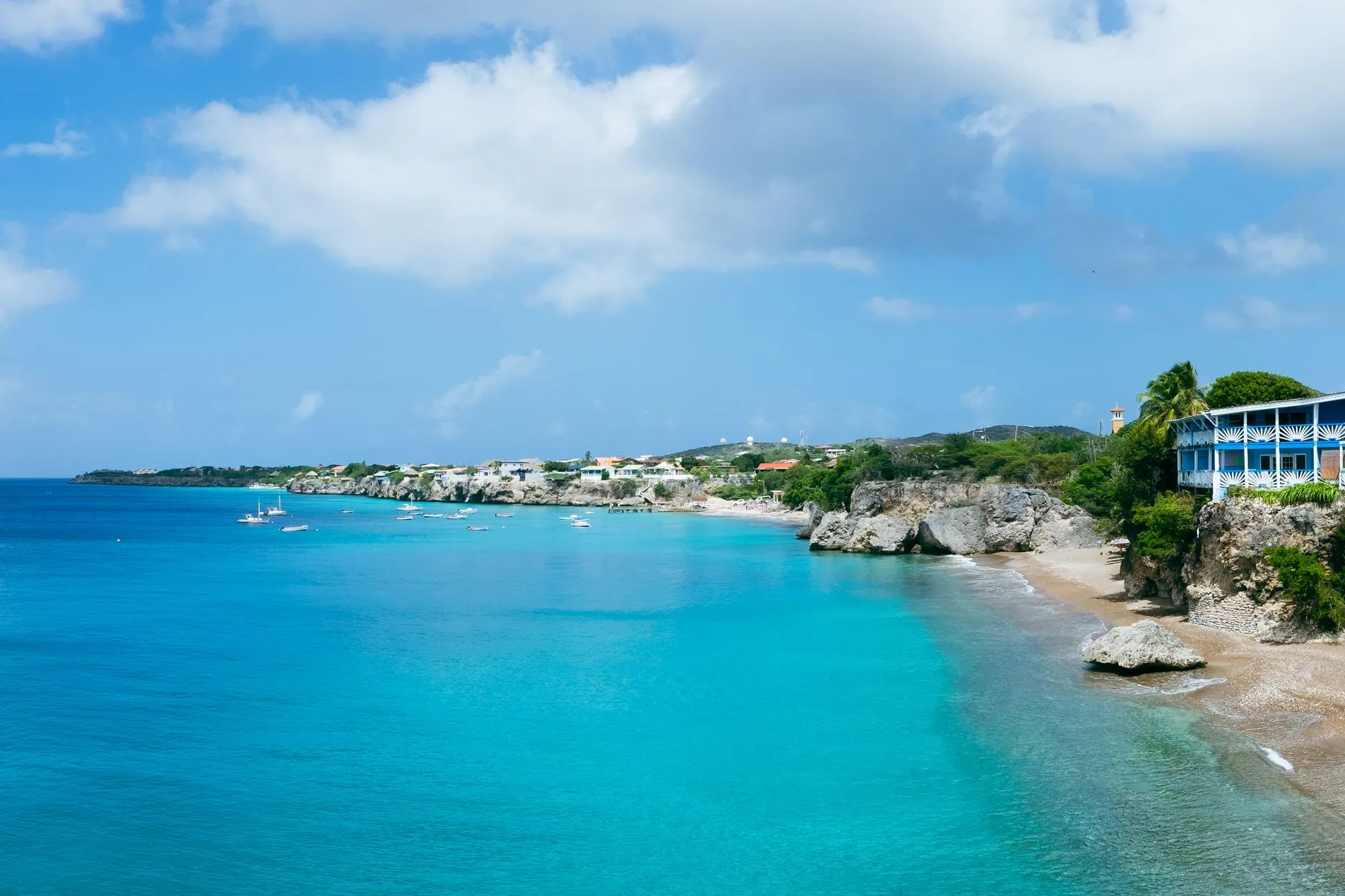
Curaçao — Complete Travel Guide 2026
Curaçao is the Caribbean for people who want more than a beach lounger — a Dutch-colonial UNESCO capital painted in sherbet colours, more than 70 dive sites you can walk into straight off the rocks, and a coast of small turquoise coves rather than one endless strand. It sits roughly 12° north of the equator, far enough south that hurricanes essentially never reach it, so the sun is a near-constant and the trade winds keep the heat honest. The catch: the good stuff is scattered across a 60-km island, so this is a rent-a-car holiday, not a stay-at-the-resort one.
Quick Reference
Southern Caribbean, off the Venezuelan coast — the largest of the Dutch ABC islands (Aruba, Bonaire, Curaçao)
CUR (Hato / Curaçao International), ~12 km from Willemstad
Caribbean guilder (XCG), pegged to the US dollar at ~1.79; USD widely accepted
Papiamentu, Dutch (both official) — English and Spanish widely spoken
Autonomous country in the Kingdom of the Netherlands; visa-free 90 days for UK/EU/US/Canada + mandatory free Digital Immigration Card
January–April (driest, steady trade winds); year-round sun, outside the hurricane belt
The candy-coloured UNESCO Willemstad waterfront, shore diving, and a string of small western coves
Pietermaai/Willemstad for culture & nightlife, the resort west for beach days, or split the two
Editor’s Note — read this first
If you take three things from this guide, take these. One: rent a car. Curaçao’s best beaches and dive sites are strung along the western half of the island, 30–60 minutes apart, with thin and unreliable public transport. Without a car you’ll burn money on taxis and see a fraction of the place. Two: pick your base deliberately. Willemstad/Pietermaai puts you in the middle of the food, history and nightlife but not on a swimming beach; the resort west (around Jan Thiel, or further toward Westpunt) puts you near sand but an hour from the old town. Most people who’ve been twice end up splitting their stay. Three: this is a dive-and-snorkel island first, a sunbathing island second. If you don’t intend to put your face in the water at least once, you’re leaving the best of Curaçao on the table.
On timing: come January to April if you can — driest, breeziest, and the busiest/priciest exactly because of it. The island runs year-round, so there’s no truly “bad” month, just a slightly wetter, stickier autumn. And don’t expect the postcard-flat Caribbean everywhere — the east and north coasts are wild, wind-battered and dangerous to swim; the calm, swimmable water is on the leeward (west/south) side. Plan around that and the island delivers.
Should You Go? Who it’s for — and who it isn’t
Go if you like a mix: a morning shore dive, an afternoon at a cove, an evening eating goat stew at a market stall or cocktails on a colonial seafront. Go if you’re a diver or snorkeller — few islands make the underwater this accessible and cheap. Go if you want guaranteed sun without the hurricane gamble, or if you like a destination with real layered culture (Dutch, African, Sephardic Jewish, Latin American, all blended into Papiamentu).
Think twice if your dream is a single wide powder beach you never leave — Curaçao’s beaches are smaller coves, often with an entry fee, and you’ll want to hop between them. Think twice if you won’t drive: the bus-and-taxi life here is genuinely limiting. And it’s not a budget-backpacker island — it’s mid-range Caribbean, with everything imported and priced accordingly.
You will need a car. This is the single most repeated piece of honest advice about Curaçao. The buses cluster around Willemstad and the coves are spread out; a rental at roughly €30–55/day pays for itself in two taxi runs and unlocks the whole island.
Getting There — CUR and entry
You’ll fly into Hato / Curaçao International (CUR), about 12 km north of Willemstad. It’s a small, easy single-terminal airport with direct links to Amsterdam (the long-haul backbone — KLM and TUI fly it), plus seasonal and year-round service from the US east coast and a growing list of European charters. From Europe the practical route is usually via Amsterdam; book the airport, not a specific fare, and shop the dates.
Entry is straightforward but has one mandatory hoop. Most Western tourists — UK, EU, US, Canada — enter visa-free for up to 90 days. Everyone, regardless of nationality, must complete the Digital Immigration Card (DI Card) online before arrival; it’s free and you fill it in within 7 days of travel at the official site, dicardcuracao.com. You’ll also need a passport, a return or onward ticket, and accommodation details — immigration genuinely checks the onward ticket.
Use only the official DI Card site. A swarm of look-alike sites charge a “fee” for a form that is free at dicardcuracao.com. Fill it in yourself, the week of travel, and ignore the paid impostors.
From the airport, a taxi to Willemstad runs from roughly €28–35 one way (taxis use fixed, pre-agreed prices, not meters). If you’re renting a car — and you should — collect it at the airport so you never need that taxi.
Willemstad & the UNESCO Old Town
Willemstad’s harbour and inner city have been a UNESCO World Heritage Site since 1997, and it’s the reason even non-beach people should give the island a couple of days. The signature view is the Handelskade — a row of 18th-century Dutch merchant houses painted mango, coral, lime and blue, lined up along the water like Amsterdam canal houses that wandered into the tropics. Go at golden hour; the colours sing.
The city splits across Sint Anna Bay into two halves: Punda (the older, tighter grid with the Handelskade, the shopping streets and the synagogue) and Otrobanda (“the other side” in Papiamentu), looser and more local. Linking them is the Queen Emma Bridge, a pedestrian pontoon bridge from 1888 that floats on 16 boats and swings open sideways to let ships pass — when it’s open (which can be for a while), a small free ferry shuttles people across.
In Punda, don’t miss the Mikvé Israel-Emanuel Synagogue — congregation founded 1651, building completed 1732, making it the oldest surviving synagogue in continuous use in the Americas, with a famous sand-covered floor. There’s a small museum attached. Wander the Pietermaai district to the southeast — once derelict, now the island’s prettiest restored quarter and its nightlife heart.
Time your photos around the bridge. The Queen Emma swings open frequently for harbour traffic and can stay open a surprisingly long time. If you want the classic Handelskade-from-Otrobanda shot, build in a buffer — or just hop the free ferry while it’s open.
The Beaches — the western coves (which one for what)
Curaçao’s swimming and snorkelling beaches are small leeward coves strung down the calm west/southwest coast. Each has a personality — pick by mood, and note many charge a small per-car entry fee.
- Cas Abao — the all-rounder and a regular on “best beach” lists: clear lagoon-like water, full facilities, palapas, loungers, a dive shop, even seaside massages. Best for families and people who want amenities. Entry is a few euros per carload.
- Grote Knip (Playa Kenepa Grandi) — the big show-stopper bay, wide turquoise water and a low cliff you can (carefully) jump from. Bring your own shade; facilities are minimal. Snorkelling along the edges is good.
- Kleine Knip (Kenepa Chiki) — Grote Knip’s smaller, quieter sibling next door; soft sand, calm water, fewer people, fine snorkelling on the rocks.
- Playa Porto Mari — the snorkeller’s pick: a famous double reef straight off the beach, calm clear water, full facilities, and resident free-roaming pigs that wander the sand. A top sunset spot too.
- Playa Lagun — a small dramatic cliff-cove on the west; the place to see turtles from shore — swim out a little and they’re often right there. Also the launch for boat trips to the Blue Room.
- Playa Jeremi — a wild, undeveloped little cove with cliffs and crystal water; the sand is tiny lava pebbles, so it feels different underfoot. No facilities — bring everything.
- Daaibooi — small, low-key, free, with good fish-filled snorkelling near the rocks; a local favourite for a quiet day.
- The Sea Aquarium / Mambo Beach strands near town — developed, lively, full of bars and clubs; convenient if you’re based in Willemstad and don’t want to drive far.
Diving & Snorkelling
This is what sets Curaçao apart. The island has 70+ dive sites, many reachable straight from shore — you park, gear up and walk in, no boat required — which makes diving here cheaper and more spontaneous than almost anywhere in the Caribbean. The reefs start close and drop fast.
The must-do trio:
- The Tugboat — a shallow, photogenic wreck sitting in just 5–7 m of water, encrusted in tube sponges and brain coral, with a wall behind it dropping to ~30 m. Genuinely great for both snorkellers and divers; one of the easiest “wreck” experiences anywhere.
- The Mushroom Forest — the island’s most celebrated reef, near the Santa Cruz plantation: rounded star- and brain-coral formations shaped like mushrooms, usually reached by boat, with eels, grouper, parrotfish, turtles and the odd nurse shark.
- The Blue Room — a partly-submerged sea cave you snorkel into through a low opening, where sunlight through the water lights the chamber an electric blue. Usually paired with the Mushroom Forest on a half-day boat trip, often launching from Playa Lagun or Santa Cruz.
For shore snorkelling without any boat, Playa Porto Mari (double reef), Playa Lagun (turtles) and the Tugboat are the easy wins. Reputable operators run the boat sites; book a day or two ahead in high season.
Wear reef-safe sunscreen. Curaçao’s reefs are the whole point — use mineral, reef-safe sun cream and never touch or stand on the coral. A rash guard does the job of sunscreen and protects the reef at the same time.
Klein Curaçao — the day trip
About two hours by boat off the southeast tip lies Klein Curaçao, an uninhabited flat sliver of sand with a candy-striped (pink) lighthouse, a couple of old shipwrecks, and a turtle-filled shallow lagoon. It’s the island’s signature day trip: clear water, hawksbill and loggerhead turtles you can snorkel with, and a beach that feels properly castaway.
Full-day tours run roughly 8–9 hours and cost about €80–120 per person, typically including the crossing, snorkel gear, a BBQ/buffet lunch and drinks; catamaran trips are the comfortable option, speedboats the faster, bumpier, cheaper one. The crossing is open ocean and can be rough — if you’re prone to seasickness, take something before you board and pick a catamaran.
Klein Curaçao has zero shade and zero shops. No trees, no facilities to speak of, full equatorial sun all day. Bring more water, sunscreen and a hat than you think you need, and carry your own. People genuinely get badly burned out here.
Book ahead in high season. From roughly December to April the popular boats sell out a week or more in advance. Don’t leave Klein Curaçao to a walk-up.
Christoffel Park, Shete Boka & the Caves
For the non-beach half of the island, head to the wild northwest.
Christoffel National Park is the island’s biggest protected area, crowned by Mount Christoffel (~375 m) — the highest point on Curaçao and a genuinely strenuous ~3-hour round-trip scramble from the visitor centre. Because of the heat you must start the climb early: the park opens at 6 AM and the latest you can begin the summit hike is 10 AM. The park itself is open daily 6 AM–2 PM (last entry 1:30 PM), with adult admission around €13–14. The summit view over the whole island (and on a clear day, neighbouring isles) is the reward.
Adjacent on the rugged north coast is Shete Boka National Park (“seven inlets”), where the ocean smashes into the limestone and erupts through blowholes — the most famous, Boka Tabla, is a cave you stand inside while the surf booms below. Open daily roughly 9 AM–5 PM (last entry ~4 PM).
Closer to the airport, the Hato Caves are a guided-tour limestone cave system with stalactites, a colonial-era runaway-slave history, and resident bats — a good rainy-hour or with-kids option (it’s cool inside). Check current tour times locally before you go.
Hike Christoffel at dawn, not midday. This is not a casual stroll — it’s a hot, steep, exposed scramble. Start at opening, carry 1.5–2 litres of water per person, wear real shoes, and don’t attempt it in the afternoon sun.
When to Visit — month by month
The headline: Curaçao is a year-round destination, sits outside the hurricane belt, and is reliably dry and sunny thanks to the constant northeast trade winds. Highs sit around 30–31°C all year, nights around 25°C.
- December–April — peak and the best weather: driest, steadiest breeze, lowest humidity. March is the single driest month; February and March are the sweet spot. Book flights and Klein Curaçao trips well ahead — this is also the busiest, priciest stretch.
- May–June — still dry and excellent, with thinner crowds and better prices as the high season tails off. A smart shoulder window.
- July–August — hot, busy with the European school holidays and the island’s own festivals; still mostly dry, but the most crowded summer weeks.
- September–November — the wettest, most humid stretch (the regional “rainy season”), though “wet” here means brief passing showers, not washouts, and Atlantic hurricanes essentially never track this far south. Cheapest, quietest months; the sea is calm and warm for diving.
Hurricanes basically don’t reach Curaçao. The island lies far south of the main hurricane track and hasn’t taken a direct hit in over a century. That reliability is a real reason to choose it over islands further north — but don’t read it as “never any rain” in autumn.
What to Eat & Drink
Curaçao’s food is a genuine blend — Dutch, West African, Latin and Caribbean — and it’s worth seeking out beyond the resort buffet.
- Keshi yena — the national dish: a whole Edam or Gouda cheese stuffed with spiced shredded chicken, olives, capers, raisins and tomato, then baked until molten. The edible legacy of slaves repurposing the rinds the Dutch left behind. Try it.
- Stoba — slow-cooked stews, the everyday backbone: kabritu stoba (goat) and karni stoba (beef) are the classics, simmered with local spices.
- Yuana stoba (iguana soup/stew) — the island delicacy for the adventurous; iguana is genuinely eaten here, prized for its tender meat. Look for it at local spots, not tourist menus.
- Funchi, pan bati, fried plantain and fresh-caught fish round out a typical local plate.
The best place to eat all of the above is Plasa Bieu (the “Old Market”) in Punda — a covered hall of family-run kitchenettes, each chalking up the day’s stews and soups, where locals come for a cheap, generous, no-frills lunch. It’s the single most authentic meal on the island.
For the famous Blue Curaçao liqueur, visit Landhuis Chobolobo, the historic distillery where it’s still made from the dried peel of the island’s bitter laraha orange — a small, easy, slightly kitsch but genuinely local visit. (The blue is just food colouring; the orange flavour is the real thing.)
Getting Around
Rent a car — really. The beaches, dive sites and parks are spread the length of the island, and a car (roughly €30–55/day) is the only way to do Curaçao properly. Drive on the right; roads to the popular coves are paved, though the last stretch to a few wild beaches is rough dirt — a small SUV helps for those.
The public options, honestly assessed:
- Konvoi — the big government buses run by ABC. Cheap and useful in and around Willemstad, mostly 6 AM–8 PM, but limited reach to the far-flung beaches.
- Minibuses (“bus”) — privately run, more frequent, will drop you anywhere along the route, but no fixed schedule (they leave when full) and cash only (XCG or USD, small notes — drivers rarely have change). Workable for a budget day to a couple of spots, frustrating as your only plan.
- Taxis — reliable, fixed pre-agreed prices (no meters), bookable by app (e.g. 24-7 Taxi Curaçao). Fine for the airport and a night out, but a beach round-trip can run €35–75, so they add up fast.
The verdict: bus it only if you’re staying in Willemstad and barely leaving; otherwise the car is non-negotiable.
Where to Stay — by area & budget
Choose your base by what you came for; many people split between two.
- Willemstad / Pietermaai — for culture, food and nightlife. Pietermaai is the restored, walkable, buzzing quarter with the highest concentration of restaurants and bars on the island and the best night scene. You’re in the thick of the city but not on a swimming beach — you’ll drive to the coves. Best for first-timers who want atmosphere, couples, and anyone who values dining out.
- The resort south/west (Jan Thiel & toward Westpunt) — for beach days. The Jan Thiel area has resorts, beach clubs and easy access to the Sea Aquarium beaches; further northwest toward Westpunt you’re remote and quiet, right by the best wild coves (Grote/Kleine Knip, Kalki) but a good hour from the old town. Best for divers, beach loungers and people who want to slow down.
- Budget — guesthouses and apartments in and around Willemstad/Otrobanda, plus dive-lodge-style stays on the west. With a rental car, an inland or city base saves money and still reaches everything.
A useful Curaçao souvenir-and-culture stop while you’re island-hopping: Serena’s Art Factory on the east side, home of the Chichi figures — the curvy, brightly painted “big sister” sculptures created by Berlin-born artist Serena Israel and now an island icon. You can watch them being painted and even paint your own.
Costs & Budget
Curaçao is mid-range Caribbean — not backpacker-cheap (almost everything is imported), but well short of the luxury islands. Rough per-person daily guidance, in euros:
- Budget — ~€70–110/day: a guesthouse or apartment, self-catering plus market lunches at Plasa Bieu, a shared rental car, and free/cheap beaches.
- Mid-range — ~€130–220/day: a 3–4★ hotel or good apartment, the rental car, a daily restaurant meal, beach entry fees and a couple of dives.
- Higher-end — €250+/day: resort or boutique stay, dining out, a Klein Curaçao day trip (~€80–120pp) and guided boat dives.
Recurring line items to budget for: the rental car (~€30–55/day), beach entry fees (a few euros per car at the managed coves like Cas Abao and Porto Mari), diving (shore dives are cheap; boat trips more), and the Klein Curaçao day trip. Tipping ~10% is appreciated where service isn’t already added.
Practical Information
Entry. Visa-free 90 days for UK/EU/US/Canada and most Western nationalities; everyone must complete the free Digital Immigration Card at dicardcuracao.com within 7 days of arrival; carry proof of an onward ticket and accommodation, and a passport valid for your stay.
Currency. Since 2025 Curaçao (with Sint Maarten) uses the new Caribbean guilder (XCG), which fully replaced the old Netherlands Antillean guilder (ANG) — the ANG ceased to be legal tender in mid-2025 and the changeover is complete in 2026. The XCG is pegged to the US dollar (about 1.79 to the dollar), and US dollars are accepted almost everywhere, often as the de facto tourist currency; cards are widely taken. (We quote budgets in euros for European readers; on the ground you’ll transact in XCG or USD.)
Safety. Curaçao is one of the safer Caribbean islands; use normal city sense in Willemstad after dark, don’t leave valuables visible in a parked rental at remote beaches, and watch the sea.
Never swim the wild north/east coast. The leeward west and south coves are calm and safe; the windward north and east coasts (around Shete Boka, Boka Pistol, the wild beaches) have powerful surf, undertow and rip currents. They’re for watching the blowholes, not for getting in the water.
Water. Tap water is desalinated and safe to drink — it’s among the best tap water in the Caribbean, so skip the bottled-water cost and refill.
Tipping. Around 10% in restaurants where service isn’t already included; round up for taxis and tour crews.
Connectivity. Mobile coverage is good across the island; many hotels and cafés have solid Wi-Fi, and local SIMs/eSIMs are easy if you want data for navigation (handy, since you’ll be driving).
Frequently Asked Questions
Cheapest Flights to Curaçao
We have tracked 445 fares to Curaçao from 64 cities. As of June 2026, here is what a good price looked like from each — the lowest fare we recorded, and a “great-deal” benchmark to judge a quote against. These are tracked observations, not live prices: by the time you read this they will have moved, so treat them as a yardstick, not a quote.
| From | Lowest fare we tracked | Great-deal benchmark |
|---|---|---|
| Amsterdam (AMS) | €354 | €505 |
| Dublin (DUB) | €422 | €603 |
| Milan (MXP) | €424 | €605 |
| Nice (NCE) | €438 | €626 |
| Naples (NAP) | €477 | €681 |
| Dusseldorf (DUS) | €482 | €689 |
| Copenhagen (CPH) | €487 | €696 |
| Warsaw (WAW) | €496 | €709 |
| Malta (MLA) | €501 | €716 |
| Geneva (GVA) | €502 | €717 |
| Oslo (OSL) | €504 | €720 |
| Palermo (PMO) | €516 | €737 |
| Vilnius (VNO) | €529 | €756 |
| Bari (BRI) | €533 | €762 |
Recent deals we have posted to Curaçao:
- London to Aruba, Curacao and the Dominican Republic from £439
- London to Curaçao from £488
- Toronto, Canada to Curacao from $422
- Amsterdam to Curacao from €521
These are fares aifly tracked to this destination, not live quotes — they have changed since and several of the deals above may have expired. Browse current flight deals →