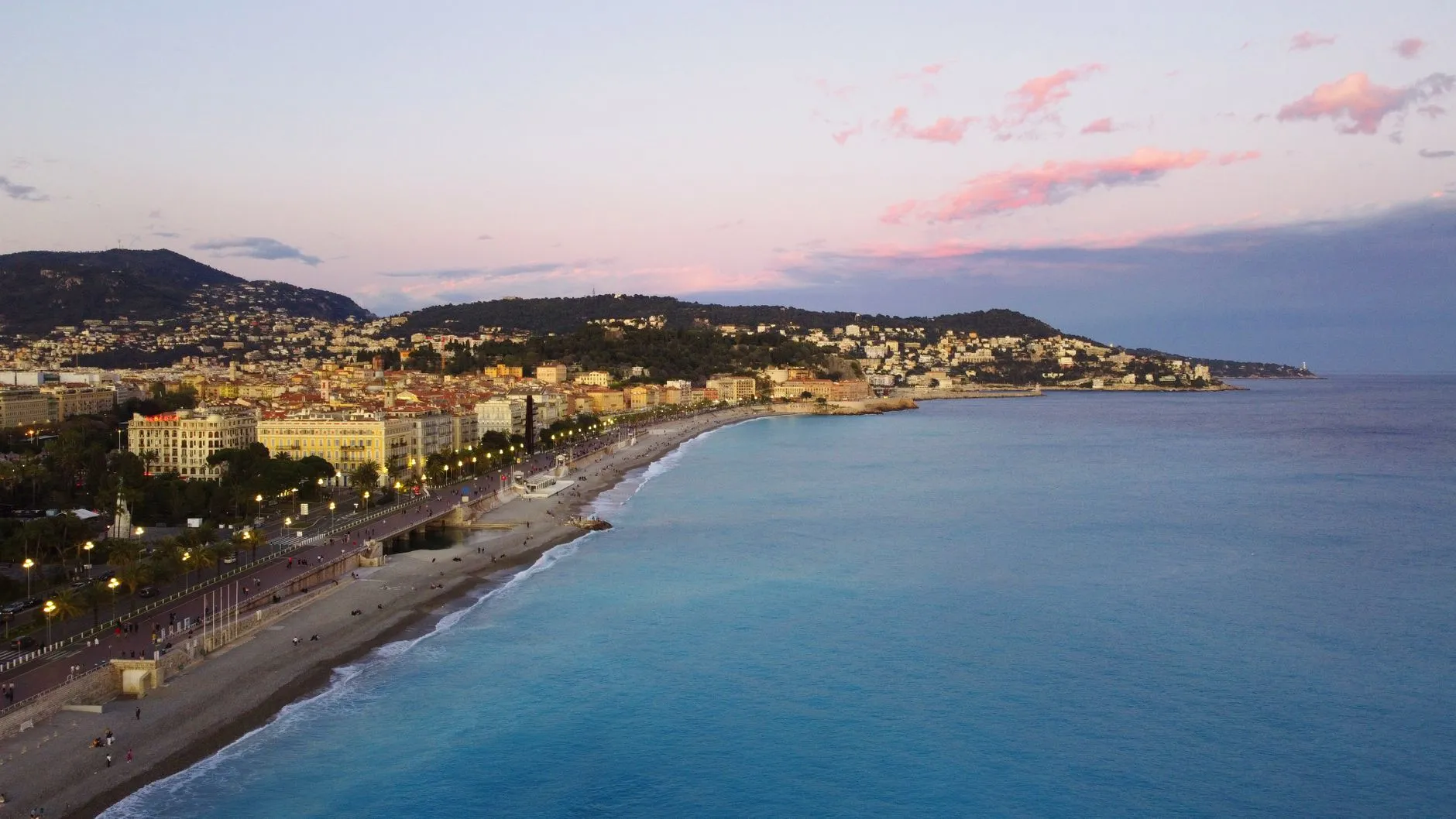
The French Riviera — Complete Travel Guide 2026
The French Riviera sells you a fantasy of Bond villains and Slim Aarons poolsides, and then hands you a pebble beach, a €9 espresso and a traffic jam — yet I keep going back, because the real Côte d’Azur isn’t the glitz at all. It’s a 30-minute regional train that threads pastel fishing harbours and cliff-top villages for the price of a sandwich, and once you stop chasing the postcard and start riding that line, the most over-hyped coast in Europe quietly becomes one of its most rewarding.
Quick Reference
Southeast coast of France (Provence-Alpes-Côte d’Azur), Mediterranean shoreline from roughly Saint-Tropez to the Italian border, plus the independent city-state of Monaco
Nice Côte d’Azur (NCE) — the gateway; Marseille Provence (MRS) for the far west
Euro (€) — including Monaco
French; English widely spoken in tourist areas, Italian common near Menton
Schengen France. EES biometric registration live since 10 April 2026 for non-EU visitors; ETIAS expected, date not announced, mandatory on a date not yet announced. EU/EEA/Swiss nationals unaffected
Late May–June and September; May for the events, but at triple the price
Glamour, superyachts, Cannes & Monaco, perched medieval villages, the corniche drives, pebble beaches, light that drew Matisse and Picasso
Nice — central, affordable by Riviera standards, and on the coastal train line that connects everything
Editor’s Note: The Most Overrated and Unmissable Coast in Europe
Let me be straight with you before you book anything. The French Riviera is expensive, crowded, and at least a third of what’s famous about it is a marketing artefact. The “golden sand” in the brochures is, in Nice and most of the central coast, grey pebble that punishes your feet and your spine. The glamour is real but thin — a strip of Monte-Carlo and a few Cap d’Antibes hotels you can’t afford to enter, surrounded by ordinary, occasionally scruffy French towns. In August it becomes a hot, gridlocked car park where a mediocre lunch costs €60 and the beach club wants €40 for a sunlounger.
And I’d still rather spend a week here than almost anywhere on the Mediterranean.
The trick is knowing what you came for. People who come for the casino, the celebrity sighting and the Instagram yacht shot leave faintly disappointed and a lot poorer. People who come for the texture — the Cours Saleya flower market at 8am, the Sentier du Littoral coastal path around Cap Ferrat, Matisse’s blue cut-outs, a €6 socca eaten standing up, the absurd theatre of three roads carved into one mountainside — leave plotting their return. This guide is unapologetically written for the second group.
The single best decision you can make on the Riviera costs about €7: base yourself in Nice and take the train. Everything else flows from that. Get it wrong and you’ll spend your holiday looking for parking.
Should You Go? Who It’s For — and Who Isn’t
Go if: you love walking and looking — markets, museums, coastal paths, Belle Époque architecture, drives that make you gasp. You want a base where you can be car-free, eat well, and string together a half-dozen distinct towns by rail. You can travel in the shoulder season (more on that below) and you’re realistic about cost.
Reconsider if: you’re chasing wide soft-sand beaches — the Riviera mostly doesn’t have them, and Greece, southern Italy or Portugal will serve you better for a fraction of the price. If your ideal holiday is a cheap all-inclusive, this is the wrong coast: the Côte d’Azur has never been, and will never be, a budget destination. And if you can only travel in the first three weeks of August, know that you’re seeing the region at its sweaty, overpriced worst.
Families, take note: the Riviera works beautifully with kids if you lean into the train, the Villefranche bay (one of the few genuinely calm, swimmable beaches), Antibes’ sandy Plage de la Salis, and gelato. It works terribly if you imagine a quiet sandy resort — that’s a different holiday in a different country.
This is a culture-and-scenery coast that happens to have sea, not a beach holiday that happens to have culture. Frame it that way and you’ll love it.
Getting There & Around: Base in Nice, Ride the Train, Don’t Rent a Car
Fly into Nice Côte d’Azur (NCE) — France’s third-busiest airport, sitting right on the sea about 7km west of the old town. It’s compact and well-connected, and crucially it’s a short hop from your base, not an hour-long shuttle saga.
From the airport, Tram Line 2 runs from both terminals straight to the city centre and the port in about 25–30 minutes. A single ticket is €1.70 — but here’s the catch that catches everyone: the machines at the airport only sell a €10 return airport ticket, not the cheap single. If you’ve downloaded the local transport app or have a single from elsewhere, you ride for €1.70; otherwise you pay the €10 tourist tax-by-design. Forewarned is forearmed.
Now the central thesis of this entire guide: do not rent a car for a classic Riviera trip. I know the corniche-drive fantasy is seductive (and I’ll tell you how to do it properly without owning the car). But for getting between towns, a car is a liability here. The coastal corridor is narrow and chronically congested; parking in Nice, Cannes, Monaco and Saint-Tropez ranges from painful to extortionate (€30–40 a day is normal, and in Saint-Tropez in August it’s a blood sport); and you’ll spend the holiday anxious about your hire car instead of looking at the view.
What you want instead is the coastal train — the regional TER service, now being rebranded ZOU — which runs the length of the coast roughly every 15–20 minutes, linking Cannes, Antibes, Nice, Villefranche, Monaco, Menton and over the border to Ventimiglia in Italy.
Nice to Monaco is about 25 minutes; Nice to Menton about 30, for around €7; Nice to Ventimiglia roughly €10.20. The TER/ZOU ticket is a fixed fare valid all day for any train on the route — there’s no “missing your booked train,” no surge pricing, and the views from the carriage between Nice and Menton are better than from most of the road.
A few practical notes: validate/keep your ticket, watch for occasional strike days (check SNCF Connect before you set out), and remember the line gets crowded on summer evenings heading back toward Nice. For Saint-Tropez (which has no train station) and a couple of the hill villages, you’ll need a bus, a boat, or for one or two specific outings, a rented car for the day only — book it, use it, return it. Treat the car as a tool you pick up for a single corniche day, not a millstone you drag through the whole week.
Nice: Your Base, and Far Better Than Its Reputation
Nice gets treated as merely the practical choice — the airport town you stay in to reach the prettier places. That sells it short. Nice is a genuine city with its own deep, slightly Italian character (it was Nizza, part of Savoy, until 1860), and it’s the only place on the coast that’s both well-priced and properly connected.
Stay in or near Vieux Nice, the old town — a tangle of ochre lanes, baroque churches and the daily Cours Saleya market (flowers and produce most mornings, antiques on Mondays). Get there early, before the cruise crowds, for the best of it. Eat socca — a hot, blistered chickpea-flour pancake, the city’s signature street snack — fresh off the griddle at Chez Pipo or a Cours Saleya stand, for a few euros.
Walk the Promenade des Anglais, the grand seafront curve, ideally at dawn or dusk when the light does its thing and the joggers and rollerbladers replace the midday crowds. The beach below is pebble — bring a thick mat, water shoes help — and you’ll pay around €20+ for a lounger at a private beach club or claim a free spot on the public stretches.
Climb (or take the free lift from the eastern end of the Promenade) up Colline du Château — there’s no actual château left, but the park gives you the classic aerial view over the terracotta roofs and the curve of the Baie des Anges. Then give a serious half-day to the Musée Matisse and the nearby Musée National Marc Chagall in the Cimiez quarter — both are first-rate, and they explain why this coast mattered to twentieth-century art in a way no beach club ever will.
Nice’s old town is wonderful at 9am and a tourist scrum at 1pm. Build your day around early markets and museums, retreat from the heat midday, and come out again for the evening passeggiata. The Riviera rewards early risers more than almost any destination I know.
For French city context beyond the coast, Nice pairs naturally with Marseille two hours west — grittier, bigger, with its own calanques — and of course Paris if you’re bookending the Riviera with the capital.
The Corniches & the Perched Villages: The Riviera’s Real Magic
Between Nice and Monaco, three roads climb the mountainside in tiers, and driving them — once — is the one time I’ll bless renting a car. The Basse Corniche (Corniche Inférieure) hugs the shore through Villefranche, Cap Ferrat and Beaulieu. The Moyenne Corniche runs at mid-height and delivers you to Èze. The Grande Corniche climbs highest of all to La Turbie and the Roman Trophée des Alpes, with eagle’s-eye views down onto Monaco and Cap-Martin — this is the road Grace Kelly drives in To Catch a Thief, and where, years later, she died in a crash. The drama is baked in.
The smart play: rent a car for one day, drive up the Moyenne to Èze, continue along the Grande for the high panoramas, descend toward Monaco, and return along the Basse Corniche through Villefranche. You get all three tiers, the best villages, and you hand the keys back by evening. No week-long parking saga, no €40-a-night hotel garage. If you genuinely don’t want to drive at all, the local Nice–Monaco–Menton bus routes climb sections of the corniches for a couple of euros, or you simply take the coastal train and trade the high panoramas for a stress-free week. I think one corniche day by car is worth the modest hassle — but it’s the only car day I’d plan.
If the coast is the Riviera’s face, the villages perchés — the medieval hill villages clinging to crags inland — are its soul, and they’re where the region’s genuine charm survives the crowds best (if you time it right).
Èze is the famous one: a near-vertical stone village above the sea, crowned by the Jardin Exotique of cacti and succulents with a jaw-dropping drop to the Med. It’s beautiful and it knows it — by late morning the single lane is a slow-moving conga of cruise excursions, and the village is essentially one long row of perfume outlets and galleries. Go at opening or in the last light, walk the Nietzsche Path (the steep mule track down to Èze-sur-Mer, said to have inspired part of Thus Spoke Zarathustra — about 45 minutes down, sweaty going up), and you’ll find the magic the midday crowds miss.
Saint-Paul-de-Vence, inland behind Nice, is the artists’ village — Chagall is buried in its cemetery, and the legendary Fondation Maeght modern-art museum sits just outside. The ramparts and lanes are lovely and, again, mobbed midday. The move is to come early or late, and to make the Fondation Maeght the real reason you came rather than another stroll past art-for-tourists boutiques.
A hard truth about the perched villages: most of them have been comprehensively gift-shopped. The lanes are gorgeous, the views are real, but you are walking through a beautifully preserved shopping arcade. The antidote is timing (early/late) and altitude — push past the first cluster of shops and the crowds thin fast, because most day-trippers don’t.
Don’t overlook the quieter perched villages where the soap-and-lavender machine hasn’t fully taken hold — they reward the traveller willing to go ten minutes further than the coach parks.
Villefranche-sur-Mer & Cap Ferrat: Where I’d Actually Stay
If money and logistics allowed me to base anywhere on the coast, it might not be Nice — it might be Villefranche-sur-Mer, a startlingly pretty deep-water harbour town one stop east of Nice by train. The Rue Obscure is a genuine 13th-century covered street; the old town tumbles in ochre and rose down to a horseshoe bay with — crucially — one of the few stretches of calm, gently shelving, properly swimmable beach on the central Riviera. It’s where the cruise ships anchor offshore for exactly this reason.
Adjacent is Cap Ferrat, a forested peninsula of obscene wealth where the headline experience isn’t a hotel you can’t afford — it’s free. The Sentier du Littoral, the coastal footpath, loops the cap past hidden coves, pine-shaded shore and glimpses of villas that cost more than small countries. Walking it is, for my money, the single best few hours on the entire Riviera, and it costs nothing but sunscreen. Pair it with the Villa Ephrussi de Rothschild — a pink Belle Époque folly with formal gardens and one of the best views on the coast — for a near-perfect day.
Villefranche to Nice is one short train stop or a cheap bus. You can stay in calmer, prettier Villefranche and still dip into Nice’s restaurants and museums whenever you like — and you’ll swim in actual clear water instead of bracing yourself on Nice’s pebbles. It’s the move many repeat visitors quietly make.
Monaco & Monte-Carlo: Go for an Afternoon, Skip the Casino Selfie
Monaco is the Riviera’s concentrated dose of money — a two-square-kilometre principality of high-rises, superyachts and tax exiles — and you should absolutely visit. For an afternoon. By train.
A quick note on the practicalities people get tangled in: Monaco is not in the EU and never signed the Schengen Agreement, but it functions as part of the Schengen area through its customs union with France. In plain terms: you can’t actually enter Monaco except through France, so there’s no separate border control and no extra paperwork — if you’re cleared into Schengen France, you walk (or train) straight in. It uses the euro, mints its own coins, and that’s the whole story. No passport drama.
The train deposits you in a dramatic station tunnelled into the rock. From there, do the genuinely worthwhile things: the Palais Princier and the changing of the guard on Le Rocher; the excellent Musée Océanographique perched on the cliff (Jacques Cousteau’s old domain — superb for kids and adults alike); the manicured Jardin Exotique; and simply gawping at the harbour full of vessels you couldn’t insure.
What I’d skip: paying to get into the Casino de Monte-Carlo just for the photo. There’s an entry fee, a dress code, and the interior — while handsome — is essentially a working casino you can admire from the magnificent square outside for free. The selfie on the casino steps with a borrowed Lamborghini idling nearby is the most over-photographed, least rewarding “experience” on the coast.
Avoid Monaco entirely on Grand Prix weekend (5–7 June in 2026) unless you have tickets and a remortgage. The principality is sealed into a circuit, the whole region’s prices triple, and accommodation books out months ahead. The same weekend, the rest of the coast is also slammed and dear. Plan around it.
Cannes & Antibes: One’s a Letdown, One’s a Keeper
These two coastal towns west of Nice get bracketed together and shouldn’t be.
Cannes is, for most of the year, smaller and more ordinary than its name implies. The Boulevard de la Croisette is a pleasant palm-lined promenade fronted by grand hotels and luxury flagships; Le Suquet, the old town on the hill, is genuinely charming; and the offshore Îles de Lérins — a 15-minute boat hop to forested, traffic-free Sainte-Marguerite — are a lovely, underrated escape. But the famous red carpet outside the Palais des Festivals is, 50 weeks a year, an unremarkable set of steps next to a conference centre and a car park. Come for the islands and Le Suquet; don’t come expecting the festival’s fairy dust when the festival isn’t on (and during it — 12–23 May 2026 — Cannes is unaffordable and impassable).
Antibes, by contrast, is the one I’d tell you not to miss. Behind honey-coloured ramparts sits a working old town with the best Marché Provençal (covered Provençal market) on this stretch of coast, a clutch of real restaurants rather than tourist traps, and the Musée Picasso in the seafront Château Grimaldi where the artist worked in 1946 — small, sunlit, and one of the most pleasurable art museums in France. Juan-les-Pins next door has actual sand and a jazz heritage; Cap d’Antibes has another superb coastal path (the Sentier de Tirepoil) and the legendary Hôtel du Cap you’ll only glimpse through the pines.
If you have a single day to spend west of Nice, give it to Antibes, not Cannes. Antibes is a town people live in; out-of-festival Cannes is a town people photograph and leave. The market, the Picasso museum and the ramparts make Antibes the keeper.
Menton: The Best Town Almost Nobody Books
Right against the Italian border, at the eastern end of the line, sits Menton — and I’m faintly reluctant to recommend it because part of its charm is that the crowds mostly don’t make it this far east.
Menton is the warmest, sunniest spot on the French coast — they grow lemons here commercially — and it looks it: a stacked amphitheatre of pastel houses, lemon and apricot and rose, rising from the sea to the baroque Basilique Saint-Michel. It feels more Italian than French (the border is a stroll away), the seafront is unhurried, the Jean Cocteau museum and the Jardin Serre de la Madone are quietly excellent, and the old town stairways are made for aimless wandering. Prices are noticeably gentler than Monaco or Cannes.
Menton is a 30-minute, ~€7 train ride from Nice — there is no excuse to skip it, and yet most short-trip visitors do. It’s my favourite town on the coast for simply being rather than ticking sights. Walk over the border to Italian Ventimiglia (especially for Friday’s enormous market) and you’ve added a country to your day for the price of a coffee.
The one time Menton stops being a secret is its Fête du Citron (Lemon Festival), 14 February–1 March 2026 (theme: “The Wonders of Life”) — when giant sculptures made of citrus fruit fill the gardens and the town fills with visitors. Wonderful if you’re there for it; worth knowing about if you’re not, because hotels spike.
Saint-Tropez & the West: Worth It? Mostly Not in Peak
Saint-Tropez, off west beyond Cannes, is where the Riviera’s celebrity-and-yacht mythology concentrates — and where, in peak season, the gap between fantasy and reality yawns widest.
The honest assessment: out of season, Saint-Tropez is a pretty pastel fishing port with a good market (the Place des Lices, Tuesdays and Saturdays), the worthwhile Musée de l’Annonciade (post-Impressionists and Fauves), and famous sandy beaches a drive out of town at Pampelonne. In July and August it becomes a parody of itself: a gridlocked approach road that can take hours, a port lined with mega-yachts and the people who photograph them, beach clubs charging extraordinary sums, and a general atmosphere of money performing for money. There’s no train — you arrive by a long, jammed road or, far better, by boat (seasonal ferries run from Sainte-Maxime, Saint-Raphaël and Nice).
Saint-Tropez in peak season is the most overrated single experience on the Riviera. If you must go, take the ferry (never drive in August), go for a morning, see the port and the market, and leave before the scene curdles. In May, June or September it’s a different, far more pleasant place — that’s when to consider it.
Further west toward Marseille you reach the calanques — dramatic limestone fjords with turquoise water near Cassis and Marseille — which are genuinely spectacular and a different landscape entirely; if that’s your priority, base around Marseille rather than Nice and treat it as a separate trip.
The Events Calendar — and How It Triples Your Hotel Bill
The Riviera’s famous events are the best and worst reason to come: thrilling to witness, brutal on your budget and the roads. Know the 2026 calendar and decide deliberately whether to chase a date or dodge it.
- Nice Carnival — 11 February–1 March 2026 (theme “Long Live the Queen!”). Flower battles and illuminated parades; cold but festive, and far cheaper than the summer.
- Menton Lemon Festival (Fête du Citron) — 14 February–1 March 2026. Overlaps Nice Carnival; you can do both in one trip.
- Cannes Film Festival — 12–23 May 2026 (79th edition). Glamorous to be near, but you won’t get into anything without industry credentials, and Cannes prices/availability go vertical.
- Monaco Grand Prix — race weekend 5–7 June 2026. The region’s single biggest price-and-crowd spike.
When Cannes (mid-May) and Monaco (early June) land, hotel rates across the entire coast — not just those towns — commonly double or triple, and rooms vanish months ahead. If you’re not specifically going for the festival or the race, the smartest single budgeting decision is to travel in the windows around them: early May, late June, or September.
If you do want the buzz without the bankruptcy, base in Nice or Menton during Cannes/Monaco, dip in for the atmosphere, and sleep somewhere the surge is slightly less savage.
Food & Markets: What to Eat, What’s a Tourist Trap
Niçois cooking on the Riviera is its own thing — closer to Liguria than to Paris — and it’s genuinely good if you order local rather than ordering the international menu the seafront cafés print for tourists.
Eat: socca (the chickpea pancake, best from a market stall); pissaladière (onion, anchovy and olive tart); pan-bagnat (a salade-niçoise sandwich, the perfect beach lunch); petits farcis (stuffed vegetables); and, on the coast, simple grilled fish and proper bouillabaisse-style soups (though true bouillabaisse is a Marseille specialty). In Menton and near the border, the cooking tilts Italian — excellent pasta and Ligurian dishes.
The markets are the heart of it and the best-value eating on the coast: Nice’s Cours Saleya, Antibes’ covered Marché Provençal, Menton’s market hall, Saint-Tropez’s Place des Lices. Assemble a picnic of bread, cheese, olives, tomatoes and a rotisserie chicken for a fraction of restaurant prices and eat it somewhere with a view.
The reliable tourist trap is the seafront restaurant with a multilingual photo menu, a pushy host, and “bouillabaisse” at a suspiciously round price. Walk two streets back from the water, look for a short handwritten menu and a French-speaking crowd, and your food improves while your bill drops. This rule holds in Nice, Cannes, Monaco — everywhere.
Money & Costs: It’s Expensive — Here’s How to Spend Less
There’s no sugar-coating it: the Côte d’Azur is one of the pricier corners of Europe, and the closer you get to Monaco and Saint-Tropez the steeper it gets. A coffee on the Croisette or in Monte-Carlo can run €6–9; a sunlounger at a private beach club €20–40; a forgettable seafront lunch €50–60 for two; a peak-season harbour-view hotel room, eye-watering.
But the Riviera is also unusually easy to do cheaply, because so much of the best of it is free or near-free. Here’s how I keep costs sane:
- Use the train, not a car — you’ve heard this, but it’s also the biggest single saving. No hire fee, no fuel, no €40 parking, ~€7 to reach Monaco or Menton.
- Picnic from markets — your best meals can be your cheapest.
- Hunt the free wins — the Cap Ferrat and Cap d’Antibes coastal paths, the Colline du Château view, the Promenade des Anglais, the corniche panoramas, Monaco’s harbour and old town, wandering Menton: all free.
- Beach public, not private — public stretches cost nothing; bring a mat and water shoes for the pebbles.
- Base in Nice or Menton, day-trip the dear towns — sleep where rooms are reasonable, visit Monaco/Cannes/Antibes by train and leave before dinner.
- Travel in shoulder season — the same hotel can cost half what it does in August.
Here’s a frugal-but-rich Riviera day: early market and socca in Nice (€8), train to Cap Ferrat (a few euros), walk the free Sentier du Littoral (€0), picnic lunch (€10), train to Villefranche for a swim and a coffee, back to Nice for the sunset Promenade. Total well under €40 — and a better day than the €400 beach-club version.
When to Go — and What to Skip Without Guilt
When: aim for late May, June, or September. The sea is warm enough by June and still warm in September; the light is glorious; the crowds and prices are well below the July–August peak. April and early May are lovely and cheaper still, with cooler water. February brings the Carnival and Lemon Festival — a genuinely good, low-cost time if you don’t need to swim. July and especially the first three weeks of August are the trap: hottest, most crowded, most expensive, with the worst traffic and the thinnest availability. The coast doesn’t reward August; it punishes it.
What to skip without a flicker of guilt:
- Paying into the Monte-Carlo Casino for a selfie. Admire the square for free; keep your money.
- Out-of-festival Cannes red-carpet pilgrimage. It’s steps by a conference centre. Do Le Suquet and the Îles de Lérins instead.
- Saint-Tropez in peak August. The scene-to-charm ratio collapses. Off-season, reconsider.
- Driving the inter-town corridor. One corniche day, fine. The rest, take the train.
- Sand-beach expectations on the central coast. Make peace with pebbles, or head to Antibes/Juan-les-Pins for the sandier stretches.
The genuine charm of the Riviera is almost never the expensive, famous thing. It’s Villefranche’s harbour, Menton’s pastel stairways, the Èze view at dawn, the Cap Ferrat path, a market socca, the train hugging the cliffs. Spend on those — in time and attention more than money — and the coast more than earns its reputation.
Practical Notes
- Entry/EES (2026): the Riviera is Schengen France. Since 10 April 2026, non-EU visitors (UK, US, Australia, Canada, etc.) register fingerprints and a photo via the Entry/Exit System (EES) at the external Schengen border on first entry — expect occasional extra time at arrivals while the system beds in. ETIAS, the separate pre-travel authorisation, is Expected, with no date announced and won’t be mandatory until ~2027 — check the official EU travel pages before you fly. EU/EEA/Swiss nationals are unaffected. Standard visa-free short stay is 90 days in any 180.
- Monaco: no separate entry formality — it’s reachable only through Schengen France and uses the euro. Dress codes apply at the Casino and some venues.
- Getting around: the TER/ZOU coastal train is your spine (Cannes–Antibes–Nice–Villefranche–Monaco–Menton–Ventimiglia); buy a single, validate, ride any train that day. Check SNCF Connect for occasional strikes. Nice has trams and buses; the airport is Tram Line 2 (€1.70 single — avoid the €10 airport-machine return if you can).
- Beaches: mostly pebble on the central coast — pack water shoes and a thick mat. Sandier options: Antibes (Plage de la Salis), Juan-les-Pins, Menton, Pampelonne near Saint-Tropez.
- Money: euro; cards accepted almost everywhere, but keep some cash for market stalls and small cafés. Tipping is modest — service is included; round up for good service.
- Safety: the Riviera is generally safe; the main risk is pickpocketing and bag-snatching in crowded tourist spots (Nice old town, stations, Monaco), and theft from parked cars — another reason not to have one. Beware aggressive heat and strong midday sun in summer.
- Language: French first; a bonjour on entering a shop is non-negotiable etiquette. English is widely understood in tourist areas; Italian common near Menton.
- Day trips: Italy is genuinely close — Ventimiglia (Friday market) is a short train hop, and Genoa/the Cinque Terre are doable as a long day or overnight.
Frequently Asked Questions
Cheapest Flights to The French Riviera
We have tracked 1,379 fares to The French Riviera from 69 cities. As of June 2026, here is what a good price looked like from each — the lowest fare we recorded, and a “great-deal” benchmark to judge a quote against. These are tracked observations, not live prices: by the time you read this they will have moved, so treat them as a yardstick, not a quote.
| From | Lowest fare we tracked | Great-deal benchmark |
|---|---|---|
| Bratislava (BTS) | €28 | €50 |
| Rome Ciampino (CIA) | €31 | €45 |
| Wrocław (WRO) | €37 | €53 |
| Charleroi (CRL) | €48 | €68 |
| Rome (FCO) | €48 | €142 |
| Budapest (BUD) | €50 | €72 |
| Gdansk (GDN) | €52 | €75 |
| Geneva (GVA) | €59 | €84 |
| Sandefjord Torp (TRF) | €65 | €93 |
| Bologna (BLQ) | €66 | €94 |
| Eindhoven (EIN) | €66 | €95 |
| Hanover (HAJ) | €72 | €103 |
| Bergamo (BGY) | €85 | €152 |
| Gothenburg (GOT) | €88 | €125 |
Recent deals we have posted to The French Riviera:
- Bucharest to Nice, France from €63
- Copenhagen to Nice, France from €93
- Cheap Flights Rome to Nice 2026 — From 300 EUR
- Cheap Flights Paris to Nice 2026 — From 300 EUR
- Cheap Flights New York to Nice 2026 — From 300 EUR
- Banjul, Gambia to Nice, France from $334
- Abidjan, Ivory Coast to Nice, France from $452
- Dublin to Nice, France from €55
- Manchester to Nice, France from £67
- Madrid to Venice, Italy from €43
These are fares aifly tracked to this destination, not live quotes — they have changed since and several of the deals above may have expired. Browse current flight deals →