Georgia — Complete Travel Guide 2026
Georgia is the best-value adventure in Europe that most of Europe still hasn’t noticed. This is the country that invented wine — eight thousand years ago, in clay pots buried in the ground, a method still used today — wedged into a corner of the Caucasus so scenically overloaded it feels invented: glacier-fed valleys, medieval stone towers under 5,000-metre peaks, a subtropical Black Sea coast, and a capital that mashes Persian bathhouses, Art Nouveau balconies and Soviet brutalism into one ramshackle, beautiful whole. It is dirt cheap, ferociously hospitable, and the food and wine alone would justify the flight. Come once and you’ll spend the trip wondering why nobody told you sooner.
Quick Reference
The Caucasus, where Eastern Europe meets Western Asia — a Black Sea coast in the west, the wall of the Greater Caucasus across the north, bordering Russia, Turkey, Armenia and Azerbaijan
Tbilisi (TBS) the main hub; Kutaisi (KUT) the low-cost gateway — Wizz Air’s big Caucasus base; Batumi (BUS) for the Black Sea coast
Georgian lari (GEL) — roughly 2.9–3.0 to the euro; cash still runs much of the country
Georgian (its own unique 33-letter alphabet); Russian still widely understood; English growing fast among the young
Visa-free for an exceptionally long list — most Western nationals can stay up to 365 days; passport valid for the duration of stay. New for 2026: mandatory travel health insurance
May–June and September–October for everything; July–August for the high mountains and the Black Sea; December–March for ski
The 8,000-year birthplace of wine, the supra feast, the dramatic Caucasus, medieval tower-villages, and being absurdly cheap
Tbilisi for the city, history and wine; Kutaisi or Mestia for the western mountains; Telavi/Sighnaghi for wine country; Batumi for the coast
Editor’s Note — the country that out-punches its size
Here is the thing about Georgia that no statistic captures: it is one of the most hospitable countries on earth, and it means it. Hospitality here isn’t a tourism slogan — it’s a near-religious cultural code. A guest, the old saying goes, is a gift from God. Get talking to a Georgian family and there’s a real chance you end up at a table you can’t escape, in front of more food than five people could eat, with a tamada (toastmaster) on his feet delivering a wine-soaked oration to peace, to your ancestors, to your future children, while everyone drains their glass to the bottom. This is the supra — the traditional feast — and it is the single most Georgian thing there is.
A country of fewer than four million people has no business being this rich. It gave the world wine. It has its own alphabet, one of only a handful of writing systems on the planet not derived from another, and a polyphonic singing tradition so distinctive UNESCO protects it. It has mountain villages that were medieval fortress-states, a cuisine that turns cheese and bread into a religion, and a landscape that runs from semi-desert to glacier inside a few hours’ drive — all carried through Persians, Mongols, Ottomans, the Russian Empire and seventy years of the USSR with its identity defiantly intact.
And it costs almost nothing. Dramatic mountains, deep history, a world-famous wine culture and genuine warmth, all without the European price tag. The catch — if it’s a catch — is that the infrastructure is rough: roads that test your nerve, marshrutkas driven like getaway cars, mountain weather that closes passes on a whim. Lean into it. Georgia rewards the traveller who’s relaxed about chaos and shows up hungry.
💡 Say yes to the table. If a Georgian invites you to eat, drink or toast, accept. Refusing food or a toast at a supra reads as a small insult; pace yourself, sip, and let your host fill your glass. These improvised invitations turn into the best memories of the whole trip.
Should You Go? Who it’s for — and isn’t
Georgia is for the traveller who wants a lot of country for very little money and doesn’t need it polished. It’s superb for mountain people — trekkers, hikers, anyone who wants serious Caucasus scenery (Kazbegi, Svaneti, Tusheti) without Alpine prices or crowds. It’s a dream for wine and food obsessives — this is the literal birthplace of wine, with a living 8,000-year tradition you can drink your way through in a week. It’s brilliant for culture-and-history travellers (cave cities, hilltop monasteries, a UNESCO-listed old town), for budget and long-stay travellers (the 365-day visa and rock-bottom costs have made Tbilisi a genuine digital-nomad hub), and for anyone who values hospitality and atmosphere over comfort and slickness.
It’s also for the off-the-beaten-path crowd who feel they’ve “done” Europe and want somewhere that still feels like a discovery.
Who it’s not for: anyone who needs everything seamless. The roads are slow and sometimes hair-raising, the marshrutkas are an acquired taste, mountain regions can be cut off by weather, and service can be brusque (warmth here is personal, not corporate). It’s not a flop-on-a-lounger beach holiday — Batumi has a coast, but the Black Sea is pebbly and the weather unreliable, and you’d be missing the point. And travellers who want a polished party-resort or guaranteed sunshine should look elsewhere. Georgia is a doing country, not a lounging one.
Getting There — TBS, KUT, BUS & the cheap way in
Three airports matter, and which one you choose can halve your airfare. Tbilisi (TBS) is the main international hub, 17 km from the capital — the widest network, the full-service carriers, and the obvious choice if the city is your start point. Kutaisi (KUT), in the west, is the budget gateway and the reason Georgia became cheap to reach: it’s Wizz Air’s big Caucasus base, with three based aircraft and a couple of dozen routes across Europe — Warsaw, Athens, Berlin, Memmingen, Milan, Venice, Paris-Beauvais, Bratislava (new for January 2026) and many more, with fares that genuinely start in the tens of euros if you catch them right. Batumi (BUS) serves the Black Sea coast and is busiest in summer.
The trade-off with Kutaisi is location: it’s a 3–4 hour drive (or a cheap marshrutka/transfer) from Tbilisi, though it sits handily close to the western mountains (Svaneti) and is an easy hop to Batumi. If you’re flying Wizz to save money and your plan is Tbilisi, factor the transfer in; if you’re heading for Svaneti or the coast, Kutaisi can actually be the smarter arrival point.
National carrier Georgian Airways flies a modest network of its own, and the bigger flag carriers and budget lines — Turkish, Lufthansa, Pegasus, flydubai, airBaltic, Ryanair (to Tbilisi) among them — connect Georgia to Istanbul, the Gulf, and across Europe. Istanbul is the great connecting hub for anywhere Wizz doesn’t reach. Shoulder-season fares are routinely cheap; midsummer to Batumi and the December ski window get pricier.
Getting around inside Georgia is its own adventure. The workhorse is the marshrutka — a shared minibus that leaves a station when it’s full, costs a few euros between cities, and is fast, frequent and driven with terrifying commitment. Trains (Georgian Railway) are the comfortable, cheap alternative on the main lines: Tbilisi–Batumi (including a fast modern Stadler service) is a few euros and a pleasant 5-ish hours. For the mountains, hire a car or — better — a car with driver: roads to Kazbegi, Svaneti and especially Tusheti are slow, switchbacked and sometimes 4WD-only, and a local driver who knows the passes is worth every lari. Self-driving is fine on the main routes if you’re confident and defensive; just know that Georgian driving is, let’s say, expressive.
⚠️ Kutaisi is not Tbilisi. A cheap Wizz fare into KUT is brilliant value, but build the 3–4 hour transfer to the capital into your plan and your budget. Conversely, if Svaneti or Batumi is your goal, flying into Kutaisi can save you a long backtrack from Tbilisi — choose your arrival airport around your actual route, not just the headline fare.
Tbilisi — the beautiful mongrel capital
Tbilisi is one of the great underrated city breaks in this part of the world, and it earns at least two or three days. The Old Town tumbles down the hillsides along the Mtkvari River in a glorious jumble of carved wooden balconies, crooked lanes, leaning Art Nouveau facades, brick Persian-style bathhouses and the odd Soviet concrete intrusion — a city that has been sacked, rebuilt and reinvented so many times it wears all its eras at once. Above it, the restored Narikala Fortress (reachable by a cheap cable car from Rike Park) gives the postcard view over the rooftops and the river.
The signature ritual is the sulphur baths of Abanotubani — the brick, beehive-domed bathhouses in the old quarter, fed by the natural hot springs the city was literally founded on (legend says a falcon led a king to the warm waters; tbili means “warm”). Book a private room, get the brutally good scrub, and emerge boiled and reborn. Above the baths the Leghvtakhevi waterfall hides in a narrow gorge, a two-minute walk most visitors miss.
Then there’s the wine and the nightlife, two of Tbilisi’s strongest cards. The city is dense with natural-wine bars and qvevri-wine cellars — this is the easiest place in the country to taste your way through Georgia’s amber/orange wines without leaving town. And Tbilisi’s club scene has become genuinely world-famous: the techno temple Bassiani, built in a disused swimming pool under the national stadium, draws a serious international crowd, and the surrounding bohemian quarters (Fabrika, a Soviet sewing factory turned hostel-and-courtyard hangout, is the social hub) keep the energy going. Add the brutalist landmarks (the wedding-cake Ministry of Highways building), the flea market on the Dry Bridge, and the food, and Tbilisi over-delivers.
Keep the country guide’s Tbilisi coverage as your overview — for the deep dive on neighbourhoods, the best baths, where to drink and eat, and how to spend three days, see our full Tbilisi city guide.
💡 Do the baths on your first night. The sulphur baths of Abanotubani are the perfect antidote to a travel day, they’re cheap (a private room for a couple is roughly €15–25 an hour), and they set the tone for the whole trip. Go after dark when the old town is lit and the tourists have thinned.
The Greater Caucasus — Kazbegi, the Military Highway & Khevi
If you do one mountain trip and have only a couple of days, make it Kazbegi. The drive north from Tbilisi runs the Georgian Military Highway — a road that has connected the Caucasus for centuries, climbing past the Ananuri fortress-monastery on its turquoise reservoir, over the Jvari Pass at 2,379 m (with its mosaic Soviet “Friendship Monument” viewpoint), and down into the Khevi region under the great wall of the mountains. It’s three hours of pure scenery; many people do it as a long day-trip, but staying over is far better.
The destination is Stepantsminda (still widely called Kazbegi), a small town spread under Mt Kazbek (5,033 m), one of the highest peaks in the Caucasus. The iconic image — and it lives up to the hype — is Gergeti Trinity Church, a lone 14th-century stone church perched on a green knoll at 2,170 m with the glaciered cone of Kazbek behind it. You can hike up from town (a steep but doable couple of hours) or take a 4WD up the rough track. Sunrise and the shifting cloud make it one of the most photographed sights in the country for good reason. Beyond it lie day-hikes to the Gergeti glacier and the Truso and Juta valleys for those who want to push deeper.
Kazbegi is the easy, accessible face of the Caucasus — a real high-mountain experience three hours from the capital. For something wilder and more remote, you go west.
⚠️ Mountain roads close, and weather turns fast. The Military Highway and the Kazbegi/Svaneti routes can be shut by snow, rockfall or fog with little warning, and a clear morning can become a whiteout by afternoon. Build slack into mountain itineraries, don’t bank on a fixed return time, and bring warm layers even in summer — it can be 30°C in Tbilisi and near-freezing on a peak the same day.
Svaneti — the medieval towers at the end of the road
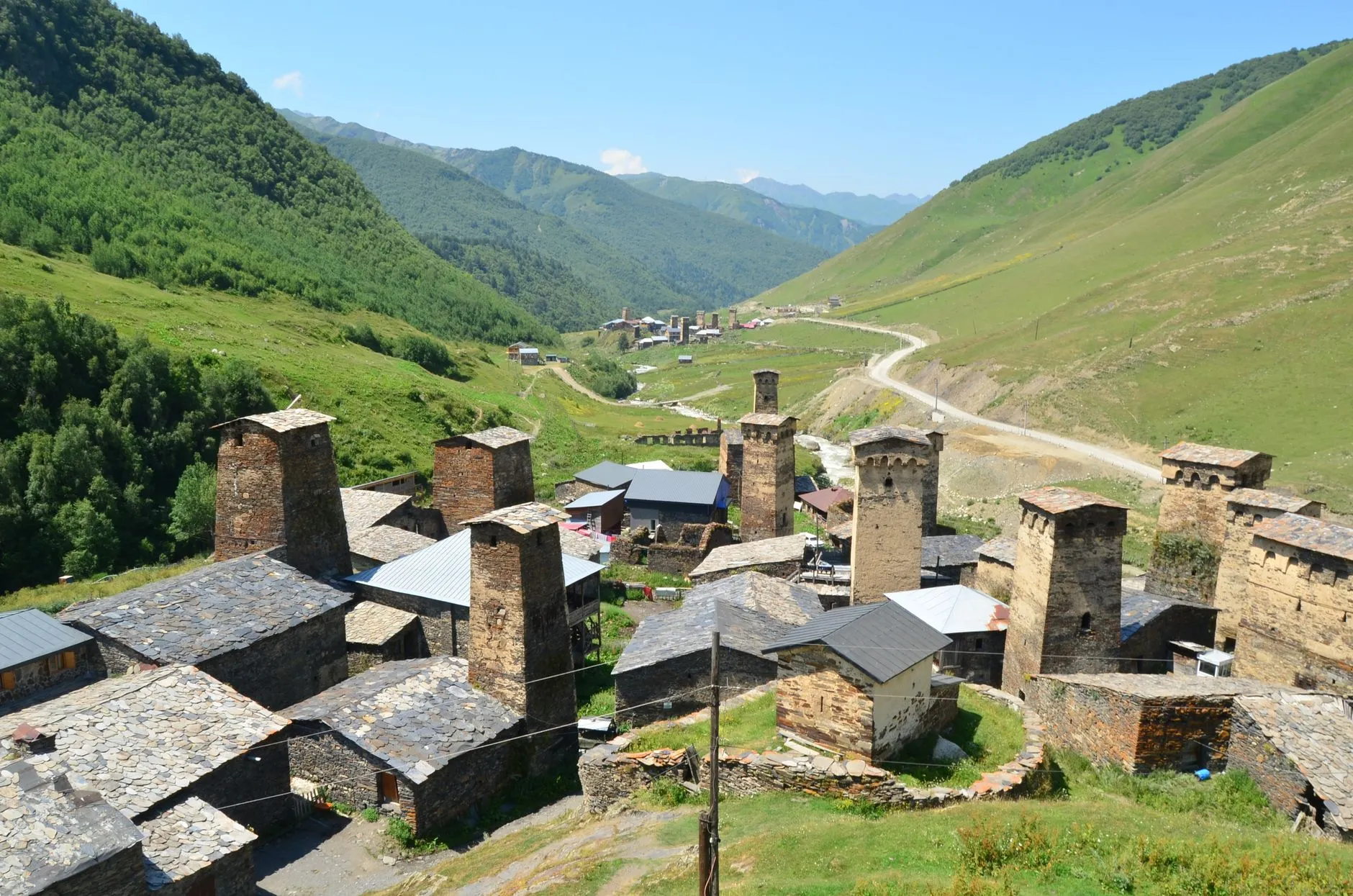
Svaneti is the trip that turns a Georgia holiday into an obsession. Tucked into the high northwest under Georgia’s tallest peaks (Shkhara, 5,193 m), it’s a region of stone tower-houses — defensive koshkebi built between the 9th and 13th centuries, where families sheltered from invaders and blood feuds, now standing like a forest of medieval skyscrapers against the glaciers. For centuries Svaneti was so isolated it was effectively a law unto itself, keeping its own dialect, customs and a hoard of ancient icons and manuscripts the rest of the country lost to invaders.
The hub is Mestia, a now-accessible town (paved road, small airport, guesthouses, a couple of excellent museums) that makes a great base. From here the classic is the multi-day Mestia-to-Ushguli trek, four days through high villages and over passes, one of the finest hikes in the Caucasus. Ushguli, at the head of the valley, is the showpiece: a cluster of tower-villages at around 2,200 m, often called the highest permanently inhabited settlement in Europe, UNESCO-listed, ringed by peaks, with Shkhara filling the head of the valley. Getting there is half the adventure — a long, rough drive from Mestia by shared 4WD.
Svaneti takes commitment: it’s a full day to reach from Tbilisi (or a shorter run from Kutaisi/Zugdidi, often by overnight train to Zugdidi then marshrutka up), the weather is serious, and the comforts are basic. It is also, by common consent, the most spectacular and atmospheric place in the country.
Kakheti — wine country and the birthplace of wine
Georgia didn’t just adopt wine; it invented it. Archaeologists have dated winemaking here back roughly 8,000 years — the oldest evidence on the planet — and the method is still alive: grapes (skins, stems and all, for the reds and the famous ambers) fermented and aged in qvevri, huge egg-shaped clay vessels buried up to their necks in the ground. This isn’t a museum piece; it’s how thousands of Georgian families still make the wine in their cellar. UNESCO protects the qvevri method as living heritage.
The heart of it is Kakheti, the eastern wine region, an easy day-trip or (better) an overnight from Tbilisi. The base towns are Telavi (the regional capital, good for cellar-hopping the Alazani Valley) and the impossibly pretty Sighnaghi — a walled hilltop town of red roofs and wooden balconies looking out over the valley to the Caucasus, nicknamed the “City of Love” (its 24-hour wedding house once let couples marry on the spot). Between the vineyards sit some of Georgia’s great monasteries: Bodbe (where St Nino, who brought Christianity to Georgia, is buried, with a sweeping valley view), the academy-monastery of Ikalto, and the cathedral of Alaverdi.
You can do Kakheti as a wine-soaked day tour from Tbilisi, but the country deserves an overnight: a family-run marani (cellar) supra, a tasting of the orange wines that have made Georgia a darling of the natural-wine world, and a slow evening in Sighnaghi watching the light go down over the vines.
💡 Drink the amber wine. Georgia’s signature is skin-contact white wine — fermented like a red, deep gold to orange, tannic and complex, the qvevri originals that sparked the global “orange wine” movement. Order Rkatsiteli or Kisi amber at a Tbilisi wine bar or, best of all, straight from a Kakheti cellar. It’s unlike anything in the Western wine canon.
Batumi & the Black Sea coast — Adjara
Batumi is Georgia’s seaside oddity — a gaudy, glittering casino-and-skyscraper resort city on the subtropical Black Sea, where Belle Époque architecture sits under a skyline of glass towers, a Ferris wheel built into a building, and a famous moving “Ali and Nino” sculpture of two figures who pass through each other. It’s brash, a little surreal, and a complete change of pace from the mountains: a long seafront boulevard, palm trees, casinos that draw weekenders from Turkey and the region, and a buzzy summer nightlife.
Be clear-eyed about the beach: the Black Sea coast here is pebbly, not sandy, the water is fine but not Mediterranean-clear, and the weather is humid and prone to rain even in summer. Batumi is a fun city break and a lively summer party town, not a flop-on-the-sand resort — chasing guaranteed sun isn’t why you come to Georgia.
The real reason to come to Adjara (the region) is the lush, green, mountainous hinterland just inland — waterfalls, the Mtirala rainforest, old arched bridges, tea plantations — and above all the food. This is the home of khachapuri Adjaruli (Adjarian khachapuri): a boat of bread filled with molten cheese, topped with a raw egg and a knob of butter that you stir into a glorious, indulgent mess. It’s the most famous dish in the country and it’s at its best right here. Come for the khachapuri and the green hills; treat the beach as a bonus.
Cave cities, monasteries & the south — Vardzia, Uplistsikhe, Mtskheta, Borjomi
Some of Georgia’s most astonishing sights are carved into rock or balanced on hilltops, mostly within reach of Tbilisi or doable on the way west.
Mtskheta, just 20 minutes from Tbilisi, is the ancient spiritual capital and an essential half-day. The 11th-century Svetitskhoveli Cathedral (where, tradition holds, Christ’s robe is buried) and the hilltop Jvari Monastery looking down over the meeting of two rivers are both UNESCO-listed and genuinely moving.
Uplistsikhe, near Gori, is a sprawling cave city hewn into a rocky outcrop — once a major pagan and early-Christian settlement of carved halls, a “queen’s theatre,” tunnels and wine cellars, inhabited for thousands of years. (Gori itself is the birthplace of Stalin, with a frank-to-uncomfortable museum, if you want the dark-history detour.)
The showstopper is Vardzia, in the deep south near the Turkish/Armenian borders — a vast 12th-century cave monastery dug into a cliff over the Mtkvari River by Queen Tamar, hundreds of rooms, chapels and tunnels across multiple levels, with a frescoed church still in use. It’s a long day or an overnight from Tbilisi but unforgettable.
Nearby, Borjomi is the leafy spa town famous across the former USSR for its salty-sour mineral water (drink it free from the spring in the park), and the gateway to the Borjomi-Kharagauli National Park and the ski resort of Bakuriani. And just outside Tbilisi, the semi-desert monastery complex of David Gareja, carved into a barren ridge on the Azerbaijan border, is a stark, beautiful contrast to the green of the rest of the country (check current access — part of the complex sits on a contested border line).
What to Eat & Drink — the supra, the cheese bread & the wine
Georgian food is having a global moment, and one meal here tells you why: it’s hearty, distinctive, vegetable-friendly, and built for sharing. The format is the supra — a table piled with many dishes at once, presided over by the tamada (toastmaster), punctuated by elaborate toasts and washed down with wine or chacha (the fierce grape brandy).
The two icons: khachapuri, cheese-filled bread in regional variations — the flat Imeruli round and above all the Adjaruli (the boat of bread, molten cheese, egg and butter from the coast); and khinkali, big juicy soup dumplings twisted into a topknot, eaten by hand — grip the knot, bite a hole, slurp the broth, eat the rest, and never eat the doughy knot (locals stack them up to count how many you’ve downed). Beyond those: lobio (spiced bean stew in a clay pot with cornbread), mtsvadi (charcoal-grilled pork skewers), pkhali (walnut-and-vegetable pâtés — spinach, beetroot, the lot), badrijani (fried aubergine rolled around walnut paste), and chakapuli (a springtime lamb-and-tarragon stew), all carried by walnut, herb and the spice blend khmeli suneli. Finish with churchkhela — strings of walnuts dipped repeatedly in thickened grape juice, the “Georgian Snickers” hanging in every market.
And the wine, of course. Beyond the ambers, Georgia’s reds (the deep, semi-sweet or dry Saperavi) and whites are excellent and absurdly cheap, homemade wine flows at every supra, and chacha — clear, potent, and pressed on you with enthusiasm — is the toast that ends the night. Drinking is woven into the culture, but it’s the warm, ceremonial, supra kind, not a binge coast.
💡 Order one khinkali plate and one Adjarian khachapuri to share, then branch out. Those two are the non-negotiables. From there add a lobio or a pkhali platter for the vegetarians (Georgia is unexpectedly great for them) and a jug of the house wine. A blow-out feast for two with wine routinely lands around €15–25.
Costs & Money — why Georgia is so cheap
Georgia is one of the cheapest destinations within a short flight of Europe, and that’s a central reason to go. The lari stretches a long way and prices are low almost everywhere outside a handful of fancy Tbilisi spots and the Batumi casinos.
A rough daily on-the-ground budget (excluding flights):
- Backpacker / budget: ~€20–30/day — hostel or guesthouse beds, marshrutkas and trains, eating in khinkali houses and bakeries. You can eat very well for €5–10 a day.
- Mid-range: ~€40–70/day — comfortable guesthouses or mid hotels, the odd hire-car or driver day, restaurant meals, wine tours, paid sites.
- Comfortable: ~€80–120/day gets you smart hotels, private drivers and the best restaurants and tastings — still a fraction of Western Europe.
Sense of individual prices: a plate of khinkali or a hearty lobio runs €3–6; a full restaurant meal with wine €10–15 a head; a glass of good qvevri wine €2–4; a bottle of decent local wine from a shop €4–8; a coffee €1–2; a marshrutka between cities a few euros; the Tbilisi–Batumi train roughly €5–15 depending on class; a private room in the sulphur baths €15–25/hour; a full-day Kakheti wine tour with driver €40–70 for the car. Tipping is becoming standard in Tbilisi restaurants (~10%, sometimes added as a service charge — check the bill); elsewhere round up.
Money mechanics: ATMs are everywhere in towns and cities and accept foreign cards (small fees apply); cards are widely accepted in Tbilisi and Batumi but carry cash for the mountains, marshrutkas, markets, guesthouses and small towns, much of which is cash-only. The lari is freely convertible, so you can change euros, dollars or pounds at the ubiquitous exchange booths at good rates.
⚠️ Carry cash off the beaten track. Tbilisi and Batumi are card-friendly, but the moment you head for Kazbegi, Svaneti, Kakheti’s cellars or a marshrutka station, you’re in cash country. Pull out lari from a city ATM before you go, in small notes — change for a big bill can be a problem in a mountain village.
Practical Information — visa, insurance, safety & the breakaway regions
Entry & visa: Georgia has one of the most generous visa policies in the world. Citizens of around 98 countries — including all EU states, the UK, the US, Canada, Australia, New Zealand and many more — can enter visa-free and stay for up to a full year (365 days), no application, no fee, just a passport stamp on arrival. It isn’t a restrictive tourist visa either: during that year you can legally work remotely, freelance, register a business, open a bank account and rent a flat, which is exactly why Tbilisi has become a magnet for digital nomads. The clock resets when you leave and re-enter. (Georgia has been an official EU candidate since December 2023, but for now it’s outside the bloc’s border systems — entry is the simple, stamp-on-arrival affair described above, with no online pre-registration to file.)
New for 2026 — mandatory health insurance. Since 1 January 2026, every foreign visitor entering Georgia must hold valid travel health and accident insurance covering the entire stay, with minimum coverage of 30,000 GEL (roughly €10,000). The policy must be in Georgian or English, on paper or digital, and border officers can ask to see it at passport control — in principle you can be refused entry without it. It applies to everyone, children included. Buy a normal travel-insurance policy that meets the threshold before you fly; most standard European/UK travel-insurance plans clear it easily, but confirm the wording and the coverage amount, and carry proof.
Safety: Georgia is genuinely one of the safer countries in Europe to travel. Violent crime against tourists is very rare, the US holds it at Level 1 “Exercise Normal Precautions” as of 2026, and locals are protective of guests. The honest cautions are ordinary: petty theft in crowded city spots, the wild driving (more dangerous than any crime), and the mountain weather. Tbilisi has also seen periodic political demonstrations — generally peaceful and confined to specific central streets, but worth steering around if you encounter one.
The breakaway regions — handled simply. Two territories, Abkhazia (the northwest Black Sea corner) and South Ossetia (in the north-centre), broke away after conflicts in the 1990s and 2008 and are Russian-backed and outside Tbilisi’s control. They are off-limits: entering from the Georgian side is illegal under Georgian law, the areas have landmine risk, and your embassy can’t help you there. Crucially, this affects nowhere a normal traveller goes — every place in this guide (Tbilisi, Kazbegi, Svaneti, Kakheti, Batumi, the cave cities) is in undisputed, safe, fully normal Georgia. Just don’t try to cross into the two breakaway zones, and you’ll never give them a thought.
Connectivity & SIMs: cheap local SIMs (Magti, Silknet, Cellfie) with big data bundles are easy to buy at the airport or in town with your passport — far cheaper than roaming. Wi-Fi is standard in city accommodation.
Language: Georgian uses its own beautiful, unique alphabet, so signs can be impenetrable — but Russian is widely understood (especially by older people), English is growing fast among the young and in tourism, and a smile plus a gaumarjos! (cheers!) goes a long way.
When to Visit — month by month
Georgia runs several climates at once — a subtropical coast, a temperate interior, and high mountains — so the “best” time depends on what you’re chasing.
May–June: arguably the best all-rounder. Tbilisi and the lowlands are warm and green, the wildflowers are out, Kazbegi and the lower trails open up, and the crowds are thin. Some high passes (Svaneti, Tusheti) may still be snow-blocked early in the window, but for a mixed city-wine-Kazbegi trip it’s ideal.
July–August: high-mountain and coast season. This is when Svaneti, Tusheti and the high trails are fully open and at their best, and when Batumi and the Black Sea come alive. But Tbilisi and the lowlands get hot and sticky (mid-30s°C), so this is the window to be up in the mountains or by the sea, not slogging round the city.
September–October: the connoisseur’s choice. The summer heat breaks, the mountains are still open early on, and — critically — it’s the wine harvest (rtveli), when Kakheti’s cellars are alive with grape-picking and family supras. October is glorious for the city, the wine country and the lower mountains. The single best month for a wine-focused trip.
November–March: low season, with a winter twist. The lowlands are mild-to-cold and quiet, sights are crowd-free and cheap, and the high mountains largely close (Svaneti and Kazbegi roads can be snowbound). But this is ski season: Gudauri (the big one, on the Military Highway), Bakuriani and Mestia/Hatsvali offer genuinely good, genuinely cheap skiing from roughly December to March. Come for the city plus the slopes.
Frequently Asked Questions
Cheapest Flights to Georgia
We have tracked 7,503 fares to Georgia from 152 cities. As of June 2026, here is what a good price looked like from each — the lowest fare we recorded, and a “great-deal” benchmark to judge a quote against. These are tracked observations, not live prices: by the time you read this they will have moved, so treat them as a yardstick, not a quote.
| From | Lowest fare we tracked | Great-deal benchmark |
|---|---|---|
| Larnaca (LCA) | €23 | €33 |
| Poznan (POZ) | €35 | €50 |
| Thessaloniki (SKG) | €36 | €52 |
| Memmingen (FMM) | €38 | €54 |
| Frankfurt Hahn (HHN) | €38 | €54 |
| Wrocław (WRO) | €41 | €59 |
| Venice (VCE) | €42 | €60 |
| Athens (ATH) | €49 | €70 |
| Katowice (KTW) | €51 | €73 |
| Warsaw (WAW) | €51 | €73 |
| Charleroi (CRL) | €55 | €79 |
| Prague (PRG) | €59 | €85 |
| Yerevan (EVN) | €63 | €90 |
| Lyon (LYS) | €69 | €99 |
Recent deals we have posted to Georgia:
- Istanbul to Batumi, Georgia from €211
- Tel Aviv to Batumi, Georgia from €205
- Billund to Tbilisi, Georgia from €150
- Vilnius to Kutaisi, Georgia from €59
- Bordeaux to Tbilisi, Georgia from €314
These are fares aifly tracked to this destination, not live quotes — they have changed since and several of the deals above may have expired. Browse current flight deals →