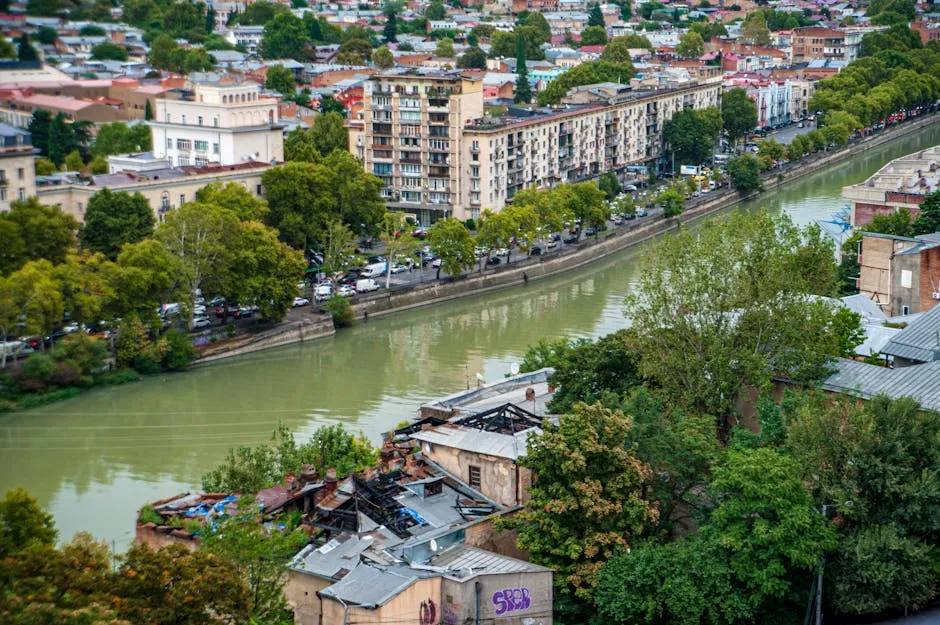
Tbilisi — The Complete City Guide 2026
A South Caucasus capital on its five hundredth consecutive night of protests, with eight thousand years of qvevri wine underneath it and one of the cheapest European city breaks on top. Old Town sulphur baths, Rustaveli Avenue, the Mother of Georgia above Narikala, and the honest version of what’s changed since November 2024.
Why Tbilisi? An Editor’s Note
Stand on Rustaveli Avenue, on the broad pavement between Government House at number 7 — the classical pile finished in 1953 as the seat of the Georgian SSR Council of Ministers — and the working parliament at number 8, and look down. The granite slab in front of you records, in metal letters set into the stone, the names of the twenty-one people killed on 9 April 1989, when Soviet Interior Ministry troops attacked an independence rally with sharpened spades and CS gas. Sixteen of the dead were women. Walk three hundred metres along the avenue and you reach the place where, between 11 and 16 May 2024, an estimated one hundred thousand Georgians filled Rustaveli to protest the Foreign Agents Law — the largest crowd on this avenue since the Rose Revolution of November 2003, which forced Eduard Shevardnadze from office on the same flagstones. Six months later, after the disputed parliamentary election of 26 October 2024 and Prime Minister Irakli Kobakhidze’s 28 November announcement suspending EU accession negotiations until 2028, the crowd returned. They have not stopped. As of 12 April 2026 the demonstrations had run for five hundred consecutive nights.
Other capitals have had revolutions. Tbilisi keeps having the same one, on the same six hundred metres of pavement, with the same demand: that the country face north-west rather than north. The 1989 monument and the 2003 monument and the 2024–26 movement are all on a single walking stretch of the same avenue. This is the first thing to understand about the city — not as background colour, but as the working spine of the place. Anyone who tells you that Tbilisi is a charming bohemian getaway and leaves it at that has not been here recently, and is not paying attention.
Tbilisi sits on a tight meander of the Mtkvari (Kura) river where the South Caucasus narrows between the Greater Caucasus to the north and the Lesser to the south. It controls the only feasible land route between Russia and Persia / Türkiye, which is why it has been worth fighting over for fifteen centuries and why it has been sacked, burned and repopulated roughly seventeen times — the count depends on definitional scope, but the cycle is real. The traditional account holds that King Vakhtang Gorgasali — the bronze horseman above Metekhi Church — moved his capital here in the late fifth century AD after his hawk killed a pheasant which fell into a hot sulphur spring in what is now Abanotubani. The city accepted Russian protection in 1801 after the Persian sack of 1795 under Agha Mohammed Khan, and most of what you walk through — the brick courtyards of Plekhanovi, the gas-lit ironwork of Sololaki’s balconies, the operatic boulevard scheme of Rustaveli itself — is imperial-period reconstruction laid over the older Persian-quarter substrate.
The way to read modern Tbilisi is as three cities sharing a postcode. The first is Old Tbilisi, in the bend of the river — the sulphur baths of Abanotubani, the alleys of Kala below Narikala fortress, the timber-balcony houses of Sololaki, the cathedral hill of Avlabari across the water. This is the photographed Tbilisi, and it deserves the photographs, with the caveat that what survives is largely a sympathetic post-Soviet restoration of a quarter that had been allowed to fall into the river for thirty years. The brick is real; the gas lamps are reproductions; the balconies have been re-carved.
The second is Imperial Tbilisi, north-west along Rustaveli Avenue: the opera house, the Kashveti church, the National Museum, the National Gallery, Government House, parliament, the Academy of Sciences, the broad chestnut-shaded pavements. This is the city that the Russian Empire built between 1845 and 1917 as the capital of its Caucasus Viceroyalty, and that the Soviet Union enlarged after 1921. The Foreign Agents protests happen here because the buildings of state power are here, on this one avenue, within walking distance of each other. To understand the protest, walk the avenue once at midday and once after dark, with the parliament floodlights on.
The third is Post-2022 Tbilisi, and it is the city that surprises most visitors. The full-scale Russian invasion of Ukraine in February 2022 triggered the largest Russian emigration since the Bolshevik Revolution; tens of thousands of relocated Russians chose Tbilisi, where they could enter visa-free, open bank accounts, register businesses, and remain indefinitely. The neighbourhoods absorbed them — Vera, Sololaki, Saburtalo, Vake — and rents in the central districts rose sharply in 2022–23, displacing Georgian renters outward (the most-cited figure is a roughly seventy-percent rise in inner-city Vera and Sololaki rents across the first eighteen months after the invasion). A wave of Russian-language coffee shops, co-working spaces, anti-war bookshops and IT companies appeared. The relationship is uneasy. Some Georgian café owners post signs requiring patrons to confirm they consider Abkhazia and South Ossetia to be Georgian territory; some Russian arrivals are pro-Ukraine dissidents who left specifically not to be conscripted; some are not. This is a working tension, not a finished one, and you will feel it.
The honest version of Tbilisi 2026 includes all three. The city is materially cheaper than any EU capital, often by half. The food is one of the great underrated cuisines of Europe and improving fast. The sulphur baths are unselfconsciously functional in a way that no Budapest or Istanbul equivalent has been for decades. And the political question that occupies the avenue between Government House and parliament is unresolved — which is to say, a visitor in spring 2026 is visiting a country in the middle of choosing its future, not a country that has chosen.
Come with the protest in mind, eat as much as you can, drink the qvevri wine, take the long view of the Caucasus from Mtatsminda at sunset, and try not to ask the obvious foreigner question — what is it like to live here right now — of the first person you meet. Save it for the third one. They will tell you.
Getting There — Airports & Land Borders
Tbilisi has one international airport — Shota Rustaveli Tbilisi International (TBS) — eighteen kilometres east of the city centre, named after the twelfth-century poet whose statue stands on the avenue in the city. It is small by EU-capital standards (one terminal, a few million passengers a year), straightforward to clear, and adequately connected: nightly flights from Istanbul on Turkish Airlines and Pegasus; daily from Warsaw on LOT and Wizz Air; Vienna on Austrian; Amsterdam on KLM; Munich on Lufthansa; Doha on Qatar Airways; Dubai on flydubai and Emirates; Frankfurt on Lufthansa; and a long list of seasonal Wizz, Pegasus and low-cost routes through the warm months.
Bus 337 (formerly Bus 37) is the local arrival ritual and the cheapest option in the city. It leaves from outside the arrivals hall, terminates at Tbilisi Central Railway Station via Freedom Square and Rustaveli Avenue, runs approximately every twenty to thirty minutes, takes forty to fifty minutes into the centre depending on traffic, and costs ₾1 in cash or ₾1.5 if paid with an international credit/debit card. The first bus from the airport is at 07:00 and the last is at 23:00; outside that window you are on a taxi. Pay attention to the route — the bus loops back along Rustaveli, so a stop on the southbound leg can be a longer walk to a hotel than the same stop on the northbound. The MetroMoney transit card (₾2 at any metro station) works on the bus and gets you the cash fare.
Taxis at the airport divide into two tiers. The fixed-fare FlyTaxi counter inside the terminal sells flat-fare rides to colour-coded city zones — Zone 2 (central Tbilisi, including Rustaveli, Sololaki, Avlabari and Vera) is roughly ₾80 as of spring 2026, payment by card accepted. Bolt and Yandex Go, the two app-based services that dominate the city, are roughly half that — expect ₾35–50 for the same trip — and you can hail one from the curb directly after arrival. The standard advice applies: if you do not have a Georgian SIM card and have not got the app pre-loaded, use FlyTaxi; if you do, use Bolt. The street-hail taxis that approach you inside the terminal hall are the worst-value option and will quote you €30–50; ignore them.
The overland alternatives are slow but real. Tbilisi has a working train link to Yerevan in Armenia (overnight, twelve hours, a sleeper at around ₾90) and to Baku in Azerbaijan (overnight, fourteen hours, similar price); marshrutka routes run hourly to both. Land borders with Türkiye (at Sarpi on the Black Sea coast, four hundred kilometres from Tbilisi) and Armenia (Bagratashen-Sadakhlo, two hours from the city) are visa-free in both directions for the same nationalities that get visa-free entry to Georgia. The Verkhny Lars border with Russia is open but is the wrong way for almost all readers of this guide; the Abkhazia and South Ossetia “borders” are de facto closed to foreign visitors and politically inadvisable to cross even where you can.
Pro Tip: Cash-or-card at Bus 337. The international-card fare of ₾1.5 is fifty per cent above the cash fare of ₾1, but a single fifty-tetri saving is not worth changing money for; what is worth doing is buying a MetroMoney card on arrival (₾2, refundable) at the airport metro-card kiosk and topping up ₾10 in cash. That same card runs your metro, bus, marshrutka, and Rike–Narikala cable car for the entire trip at the local-resident rate.
Top 12 Attractions in Tbilisi
The Tbilisi attraction map is unusually compact. Eight of the twelve below are within a forty-minute walk of each other in the bend of the river — you do not need transport for most of a first visit. The order is roughly: must-do, should-do, would-be-a-shame-to-miss, and the contrarian picks at eleven and twelve.
1. Narikala Fortress & the Mother of Georgia (Kartlis Deda)
Narikala is the citadel that the city was built around — fourth-century Persian foundations, expanded by the Arabs in the seventh century, finished by the Mongols, sacked by everyone in turn. What remains is a partial circuit of walls and towers on the steep ridge above the sulphur quarter, with the eighteenth-century St Nicholas Church (rebuilt 1996) inside the upper ward. The fortress is open 24 hours, entry free. Most visitors approach by the Rike–Narikala cable car from the river-park at Rike across to the Narikala upper station: ₾2.50 one-way on a MetroMoney card, running 10:00 to midnight in summer and 10:00 to 22:00 in winter. From the upper station a five-minute walk along the ridge brings you to the twenty-metre aluminium statue of Kartlis Deda — the Mother of Georgia — finished in 1958 by Elguja Amashukeli, holding a sword in one hand for enemies and a wine bowl in the other for guests. The hand-railed path down the ridge takes you to Abanotubani in fifteen minutes.
Editor’s tip: Walk up via the path behind Maidan Square, ride the cable car down. The walk up is steep enough that the cable car as second-leg feels earned; the reverse leaves you stranded on the wrong side of the river at altitude after a steep climb. Sunset from the Mother of Georgia terrace is the postcard view but is also the most crowded forty minutes of the day; either go an hour before sunset and stay through, or go the morning after.
2. Abanotubani — The Sulphur Baths
The sulphur baths in the brick-domed quarter at the foot of Narikala are not a museum experience. They are working public baths, used daily by Tbilisi residents for the same reasons baths have been used here since the founding myth — the water comes up at around forty degrees Celsius from the Mtkvari sub-strata, smells unmistakably of hydrogen sulphide, and is locally considered medicinal. There are two ways to bathe.
The public bathhouse along Abano Street is the cheapest entry point. ₾5–10 for a single-sex communal bath, no booking, towels not provided, and the regulars are locals not tourists. This is the authentic version and is intimidating only the first thirty seconds. The private cabins at Chreli Abano (the famous blue-tiled facade, the most-photographed bath in the city) and at the other private-cabin baths along Abano Street rent by the hour: ₾40–80 per hour for two to four people in a tiled cabin with private plunge pool, ₾120–200 per hour for a VIP room with massage and scrub (kisi). Booking is generally not required mid-week; on weekends Chreli Abano and the surrounding houses fill up on Friday and Saturday nights.
Pro Tip: Ask for the kisi — the Persian-style exfoliation scrub by a working bath attendant. It costs ₾20–30 on top of the cabin price, takes about fifteen minutes, removes a quantifiable layer of skin, and is the bit visitors remember six months later. Tip ₾10 in cash on top of the listed price; the attendants are not on the bath salary.
3. The Old Town — Kala, Sololaki and the alleys
The triangle bounded by Freedom Square, Maidan Square and the river is the most photographed neighbourhood in the South Caucasus and the substrate of every Tbilisi marketing image — the brick-and-wood balcony houses with cast-iron ornament, the leaning facades, the courtyards, the carved wooden doors. Sololaki is the higher quarter, on the slope below Mtatsminda; Kala is the lower quarter, around the cathedrals and bathhouses; together they form the historic Persian-, Armenian- and Georgian-quarter substrate that was rebuilt after the 1795 sack.
A walking circuit that works: start at Freedom Square (Tavisuplebis Moedani) with the gold St George statue on the column; walk south on Pushkin Street past the National Gallery to Erekle II Street; turn into Bambis Rigi with its outdoor terraces and the wine bars; come down to Shardeni Street past the Sioni Cathedral and continue to Maidan Square. Cross the Bridge of Peace (the curved glass-and-steel pedestrian bridge by Michele de Lucchi, finished 2010 — locals call it “always sanitary” because it resembles a tampon, a description you will hear delivered with absolute flatness) to Rike Park, and either take the cable car up or walk to the lower stations of Avlabari. The full circuit is about ninety minutes at attractions-pace.
Editor’s tip: Bambis Rigi (also written Bambisrigi or Bambis Street) is the strip where most of the photogenic balcony terraces are concentrated and where the tourist-trap restaurants are concentrated for the same reason. Eat in Sololaki proper (uphill on Lermontov, Asatiani or Geronti Kikodze streets) or at Café Littera at Iv. Machabeli 13 in the Writers’ House courtyard; have a coffee on Bambis Rigi to enjoy the view and then leave.
4. The Holy Trinity Cathedral of Tbilisi (Sameba)
The largest Orthodox cathedral in the South Caucasus, on Elia Hill in Avlabari across the river. Built between 1995 and 2004 to a competition-winning design by Archil Mindiashvili, capped with a hundred-metre gilded central cupola. It is a controversial building — funded substantially by donations from the Georgian-Russian oligarch Bidzina Ivanishvili (the same Ivanishvili who founded Georgian Dream in 2012 and remains the dominant figure in the current government), built on land that had been a partially Armenian cemetery, criticised by some Georgian Orthodox scholars as architecturally syncretic — but it is also the working seat of the Catholicos-Patriarch of All Georgia and the dominant element of the Tbilisi skyline from any high point. Entry is free; the cathedral is open daily roughly 09:00 to 20:00.
The dress code is enforced and not aspirational. Women must have shoulders and knees covered and a scarf over their hair; men must have shoulders and knees covered and head uncovered. A basket of borrow-and-return wraps and aprons sits at the public entrance for visitors who arrived in shorts. The basket runs out at peak times; bring your own.
Pro Tip: Walk up from Avlabari Metro (Line 2, red) via Ketevan Tsamebuli Avenue rather than taking a taxi to the cathedral itself; the climb sets the scale of the building and lets you approach the main gate from the south, which is the intended sightline. Allow forty-five minutes inside and a further fifteen for the surrounding ecclesiastical complex (smaller chapels, the Patriarchate offices, the bell tower).
5. Georgian National Museum (Janashia Museum), Rustaveli 3
The flagship of the Georgian National Museum federation, on Rustaveli Avenue immediately south of Freedom Square. Three permanent collections justify the visit:
- The Treasury (Sakebrul Pondi), in the basement, holding the gold and silver of the pre-Christian and early Christian Caucasus — Colchian gold-work from the seventh century BC, Trialeti silver, the Akhalgori hoard — at a quality that has had Greek and German museum directors visibly jealous. The collection ranks with the Persian Treasury at the National Museum of Iran and is the strongest single justification for the museum.
- The Museum of Soviet Occupation, on the upper floor: a deliberately polemical permanent exhibit on the 1921 Red Army invasion that ended the first Georgian democratic republic, on the deportations and executions of the Stalin period (Stalin was Georgian; this is not commemorated in the museum), and on the Soviet-era political prisons. The exhibit is contested by some Russian and Georgian historians; that is the point.
- The Archaeology floors, with the Dmanisi early-hominid skulls — the oldest hominin remains found outside Africa, dated 1.8 million years before present.
Entry: roughly ₾15 adults, free under 18. Open Tuesday–Sunday 10:00–18:00, closed Monday. Allow two hours minimum, three for the full slow tour. English-language signage is partial but improving.
6. The Open Air Ethnographic Museum (Giorgi Chitaia)
Forty hectares of preserved vernacular architecture from across Georgia, laid out on a forested hillside above Vake Park — twelve regional zones, eighty traditional buildings physically moved here from the regions they belong to, dating from the early eighteenth century to the early twentieth. Svaneti tower-houses, Kakhetian wine-cellars (marani), a Mingrelian peasant farm, the Khevsureti fortress-villages, the Adjarian Black-Sea-coast water-mill, basket-weavers and qvevri-makers working at season. It is the closest a visitor can get in a day to seeing the rural Georgia that most of the population traces back to within two generations.
Open Tuesday–Sunday 10:00–17:30 (closes 17:00 in winter), closed Monday. Entry roughly ₾10 adults. The Art-Gene festival, the biggest folk-and-handicraft event in the country, takes over the museum for one weekend in July (usually mid-to-late month — exact dates announced in spring) and is worth booking a trip around if your dates flex.
Editor’s tip: Take Bus 61 from Vake Park or a Bolt up the hill (₾6–8); the museum is genuinely uphill and the walk-up is a thirty-minute climb in summer heat. Allow three hours for the full circuit. Bring water — the on-site café is functional but limited.
7. Rustaveli Avenue
The avenue itself is the seventh attraction. One and a half kilometres from Freedom Square to Rustaveli Metro, lined on both sides with the imperial-Russian institutional architecture of the 1845–1917 Caucasus Viceroyalty: the Rustaveli Theatre (Konstantine Marjanishvili’s house, finished 1901); the Opera and Ballet Theatre (Zakhary Pailadze, 1851, rebuilt 1880 in Moorish-revival brick — re-opened January 2016 after a long restoration); the Kashveti Church of St George (1910, neo-Georgian on twelfth-century foundations); the Georgian National Gallery (Blue Gallery) with the Pirosmani and Gudiashvili collections; the Academy of Sciences building with its Stalin-Gothic spire; the Marriott (formerly the Tbilisi Hotel, 1915); and the working Parliament at №8. Walk it once at midday and once after dark.
Pro Tip: The avenue is the protest spine. As of spring 2026, demonstrations gather in front of parliament most evenings from approximately 19:00, peaking at weekends. The demonstrations have been overwhelmingly peaceful but have been the site of crowd-control measures including water cannon and tear gas on a handful of occasions since November 2024. Walking the avenue during a demonstration is fine and tolerated; standing in front of riot lines with a camera is not. If you see crowd-control deployments forming, leave the avenue and re-enter at the Tabidze or Chichinadze cross-streets rather than along Rustaveli itself.
8. Mtatsminda Park and the Funicular
The park on top of Mount Mtatsminda (“Holy Mountain”), 770 metres above sea level, with the city laid out below. Access is by the funicular railway from Chonkadze Street, opened 1905, rebuilt 2012, running 09:00 to midnight daily. One-way ticket ₾12 with a ₾2 refundable card (or ₾10 with a MetroMoney card balance), takes four minutes top-to-bottom on a thirty-degree grade. The summit has the Mamadaviti Pantheon, where most of Georgia’s nineteenth- and twentieth-century writers, painters and composers are buried — Ilia Chavchavadze, Akaki Tsereteli, Vazha-Pshavela, Niko Pirosmani — and the working St David’s Church above it; an early-twentieth-century TV tower; and the Mtatsminda Amusement Park with a Ferris wheel, roller coaster and the city’s best viewpoint terrace.
Editor’s tip: Go up for sunset, eat at the Funicular Restaurant in the original 1905 station building at the summit (mid-range — expect roughly ₾60–90 per head for Georgian-with-French-edges cooking), and ride back down in the dark. The middle station has the Pantheon entrance and is a separate stop worth taking on the way down — Pantheon entry free, open until 18:00.
9. The Bridge of Peace, Rike Park and the Presidential Residence
The Bridge of Peace, by Michele de Lucchi and Philippe Martinaud, finished 2010 in glass-and-steel canopy form, connects the Old Town’s Erekle II Square to Rike Park across the river. The bridge is illuminated after dark with an animated LED programme by the French artist Philippe Martinaud; from a distance the structure resembles, depending on whom you ask, a sanitary product or a marine creature, and the local nickname reflects this. Rike Park itself is a 2010 Saakashvili-era construction — the same wave of urban projects that produced the cable car, the cypress-lined river promenade and the Public Service Hall on the opposite bank — and contains the lower station of the Rike–Narikala cable car. The former Presidential Residence (Avlabari Palace, finished 2009, abandoned as the presidential seat after the 2018 move to Orbeliani Palace) is on the hill behind Rike Park, still glassy and floodlit at night and still a useful sightline from the Old Town across the river.
10. Sioni Cathedral and Anchiskhati Basilica
The two oldest working churches in the city. Sioni Cathedral (Sioni Street, off Shardeni) has been the cathedral church of Tbilisi since the sixth century; the present building is mostly thirteenth-to-seventeenth century, restored 1980s. Inside is the cross of St Nino — the fourth-century Cappadocian missionary who converted Georgia to Christianity in 337 (the traditional account holds) — woven from vine wood and her own hair. Anchiskhati Basilica (Shavteli Street, near the Bambis Rigi end of the Old Town) is older still — sixth century, built under King Dachi, the only surviving early-Christian basilica in the city centre. Both are free, open daily roughly 09:00 to 19:00, observe dress code, and are considerably emptier than Sameba.
11. The Dry Bridge Flea Market (Mshrali Khidi)
The contrarian pick. Six days a week (closed in heavy rain), the long pedestrian “dry bridge” and the parkland beside it on the Mtkvari embankment east of the National Museum becomes the city’s open-air flea market. Soviet medals, hand-pressed wax records, Tsarist silver, Georgian icons of varying provenance, samovars, embroidered textiles, vinyl, paint-on-canvas Pirosmani reproductions, vintage cameras, and a long row of Georgian sellers who will explain the provenance of every item at length. The market trades in genuine objects (most of them) at genuine flea-market prices (haggle expected); it is not a curated antiques shop and not all of the silver is real silver. Open roughly 10:00 to sundown, daily; busier and broader on weekends.
Editor’s tip: Bring small notes — ₾5, ₾10, ₾20. Sellers will not generally have change for a ₾100 on a ₾30 transaction. The end of the market on the side closer to the National Museum tends to have the more serious antiques sellers and higher prices; the side closer to Saarbrücken Bridge has more textiles, vinyl and bric-à-brac.
12. 14 (Ietim Gurji’s House), the Tbilisi History Museum & the Karvasla
The Tbilisi History Museum (Karvasla) at Sioni Street 8 is housed in a working caravanserai — a thirteenth-to-nineteenth-century goods-trading inn on the silk-road branch — with the building itself being a substantial part of the attraction: galleried courtyards, brick vaults, a basement with original stone troughs. The permanent exhibit covers the city from prehistory to the twentieth century, with particularly good Soviet-period photography. Entry roughly ₾10, open Tuesday–Sunday 10:00–18:00. The poet Ietim Gurji’s preserved studio is on the same complex.
Pro Tip: The museum café on the upper gallery has the best mid-morning coffee in the Old Town and a view down into the caravanserai courtyard. Locals use it as a working café; it is not a tourist trap. Order the coffee black with a half-glass of cold water on the side, Georgian style.
Tbilisi’s Neighbourhoods
A visitor who stays in the central districts can walk between the next six neighbourhoods in a single day. They are listed roughly in clockwise order around the river.
Old Town (Kala / Sololaki / Abanotubani) — what to base in if you want the postcard
The triangle described above. Walking distance to almost every attraction in this guide; loud at weekends on Erekle II and Bambis Rigi; quiet on the higher streets of Sololaki (Lermontov, Asatiani, Geronti Kikodze). The substrate has been substantially restored since 2007 and many of the famous balcony houses are now boutique hotels or short-let apartments. The compromise: full visual character, central location, restaurant tourist-trap concentration, weekend noise, the highest base-rate prices in the city — and still cheap by EU standards.
Avlabari — across the river
Across the Mtkvari east of the Old Town, on the hill below Sameba Cathedral. Historically the Armenian quarter (the Armenian Cathedral of St George, Yerevan Square, the older Armenian cemetery). Walking distance to the Old Town via the Metekhi Bridge or the Bridge of Peace, ten-minute climb from the river to the Cathedral; cheaper than Old Town for accommodation, more residential, quieter at night. Avlabari Metro is on the red Line 2.
Marjanishvili & the Aghmashenebeli Boulevard
North of the river along David Agmashenebeli Avenue, named for the eleventh-century king. The avenue was restored 2010–13 as a pedestrianised boulevard with the imperial Russian apartment buildings reroofed and refaced — the result is one of the most pleasant walks in central Tbilisi and the heart of the post-2022 expat scene. Restaurants, third-wave coffee, anti-war Russian bookshops, IT companies. Marjanishvili Metro (Line 1, red) at one end, Saarbrücken Square at the other. Good base if you want walkable, central, slightly cheaper than Old Town, and the most cosmopolitan crowd.
Vera
A leafy hillside neighbourhood between Rustaveli Avenue and Vake. Twentieth-century apartment buildings, plane-tree streets, a concentration of relocated Russian and Ukrainian residents since 2022, the highest density of independent cafés and small restaurants in the city. Pekini and Asatiani are the working streets. Substantially residential — quieter than Old Town, more interesting than Vake. Costs roughly the same as Marjanishvili for accommodation.
Vake
West of Vera, between Heroes’ Square and Vake Park. Soviet-era apartment blocks built for the academic and party-administrative class — the closest Tbilisi gets to a middle-class residential district in the West-European sense. Vake Park is the city’s main green space; Chavchavadze Avenue is the main shopping street; the diplomatic embassies are concentrated here. The neighbourhood is comfortable, well-served, and somewhat boring; a quieter base for travellers who do not want the Old Town crowd. Walkable to Heroes’ Square Metro (Line 1).
Saburtalo
West of Vake, behind Mtatsminda. A vast Soviet-era residential district built 1960s–80s, comprehensively unphotogenic, with the strongest concentration of post-2022 Russian arrivals and the corresponding rental-price inflation. Not a tourist base; mentioned here because the Tbilisi National Stadium, the Sports Palace, the central bus station and several major Russian-Tbilisi institutions are here. Skip unless you have specific business in the area.
Plekhanovi (Vorontsov) and Marjanishvili side-streets — the contrarian base
The side streets running south from Aghmashenebeli into Plekhanovi (the older Soviet-era working-class brick-quarter) hold a lot of the city’s character in a smaller compass than Old Town. Cheaper than Sololaki, less restored, the architecture is more raw, the restaurants are less curated, and a base here lets you walk to Marjanishvili Metro in five minutes and to the Old Town in fifteen. Recommended for a second-visit traveller who has done the Old Town once.
Where to Stay — by Budget
Rates below are for high season (May–September and late December) and are double-occupancy unless flagged. Off-season (November, February, March) typically runs 25–35 percent lower.
Budget — ₾35–80 per person per night (€11–26)
Fabrika Hostel & Suites (Egnate Ninoshvili 8, in Marjanishvili) is the obvious budget anchor. A converted Soviet sewing factory turned into a hostel-plus-creative-complex with a large open courtyard ringed by small Georgian-run independent businesses (a bookshop, a vinyl bar, a ceramicist, two small kitchens). Dorm beds from around ₾40, doubles from ₾180. The courtyard is excellent; the rooms are functional rather than luxurious. Around ten minutes’ walk to Marjanishvili Metro and twenty to the Old Town.
Envoy Hostel Tbilisi (off Aghmashenebeli) is the more polished option in the same band — purpose-built rather than converted, with cleaner private singles and doubles, a proprietary tour-desk operation, and a strong returning-traveller scene. Dorms from around ₾50, doubles from ₾200.
For straightforward private rooms at hostel prices, the Sololaki Tbilisi and Vera Stories budget guesthouse scene runs ₾100–180 per night for a clean double, often with breakfast. Booking directly through the property (or through their Telegram channel, in 2026 the lower-friction option than Booking.com on which the 14% margin is now visible to the property) typically beats Booking.com prices by 10–15 percent.
Mid-range — ₾220–500 per night (€70–160) for a double
Rooms Hotel Tbilisi (Merab Kostava 14, in Vera) is the city’s best-known design hotel — opened 2012 in a converted publishing house, with the now-recognisable industrial-chic interior that the Adjara Group went on to roll out in Stamba and Fabrika. The Living Room bar on the ground floor was the model for a generation of post-Soviet hotel bars. Rates from around ₾380 for a king classic in shoulder season, well above that in peak summer.
Stamba Hotel (Merab Kostava 14, next door to Rooms — same complex, same group) is the higher-end sister property. Stamba is the more visually distinctive of the two — the structural concrete and exposed brick of the original publishing-house bones left intact, the library bar with the four-storey wall of books that has been on every interiors magazine in the post-Soviet world since 2018. Rates from around ₾550 in shoulder season, ₾800–1,200 in peak. Stamba’s swimming pool is on the rooftop terrace with a city view; non-residents can sometimes use it as part of a spa package — book direct with the concierge.
Several boutique mid-range hotels sit between Freedom Square and Sololaki in renovated nineteenth-century courtyard buildings — expect ₾250–400 a night for a refurbished double with breakfast.
Splurge — ₾900+ per night (€290+) for a double
The Biltmore Hotel Tbilisi (Rustaveli Avenue 29, in the former IMELI building) is the genuine five-star of the avenue — the seventy-five-metre Stalin-Gothic facade of the former Institute of Marxism-Leninism, restored 2014. Restaurant on the rooftop with the best Rustaveli view in the city. Rates ₾1,000–1,800 in shoulder, ₾1,500–2,400 in peak.
The Tbilisi Marriott (Rustaveli Avenue 13) is the older five-star anchor — the 1915 grand hotel of the imperial period, refurbished as the Marriott since the late 1990s. Rates roughly comparable to the Biltmore.
Paragraph Freedom Square (a Marriott Autograph Collection property at Freedom Square 4, opened 2020) is the newer luxury alternative and the design-conscious choice in this band.
Where not to stay
Avoid anything booked on Booking.com as a “Tbilisi apartment” without checking the actual neighbourhood. Saburtalo, the outer parts of Isani, and the apartment blocks above Didube bus station are all available cheap and are all bad places to stay for a short visit; you will spend half your trip on Bus 31 or in Bolts back to the centre. The Old Town and Sololaki are walkable to everything; Avlabari, Marjanishvili, Vera and Vake are all metro- or fifteen-minute-walk-accessible; everything further out is not, and Bolt’s surge prices in evening traffic make the daily cost-saving illusory.
Where to Eat — Khinkali, Khachapuri, the Supra
Georgian cooking is one of the great underrated cuisines of Europe — the country sits at the intersection of Persian, Turkish, Russian and West-Caucasian food-cultures and has its own distinct identity over the top of all of them. The defining structures are the supra (the long ritualised feast, presided over by a tamada or toastmaster, with toasts in fixed sequence — Georgia, ancestors, parents, friends, women, children, peace, the visitor); khinkali (the soup-filled dumpling, gathered at the top, the cap left uneaten — counting your caps is a common end-of-meal joke); khachapuri (cheese bread, in regional variants — Imeretian flat, Megrelian stuffed, Adjarian boat-with-egg, Penovani layered); and qvevri wine (the eight-thousand-year-old Georgian method, UNESCO-listed in 2013, made by fermenting whole-cluster grapes in clay vessels buried in the ground).
A short and opinionated list of where to eat, by category. Reservations are not generally needed midweek for any of these; for weekend evenings at the named restaurants, book through their Instagram or Facebook DM the day before — it is the local norm.
High-end Georgian — ₾60–180 per person
- Barbarestan, David Aghmashenebeli Avenue 132 — the restaurant that revived the 1874 cookbook of Barbare Jorjadze (the nineteenth-century Georgian noblewoman, cookbook-author and women’s-education advocate). Set menu of forgotten Georgian recipes — veal in plum sauce, cherry-and-mint soup, badrijani nigvzit (eggplant rolls with walnut paste), Jorjadze-recipe chakapuli. Around ₾80–150 per head with wine. Book ahead at weekends. The Worlds 50 Best Restaurants Discovery list features it as the Tbilisi anchor.
- Café Littera, Ivane Machabeli 13 — in the courtyard of the Georgian Writers’ Union, a nineteenth-century Sololaki mansion with terrace dining under plane trees and string-lights. Georgian-fusion plating with sourcing from named producers. Around ₾70–130 per head. Closes in winter (the dining is courtyard-only).
- Shavi Lomi, Mosashvili Street 23, Vera — the restaurant that triggered the modern Georgian movement in the late 2000s. Re-imagined regional cooking, particularly strong on Megrelian (the kubdari and the gebjalia are the items to order). Around ₾40–70 per head.
- Funicular Restaurant (atop Mtatsminda) — the touristic-set-piece restaurant with the unbeatable view; the food is competent rather than the city’s best, but the location is the point. Around ₾60–90 per head.
Mid-range Georgian — ₾25–60 per person
- Salobie Bia, Rustaveli Avenue 14 — the central-avenue anchor for a focused twenty-dish Georgian menu; the shkmeruli (chicken in garlic-milk sauce) is the reason to come.
- Pasanauri — a long-running khinkali-and-mountain-food spot known for proper Pshav-Khevsureti-style dumplings; order kalakuri (mixed pork-and-beef) by the dozen at any of its branches.
- Machakhela, with branches across the city — the reliable chain for Adjarian khachapuri (the egg-on-the-cheese-boat version) at ₾10–18 a boat.
- The back-streets khinkali houses on and around Atoneli Street — sticky tables, plastic stools, three-line menus, ₾2 per khinkali. Pick the one with the most locals in it. The bench mark.
Budget — ₾8–20 per person
- Samikitno Machakhela on Freedom Square is the late-night option for adjaruli khachapuri, khinkali and a beer at ₾20–30 total.
- Any working neighbourhood bakery (lobiani — bean bread — at ₾2.50 a slice, coffee ₾4). The Sololaki and Marjanishvili side-streets each have two or three; pick the one with a queue at 09:00 and you are right. This is the Tbilisi working breakfast.
- The Dezerter Bazaar food stalls behind the central railway station — for the brave, real working-market eating: pork khinkali for ₾2, lobio (bean stew) with mchadi (cornbread) for ₾8, and the city’s best churchkhela (walnut-and-grape-must rope candy) at the dried-fruit corner.
Non-Georgian and the post-2022 wave
The post-2022 Russian relocation brought with it a non-trivial number of relocated St Petersburg and Moscow chefs and a substantial new Russian-, Ukrainian- and post-Soviet-international restaurant cohort. The anti-war Russian-language bars and bakeries clustered in Vera and along Aghmashenebeli (a couple of them famously check at the door that patrons consider Abkhazia and South Ossetia to be Georgian territory) and the hotel-restaurant scenes inside Stamba and Rooms are representative. The post-2022 wave is the section of the food scene that has changed most since pre-pandemic guidebooks were last accurate.
Editor’s tip: The single best Georgian-food rule in Tbilisi is to order shared plates and one main per person, not multiple mains. Georgian eating is plate-sharing by default; ordering four mains for four people gets you four plates of cold leftovers. A typical mid-range order for two: one khachapuri, six khinkali, one badrijani nigvzit, one lobio, one main (chakapuli or shkmeruli), 500 ml of qvevri wine. About ₾90–110 total.
Drinking — Qvevri Wine, Chacha and the Cha-Cha
Georgia’s wine claim is genuinely ancient. The archaeological evidence — clay-vessel residues from sites in Shulaveri Gora and Imiri Gora in eastern Georgia — dates organised viticulture in the South Caucasus to roughly 6000 BC, eight thousand years before the present. Whether you call this “the oldest wine in the world” depends on definitional scope (the Iranian Zagros sites are roughly contemporary), but Georgia’s distinct technical claim is firmer: qvevri — fermenting whole-cluster wine in clay vessels buried in the ground — is unique to the South Caucasus and has been continuously practised since prehistory. UNESCO inscribed the method on its Intangible Cultural Heritage list in 2013.
The qvevri tradition produces amber wines — white grapes fermented with skin contact, giving the colour and the tannin structure that has driven the global natural-wine interest in Georgian wine since the early 2010s. Rkatsiteli, Mtsvane and Kisi are the grapes to ask for in white-amber; Saperavi is the dominant red. A good qvevri-method bottle in a Tbilisi wine bar runs ₾35–80; in a restaurant ₾60–150; by the glass ₾10–25.
A short list of wine bars worth the visit:
- Vino Underground, Galaktion Tabidze 15 — the original natural-wine bar, opened 2012, co-operatively owned by ten or eleven small qvevri producers. The benchmark.
- G.Vino, Erekle II Street — Old Town, slightly more polished, well-curated by-the-glass selection.
- 8000 Vintages, on Rustaveli Avenue — the wine shop-plus-bar that does flights of eight wines by region, with the longest by-the-glass list in the centre.
- Wine Merchants of Old Tbilisi, Bambis Rigi — useful for the visiting tourist who wants to try six things in an hour; less interesting for the second visit.
Chacha is the local pomace brandy — what is left of the grape after qvevri fermentation, double-distilled to roughly 50–65 percent ABV. The good versions are a clean and floral grappa equivalent; the bad versions are industrial alcohol with grape colouring. Order in restaurants by named producer (Askaneli, Marani, Telavi Wine Cellar) rather than house pour. Two thimble-shots after a meal is the local dose; do not match a Georgian host shot-for-shot.
The Cha-Cha Time electronic-pop bar scene of Vera and Marjanishvili — the late-night dance culture that the city built around Bassiani (in the basement of the National Stadium) and Khidi (under the bridge across the Mtkvari) — is internationally known and operates on its own clock. The doors at Bassiani open at midnight Saturday and the dance floor empties around 10:00 Sunday morning; entry is ID-checked, the door is run by Horoom Nights’ Naja Orashvili and selectivity is real. This is the night-life equivalent of the city’s wine scene: serious, internationally regarded, and intimidating only on first contact.
Pro Tip: If you intend to do Bassiani or Khidi, do it on a Saturday night, sleep through Sunday daytime, and do not attempt to do Mtatsminda or the National Museum on the Sunday. The recovery time is built into the local clock for a reason.
Getting Around the City
Tbilisi runs on a two-line metro, a working bus network, marshrutkas, and Bolt. The metro is fast and cheap and runs from 06:00 to 24:00 daily.
Metro
Line 1 (red) runs north-south from Akhmeteli Theatre to Varketili through Rustaveli, Freedom Square, Avlabari and the central interchange at Station Square. Line 2 (green) runs west from Saburtalo through Vake to Station Square. Fare ₾0.50 per ride (about €0.16) on a MetroMoney card; the card costs ₾2 and is refundable at any station. The metro is Soviet-built and the escalators on the deeper stations (Rustaveli, Tavisuplebis Moedani, Avlabari) are 50–60 metres deep — long descents, fast escalators.
Bus and Marshrutka
Buses are ₾1 flat-fare, payable in cash or MetroMoney. The municipal bus network is reasonable but not intuitively legible to a first-time visitor; use Google Maps for routing, which is reliable in Tbilisi. Marshrutka (shared minibuses) cover routes the buses do not, run on fixed routes for ₾1 flat-fare in the city, and are the inland rural choice (Tbilisi-Gori ₾5; Tbilisi-Kazbegi ₾15–20; Tbilisi-Sighnaghi ₾8–10) — though spring 2026 fuel rises have pushed some intercity fares up by ₾5.
Bolt and Yandex Go
Bolt is the working taxi app in Tbilisi. Most rides across the central city are ₾6–15; airport runs ₾35–50; cross-city in evening rush ₾15–25 with a surge multiplier. Yandex Go is the Russian-origin app, broadly cheaper and broader in coverage, but the Russian-Belarusian-Kazakh ownership question is a live one for some visitors and most Georgians will choose Bolt where the price difference is marginal.
Editor’s tip: The MetroMoney card is the single most useful logistics item to buy on arrival. ₾2 deposit, refundable at any station. Top up ₾10–15 for a multi-day visit. Works on metro, bus, three cable cars (Rike–Narikala, Turtle Lake, Bagebi), and the funicular. The day-pass for unlimited urban transit is ₾3; the week pass ₾20.
Walking
The centre is walkable end-to-end in roughly an hour: from the Holy Trinity Cathedral down through Avlabari, across the Bridge of Peace, through Rike Park, up Narikala by cable car, down through Abanotubani and Maidan Square, up Rustaveli to Freedom Square, on to Aghmashenebeli through Marjanishvili. Tbilisi’s centre is a walking city; the topography (the steep ridge below Mtatsminda, the climb to Sameba) is real, but the distances are short.
Driving in Tbilisi
The short answer: don’t, unless you are leaving the city. Tbilisi traffic is dense, parking enforcement is patchy but real (the green-zone parking-meter system covers most of the centre), and the local driving standard is best described as confident. Pick up a rental car at the airport for day-trip departures, return it within the same day if possible; for the day trips described below, a driver-hire-for-the-day (around ₾180–280) is often cheaper and more relaxed than self-drive.
When to Visit
Tbilisi has four genuine seasons. The shoulder months — May, June, September, early October — are the right window.
- May–June: long days, comfortable warmth (18–28 °C), the Caucasus mountains still snow-capped on day-trip range, the spring wine releases in the bars. The single best month is probably June, before the July heat sets in.
- July–August: hot (often 33–35 °C, occasional 38 °C heatwave days), the city quiet as residents leave for the Black Sea or the mountains, Art-Gene at the Open Air Museum in mid-July. Bearable if you are comfortable with heat and take siestas; the price tradeoff is real (rooms run 15–20 percent cheaper in late August than in May).
- September–October: the second-best window, with September particularly good — rtveli (the wine harvest) in Kakheti, mild city temperatures, Tbilisoba in late October (the exact dates are confirmed only a few weeks out — usually announced in mid-September). October days are still warm, evenings cool, Caucasus colours impressive.
- November–March: low season. Cold (often around freezing in January, occasional snow), the day-trip range to Kazbegi and the high Caucasus restricted by snow, the city quieter and substantially cheaper. The sulphur baths and the qvevri-wine bars are still working; many of the courtyard-only restaurants close. February and March are the bargain months and a viable choice for a returning visitor.
The political-calendar layer: the anniversary of the 9 April 1989 massacre, the Foreign Agents protests of May 2024, and the 28 November 2024 EU-accession-suspension announcement all draw larger commemorative gatherings on their anniversaries. These are not violent occasions but are crowded and politically charged; plan around if you would rather not be in the centre on those evenings, or attend them deliberately.
Month-by-Month Weather
Tbilisi has a marked seasonal swing — cold-snap winters to genuinely hot mid-summer. The figures below are typical multi-year averages.
| Month | Daytime high (°C) | Night low (°C) | Rain days | Notes |
|---|---|---|---|---|
| Jan | 5 | −2 | 8 | Cold, occasional snow; protests continue on Rustaveli regardless |
| Feb | 7 | −1 | 7 | Cheapest month |
| Mar | 12 | 3 | 8 | Spring beginning; Caucasus still inaccessible |
| Apr | 18 | 7 | 9 | Genuinely pleasant; April 9 commemorations |
| May | 22 | 12 | 10 | Best month, with caveat — late May to early June is peak |
| Jun | 27 | 15 | 8 | Hot but bearable, light evenings |
| Jul | 32 | 19 | 6 | First serious heat; Art-Gene mid-July |
| Aug | 32 | 19 | 5 | Hottest, driest, emptiest of locals |
| Sep | 26 | 14 | 5 | Second-best month; rtveli harvest |
| Oct | 19 | 9 | 6 | Tbilisoba late month; Caucasus colours |
| Nov | 11 | 4 | 7 | Cold-snap window begins |
| Dec | 6 | 0 | 8 | New Year’s a major holiday |
Daily Budget Breakdown
The figures below are per person per day, in lari and euro equivalent, at the ₾3.10 = €1 rate verified 22 May 2026. They cover accommodation (double occupancy, divided by two), three meals, transit, and modest attraction-ticketing.
| Budget level | Per day | What you get |
|---|---|---|
| Backpacker | ₾60–90 / €19–29 | Hostel dorm (₾40), khinkali-and-beer dinner (₾18), bakery breakfast (₾5), metro+bus (₾2), one paid attraction (₾10) |
| Mid-range | ₾180–350 / €58–113 | Mid-range double per-person (₾110), supra dinner with wine (₾80), café breakfast (₾15), Bolts (₾15), two attractions (₾20) |
| Higher | ₾550–900 / €175–290 | Stamba/Biltmore per-person (₾400), Café Littera or Barbarestan with bottle (₾140), hotel breakfast (₾50), private bath cabin (₾80), private driver afternoon (₾140) |
| Splurge | ₾1,200+ / €380+ | High-end suite, Funicular Restaurant tasting menu, Mercedes-driven Kakheti day trip, private bath VIP, qvevri-cellar private tasting |
Tbilisi is materially cheaper than any EU capital city and most of the cheap-Mediterranean comparison set. As a working comparison: a mid-range day in Tbilisi at €58–113 corresponds to a backpacker day in Milan or Vienna and to a low-mid-range day in Lisbon or Prague.
Sample Itineraries
3 days — the essential first visit
- Day 1. Old Town circuit on foot: Freedom Square, Pushkin Street, National Gallery (Pirosmani room) → Erekle II → Sioni Cathedral → Maidan Square → Abanotubani (sulphur bath cabin, two hours) → Narikala (walk up, cable car down) → Bridge of Peace at dusk. Dinner at Café Littera.
- Day 2. Rustaveli walk: National Museum (allow 2.5 hours, focus on the Treasury and Soviet Occupation rooms) → Kashveti Church → Opera House → walk to Mtatsminda funicular base → up for sunset → dinner at the Funicular Restaurant. Late drink at Vino Underground if going on to wine bars.
- Day 3. Day trip to Mtskheta (Jvari Monastery, Svetitskhoveli Cathedral) — half day by marshrutka or Bolt; afternoon at the Open Air Ethnographic Museum, or, if Tuesday-Sunday off-Monday, swap morning Mtskheta for the Dry Bridge market and afternoon for Mtskheta.
5 days — adds Kakheti
Days 1–3 as above. Day 4: Kakheti wine day — Sighnaghi, Bodbe Monastery, two cellar visits (one large at Telavi, one small qvevri-producer at Tibaani or Eniseli — see Day Trips below). Self-drive or driver-hired Bolt. Day 5: slower Tbilisi — Sameba Cathedral and Avlabari in the morning, Dezerter Bazaar at midday, neighbourhood walk through Vera and Vake in the afternoon (Stamba and Rooms hotels’ bars are worth a visit even if you are not staying), dinner at Shavi Lomi.
7 days — adds Kazbegi and Davit Gareja
Days 1–5 as above. Day 6: Kazbegi day trip — leave Tbilisi at 08:00, the Georgian Military Highway to the Russian frontier, Ananuri fortress on the way up, Gergeti Trinity Church (the iconic Caucasus-postcard church) at lunchtime, return for dinner. The driver-hire rate is roughly ₾280–400 for the day. Day 7: Davit Gareja monastery complex on the Azerbaijani border, a long day-trip but a notable contrast — semi-desert cave-monastery rather than mountain-monastery landscape. Return late afternoon, final dinner at Barbarestan.
Best Day Under €25 — Old Tbilisi on Foot
A genuinely cheap day, walked, with the city’s defining experiences. Cyprus’s Best Day was €32.60 because the Green-Line crossing requires a paid bus and a paid cathedral entry; Munich’s was €12; Tbilisi sits between them.
| Item | Cost | Notes |
|---|---|---|
| Bakery breakfast: lobiani + coffee | ₾7 (€2.25) | Any neighbourhood bakery on a side street off Rustaveli |
| Metro day pass | ₾3 (€0.97) | MetroMoney card, unlimited transit |
| Communal sulphur bath, men’s or women’s side | ₾10 (€3.20) | Bathhouse №5 on Abano Street |
| Rike–Narikala cable car (one way down) | ₾2.50 (€0.81) | Walk up, cable car down |
| Lunch: 8 khinkali + a beer at a working khinkali house | ₾22 (€7.10) | ₾2 per khinkali, ₾6 for the beer |
| Mtatsminda funicular (one way up) | ₾12 (€3.87) | The day’s biggest single line-item |
| Sunset coffee at the summit | ₾6 (€1.94) | The funicular-station café, not the amusement-park stalls |
| Walk down via the Pantheon | ₾0 | Entry free until 18:00 |
| Dinner: adjaruli khachapuri + 250 ml qvevri house wine | ₾25 (€8.06) | At a working neighbourhood place, not the Old Town tourist strip |
Running total: ₾87.50 / €28.23
That overshoots the €25 target by roughly €3. Two honest paths to fit. Drop the funicular and walk up Mtatsminda via the road and stairs from Chonkadze Street — a 45-minute climb in light afternoon, free, and the view at the top is the same: net ₾75.50 / €24.36, comfortable under target. Or keep the funicular and trim the dinner to a stand-bakery khachapuri-to-go (₾10) on the riverside walk back: net ₾72.50 / €23.39.
To go materially cheaper — under €15 — drop the funicular, drop the cable car (walk Narikala both ways), drop the day-pass (use cash fares per ride), and downgrade dinner to a stand-bakery: net ₾45–50 / €14.50–16.15. This is genuinely a €15 day; the trade-off is that you lose the Mtatsminda view and the bath becomes the only non-walking attraction.
For context, the fleet’s Best Day Under leaderboard reads roughly: Cairo $3.50 · Bogotá $6 · Kuala Lumpur €8.50 · Munich €12 · Tbilisi €25 · Nicosia €32.60 · Sicily/Corsica €35–40. Tbilisi sits below the Mediterranean band and above the deep-cheap Asian band — a fair placement for one of the cheapest European capitals.
Editor’s tip: Of all the line-items here, the funicular is the most variable. Tbilisi’s defining view is the one from the Mother of Georgia terrace at Narikala, not the one from Mtatsminda — and Narikala costs ₾2.50 on the cable car or nothing on foot. If you have to pick one ridge to climb, pick Narikala and save the funicular for the next trip.
Hot Afternoon, Rainy Day & Off-Season Plans
Hot afternoon (July–August, 32–35 °C)
Tbilisi loses thirty percent of its outdoor appeal between 14:00 and 18:00 in high summer. Move indoors and underground. The National Museum has air-conditioning and three hours of legitimate content; the State Silk Museum (a Tsarist-imperial silk-research institute with the original interiors preserved) is small, air-conditioned and excellent; the Dry Bridge area metro station Tavisuplebis Moedani is, by Soviet design, the coolest interior space in the central city at midday — sit in a metro-station café and read a book. The sulphur baths are technically a hot-afternoon location and are not what you want; save them for an evening when the temperature drops.
Rainy day
Rain in Tbilisi tends to be brief and tropical-shower-style rather than long-day grey. If you have a half-day of rain, the National Museum, the National Gallery, and the History Museum / Karvasla together comprise more good rain-fallback content than any visitor needs in one weather window. For longer rain, the Stamba or Rooms lobby bars are designed for sitting; both are open to non-residents. The Open Air Museum is the wrong choice in rain — the buildings are open-fronted and exposed; save it for a clear day.
Off-season (November–March)
The off-season Tbilisi is the city the locals get. The cafés are open, the baths are open, the National Museum is open, and the Old Town is empty enough that you can photograph the Bambis Rigi balconies without other photographers in the shot. Restrictions: the courtyard restaurants (Café Littera in particular) are closed November-March; the Mtatsminda summit is sometimes snow-closed; the Caucasus day trips (Kazbegi above all) are weather-dependent and may not be drivable. Trade-off: rooms cost 25–35 percent less; the cheap-mid-range food is unchanged in price; the political crisis is undiminished. February and early March are the bargain months for a returning visitor with a strong-coat-and-boots posture.
Day Trips
Mtskheta (UNESCO) — half day, ₾10–25 return by marshrutka
The original capital of the Kingdom of Iberia, twenty kilometres north of Tbilisi at the confluence of the Mtkvari and the Aragvi rivers. Both UNESCO sites are walkable from each other once you arrive: Svetitskhoveli Cathedral (eleventh century, on fourth-century foundations, the burial place of most Georgian kings) in the town itself; Jvari Monastery (sixth century) on the bluff above the river-confluence, with the iconic view of the two rivers running side-by-side in different colours before they merge. Half day with lunch in town — the lobiani at the bakery on the cathedral square is the lunch.
Kakheti — full day, ₾180–400 by driver
The wine region. The classic Kakheti day-trip route is Sighnaghi (the “City of Love” walled hilltop town — Saakashvili-era restored, attractive in the strict tourist-board sense, real-ish but heavily curated) → Bodbe Monastery (the convent where St Nino is buried, 700 metres outside Sighnaghi, working nuns, the view down the Alazani Valley is one of the great Caucasus panoramas) → one wine cellar (the large Khareba at Kvareli operates a working tunnel-cellar that is over-the-top in scale; a small qvevri producer such as Pheasant’s Tears in Sighnaghi or Twins Wine Cellar in Napareuli is the more honest version — your driver will usually have a preferred small cellar and the better-than-guidebook tasting is at whichever of them is in shape that week) → return via Telavi (the regional capital, with the eleventh-century Erekle II palace) and the Gombori Pass. Allow ten to twelve hours door-to-door.
Pro Tip: Skip the marshrutka-tour-bus version and hire a driver (the standard rate is ₾250–350 for the day in a sedan; ₾350–500 for a comfortable SUV) — split four ways it is the same per-head cost as the bus tour and you control the schedule. Book through Envoy Hostel, your hotel concierge, or directly through Bolt’s “driver for the day” option.
Kazbegi (Stepantsminda) — full day, ₾280–450 by driver
The Georgian Military Highway north from Tbilisi to the Russian frontier. The route is the attraction as much as the destination: Ananuri fortress on the Aragvi reservoir at the one-hour mark; the dramatic climb over Jvari Pass (the road’s name is unrelated to the monastery — also called Cross Pass; 2,395 m, sometimes closed November-April); the village of Stepantsminda at the foot of Mount Kazbek (5,054 m); the steep climb to Gergeti Trinity Church (2,170 m altitude, on the meadow below Kazbek, the icon-painting view of the Caucasus). Three to four hours of driving each way; allow twelve hours total. Weather-dependent November to April.
Davit Gareja — full day, ₾220–400 by driver
The cave-monastery complex on the Azerbaijani border, seventy kilometres south-east of Tbilisi, founded in the sixth century. The frontier runs across the upper monastery’s ridge, which has caused recurring political tension (the unresolved border-demarcation dispute flared most notably in 2019), and access to the Udabno upper monastery is sometimes restricted by border-guard activity. The lower Lavra of David is always accessible. Semi-desert landscape, sharply different from Caucasus-mountain scenery; the contrast with Kazbegi is the point.
Safety & Practical Information
Crime
Tbilisi is one of the safer capitals in Europe by violent-crime metric. Petty crime exists — pickpocketing in metro stations, occasional bag-grab on crowded buses, the standard scam menu (currency-exchange short-changes at non-bank kiosks, taxi over-quotes on street hail) — but no serious tourist-targeted crime profile. The Numbeo Safety Index ranks Tbilisi consistently in the safest third of European capitals. The two specific things to know:
- The protest area around parliament after 19:00 is overwhelmingly peaceful but is the location of any crowd-control action the government has chosen to take. Since November 2024 there have been a handful of documented use-of-force incidents, mostly involving water-cannon and tear-gas dispersal. If you see riot-police vans staging in the side streets of Rustaveli, leave the avenue and walk parallel along Pushkin or Tabidze.
- Stray dogs are an unexpected Tbilisi feature for a first-time visitor. The city has a tag-and-release sterilisation programme — the yellow ear-tag indicates a vaccinated, sterilised animal that is community-fed and generally docile. Untagged dogs do exist and a small minority can be territorial; walk past, do not stare, and a tagged dog will ignore you.
Health
Tap water in Tbilisi is officially potable and most locals drink it; first-time visitors often choose bottled water for the first day or two to acclimatise. Medical care at private clinics in the centre (Aversi, PSP Pharmacy, MediClubGeorgia) is competent and affordable by EU standards (a GP appointment runs ₾80–150). Public hospital infrastructure outside the private network is below EU standard; for anything serious, travel insurance with evacuation cover is the conservative choice. Pharmacies are everywhere, English is partial, and most EU-standard medications are available over the counter at lower prices than in the EU.
Language
Georgian is the working language. Russian is widely spoken by everyone over thirty-five, contested as a language of conversation by parts of the post-2008 and post-2022 political moments, and re-emerging as a working visitor-language because of the post-2022 arrivals. English is widespread in the centre, in hotels, in cafés, and in the post-2022 expat scene; less so in marshrutka stations and the outer neighbourhoods. The Georgian script (Mkhedruli — the round, sinuous alphabet) is unrelated to either Latin or Cyrillic and is worth learning the seven or eight commonest letters of for menus.
Money
ATMs are everywhere and most accept Visa/Mastercard with low fees (TBC Bank and Bank of Georgia are the two largest networks). Withdraw in lari, not in USD or EUR; the conversion at the ATM is consistently worse than letting your home bank do it. Card payment is the dominant method in the centre — almost every restaurant, taxi, and supermarket takes Apple Pay or contactless card. The exceptions: the Dezerter Bazaar, the Dry Bridge market, smaller marshrutkas and small bakeries. Carry ₾50 in small notes for these.
Electrical and SIM
220V European two-pin sockets, standard EU-compatible. Local SIMs from Magti and Geocell sell at the airport for ₾20–35 with 30 GB data — useful if you intend to Bolt around or use Google Maps without roaming. Many EU and UK roaming plans now include Georgia in their standard package — check yours before paying for a local SIM.
Visa & Entry Requirements
Citizens of the European Union, the United Kingdom, the United States, Canada, Australia, Japan, New Zealand, and ninety-eight other jurisdictions enter Georgia visa-free for 365 days on a single entry. This is one of the most generous tourist policies in the world and has been in force in its current 365-day form for years. Entry is by stamp on arrival, no e-visa required, no online form, no fee. You may exit and re-enter, and the 365-day count resets on each entry.
Important 2026 distinctions:
- The visa-free entry is a residency privilege, not a work authorisation. Tourist activities, remote work for non-Georgian employers, and short-term business meetings are permitted; taking employment with a Georgian employer requires a work permit (the regulatory regime was tightened on 1 March 2026 — the relevant change is that Georgia has moved from a “don’t ask, don’t tell” labour-market posture to a regulated European-style work-permit regime).
- Passport validity: at least three months beyond the planned return date, six months recommended.
- The Russian, Abkhazian and South Ossetian land borders are politically sensitive (the Verkhny Lars/Upper Lars crossing to North Ossetia / Russia is open and is used; the Abkhazia and South Ossetia “borders” are de facto closed to foreigners on the Georgian side and entry from the Russian-administered side is a punishable Georgian-law violation that voids visa-free status).
Hidden Tbilisi
Genuinely under-visited rather than secret. These are the things a second-visit traveller can stack into an itinerary, not the ones to chase on a first trip.
- The Chronicle of Georgia, on a hill above the Tbilisi Sea reservoir (the artificial lake to the city’s north-east). Zurab Tsereteli’s sixteen-pillar monumental sculpture, started 1985, never officially finished, depicting the kings and saints of Georgian history at thirty-metre scale. Reachable by Bolt only (the road up is poor and there is no bus). Free, open all hours, vast and quiet. The view of the Tbilisi Sea is the bonus.
- The Botanical Garden, in the Tsavkisistskali Gorge directly below Narikala — ninety hectares of working botanical research garden on the river the city was named for. Walkable from the Old Town via the back of Narikala; a small entry fee of a few lari; allow two hours.
- The Soviet Mosaics walk through Saburtalo and Gldani: the late-Soviet-period mosaics on the gable ends of 1970s apartment blocks, the bus-stop pavilions, the unrecognised civic art of the period that has not yet been demolished. There is no signposted route; the local researchers and architects who document this work (Nino Palavandishvili and Lela Tsiklauri being the most-cited names) have published photographic surveys that are the right starting point.
- The Writers’ House Sololaki garden, the courtyard where Café Littera sits, but worth a coffee at the standalone garden café on a non-restaurant weekday morning; the building is one of the great nineteenth-century Sololaki mansions and has a working Georgian-literature library on the upper floor (English-speaking staff available on weekdays).
- The Eastern Cemetery (Petre Melikishvili Pantheon) in Vera, with the grave of Pirosmani (relocated from the Nino Pirosmanashvili village in Kakheti where he died of tuberculosis in 1918) and a quiet poplar-shaded walking circuit.
Romantic Tbilisi
The city is unselfconsciously romantic in a way that the heavily-touristed Mediterranean cities are not. A short list of the right places, with the caveat that “romantic” in Tbilisi means courtyard dinners, long sunsets, and the bath-and-wine sequence rather than the rose-and-sunset-villa idiom.
- Sunset at the Mother of Georgia terrace, then cable car down to a dinner at Café Littera under the courtyard fairy-lights.
- Private sulphur cabin at Chreli Abano at 18:00 — the famous tiled-blue facade, the most photographed of the bath complexes, an hour in private water; then a short walk to dinner.
- The Funicular Restaurant for a sunset booking, riding back down through the dark city after.
- The rooftop pool at Stamba (in-spa-package guests, but worth booking a night) — the design-magazine version, but the view delivers.
- A private qvevri-cellar tasting in Kakheti (Pheasant’s Tears, Twins Wine, or any of fifty small producers) — booked as a day-trip with a private driver; the slow lunch with wine at the cellar, the drive back through the Alazani at dusk, the late return to Tbilisi.
Tbilisi with Kids
Tbilisi is more child-friendly than most visitors expect. The under-twelve cohort is well-served by:
- Mtatsminda Amusement Park — the rides, the Ferris wheel, the city view. A small bundle of rides runs roughly ₾30–80.
- The Open Air Ethnographic Museum is a working hit with children, particularly the live-craft demonstrations in summer (basket-weaving, bread-baking, qvevri-making).
- The cable cars — Rike–Narikala in particular — are an experience rather than a transit for the under-tens.
- The Tbilisi Sea in summer for swimming (the artificial lake to the north-east; sandy beaches, a few lari entry to the beach concessions).
- Vake Park — playgrounds, ducks, ice cream, the boating lake.
Practical: most Tbilisi sit-down restaurants will accommodate children without comment; the supra style of long shared-plate eating works well with children who can graze. Strollers are not a Tbilisi-friendly piece of equipment in the Old Town (cobblestones, no curb-cuts) but work fine on Rustaveli and Aghmashenebeli.
What’s New in 2026
- The political crisis is ongoing, not background. Foreign Agents Law in force from 1 August 2024; EU accession negotiations suspended by the Georgian government on 28 November 2024 until end-2028; nightly protests on Rustaveli Avenue continuing through 2025 and 2026; US targeted sanctions on Georgian officials introduced in early 2025; EU formally suspended accession process in December 2024.
- The labour-market regulation change of 1 March 2026 moved Georgia from a “don’t ask, don’t tell” immigration posture to a regulated European-style work-permit regime — visa-free entry unchanged at 365 days, but the practical regime for digital-nomad-style longer stays has tightened.
- Marshrutka fares rose by approximately ₾5 on intercity routes in spring 2026 on fuel-cost grounds.
- The post-2022 Russian relocation wave has stabilised; the inner-city rental inflation it triggered has plateaued in 2025–26 but the underlying restaurant- and café-scene transformation is now established rather than emergent.
- A new airport-rail link has been discussed at planning level but is not in operation in 2026.
- Tbilisoba 2026 is scheduled for late October — the exact dates are not finalised until a few weeks out, traditionally announced in mid-September.
- Michelin status, plainly stated: Georgia has no Michelin guide as of May 2026. Some Tbilisi marketing copy describes individual restaurants as “Michelin-rated” or “Michelin-recommended”; this is not the same as a Michelin star within Michelin’s own published scope. Tbilisi restaurants do appear on the World’s 50 Best Restaurants’ Discovery platform (Barbarestan most notably).
🌍 See the bigger picture: our Georgia travel guide covers regions, when to go, and getting around.
Frequently Asked Questions
1. How many days do I need in Tbilisi?
Three days is the minimum for a proper first visit (Old Town, sulphur baths, Rustaveli, Mtatsminda, one day trip). Five days is the comfortable version (adds Kakheti). Seven days lets you also do Kazbegi or Davit Gareja and gives you space to repeat the bits you liked.
2. Is Tbilisi safe to visit in 2026 given the ongoing protests?
Yes, with one caveat. Tbilisi is one of the safer European capitals by violent-crime metric. The political protests on Rustaveli Avenue have been running nightly since 28 November 2024 — five hundred consecutive nights as of 12 April 2026 — and are overwhelmingly peaceful. Crowd-control measures (water cannon, tear gas) have been deployed on a handful of occasions since November 2024. The caveat: avoid the immediate vicinity of parliament (Rustaveli 8) on weekend evenings if you would rather not be in a demonstration, and leave the avenue immediately if you see riot-police vans staging. The rest of the city is unaffected.
3. What is Georgia’s visa policy for EU, UK and US citizens in 2026?
Visa-free entry for 365 days on a single entry — by stamp on arrival, no application, no fee. Applies to EU citizens, the UK, the US, Canada, Australia, Japan, New Zealand and 98 other jurisdictions. The 1 March 2026 labour-market regulation tightened the work-permit regime but did not change the visa-free entry policy.
4. Does Tbilisi have any Michelin-star restaurants?
No. Michelin does not currently publish a guide for Georgia (verified May 2026). Tbilisi restaurants appear on the World’s 50 Best Restaurants’ Discovery platform — Barbarestan most notably — and the city’s dining scene is one of the fastest-developing in Europe, but no Tbilisi restaurant holds a Michelin star within Michelin’s published scope. Claims to the contrary in marketing materials should be read with caution.
5. How much does a trip to Tbilisi cost?
Tbilisi is materially cheaper than any EU capital. A mid-range day runs €58–113 per person all-in (mid-range hotel, two restaurant meals, transit, attractions). A backpacker day runs €19–29. A high-end day runs €175–290. As a comparison point, the same trip in Vienna or Milan runs roughly 1.8–2.5× the Tbilisi cost.
6. What is the best time to visit Tbilisi?
May–June and September–early October. May has long days and the spring wine releases; June is the single best month before the July heat. September is the rtveli (wine harvest) and Tbilisoba (city festival, late October) shoulder. July–August is hot (often 32–35 °C); November–March is cold and substantially cheaper.
7. How do I get from Tbilisi airport (TBS) to the city centre?
Bus 337 is the cheapest — ₾1 cash (₾1.5 with an international card), 40-50 minutes to Rustaveli, runs 07:00 to 23:00. Bolt is ₾35–50 and quickest. FlyTaxi from inside the terminal is ₾80 fixed to central Tbilisi. The taxi touts in the arrivals hall are the worst-value option.
8. Is Tbilisi expensive?
No. It is the cheapest European capital outside Eastern Ukraine and most of the Western Balkans. A €15 day genuinely fits if you walk and eat cheap; €60 covers a comfortable mid-range day. Restaurant prices are about half of equivalent quality in Lisbon or Krakow; accommodation is about a third of equivalent quality in Vienna or Munich.
9. What is the qvevri wine method and why does it matter?
Qvevri is the Georgian method of fermenting whole-cluster grapes in clay vessels buried in the ground. UNESCO inscribed the method on its Intangible Cultural Heritage list in 2013. The archaeological evidence dates the method in the South Caucasus to roughly 6000 BC — eight thousand years before the present — which is the basis for Georgia’s claim as the cradle of wine. The technical result is amber wine (white grapes fermented on skins, giving colour and tannin) and a specific structural profile that has driven the natural-wine global interest in Georgian wine since the early 2010s.
10. What’s the deal with the sulphur baths — are they intimidating?
Less than the photographs suggest. The communal baths (₾5–10 at Bathhouse №5 on Abano Street) are single-sex, working, and basic — no English, no frills, but the regulars do not pay foreign visitors any attention. The private cabins (₾40–80 per hour for two to four people at Chreli Abano or Bathhouse №5 Royal) are tiled, private, mid-priced, and add the kisi scrub (₾20–30) on top. Either is fine for a first-timer; the private cabin is the more relaxing version, the communal is the more authentic.
11. What’s the best day trip from Tbilisi?
Kakheti for the wine (the standard Sighnaghi-Bodbe-Telavi-cellar circuit, ₾180–400 by driver); Kazbegi for the mountains (₾280–450 by driver, weather-dependent November-April); Mtskheta for the UNESCO Cathedrals (half-day, ₾10–25 by marshrutka). If you can only do one, Kakheti is the answer.
12. Should I use Bolt or Yandex Go for taxis?
Bolt is the working standard. Yandex Go is the Russian-origin app, broadly cheaper, broader coverage, and a live political-association question for some visitors and most Georgians; choose Bolt where the price difference is marginal, which it usually is. Both work in English with foreign credit cards.
13. Is there really no Michelin star in the whole country?
Verified — as of May 2026, no Tbilisi restaurant holds a Michelin star, and Michelin does not currently publish a guide for Georgia. The World’s 50 Best Restaurants’ Discovery platform features Tbilisi; the Gault & Millau guide has reviewed Tbilisi at various points. Local awards are run primarily by Tbilisi Restaurant Week and Wine Tourism Association awards.
14. Should I worry about the Russian-language scene given the post-2022 relocation?
Worth understanding rather than worrying about. Tens of thousands of Russians relocated to Tbilisi after the February 2022 Ukraine invasion, choosing Georgia’s visa-free regime over conscription or political constraint at home. The result is a substantial Russian-language café and restaurant scene in Marjanishvili, Vera and Saburtalo, often run by anti-war emigrés. Many venues post signs requiring patrons to affirm that Abkhazia and South Ossetia are Georgian territory; Georgian-Russian relations are publicly tense and personally varied. As a foreign visitor you will be peripheral to the question; engaging or disengaging with the Russian-language scene is a personal call and either is fine.
Explore More AiFly Guides
City guides: Tbilisi, GeorgiaYerevan, ArmeniaBangalore, IndiaAhmedabad, IndiaKolkata, IndiaChengdu, ChinaShenzhen, ChinaXi’an, ChinaChongqing, ChinaUlaanbaatar, MongoliaHalifax, CanadaWashington, D.C.San Salvador, El Salvador
Island guides: SeychellesCape VerdeMaldivesFijiCreteCyprusCorfuMykonosNaxosZakynthosRhodesSantoriniSicilySardiniaCorsicaMalta
Cheapest Flights to Tbilisi
We track flight deals to Tbilisi from 12 cities worldwide. Here are the best recent fares:
- Wrocław to Tbilisi from €121
- Kraków to Tbilisi from €142
- Stockholm to Tbilisi from €150
- Bucharest to Tbilisi from €152
- Naples to Tbilisi from €156
- Cluj-Napoca to Tbilisi from €174
- Munich to Tbilisi from €184
- Hamburg to Tbilisi from €188
- Oslo to Tbilisi from €199
- Palma to Tbilisi from €203
- Barcelona to Tbilisi from €204
- Kastamonu to Tbilisi from €228
Flight Deals from Tbilisi
Looking for cheap flights departing Tbilisi? Here are deals to 2 destinations:
Prices are based on recent deals and may no longer be available. Browse all flight deals