Namibia — Complete Travel Guide 2026
Namibia is the size of France and Germany combined with the population of a mid-sized European city — about 2.6 million people scattered across 825,000 square kilometres, making it one of the two or three least densely populated countries on Earth. You can drive for two hours on a gravel road and pass three cars, a windmill and an oryx. The emptiness is the destination. This is the world’s oldest desert pouring into the Atlantic, dunes the colour of rust climbing 300 metres, a coast paved with shipwrecks, and a sky so unpolluted by light that the Milky Way throws a shadow. It is also, flatly, a road trip — possibly the greatest one left on the planet — and that fact shapes everything about how you should plan it.
Quick Reference
Southwest Africa, on the Atlantic — where the world’s oldest desert runs straight into a cold, foggy sea
Windhoek Hosea Kutako (WDH) is the international hub, 45 km out of the capital; Eros (ERS) in town for light domestic flights; Walvis Bay (WVB) on the coast
Namibian dollar (NAD), pegged 1:1 to the South African rand — and the rand is legal tender here too, so carry either
English is official; Afrikaans is the lingua franca of daily life, German lingers from the colonial era, plus Oshiwambo, Damara/Nama, Herero and more
Most Western tourists now need a visa on arrival or e-visa — this changed on 1 April 2025; budget ~€85 and a passport valid 6 months with two blank pages
May–October dry season for wildlife, cool clear desert days and dark skies; November–April is the green season — hot, dramatic, cheaper, calving season
Sossusvlei’s red dunes and Deadvlei, Etosha’s salt pan, the Skeleton Coast, desert elephants, and some of the darkest skies on Earth
You don’t base in a town — you base in a vehicle. Namibia is a self-drive country, and your “hotel” moves with you
Editor’s Note — this is a road trip, full stop
Let’s get the single most important thing straight before you book a flight: Namibia is a self-drive country, and almost nothing good happens to the traveller who refuses to drive. There is no rail network for tourists, no Greyhound threading the parks, no cheap internal flights to every sight. The country is built around the rented 4×4 and the gravel road, and the entire experience — the freedom, the silence, the “we have this dune to ourselves at sunrise” magic — is unlocked by a steering wheel.
The distances are genuinely enormous and people underestimate them every single time. Windhoek to Sossusvlei is roughly 5 hours. Sossusvlei to Swakopmund is 5–6 hours. Swakopmund to Etosha is the better part of a day. A “two-week loop” of the headline sights is something like 3,000–3,500 km of driving, most of it on graded gravel (Namibia’s famous C- and D-roads), not tarmac. You will average 70–90 km/h on the good gravel, less on the bad. You’ll cross stretches where the next fuel is 250 km away and you carry a jerrycan to be safe.
None of this is hard — Namibia is one of the easiest and safest African countries to self-drive — but it is the opposite of a fly-in-flop-on-a-beach holiday. You plan a route, you book lodges or campsites ahead in peak season (they fill), you drive 3–5 hours most days, and you arrive somewhere extraordinary. If that sounds like a chore rather than the point, Namibia may not be your trip. If it sounds like freedom, there’s nowhere better.
⚠️ Do not treat Namibia as a beach holiday. The Atlantic here is fed by the Benguela current — it’s cold, grey and fog-bound, not a swimming sea. People who come expecting a tropical coast leave baffled. You come to Namibia to drive, to photograph, and to stand in a silence you can’t get anywhere in Europe. Budget the driving days into your plan or you will spend the whole trip behind the wheel and see half of what you flew for.
Should You Go? Who it’s for — and isn’t
Namibia is for the road-tripper, the photographer, the stargazer and the desert romantic above all. If the idea of a rooftop tent, a cooler box of meat and a campfire under a billion stars makes you happy, you will love every kilometre. Photographers in particular treat this place as holy ground — the dunes at Sossusvlei, the dead camel-thorn skeletons of Deadvlei against an orange wall, the ghost mining town of Kolmanskop with sand pouring through its drawing rooms, the elephants in the dust of Etosha. It is one of the most photogenic countries on Earth, and the light does most of the work for you.
It’s also for the wildlife traveller who wants a self-drive safari rather than a guided Land Cruiser convoy. Etosha is one of the few great African parks you can drive yourself, parking at floodlit waterholes and waiting for the animals to come to you. And it’s for the first-timer to Africa who wants adventure without chaos — Namibia is orderly, safe, low-malaria over most of the country, English-speaking, and the infrastructure (lodges, campsites, fuel, mobile signal in towns) is genuinely good.
Who it’s not for: the traveller who won’t or can’t drive long distances on gravel. Without your own wheels, Namibia collapses into a handful of expensive fly-in lodges and you miss the entire point. It’s also not for the person wanting a quick, cheap, lie-down beach week — the coast is cold and the country is big and a proper trip needs 10 days minimum, two-plus weeks ideally. And it’s not the cheapest African destination once you add up 4×4 rental, fuel over those distances, park fees and lodges; it’s superb value for what it is, but it isn’t a backpacker bargain.
Getting There & the Self-Drive Reality
Windhoek Hosea Kutako International (WDH) is your arrival point — a small, calm airport 45 km east of the capital. (Don’t confuse it with Eros / ERS, the in-town airport used for light aircraft and domestic hops.) The national carrier Air Namibia collapsed in 2021, so the long-haul map is now flown by foreigners. From Europe, the workhorse is Eurowings Discover (the Lufthansa-group leisure arm), with year-round direct flights from Frankfurt and Munich — for most European travellers this is the simplest routing. Lufthansa code-shares heavily on it. Otherwise you connect: Qatar Airways via Doha, Ethiopian Airlines via Addis Ababa (excellent punctuality and the cheapest one-stop from much of Europe), RwandAir via Kigali, and a dense web of regional flights up from Johannesburg and Cape Town on Airlink and friends. There is no direct flight from North America — you’re connecting via Europe, Doha or Addis.
Then comes the decision that defines the trip: what do you drive?
The default — and the right answer for most people doing the classic loop — is a 4×4 double-cab pickup (a Toyota Hilux or similar) kitted with a rooftop tent and full camping gear: fridge, dual battery, jerrycans, table, chairs, the lot. You pay roughly €80–130 a day depending on season and spec, you camp where you like, and you are completely self-sufficient. It’s the iconic Namibian setup and it suits the gravel beautifully. A step up, a 2WD sedan is just about possible for a stripped-back itinerary (Windhoek–Sossusvlei–Swakopmund–Windhoek is mostly doable in a high-clearance 2WD if you’re careful), and it’s cheaper — but the moment you want Damaraland, the deep north or any real off-road, you need the 4×4. Don’t try to save money on the vehicle and then find yourself stuck in sand 200 km from anyone.
A few hard truths about the driving. The gravel is the danger, not the wildlife: rollovers from over-speeding on loose gravel are the number-one cause of tourist injury in Namibia. Keep it to 80 km/h on gravel, slow right down for corrugations and corners, and never overcorrect a slide. Tyre punctures are routine — know how to change one, carry two spares if the rental allows, and the standard insurance often excludes tyres and windscreen (which will get chipped). Fuel up at every town whether you need to or not; the gaps are long and many stations are cash-only and close at dusk. And drive only in daylight — animals, livestock and unlit vehicles make night driving genuinely dangerous out here.
⚠️ Rooftop-tent rollovers and tyre blowouts are the real risks, not lions. Hold your gravel speed at 80 km/h, slow for every bend and dip, and accept that a punctured tyre is a when, not an if. Check exactly what your rental insurance excludes — tyres, windscreen and the underbody are commonly your problem, and a single sand-stuck recovery can cost a fortune.
Sossusvlei & the Namib — the red dunes
This is the image of Namibia: towering apricot-and-rust dunes, some of the tallest on Earth, marching across the Namib — the oldest desert on the planet at perhaps 55 million years. The dunes live inside the Namib-Naukluft National Park, and the gateway is Sesriem, where the gate opens at sunrise.
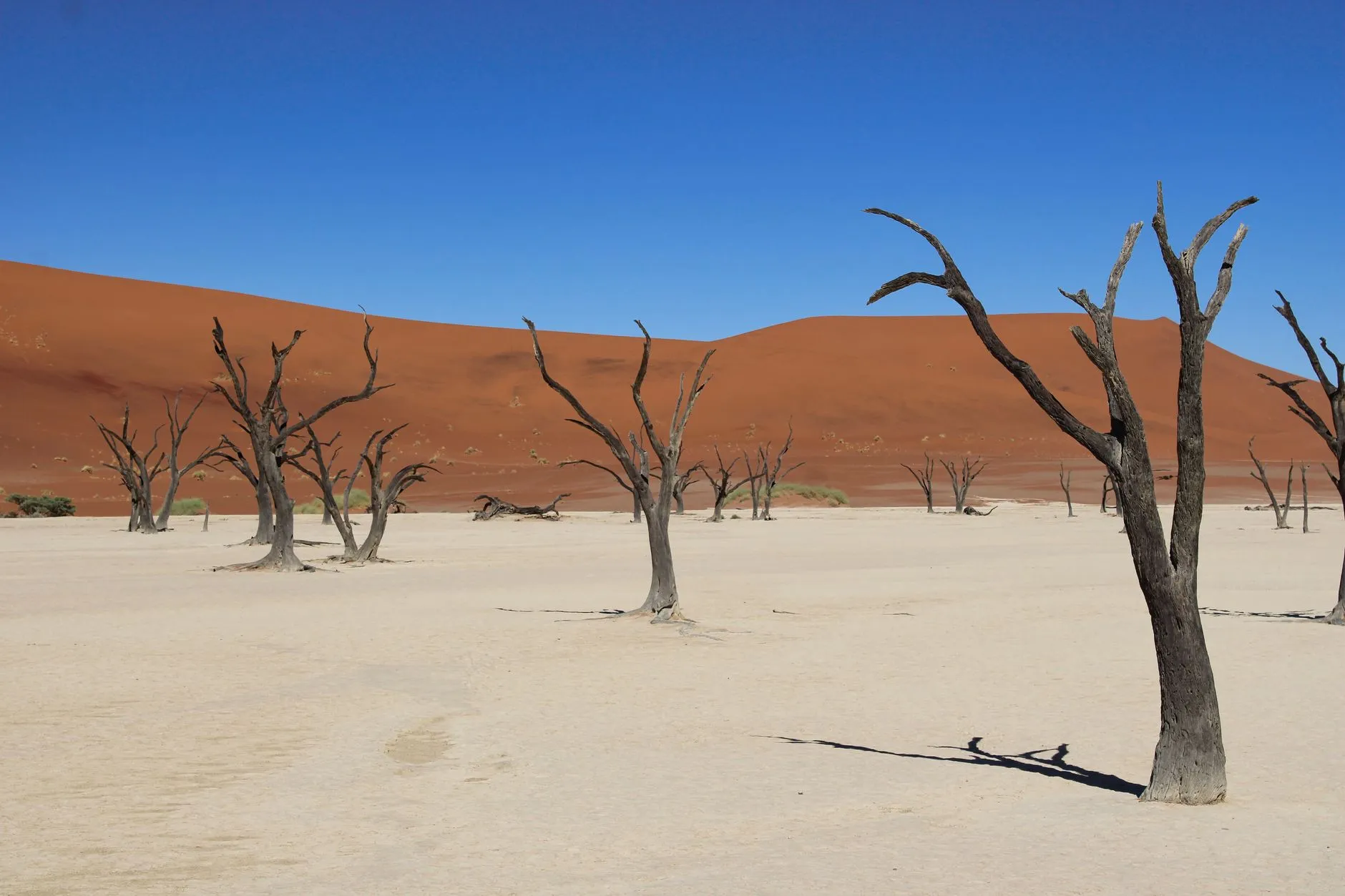
The drill matters here, because the magic is in the timing. You want to be inside the gate before dawn — which means either staying at the NWR campsite/lodge inside the inner gate (Sesriem) or at a lodge just outside, so you can hit the gate at opening and drive the 60 km of paved road to the dune fields as the first light turns the sand to fire. Dune 45 (so named for its distance marker) is the classic climbable one, a knife-edged ridge you scramble up for the sunrise panorama. Further in, the road runs out and a 4×4 shuttle (or your own, through deep sand) takes you the last 5 km to Sossusvlei itself, a white clay pan ringed by giant dunes, and the unmissable Deadvlei — a cracked-white pan studded with 900-year-old blackened camel-thorn skeletons standing against a vast orange dune wall. It is one of the most photographed landscapes on Earth and, in person, genuinely better than the photographs. Climb Big Daddy (one of the world’s tallest dunes at ~325 m) if your lungs are willing, then run down its face into Deadvlei.
Don’t rush off the same day. The Sesriem Canyon, a narrow slot the river carved into the conglomerate, is a cool walk for the harsh midday hours. And the wider NamibRand reserve to the south is one of the world’s premier dark-sky sanctuaries (more on that below).
💡 Stay inside or right at the Sesriem gate. The whole point of Sossusvlei is being on Dune 45 or in Deadvlei at sunrise, before the heat haze and the day-tripper buses. Lodges outside the outer gate can’t enter until the public opening; only the inner Sesriem accommodation gets the genuine pre-dawn head start. Book it months ahead — it’s the most contested bed in the country.
Swakopmund & the Coast — German seaside meets the Skeleton Coast
Drive west out of the dunes and the world changes: the gravel runs to the Atlantic and you hit Swakopmund, the strangest, most charming town in Namibia — a little slice of Wilhelmine Germany dropped onto a fog-bound African coast. Half-timbered houses, a Lutheran church, a colonial-era jetty, Kaffee und Kuchen, bakeries selling Schwarzwälder Kirschtorte, and a microbrewery — all under a permanent cool sea mist while the desert rises out the back of town. It’s the country’s de facto adventure capital and the place everyone exhales after the long desert drives.
This is where you do the adrenaline menu: sandboarding and quad-biking on the dunes that wall the town, scenic flights over the Skeleton Coast, skydiving over the dune-sea-meets-ocean. Just down the coast, Walvis Bay delivers the natural showpieces — a lagoon stained pink by thousands of flamingos, the towering orange dune of Sandwich Harbour where the Namib literally crashes into the surf (a serious 4×4 expedition, do it with a guide), and superb kayaking among the Cape fur seals and dolphins off Pelican Point. Eat the oysters; Walvis Bay grows world-class ones in the cold upwelling.
North of here the coast turns wild and lethal: the Skeleton Coast, named for the whale bones and the ribs of wrecked ships littering its fog-shrouded sand. The Zeila and other rusting hulks sit half-buried in the surf, a few hours’ drive north of Swakopmund past the seal colony at Cape Cross (100,000-plus fur seals; bring a peg for your nose). The far northern Skeleton Coast wilderness is fly-in, permit-only and otherworldly; the southern, drivable section gives you a real taste.
Etosha National Park — the great salt pan
If the dunes are Namibia’s soul, Etosha is its safari heart — and it works completely differently from East Africa. There are no green Serengeti plains here. The park is built around the Etosha Pan, a vast, blinding, salt-encrusted depression so large it’s visible from space — 5,000 square kilometres of cracked white nothingness that fills with shallow water and flamingos in a good rainy season. The wildlife clusters at the waterholes strung along the southern edge of the pan, and the genius of Etosha is that you drive yourself between them, park, switch off the engine, and wait. In the dry season (the best game-viewing window, May–October) the animals have nowhere else to drink, so they come to you: elephants, lions, the endangered black rhino, giraffe, zebra, springbok, oryx, and the leggy Etosha favourites.
The masterstroke is the floodlit waterholes at the three main NWR rest camps — Okaukuejo (the most famous, and arguably the best rhino-watching on Earth), Halali and Namutoni (a quirky old German fort). Stay inside the park, walk to the lit waterhole after dark, and watch black rhino, elephant and lion come to drink in silence — no guide, no jeep, just you and a low wall. It’s one of the great wildlife experiences in Africa and you can do it on a self-drive budget.
Etosha is fully self-drivable in a normal 2WD on its graded internal roads (you don’t need the 4×4 inside the park), gates open sunrise to sunset, and the pace is yours. It’s less lush and less “big cat dense” than the Mara, but the waterhole-watching and the sheer scale of the pan make it unmistakably its own thing.
💡 Sleep inside Etosha for the floodlit waterholes. The NWR camps (Okaukuejo, Halali, Namutoni) are nothing fancy and you book them well ahead, but a private game lodge outside the gate can’t give you the after-dark, no-jeep, walk-up rhino-and-elephant viewing at a floodlit waterhole. That, not the daytime drives, is the reason to be inside the fence.
Damaraland & the Northwest — desert elephants and ancient art
West of Etosha lies the country’s most hauntingly beautiful region and, for many repeat visitors, their favourite: Damaraland (officially the Kunene region), a tract of red rock, flat-topped mountains, dry riverbeds and astonishing emptiness. This is where you find the famous desert-adapted elephants — herds that have learned to survive in near-waterless country, walking vast distances between ephemeral rivers, with longer legs and bigger feet than their savanna cousins. The desert-adapted black rhino roam here too, tracked on foot by the conservation-led Save the Rhino Trust — one of Africa’s genuine conservation success stories, and you can join a tracking experience that funds it.
The cultural showpiece is Twyfelfontein, a UNESCO World Heritage site holding one of the largest concentrations of rock engravings in Africa — thousands of petroglyphs of giraffe, rhino, lion and the famous “Lion Man,” carved into the sandstone by hunter-gatherers over six millennia. Nearby are the geological oddities: the Organ Pipes (a cleft of dolerite columns), Burnt Mountain, and the petrified forest. And looming over it all is the Brandberg, Namibia’s highest massif, whose ravines shelter the celebrated White Lady rock painting (a guided walk to reach it). Damaraland is rugged, remote and 4×4 country — and it rewards the effort with the most cinematic driving in Namibia.
The Far North & the Caprivi / Zambezi — a different Namibia entirely
Push to the far northeast and Namibia stops being a desert altogether. The Zambezi Region — the old “Caprivi Strip,” a finger of land poking east between Botswana and Angola toward Zambia and Zimbabwe — is lush, wet, green and tropical, threaded by four rivers (the Okavango, Kwando, Chobe and Zambezi) and dense with riverine forest. This is hippo, crocodile, buffalo and elephant country; the parks here (Bwabwata, Mudumu, Nkasa Rupara) feel like an extension of the Okavango Delta next door, and the birdlife is extraordinary. It’s also the natural land bridge to Victoria Falls — many travellers tack the Falls onto a Namibian trip by driving or hopping across the eastern border.
Closer in, the Owambo heartland of the north-central regions is the populous, cultural core of the country — the homeland of nearly half of all Namibians, a flat land of mahangu (millet) fields, traditional homesteads and lively open markets. It’s not on the standard scenic loop, but if you want the human, lived-in Namibia rather than the empty postcard, this is it. Note that the north is the malaria zone — the only part of the country where you’ll want prophylaxis, especially in the wet season.
The South — Fish River Canyon, Lüderitz & the Kolmanskop ghost town
The south is the long way round and emptier still, but it holds two of Namibia’s great set-pieces. The Fish River Canyon is the second-largest canyon on Earth after the Grand Canyon — a 160 km gash up to 550 m deep and 27 km wide, best seen from the Hobas viewpoints at sunrise or sunset when the layered rock glows. The legendary multi-day Fish River Hike (85 km, four to five days, May–September only, permit and medical certificate required) is one of Africa’s classic treks for the serious; everyone else takes in the rim and is rightly floored.
Out on the southern Atlantic, Lüderitz is a marooned little German colonial port — Art Nouveau buildings in candy colours clinging to black rock above a cold, wild sea, reachable only by a long, lonely drive across the gravel. The reason most people make the trek is just outside town: Kolmanskop, a diamond-rush boomtown abandoned in the 1950s and slowly being swallowed by the desert. You walk through grand German houses — a ballroom, a hospital, a bowling alley — with dunes pouring through the doorways and drifting up the staircases. It’s eerie, beautiful and one of the most photographed places in the country (go early; you need a permit, easily bought in town). The wider Sperrgebiet (“forbidden zone”) around it remains a restricted diamond area — don’t wander off the marked routes.
⚠️ The Fish River Hike is no joke and seasonal. It runs only mid-April to mid-September (closed in the lethal summer heat), demands a permit, a medical certificate and real fitness, and there’s no exit once you’re in the canyon. If you’re not doing the multi-day trek, the rim viewpoints at Hobas give you 90% of the awe for none of the suffering.
Food & Lodges — game meat, campfires and the lodge culture
Namibian eating is unfussy, German-tinged and gloriously carnivorous. This is game-meat country: oryx (gemsbok), kudu, springbok and zebra appear on menus as steaks and stews, lean and excellent, and they’re the thing to order. Biltong (air-dried, spiced cured meat) and droëwors (dried sausage) are the national road-trip snack — buy a bag at any town butcher and graze across the gravel. The braai (barbecue) is a near-religion; if you’re camping, half the joy is grilling kudu sausage over coals as the sun drops. From the German legacy come superb bakeries (the Konditorei in Swakopmund and Windhoek), Eisbein and sauerkraut on old-school menus, and Windhoek Lager, a genuinely good crisp German-style beer brewed to the 1516 purity law. On the coast, eat the Walvis Bay oysters and the line-caught fish.
Where you sleep is half the experience, and it splits three ways. Campsites — from the excellent national NWR sites inside the parks to private farm camps — are the backbone of a self-drive trip: you pitch (or pop the rooftop tent), braai under the stars, and pay a fraction of a lodge. Guest farms and mid-range lodges dot the country, often working farms turned guesthouse, full of character and good home cooking. And then there are the high-end design lodges — Namibia does these spectacularly, isolated architectural jewels in the dunes or the Damaraland rock at €400–800-plus a night, with private plunge pools and astronomers on staff. Most travellers mix all three: camp where it’s wild, splurge a night or two where it counts.
Costs & Money — the NAD, the rand, and the self-drive budget
Namibia is not a backpacker-cheap country, but it’s superb value for what you get — and the budget is dominated by three things: the vehicle, the fuel, and the park-and-lodge bill.
The currency is the Namibian dollar (NAD), pegged 1:1 to the South African rand, and crucially the rand is also legal tender here — so notes you bring from a South African leg work fine (though Namibian dollars don’t readily spend back in South Africa). Reckon roughly €1 ≈ N$19–20 in 2026. Cards work in towns, lodges and supermarkets, but the gravel-road reality is cash-only at many rural fuel stations, campsite gates and small shops — always carry a wad.
Rough on-the-ground numbers for 2026 (excluding international flights):
- The 4×4 with rooftop tent and camping kit: ~€80–130 a day, the single biggest line item. Book early; peak-season (Jul–Oct) availability is tight and pricier.
- Fuel: petrol runs around N$22 a litre at the coast and a bit more inland — roughly €1.10–1.20 per litre. Over a 3,000 km loop in a thirsty 4×4 (~12 L/100 km) that’s easily €350–450 of fuel for the trip.
- Park fees: modest by African standards — Etosha is about N$280 (~€14) per adult per day plus ~N$60 for the vehicle; Sossusvlei/Namib-Naukluft around N$150 (~€8) per adult per day plus the vehicle. A handful of euros per person per park-day.
- Sleeping: a national-park or farm campsite runs roughly €12–25 per person; a comfortable mid-range lodge ~€90–180 a night; the design lodges start around €400 and climb steeply.
- Eating: a game-meat dinner with a beer in a lodge or town restaurant is ~€15–25; self-catering from supermarkets (Windhoek and the bigger towns have well-stocked ones — stock up before the empty stretches) is dramatically cheaper.
A realistic mid-range self-drive couple sharing a 4×4, mixing camping and lodges, lands around €120–180 per person per day all-in on the ground. Camp hard and you’ll come well under that; chase the design lodges and you’ll blow past it.
💡 Buy your park permits and stock your fridge in advance. Park entry is paid at the gate (cash is safest), and there’s no supermarket inside the parks or out in the desert — load up on water, meat, firewood and fuel in Windhoek, Swakopmund or the bigger towns before you head into the empty country. Carry far more drinking water than you think you need: 4–5 litres per person per day in the heat.
Practical Information — driving, dark skies, safety & connectivity
Visa & entry (read this carefully — it changed): As of 1 April 2025, Namibia ended visa-free entry for a long list of previously exempt nationalities, including the US, UK, most European countries, Canada and Australia. Those travellers now need a visa on arrival or an e-visa. The fee is around N$1,600 (~€85 / ~US$90) for non-African-Union visitors, the visa is valid for 30 days by default, and it’s smoothest to apply through the official online e-visa portal before you fly rather than queue at the counter — Namibia has also flagged an extra ~N$400 (~€21) service surcharge for applications made manually at the immigration desk on arrival. Your passport needs 6 months’ validity and at least two blank pages, and you may be asked for proof of onward travel and funds. Check your own nationality’s current status on the Ministry of Home Affairs site before booking — but assume you now pay, because most Western travellers do.
Driving practicalities: Namibia drives on the left (a legacy of South African rule). An English-language home licence is generally fine for a tourist rental; an International Driving Permit is a sensible backup. Roads are signed in km; the speed limit is 120 km/h on tar and 100 km/h on gravel by law, but the smart self-driver holds 80 on gravel regardless. Police checkpoints are routine, polite and quick — have your licence and rental papers handy.
The dark skies — don’t skip this. Namibia has some of the darkest, clearest night skies on Earth, and the NamibRand Nature Reserve is an officially certified International Dark Sky Reserve — one of only a few in the world. On a moonless night out in the desert the Milky Way is bright enough to cast a faint shadow, the zodiacal light glows, and you can see structure in the galaxy with the naked eye. Several lodges keep observatory-grade telescopes and resident astronomers. Even just lying on the roof of your tent in a campsite, away from any town, the sky is unlike anything most visitors have ever seen. Plan at least one or two nights around a new moon if astronomy matters to you.
Safety: Namibia is one of the safest countries in Africa for the traveller. Violent crime against tourists is rare, the country is politically stable, and the self-drive infrastructure is reassuringly well-run. The real risks are the road (gravel speed, fatigue, wildlife, night driving) and the environment (heat, dehydration, getting stuck in sand, breaking down in remote country with no signal) — not crime. Windhoek has the usual big-city petty-theft caution after dark; out in the country you’ll feel safer than at home.
Malaria & health: most of Namibia is malaria-free — the desert, the coast, Sossusvlei, the south, Damaraland and Windhoek carry essentially no risk. The exception is the far north and the Zambezi/Caprivi strip, especially in the wet season (roughly November–June), where prophylaxis is advised. Tap water in towns and lodges is generally safe to drink; in the deep bush, stick to bottled or filtered.
Connectivity: mobile coverage is good in towns and along the main routes and dead in the empty stretches — which is most of the scenic country. Buy a local MTC or Telecom Namibia SIM with a data bundle at the airport or in town for cheap, but accept that for hours of every driving day you’ll have no signal at all. Download your maps offline (Tracks4Africa is the gold standard for Namibian gravel roads), tell your lodge your route, and treat the disconnection as a feature, not a bug.
When to Go — month by month
May–October (the dry season) is the headline window and when most people come — and rightly. The skies are clear and cobalt, the days are warm and dry, the nights cool to cold (genuinely cold in the desert in June–August — pack a fleece and a hat for camping). Crucially, this is peak game-viewing: the bush thins out, the waterholes become the only water, and Etosha’s wildlife concentrates spectacularly. Sossusvlei is at its most photogenic and comfortable. The trade-off is crowds and price — July through October is high season, lodges and campsites book out months ahead, and the 4×4 rental fleet gets tight and dear.
The shoulders — May and November — are the connoisseur’s pick: still good weather, fewer people, easier bookings, gentler prices, and at the edges of the green season some welcome drama in the light.
November–April (the green season / summer) flips the country. It’s hot — 35–40°C in the desert and the north — and the rains (such as they are; this is a dry country) arrive, turning the landscape briefly green, filling the pans, and triggering the calving season, when the plains fill with newborn springbok and the predators follow. The birdlife explodes with migrants. It’s dramatic, far cheaper, far emptier of tourists, and the photography of a green Deadvlei or a water-filled Etosha pan is special. The downsides: the heat is serious, some gravel roads wash out, malaria risk rises in the north, and certain wildlife disperses now that water is everywhere. It’s a real option for the budget-conscious or the photographer chasing a different look — just go in with your eyes open about the temperatures.
Frequently Asked Questions
Cheapest Flights to Namibia
We have tracked 1,714 fares to Namibia from 59 cities. As of June 2026, here is what a good price looked like from each — the lowest fare we recorded, and a “great-deal” benchmark to judge a quote against. These are tracked observations, not live prices: by the time you read this they will have moved, so treat them as a yardstick, not a quote.
| From | Lowest fare we tracked | Great-deal benchmark |
|---|---|---|
| Stockholm (ARN) | €402 | €575 |
| Oslo (OSL) | €419 | €598 |
| Gothenburg (GOT) | €419 | €599 |
| Vienna (VIE) | €422 | €603 |
| Copenhagen (CPH) | €438 | €625 |
| Frankfurt (FRA) | €479 | €684 |
| Munich (MUC) | €484 | €691 |
| Porto (OPO) | €505 | €722 |
| Dusseldorf (DUS) | €524 | €749 |
| Bucharest (OTP) | €533 | €762 |
| Krakow (KRK) | €538 | €768 |
| Warsaw (WAW) | €541 | €773 |
| Amsterdam (AMS) | €543 | €776 |
| Salzburg (SZG) | €545 | €778 |
Recent deals we have posted to Namibia:
- Munich to Windhoek, Namibia from €587
- Copenhagen to Windhoek, Namibia from €513
- Stockholm to Windhoek, Namibia from €435
- Oslo to Windhoek, Namibia from €558
- Brussels to Windhoek, Namibia from €719
- Frankfurt to Windhoek, Namibia from €695
- Vienna to Windhoek, Namibia from €750
- Frankfurt to Windhoek, Namibia from €682
- Porto to Windhoek, Namibia from €613
These are fares aifly tracked to this destination, not live quotes — they have changed since and several of the deals above may have expired. Browse current flight deals →