Rwanda — Complete Travel Guide 2026
Rwanda is the most surprising country in Africa, and it confounds every expectation in the first hour. You land at a small, modern airport, drive into a capital with no litter and no hassle, past hills terraced green to their summits, and you slowly realise this is one of the safest, cleanest, best-run places you have ever travelled — and that thirty years ago it was the site of one of the worst genocides in human history. That collision of beauty, order and unbearable past is Rwanda. You come for the mountain gorillas, who live in the bamboo and Hagenia forests of the Virungas exactly where Dian Fossey studied them. You leave understanding something about how a nation rebuilds itself.
Quick Reference
East-Central Africa, landlocked — the “Land of a Thousand Hills,” bordering Uganda, Tanzania, Burundi and the Democratic Republic of Congo
Kigali International (KGL) — the modern, efficient hub, about 40 minutes from the city centre
Rwandan franc (RWF); roughly €1 ≈ 1,400 RWF. Cards work in Kigali and lodges; carry cash beyond them
Kinyarwanda, English, French and Swahili are all official — Rwanda switched to English-medium education in 2008, so English is now widely spoken
Visa-on-arrival / e-visa for all nationalities, no exceptions — €46/US$50 for 30 days single-entry. East Africa Tourist Visa (Rwanda + Uganda + Kenya) ~€93/US$100 for 90 days. Yellow-fever certificate required
The two dry seasons — June–September and December–February — for gorilla trekking and the parks
Mountain gorillas, a spotlessly clean and exceptionally safe society reborn from the 1994 genocide, the thousand green hills, premium conservation tourism, and a rising specialty-coffee scene
Kigali for the city and the history; Musanze (Volcanoes) for the gorillas; Lake Kivu to decompress — most trips chain all three
Editor’s Note — the premium-country truth
Here is the thing nobody tells you until you’re pricing it out: Rwanda has deliberately, strategically made itself the most expensive way to see Africa’s headline wildlife — and that’s the whole business model. The mountain-gorilla permit costs US$1,500 (about €1,390) for a single hour with one habituated family. It is the most expensive wildlife permit on earth, and it is non-negotiable, government-fixed, and exactly double what you’d pay in neighbouring Uganda. Rwanda decided years ago not to compete on price. It competes on exclusivity, conservation credibility, slickness and safety — and it has the high-end eco-lodges, the polished logistics and the Hollywood-and-royalty clientele to match.
So decide which traveller you are before you book. If a single transcendent hour with a silverback at arm’s length, in a country where everything works and nothing feels risky, is worth four figures to you — Rwanda delivers it better than anywhere. If you want the same gorillas for half the permit price and you’re willing to trade polish for a rougher, more adventurous trip, Uganda’s Bwindi is the answer, and you can drive there from Kigali in a long day. Rwanda is not, and does not pretend to be, a budget destination. The gorilla permit alone will dominate your trip budget the way nothing else in African travel does.
But within that premium framing it is extraordinary value in a different currency: peace of mind. This is arguably the safest country in Africa, one of the cleanest in the world, with good roads, honest policing, and a tourism industry that genuinely works. You get what you pay for.
⚠️ The permit is the budget. At ~€1,390 per person for one hour, the gorilla permit will likely be the single biggest line in your entire trip — bigger than your flights. Build the whole budget around it, book it months ahead, and don’t fly all the way to Rwanda and then balk at the price on arrival. They won’t discount it, and permits sell out.
Should You Go? Who it’s for — and isn’t
Rwanda is for the traveller who wants a meaningful trip and will pay for quality: the wildlife pilgrim chasing the mountain-gorilla bucket-list moment; the conservation-minded who want their tourist dollars to demonstrably fund anti-poaching and community revenue-sharing; the safety-first traveller (solo women very much included) who wants Africa without the edge; and anyone moved by the rare spectacle of a country that has rebuilt itself from catastrophe into a model of order. It’s superb for honeymooners and special-occasion travellers — the lodge scene is genuinely world-class — and for short, intense trips, because the country is tiny and everything is reachable.
It pairs beautifully with the history: you cannot honestly visit Rwanda without engaging the 1994 genocide, and the memorials are among the most important, sobering places you will ever stand. That gravity is part of why a Rwanda trip stays with people.
Who it’s not for: the budget backpacker counting euros — the gorilla permit alone breaks most shoestring budgets, and Rwanda is the priciest of the East African wildlife countries. It’s not for the classic Big-Five safari purist either; Rwanda has one good savanna park (Akagera), but for vast plains of game you want Tanzania or Kenya. And it’s not a beach or party destination — Lake Kivu is lovely but it’s relaxation, not nightlife. Come for the gorillas, the forests and the story, not for cheap thrills.
Getting There & Around — KGL, good roads & a compact country
Almost everyone arrives at Kigali International (KGL), a small, clean, efficient airport about 40 minutes from the city centre. The national carrier RwandAir is the dominant airline and a growing force — it flies a widening network across Africa, plus long-haul to London, Brussels, Paris, Dubai and beyond, and uses Kigali as a genuine regional hub. The other workhorses are Brussels Airlines (the long-standing European link) and KLM from Amsterdam, joined by Qatar Airways (Doha), Turkish Airlines (Istanbul), Ethiopian Airlines (Addis Ababa, often the cheapest one-stop from many cities) and Kenya Airways (Nairobi). From Europe you’re looking at one stop via Brussels, Amsterdam, Istanbul, Doha or Addis; RwandAir and Brussels offer the most direct options.
Once you’re in, the great gift of Rwanda is its size. The whole country is smaller than Belgium, and you can drive Kigali to the Volcanoes gorilla base in around 2.5–3 hours, to Lake Kivu in 3, to Nyungwe in the deep southwest in 5–6, and to Akagera in the east in 2.5. The roads are genuinely good — smooth tarmac, well-maintained, a point of national pride — though they wind endlessly through the hills, so journeys feel longer than the distances suggest.
How to move: most visitors hire a car with a driver (roughly €70–110 a day including fuel and the driver), which is the sane choice — a good driver-guide handles the mountain roads, knows the parks, and frees you to look out the window. Self-drive is possible but the constant switchbacks, the moto-taxis and the rural traffic make a driver worth every euro. In Kigali itself, the iconic moto-taxis (helmeted motorbike taxis, fares a euro or two, now app-bookable via Yego or Move) are how the city actually gets around — fast, cheap and a rite of passage. Ride-hailing apps and metered cabs cover the rest.
💡 A car-and-driver is the default, not a luxury. For a gorilla-plus-Kivu-plus-Kigali loop, a private driver-guide at ~€70–110/day is cheaper than stacking transfers, removes all the stress of the mountain roads, and a good one becomes the best part of the trip. Book through your lodge or a reputable Kigali operator.
Gorilla Trekking — Volcanoes National Park
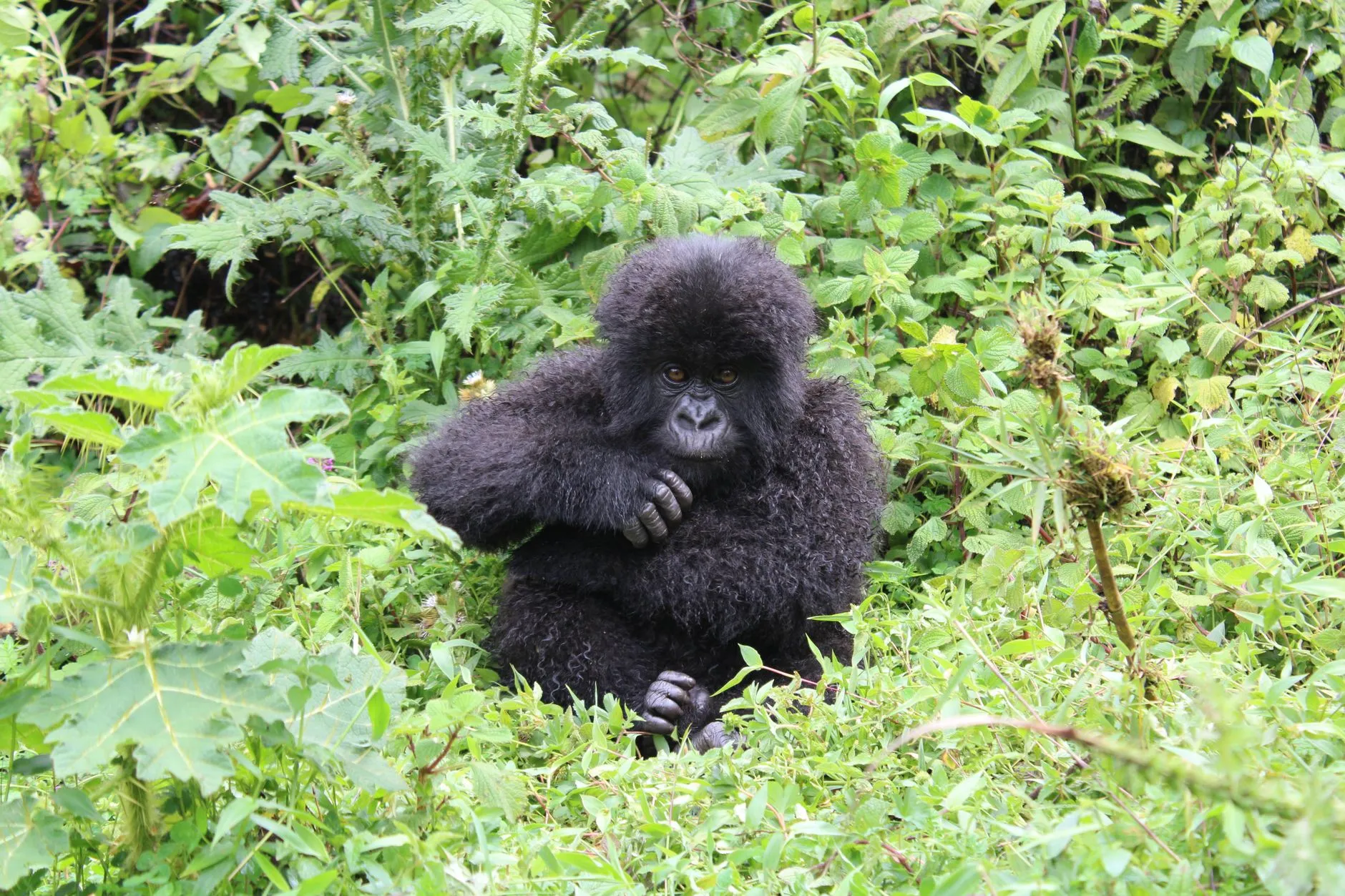
This is why you came, and it is worth every difficult euro. Volcanoes National Park (Parc National des Volcans) caps the country’s northwest, a chain of green, mist-wrapped volcanoes — the Rwandan flank of the Virunga Massif that straddles Rwanda, Uganda and DR Congo. In its bamboo and Hagenia forests live some of the world’s last mountain gorillas, and this is the exact landscape where Dian Fossey ran her Karisoke research camp and waged her war against poachers, the story told in Gorillas in the Mist. Her grave, beside those of the gorillas she loved, sits high on the saddle between Karisimbi and Bisoke — a strenuous but moving day-hike in its own right.
How it works: you buy a permit for US$1,500 (~€1,390) — fixed by the Rwanda Development Board, the same for everyone, no haggling — which buys you one hour with a single habituated gorilla family, plus the trackers who find them at first light, the armed rangers who escort you, and Rwanda’s conservation and community funding. Numbers are strictly capped: only a small set of families is visited each day, and only eight people per family. Book three to six months ahead through a licensed operator or the RDB’s Irembo platform — peak-season permits genuinely sell out. On the morning you gather at the Kinigi park headquarters, get sorted into a group, and drive to a trailhead. The trek itself ranges from an easy hour to a brutal half-day uphill through stinging nettles and thick forest — your fitness and the gorillas’ mood decide. Then a tracker parts the bamboo and you are standing a few metres from a 200-kilogram silverback, his family rolling and grooming and the babies tumbling, utterly indifferent to you. The hour vanishes. People weep. It is the real thing.
Time it right and you can catch Kwita Izina, Rwanda’s annual gorilla-naming ceremony each September — a genuine national festival, modelled on the Rwandan tradition of naming a newborn, where each baby gorilla born that year is given a name in a huge public celebration. It’s part conservation theatre, part party, and it’s how Rwanda made the gorillas a source of national pride.
Why pricier but slicker than Uganda: Rwanda’s park is closer to the capital (a half-day drive versus a punishing one for Uganda’s Bwindi), the organisation is seamless, the lodges nearby are the best in the region, and the whole experience is engineered for comfort. Uganda charges roughly half (around US$800) for the same species in wilder, denser forest with a tougher, more adventurous feel and a longer drive. Both deliver the gorillas. Choose Rwanda for ease, polish and a short trip; choose Uganda to save four figures and don’t mind roughing it.
⚠️ Book the permit before you book anything else. Permits are capped and date-specific, and the whole trip pivots on the day you secure. Lock the permit first, then build flights and lodges around it — not the other way round. And get reasonably fit: the trek can be a steep, muddy, multi-hour slog at altitude.
Kigali — the cleanest capital in Africa
Spend a day or two in Kigali at the start or end, and not just to sleep. The Rwandan capital is, simply, one of the most pleasant cities in Africa — spread across ridges and valleys, leafy, orderly, and famously clean. There is no litter, because there is essentially no littering: plastic bags have been banned nationwide since 2008 (they confiscate them at the airport), and on the last Saturday of every month the entire country, the president included, downs tools for Umuganda — a mandatory morning of community service, cleaning streets, building, planting. It’s why Kigali sparkles, and it’s a window into how Rwanda runs.
The city is also genuinely safe — you can walk at night, the moto-taxi drivers are honest, the hassle that defines so many African capitals is simply absent. There’s a real café and art scene now: third-wave coffee shops roasting Rwandan beans, craft markets like the Kimironko market and the Caplaki cooperative, the Inema and Niyo art galleries, rooftop bars across the hills, and a confident, young, entrepreneurial energy. Eat the buffet lunch like a local, ride a moto across town for a euro, and watch a model African-city success story in motion.
But Kigali holds the country’s most important site, and you must give it the time and the gravity it demands: the Kigali Genocide Memorial at Gisozi, where more than 250,000 victims are buried in mass graves, and whose unflinching exhibition is the essential primer for understanding everything you will see in Rwanda. Go there first if you can. It reframes the whole trip.
The 1994 Genocide — the history you must understand
You cannot honestly travel in Rwanda without confronting what happened here, and it would be a disservice to pretend otherwise. Over roughly 100 days, from April to July 1994, an estimated 800,000 to one million people were murdered in the genocide against the Tutsi — neighbours killing neighbours, mostly by machete, in the fastest mass killing of the twentieth century. It was not chaos; it was organised — incited over the radio, directed by an extremist government, carried out by militias and ordinary citizens against the Tutsi minority and the moderate Hutu who refused to take part. The world watched and did nothing. The genocide ended only when the Rwandan Patriotic Front, led by the current president Paul Kagame, took the country militarily.
What Rwanda has done since is, by any measure, remarkable: a near-total rebuilding of a shattered society, a deliberate national project of reconciliation (including the community gacaca courts that tried hundreds of thousands of cases), the outlawing of the ethnic labels that fuelled the killing, and the transformation of one of the poorest, most traumatised places on earth into the orderly, ambitious country you now visit. The hills you find so beautiful were, three decades ago, killing grounds. Holding both truths at once is the heart of a Rwanda trip.
The memorials are essential, and they are not easy. The Kigali Genocide Memorial (Gisozi) is the main one — burial place of a quarter-million victims and a clear, devastating, well-curated history. Beyond the capital, two sites are among the most harrowing places on earth and are visited as acts of witness rather than sightseeing: Nyamata, a church south of Kigali where some 10,000 people who had sought sanctuary were slaughtered, the bloodstained clothing of the dead still laid across the pews; and Murambi, a former technical school in the south where tens of thousands were killed, and where lime-preserved bodies are displayed exactly where they fell. These are not tourist attractions. They ask something of you. But to understand Rwanda’s astonishing present, you have to stand in its past.
⚠️ Treat the memorials with absolute respect. No casual photos of the human remains, dress modestly, keep your voice down, and don’t film for social media. Murambi and Nyamata in particular are graphic and emotionally shattering — go because it matters, prepare yourself, and give yourself a gentle rest of the day afterward.
Nyungwe Forest & the primates
Down in the deep southwest, hugging the Burundi border, Nyungwe National Park is one of Africa’s oldest and largest montane rainforests — a vast, ancient, biodiverse tangle of more than a thousand tree species, 300 birds, and thirteen species of primate. It’s the counterpoint to the gorillas: where Volcanoes is about a single iconic encounter, Nyungwe is about the wild richness of a true rainforest.
The headline is chimpanzee tracking — a permit runs US$250 (~€231), far cheaper than the gorillas, and buys you a forest hike in search of habituated wild chimps, who are louder, faster and harder to find than gorillas, so it’s a genuine bushcraft chase rather than a guaranteed photo op. Easier and just as rewarding are the troops of Angolan colobus — black-and-white monkeys that move through the canopy in spectacular super-groups, sometimes hundreds strong, one of the largest primate aggregations in Africa. And the signature soft adventure is the Canopy Walkway — a 160-metre suspension bridge strung 50 metres above the forest floor, the only one of its kind in East Africa, a swaying, vertiginous, two-hour guided walk through the treetops for US$60 (~€56). Add waterfall hikes and superb birding, and Nyungwe earns the long drive south. It’s remote — base at one of the forest lodges and give it a couple of nights.
Lake Kivu — the great decompression
After the altitude, the early starts and the emotional weight, Lake Kivu is where Rwanda lets you exhale. One of Africa’s Great Lakes, it fills a long rift valley along the Congo border — a deep, calm, bilharzia-free expanse of blue ringed by green hills and lakeside towns, and the natural soft landing after a gorilla trek (the main resort town is barely an hour from the Volcanoes base).
Rubavu (Gisenyi), the northern lakeside town, is the most developed — a sandy waterfront, a faded colonial-era promenade, hotels and beach bars, and a genuinely relaxed, holiday feel; you can literally see the lights of Goma in the DRC across the water. Karongi (Kibuye), further south, is quieter and arguably prettier — a scatter of islands, hilltop churches and a slower pace. Linking them is the celebrated Congo-Nile Trail, a multi-day hiking and mountain-biking route that traces the lake’s eastern shore through coffee terraces and fishing villages — do a day of it or the whole thing. Out on the water, boat trips visit island bird colonies and hot springs, and at dusk you’ll see the singing fishermen paddle out in their distinctive triple-hulled boats. Swim, kayak, drink a beer on the shore, and let the trip settle.
💡 Sequence Kivu last, or in the middle. Trek the gorillas while you’re fresh and the permit is locked, then drop down to the lake to recover — Rubavu is barely an hour from Musanze. It’s the perfect, low-effort end to an intense itinerary, and the contrast makes both halves better.
Akagera National Park — the conservation comeback
Out east on the Tanzanian border, Akagera National Park is Rwanda’s lone classic savanna park, and its story is one of the great conservation comebacks in Africa. After the genocide, the park was overrun — settled by returning refugees, poached out, its lions gone entirely, its rhinos vanished. Since 2010 a partnership between the Rwandan government and the NGO African Parks has rebuilt it almost from scratch: a fence around the whole park, anti-poaching transformed, and the dramatic reintroduction of lions (2015) and both black and white rhinos (2017 and 2019).
The result is that Akagera is once again a Big Five park — lion, leopard, elephant, buffalo and rhino — set in a beautiful patchwork of acacia savanna, papyrus swamp and a chain of lakes, very different scenery from the East African plains you might picture. It’s not the Serengeti and it won’t pretend to be — game densities are lower, the sightings more earned — but a proper Akagera safari (game drives, a boat trip on Lake Ihema among hippos and crocodiles, superb birdlife) is a rewarding, uncrowded day or two, and it completes a Rwanda trip with the savanna chapter the gorillas and forests don’t provide. Just 2.5 hours from Kigali, it’s the easiest add-on, and the comeback story makes it more than just a game drive.
Food, Lodges & Coffee
Rwandan everyday food is hearty and unflashy — a starch-heavy cuisine built around beans, plantains, sweet potato, cassava, rice and grilled meat. The institution to know is the buffet (mélange): a spread of all of the above that workers and travellers alike eat for a few euros at lunch, piling a single plate high. The national street food and bar snack is the brochette — skewers of grilled goat (sometimes beef, fish or agatogo offal), charred over coals, eaten with grilled plantain and a cold Primus or Mützig beer; a brochette-and-beer evening is the classic Rwandan night out, and it’s cheap and brilliant. Look also for isombe (mashed cassava leaves), ubugali (a stiff cassava porridge), tilapia from Lake Kivu, and the ubiquitous “Irish” (potatoes). Kigali’s dining has climbed fast — there are now genuinely good international restaurants, Ethiopian and Indian spots, and ambitious modern-Rwandan kitchens.
At the top end, Rwanda’s eco-lodge scene is world-class — this is where the premium positioning shows. Around Volcanoes you’ll find some of Africa’s most celebrated lodges (the Bisate and Singita-style properties run well into four figures a night), built with genuine conservation and community ethos, plus a deep middle tier of excellent mid-range lodges and a handful of budget guesthouses in Musanze for those not splurging. The lodges are, for many, a highlight in their own right.
And drink the coffee. Rwanda has quietly become one of the most exciting specialty-coffee origins on earth — high-altitude, washed Arabica from smallholder cooperatives on those thousand hills, bright and fruity, now poured by serious baristas in Kigali cafés (Question Coffee, Inzozi, the Kivu Belt roasters). A coffee-farm tour on the Kivu shore is a lovely, low-key half-day. It’s a rising-star origin you can taste at the source.
Costs & Money
Rwanda is the premium East African wildlife destination, and there’s no getting around it — but the premium is wildly lopsided. One line item, the gorilla permit, distorts the entire budget; almost everything else (food, transport, mid-range lodging) is reasonable.
The maths of a typical gorilla-centric trip:
- The permit: US$1,500 (~€1,390) per person, per trek. This is the immovable centre of the budget — for most visitors it dwarfs flights, lodging and everything else combined. A second permit (chimps at Nyungwe ~€231, or a second gorilla day) stacks on top.
- Lodging: enormous range. Budget guesthouses in Kigali or Musanze from ~€25–40 a night; comfortable mid-range lodges ~€90–180; the famous high-end gorilla lodges from ~€500 to well over €1,000 a night.
- Car + driver: ~€70–110/day all-in — the standard way to get around.
- On-the-ground daily (food, drinks, moto-taxis, incidentals): a buffet lunch €3–5, a brochette-and-beer dinner €6–10, a Kigali restaurant meal €12–20, a moto-taxi a euro or two, a good coffee €2–3.
So a real Rwanda budget is the permit (or permits) plus everything else — and “everything else,” if you stay mid-range, is genuinely affordable. Tipping is expected and appreciated: trackers and porters on the gorilla trek (a porter to carry your bag is ~€10–15 and supports the local economy — always hire one), drivers, lodge staff and guides. ATMs are reliable in Kigali and tourist towns (Bank of Kigali, Equity), cards work at hotels and lodges, but carry RWF cash for markets, moto-taxis, brochettes and anywhere rural. US dollars are widely accepted for big-ticket items like permits and lodges — bring crisp, post-2013 notes.
💡 Always hire a porter on the trek. For ~€10–15 a porter carries your daypack up the mountain, gives you a literal helping hand on the steep, muddy bits, and — crucially — puts tourist money directly into the local community, much of it ex-poachers now invested in the gorillas’ survival. It’s the single best small thing you can do, and the climb is much easier for it.
Practical Information
Entry & visa: this is Rwanda’s famous flex — visa-on-arrival for every nationality on earth, no advance application required, since 2018. The standard tourist visa is US$50 (~€46) for 30 days single-entry, or US$70 multiple-entry, payable on arrival by card or US dollars. Citizens of the African Union, Commonwealth and Francophonie blocs get the 30-day visa free. The East Africa Tourist Visa (EATV) — US$100 (~€93), 90 days, multiple-entry — covers Rwanda, Uganda and Kenya on one visa and is the smart buy if you’re combining (very common with Uganda’s gorillas). You can apply online via the Irembo platform in advance or simply get it at the airport. A yellow-fever vaccination certificate is required for entry.
Safety: Rwanda is one of the safest countries in Africa, full stop — low crime, honest and visible policing, and a degree of personal security (including for solo women and at night) that surprises every first-timer. Petty pickpocketing exists in crowded markets, as anywhere, but violent crime against tourists is rare. The one genuine caveat is the western border with the DRC: the situation in eastern Congo (around Goma, just across from Rubavu) can be volatile, so check your government’s advisory before lingering near the frontier — but the lakeside tourist towns on the Rwandan side are calm and routinely visited. The standard southern-and-central tourist circuit is rock-solid.
Cleanliness & the plastic ban: Rwanda banned single-use plastic bags in 2008 — they will confiscate them from your luggage at the airport, so decant anything packed in plastic before you fly. Combined with the monthly Umuganda clean-ups, it makes Rwanda one of the cleanest countries on earth.
Permits & booking: for gorillas and chimps, book months ahead through a licensed operator or the RDB Irembo platform — permits are capped and date-specific and do sell out in the dry-season peaks. Don’t show up hoping for a permit; plan the trip around the date you secure.
Health: beyond the mandatory yellow-fever cert, take malaria prophylaxis (the lowland east and Kivu shore are malarial; high-altitude Volcanoes less so), and the usual travel vaccinations. Tap water isn’t reliably safe — drink bottled or filtered. Altitude on the gorilla treks (2,500m+) is worth a thought if you’re unfit.
Connectivity: cheap local SIMs (MTN, Airtel) with generous data are easy to buy with your passport at the airport or in town — far better than roaming. Kigali has excellent 4G and widespread Wi-Fi; the parks and lake towns are patchier but generally covered.
When to Go
Rwanda is equatorial and green year-round, but the rains run the calendar — and for trekking and the parks, dry is what you want, because mud, slick trails and rain-soaked forest make the gorilla hike far harder.
June–September (long dry season): the prime window and the peak. Drier trails, easier treks, the best park conditions, and the September Kwita Izina gorilla-naming festival. This is when most people come — book permits and lodges well ahead, and expect the highest prices.
December–February (short dry season): the other excellent window — drier weather, good trekking, fewer crowds than the June–September peak, and a fine time to do the full circuit. A strong, slightly quieter alternative.
March–May (long rains): the wettest, greenest, cheapest time. The treks get genuinely muddy and the afternoon downpours are heavy, but the landscape is at its most lush, the lodges run low-season rates, and the gorillas don’t go anywhere — a real option for the budget-minded who don’t mind getting wet.
October–November (short rains): lighter, more intermittent rain — a decent shoulder, often with good-value rates and manageable conditions between the showers.
Because Rwanda is small, you can do gorillas, Kivu, Nyungwe and Akagera in a single 7–10 day trip regardless of season — just lean toward the dry windows for the treks, and remember the equatorial rule: pack a rain shell and warm layers for the high forests no matter when you visit.
Frequently Asked Questions
Cheapest Flights to Rwanda
We have tracked 481 fares to Rwanda from 57 cities. As of June 2026, here is what a good price looked like from each — the lowest fare we recorded, and a “great-deal” benchmark to judge a quote against. These are tracked observations, not live prices: by the time you read this they will have moved, so treat them as a yardstick, not a quote.
| From | Lowest fare we tracked | Great-deal benchmark |
|---|---|---|
| Vienna (VIE) | €329 | €470 |
| Stockholm (ARN) | €419 | €599 |
| Venice (VCE) | €449 | €642 |
Recent deals we have posted to Rwanda:
- Gothenburg to Kigali, Rwanda from €556
- Paris to Kigali, Rwanda from €471
- Marseille to Kigali, Rwanda from €462
- Toulouse to Kigali, Rwanda from €461
- Lyon to Kigali, Rwanda from €459
- Vienna to Kigali, Rwanda from €491
- Stockholm to Kigali, Rwanda from €546
- Vienna to Kigali, Rwanda from €489
- Paris to Kigali, Rwanda from €474
These are fares aifly tracked to this destination, not live quotes — they have changed since and several of the deals above may have expired. Browse current flight deals →