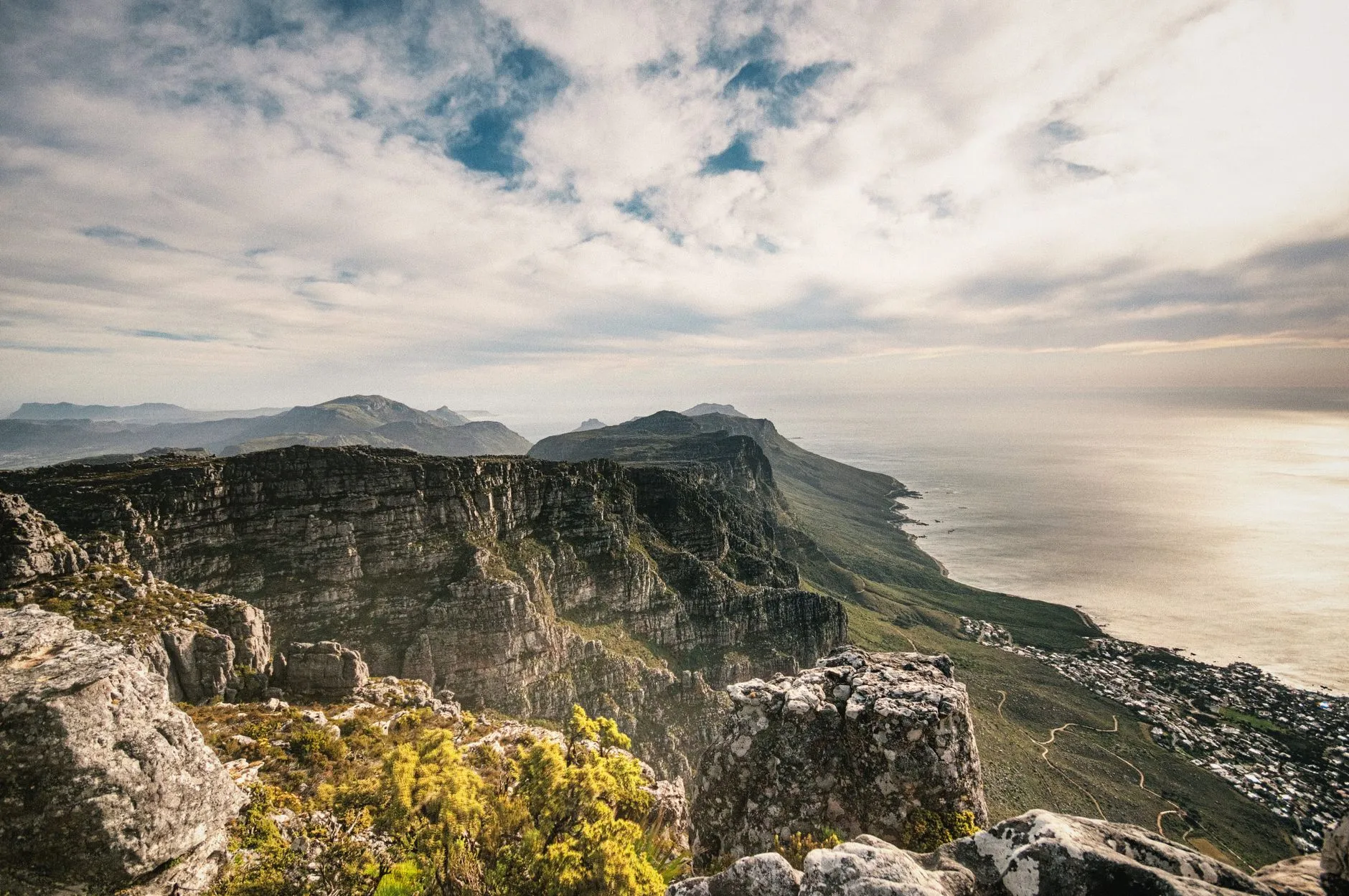
South Africa — Complete Travel Guide 2026
South Africa is the rare country where you can spend a morning on a white-tablecloth wine estate, an afternoon tracking a leopard through the bush, and a sunset on a beach below a flat-topped mountain — and the exchange rate means most of it costs a fraction of what the same quality runs in Europe. The catch is that it’s two trips pretending to be one (the Cape in the southwest, the bushveld in the northeast, a full day’s flight apart), and you have to be honest with yourself about driving and safety. Get those two decisions right and it’s one of the great trips on Earth.
Quick Reference
Southern tip of Africa, two oceans (Atlantic + Indian)
Cape Town (CPT), Johannesburg O.R. Tambo (JNB), Durban King Shaka (DUR)
South African rand (ZAR) — roughly €1 ≈ 18–19 ZAR, very favourable for visitors
12 official languages; English is the lingua franca and used everywhere
Visa-free for up to 90 days for UK, EU, US, Canada and Australia passport holders
May–Sep dry winter for safari + whales; Nov–Mar summer for Cape Town & the coast
The Big Five, Table Mountain, the Cape Winelands, the Garden Route drive
Cape Town for the Cape; a Kruger/Sabi Sand lodge for safari; Joburg for history
Editor’s Note: Read This First
Here is the single most useful thing I can tell you about planning South Africa: it is not one destination, it is two, and they are roughly 1,500 km apart. The Cape side — Cape Town, the Winelands, the Garden Route — is a self-drive road trip through wine country and coastline that feels almost Mediterranean. The bush side — Kruger and the private reserves up in the northeast, plus the Panorama Route and Johannesburg — is the classic African safari. Most first-timers try to cram both into ten days, fly between them, and end up rushed. Two weeks is the honest minimum to do both justice; if you only have a week, pick a side.
The big decisions, in order:
- Cape + Garden Route, or safari, or both? If it’s a first Africa trip and you must choose, I’d weight toward the Cape-plus-Garden-Route loop for sheer variety and ease, with a 2–3 night safari add-on flown in. If you came primarily for animals, do it the other way.
- Kruger or a private reserve? The defining safari question, covered in full below. Short version: self-drive Kruger is cheap and rewarding; a Sabi Sand private lodge is expensive and unbeatable for close, off-road, guided Big Five. Many people do both.
- Self-drive or be driven? South Africa is genuinely one of the world’s best self-drive countries — good roads, signposted, English everywhere — but they drive on the left and you do not drive at night.
- When? Dry winter (May–September) for safari and whales; summer (November–March) for the Cape and the beaches. They pull in opposite directions, which is why “when” depends entirely on what you came for.
And the thing everyone asks about: yes, crime is real, and no, it should not stop you. It’s a situational-awareness country, not a no-go one — handled honestly near the end.
Should You Go? Who It’s For — and Isn’t
South Africa is for the traveller who wants range: wildlife and wine and mountains and ocean and a serious, unflinching history, all in one country, at prices that feel generous. It rewards people comfortable behind a wheel, happy to plan a route, and willing to apply common sense about where they walk after dark. Food lovers do extraordinarily well here. So do families — it’s malaria-free across most of the Cape, lodges are kid-friendly, and the logistics are easier than most of Africa.
It’s less ideal if you want a single beach resort to never leave (go to Mauritius or Zanzibar), if the idea of driving on the left and managing your own safety stresses you more than it excites you (then book a guided tour or a fly-in lodge package and let someone else handle it), or if you need a guaranteed leopard in 48 hours on a budget (the maths doesn’t work — that’s a private-reserve splurge). It is also a country of real inequality and a heavy past; the history is not background, it’s part of the trip, and a thoughtful visitor engages with it rather than touring past it.
Getting There: CPT vs JNB — and Entry
Two gateways matter. Johannesburg O.R. Tambo (JNB) is the continent’s busiest hub and the natural entry for a safari-first trip — it’s the springboard for Kruger, the Panorama Route and the eastern reserves. Cape Town (CPT) is the entry for the Cape-and-Garden-Route loop and, frankly, the nicer airport to land at. Durban King Shaka (DUR) is the third, for the KwaZulu-Natal coast and the Drakensberg.
A smart structure for “both sides” is an open-jaw: fly into one city and out of the other (e.g. into JNB, safari and Panorama Route first, then a 2-hour domestic hop to Cape Town for the Cape and Garden Route, fly home from CPT). It saves you backtracking across the whole country.
Entry is refreshingly simple. Citizens of the UK, the EU, the US, Canada and Australia get visa-free entry for up to 90 days as tourists — no e-visa, no fee, you get a stamp on arrival. Two things trip people up: your passport must be valid for at least 30 days beyond your intended departure and have at least two completely blank pages for the entry stamp (immigration has turned people back over full passports — check before you fly). Children under 18 need their own valid passports; since late 2019 foreign minors travelling with both parents no longer need to carry birth certificates, though if only one parent or another adult is travelling with a child, carry an unabridged birth certificate and a consent affidavit.
Don’t gamble on blank pages. A passport that’s “nearly full” is the most common reason tourists get refused boarding to South Africa. You need two clean facing pages. If you’re short, renew before you go.
Cape Town & the Cape Peninsula (Briefly)
Cape Town is one of the most beautiful cities on the planet and deserves its own deep dive — see our full Cape Town city guide for the detail. In the context of a country trip, here’s what to lock in: Table Mountain (take the cable car, but only book a clear, low-wind day — it closes often, and “tomorrow” is sometimes your only window, so do it the moment conditions are good); the Cape Peninsula day down to Cape Point and the Cape of Good Hope, looping back via Boulders Beach and its colony of African penguins and the Chapman’s Peak coast road; and Robben Island, the prison where Nelson Mandela spent 18 years, now a museum led by former political prisoners — book ahead, it sells out and the ferry is weather-dependent.
Give Cape Town a minimum of three full days — more if you’re not racing to the bush. It’s also your best-value city for restaurants, and the natural start or end point of the Winelands and Garden Route below.
The Winelands: Stellenbosch, Franschhoek, Paarl
This is where I’d spend an extra day or two that most people don’t budget. The Cape Winelands sit in a green amphitheatre of mountains 45–90 minutes from Cape Town, and they’re produced some of the best-value world-class wine you’ll ever drink — tastings run roughly R60–260 (≈ €3–14) per estate, often refunded against a bottle. The three towns have distinct personalities:
- Stellenbosch — the biggest and most prestigious, a handsome old university town with oak-lined streets and the widest range of estates from grand to tiny. The default base if you want walkable evenings.
- Franschhoek — the “French corner,” settled by Huguenots, now the gourmet capital. This is home to the Franschhoek Wine Tram, a hop-on-hop-off vintage tram + open-air tram-bus that loops a string of estates so you don’t have to choose a designated driver. Tickets run roughly R760–4,400 (≈ €40–250) depending on the line and package; book a morning departure and pace yourself.
- Paarl — the quieter, better-value third, with the KWV heritage cellars and far fewer tour buses. Where locals go.
My honest take: don’t try to “do” all three in a day. Pick one valley, take the tram or hire a driver (do not drive yourself between tastings — see the warning), and treat lunch on an estate as the main event, not a pit stop. Many people make the Winelands an overnight rather than a day trip from Cape Town, and they’re right to.
Never self-drive a wine tour. South Africa enforces drink-driving hard, the roads home wind through the mountains, and the whole point is to actually taste. Take the Franschhoek tram, book a winelands driver for the day (cheap by European standards), or stay over.
The Garden Route: The Coastal Drive
The Garden Route is the classic South African road trip — a roughly 300 km ribbon of coast, lagoon, forest and mountain running east from around Mossel Bay to the Storms River. You can technically drive the headline stretch in a day; you should give it four to seven. It’s the easiest, safest, most rewarding self-drive in the country, and it strings together a genuinely varied set of stops:
- Hermanus (technically just before the Garden Route proper, ~90 min from Cape Town) — the world’s best land-based whale watching. From roughly June to November, southern right whales come into Walker Bay to calve, and you watch them breach from the clifftop path, no boat required. Peak is mid-July to mid-September. There’s a “whale crier” who blows a kelp horn when they’re in close.
- Wilderness & George — lakes, lagoons and forest; a calm first night out of the city.
- Knysna — a lagoon town with oysters and the famous Knysna Heads; the natural mid-route base.
- Plettenberg Bay (“Plett”) — the prettiest beaches on the route, ~30 minutes from Knysna.
- Tsitsikamma — the dramatic eastern end: indigenous forest, the Storms River mouth suspension bridge, and the Bloukrans Bridge bungee (216 m, one of the world’s highest). Bloukrans to Plett is about 40 km; Storms River village is ~50 min from Plett.
- Oudtshoorn & the Karoo — an inland detour over a mountain pass into ostrich country and the Cango Caves, about 1.5 hours from Knysna. Worth the diversion if you have the day.
Many people add Addo Elephant National Park at the eastern end — a malaria-free, self-drive Big Five park near Port Elizabeth (Gqeberha), an excellent low-cost safari taster if you’re not flying to Kruger.
Plan your driving days short. Garden Route legs look tiny on a map but the speed limits, the views you’ll stop for, and the rule of never driving after dark mean you want to arrive at each town by mid-afternoon. Three hours of actual driving is a full day here.
Kruger & Safari: The Park-vs-Private-Reserve Call
This is the decision that defines your safari, so here it is straight.
Kruger National Park is enormous (the size of a small country), run by SANParks, and the great democratic safari: you can self-drive it in an ordinary hire car, set your own pace, and pay almost nothing relative to a lodge. The international conservation fee is about R602 per adult per day (≈ €32), you sleep in SANParks rest camps (chalets or camping, modest but comfortable), and you’ll very likely see four or even all of the Big Five over a few days. The trade-offs are real: you must stay on the tarred and gravel roads, there are no off-road drives and no self-drive night drives, sightings can be distant, and you’re navigating yourself. It is wonderful, and it is cheap — three or four nights of self-drive Kruger can cost less than a single night at a top private lodge.
The private reserves — above all Sabi Sand, which shares an unfenced border with Kruger so animals move freely between them — are the opposite proposition. You stay at a lodge, all game drives are guided by a ranger and tracker, vehicles go off-road right up to a sighting, night drives are standard, and the leopards in particular are so habituated that Sabi Sand is widely considered the best place on earth to watch them up close. It is genuinely all-inclusive (drives, meals, often drinks) and genuinely expensive — figure thousands of euros per person for a few nights at the well-known names, though there are mid-tier lodges that bring it down.
My recommendation for most people: if budget is the constraint, self-drive Kruger for 3–4 nights and don’t feel you’re missing out — you’re not. If this is a once-in-a-lifetime trip and you can stretch, do the hybrid: a few self-drive nights in Kruger for the freedom, then 2 nights at a Sabi Sand lodge for the guided, off-road, close-up, night-drive experience that the national park rules don’t allow. That combination is the best of both worlds and the one I’d book.
Practical notes: the lowveld around Kruger is a malaria area (low-to-moderate risk, seasonal — peaks in the wet summer months); talk to a travel clinic about prophylaxis and pack repellent regardless. You can fly in to skip the long drive — Airlink and others serve Skukuza (SZK) inside the park and Hoedspruit (HDS) on its western edge, about 2 hours from Cape Town or a short hop from Joburg.
Take malaria seriously in the Kruger lowveld. It’s low season-dependent risk, not the high-risk zones of further north, but it’s real. See a travel clinic 4–6 weeks before you go about antimalarials, and use repellent and cover up at dusk. The Cape, Winelands and Garden Route are malaria-free.
Choose ethical operators. Avoid any “lion park,” cub-petting or walk-with-lions attraction — these feed the captive-breeding and canned-hunting industry. Real safari is wild animals on their own terms; reputable Kruger and Sabi Sand operators are the model.
Johannesburg & Soweto (Briefly)
Johannesburg gets unfairly skipped, and it shouldn’t — it’s the engine room of the country and the place to actually understand its history. The detail is in our full Johannesburg city guide; for a country trip, the two essentials are the Apartheid Museum — one of the best museums of its kind anywhere, do not rush it, give it half a day — and Soweto, the township that was the heart of the anti-apartheid struggle, where you can visit the Mandela House on Vilakazi Street (the only street to have housed two Nobel laureates) and the Hector Pieterson Memorial to the 1976 student uprising, ideally with a local guide.
Stay in Sandton, Rosebank or Melrose Arch — modern, secure, well-served districts — and use Joburg as a one-or-two-night hinge between your flight and the bush, rather than a destination in itself. The inner-city CBD, Hillbrow and Berea are not for casual wandering.
The Panorama Route & the Drakensberg
If you’re going to Kruger from Joburg, build in the Panorama Route — it’s right there on the way and it’s spectacular. This is a roughly 240 km scenic drive along the edge of the Drakensberg escarpment in Mpumalanga, and it deserves a full day, ideally an overnight in Graskop or Sabie. The headline stops:
- Blyde River Canyon — one of the largest canyons on Earth and the greenest, with the Three Rondavels viewpoint over the reservoir; the God’s Window lookout, where the escarpment falls 700 m and you can see toward Mozambique on a clear day; and Bourke’s Luck Potholes, where the rivers have drilled cylindrical holes into the rock.
- The waterfalls and old gold-rush towns (Pilgrim’s Rest) along the way.
Do it before or after Kruger as a natural pairing — canyon viewpoints one day, the bush the next.
The Drakensberg proper — the high, jagged “barrier of spears” (uKhahlamba) on the KwaZulu-Natal/Lesotho border — is a different mountain experience: serious hiking, San rock art (over 30,000 ancient paintings in hundreds of caves), and amphitheatre-scale cliffs. It’s a destination in its own right for walkers, a few hours from Durban, and usually a separate add-on rather than part of the Kruger swing.
The Wild Coast & Durban (Briefly)
The third corner of the country is KwaZulu-Natal — subtropical, Indian-Ocean, and the centre of Zulu culture. Durban is a warm, multicultural port city with the country’s largest Indian community (and therefore the best curry — see bunny chow below) and a long beachfront promenade. North of it lie the iSimangaliso Wetland Park (a UNESCO site of estuaries, hippos and beaches) and Hluhluwe-iMfolozi, a superb, lower-key, malaria-edge reserve famous for rhino. The Wild Coast further south is rugged, rural, traditional Xhosa country — beautiful and remote, more for the adventurous than the first-timer.
This side is a worthwhile second or third trip, or an add-on for travellers who want the Zulu-heritage and Indian-Ocean dimension rather than the Cape’s wine-and-mountain one. For a first visit with limited time, I’d prioritise the Cape and the bush over it.
When to Visit: Month by Month
The frustrating truth: the best time for safari is the opposite of the best time for the Cape. Choose by priority.
- May–September (dry winter) — prime safari. The bush thins out, animals cluster at waterholes, sightings are at their best, and it’s malaria-low. It’s also whale season on the Cape coast (June–November, peaking July–September at Hermanus). Cool, dry, sunny days inland; cold nights on game drives (pack a fleece). Cape Town itself is in its wet, windy winter — fine, but not beach weather. September is the sweet spot if you want a bit of everything: good game, whales, wildflowers, decent Cape weather.
- November–March (summer) — prime Cape. Hot, dry, long days; Table Mountain, the beaches, the Winelands and the Garden Route at their best. Safari is harder — thick green bush, dispersed animals, higher malaria risk in the lowveld, and afternoon thunderstorms up north. December–January is local-holiday peak: the Cape is busy and pricey, book well ahead.
- April & October (shoulder) — quietly excellent. Fewer crowds, lower prices, the bush still good and the Cape still pleasant. Autumn (April–May) turns the vineyards gold.
If you can only go once and want a single answer: September for the best overall balance, or late October for a Cape-leaning trip with a safari taster.
What to Eat & Drink
South African food is a genuine highlight and absurdly good value. The pillars:
- Braai — far more than a barbecue, it’s the national social ritual: meat (boerewors sausage, lamb chops, steak) grilled over wood coals, often as a whole afternoon. Heritage Day (24 September) is unofficially “National Braai Day.”
- Biltong — air-dried, spiced cured meat, the country’s road-trip snack. Buy it at any farm stall; it’s better than any jerky you’ve had.
- Bunny chow — Durban’s gift: a hollowed-out half-loaf of bread filled with curry, invented by the Indian community. Messy, cheap, brilliant.
- Cape Malay cuisine — the fragrant, lightly spiced Cape tradition brought by enslaved Southeast Asians: bobotie (curried mince baked under an egg custard — effectively the national dish), denningvleis, koeksisters. Best eaten in Cape Town’s Bo-Kaap.
- The wine — the whole reason the Winelands exist. World-class Chenin Blanc, Cabernet, Pinotage (the local grape) and superb sparkling “Méthode Cap Classique,” at prices that make European wine lists look like a joke.
Eat at the farm stalls and roadside spots between towns, not just restaurants — that’s where biltong, droëwors and homemade pies live. A good dinner with wine in Cape Town runs a fraction of its London or Paris equivalent.
Getting Around
Self-drive is the way to do the Cape and the Garden Route — it’s one of the world’s easiest self-drive countries, with good highways, clear signage, and English everywhere. Three things to internalise:
- They drive on the LEFT. Hire automatic if you’re not confident with a manual on the wrong side. Roundabouts and the give-way logic are mirror-image from the right-driving world.
- Do not drive at night. This is the single most repeated piece of advice in the country, and it’s mostly about hazards you can’t see — unlit pedestrians, livestock, wildlife, potholes — not just crime. Plan to be parked by dusk.
- Distances are big. Joburg to Cape Town is ~1,400 km, a two-day drive nobody recommends — fly it (~2 hours, one of the world’s busiest, cheapest air routes, served by FlySafair, Airlink and CemAir). Within the Cape, drive. To connect the two sides of the country, fly.
For the bush, you can self-drive Kruger or fly in (Skukuza/Hoedspruit). Use Uber/Bolt in the cities — they’re cheap, widespread and safer than flagging street taxis. And for a splurge with the journey as the destination, the Blue Train and Rovos Rail run sumptuous multi-day services between Pretoria and Cape Town across the Karoo (Blue Train from roughly R30,000+ per person; Rovos from around R45,000) — five-star, all-inclusive, book a year or two out.
Drive on the left, and never at night. If you remember nothing else about driving here, remember those two things. Carjacking exists but is rare for tourists on main routes by day; the real night-driving danger is simply not seeing what’s on the road.
Where to Stay — by Region & Budget
- Cape Town — base in the City Bowl/Gardens, Sea Point or the V&A Waterfront for safety and walkability; Camps Bay for the beach splurge. Guesthouses and boutique hotels are excellent value.
- Winelands — stay in or near Stellenbosch or Franschhoek for an overnight; wine-estate guest cottages are a romantic option.
- Garden Route — Knysna or Plettenberg Bay make the best mid-route bases; the route is full of comfortable guesthouses and self-catering cottages.
- Safari — in Kruger, the SANParks rest camps (e.g. the main camps) are affordable and well-run; for the private experience, a Sabi Sand lodge is the all-inclusive splurge. Mid-tier private lodges around Hoedspruit and the Klaserie bring the guided experience down in price.
- Joburg — Sandton, Rosebank, Melrose Arch for security and convenience.
Across the board, your money goes remarkably far: a smart guesthouse, a lodge dinner, a hire car all cost meaningfully less than the European equivalent.
Costs & Budget
This is the happy part. With the rand at roughly €1 ≈ 18–19 ZAR, South Africa is one of the best-value premium destinations on the planet for European visitors. Rough day budgets (excluding the international flight and any private-lodge splurge):
- Comfortable mid-range — quality guesthouse, hire car, restaurant meals, paid attractions: around €90–150 per person per day.
- Self-drive Kruger — chalet or camping, park fees (~€32/day), fuel, self-catering: genuinely cheap, well under the above.
- Private safari lodge — the one place the value flips: thousands of euros for a few all-inclusive nights at the famous names. Budget for it separately, or pick a mid-tier lodge.
Tasting fees, restaurant bills, fuel, domestic flights and Ubers are all a fraction of home prices. The big-ticket items are international airfare and, if you choose it, the private-reserve lodge.
Practical Information
Entry & visa. Visa-free for up to 90 days for UK/EU/US/Canada/Australia tourists; passport valid 30+ days beyond departure with two blank pages; children need their own passports (carry a birth certificate + consent affidavit if a child is travelling without both parents).
Money. Currency is the South African rand (ZAR), ~€1 ≈ 18–19 ZAR. Cards are accepted almost everywhere, including most restaurants, lodges and fuel stations; carry some cash for tips, farm stalls, parking attendants and rural areas. ATMs are common — use ones inside banks, malls or hotels, and decline help from strangers at the machine.
Power. The famous load-shedding (rolling blackouts) has effectively ended — Eskom recorded over 340 consecutive days without load-shedding by April 2026 and projected a load-shedding-free winter, the best the grid has performed in years. It is no longer the trip-wrecker it was; still, many guesthouses and lodges keep backup power, and it’s worth a quick ask when you book in case of localised municipal outages. Plugs are the unusual three-round-pin Type M (and increasingly Type N) — bring a universal adapter; many places also have standard EU sockets.
Water. Tap water is safe to drink in the cities and most towns (Cape Town, Joburg, the Garden Route). In remote rural areas or some township areas, stick to bottled or filtered.
Tipping. Expected and appreciated: ~10–15% in restaurants (check it’s not already added for larger groups), a few rand for fuel and parking attendants, and a meaningful tip for safari guides and trackers at the end of a stay (ask the lodge for guidance).
Connectivity. Good 4G/5G in cities and most tourist areas; buy a local SIM (Vodacom, MTN) or an eSIM on arrival — data is cheap. Coverage drops in deep bush and the remote Wild Coast/Drakensberg.
Safety — the honest version. South Africa carries a US “exercise increased caution” (Level 2) advisory — the same tier as France, Italy and Germany — and the truth sits between the headlines and the brochures. Violent crime statistics are high, but they’re overwhelmingly concentrated in specific areas and communities that tourists never go near; the popular routes (Cape Town’s tourist zones, the Winelands, the Garden Route, Kruger, the safari lodges) have strong security and see millions of visitors safely every year. The rules are simple and they work: don’t walk alone at night, especially in city centres; don’t flash phones, jewellery or cameras in public; use Uber/Bolt rather than street taxis after dark; keep car doors locked and valuables out of sight; and don’t visit townships or informal settlements except on an organised tour with a local guide. In Joburg, stay in Sandton/Rosebank/Melrose Arch and avoid the inner-city CBD, Hillbrow and Berea; in Cape Town, the Cape Flats townships are not for casual visits. Don’t follow GPS blindly off the main routes. Apply the awareness you’d use in any big city and dial it up a notch, and the overwhelming majority of visitors have nothing but a brilliant trip.
Safety is about situational awareness, not fear. Avoid walking at night, keep valuables hidden, use ride-hailing apps, lock the car, skip the unguided townships, and stay in the well-run tourist districts. Millions visit safely every year — be sensible, not paranoid.
Frequently Asked Questions
Cheapest Flights to South Africa
We have tracked 5,655 fares to South Africa from 159 cities. As of June 2026, here is what a good price looked like from each — the lowest fare we recorded, and a “great-deal” benchmark to judge a quote against. These are tracked observations, not live prices: by the time you read this they will have moved, so treat them as a yardstick, not a quote.
| From | Lowest fare we tracked | Great-deal benchmark |
|---|---|---|
| Rome (FCO) | €293 | €418 |
| Milan (MXP) | €293 | €418 |
| Toulouse (TLS) | €305 | €517 |
| Lyon (LYS) | €307 | €519 |
| Frankfurt (FRA) | €329 | €470 |
| Geneva (GVA) | €337 | €482 |
| Vienna (VIE) | €352 | €503 |
| Dublin (DUB) | €354 | €506 |
| Marseille (MRS) | €364 | €520 |
| Madrid (MAD) | €369 | €527 |
| Hamburg (HAM) | €377 | €538 |
| Mallorca (PMI) | €377 | €539 |
| Frankfurt Hahn (HHN) | €383 | €547 |
| Budapest (BUD) | €390 | €557 |
Recent deals we have posted to South Africa:
- London to Cape Town, South Africa from £450
- Vilnius to Cape Town, South Africa from €495
- Berlin to Johannesburg, South Africa from €578
- Frankfurt to Cape Town, South Africa from €538
- Birmingham to Johannesburg, South Africa from £490
- Frankfurt to Johannesburg, South Africa from €509
- Amsterdam to Johannesburg, South Africa from €573
- Berlin to Johannesburg, South Africa from €538
- Nice to Johannesburg, South Africa from €501
- Brussels to Johannesburg, South Africa from €510
These are fares aifly tracked to this destination, not live quotes — they have changed since and several of the deals above may have expired. Browse current flight deals →