Tunisia — Complete Travel Guide 2026
Tunisia is the cheapest doorway into the Arab world and the Sahara that Europe has, and it punishes anyone who treats it as only a cheap beach. The same country that sells you a €70-a-night all-inclusive on the Gulf of Hammamet also holds the second-best-preserved Roman amphitheatre on earth, the world’s largest collection of Roman mosaics, a holy city older than most cathedrals, and the actual dunes George Lucas filmed as Tatooine. Come for the lounger if you must — but rent a car, or book one desert run, and you’ll see why the beach is the least interesting thing here.
Quick Reference
North Africa, on the Mediterranean — the continent’s northernmost tip, facing Sicily across a narrow strait
Tunis-Carthage (TUN), Djerba-Zarzis (DJE), Monastir Habib Bourguiba (MIR) / Enfidha-Hammamet (NBE)
Tunisian dinar (TND) — a closed currency; get it on arrival, spend it before you leave
Arabic (official); French is the everyday second language; English in tourist zones
Visa-free for most Western tourists up to 90 days; passport valid 6 months beyond departure
April–May and September–October for everything; June–September for the beaches; November–March for the Sahara
World-class Roman ruins, blue-and-white Sidi Bou Saïd, all-inclusive beaches, the Sahara, and the real Star Wars Tatooine
Hammamet/Sousse for the coast; Tunis for culture; Tozeur or Douz for the desert — most people do two of the three
Editor’s Note — the beach lie
Most people fly to Tunisia, get bussed from the airport to a resort compound in Yasmine Hammamet or Port El Kantaoui, and spend a week behind a wristband within sight of a private beach. They have a perfectly nice time and they see roughly none of the country. That’s the central tension of a Tunisia trip, and you need to decide which side of it you’re on before you book.
The all-inclusive coast is genuinely good value and genuinely pleasant — but it’s an engineered bubble, deliberately walled off from the louage stations, the spice souks and the desert. The real Tunisia is the world-class Roman heritage (El Djem, Carthage, the Bardo mosaics), the holy city of Kairouan, the laid-back island of Djerba, and above all the south: the oases of Tozeur, the camel-dune gateway of Douz, the cracked white salt-pan of Chott el Djerid, and the troglodyte film sets. None of that comes to your sunbed.
The sweet spot is a hybrid. Base on the coast (Hammamet or Sousse) for a few days of beach and easy day-trips to Tunis/Carthage/El Djem/Kairouan, then break out for two or three nights into the south — either self-driven or on a proper desert tour out of Tozeur or Douz. Do that and Tunisia goes from “fine package holiday” to one of the best-value culture-and-desert trips in the Mediterranean basin.
⚠️ The all-inclusive misses the country. If you never leave the resort, you’ve paid to fly to North Africa to see a swimming pool. Block out at least two days — one for Tunis/Carthage, one for the south or El Djem/Kairouan. It’s the difference between a holiday and a trip.
Should You Go? Who it’s for — and isn’t
Tunisia is for the value-hunter who wants more than a tan: the traveller who’ll happily lie on a beach for three days and then go look at a 35,000-seat Roman amphitheatre. It’s superb for families (short flights from Europe, warm shallow sea, cheap, easy resorts), for Roman-history nerds (the ruins genuinely rival Italy’s and you’ll often have them half to yourself), for Star Wars fans (this is the original Tatooine, not a theme park), and for first-time desert travellers who want the Sahara without a serious expedition.
It’s also for budget travellers full stop. Few destinations this close to Europe stretch a euro further — a sit-down couscous for €4, a mint tea for under a euro, intercity travel for the price of a coffee.
Who it’s not for: anyone expecting nightlife and freely flowing alcohol everywhere (it’s a Muslim country — drink is available in hotels, resort zones and licensed restaurants, but it isn’t a party coast like Spain). Solo women travellers should expect persistent low-level attention and hassle, especially in the medinas and on resort beaches — manageable, but real. And anyone unwilling to handle a little chaos: louage stations, taxi haggling and the medina touts are part of the deal off-resort.
Getting There — TUN, DJE, MIR/NBE & entry
Four airports matter, and which one you fly into largely dictates your trip. Tunis-Carthage (TUN) is the main hub, right by the capital — fly here for culture, the north, and the widest airline choice. Enfidha-Hammamet (NBE) is the big modern airport built to feed the Hammamet/Sousse resort strip — most package charters land here. Monastir (MIR) is the older resort airport for the Sousse/Monastir coast. Djerba-Zarzis (DJE) serves the southern island and is the most convenient base for the deep south and the Star Wars circuit. There’s also a small Sahara airport at Tozeur-Nefta if you want to fly straight to the desert.
National carrier Tunisair flies the widest European network — Paris, Marseille, Lyon, London Gatwick, Frankfurt, Brussels, Amsterdam, Rome, Milan, Madrid, Barcelona and dozens more, seasonally. Nouvelair is the serious low-cost option, strong from France and Germany, and the major European budget and flag carriers (Transavia, easyJet, ITA, Lufthansa, Air France, Turkish) all serve the country. Shoulder-season round-trips from Europe are routinely cheap; summer to the beach airports gets pricier and books up.
Entry: most Western tourists — UK, EU, US, Canada, Australia — enter visa-free for up to 90 days (a few EU nationalities have shorter default allowances; Germans get longer). Your passport must be valid for at least six months beyond your departure date. No advance visa, no e-visa for ordinary tourism — you get a stamp on arrival. Verify your own nationality’s allowance before you fly, but for the big Western markets it’s a non-event.
⚠️ No airport transit, anywhere. There is no bus, train or metro from any Tunisian airport to any city or resort. Your only options are a taxi (insist on the meter, or agree the fare before getting in — overcharging arrivals is a sport), a pre-booked private transfer, or a hire car waiting on arrival.
Tunis, Carthage & Sidi Bou Saïd
The capital is a day or two, easily done from the coast. The Medina of Tunis is a UNESCO-listed warren of covered souks, mosques and fondouks — denser, grittier and less prettified than Marrakech, which is exactly its appeal. Aim for the Zitouna (Great Mosque) at its heart, wander the perfume and chéchia (felt-cap) souks, and accept that you will be guided, helped and steered toward shops whether you like it or not.
The unmissable stop is the Bardo National Museum, a few kilometres out in a 19th-century beylical palace, holding the world’s largest collection of Roman mosaics — room after room of astonishing floor-art prised from villas across the province: Virgil flanked by his muses, the Triumph of Neptune, fishing and hunting scenes in impossible detail. The museum reopened after a long, troubled closure (it was the site of a 2015 attack, then shut intermittently amid political upheaval) and is once again fully open; admission is around 12 TND (~€3.50), open Tuesday–Sunday. It is the single best thing in Tunis and one of the best museums in Africa.
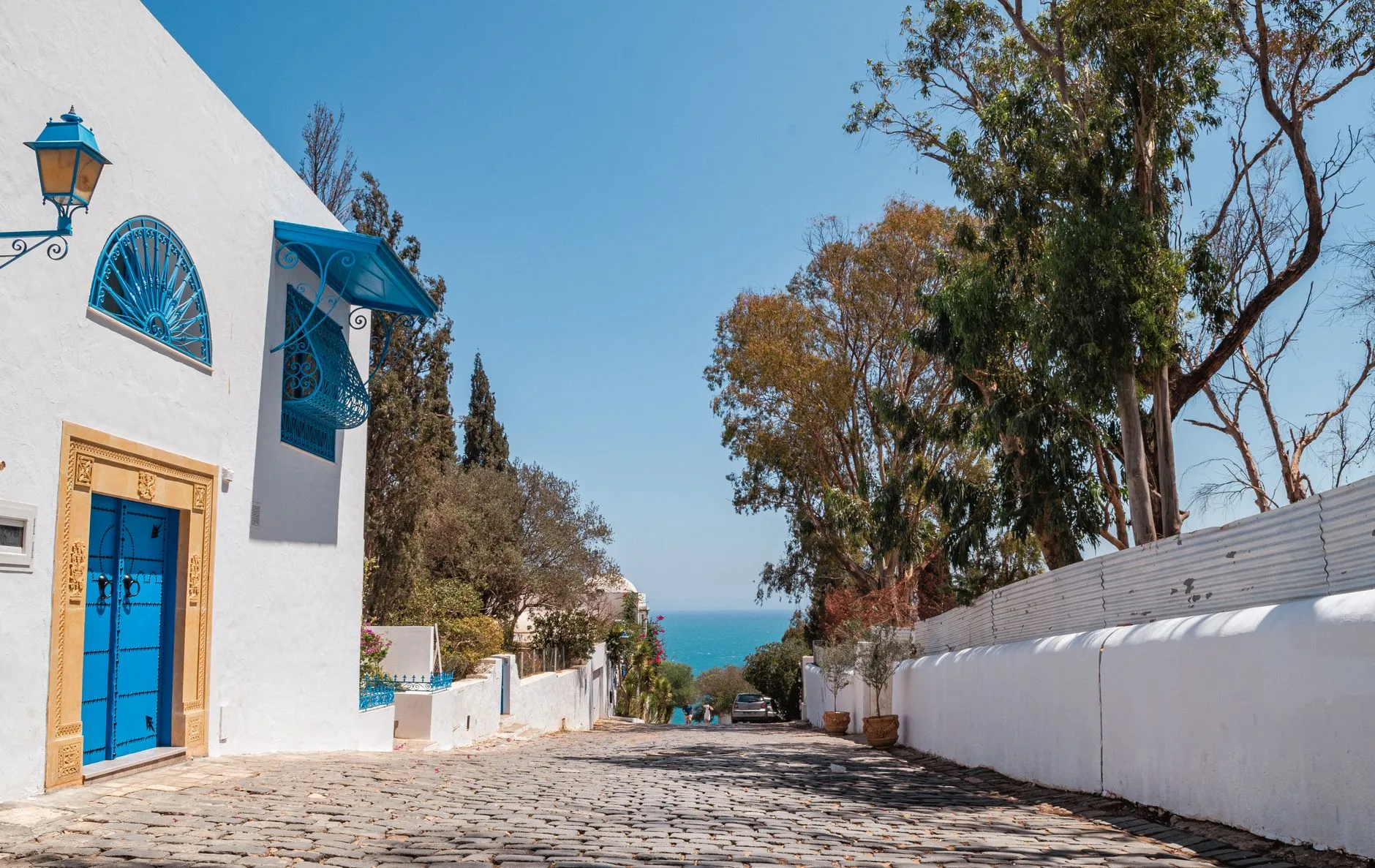
A short train ride out on the TGM line brings the coastal triple-header. Carthage — the rival that fought Rome to the death — is now a scatter of UNESCO-listed sites across leafy suburbs: the Antonine Baths down on the bay, the Punic ports, the Byrsa hill, the amphitheatre. Be honest with yourself: the ruins are spread out and largely unrestored, more atmosphere than spectacle, and far better with a guide who can reassemble the story for you. Sidi Bou Saïd, just up the cliff, is the postcard — a clifftop village where every house has been blue-and-white by decree since 1920, with Mediterranean views, bougainvillaea, cafés and the famous bird-cage doors. It’s touristy and it’s genuinely lovely; go early or late to beat the cruise crowds, climb to the Café des Délices for the view, and try the bambalouni (hot sugared doughnut) from a street stand.
💡 Do the coast loop as one day, the medina as another. Carthage + Sidi Bou Saïd + La Marsa is a relaxed full day on the TGM line. Save the Tunis medina and the Bardo for a separate, less rushed day — both deserve unhurried hours.
The Beach Coast — Hammamet, Sousse, Monastir, Mahdia
This is package Tunisia, and on its own terms it works. The strip runs down the eastern Sahel coast and each resort town has a personality.
Hammamet is the original Tunisian beach resort and still the most polished — soft white sand, a pretty old medina with a kasbah, and the purpose-built Yasmine Hammamet zone of marina, modern hotels and a (kitsch but fun) Medina theme-park. It’s the easy, family-friendly default, and the closest big resort to Tunis and Cap Bon.
Sousse is bigger, livelier and has real substance behind the beach: its medina is UNESCO-listed, with a striking ribat (fortified monastery) and the 9th-century Great Mosque. The resort sprawl at Port El Kantaoui just north is the all-inclusive heartland — marina, golf, hotels in a row. Sousse is the best base if you want beach plus a working Tunisian city and the easiest rail access (it’s on the main line and the Metro du Sahel to Monastir).
Monastir, just down the coast, is quieter and handsome — the grand Ribat (which doubled as a film location), the over-the-top Bourguiba mausoleum, a palm-lined marina and a more relaxed feel. Its airport feeds the whole Sahel.
Mahdia is the connoisseur’s choice — a genuine fishing town on a peninsula with arguably the best sand on the coast, a real medina, far fewer crowds and a slower pulse. If you want the beach without the conveyor belt, this is it.
💡 Pick your resort by personality, not price — they’re all cheap. Hammamet for easy polish, Sousse for city-plus-beach and rail links, Monastir for calm, Mahdia for the prettiest, quietest sand. Port El Kantaoui is peak all-inclusive if that’s the point.
Djerba — the island
Off the south coast, Djerba is the largest island in North Africa and the country’s most relaxed corner — flat, sandy, palm-dotted, and UNESCO-listed (2023) for its layered Jewish, Muslim and Ibadi heritage. It has 125 km of beaches (the best stretch from Sidi Mahrez to Aghir on the east), gentle turquoise water swimmable May–October, and a famously easy-going atmosphere.
The island’s soul is Houmt Souk, the little capital — a compact whitewashed medina you can cross in twenty minutes, dense with covered souks selling Djerba’s celebrated pottery and silver jewellery. El Ghriba is Africa’s oldest synagogue, occupying a site Jewish tradition ties back over two millennia; every spring it draws a major pilgrimage of the Tunisian-Jewish diaspora. And Djerba is Tatooine — George Lucas filmed here: the exterior of the Mos Eisley Cantina is a real building in the fishing village of Ajim, and “Obi-Wan’s house” sits out on the flats. Add the open-air folk-architecture museum (Djerba Explore) and a heritage of 300-plus mosques, and the island earns more than the beach week most people give it.
Practically, Djerba is also the natural launchpad for the deep south — the Star Wars ksour and Matmata are a feasible day-trip or overnight from here.
Kairouan & El Djem — the great monuments
Two inland giants, both easy day-trips from the coast, and both reasons to leave the beach.
Kairouan is one of the holiest cities in Islam — the fourth, by tradition, after Mecca, Medina and Jerusalem — and a UNESCO World Heritage city. Its Great Mosque is one of the oldest and most important in the Muslim world, a vast, austere courtyard of recycled Roman columns under a square minaret that set the template for North African mosque-building. Non-Muslims can visit the courtyard (modest dress essential; the prayer hall is off-limits but visible from the doorways). The medina around it is a working one — and Kairouan is the home of the Tunisian carpet, so expect a charming, relentless sales effort and the famous local makroudh (date-stuffed semolina pastry).
El Djem is the showstopper. A 3rd-century Roman amphitheatre rising out of a small modern town, it held up to 35,000 spectators and is second in preservation only to the Colosseum — but here you can walk the arena floor, climb the tiers, and roam the underground passages where gladiators and animals waited, often nearly alone. Entry is around 12 TND (~€3.50) and includes the on-site museum and Roman villa mosaics. It is genuinely jaw-dropping, and the contrast — a monument this colossal in a quiet provincial town — is half the magic. Kairouan and El Djem combine well into one long day from Sousse or Hammamet.
💡 At Kairouan and any mosque or medina, dress modestly. Shoulders and knees covered, women a scarf to hand. It’s both respect and the difference between a warm welcome and friction.
The Sahara & the South — Douz, Tozeur, Chott el Djerid & the Star Wars sets
This is why you really came, even if you don’t know it yet. The south is a different country: oases, salt flats, dunes, and the most cinematic landscapes in the Maghreb.
Douz is “the gateway to the Sahara” — a date-palm town where the tarmac gives way to real dunes. This is the classic camel-trek and dune-bivouac base: ride out at sunset into the sand, sleep under a sky thick with stars, and eat in a Berber camp. It’s touristy in the sense that it’s set up for visitors, but the dunes are real and the experience delivers.
Tozeur, to the west, is the larger oasis hub — a remarkable mud-brick old quarter (Ouled El Hadef) of patterned brickwork, a vast palmeraie of date gardens, and the launchpad for the spectacular mountain oases of Chebika, Tamerza and Mides (waterfalls and canyons in the desert) and the Star Wars circuit. Many travellers prefer Tozeur as their southern base.
Between Tozeur and Douz you cross the Chott el Djerid, Tunisia’s largest salt lake — a blinding, cracked white pan that shimmers with mirages and pink-tinged pools, crossed by a single causeway. It’s a photo stop on every southern tour and genuinely otherworldly.
And the Star Wars sets are scattered through here for real. Mos Espa, the most complete set, still stands in the sand near Tozeur (out by the Ong Jemel dune). At Matmata, the troglodyte pit-dwellings carved into the earth include the Sidi Driss hotel, which was the interior of the Lars homestead — Luke Skywalker’s home — and you can sleep in it. The fortified granaries, the ksour, especially Ksar Ouled Soltane near Tataouine, are stacked honeycomb cells of mud and palm that appeared as Mos Espa slave quarters and are stunning film locations in their own right. You can stitch all of it — dunes, salt lake, oases, film sets — into a 2–4 day loop by 4WD tour or self-drive.
⚠️ The desert is a winter destination. From late spring through summer the south is brutally hot — 40°C+ — and a camel trek becomes an ordeal, not a pleasure. The Sahara season is roughly October to March; aim for it.
When to Visit — month by month
Tunisia has two clocks running at once: a Mediterranean coast and a desert south, and they want opposite seasons.
April–May: the all-rounder’s window. Warm but not hot, wildflowers, the south still comfortable, the coast pleasant if not yet swimming-warm everywhere. Best for a mixed coast-and-desert trip.
June–early September: beach season. The sea is at its warmest (around 26°C by late summer), the resorts are full, and rates and crowds peak — book ahead. But the south is an oven and the cities sweat; this is for the lounger, not the ruins or the dunes.
September–October: arguably the best of all. The sea is still warm into October, the coast empties a little, prices ease, and the south becomes tolerable again. October especially is a sweet spot for doing the whole country.
November–March: desert prime time and culture without crowds. The Sahara is at its best — cool, clear days, cold nights (pack layers for a desert bivouac). The coast is mild and quiet, the ruins are crowd-free, and prices are at their lowest. Too cool for beach swimming, perfect for everything else.
Ramadan (the Islamic lunar month — falling in late winter/early spring across 2026–27) reshapes the rhythm: daytime cafés and some restaurants close or run reduced hours, the pace slows, and evenings come alive after the fast breaks. It’s an atmospheric time to visit, but plan around midday closures and expect a quieter, more inward country.
What to Eat & Drink
Tunisian food is the most underrated cuisine on the Mediterranean’s south shore — a fiery, sun-driven blend of Berber, Arab, Ottoman and Mediterranean, and far spicier than its neighbours.
Couscous is the national dish (UNESCO-recognised), most gloriously done here as couscous au poisson — fluffy semolina with a whole grilled fish, vegetables and harissa-spiked broth. Brik is the test dish: a paper-thin pastry triangle deep-fried around a runny egg, tuna, capers and parsley — eat it carefully, in one hand, over a plate. Harissa, the chilli-garlic-caraway paste, is on every table; Tunisians put it on everything and so should you. Look also for ojja (a shakshuka-like tomato-and-egg stew, often with merguez), lablabi (a humble chickpea-and-bread breakfast soup, the great cheap eat), grilled sea bass and bream straight off the boat on the coast, and mechouia salad (grilled-pepper-and-tomato).
For sweets, makroudh (date-and-semolina diamonds soaked in honey, Kairouan’s specialty) and the hot, sugar-dusted bambalouni doughnut. And drink the mint tea — green tea, fresh mint and far too much sugar, often with pine nuts floating on top, the ritual full-stop to every meal. Coffee is strong and Turkish-style; alcohol exists (local Celtia beer, decent Tunisian wines like Magon) but is confined to hotels, resorts and licensed restaurants, not the corner café.
Getting Around — louages, trains, car hire & desert tours
Louages are the country’s circulatory system — shared long-distance taxis (usually 8-seat minibuses) that leave from a “station louage” when full, no timetable, no booking, government-fixed fares, and astonishingly cheap. They’re the authentic, efficient way to move between towns if you’re game; carry small cash, they take no cards, and every city has multiple stations serving different directions.
Trains (SNCFT) link Tunis–Sousse–Sfax–Gabès down the coast and out to a few inland points; they’re cheap and scenic but slow and not always reliable. The Sousse–Monastir–Mahdia Metro du Sahel light rail, though, is a handy, dirt-cheap way to hop along the resort coast.
Car hire is the honest recommendation for seeing the real country. If you’re going beyond day-trips, a rental (international and local agencies at all airports; drive on the right; bring your licence) is cheaper than stacking up private transfers and frees you completely from the resort-tour schedule. Roads are decent; drive defensively, watch for police checkpoints (routine, polite), and don’t drive the southern pistes off-road without a guide.
Desert tours are the sensible way to do the deep south if you don’t want to self-drive — multi-day 4WD circuits out of Tozeur, Douz or Djerba that bundle the Chott, the oases, the Star Wars sets and a dune camp. Quality varies wildly; book a reputable Tozeur/Douz operator rather than the cheapest resort-desk offer, and a private or small-group 4WD beats a coach.
💡 Rent a car for the south, louage the north. A hire car unlocks the desert loop and the inland ruins on your own terms. For coast-to-Tunis hops, the louage or the train is cheaper and part of the experience.
Where to Stay — by area & budget
Three very different lodging worlds, and the best trips mix them.
The resort coast (Hammamet, Sousse/Port El Kantaoui, Monastir, Mahdia, Djerba): this is all-inclusive country, and it’s a bargain — full board, drinks, pool and beach from around €70 a night, often less off-peak. Great for families and for a low-effort beach base. Just know what you’re buying: comfort and convenience, not local character.
Medina riads & boutique stays (Tunis, Sidi Bou Saïd, Houmt Souk, Sousse): restored old-city houses and small character hotels — the antidote to the resort. More atmosphere, more soul, a little more money than a budget hotel but still cheap by European standards. The way to actually feel a Tunisian town.
The desert (Tozeur, Douz, Matmata): from simple oasis guesthouses and the surreal troglodyte Sidi Driss “Luke’s homestead” hotel in Matmata, to a handful of upscale desert lodges around Tozeur, to the dune bivouacs of a Sahara trek. At least one night in the south is the most memorable bed you’ll book here.
Costs & Budget
Tunisia is one of the best-value destinations within a short flight of Europe — this is a core reason to come. The currency works in your favour and prices off-resort are low.
A rough daily on-the-ground budget (excluding flights and excluding any all-inclusive you’ve prepaid):
- Backpacker / budget: ~€25–35/day — cheap hotels or guesthouses, louages and trains, street food and local restaurants. Food can run as little as ~€15/day per person if you eat where Tunisians eat.
- Mid-range: ~€50–90/day — comfortable hotels or riads, the odd hire-car day or private tour, restaurant meals, a few paid sites.
- Comfortable / resort-plus-trips: an all-inclusive (~€70/night and up) covers most of your eating and drinking; budget extra for the day-trips and the southern tour that justify the whole trip.
Sense of individual prices: a sit-down couscous or a hearty stew runs €4–8; a fancier three-course restaurant meal around €15–18; a mint tea or coffee well under €1; street snacks (brik, bambalouni) under €1; a museum or ruin entry typically €3–4; a louage between towns, a couple of euros. Tipping is modest and appreciated (round up; ~10% in restaurants).
⚠️ The dinar is a closed currency. You cannot buy Tunisian dinars before you arrive, and you can’t legally take them out. Withdraw from ATMs or change cash on arrival, keep receipts, and spend down (or reconvert at the airport) before you fly home. Carry cash — much of the country, especially louages, souks and small towns, is cash-only.
Practical Information
Entry & visa: visa-free for up to 90 days for most Western tourists (UK, EU, US, Canada, Australia — a few EU nationalities differ); passport valid six months beyond departure; you get a stamp on arrival, no advance paperwork for ordinary tourism. Confirm your nationality’s terms before flying.
Safety: Tunisia’s tourist heartland — the coast, Tunis, Carthage/Sidi Bou Saïd, the islands, the main southern circuit — is broadly safe and heavily policed, and tens of millions visit yearly. The honest caveats: petty crime (pickpocketing, bag-snatching) happens in crowded medinas and on resort beaches, more so after dark; and Western governments advise against travel to specific border zones — the remote areas near the Algeria and Libya frontiers and parts of the interior mountains — well away from anywhere a normal itinerary goes. As of 2026 the US lists Tunisia at “exercise increased caution.” Check your own government’s current advisory and stick to the established regions, and you’re on solid ground.
Hassle & faux-guides: in the Tunis and Kairouan medinas especially, expect “helpful” strangers steering you to a relative’s carpet shop, and a hard sell once inside. It’s tiresome, not dangerous — a firm, friendly “non merci” and walking on works.
Water: don’t drink the tap water — stick to bottled (cheap and everywhere). Fine for brushing teeth in most places, but bottled is the safe default for drinking.
Dress & culture: Tunisia is relatively liberal but it’s a Muslim country. Beachwear stays on the beach and in resorts; in medinas, mosques and the conservative south, cover shoulders and knees, and women carry a scarf. Public displays of affection are best kept discreet. Friday is the main prayer day; Ramadan reshapes daytime hours.
Connectivity: cheap local SIMs (Ooredoo, Orange, Tunisie Telecom) with generous data are easy to buy at the airport or in town with your passport — far better value than roaming. Wi-Fi is standard in hotels.
Frequently Asked Questions
Cheapest Flights to Tunisia
We have tracked 2,654 fares to Tunisia from 82 cities. As of June 2026, here is what a good price looked like from each — the lowest fare we recorded, and a “great-deal” benchmark to judge a quote against. These are tracked observations, not live prices: by the time you read this they will have moved, so treat them as a yardstick, not a quote.
| From | Lowest fare we tracked | Great-deal benchmark |
|---|---|---|
| Basel (BSL) | €57 | €82 |
| Salzburg (SZG) | €76 | €108 |
| Athens (ATH) | €78 | €112 |
| Geneva (GVA) | €85 | €122 |
| Cologne (CGN) | €87 | €124 |
| Milan (MXP) | €102 | €145 |
| Nice (NCE) | €108 | €155 |
| Luxembourg (LUX) | €115 | €164 |
| Munich (MUC) | €116 | €166 |
| Hanover (HAJ) | €118 | €168 |
| Dusseldorf (DUS) | €124 | €177 |
| Bremen (BRE) | €132 | €188 |
| Prague (PRG) | €132 | €189 |
| Stuttgart (STR) | €136 | €194 |
Recent deals we have posted to Tunisia:
- Miami to Tunis, Tunisia from $655
- New York to Tunis, Tunisia from $670
- Detroit to Tunis, Tunisia from $697
- Geneva to Tunis, Tunisia from CHF 86
These are fares aifly tracked to this destination, not live quotes — they have changed since and several of the deals above may have expired. Browse current flight deals →