Florence — The Complete City Guide 2026
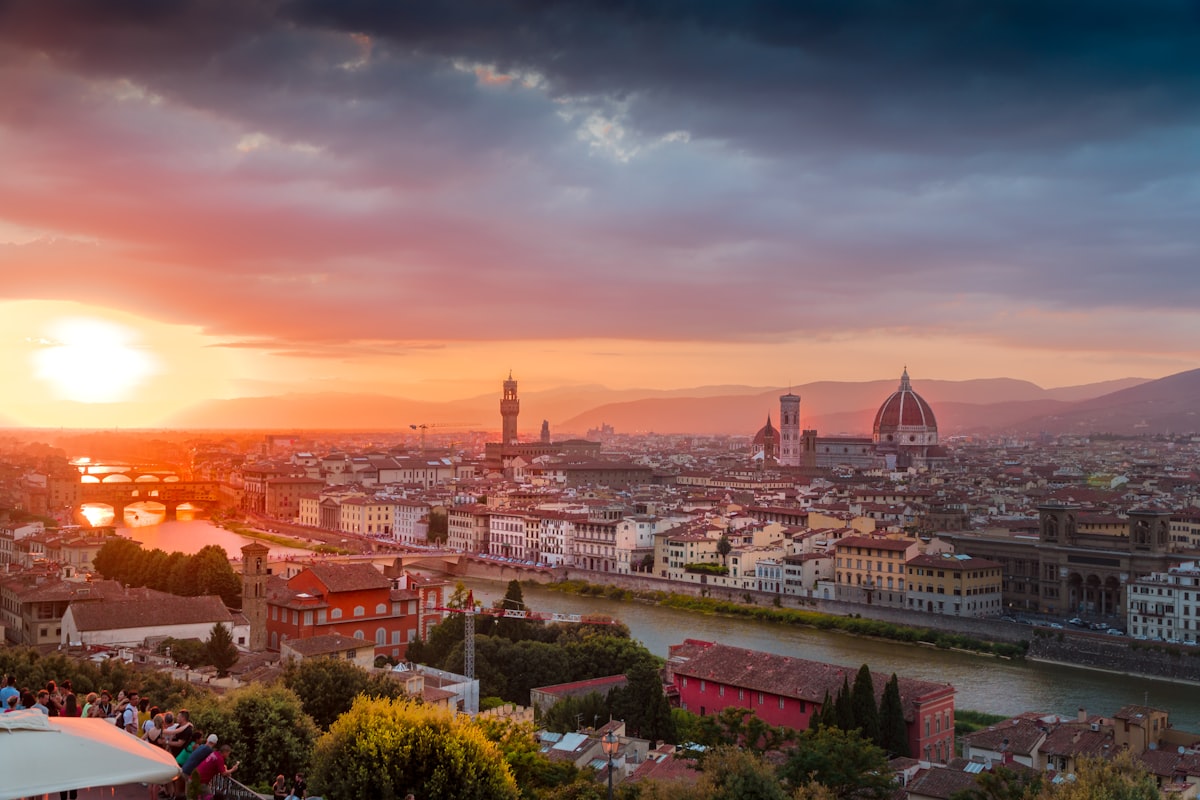
Florence is where the Renaissance began and where it still lives. In a city barely 4 km across, you’ll find Botticelli’s Birth of Venus, Michelangelo’s David, Brunelleschi’s impossible dome, and some of the best food in Italy. The Arno River splits the city in two — the grand museums and piazzas on the north side, the artisan workshops and trattorias of the Oltrarno on the south. Florence is a city where a T-bone steak is a religion, a lampredotto sandwich costs €4, and every sunset over the Ponte Vecchio feels like a painting you’ve seen in a gallery that morning.
Last verified: April 2026. Every price, opening hour, and practical detail in this guide has been checked against current sources. All prices are in euros (€). Florence is mid-range by Italian standards — cheaper than Milan or Venice, comparable to Rome. The city is compact enough to walk everywhere.
Why Florence? An Editor’s Note
Florence should feel like a museum, but it doesn’t. It feels alive. The Uffizi may hold Botticelli’s greatest works, but the real gallery is the city itself — every church, palazzo, and piazza is a masterpiece. What sets Florence apart is scale: you can see Michelangelo’s David in the morning, eat a bistecca that weighs more than your guidebook at lunch, taste Chianti in an ancient enoteca in the afternoon, and watch the sunset from Piazzale Michelangelo by evening. All on foot, all within 20 minutes of each other.
The Oltrarno (south of the Arno) is Florence’s secret weapon. While tourists pack the Uffizi side, the Oltrarno has the artisan workshops, the neighbourhood trattorias, and the Pitti Palace gardens. Cross the Ponte Vecchio and keep walking — that’s where the real Florence begins.
Table of Contents
- Top Attractions & 2026 Prices
- The Duomo Complex
- The Uffizi & Accademia
- Florentine Food & Dining
- Bistecca alla Fiorentina Deep-Dive
- Street Food & Markets
- Fine Dining & Michelin 2026
- Gelato
- Tuscan Wine Guide
- Neighbourhoods
- The Oltrarno
- Viewpoints & Piazzas
- Shopping & Artisans
- Nightlife & Bars
- Getting Around
- Day Trips from Florence
- Budget & Money
- Weather & Best Time to Visit
- Safety & Tips
- What’s New in 2026
- How Many Days?
- Frequently Asked Questions
- Explore More Guides
Top Attractions & Verified 2026 Prices
| Attraction | Price | Notes |
|---|---|---|
| Uffizi Gallery | €25.00 | Timed entry; €29 online (incl. booking); from 4 PM €16; free 1st Sunday |
| Galleria dell’Accademia (David) | €20.00 | Increased Feb 2026; book ahead; combo with Bargello €26 |
| Duomo (Cathedral) | Free | Dome climb, Baptistery, Bell Tower: separate tickets |
| Brunelleschi’s Dome | €30.00 | Brunelleschi Pass (dome + Baptistery + tower + museum + crypt) |
| Palazzo Vecchio | €18.00 | Museum (increased Feb 2026); Arnolfo Tower €20 |
| Palazzo Pitti (Palatine Gallery) | €16.00 | Includes Modern Art + Treasury; Boboli separate |
| Boboli Gardens | €10.00 | Include Porcelain Museum + Bardini Garden |
| Santa Croce | €10.00 | Michelangelo, Galileo, Machiavelli tombs; Bardi Chapel closed for restoration |
| Bargello Museum | €12.00 | Donatello’s David; increased Feb 2026; combo with Accademia €26 |
| Medici Chapels | €11.00 | Michelangelo’s Night and Day; increased Feb 2026 |
| Santa Maria Novella | €7.50 | Masaccio’s Trinity; cloisters; pharmacy nearby |
| Piazzale Michelangelo | Free | Best panoramic view of Florence; go at sunset |
The Duomo Complex
The Cathedral of Santa Maria del Fiore — the Duomo — dominates the Florence skyline. Brunelleschi’s dome (1436) remains the largest masonry dome ever built, an engineering miracle that still baffles architects. The cathedral itself is free to enter.
The Brunelleschi Pass (€30) gives access to all Duomo complex attractions: the dome climb (463 steps, timed entry, mandatory reservation), the Baptistery (with Ghiberti’s Gates of Paradise), Giotto’s Bell Tower (414 steps, no reservation needed), the Opera del Duomo Museum (original Gates of Paradise panels, Michelangelo’s Pietà Bandini), and the Crypt of Santa Reparata (remains of the earlier church beneath the cathedral floor).
The dome climb is the highlight — you walk between the inner and outer shells, see Vasari’s Last Judgement fresco from arm’s length, and emerge at the top for a 360-degree view of Florence and the Tuscan hills. Book the dome slot online well in advance — slots sell out, especially in summer.
The Uffizi & Accademia
Uffizi Gallery
The Uffizi is one of the world’s greatest art museums. In a single visit you’ll see Botticelli’s Birth of Venus and Primavera, Leonardo’s Annunciation, Raphael’s Madonna of the Goldfinch, Caravaggio’s Medusa and Bacchus, Titian’s Venus of Urbino, and Michelangelo’s Doni Tondo (his only finished easel painting). Allow 3–4 hours.
€25 at the door (or €29 pre-purchased online, which includes the €4 booking fee). New for 2026: an afternoon discount — entry from 4 PM costs just €16 (€20 online). Timed entry is mandatory. Book at uffizi.it — walk-up queues can exceed 2 hours in peak season. Free first Sunday of the month (no booking, but arrive very early).
The Vasari Corridor — the elevated passageway connecting the Uffizi to Palazzo Pitti across the Ponte Vecchio — reopened in late 2024 after 8+ years of closure. Separate ticket: €20 (€24 online). Combined Uffizi + Vasari: €43. A 40-minute one-way walk through the most exclusive corridor in art history.
Galleria dell’Accademia
Home to Michelangelo’s David (1504) — the most famous sculpture in the world. Also houses Michelangelo’s unfinished Prisoners (Prigioni), which are arguably more moving than the David itself. The gallery also has a notable collection of musical instruments.
€20 (increased from €16 on February 1, 2026; +€4 booking fee online). Since March 2026, the Accademia and Bargello merged into a single institution — a new combined ticket (€26, 48h) covers both museums. The David visit takes 30–60 minutes — combine it with a morning walk through San Marco. Free first Sunday.
Palazzo Pitti & Boboli
The Medici’s grand palace on the Oltrarno side. The Palatine Gallery holds Raphael’s Madonna of the Chair, Titian’s Mary Magdalene, and a stunning Caravaggio. Less crowded than the Uffizi, more intimate, and the art is hung salon-style in lavishly frescoed rooms.
Palazzo Pitti: €16 (Palatine + Modern Art + Treasury). Boboli Gardens: €10 (includes Porcelain Museum + Bardini Garden). The gardens are 45,000 sq metres of Renaissance landscaping — grottoes, fountains, and cypress avenues. A half-day easily.
Florentine Food & Dining
Florentine cuisine is Tuscan cuisine at its purest: simple ingredients, no fuss, extraordinary results. The cooking philosophy is “povera ma buona” (poor but good) — bread without salt, beans, olive oil, grilled meat, and vegetables. No cream sauces, no unnecessary complication. This is food that has been perfected over centuries by people who trust their ingredients.
| Dish | Description | Typical Price |
|---|---|---|
| Bistecca alla fiorentina | T-bone steak from Chianina cattle, charcoal-grilled (see deep-dive) | €45–€65/kg |
| Lampredotto | Tripe sandwich from street carts — Florence’s true street food | €4–€5 |
| Ribollita | Thick bread, bean & vegetable soup — Tuscan comfort food | €8–€12 |
| Pappa al pomodoro | Tomato and bread soup with basil & olive oil | €8–€12 |
| Panzanella | Summer bread salad with tomatoes, onion, basil (June–Sep) | €8–€10 |
| Crostini toscani | Chicken liver pâté on toasted bread — the classic antipasto | €6–€10 |
| Peposo | Black pepper beef stew, slow-cooked with red wine | €12–€16 |
| Schiacciata | Tuscan flatbread with olive oil (or filled like a sandwich) | €3–€6 |
| Trippa alla fiorentina | Tripe in tomato sauce with Parmesan — a local delicacy | €10–€14 |
| Cantucci & Vin Santo | Almond biscotti dipped in sweet dessert wine | €6–€8 |
Where to Eat Traditional
Trattoria Mario (Via Rosina 2, San Lorenzo) — A communal-table institution since 1953. Cash only. No reservations. Queue before opening (noon/19:30). Ribollita, bistecca, and daily specials for €10–€18. The quintessential Florence lunch experience.
Il Latini (Via dei Palchetti 6) — A legendary trattoria since 1911. Hams hang from the ceiling. The bistecca is famous. Mains €15–€25. Always packed — arrive before opening or queue.
Trattoria Sostanza (Il Troia) (Via del Porcellana 25) — Tiny, cash-only, famous for butter chicken and artichoke omelette. One of Florence’s most beloved old-school trattorias. €15–€25.
Buca Mario (Piazza degli Ottaviani 16) — Underground vaulted ceilings, traditional dishes. One of Florence’s oldest trattorias (1886). Bistecca is the star. €20–€35.
Trattoria Cammillo (Borgo San Jacopo 57, Oltrarno) — Family-run, classic Tuscan. Ribollita, rabbit, seasonal dishes. €15–€25.
Bistecca alla Fiorentina Deep-Dive
The bistecca alla fiorentina is Florence’s most sacred dish. A T-bone steak from Chianina cattle (the world’s oldest and largest breed), at least 3 fingers thick (5–6 cm), weighing 1–1.5 kg, grilled over charcoal or wood, served rare to medium-rare (never well-done — if you ask for well-done, you’ll get a look of genuine sorrow). Seasoned only with salt, pepper, and a drizzle of Tuscan olive oil after cooking.
The steak is priced by weight, typically €45–€65 per kg. A typical steak for two costs €50–€80. It’s almost always shared. Order a Chianti Classico Riserva alongside.
Best Bistecca in Florence
Trattoria dall’Oste (Via Luigi Alamanni 3) — Specialist in bistecca. Certified Chianina beef. Excellent quality, reasonable prices (~€50/kg). Lively atmosphere. Book ahead.
Buca Mario — See above. The vaulted cellar setting adds to the experience.
Perseus (Viale Don Minzoni 10) — A classic neighbourhood restaurant known for its bistecca. Locals eat here. Around €50/kg.
Trattoria Mario — Smaller steaks available by the portion, not only by the kilo. Good for solo travellers who don’t want 1.2 kg of beef.
Buca Lapi (Via del Trebbio 1) — In a 14th-century basement. One of the most atmospheric places for bistecca. €55–€65/kg.
Street Food & Markets
Lampredotto
Florence’s true street food is lampredotto — the fourth stomach of a cow, slow-simmered for hours and served in a bun (panino con lampredotto) dipped in the cooking broth, with salsa verde (parsley sauce) and/or salsa piccante (spicy sauce). It sounds intimidating but tastes incredible — tender, savoury, and deeply Florentine. €4–€5 from street carts (trippai).
Where to find it: Look for the mobile food carts (trippai) scattered across the city. The most famous: Nerbone (inside Mercato Centrale), L’Antico Trippaio (Piazza dei Cimatori), Il Trippaio del Porcellino (Loggia del Porcellino), and Da Vinattieri (Via Santa Margherita). They usually serve from late morning to early afternoon.
Mercato Centrale (San Lorenzo Market)
Florence’s iconic two-storey market. The ground floor is the traditional fresh food market: butchers, cheesemongers, produce, dried goods, truffle stalls. It’s been here since 1874. Open Mon–Sat 07:00–14:00.
The first floor is a modern food hall (opened 2014) with artisan food stalls: pasta, pizza, lampredotto, bistecca, focaccia, vegetarian, craft beer, gelato, and more. Open daily 10:00–00:00. It’s touristy but the quality is genuinely good. A meal costs €10–€20.
All’Antico Vinaio
The most famous sandwich shop in Florence — and possibly Italy. The queue is always long. Enormous schiacciata sandwiches filled with cured meats, cheeses, truffle cream, and vegetables. €5–€8 for a sandwich that could feed two. Multiple locations on Via dei Neri. Is it worth the queue? Yes, but go at off-peak times (14:00–16:00).
Other Street Food
Schiacciata — Tuscan flatbread, either plain with olive oil and salt, or filled like a sandwich. The Florentine answer to focaccia.
Trippa alla fiorentina — Tripe in tomato sauce with Parmesan, from the same trippai carts that sell lampredotto.
Cecina/farinata — Chickpea flour flatbread, thin and crispy. Originally from Liguria but popular in Florence.
Porchetta — Herb-stuffed roast pork, sliced and served in a sandwich. Find it at markets and street stalls.
Fine Dining & Michelin 2026
Florence’s fine dining scene ranges from the extravagant to the understated. The best restaurants combine Tuscan tradition with modern creativity.
Michelin-Starred Restaurants (2026)
Florence has 9 Michelin-starred restaurants in the 2026 guide, including Tuscany’s only three-star and a new addition for 2026.
| Restaurant | ⭐ | Cuisine |
|---|---|---|
| Enoteca Pinchiorri | ⭐⭐⭐ | Italian haute cuisine; legendary 100,000-bottle wine cellar (Via Ghibellina) |
| Santa Elisabetta | ⭐⭐ | Creative Italian in a medieval tower (Hotel Brunelleschi) |
| Gucci Osteria da Massimo Bottura | ⭐ | Global-Italian (Piazza della Signoria) |
| Il Palagio | ⭐ | Refined Italian (Four Seasons Hotel) |
| Borgo San Jacopo | ⭐ | Contemporary Italian (Lungarno Collection) |
| Saporium Firenze | ⭐ | Modern Tuscan |
| Atto di Vito Mollica | ⭐ | Italian fine dining |
| Serrae Villa Fiesole | ⭐ | Hilltop dining in Fiesole |
| Luca’s (Hotel La Gemma) | ⭐ | Creative Italian — NEW 2026 |
Worth a detour in Tuscany: Arnolfo in Colle di Val d’Elsa (2⭐), Campo del Drago in Montalcino (2⭐), Caino in Montemerano (2⭐), and Il Piccolo Principe in Viareggio (2⭐).
Excellent Restaurants Under €50
Il Palagio (Four Seasons) — One Michelin star. Elegant terrace dining. Lunch tasting from €90. Out of budget for most, but the experience is memorable.
Cibreo Trattoria (Via Andrea del Verrocchio 8) — The more casual sibling of Cibreo Ristorante. Same kitchen, no reservations, half the price. Traditional Florentine dishes. €25–€40.
Il Santo Bevitore (Via di Santo Spirito 64, Oltrarno) — Modern Tuscan in a beautiful vaulted space. Excellent wine list. €30–€45. Reservations essential.
Essenziale (Piazza di Cestello 3, Oltrarno) — Creative contemporary. Simone Cipriani’s refined take on Tuscan ingredients. Tasting menu from €55.
Gelato
Florence takes gelato seriously. The city claims to have invented it (the Medici court, Bernardo Buontalenti, 1565 — though this is disputed). What matters is that the gelato here is extraordinary.
How to spot good gelato: colours should be natural (pistachio is grey-green, not neon), fruit flavours should be seasonal, and the gelato should be stored in covered metal containers — not piled in mountains of bright colours. €2.50–€4 for 2–3 scoops.
Best Gelaterie
Vivoli (Via dell’Isola delle Stinche 7) — Florence’s most famous gelateria since 1930. Traditional flavours, excellent quality. Near Santa Croce.
La Sorbettiera (Piazza Tasso, Oltrarno) — Small, local, and arguably the best in Florence. The crema and pistachio are legendary. Worth the walk.
Perché no! (Via dei Tavolini 19) — Central and excellent. Good range of flavours. Since 1939.
My Sugar (Via de’ Ginori 49) — Organic ingredients, creative flavours. A newer addition but quickly beloved.
Gelateria della Passera (Via Toscanella 15, Oltrarno) — Small, authentic, and packed with locals. The ricotta and fig is exceptional.
Tuscan Wine Guide
Tuscany is one of the world’s great wine regions, and Florence is the perfect base for exploring it. The Sangiovese grape dominates — it produces everything from everyday Chianti to profound Brunello di Montalcino.
Key Tuscan Wines
- Chianti Classico — The heart of Tuscan wine. Made from Sangiovese in the hills between Florence and Siena. Look for the black rooster (Gallo Nero) label. Chianti Classico Riserva (24+ months ageing) and Gran Selezione (30+ months) are the premium tiers. €4–€8/glass in Florence.
- Brunello di Montalcino — 100% Sangiovese, aged 5 years minimum. One of Italy’s greatest wines. Powerful, complex, and expensive. €10–€25/glass in enotecas.
- Vino Nobile di Montepulciano — Sangiovese-based (locally called Prugnolo Gentile). Similar to Chianti Classico but with its own character. Excellent value.
- Super Tuscans — Premium wines that blend Sangiovese with Cabernet Sauvignon, Merlot, or other international grapes. Originally rebellious (classified as basic “Vino da Tavola”), now among Italy’s most prestigious wines. Sassicaia, Ornellaia, Tignanello.
- Vernaccia di San Gimignano — Tuscany’s most important white wine. Crisp, mineral, perfect with seafood or as an aperitivo.
- Vin Santo — Sweet dessert wine, traditionally served with cantucci (almond biscotti) for dipping. The perfect end to a Tuscan meal.
Wine Bars (Enotecas)
Enoteca Pitti Gola e Cantina (Piazza Pitti 16) — Directly opposite the Pitti Palace. Outstanding Tuscan wine selection, paired with cheese and cured meats. Glasses from €5.
Le Volpi e l’Uva (Piazza dei Rossi 1, Oltrarno) — A tiny, acclaimed wine bar near the Ponte Vecchio. Focus on small producers. Glasses from €5. Cheese and salumi boards.
Fuori Porta (Via del Monte alle Croci 10) — Just below Piazzale Michelangelo. Huge wine list (600+ labels), crostini, and cold cuts. €4–€10/glass.
Il Santino (Via di Santo Spirito 60, Oltrarno) — The wine bar sibling of Il Santo Bevitore. Small plates and excellent wines in a cosy space.
Procacci (Via de’ Tornabuoni 64) — Historic (1885) wine bar famous for its truffle panini. A splurge but iconic.
Neighbourhoods
Centro Storico (Historic Centre)
The UNESCO-listed heart: Duomo, Piazza della Signoria, Uffizi, Ponte Vecchio. Dense with tourists, especially in summer. Stay here for convenience, eat one block off the main streets for better food and prices.
San Lorenzo
The market district. Mercato Centrale, the leather market stalls, the Medici Chapels, and the Laurentian Library (designed by Michelangelo). Gritty and commercial but full of character. Home to some of the best budget trattorias (Trattoria Mario, Da Nerbone).
Santa Croce
The Santa Croce basilica (tombs of Michelangelo, Galileo, Machiavelli) anchors this neighbourhood. More residential than the centro, with good restaurants and bars. Via dei Neri is the food street (All’Antico Vinaio, Vivoli).
Oltrarno
South of the Arno — see dedicated section below. The artisan quarter, with Pitti Palace, Boboli Gardens, Santo Spirito, and Florence’s best neighbourhood dining.
San Marco / SS. Annunziata
University area north of the Duomo. The Accademia (David) is here. More residential, fewer tourists, better prices. Piazza SS. Annunziata is one of Florence’s most beautiful squares.
San Frediano
The most local part of the Oltrarno. Piazza Tasso, craft beer bars, neighbourhood trattorias, and very few tourists. This is where young Florentines live and eat.
The Oltrarno
Cross the Ponte Vecchio and you enter a different Florence. The Oltrarno (“beyond the Arno”) is the artisan quarter, where craftspeople have worked leather, wood, and gold for centuries. It’s where Florentines themselves go to eat and drink.
Piazza Santo Spirito — The social heart of the Oltrarno. Brunelleschi’s Santo Spirito church (free, austere and beautiful) faces a piazza lined with cafés, bars, and restaurants. On summer evenings it fills with locals, students, and aperitivo drinkers. The morning market (Mon–Sat) sells food and goods.
Artisan workshops — Wander the streets around Via Maggio, Via di Santo Spirito, and Borgo San Frediano. You’ll find goldsmiths, leather workers, frame makers, and restorers at work with their doors open. Many welcome visitors. This is the last surviving artisan quarter in a major European city.
San Niccolò — A quiet neighbourhood between the Arno and Piazzale Michelangelo. Excellent bars and restaurants (Bevo Vino, Il Rifrullo), a medieval gate, and the stairs up to the piazzale.
Viewpoints & Piazzas
Piazzale Michelangelo
The most famous viewpoint in Florence. A wide terrace on a hill south of the Arno with a panoramic view of the entire city — the Duomo, the bridges, the towers, and the Tuscan hills behind. Free. Walk up the steps from San Niccolò (15 min) or take bus 12 or 13. Go at sunset — it’s busy but the view is worth every person around you.
San Miniato al Monte
Continue climbing 5 minutes above Piazzale Michelangelo to this 11th-century Romanesque church. The façade is extraordinary. The interior is serene, with a remarkable 13th-century mosaic apse. Gregorian chant at vespers (17:30 in summer, 16:30 in winter). Free. Fewer tourists than the piazzale and an even better view.
Giotto’s Bell Tower
414 steps to the top of the campanile. The reward is the best view of the dome itself — you can’t see the dome from the dome. Included in the Brunelleschi Pass (€30).
Arnolfo Tower (Palazzo Vecchio)
The medieval tower of the town hall. €20 (increased Feb 2026; or combined museum + tower €26). 418 steps through narrow stone staircases. Stunning views over Piazza della Signoria and the rooftops.
Key Piazzas
Piazza della Signoria — Florence’s civic heart since medieval times. The Loggia dei Lanzi (free outdoor sculpture gallery, with Cellini’s Perseus) and the copy of Michelangelo’s David. Palazzo Vecchio dominates.
Piazza del Duomo — The cathedral, baptistery, and bell tower. Overwhelming and beautiful. Visit early morning or evening to avoid the worst crowds.
Piazza Santa Croce — A grand piazza in front of the basilica. Historic calcio storico matches are played here in June.
Piazza Santo Spirito — The Oltrarno’s living room. See above.
Shopping & Artisans
Ponte Vecchio — The medieval bridge lined with goldsmiths and jewellers since 1593 (when the Medici evicted the butchers). Beautiful to walk across; the shops are high-end. Free to walk.
San Lorenzo Market — The leather market stalls surrounding the Medici Chapels. Quality varies enormously — bargain hard, check seams and smell the leather (real leather smells of leather, not chemicals). Expect to pay €30–€80 for a decent bag after negotiating.
Scuola del Cuoio (Santa Croce) — A genuine leather school inside the Santa Croce complex. You can watch artisans at work and buy high-quality leather goods at fair prices. Better quality and more honest than the San Lorenzo stalls.
Officina Profumo-Farmaceutica di Santa Maria Novella — A pharmacy and perfumery operating since 1612 in a stunning frescoed space. Soaps, perfumes, herbal remedies. An experience in itself. Free to enter.
Via de’ Tornabuoni — Florence’s luxury shopping street. Gucci, Ferragamo, Prada — all of which are Florentine brands. Even if you’re not buying, the street is beautiful.
Nightlife & Bars
Aperitivo — Florence’s version of happy hour. From 18:00–21:00, many bars offer a drink (€8–€12) with access to a buffet of food. It’s a Florentine tradition and often replaces dinner.
Piazza Santo Spirito — The best evening atmosphere. Volume, Gallo Nero, and Il Rifrullo are popular spots.
MAD (Murate Art District) — A former prison turned cultural centre with cafés, a cinema, and events. Relaxed and creative.
Todo Modo (Via dei Fossi 15) — A bookshop-wine bar. Browse books, drink wine. Perfectly Florentine.
Negroni cocktail: Invented in Florence in 1919 at Café Casoni (now Café Roberto Cavalli on Via de’ Tornabuoni). The original recipe: equal parts gin, Campari, and sweet vermouth. Order one everywhere.
Craft beer: Florence has a growing craft scene. Archea Brewery (Via de’ Serragli, Oltrarno) and Il Birrino (Via delle Oche) are good starting points.
Getting Around
| Transport | Price | Notes |
|---|---|---|
| Walking | Free | Florence is tiny — most attractions within 20 min walk |
| ATAF bus (90 min) | €1.70 | Buy before boarding at tabacchi or machines |
| Tram T2 (airport) | €1.70 | Airport to Unita/Alamanni (near SMN station), 20 min |
| Contactless/app | €1.50 | Tap debit/credit card or use Tabnet app; 90 min validity |
| Train to Rome (Freccia) | from ~€15 | Frecciarossa 1h 30m; from €13 advance purchase |
| Train to Pisa | from €9 | Regional, 1h–1h 15m |
| Train to Siena | from €10 | Direct bus faster (75 min, from €8); train via Empoli |
From Florence Airport (Peretola/Amerigo Vespucci)
Small airport, 5 km from the centre. The Tramvia T2 runs from the airport terminal to Unita/Alamanni (next to Santa Maria Novella station) in 20 minutes. €1.70 for a standard ticket. Trams run every 5–8 minutes. This is the best option.
Taxi: €22 fixed rate (set by city ordinance) + €1 per bag. 15–25 min depending on traffic.
From Bologna Airport (Marconi)
Many budget airlines fly to Bologna. The Marconi Express monorail connects the airport to Bologna Centrale station (7 min, €11.50), then a Frecciarossa to Florence SMN takes 37 minutes (from €15). Total time: about 1h 15m door-to-door.
Walking Florence
Florence is one of Europe’s most walkable cities. The historic centre is barely 4 km across. From the Duomo to Piazzale Michelangelo: 25 minutes. From the Uffizi to the Accademia: 15 minutes. From the Ponte Vecchio to Palazzo Pitti: 5 minutes. You do not need public transport for sightseeing.
Day Trips from Florence
Siena
Florence’s eternal rival. A medieval hilltop city with the shell-shaped Piazza del Campo (site of the Palio horse race), the striped Duomo (€5 cathedral, €15 OPA SI Pass for all monuments), and the Pinacoteca Nazionale. The best day trip from Florence.
Getting there: Direct bus from Florence SMN (SITA/Autolinee Toscane, 75 min, from €8) is easier than the train (requires a change at Empoli). Or drive (1h 15m via the scenic Chiantigiana road through Greve and Castellina).
Pisa
More than just the tower. The Campo dei Miracoli (Cathedral, Baptistery, Camposanto, and the Leaning Tower) is genuinely stunning. Leaning Tower: €20 (timed entry, 30 min, book online). Cathedral: free. Baptistery: €5. Combo ticket (tower + 1 monument): €27. Train from Florence: 1h, from €9.
Lucca
A charming walled city with intact Renaissance walls you can walk or cycle on top of (bike rental €3–€5/hour). Piazza dell’Anfiteatro (built on a Roman amphitheatre), the Duomo, and Torre Guinigi (with trees growing on top, €5). Less touristy than Pisa or Siena. Train from Florence: 1h 20m, from €8.
San Gimignano
The “medieval Manhattan” — a hilltop town famous for its 14 surviving medieval towers (originally 72). Collegiata (cathedral with frescoes, €5). The gelato at Gelateria Dondoli (Piazza della Cisterna) has won multiple world championships. Bus from Florence: 1h 30m via Poggibonsi, from €7.
Chianti Wine Country
The rolling hills between Florence and Siena. Stop at Greve in Chianti (market town), Castellina in Chianti, and Radda in Chianti. Visit a winery (cantina) for tastings — many require booking. Best by car. Organised wine tours from Florence cost €60–€120 (half-day) or €100–€180 (full day with lunch).
Cinque Terre
Technically possible as a long day trip (2h 30m each way by train via La Spezia), but exhausting. Better as an overnight. If you go: Cinque Terre Card: €16/day (trains + hiking paths). Train from Florence to La Spezia: from €15.
Budget & Money
| Category | Budget | Mid-Range | Luxury |
|---|---|---|---|
| Accommodation | €25–€50 dorm | €100–€200 | €300–€800+ |
| Food (per day) | €20–€40 | €50–€100 | €150–€400 |
| Transport (per day) | €0 (walk) | €0–€5 | €20–€50 |
| Wine (glass) | €3–€5 | €5–€10 | €15–€40 |
| Daily Total | €50–€100 | €160–€320 | €480–€1,300+ |
Money-Saving Tips
- Free first Sunday: State museums (Uffizi, Accademia, Pitti, Bargello, Medici Chapels) are free on the first Sunday of the month. No booking — arrive very early.
- Firenze Card (€85/72h): Worth it if visiting 4+ major museums. Skips the booking fee and most queues. Does NOT include Duomo complex. Also consider the Uffizi+Pitti+Boboli 5-day pass (€40).
- Eat at trattorias, not tourist restaurants. A full lunch at a tasca costs €10–€15. A lampredotto sandwich costs €4.
- Free views: Piazzale Michelangelo, San Miniato al Monte, and the Ponte Vecchio are all free.
- Free churches: The Duomo (nave), Santo Spirito, San Miniato, Orsanmichele, and most churches are free.
- Water fountains: Florence has free drinking fountains (nasoni) throughout the city. Carry a refillable bottle.
Weather & Best Time to Visit
Summer (Jun–Aug): Hot and crowded. 30–38°C. July–August can be oppressive. Florence is in a valley and traps heat. Museums are air-conditioned refuge.
Spring (Apr–May): Ideal. 15–25°C. Flowers in the Boboli Gardens. Easter crowds, then quieter in May.
Autumn (Sep–Oct): Warm and golden. 15–28°C in September, cooler in October. Wine harvest. Truffle season begins. Fewer tourists. Many consider this the best time.
Winter (Nov–Mar): Cool and quiet. 3–12°C. Some rain. Many tourists gone. Christmas markets. Hotel prices drop significantly.
Best months: April–May and September–October. Good weather, manageable crowds, best light for photography.
Safety & Tips
- Florence is very safe. Violent crime against tourists is extremely rare.
- Pickpockets: Active around the Duomo, Santa Maria Novella station, San Lorenzo Market, and on crowded buses. Standard awareness applies.
- Street sellers: Persistent around tourist areas. A firm “no grazie” is sufficient.
- Flooding: The Arno flooded catastrophically in 1966 (you’ll see watermarks on buildings). Modern flood controls are in place, but check during heavy November rains.
- Eating rules: Do NOT eat or sit on church steps in the centro storico. Fines of €500 apply (Florence anti-picnic ordinance). Eat at a table or standing at a bar.
- Tipping: Not expected. Coperto (cover charge, €1.50–€3) is added to restaurant bills automatically. Rounding up for good service is appreciated but optional.
- Tap water: Safe and excellent in Florence. Ask for “acqua del rubinetto” at restaurants (though many prefer to sell bottled).
What’s New in 2026
Vasari Corridor reopened: The elevated passageway connecting the Uffizi to Palazzo Pitti across the Ponte Vecchio reopened in late 2024 after 8+ years of closure. Separate ticket €20 (€24 online), or combined Uffizi + Vasari €43. A 40-minute one-way walk through the most exclusive corridor in art history.
Uffizi afternoon discount (new): Entry from 4 PM now costs just €16 (€20 online) — a significant saving on the standard €25/€29 ticket. A smart option for those who don’t need the full day.
Uffizi + Pitti + Boboli 5-day pass: A new combined ticket (€40) covers the Uffizi, Palazzo Pitti, and Boboli Gardens, valid for 5 days. Good value if visiting all three.
February 2026 price increases: Several major museums raised prices on Feb 1: Galleria dell’Accademia €16→€20, Bargello €10→€12, Medici Chapels €9→€11, Palazzo Vecchio €12.50→€18, Arnolfo Tower €12.50→€20, Palazzo Davanzati and Orsanmichele also increased. All prices in this guide reflect the new rates.
Accademia–Bargello merger (March 2026): The two museums are now managed as a single institution. A new combined ticket (€26, 48h) covers both. The merger aims to boost Bargello visitor numbers.
Rothko at Palazzo Strozzi: The major exhibition of 2026 — “Mark Rothko” runs Mar 14–Aug 23, 2026. A comprehensive retrospective of the abstract expressionist master. Also: Rothko exhibition at the Laurentian Library (€7).
Bardi Chapel closed: The Bardi Chapel in Santa Croce (Giotto frescoes) is closed for restoration through 2026.
Tram T2 extended: The airport tram line was extended to Piazza San Marco (Jan 2025), making it even easier to reach the Accademia and San Marco directly from the airport.
Scoppio del Carro 2026: Easter Sunday (April 5) — Florence’s spectacular “Explosion of the Cart” in Piazza del Duomo. A 350-year tradition involving a cart full of fireworks ignited by a mechanical dove.
Maggio Musicale Fiorentino 2026: Florence’s annual music and opera festival runs Apr 19–Jul 1 at the Teatro del Maggio. One of Italy’s most prestigious cultural events.
Firenze Rocks 2026: Florence’s major rock festival at Visarno Arena, Jun 12–14, 2026.
Calcio Storico 2026: Florence’s brutal historic football matches are held in Piazza Santa Croce in June. Three matches between the four city quarters, with the final on June 24 (Feast of San Giovanni, Florence’s patron saint). Tickets sell out fast.
1966 Flood 60th anniversary: November 4, 2026 marks 60 years since the catastrophic Arno flood. Expect commemorative exhibitions and events throughout autumn.
Tourist tax: Florence charges a €3–€8 per night tourist tax depending on accommodation type and star rating. Max 7 nights. Paid at check-in.
ZTL (Zona a Traffico Limitato): Daytime restrictions as usual, plus evening restrictions Thu–Sat 23:00–03:00 (Apr–Oct) covering parts of the centro storico. Camera-enforced — fines €80+ per entry.
Entry requirements: Italy is in the Schengen Area. EU/EEA citizens need only an ID card. Non-EU visa-exempt nationals: 90 days in any 180-day period. ETIAS is not yet in effect as of April 2026.
Anti-picnic rules: Florence has strict rules against eating on church steps and in certain piazzas in the centro storico. Fines of €500. Eat at restaurants, bars, or designated areas.
How Many Days in Florence?
2 days: Uffizi, Duomo + dome climb, Accademia (David), Piazzale Michelangelo sunset, bistecca dinner. Intense but possible.
4 days: Add Pitti + Boboli, Oltrarno exploration, Santa Croce, shopping, a Chianti wine experience, and a day trip to Siena or Pisa.
7+ days: Deep dive: multiple day trips (Siena, Pisa, Lucca, San Gimignano, Chianti), cooking class, leather workshop visit, slow Oltrarno mornings, and meals that go long into the evening.
Frequently Asked Questions
How many days do I need in Florence?
Three to four days is ideal. Two covers the highlights, four lets you add day trips and deeper exploration of the Oltrarno.
Is the Firenze Card worth it?
If you’re visiting 4+ major museums in 3 days, yes. It costs €85 and covers the Uffizi (€25), Accademia (€20), Pitti (€16), Boboli (€10), Bargello (€12), and 55+ more with skip-the-line access. Note: it does NOT include the Duomo complex — buy the Brunelleschi Pass (€30) separately.
Uffizi or Accademia: which if I can only choose one?
The Uffizi. The Accademia has the David (extraordinary) but little else for most visitors. The Uffizi has depth and breadth across centuries of Italian art.
Is the bistecca really worth it?
If you eat red meat, absolutely. It’s the definitive Florentine food experience. Share one between two, order a Chianti, and surrender to it.
What about vegetarian food?
Tuscan cuisine is naturally rich in vegetarian options: ribollita, panzanella, pappa al pomodoro, pasta e fagioli, and most trattorias offer good vegetable sides. Florence also has excellent dedicated vegetarian restaurants.
Is Florence walkable?
Extremely. The entire historic centre is a 20-minute walk across. You don’t need public transport for sightseeing.
Should I visit in summer?
If you can avoid July–August, do. Florence is in a valley and temperatures reach 35–38°C. Spring and autumn are far more pleasant. If you must visit in summer, hit museums in the afternoon (air conditioning) and explore outside in the morning and evening.
Is Florence safe?
Very safe. Pickpockets are the only concern, mainly around the Duomo and Santa Maria Novella station. Standard awareness.
Explore More Guides
- 🇮🇹 Naples City Guide 2026
- 🇪🇸 Madrid City Guide 2026
- 🇪🇸 Seville City Guide 2026
- 🇵🇹 Porto City Guide 2026
- 🇫🇷 Marseille City Guide 2026
- 🇨🇿 Prague City Guide 2026
- 🇵🇱 Krakow City Guide 2026
- 🇩🇰 Copenhagen City Guide 2026
This guide was researched and written by the AiFly editorial team. Last verified April 2026. Prices and opening hours are subject to change — always confirm locally. AiFly may earn a commission from partner links at no extra cost to you.