Lanzarote — The Complete Island Guide 2026
An island whose landscape was reset by a six-year volcanic eruption that ended in 1736, and whose above-ground aesthetic was reset by one artist between 1966 and 1992. No building stands taller than a palm tree. The rule is enforced. This guide covers the volcanic park, the lava tubes, the black vineyards of La Geria, the Manrique circuit, La Graciosa, and why the resort strip is not the point.
€130–400/day budget
Desert Atlantic: 18–29°C
🇪🇸 EU / Schengen / EUR €
No tourist tax · IGIC 7%
EES active · ETIAS late 2026
Why Lanzarote? An Editor’s Note
On the evening of 25 September 1992, César Manrique was driving himself home from Arrecife — something he was not meant to be doing. He had had cataract surgery a few weeks earlier and the Cabildo’s chauffeur had called in sick that afternoon, so he had taken the wheel himself. At the Tahíche roundabout, near his foundation, another vehicle struck his car. Manrique, aged 73, died at the scene.
He had spent most of the previous four years — the longest and loudest years of his public life — trying to stop the island’s traffic engineers from modernising that junction. No flyover. No traffic lights. No advertising hoardings. Keep the roundabout flat and the land around it unbuilt. The design he had fought for was the design at which he was killed. Manrique was buried in a simple grave at the cemetery in Haría a few days later. A small wind-toy called Fobos, one of the pieces he had sketched and never installed in his lifetime, was sited at the roundabout by the Foundation the year after his death. It still turns.
What Manrique had been defending at that junction is the reason Lanzarote looks the way it looks in 2026 — and why, in a Canary archipelago that received close to eighteen million tourists last year, this one island still has neither a tourist tax nor a skyline. The planning code the Cabildo commissioned in 1988 from the Madrid architect Fernando Prats on Manrique’s insistence, adopted in 1991 as the Plan Insular de Ordenación del Territorio, is still the active island plan. No building above the height of a palm tree. Houses painted white, with woodwork in dark green (inland) or blue (fishing villages). Billboards are prohibited on the main roads, and industrial advertising is not allowed within sight of any viewpoint the plan protects. The code is a planning document rather than a nostalgic fantasy, and the Cabildo enforces it with fines.
Modern Lanzarote is, as a result, an unusual object. It is an island whose surface was reset by a six-year volcanic eruption that ended in 1736 and whose above-ground aesthetic was reset by one artist between roughly 1966 and 1992. Most of what a visitor now photographs — the black vineyards of La Geria with their crescent lava-rock windbreaks, the Mirador del Río viewpoint over La Graciosa, the Jameos del Agua cave-and-lake complex below the basalt tube, the circular glass restaurant at Timanfaya that cooks on geothermal heat alone, the cactus amphitheatre at Guatiza — was either produced by the first reset or built on Manrique’s instructions during the second. Understanding both resets is the precondition for reading anything else on the island.
A guide that talks only about beaches is a guide to three purpose-built resorts on the south-east coast — Playa Blanca, Puerto del Carmen, Costa Teguise — that between them absorbed most of Lanzarote’s 3.4 million tourist arrivals in 2024. The resorts are fine at what they do. They are also not what most of this guide is about. This guide is about the inland and northern island the three resorts sit on: a 166,000-person, 800 km² volcanic desert north-west of the motorway, where the visual discipline Manrique began imposing in 1966 is still being enforced. From the Órzola ferry terminal at first light you may also see a salvamento marítimo rescue launch returning with arrivals from the western Sahara — a route that has, since 2023, carried more migrants north than at any point in recorded history.
There are several tourist-trap warnings scattered through the sections that follow, but the main one is worth naming here. The Avenida de las Playas in old Puerto del Carmen between 20:00 and midnight in July and August — the two-kilometre strip of neon Irish pubs, karaoke bars, English breakfast boards, tribute-band venues and Sky Sports screens that runs above Playa Grande — is exactly what Manrique was trying to stop the rest of the island from becoming. It is worth walking once, if only to read what he was fighting against. It is also worth leaving by 21:00 and driving inland. Nine-tenths of this guide is about the island that the Cabildo managed to keep out of that strip’s reach.
Who this guide is for. Travellers who booked the flight because the fares from Dublin, Manchester, Stansted, Gatwick or Cologne were cheap, and who are now trying to work out whether the island rewards the effort of leaving the pool. It does. The chapters that follow assume a rental car for at least three of your days, because Timanfaya is not on any public bus and neither is half of La Geria, and they assume a willingness to eat papas arrugadas for lunch, drink Malvasía Volcánica with dinner, and spend at least one afternoon inside a lava tube. None of that is expensive. Lanzarote is still one of the cheapest UNESCO Biosphere Reserves in Europe to experience properly, and — for reasons Manrique died trying to secure — it remains one of the most photogenic.
Table of Contents
- Twelve Attractions Worth Your Time
- The Island by Region
- Where to Stay — by Budget
- Where to Eat
- Drinking La Geria — A Wine Culture
- Getting Around
- Best Time to Visit
- Month-by-Month Weather
- Daily Budget Breakdown
- Sample Itineraries
- Best Day Under €35
- Windy Day / Calima Day Plan
- Day Trips
- Safety and Practical Information
- Visa and Entry Requirements
- Hidden Lanzarote
- What’s New in 2026
- Frequently Asked Questions
- Explore More Aifly Guides
Twelve Attractions Worth Your Time
1. Timanfaya National Park (Montañas del Fuego)
On the evening of 1 September 1730, between nine and ten o’clock, the earth opened near the village of Timanfaya, roughly three kilometres from Yaiza. An enormous cone rose from the ground with flames at its summit, and over the next six years — until 6 April 1736 — a fissure eruption destroyed more than ten villages (Tingafa, Mancha Blanca, Maretas, Santa Catalina, Jaretas, San Juan, Peña de Plomos, Timanfaya, Rodeo, Mazo), buried a quarter of the island under lava and ash, and remapped the entire south-west coast. The contemporary chronicler was Father Andrés Lorenzo Curbelo, priest at Yaiza, whose diary is the main historical source for what happened. The eruption lasted 2,065 days. Its lava flows now cover roughly two hundred square kilometres of the island, and the ground beneath your feet at Islote de Hilario — the operations centre inside the park — is still hot enough, a few centimetres below the surface, to ignite dry brush within seconds.
The visitor experience is organised around that fact. You park at Islote de Hilario, the park guides perform three short geothermal demonstrations (dry bundles thrown into a shallow hole burst into flame; buckets of cold water poured into a pipe at ground level come back out as a steam explosion a few seconds later; raw food laid on an open grill cooks without a gas line), and you then board a mandatory diesel-electric bus for the Ruta de los Volcanes, a 14-kilometre one-way loop through the lava fields with a recorded multilingual commentary. The bus does not stop. You do not get out. This is deliberate: the ecosystem outside the bus route is protected, and off-trail walking is forbidden. The experience is therefore visual and interior rather than physical, and some visitors find it underwhelming for the price. It is still worth doing once — there is no other eruption this large, this young, and this well-preserved in inhabited Europe.
Price: €30 adult, €15 child 7–12, free under 7. Hours: 09:30–17:00, last entry 15:45. Access: drive only (no bus route). Book: ventaonline.cactlanzarote.com — online booking for a specific time slot is strongly recommended; walk-up tickets sell out by mid-morning in peak season.
2. Jameos del Agua (and Cueva de los Verdes)
Six kilometres inland from the north coast, a lava tube runs underground from the Monte de la Corona volcano to the sea. The tube is part of one of the longest sub-aerial volcanic tubes on the planet — roughly seven kilometres in length, with sections still being mapped. Two public sections have been opened. Jameos del Agua is the seaward end, where the roof has collapsed into two natural skylights, and Manrique’s 1966 intervention turned the lower pool into the first of his Centros de Arte, Cultura y Turismo complexes: a bright-white subterranean bar around a natural saltwater pool, a cave auditorium that still hosts concerts, and a museum of volcanology above. Cueva de los Verdes, a few hundred metres uphill, is the more conventionally “cave” section of the tube: a 45-minute guided walk through volcanic passages that were used as a hiding place by Lanzarote’s population during Berber raids in the sixteenth and seventeenth centuries, ending in a deliberately-withheld optical illusion that has been photographed more times than almost any other feature of the island and which is ruined to describe in advance.
Visit both. They are three kilometres apart on the same road and designed to be seen together. The combined walk is about two hours.
Price: €17 adult / €8.50 child each. Joint tickets sometimes available through CACT. Hours: Jameos del Agua 10:00–18:30; Cueva de los Verdes 10:00–16:00 (last entry). Access: drive; no direct public bus. Book: cactlanzarote.com — Cueva de los Verdes tickets are online only, no walk-up sales.
3. Fundación César Manrique (Tahíche)
The house Manrique built for himself on his return from New York in 1968, on a lava field next to the LZ-1, is now his foundation’s main museum. The ground floor is a standard arrangement of white-painted gallery walls and polished-concrete floors, with his private collection of twentieth-century art (Picasso, Miró, Tàpies, Chillida, a respectable second-tier) hung thematically. The basement is something else entirely: five volcanic bubbles from the 1730s eruption, each about the size of a small living room, connected by short tunnels Manrique cut by hand, each one retaining its natural lava curvature and furnished as a different themed lounge — a red one, a white one, a plant-filled one, one with a turquoise swimming pool fed by natural rainwater, and one that functions as a bar. The experience of going down the narrow staircase from the pristine gallery above into a series of naturally-formed volcanic caverns underneath is the single best physical demonstration of Manrique’s central artistic idea, which was that architecture and landscape do not have to be adversaries.
Allow an hour and a half. The foundation shop, in a white-walled courtyard at the exit, is one of the best-curated design bookshops on the island.
Price: €10 adult / €3 child 7–12. Hours: 10:00–17:30 daily (ticket counter closes 17:00; full evacuation by 17:20); closed 1 January. Access: Tahíche, 7 km north of Arrecife on the LZ-1; bus lines 7, 9, 22 from the capital. Book: fcmanrique.org.
4. Casa-Museo César Manrique (Haría)
In early 1986, six years before his death, Manrique bought a derelict farmhouse in a palm grove on the south edge of Haría village, in the Valle de los Mil Palmeras (Valley of a Thousand Palms), and rebuilt it as his private home. He moved out of the much more famous Tahíche house and lived here, quietly, until the accident. The house was opened to the public in 2013 as a house-museum in the British National Trust sense — every room preserved more or less as he left it, including his studio, with paintings on the easel and his boots by the door. The palm garden and stone courtyard outside are worth the visit on their own. You do not need to have any particular interest in Manrique to be moved by the studio, which is the quietest and most private space on his entire island-scale CV.
Price: €10 adult / €3 child 7–12. Hours: 10:30–17:30 daily; closed 1 January. Access: 28 km north of Arrecife via the LZ-1 and LZ-10; a pleasant drive through the Monte Corona volcanic massif. Book: fcmanrique.org.
5. Jardín de Cactus (Guatiza)
Manrique’s last completed project, opened in 1990 in a former rofero — a quarry for picón, the volcanic cinder used as mulch in Lanzarote’s traditional dry-farming system — in the village of Guatiza on the eastern coastal road. He worked with the botanist Estanislao González Ferrer, who designed the collection: roughly four thousand five hundred specimens of around four hundred and fifty species of cactus and succulent from across the Americas, Africa and the Canaries themselves. The quarry has been landscaped as a tiered amphitheatre, with basalt-rock terraces descending to a central circular court; the species are grouped by continent and by architectural silhouette rather than strictly by taxonomy. The overall effect — black lava walls, ochre path surfaces, green-and-grey cacti at every height, a single restored nineteenth-century windmill on the rim — is the closest thing in Manrique’s canon to a built work of sculpture.
Price: €8.50 adult / €4.25 child 7–12 / €36 for the Insólita guided tasting (cactus-based spirits and conserves) / €6 reduced rate at the ticket office for people with disabilities. Hours: 10:00–17:00 daily. Access: LZ-1 to Guatiza, 25 km north of Arrecife. Book: ventaonline.cactlanzarote.com.
6. Mirador del Río
The north end of the island falls off a nearly five-hundred-metre escarpment into a narrow strait — El Río, “the river” — that separates Lanzarote from La Graciosa. Manrique’s 1974 intervention on the clifftop is a small, partially-buried viewpoint building disguised as a fortification: a glass-fronted interior lounge cantilevered over the edge, a curved staircase to an open terrace on the roof, and a single sculpted metal canopy that frames the archipelago below. On a clear day from the terrace you see all four inhabited islands of the Chinijo archipelago — La Graciosa directly below, Montaña Clara behind it, Alegranza further out, and the small tooth of Roque del Este on the horizon — and you understand, in a way no map can convey, that the Canary Islands are the tips of an underwater mountain range.
Price: €5 adult online. Hours: 10:00–17:00 daily; last admission 16:40. Access: LZ-1 to Ye, 35 km north of Arrecife; the final approach is on a winding one-lane road. Book: cactlanzarote.com.
7. La Geria — The Volcanic Vineyards
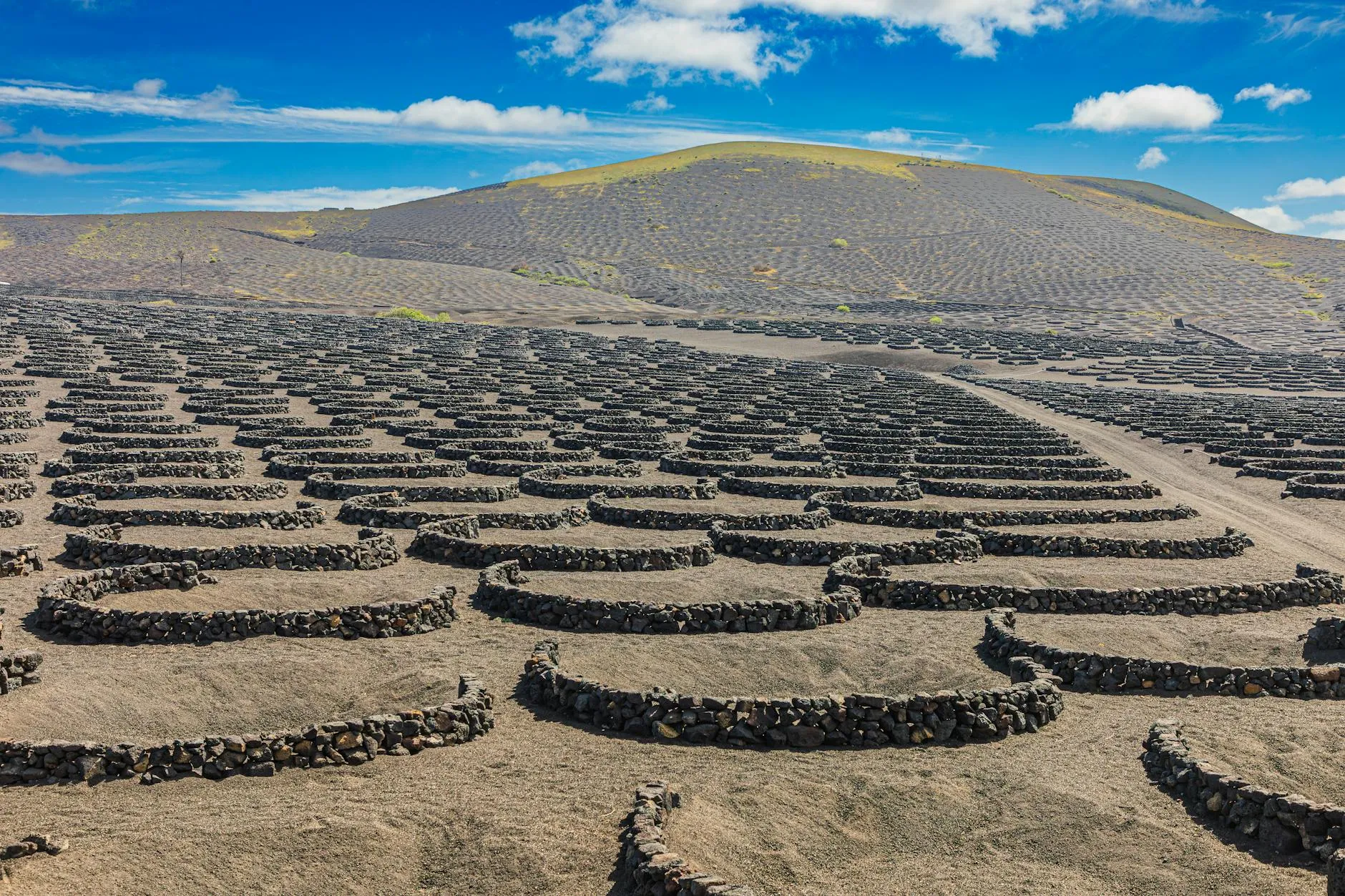
The one section of the island that looks more improbable in person than in photographs. Over five thousand hectares of black volcanic ash, stretching along the LZ-30 from Masdache to Uga, have been dug out into semicircular or conical pits — hoyos — each about three metres across and up to two and a half metres deep, with a single old vine at the bottom of each pit and a crescent-shaped dry-lava-rock wind-wall — a zoco — built on the upwind side. The pits are dug down to reach the pre-eruption agricultural soil below the 1730–36 picón deposit; the picón itself, which buried everything at a stroke, turned out (by trial and error in the decades after the eruption) to be an almost perfect moisture sponge for a landscape that receives less than a hundred and fifty millimetres of rain a year. Dew condenses on the lapilli at night and drains down to the vine roots. Everything from digging to harvest is done by hand. The region was recognised by the UN FAO as a Globally Important Agricultural Heritage System in the 1990s.
The signature grape, Malvasía Volcánica, does not exist in trace quantities anywhere else in the world. It makes up roughly three-quarters of La Geria’s production: dry, mineral, high-acid, with tropical floral notes and a distinct salinity from the volcanic terroir. Four producers are open to the public for proper structured visits — see Drinking La Geria below for individual notes on El Grifo, La Geria, Rubicón and Los Bermejos. Tasting fees run €8–15 for three wines.
Price: free to drive the LZ-30; €8–15 at any bodega for a tasting. Access: rental car essential — no bus route. Book: at each bodega individually; no island-wide portal.
8. Caleta de Famara
A fishing village at the foot of the Famara cliffs on the north-west coast, with a six-kilometre sand beach stretching south along the protected bay, the five-hundred-metre Los Riscos escarpment rising almost vertically behind it, and the best surf conditions in the Canaries for October through May. The Atlantic comes in from the north-west here without landmass interruption and produces consistent waves at every level — beginners at the south end where a shallow sand-bottom break generates forgiving whitewater, intermediate and advanced surfers at the north end where reef breaks produce heavier sets. Almost every surf school on the island runs camps from Famara.
The village itself is one of the few settlements on Lanzarote that predates the Manrique-era planning code and looks it: low, sand-coloured, half-finished-in-places, painted only approximately white, with a mechanic’s yard visible from the main square. This is why you should go. It is also the closest walkable settlement on Lanzarote to a genuinely wild Atlantic beach — the dune-and-sand plain north of the village, walking towards the cliff base, has more horizon than almost anywhere else on the south-east Canaries.
Price: free; surf lessons €35–60 per session; board rental €15–20/day. Access: 25 km from Arrecife on the LZ-20 and LZ-402. Bus 201 runs twice daily from Arrecife.
9. Teguise — The Old Capital
Until 1852, Teguise was the capital of Lanzarote. It was founded in the early fifteenth century by Maciot de Béthencourt, nephew of the Norman conquistador Jean de Béthencourt who annexed the island for the Crown of Castile in 1402, and it sits on a high inland plateau at the centre of the island — far enough from the coast to be defensible against the Berber and pirate raids that repeatedly devastated the Canaries between about 1550 and 1720 (the underground passages at Cueva de los Verdes were dug as hiding places during exactly those raids). The capital was moved to Arrecife only in the nineteenth century, when shipping definitively overtook defensibility as a criterion. Teguise kept its whitewashed plazas, its seventeenth-century church of Nuestra Señora de Guadalupe, its fortified palaces, and its defensive tower on Monte Guanapay above the village — Castillo de Santa Bárbara, now a small piracy museum that is genuinely good.
Price: village free; Castillo de Santa Bárbara museum €3. Access: 12 km north-west of Arrecife on the LZ-30; bus 10 (line runs hourly from Arrecife in season).
10. La Graciosa — The Eighth Canary Island
In 2018 the Spanish Senate officially recognised La Graciosa as the eighth Canary Island. It had previously been classified as an islote, an islet administered by the municipality of Teguise on Lanzarote. The twenty-seven-square-kilometre island sits two kilometres off Lanzarote’s north coast across the El Río strait. It has two settlements — the larger of which, Caleta de Sebo, houses almost all of the island’s roughly seven hundred and thirty permanent residents — no paved roads (everything is sand or lava-gravel track), no high-rise, no traffic lights, and five beaches that are, in the estimation of the Lanzaroteño residents who go there on weekends, among the best in Europe.
The ferry from Órzola on Lanzarote’s north-east tip runs roughly every forty-five minutes from 08:00 to 17:30 (two operators: Biosfera Express and Líneas Marítimas Romero), takes twenty-five minutes each way, and costs from €16 one-way for adults. There are no cars to rent; bicycle rental is about €10–15 per day, or you can take a taxi 4×4 jeep that runs as a shared service between beaches. The usual half-day itinerary is: 08:00 ferry from Órzola, rent bike at Caleta de Sebo (one street in from the quay), cycle south along the coast to Playa Francesa and Playa de la Cocina (the quietest and most photogenic), lunch at a pescadería in the village, and back on the 15:30 or 17:30 ferry. A full-day version reaches Playa de las Conchas on the north coast, the best beach on the island and a forty-five-minute cycle or four-hour walk from the village.
Price: from €16 one-way ferry; €10–15 bike rental; free beach access. Access: Biosfera Express from Órzola; book online at biosferaexpress.com if you want a specific departure.
11. The Atlantic Route — Understanding What Arrives at Órzola
Lanzarote is the closest European territory, on the Atlantic side, to the coast of Africa. The distance from Playa Blanca in the south to the Moroccan shore at Tarfaya is about a hundred and twenty-five kilometres, and from the north coast of Lanzarote to the coast of Western Sahara only slightly further. For roughly two decades a migration route has run from Mauritania, Senegal and the western Sahara to the Canary archipelago, usually on converted wooden fishing boats — cayucos — that carry between forty and two hundred people and take between five and ten days at sea. The route has become the single most-used irregular entry route into the European Union on the Atlantic side. In 2024 the Canary Islands as a whole recorded 46,843 arrivals by sea — a record — with roughly six hundred and ninety-two boats, about two arrivals per day averaged over the year. The human cost is estimated by the Spanish NGO Caminando Fronteras at more than ten thousand deaths in 2024 alone, making it, by their count, the deadliest sea-migration route in the world.
In 2025 arrivals fell sharply — 12,126 in the first eight months, roughly half the 2024 rate — largely because of intensified Moroccan and Mauritanian coastguard cooperation with Spain, not because the underlying pressure eased. The European NGO ECRE recorded at least 1,865 deaths on migration routes to Spain between January and September 2025.
On Lanzarote specifically, the most frequent arrival points have been the north-east coast near Órzola and the south-east coast near Arrecife. The rescue service Salvamento Marítimo Canario, operating out of Arrecife harbour, is the agency that brings in most of the cayucos that reach Lanzarote’s shoreline; the Red Cross reception centre at Arrecife port is where people are processed on landing. None of this is a visitor attraction and nothing here should be photographed. The Red Cross Arrecife office accepts donations if you want to support the humanitarian response while on the island.
12. Arrecife — The Capital You Are Probably Skipping
Arrecife has a reputation among package travellers as a place to avoid — a functional commercial port with industrial edges, no beach resort, and less polished architecture than any of the three holiday towns. Almost all of that is true. It is also the only settlement of any real civic density on the island — fifty-two thousand residents in the city proper, seventy thousand in the municipality, and the only place on Lanzarote where you see actual Canary Islands daily life rather than a tourist-economy version of it.
Four reasons to spend half a day here. First, Charco de San Ginés: a natural saltwater lagoon in the middle of the old town, ringed by white-painted fishing houses, with small wooden fishing boats still working out of it at dawn. The best photographed spot on the island at first light. Second, Castillo de San Gabriel: a sixteenth-century coastal fort on a small island in the harbour, reached by a wooden drawbridge, now a small history museum (€3). Third, Castillo de San José at the north edge of the harbour — another sixteenth-century fort, converted by Manrique in 1976 into the Museo Internacional de Arte Contemporáneo (MIAC), with a permanent collection of twentieth-century Spanish abstract art and a small, good restaurant in the basement (€5 entry). Fourth, the Lilium restaurant at the marina, which is the closest thing Lanzarote has to a genuinely ambitious restaurant and which appears in the Michelin Guide 2026 as “Recommended” with a Bib Gourmand. And fifth (unclaimed), Arrecife Gran Hotel, the only high-rise building on Lanzarote: a fifty-four-metre concrete tower completed in 1974, before the 1991 island plan came into force, which the plan grandfathered rather than ordered demolished. It stands now as a minor monument to what Manrique was trying to prevent. The rooftop bar — Blue 17 on the seventeenth floor — has the best view of the harbour and the Chinijo islands on the horizon.
Price: all free to walk. €3 Castillo de San Gabriel. €5 MIAC. Access: ACE airport bus 22/23 runs every 25–50 minutes, €2 or less.
The Island by Region
The south (Yaiza, Playa Blanca, Papagayo). The lava fields of Timanfaya, the beach resort of Playa Blanca, the wine villages of La Geria, the natural monument of Los Ajaches, and the long unbuilt coastline that runs from Playa Blanca east to the Papagayo cluster of beaches. The Papagayo beaches are within a protected natural monument — access is through a dirt road from Playa Blanca that charges €3 per car (pedestrians and cyclists free), with parking at two lots (the main one above Papagayo itself, a quieter one above Playa del Congrio five minutes’ walk away). The south is the part of the island where the 1730–36 eruption transformed everything, and you feel it in the drive as much as anywhere else: the road from Uga to Playa Blanca runs through thirty kilometres of uninterrupted lava country.
The centre (Arrecife, San Bartolomé, Tahíche, Costa Teguise). The populated waist of the island. Arrecife as a working city, the Monumento al Campesino at San Bartolomé — Manrique’s 1968 sculpture-monument to the Lanzaroteño farmer, which also functions as the island’s geographic centre — the Fundación César Manrique at Tahíche, and the Manrique-designed resort of Costa Teguise (a rare case of Manrique actually designing a tourist development; it shows in the low-rise, white-walled layout around Las Cucharas beach, and also, unfortunately, in the 1970s street grid that has aged less gracefully).
The north (Teguise, Haría, Órzola, Mirador del Río). The agricultural heart of the island, historically the most populated and most productive, and now the quietest. The palm valley of Haría. The old capital at Teguise. The sunken cactus quarry at Guatiza. The Jameos and Cueva de los Verdes on the LZ-1 north of Mala. The ferry port of Órzola, the clifftop viewpoint at Mirador del Río, and the final village of Ye on the volcanic massif of Monte Corona — with, on a clear morning, a view across El Río strait to La Graciosa.
The north-west (Famara, Tiagua, Soo, El Golfo). The windward coast. Famara and its six-kilometre beach; the hamlet of Tiagua (a preserved nineteenth-century farmer’s house open as a small museum); the black-sand beach of El Golfo where the sea has eroded a half-submerged volcanic crater to reveal the green mineral pool of Charco de los Clicos; the fishing cove at Los Hervideros where the Atlantic breaks into narrow lava-tube chambers and spouts dramatically in heavy weather.
Puerto del Carmen. The oldest and largest tourist resort, built from the late 1960s onward, running in a long strip along the south-east coast between the LZ-2 motorway and Playa Grande / Playa Chica / Playa de los Pocillos. Old town at the east end is still a working fishing village. New town in the middle is the tourist strip. West end, towards Matagorda, is more residential and less chaotic. The nightlife strip on Avenida de las Playas is the one named tourist trap on the island.
Costa Teguise. Mid-sized planned resort, built from the mid-1970s on land purchased by the Cabildo and designed partially by Manrique’s studio. Pleasant family atmosphere, good beach at Las Cucharas, a less-crowded second beach at Los Charcos, and decent restaurants along the central plaza. Noticeably quieter and more low-key than Puerto del Carmen; a useful alternative for travellers who want a resort base without the party economy.
Playa Blanca. The southernmost and newest resort, built from the late 1980s and still expanding. Better beaches than Puerto del Carmen, smaller and less dense than Costa Teguise in total footprint, with the best access to both Papagayo and (by ferry to Fuerteventura) the neighbouring island.
Where to Stay — by Budget
Budget (€55–95 per night for two)
Arrecife and Costa Teguise both have clean one-star and two-star hotels and apartment complexes in this range, and they are better bases for a driving holiday than Puerto del Carmen, which is almost entirely in the €110+ range during high season.
- Miramar Hotel Lanzarote (Arrecife) — seafront three-star on the promenade with a small rooftop pool, from €65/night double.
- Sands Beach Resort (Costa Teguise) — functional apartment complex near Las Cucharas beach, from €75 for a one-bedroom, good for families.
- Casas Heddy (Puerto del Carmen, far west end) — adult-focused apartment complex slightly removed from the strip, from €85/night double with kitchenette.
Mid-range (€100–190 per night for two)
The sweet spot on the island. Good four-star hotels, boutique rural casas inland, and larger apartment complexes with pools.
- Hotel Fariones (Puerto del Carmen, old town) — the original hotel on the island, built 1966, renovated in 2018 and now a genuinely good four-star on the east promenade. From €140/night.
- Princesa Yaiza Suite Hotel Resort (Playa Blanca) — older but well-maintained five-star property on Playa Dorada, from €180 in shoulder season.
- Casona de Yaiza (Yaiza) — a rural casa in the wine country, white-walled, owner-run, with only eight rooms; the best non-resort base on the island. From €125/night.
- Finca de Arrieta (Arrieta, north coast) — eco-friendly yurt and cabin camp above a fishing village on the north-east coast, run by a Scottish family; solar-powered, walking distance to beach. From €110/night.
Luxury (€220–600+ per night for two)
Lanzarote is not, by fleet standards, an expensive island at the top end. The top bracket is smaller and less inflated than the equivalent on Mallorca or Santorini. You still get the full luxury experience — it just stops short of €1,000.
- Barceló Teguise Beach (Costa Teguise, adults only) — renovated mid-2020s five-star with one of the better pools on the island. From €240/night.
- Secrets Lanzarote Resort & Spa (Puerto Calero) — adults-only five-star on the marina. From €280/night.
- Kamezí Boutique Villas (Playa Blanca) — private villas with pools in a gated garden complex, restaurant on site. From €350/night.
- Finca Malvasía (La Geria, near Masdache) — converted finca on a working vineyard, only six suites, one of the best small hotels in the Canaries. From €320/night.
Where NOT to stay
The western end of Avenida de las Playas in Puerto del Carmen, between about numbers 40 and 120, puts you directly above the strip and onto the noise line until about 02:00 in summer. Costa Teguise’s Los Geranios commercial centre at the north end is the older and tattier end of the resort. Anything booked as “Playa Blanca Area” that turns out to be in Montaña Roja: this is a disconnected housing estate twenty minutes’ walk from the main town with nothing to do at night.
Tourist tax and accommodation notes
As of April 2026, Lanzarote does not levy a tourist tax. The Canarian regional government has consistently said it does not intend to introduce one island-wide, though individual municipalities (Mogán in Gran Canaria since 2025, potentially Tenerife in the near future) are charging small local levies. A 2024 Cabildo survey found three in four visitors to Lanzarote would accept a tax if introduced. Budget on zero for now; check the island’s two main news aggregators (Gazette Life, Canarian Weekly) a week before you travel if you want to be sure.
IGIC — the Canary Islands’ local equivalent of VAT — is 7% on most tourist goods and accommodation, considerably below the mainland Spanish 21%. This is one of the quiet reasons prices on the island run 10–15% below mainland-Spain equivalents.
Where to Eat
Lanzarote’s food culture is a subset of wider Canarian food culture — Spanish-Atlantic, with strong North African and Latin American influences and a peculiarly local obsession with salt, goat and wrinkled potatoes — overlaid with the volcanic particularities of this one island. The signature dishes are all versions of things eaten across the archipelago: papas arrugadas (small new potatoes boiled in heavily salted water until their skin wrinkles), served with mojo rojo (paprika-red pepper-cumin sauce) and mojo verde (coriander-garlic-olive-oil sauce); sancocho canario (salt-cured fish stew with sweet potato); lapas a la plancha (limpets grilled with garlic butter); conejo en salmorejo (rabbit marinated in wine and vinegar with garlic and thyme); vieja (parrotfish, usually grilled whole). Queso de cabra — ash-rinded goat’s cheese — is a dinner course rather than a starter. The local sweet is bienmesabe, a honey-almond paste on toast.
The food to eat on Lanzarote, in descending order of how strongly the island is identified with it: Malvasía wine (see the next section); papas arrugadas with mojo; grilled local fish (especially vieja and sama); rabbit in salmorejo; salt-crusted goat cheese. The food NOT to eat: anything called “fusion tapas” on Avenida de las Playas, anything advertising “traditional English Sunday roast,” and most of the paella served by the metre in tourist streets, which is as reliably bad as it is on the mainland Costas.
Budget (mains €6–14)
- El Almacen de la Sal (Arrecife, Charco de San Ginés) — old salt warehouse converted to a taperia with fresh-catch fish of the day. Lunch for two with wine: €32. Always full of locals.
- El Mirador de las Salinas (Janubio, south) — small café at the Salinas de Janubio salt pans, tapas and papas arrugadas from €5.
- Restaurante Los Helechos (Mirador de Haría) — truckers-and-farmers lunch spot on the way to Haría, menu of the day €14 for three courses with wine.
- La Cantina (Teguise) — former salt cellar converted to a wine bar, €6 tablas of local cheese and cured tuna, €12 three-wine flight.
- Kiosko de Papagayo (Papagayo Beach) — beach shack; grilled fish plate €13, fries €4, and a cold can of Tropical beer for €2.50.
Mid-range (mains €16–28)
- La Bodega de Santiago (Yaiza) — traditional Canarian in the wine country, 17th-century farmhouse, rabbit in salmorejo, grilled local goat, salt-cod with pil-pil. Mains €18–24. Book.
- El Recoveco de NaRa (Teguise) — family-run, emphasis on produce from the island’s own farms, tasting menu €38, mains €16–22. Outstanding mojo-verde.
- La Casa Roja (Playa Blanca, Rubicón Marina) — seafood specialist, the best sama on the south coast, €22 the whole-grilled fish.
- El Risco (Famara, clifftop) — grilled-fish restaurant above the beach with the sunset view over Los Riscos. €25 the fish plate. Book.
- Restaurante La Tegala (Mácher) — modern Canarian, one of the few restaurants on the island pushing beyond traditional; tasting menu €55.
Fine dining / special occasion (tasting menus €65–120)
The Michelin Guide Spain 2026 lists five Lanzarote restaurants as Recommended (no stars). The island holds no Michelin stars in the 2026 selection.
- Lilium (Arrecife, Marina Lanzarote) — Michelin Recommended 2026 with a Bib Gourmand. Modern Canarian, six-course tasting menu €75, strongest on volcanic-region rice dishes. The most reliably excellent meal on the island.
- Palacio Ico (Teguise, historic palace) — Michelin Recommended 2026 plus Sol Repsol 1. Seventeenth-century restored palace, pure Canarian produce, tasting menu €95.
- SeBE (Puerto Calero marina) — Michelin Recommended 2026. Rice specialist, known for arroz de carabineros with deep-red prawns from La Santa. Mains €28–38.
- Tacande (Puerto del Carmen, old town) — Michelin Recommended 2026. Canarian base with Asian, Peruvian and Moroccan influences; tasting menu €68.
- La Cocina de Colacho (Arrecife) — Michelin Recommended 2026. Quietly ambitious Canarian; tasting menu €72.
El Diablo at Timanfaya — see attraction #1 for the geothermal-oven specifics. Mains €22–32; the draw is the kitchen rather than the cooking.
What to skip
- Any restaurant on Avenida de las Playas between numbers 40 and 120. With two or three honourable exceptions which are not worth hunting for amid the noise.
- “Beach restaurants” on Papagayo’s approach road. €12 for a bottle of water.
- Hotel buffets. Almost all are perfectly adequate and almost none are why you came to this island.
- Restaurants advertising “Canarian food” in Spanglish on tourist-pedestrian menus outside. Reliable sign of a tourist-coach contract.
Drinking La Geria — A Wine Culture
The signature drink on Lanzarote is a glass of bone-dry, high-acid, lemon-mineral Malvasía Volcánica from La Geria at roughly 14°C, served with either fresh goat cheese or grilled limpets. This is the pairing the island was built around, once the 1730–36 eruption forced the population to reinvent agriculture over ash, and the pairing it still builds holidays around in 2026.
The grape — Malvasía Volcánica — is not the Malvasia found elsewhere in the Mediterranean. It is a distinct variety isolated on Lanzarote for enough generations after the eruption to qualify as endemic; DNA work in recent years has confirmed that it does not exist in trace quantities anywhere else. Approximately seventy-five per cent of La Geria’s commercial production is Malvasía Volcánica, with smaller amounts of Listán Negro, Moscatel, and Diego. The DO (Denominación de Origen) is DO Lanzarote.
The four producers open to the public with structured visits and tastings:
- Bodega El Grifo (San Bartolomé) — founded 1775, the oldest operating winery in the Canaries and one of the oldest in Spain. Has a small museum of pre-industrial wine-making equipment on site. Tasting flight €10 for three wines including the seco Malvasía and the sweet. Open daily.
- Bodega La Geria (La Geria, on the LZ-30) — touristic but well-run; the one you see from the road. Tasting €8 for three.
- Bodega Rubicón (La Geria) — smaller, less busy; the dry Malvasía here is arguably the best on the island.
- Bodegas Los Bermejos (Masdache) — the estate widely considered the leading producer for structured whites and some of the only credible Lanzaroteño reds.
A half-day itinerary: drive the LZ-30 west-to-east from Uga, stop at Rubicón and La Geria, lunch at Casa Tomás in Mancha Blanca (Canarian home cooking, €15 per head), then Los Bermejos and El Grifo in the afternoon. Pick up one bottle at each for around €40 total. The Seco de Malvasía is the style to focus on.
The second island drink is ron miel canario — a honey-infused rum produced on Gran Canaria and La Palma, not on Lanzarote itself, but universally available in bodegas as an after-dinner digestif. The third is mojito de Sabina — a local variant using juniper from Lanzarote’s wild interior. Avoid the neon-blue and neon-green “cocktails” on tourist menus; they are not a Canarian thing.
Getting Around
From Arrecife Airport (ACE)
Bus 22 (weekdays) runs from the airport to Arrecife bus station every 25 minutes from 07:00 to 22:40. Bus 23 (weekends and holidays) runs every 50 minutes from 07:10 to 21:10. Single fare: around €2 or less, paid to the driver in cash. Travel time: 20–40 minutes depending on traffic. Both buses run to Arrecife’s central bus station; from there, Bus 60 runs onward to Playa Blanca, Bus 6 to Costa Teguise, Bus 2 to Puerto del Carmen, and Bus 10 to Teguise.
Taxi: official fares are fixed and posted at the taxi rank outside Terminal 1. Arrecife approximately €18, Puerto del Carmen €20–25, Costa Teguise €25, Playa Blanca €50.
Rental car: by far the most common option, and the one this guide assumes. Most major operators have counters at the airport. Compact cars from around €18/day in low season, €35/day in peak. The island is small enough that you do not need a larger car; the roads are all paved; no four-wheel-drive required (the only unpaved stretch on the standard itinerary is the Papagayo access track, which a city car can handle).
Public buses
The network is run by IntercityBus Lanzarote (also known locally as Arrecifebus). Key lines:
- Line 22 / 23 — Airport ↔ Arrecife, as above.
- Line 60 — Playa Blanca ↔ Arrecife, hourly, about 36 minutes, €3–5.
- Line 2 — Puerto del Carmen ↔ Arrecife, every 20–30 minutes.
- Line 6 — Costa Teguise ↔ Arrecife, every 25 minutes.
- Line 10 — Teguise ↔ Arrecife, hourly.
- Line 7, 9 — Arrecife ↔ Tahíche (for Fundación César Manrique).
The crucial limitation: there is no public bus to Timanfaya, La Geria, Mirador del Río, or Papagayo. For any day that includes one of those, you need a car or an organised tour.
The Bono General transport card costs €2 at the bus station and gives a 10% discount on fares thereafter. Worth it for stays of four or more days using public transport.
Taxis and rideshare
Standard taxis (all cream-coloured with a green “Libre” light) are reliable and metered within Arrecife; fixed-fare between resorts. Uber and Bolt are not currently available on Lanzarote; there is no rideshare app.
Walking between key points
- Arrecife old town to Marina: 1 km
- Charco de San Ginés to MIAC (Castillo de San José): 2 km, along the harbour
- Caleta de Sebo (La Graciosa) to Playa Francesa: 3 km, sand path
- Playa Blanca centre to Marina Rubicón: 2 km, paved seafront
- Teguise main plaza to Castillo de Santa Bárbara (Monte Guanapay): 2 km uphill
Best Time to Visit
The Canary Islands sit at roughly 29° north, on the edge of the Sahara; the climate is oceanic desert and the island has what meteorologists politely call “eternal spring” — 365 days of temperatures in the 17–30°C band, with almost no rain between April and September and only light rain in winter. That is not hype. Total annual rainfall at Arrecife is about 115 millimetres — roughly one-tenth of London’s.
April, May, October and November are the four best months. Temperatures 22–27°C, sea warm enough for swimming (20–22°C), hotels in shoulder-season rates, attractions uncrowded, and you avoid the peak August pressure on Timanfaya and Papagayo. June is a close fifth-best, with water warming rapidly and peak trade winds tailing off.
July and August are peak — warmer (28–32°C), busier, more expensive, and with the calima (a Sahara dust wind) making occasional appearances. Almost all visitors from the UK and Ireland who book on package are here in these two months; it is the one period when Avenida de las Playas reaches full saturation.
December, January, February are the quietest months and offer the unique proposition of a European winter holiday at 20°C in full sun. The water is a little cool for swimming (17–19°C) but the hiking, wine and driving itineraries work as well as they do in June. British, Irish and German package travellers are the dominant winter market.
Wind: the prevailing trade winds (alisios) blow from the north-northeast for most of the year, strongest in May–August when they can reach 25–35 km/h on any given afternoon. This is why Famara has the surf and why kite-surfing is a year-round pursuit on the north-west coast. It is also why the pool deck at many Playa Blanca hotels is sheltered to the south: the wind can be an issue for anyone who expected still-air Mediterranean.
Month-by-Month Weather
Arrecife (airport weather station, coastal, 7 metres above sea level). Inland Haría is 2–3°C cooler on winter nights and the northern coast feels the wind more. La Graciosa matches Arrecife on temperature but with more exposure.
| Month | High/Low (°C) | Sea (°C) | Rain (mm) | Key events & notes |
|---|---|---|---|---|
| Jan | 20 / 14 | 18 | 17 | Quietest month. Three Kings 6 Jan. Cool sea. |
| Feb | 21 / 14 | 17 | 16 | Arrecife Carnival 6–18 Feb (Gran Coso 16 Feb); Puerto del Carmen Carnival 19–22 Feb. |
| Mar | 22 / 15 | 17 | 12 | Teguise Carnival 2–15 Mar (Mexico-themed). Easter in 2026 falls later (April). |
| Apr ⭐ | 22 / 16 | 18 | 6 | Ideal. Easter crowds in first half. EES active at ACE from 10 Apr. |
| May ⭐ | 23 / 17 | 19 | 2 | Perfect shoulder. Surf season ends mid-month at Famara. |
| Jun | 25 / 19 | 20 | 0 | Water warming fast. Trade winds peak. |
| Jul | 27 / 21 | 21 | 0 | Peak heat begins. Busy. Fiesta del Carmen mid-month. |
| Aug | 28 / 22 | 22 | 0 | Peak. Avenida de las Playas at saturation. |
| Sep | 28 / 22 | 22 | 4 | Fiesta de los Dolores 15 Sep at Mancha Blanca (pilgrimage to the Virgin of the Volcano, island’s biggest religious festival). |
| Oct ⭐ | 26 / 20 | 22 | 10 | Ideal return month. Surf season resumes at Famara. |
| Nov ⭐ | 23 / 18 | 21 | 13 | Quietest of the good months. |
| Dec | 21 / 15 | 19 | 24 | Wettest month by a small margin. Christmas markets at Teguise and Arrecife. |
Sources: Spanish State Meteorological Agency (AEMET) 1991–2020 normals at Lanzarote/Arrecife airport; CACT event calendar; Cabildo of Lanzarote 2026 festival programme.
Daily Budget Breakdown
Two adults, one night. All figures in EUR (the Canary Islands use EUR; IGIC 7%, not Peninsular VAT 21%). Car-rental costs amortised over seven days.
| Category | Budget | Mid-range | Luxury |
|---|---|---|---|
| Accommodation | €55–95 | €100–190 | €220–600 |
| Meals & drinks | €40–55 | €60–110 | €130–260 |
| Transport (car + fuel, per day) | €22 | €28 | €45 (upgraded car) |
| Attractions | €10–25 | €25–55 | €55–90 |
| Daily total (two people) | €130–200 | €215–380 | €450–1,000 |
Budget: a self-catering apartment in Costa Teguise or Arrecife, two meals out per day at taperías and budget seafood places, a rental car shared between two, and three or four paid CACT attractions over the week. Attainable and does not feel austere; the island’s culture is not luxury-dependent.
Mid-range: a good four-star hotel or rural casa, one proper sit-down dinner at a mid-range Canarian restaurant each day, rental car, and all the main attractions plus one organised tour (Timanfaya, La Graciosa, wine-tasting). The comfortable tier for a first visit.
Luxury: a five-star resort in Playa Blanca or a private villa, fine dining two or three evenings (Lilium, Palacio Ico, SeBE), upgraded convertible or compact SUV, private driver for one full day. Still well below Mykonos or Mallorca equivalents at the same level.
Sample Itineraries
Three-Day Essential
Day 1 — Manrique and the North. 10:00 Fundación César Manrique (1.5 h). 12:00 drive via LZ-1 to Guatiza; Jardín de Cactus (1 h, lunch at the rim café). 14:30 Cueva de los Verdes (1 h). 15:45 Jameos del Agua (1.5 h). 18:00 Mirador del Río for sunset (€5). Dinner in Haría at Casa-Museo’s neighbouring taberna. Overnight Arrecife or Costa Teguise.
Day 2 — Timanfaya, La Geria, West Coast. 09:30 Timanfaya National Park (2 h, book online). Lunch at El Diablo if you want the geothermal kitchen (€22–30), or drive back to Uga for La Bodega de Santiago (Canarian, €20). 14:30 drive the LZ-30 through La Geria; stop at Bodega Rubicón and Bodegas Los Bermejos for tastings (€8–15). 17:00 drive to El Golfo for the green lagoon at Charco de los Clicos and the sunset at Los Hervideros cliffs. Dinner at Casona de Yaiza. Overnight Yaiza or Playa Blanca.
Day 3 — Arrecife and Teguise. 09:00 Teguise old town (if it’s Sunday, the market; if not, a quiet walk). 11:00 Castillo de Santa Bárbara and its piracy museum (€3). 13:00 lunch in Teguise at El Recoveco de NaRa (€16–22). 15:00 drive to Arrecife; Charco de San Ginés walking tour, Castillo de San Gabriel (€3). 17:00 MIAC at Castillo de San José (€5). 20:00 dinner at Lilium at the Marina (book) or tapas around Charco de San Ginés.
Day 4–5 add-ons
Day 4 — La Graciosa. 08:00 ferry from Órzola to Caleta de Sebo (25 min, €16). Rent a bike in the village (€12/day). Cycle south to Playa Francesa and Playa de la Cocina; lunch at a pescadería in the village; 15:30 or 17:30 ferry back. Dinner in Arrieta at a north-coast fish restaurant.
Day 5 — Famara and the West. Drive to Caleta de Famara via Tiagua (stop at Museo Agrícola El Patio, a preserved nineteenth-century farm, €5). Morning surf lesson at Famara (€40). Lunch at El Risco with cliff views. Afternoon at the salinas at Janubio (Europe’s largest working salt pans). Dinner back at Yaiza.
Best Day Under €35
A walking day in Arrecife. Costed for one adult, no rental car.
- Bus 22/23 from accommodation to Arrecife: €2 (€4 round-trip if not overnighting in the city)
- Walk around Charco de San Ginés and the old town: free
- Castillo de San Gabriel entry: €3
- Lunch at El Almacen de la Sal (tapas plate plus glass of Malvasía): €12
- Walk to MIAC at Castillo de San José along the harbour: free (2 km)
- MIAC entry: €5
- Coffee and bienmesabe at a cafetería on the way back: €3.50
- Playa del Reducto swim in the afternoon: free
- Evening tapas in Charco de San Ginés (two rounds, two glasses of house white): €8
Total: €33.50. Not the cheapest best-day in the fleet (Cairo $3.50, Bogotá $6, Kuala Lumpur €8.50, Munich €12, Santiago $13, Nicosia €32.60), but below Ibiza’s best-day and below Mallorca’s. Credit the Canarian IGIC tax rate and the fact that Arrecife is a working city rather than a tourist economy.
The day can be done for under €25 if you skip the two paid attractions and spend the afternoon at Playa del Reducto instead. The €8 gain is real; the loss is an excellent Manrique-designed art museum. Most readers will want the €33.50 version.
Windy Day / Calima Day Plan
Lanzarote’s weather is reliable in the sense of warmth and rain-free; less so in the matter of wind. The prevailing trade winds blow strongly from the northeast on most afternoons from April through September and can reach 25–35 km/h with occasional gusts higher. Once or twice a year, usually in summer, a calima — a hot Saharan dust wind — rolls over the archipelago and visibility drops to a few hundred metres, with daytime temperatures spiking to 40°C. Both conditions make outdoor days difficult.
The wind-and-calima plan (comfortable, €45 for one)
Spend the morning inside a lava tube. Jameos del Agua (€17) then Cueva de los Verdes (€17) take three hours together and are entirely underground. Lunch at the Jameos café above the pool (€15, €25 with wine). Afternoon at the Castillo de San José / MIAC basement restaurant (€25 for lunch, or the €5 museum entry plus a coffee if you already ate). Evening indoors at a Yaiza or Teguise restaurant. Total for the two attractions plus a €15 lunch and a €10 dinner: €59.
The budget version (€23 for one)
Morning: Cueva de los Verdes (€17) alone — skip Jameos. Lunch: supermarket picnic at the Jameos car park, €5. Afternoon: Casa-Museo del Campesino (free) and Castillo de San Gabriel in Arrecife (€3). Evening: one beer at a Charco de San Ginés taperia (€2). Total: €27.
Both versions keep you out of wind-driven volcanic dust, which can close Timanfaya on the worst calima days and make any beach day unpleasant.
Day Trips
Essential: La Graciosa
See attraction #10. If you only have one spare day, this is it; budget around €40 per person including ferry, bike rental and lunch (verify against current schedule before travel).
Fuerteventura — Corralejo
A 25-minute Líneas Romero or Fred. Olsen ferry from Playa Blanca puts you in Corralejo on Fuerteventura’s north coast. The main draws are the Parque Natural de las Dunas de Corralejo (a genuinely Saharan dune complex on the island’s northeast coast) and Isla de Lobos, a small uninhabited islet of its own just offshore with a requirement-booking protected-area permit. A full-day version: 09:00 ferry, taxi to dunes, lunch in Corralejo at La Casa del Pescador, afternoon at El Tostón lighthouse, 18:00 ferry back. Ferry €26 round-trip. Not as satisfying as La Graciosa, but worthwhile if you want to stand in a real Saharan dune field.
The Western Coast (Los Hervideros, El Golfo, Janubio)
A half-day drive around the south-west coast: leave Playa Blanca or Yaiza in the mid-afternoon, first stop at Los Hervideros, the series of lava-tube sea-caves that spout dramatically in heavy surf; second stop at El Golfo and the green-mineral lagoon of Charco de los Clicos; third stop at the Salinas de Janubio, Europe’s largest working salt pans and, at sunset, one of the most photogenic spots on the island. All free, all close to the LZ-2. Budget €10 for a café en route and €15 for dinner at El Golfo village.
Órzola and the North-East
Combine with a La Graciosa day or make a standalone half-day. The LZ-1 north of Mala runs through twenty kilometres of volcanic coast with black-sand beaches (Caletón Blanco, the most photographed; Playa de la Garita at Arrieta, a family favourite). Lunch at El Norte in Arrieta — the longest-running fish restaurant on the north coast — and drive up to the Mirador del Río before returning. Total road-loop from Arrecife: about 80 km / 3 hours plus stops.
Inland Volcanoes (Monte Corona / Caldera Blanca)
For hikers. The Monte Corona volcano, the cone whose lava tube contains Cueva de los Verdes and Jameos del Agua, can be climbed in about 90 minutes from the village of Yé; the summit rim gives a 360° view over the north of the island and the Chinijo archipelago. A more ambitious hike is Caldera Blanca, a collapsed cone on the edge of the Timanfaya lava field; 4 hours round-trip from the trailhead at the LZ-56, one of the best walks in the Canaries. Both free; bring water and a hat.
Tinajo, Mancha Blanca, The Road Less Taken
The inland route from the centre of the island towards Timanfaya runs through two villages — Tinajo and Mancha Blanca — that are not on any tourist itinerary but which have the best residents-only restaurants on the island and, at Mancha Blanca, the small pilgrimage church of Nuestra Señora de los Dolores (the “Virgin of the Volcano”). The traditional account, drawn from Andrés Lorenzo Curbelo and later pilgrimage records, holds that in August 1736 villagers carrying the image of the Virgin towards the advancing lava front saw the flow halt a few metres short of the church; the story remains the local explanation for why any part of the south-west coast survived the eruption. The church itself is modest. The Fiesta de los Dolores on 15 September each year is the island’s biggest religious festival — thousands of pilgrims, many on foot from Arrecife, many dressed in traditional Lanzaroteño farming clothes.
Safety and Practical Information
Safety
Lanzarote is one of the safer destinations in the Mediterranean and Atlantic archipelago. Violent crime against tourists is rare. The usual precautions apply: do not leave visible valuables in a rental car (break-ins at Papagayo car parks happen every summer), watch your drinks in the Puerto del Carmen strip at night, do not swim at Famara’s north end without surfing or a lifeguard. Rip currents on the north-west coast are genuinely dangerous — people die in them every year, almost all from poor swimming judgement. Beach-patrol yellow flags at Famara and red flags at Playa Dorada mean what they say.
Calima days and wind-driven dust can aggravate respiratory conditions. Anyone with asthma or lung sensitivity should treat the worst calima events (twice a year, about 72 hours each) as indoor days.
Currency, cards and tipping
Canary Islands use the Euro (€). IGIC at 7% on most tourist goods (vs mainland 21% VAT). ATMs widespread; cards accepted everywhere from supermarkets to small fish restaurants; cash needed only at Teguise market and some beach kiosks. Tipping is light by British or North American standards: 5–10% on a sit-down restaurant bill, nothing at bars, round up in taxis.
Language
Spanish (Canarian dialect — seseo, aspirated final s, ustedes rather than vosotros, a rhythm closer to Caribbean Spanish than Peninsular). English is widely spoken in all three resorts and at all CACT attractions; less so in inland villages. German and French are common in the larger resorts. The indigenous pre-Spanish language of the island’s original Majo inhabitants is extinct since roughly the sixteenth century; a small number of surviving words remain in place-names and technical agricultural vocabulary.
Connectivity
Free Wi-Fi at Arrecife airport, all CACT attractions, most restaurants and hotels. Canary Islands mobile roaming for EU contracts is included under Roam Like At Home. UK contracts post-Brexit often charge a day rate; check before you land. 4G coverage is excellent across the island; 5G is available in Arrecife and the three main resorts.
Tourist information
Patronato de Turismo de Lanzarote main office at Avenida Blas Cabrera Felipe, Arrecife; smaller offices at ACE airport and at the main plaza in each of the three resorts. Maps free. The office at Puerto del Carmen (Avenida de las Playas, at the old town boundary) is the most helpful for first-timers.
Emergency numbers
- 112 — European emergency (all services, multilingual operators)
- 091 — Policía Nacional
- 092 — Local police
- Main hospital: Hospital Dr. José Molina Orosa, Arrecife (north edge of the city, 15 minutes from airport)
Visa and Entry Requirements
The Canary Islands are a fully integrated part of Spain and of the Schengen Area. Rules are identical to entering Barcelona or Madrid.
EU and EEA nationals: free movement under EU law; ID card or passport. No visa, no entry tax, no registration.
UK nationals (since 1 January 2021): no visa for stays up to 90 days in any 180-day period. Passport must have at least three months’ validity beyond planned departure and have been issued within the last ten years. EES biometric registration is active at Arrecife airport from 10 April 2026. This replaces the passport stamp: on first post-April-2026 entry your fingerprints and face are registered. ETIAS — the new €20, three-year travel authorisation for visa-exempt non-EU nationals entering Schengen — is delayed from its original October 2025 target and now with no announced launch date with a minimum six-month transitional period. It will not be legally required before the start of the transition period, expected around Q2 2027 at the earliest. Until then, UK visitors travel exactly as in 2025 — passport plus biometric EES check, nothing else.
US, Canadian, Australian, New Zealand and Japanese nationals: 90/180 Schengen rule, no visa, EES and ETIAS apply on the same timeline as for UK visitors.
Digital Nomad Visa: Spain issues a one-year renewable digital nomad visa for non-EU nationals who can prove remote employment income above roughly €2,650/month and valid health insurance. The Canary Islands are eligible and have become one of the more popular destinations for it; Arrecife and Playa Blanca both have small coworking scenes as a result.
No separate Canary Islands permit. Older guidebooks sometimes reference historic tarjeta de turismo cards or regional permits; none exist in 2026.
Hidden Lanzarote
Six entries that are not on the standard tourist routes and which reward the specific kind of traveller who has already done Timanfaya and the CACTs.
Museo Agrícola El Patio (Tiagua). A preserved eighteenth-century farmstead on the LZ-20 between Teguise and Famara, run as a working museum of pre-industrial Lanzaroteño farming. Windmills, camel-driven grain mills, a restored aljibe cistern. €5 entry. Quieter than any CACT. Good for an hour at the end of a Teguise morning.
Salinas de Janubio. The largest working salt pans in the Canaries, on the south-west coast below the El Golfo road. Still in commercial production — today at roughly two thousand tonnes a year, down from a peak of around ten thousand before refrigeration reduced industrial demand — using the same traditional evaporation channels. Walkable perimeter, no charge. The flamingo colonies that use the pans as winter stop-over are a separate, entirely free spectacle from November through February. Best at sunrise for photographers.
Monumento al Campesino and Museo del Campesino (San Bartolomé). Manrique’s 1968 monument-sculpture to the island’s farmer — a fifteen-metre white abstract sculpture visible from the LZ-20 — sits at the geographic centre of the island. Attached is the Casa-Museo del Campesino, a Manrique-designed complex of courtyards, workshops, and a free museum of traditional Lanzaroteño rural crafts. Free entry. Open 10:00–18:00 daily, 365 days a year. The restaurant does a Canarian menu of the day for €18. Almost always uncrowded.
LagOmar (Nazaret, Teguise). The one slightly salacious piece of local Manrique mythology. Designed in the early 1970s by Jesús Soto in collaboration with Manrique, built into the face of a volcanic quarry on the hillside above Nazaret, as a speculation property by the British developer Sam Benady. The actor Omar Sharif reportedly visited in 1972 while filming The Mysterious Island and agreed to buy it, then lost ownership back to Benady at a game of cards — the story is that Benady was at the time the European Bridge Champion and Sharif did not know. Whether or not the card game actually happened is disputed; Sharif definitely visited, and ownership remained with Benady. The house is now a small museum-restaurant, with one of the best terrace views on the island. €8 entry.
Bodega El Grifo Wine Museum. Independent from the visitor centre, and worth a separate forty-five minutes. A modest but well-curated collection of pre-industrial Canarian wine-making equipment — wooden presses, lagares (grape-treading vats), hand-blown green bottles — housed in the cellars of Spain’s tenth-oldest winery. €5 separate from the tasting. The oldest bottles in the collection date to the nineteenth century.
The Orzola Lookout at first light. Not an attraction, just a direction: leave Arrecife at 07:00 in September or October, drive the LZ-1 to Órzola, park at the ferry terminal, and walk up the small rise to the north of the village. On a calm morning the Atlantic in the strait is glassy, La Graciosa sits in silhouette against the pink dawn, and you can hear the first fishing boats leaving Caleta de Sebo across the water. Free.
What’s New in 2026
EES and ETIAS. EES biometric entry has been active at ACE since 10 April 2026; ETIAS is delayed to late 2026 with a six-month transitional period (mandatory date no earlier than Q2 2027). Full details in Visa and Entry Requirements.
Canarian Hospitality 97-suite five-star hotel under construction in Playa Blanca. Built by Grupo Acosta Matos alongside a consortium of Canarian investors, scheduled near Marina Rubicón. Groundbreaking in February 2026; opening date not yet confirmed. Each unit will have a private swim-up pool terrace. Announced price positioning: the island’s highest.
Radisson Blu Lanzarote. Construction began February 2026; opening expected spring 2028. Will be Lanzarote’s first Radisson Blu property.
Michelin Guide Spain 2026 — Canary Islands selection: no Michelin star added for Lanzarote. The island holds five Recommended entries (Lilium, Palacio Ico, SeBE, Tacande, La Cocina de Colacho), plus a Bib Gourmand for Lilium and a Sol Repsol 1 for Palacio Ico. No change from 2025. Gran Canaria and Tenerife hold the Canaries’ starred restaurants.
Lanzarote joined the Global Sustainable Tourism Council (GSTC) in 2026 — extending the island’s UNESCO Biosphere Reserve framework (held since 7 October 1993, the first whole inhabited island to receive the designation) into a formal sustainability certification process for hotels and operators.
Carnival 2026: Arrecife 6–18 February (Gran Coso Monday 16 Feb, theme “Children’s TV personalities from the 80s and 90s”; Burial of the Sardine 18 Feb); Puerto del Carmen 19–22 February (Gran Coso Saturday 21 Feb, theme “The Roaring 1920s”); Teguise 2–15 March (theme “Beautiful Mexico and Beyond — Day of the Dead”). These are the public carnivals; Playa Blanca’s Gods of Olympus carnival runs on separate dates in February.
200-year anniversary of the Tao, Nuevo del Fuego and Tinguatón eruptions was commemorated in 2024; the Cabildo and UNESCO Global Geopark have extended parts of the programme — geological walking tours on the 1824 cones — into 2026. Details at geoparquelanzarote.org.
El Grifo Bodega and Museum: announced in early 2026 that they are planning a 250th-anniversary programme for 2025–26 (bodega founded 1775). Limited editions of the seco Malvasía and a revised museum hang in the existing rooms. Worth an extra forty-five minutes if you are already driving the LZ-30.
🌍 See the bigger picture: our Spain travel guide covers regions, when to go, and getting around.
Frequently Asked Questions
How many days do I need on Lanzarote?
Three days is the minimum for the headline volcanic and Manrique attractions (Timanfaya, Jameos/Cueva de los Verdes, Mirador del Río, Fundación and one of the Haría or Jardín de Cactus sites). Five days lets you add La Graciosa and La Geria properly. Seven days is the sweet spot for a first visit — room for two beach days, two inland-driving days, the full Manrique circuit, La Graciosa, a wine-tasting afternoon, and one day in Arrecife. Anything past ten becomes resort-holiday territory, which the island supports well but which is not the same trip.
Is Lanzarote expensive?
No, by Mediterranean island standards. It is materially cheaper than Mallorca, Ibiza or Santorini on the same budget profile — largely because IGIC is 7% versus the 21% VAT on the mainland, which compresses both restaurant and supermarket prices by about 10–15%, and because the island does not (yet) levy a tourist tax. A couple can cover the mid-range itinerary at €215–380 per day all-in; the budget version hits €130–200. Specific numbers in the Daily Budget Breakdown section above.
What is the best day under €35 on Lanzarote?
A walking day in Arrecife totalling around €33.50 — see the Best Day Under €35 section above for the line-by-line costing.
Do I need a rental car?
For the three-day essential itinerary, yes — Timanfaya, La Geria and Mirador del Río all sit off the public bus network (see Getting Around). If you intend to stay at one resort and visit only the three main resort beaches, the bus network between Arrecife, Costa Teguise, Puerto del Carmen and Playa Blanca is adequate. A midway option is to rent a car for three of your days and use buses the rest. Compact rental cars run €18–35 per day depending on season.
Is La Graciosa worth the day trip?
Yes. It is the one place on the Lanzarote map where you will walk on an unpaved road, see no cars, and swim from a beach with no infrastructure around you. Four and a half hours on the island including the two ferry crossings is enough; a full day is generous.
Is Timanfaya worth €30?
Marginal. The geothermal demonstrations at Islote de Hilario are genuinely extraordinary — there is nothing comparable anywhere else in inhabited Europe — but the mandatory bus tour of the lava fields, without stops or photo breaks, is underwhelming for the price. The €30 is worth paying once for the full experience; you would not pay it twice. If the budget matters, the geothermal demos at Islote de Hilario are accessible as part of the entry, and the El Diablo restaurant is a legitimate lunch destination in its own right.
What is the weather like in December and January?
20–21°C in the day, 14–15°C at night, minimal rain, full sun most days, wind-calmer than summer. The sea is cool (17–19°C) — swimmable for cold-water swimmers and surfers; not quite holiday-water for most. This is Europe’s most reliable winter-sun climate and the main reason for the UK/Irish/German winter-package market.
Is there a tourist tax?
Not as of April 2026 — see Tourist tax and accommodation notes under Where to Stay for the regional context and Mogán/Tenerife experiments.
Can I use a bus from the airport?
Yes — Bus 22/23 to Arrecife, then onward buses to the three resorts (see Getting Around for frequencies and fares). If you are heading directly to Playa Blanca, a €50 taxi may beat two buses for the fifty-minute onward leg.
How do I get to Timanfaya if I don’t rent a car?
You take an organised tour. Most of the reputable tour operators on the island run half-day Timanfaya visits from each resort, priced €50–75 including the entry ticket; some combine with La Geria and El Golfo into a full day at €80–100. The experience is identical to a self-driving visit — same bus tour, same geothermal demo, same timing — and the main trade-off is whether you want the inflexibility of a tour-bus departure in exchange for not renting a car for one day.
What happens on Carnival?
Three separate public carnivals across February and March (dates and themes in What’s New in 2026). Arrecife is the main one, with parades, street parties, murgas (satirical chorus performances), drag queen galas, and the Burial of the Sardine as the ritual close. Accommodation prices spike during the parade weekends. The atmosphere is friendly; Tenerife’s and Gran Canaria’s carnivals are bigger, but Lanzarote’s is less touristic.
Is the migration crisis visible to visitors?
Sometimes, yes. Cayucos occasionally land on north-east beaches (Órzola, Arrieta, Caletón Blanco) and a rescue launch may be returning to Arrecife harbour at first light. Do not photograph people on arrival, follow ambulances, or obstruct rescue services. Background and donation channel in attraction #11.
Explore More Aifly Guides
- 🇪🇸 Gran Canaria Island Guide 2026 — Guanche heritage, Risco Caído, Maspalomas dunes
- 🇬🇷 Santorini Island Guide 2026 — Akrotiri excavations, caldera, 2025 earthquake swarm
- 🇬🇷 Rhodes Island Guide 2026 — Knights, Ottomans, Italians, Greeks — four-regime palimpsest
- 🇲🇹 Malta Island Guide 2026 — prehistoric temples, Knights of St John, Caravaggio
- 🇪🇸 Mallorca Island Guide 2026 — Tramuntana olive country, Michelin roster, housing crisis
- 🇪🇸 Ibiza Island Guide 2026 — Puig des Molins Phoenician necropolis, Dalt Vila