Singapore — The Complete City Guide 2026
Singapore is a city that should not work. A tropical island smaller than London, with no natural resources, that became one of the wealthiest and most liveable places on earth in a single generation. It is absurdly clean, ruthlessly efficient, and so architecturally ambitious that the skyline looks like a science fiction film set. But beneath the gleaming surface is a city of extraordinary depth: hawker centres where a SGD 4 plate of chicken rice can rival any restaurant meal on earth, ethnic neighbourhoods where Tamil temples sit next to Chinese shophouses and Malay mosques, and a food culture so obsessive that lunch is discussed over breakfast. Singapore is proof that a city can be both futuristic and deeply, warmly human.
Last verified: April 2026. Every price, opening hour, and booking link in this guide has been checked against official sources. All prices are in Singapore dollars (SGD); €1 ≈ SGD 1.45 / $1 ≈ SGD 1.34 / £1 ≈ SGD 1.70 at time of writing. Singapore offers visa-free entry for most nationalities (30–90 days). Verify at the listed URLs before travelling.
Why Singapore? An Editor’s Note
I first visited Singapore in 2016 on a layover that was supposed to last 12 hours. I extended it to three days and have been coming back at least once a year since. The reason is simple: Singapore is the best food city in the world. Not the most famous, not the most romantic, not the most historic — but the best. The combination of Malay, Chinese, Indian, Peranakan, and Western culinary traditions, concentrated on a single small island where everyone is obsessed with eating, produces a food culture of staggering depth and quality at every price point.
But Singapore is far more than food. The Gardens by the Bay is the most extraordinary public garden I have ever seen — a science fiction forest of solar-powered Supertrees that light up at night. The Marina Bay Sands infinity pool is one of the great architectural flexes of the 21st century. The ethnic neighbourhoods — Chinatown, Little India, Kampong Glam — each have distinct character, architecture, and food traditions. The Mandai Wildlife Reserve (Zoo, Night Safari, Bird Paradise) is world-class. And Jewel Changi Airport is so beautiful that people visit it as an attraction, not a transit point.
Singapore is expensive by Southeast Asian standards but accessible by global city standards. A hawker meal costs SGD 4–8. An MRT ride costs SGD 1–2. A world-class cocktail costs SGD 25–30. The only thing that’s genuinely expensive is accommodation. This guide covers everything: the food, the gardens, the neighbourhoods, the architecture, the nightlife, and the practical details. For other Asian cities, see our Hong Kong guide, Bangkok guide, or Tokyo guide.
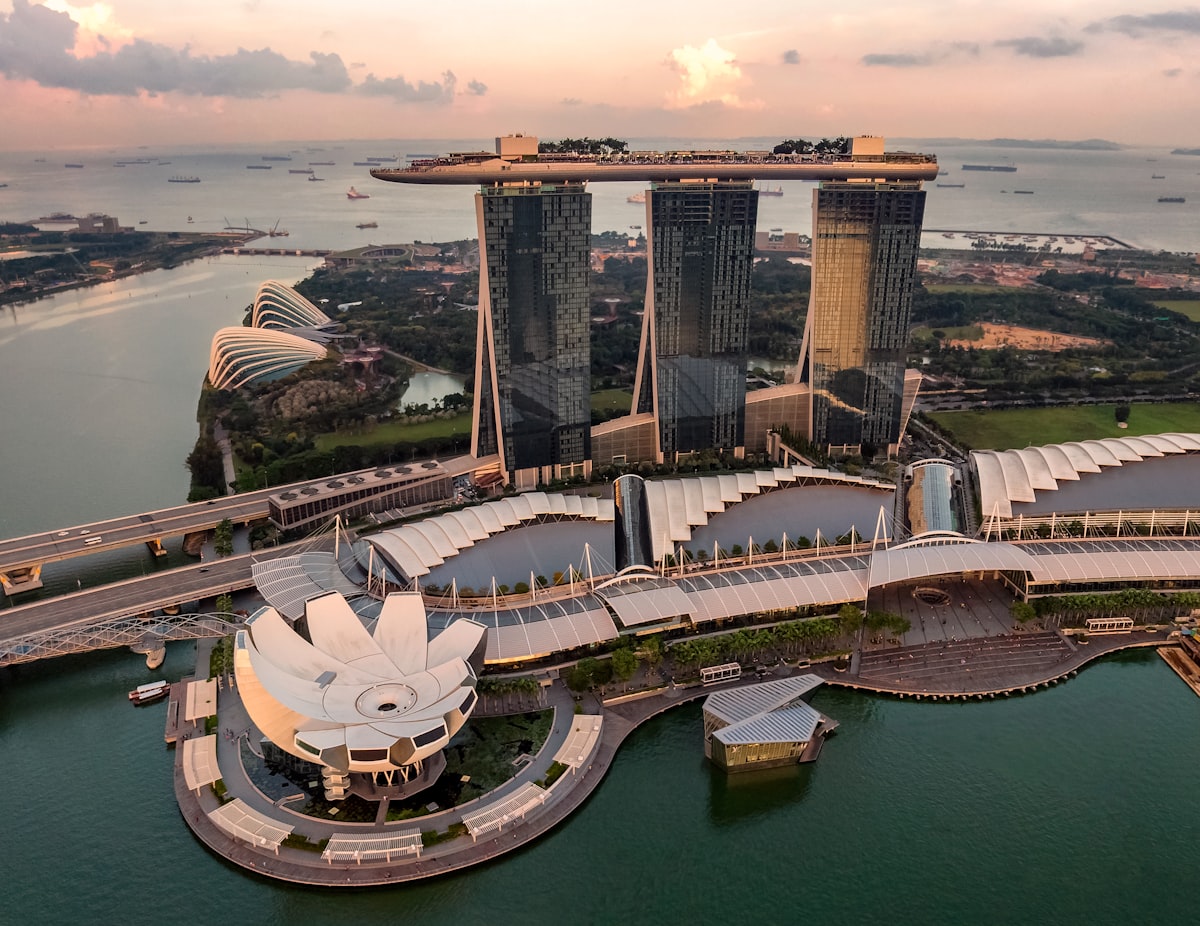
Table of Contents
- Top Attractions in Singapore
- Hawker Food — The World’s Greatest Street Food Culture
- Must-Eat Dishes
- Michelin-Starred Dining (2026)
- Rooftop Bars & Nightlife
- Neighbourhood Guide
- Gardens & Green Spaces
- Museums & Culture
- Sentosa Island
- Mandai Wildlife Reserve
- Shopping
- Getting Around
- Singapore with Kids
- When to Visit & Weather
- Budget Breakdown
- Safety & Practical Tips
- 2026 Travel Notes & Changes
- Hidden Gems & Local Secrets
- Day Trips from Singapore
- Frequently Asked Questions
Top Attractions in Singapore
1. Gardens by the Bay — The Supertree Grove & Cloud Forest
Gardens by the Bay is the single most impressive public garden in the world. Built on 101 hectares of reclaimed land behind Marina Bay Sands, it contains three waterfront gardens, the centrepieces being the Cloud Forest (a 35-metre indoor waterfall inside a cooled conservatory that recreates a tropical mountain environment), the Flower Dome (the world’s largest glass greenhouse, recreating Mediterranean and semi-arid climates), and the Supertree Grove — 18 vertical gardens between 25 and 50 metres tall, connected by the OCBC Skyway (a 128-metre aerial walkway) and lit up in a dazzling light show every night at 19:45 and 20:45.
Price: Outdoor gardens and Supertree Grove: FREE. Flower Dome + Cloud Forest combo: SGD 46 adult / SGD 33 child. OCBC Skyway: SGD 14 / SGD 10. Floral Fantasy: SGD 20 / SGD 12. Hours: Outdoor gardens 05:00–02:00 daily. Conservatories: 09:00–21:00. Getting there: MRT Bayfront (CE1/DT16), exit B, 5-min walk through Dragonfly Bridge.
2. Marina Bay Sands — The Iconic Skyline
Marina Bay Sands is Singapore’s defining building: three 57-storey towers connected by a 340-metre SkyPark shaped like a surfboard. The infinity pool on top (for hotel guests only) is one of the most photographed views in Asia. Non-guests can access the SkyPark Observation Deck for panoramic views over the entire city, the Strait of Singapore, and on clear days, Indonesia.
Price: SkyPark Observation Deck: SGD 35 adult / SGD 29 child/senior (SGD 39/33 peak weekends & holidays). Hours: Mon–Thu 11:00–21:00, Fri–Sun 11:00–22:00. Getting there: MRT Bayfront (same station as Gardens by the Bay). Tip: The Spectra light and water show at Marina Bay (free, nightly at 20:00 and 21:00, Fri–Sat also 22:00) is best viewed from the Event Plaza on the waterfront side of MBS.
3. Chinatown — Temples, Shophouses & Hawker Heritage
Singapore’s Chinatown is a tight grid of colourful shophouses, temples, and some of the island’s best food. The main strip (Pagoda Street, Temple Street, Smith Street) has souvenir shops and the open-air Chinatown Food Street. But the real treasures are slightly off the tourist path: the stunning Buddha Tooth Relic Temple & Museum (free, with a rooftop garden and a chamber said to house a tooth relic of the Buddha), the Sri Mariamman Temple (Singapore’s oldest Hindu temple, built 1827, ornate gopuram tower), and the Chinatown Heritage Centre (SGD 18, a beautifully curated museum recreating the cramped living conditions of early Chinese immigrants in original shophouse interiors).
Getting there: MRT Chinatown (NE4/DT19). Best time: Evening for atmosphere and food. Don’t miss: Maxwell Food Centre (one of Singapore’s best hawker centres, 2 min walk south).
4. Little India — Spice Markets & Tamil Culture
Little India is the most sensory neighbourhood in Singapore: garlands of jasmine hanging from shop doorways, Bollywood music from clothing stores, the smell of biryani and fish-head curry, and the dazzling colours of Sri Veeramakaliamman Temple and Sri Srinivasa Perumal Temple. The Tekka Centre (also called Tekka Market) is the neighbourhood’s hawker centre and wet market — the best place for Indian food in Singapore (biryani, roti prata, dosai, fish-head curry, murtabak). Mustafa Centre, a 24-hour department store filling an entire block, sells everything from gold jewellery to electronics at competitive prices.
Getting there: MRT Little India (NE7/DT12). Best time: Sunday evening, when the neighbourhood fills with migrant workers on their day off and the energy is electric. During Deepavali (October/November), the street lights up in spectacular fashion.
5. Kampong Glam & Arab Street — Sultan Mosque & Haji Lane
Kampong Glam is Singapore’s Malay-Arab quarter, centred on the golden-domed Sultan Mosque (Masjid Sultan, built 1824, free to visit outside prayer times — robes provided for non-Muslims). The surrounding streets are a feast: Arab Street for textiles, carpets, and perfumes; Haji Lane for independent boutiques, street art, and cafés (the narrowest street in Singapore, now its most Instagrammed); and Bussorah Street for the best view of the mosque dome with shophouse facades framing it.
Getting there: MRT Bugis (EW12/DT14), 5-min walk. Don’t miss: Malay Heritage Centre (SGD 6, closed for renovation until late 2026 — check before visiting) and Zam Zam restaurant (since 1908, famous murtabak, SGD 7–15).
6. Jewel Changi Airport — The World’s Most Beautiful Airport
Jewel is a nature-themed entertainment complex attached to Changi Airport, centred on the Rain Vortex — the world’s tallest indoor waterfall (40 metres), cascading through a glass dome surrounded by a terraced forest of over 2,000 trees. The Rain Vortex is free to view from the ground floor. The upper levels house the Canopy Park (SGD 11 for Canopy Park only, SGD 27 with all attractions: hedge maze, mirror maze, sky nets, walking nets, and the Canopy Bridge glass-floor walkway), plus 280 shops and restaurants.
Hours: Daily, Rain Vortex runs 24 hours (light show at 19:30, 20:30, 21:30, 22:30). Canopy Park: 10:00–22:00. Getting there: MRT Changi Airport (CG2). Free Skytrain from all terminals.
7. Singapore Zoo & Night Safari — World-Class Wildlife
The Singapore Zoo (part of the Mandai Wildlife Reserve) is consistently ranked among the world’s best: an open-concept zoo where animals roam in naturalistic habitats separated from visitors by hidden moats and vegetation rather than bars. Highlights: the Orangutan Breakfast (eat alongside free-ranging orangutans, SGD 55 adult), the Fragile Forest biodiversity dome, and the white tigers. The Night Safari (separate park, opens 18:15) is the world’s first nocturnal zoo: a tram ride through seven geographic zones of animals active after dark, plus walking trails. It’s one of the most unique wildlife experiences in Asia.
Price: Singapore Zoo: SGD 49 adult / SGD 34 child. Night Safari: SGD 58 / SGD 40. Multi-park passes available. Hours: Zoo 08:30–18:00. Night Safari 18:15–24:00 (tram ride ~40 min). Getting there: MRT Springleaf (TE4) then Mandai shuttle bus, or direct Mandai Khatib Shuttle from Khatib MRT.
8. National Gallery Singapore — Southeast Asian Art in a Colonial Masterpiece
The National Gallery occupies two of Singapore’s grandest colonial buildings — the former Supreme Court and City Hall — connected by a striking modern canopy. It houses the world’s largest public collection of Southeast Asian modern art (over 9,000 works): from Indonesian, Filipino, Thai, Vietnamese, and Singaporean artists spanning the 19th century to today. The building itself is magnificent, with the former courtroom preserved as an installation space.
Price: SGD 20 adult (Singapore residents free). Children under 6 free. Hours: Mon–Thu & Sat–Sun 10:00–19:00, Fri 10:00–21:00. Getting there: MRT City Hall (EW13/NS25), exit B. ⚠️ Note (Apr 2026): The Supreme Court Wing levels 3–5 are closed for major renovation. The ground floor and City Hall Wing galleries remain open.
9. Singapore Flyer — Asia’s Tallest Observation Wheel
The Singapore Flyer is a 165-metre observation wheel on the Marina Bay waterfront, offering 360-degree views of the city skyline, Marina Bay, Sentosa, and on clear days, Malaysia and Indonesia. Each rotation takes 30 minutes in a fully air-conditioned capsule. The best time is sunset or after dark when the skyline lights up.
Price: SGD 33 adult / SGD 21 child. Premium experiences (Singapore Sling cocktail flight, dinner flight) available at higher prices. Hours: Daily 14:00–22:00 (last boarding 21:30). Getting there: MRT Promenade (CC4/DT15), exit A, 5-min walk.
10. Merlion Park — Singapore’s Icon
The Merlion — a mythical creature with a lion’s head and a fish’s body, spouting water into the bay — is Singapore’s official mascot and most-photographed landmark. The 8.6-metre statue stands in Merlion Park, a waterfront plaza with direct views across to Marina Bay Sands. It’s touristy, yes, but the setting is genuinely impressive, especially at night when MBS is lit up.
Price: FREE. Hours: Always open (lit up at night). Getting there: MRT Raffles Place (EW14/NS26), exit H, 5-min walk along the waterfront.
11. ArtScience Museum — Where Art Meets Science
The lotus-shaped ArtScience Museum at Marina Bay Sands hosts rotating exhibitions that blend art, science, technology, and culture. The permanent Future World exhibition (a collaboration with teamLab) is an immersive digital art experience of interactive light projections, cascading waterfalls, and responsive environments that children and adults find equally mesmerising.
Price: Future World: SGD 28 adult / SGD 20 child. Special exhibitions vary (SGD 22–28). Combo tickets available. Hours: Daily 10:00–19:00 (last entry 18:00). Getting there: MRT Bayfront (CE1/DT16).
12. Fort Canning Park — History Above the City
A hilltop park in the heart of the city with 700 years of history: the site of 14th-century Malay kings, a British colonial fort, the Battle Box (underground command centre where the British decided to surrender Singapore to the Japanese in 1942, guided tour SGD 20), a spice garden, and the much-Instagrammed Fort Canning Tree Tunnel (a spiral staircase framed by a canopy of trees). The park is peaceful, green, and a welcome escape from the heat.
Price: Park: FREE. Battle Box: SGD 20. Hours: Park always open. Battle Box: 09:30–17:30 (closed Mon). Getting there: MRT Fort Canning (DT20), exit B.
At a Glance — Quick Reference
| Attraction | Price (SGD) | ≈ EUR | Time needed |
|---|---|---|---|
| Gardens by the Bay (conservatories) | SGD 46 | €31.70 | 2–3 hours |
| Marina Bay Sands SkyPark | SGD 35 | €24.15 | 1 hour |
| Chinatown Heritage Centre | SGD 18 | €12.40 | 1–1.5 hours |
| Jewel Changi (Rain Vortex) | Free (Canopy Park SGD 11–27) | — | 1–2 hours |
| Singapore Zoo | SGD 49 | €33.80 | 3–4 hours |
| Night Safari | SGD 58 | €40.00 | 3 hours |
| National Gallery | SGD 20 | €13.80 | 2–3 hours |
| Singapore Flyer | SGD 33 | €22.75 | 30 min |
| Merlion Park | Free | — | 15–30 min |
| ArtScience Museum (Future World) | SGD 28 | €19.30 | 1.5–2 hours |
| Fort Canning Park | Free (Battle Box SGD 20) | — | 1–2 hours |
| Universal Studios Singapore | SGD 83 | €57.25 | Full day |
Hawker Food — The World’s Greatest Street Food Culture
Singapore’s hawker centres are the soul of the city. These open-air food courts — descendants of the street hawkers who once lined every road — are where Singapore eats: a cross-section of Chinese, Malay, Indian, and fusion cuisines, cooked fresh to order at dozens of individual stalls, for SGD 3–8 per dish. In 2020, Singapore’s hawker culture was inscribed on the UNESCO Intangible Cultural Heritage list. There are over 110 hawker centres across the island. Every Singaporean has their favourite stall for every dish, and the debates are passionate, endless, and deadly serious.
Best Hawker Centres (2026)
- Maxwell Food Centre (Chinatown) — The most famous hawker centre in Singapore, home to the legendary Tian Tian Hainanese Chicken Rice (SGD 6–8 — the queue tells you which stall). Also: Ah Tai Hainanese Chicken Rice (the apprentice’s stall, shorter queue, arguably as good), Zhen Zhen Porridge, Marina South Delicious Food. 100+ stalls. MRT Chinatown or Tanjong Pagar.
- Old Airport Road Food Centre (Geylang) — One of the largest hawker centres in Singapore (150+ stalls) and arguably the best overall. Less touristy than Maxwell. Famous for: Lao Fu Zi Fried Kway Teow, Dong Ji Fried Kway Teow, Old Airport Road Char Kway Teow, Nam Sing Hokkien Mee. MRT Dakota or Mountbatten.
- Lau Pa Sat (Raffles Place) — A stunning Victorian cast-iron structure in the financial district. Tourist-friendly but genuinely good. The Satay Street (Boon Tat Street, next to Lau Pa Sat) opens nightly for satay vendors — one of Singapore’s most atmospheric eating experiences. MRT Raffles Place or Telok Ayer.
- Tiong Bahru Market (Tiong Bahru) — A beloved neighbourhood market in Singapore’s oldest public housing estate (now a hip café district). Famous for: Lor Mee 178, Tiong Bahru Hainanese Boneless Chicken, chwee kueh (steamed rice cakes with preserved radish). MRT Tiong Bahru.
- Chomp Chomp Food Centre (Serangoon Gardens) — An evening-only hawker centre famous for BBQ seafood (stingray, prawns, satay) and a lively atmosphere under the trees. Cash-heavy. More local, less tourist. Taxi or bus from Serangoon MRT.
- Amoy Street Food Centre (Tanjong Pagar) — A lunchtime favourite with the CBD crowd. Home to A Noodle Story (Singapore-style ramen, Michelin Bib Gourmand). MRT Tanjong Pagar.
Must-Eat Dishes in Singapore
- Hainanese chicken rice (海南鸡饭) — Singapore’s national dish: poached chicken, fragrant oily rice cooked in chicken broth, chilli sauce, and ginger paste. Simple, perfect, and the subject of more arguments than any other food in Singapore. SGD 4–8. Best: Tian Tian (Maxwell), Boon Tong Kee (Balestier), Wee Nam Kee (Novena).
- Laksa — A coconut curry noodle soup with shrimp, fish cake, tofu puffs, and cockles in a rich, spicy, utterly addictive broth. The Katong laksa variant (cut noodles eaten with a spoon) is the most famous. SGD 5–8. Best: 328 Katong Laksa, Sungei Road Laksa (Jalan Berseh).
- Char kway teow (炒粵条) — Wok-fried flat rice noodles with Chinese sausage, shrimp, cockles, bean sprouts, egg, and chives, in dark soy sauce. The key is wok hei — the smoky breath of the wok. SGD 4–6. Best: Hill Street Fried Kway Teow (Bedok South), Outram Park (Hong Lim).
- Chilli crab — Mud crab stir-fried in a sweet, savoury, spicy tomato-chilli sauce, eaten with fried mantou buns to mop up the sauce. Singapore’s most famous restaurant dish. SGD 50–100+ per crab (market price). Best: No Signboard Seafood, Jumbo Seafood (Clarke Quay), Long Beach.
- Satay — Skewered, charcoal-grilled marinated meat (chicken, mutton, beef) with peanut sauce, ketupat (compressed rice), and onion-cucumber relish. SGD 0.60–1.00 per stick (order 10+). Best: Lau Pa Sat Satay Street, Chomp Chomp.
- Roti prata — Indian-influenced flatbread, flipped and griddled until crispy-layered, served with curry dipping sauce. Plain, egg, or cheese. A breakfast or supper staple. SGD 1.50–4. Best: Mr and Mrs Mohgan’s Super Crispy Roti Prata (Joo Chiat), The Prata Place (upper Thomson).
- Bak kut teh (肉骨茶) — Pork rib soup in a peppery herbal broth, eaten with rice, fried dough sticks (you tiao), and tea. The Teochew version (peppery, clear broth) is Singapore’s standard. SGD 7–12. Best: Song Fa (Clarke Quay), Founder Bak Kut Teh (Balestier).
- Kaya toast & soft-boiled eggs — The quintessential Singaporean breakfast: charcoal-toasted bread with kaya (coconut jam) and butter, plus two soft-boiled eggs seasoned with dark soy and white pepper, and a cup of kopi (local coffee). SGD 4–6 for the set. Best: Ya Kun Kaya Toast, Chin Mee Chin Confectionery (Katong), Heap Seng Leong (Lavender).
- Hokkien mee — Stir-fried egg noodles and rice vermicelli in a prawn and pork stock, with prawns, squid, pork belly, and sambal chilli on the side. The stock is the star — rich, sweet, and deeply savoury. SGD 5–8. Best: Nam Sing (Old Airport Road), Geylang Lor 29.
- Ice kachang / chendol — Shaved ice desserts: ice kachang topped with red beans, grass jelly, corn, and coloured syrups; chendol with pandan jelly strips, red beans, and gula melaka (palm sugar) coconut milk. SGD 2–4. Essential in the heat.
Michelin-Starred Dining (2026)
Singapore’s Michelin Guide (released annually since 2016) features a mix of fine dining and hawker stalls — a unique combination that reflects the city’s extraordinary food culture. Key starred restaurants in 2026:
- Odette (National Gallery) — 3 Michelin stars. Chef Julien Royer’s modern French with Asian accents. Regularly ranked among the World’s 50 Best Restaurants. Tasting menu from SGD 398. Book months ahead.
- Les Amis (Orchard) — 3 Michelin stars. Classical French fine dining, Singapore’s longest-running fine dining institution. Tasting menu from SGD 458.
- Zén (Bukit Pasoh) — 3 Michelin stars. Scandinavian cuisine by Björn Frantién of Sweden’s Frantzen. Tasting menu from SGD 550.
- Burnt Ends (Dempsey Hill) — 1 Michelin star + Asia’s 50 Best. Australian chef Dave Pynt’s wood-fire grill restaurant. Counter dining from SGD 200–300 per person.
- Labyrinth (Esplanade) — 1 Michelin star. Chef Han Li Guang reimagines Singaporean hawker dishes as fine dining. Tasting menu from SGD 268. The most “Singaporean” starred restaurant.
- Hill Street Tai Hwa Pork Noodle (Crawford Lane) — 1 Michelin star. A hawker stall serving bak chor mee (minced pork noodles) for SGD 8–12. The queue is typically 45–90 minutes. Worth it.
- Liao Fan Hong Kong Soya Sauce Chicken Rice & Noodle (Chinatown Complex) — Formerly 1 Michelin star (lost it in 2021) and once the world’s cheapest Michelin meal at SGD 2. Now SGD 3.80–5.80 and still a Bib Gourmand. The soya sauce chicken remains outstanding and the queues prove it.
Rooftop Bars & Nightlife
Singapore’s bar scene punches far above its weight: the city regularly places multiple entries in the World’s 50 Best Bars list. For rooftop views, see our Hong Kong guide for comparison.
- Cé La Vi (Marina Bay Sands SkyPark, Level 57) — The rooftop bar atop MBS. Cocktails from SGD 28. Stunning 360-degree views. Smart casual dress code. Open to non-hotel-guests (unlike the pool).
- 1-Altitude (One Raffles Place, Level 63) — The highest rooftop bar in Singapore (282 metres). Panoramic views. Cocktails from SGD 25. Cover charge may apply on weekends.
- Atlas (Parkview Square, Bugis) — An Art Deco gin palace with the world’s largest gin collection (over 1,300 bottles). The 15-metre golden lobby is one of the most photographed interiors in Singapore. G&Ts from SGD 25.
- Jigger & Pony (Amara Hotel) — Regularly ranked among Asia’s 50 Best Bars. Classic cocktails done perfectly. SGD 24–28.
- Native (Amoy Street) — Foraging-inspired cocktails using regional Southeast Asian ingredients. Consistently ranked in the World’s 50 Best Bars. SGD 22–28.
- Clarke Quay — Singapore’s main nightlife district: a riverside strip of bars, clubs, and restaurants. Ranges from backpacker to upscale. Good for a bar crawl. MRT Clarke Quay.
- Ann Siang Hill / Club Street — The more sophisticated alternative to Clarke Quay: wine bars, cocktail bars, and restaurants in restored shophouses. Chinatown MRT.
Neighbourhood Guide
Marina Bay & the Civic District
The showpiece waterfront: Marina Bay Sands, Gardens by the Bay, the Merlion, ArtScience Museum, Esplanade (the “Durian” performing arts centre), and the National Gallery. This is the Singapore of the postcards, spectacular at night when everything lights up. The Marina Bay Boardwalk connects all the major landmarks in a waterfront loop. MRT Bayfront, City Hall, or Raffles Place.
Chinatown
Colourful shophouses, temples, hawker centres, and a mix of heritage and tourism. The core streets (Pagoda, Temple, Smith) are touristy but atmospheric. The edges — Keong Saik Road (cocktail bars, boutique hotels), Ann Siang Hill (restaurants, wine bars), and Telok Ayer Street (the “new Chinatown” of cafés and startups) — are where locals go. Don’t miss Maxwell Food Centre and the Buddha Tooth Relic Temple. MRT Chinatown.
Little India
The most vibrant neighbourhood: Tamil temples, spice shops, garland makers, gold jewellery, and the best Indian food in Southeast Asia. Tekka Centre for biryani and roti prata. Mustafa Centre for 24-hour shopping. Sunday evenings when the neighbourhood fills with migrant workers is the most energetic time to visit. MRT Little India.
Kampong Glam / Arab Street
The Malay-Arab quarter: Sultan Mosque, Haji Lane boutiques, Arab Street textiles, and some of the best Middle Eastern and Malay food in Singapore. More relaxed and bohemian than the rest of Singapore. Muscat Street for the iconic mosque-with-shophouses photo. MRT Bugis.
Tiong Bahru
Singapore’s oldest public housing estate (1930s Art Deco blocks) reinvented as the city’s hipster neighbourhood: independent bookshops (BooksActually), specialty coffee (Tiong Bahru Bakery, 40 Hands), vintage shops, and the excellent Tiong Bahru Market hawker centre upstairs. A morning here — coffee, pastry, market, walk — is a perfect Singapore experience. MRT Tiong Bahru.
Joo Chiat / Katong
The heart of Peranakan (Straits Chinese) culture: a long road of pastel shophouses, Peranakan restaurants, Katong laksa shops, and a neighbourhood that feels miles from the skyscrapers. The Koon Seng Road row of ornate Peranakan terrace houses is the most photogenic residential street in Singapore. Intan is a private Peranakan museum-house (by appointment, SGD 40). MRT Paya Lebar, then 10-min walk.
Dempsey Hill
A cluster of former British military barracks repurposed into restaurants, galleries, and lifestyle shops in a lush jungle setting. Home to Burnt Ends (Michelin-starred), Candlenut (Michelin-starred Peranakan), and COMO Dempsey. The greenery and space make it feel like a different country. Taxi or bus from Orchard MRT (no direct MRT access).
Holland Village
An expat-friendly neighbourhood with pavement cafés, independent shops, a small hawker centre (Holland Village Market), and a relaxed, village-like atmosphere. Good for an evening of eating and drinking without the CBD intensity. MRT Holland Village.
Gardens & Green Spaces
- Singapore Botanic Gardens — A UNESCO World Heritage Site (the only tropical botanic garden on the list). 82 hectares of lush gardens, including the National Orchid Garden (SGD 15 adults, 1,000+ species) — the most beautiful orchid collection in the world. The rest of the gardens is free. Dawn jogging, Swan Lake, and the rainforest trail are highlights. MRT Botanic Gardens. Open 05:00–24:00.
- Gardens by the Bay — See Top Attractions above. Outdoor gardens free, conservatories paid.
- MacRitchie Reservoir Park — A nature reserve in the centre of the island with a 250-metre TreeTop Walk (free, a suspension bridge through the rainforest canopy). Monkeys, monitor lizards, and total silence. 11 km of trails. Bus from Marymount MRT.
- Bukit Timah Nature Reserve — Singapore’s highest hill (163 metres) and one of only two places in the world where primary tropical rainforest exists within city limits (the other is Rio). Short trails (1–2 hours), rich biodiversity. Free. MRT Beauty World.
- Southern Ridges — A 10 km connected series of parks and hilltop walks from Mount Faber to Kent Ridge, with the spectacular Henderson Waves bridge (the highest pedestrian bridge in Singapore, 36 metres, undulating timber design). Free. Best at sunset. MRT HarbourFront, then walk/taxi to Mount Faber.
- East Coast Park — Singapore’s recreational coastline: 15 km of cycling paths, seafood restaurants (East Coast Lagoon Food Village hawker centre), and beach-adjacent BBQ pits. Bike rental from SGD 8/hour. Bus from Bedok or Kembangan MRT.
Museums & Culture
- National Gallery Singapore — Southeast Asian art in former Supreme Court + City Hall. SGD 20. See Top Attractions.
- National Museum of Singapore — Singapore’s oldest museum (1887). The Singapore History Gallery traces the island from the 14th century to independence. Excellent. SGD 15 adults (Singapore residents free). MRT Bras Basah or Bencoolen.
- Asian Civilisations Museum — Trade, faith, and material culture across Asia, housed in a stunning colonial building on the Singapore River. The Tang Shipwreck collection (60,000+ pieces from a 9th-century Arab dhow) is extraordinary. SGD 20 adults. MRT Raffles Place.
- Peranakan Museum (Armenian Street) — Reopened 2023 after a 4-year renovation. The world’s finest collection of Peranakan (Straits Chinese) art and culture: beadwork, porcelain, jewellery, and wedding traditions. Beautifully done. SGD 16. MRT Bras Basah.
- Haw Par Villa — Singapore’s most bizarre attraction: a 1937 theme park of over 1,000 statues and 150 dioramas depicting Chinese mythology, folklore, and the famous Ten Courts of Hell (graphic depictions of punishments in the Chinese underworld). The new Hell’s Museum (SGD 22) is a curated deep-dive into death and the afterlife across cultures. Outside areas free. MRT Haw Par Villa.
- Lee Kong Chian Natural History Museum — Three diplodocid sauropod skeletons (nicknamed Prince, Apollonia, and Twinky), 2,000+ zoological specimens, and a Southeast Asian biodiversity focus. SGD 21 adults. NUS campus, shuttle from Kent Ridge MRT.
Sentosa Island
Sentosa is Singapore’s resort island, connected to the mainland by monorail, cable car, boardwalk, or car. The main draws:
- Universal Studios Singapore — Southeast Asia’s only Universal theme park. 28 rides across 7 zones, including Battlestar Galactica (duelling roller coasters), Transformers 3D, Jurassic World Rapids, and the new Minion Land (opened Feb 2025 — Despicable Me-themed rides and dining). SGD 83 adult / SGD 62 child (SGD 86/65 peak days). Book online for date-specific pricing. Hours: 10:00–21:00 (varies). Sentosa Express monorail from VivoCity.
- Singapore Oceanarium (formerly S.E.A. Aquarium, reopened Aug 2025) — Three times the size of its predecessor, making it one of the world’s largest aquariums, with 100,000+ marine animals and the mesmerising Open Ocean viewing panel (36m wide, 8.3m tall). SGD 44–48 adult / SGD 33–37 child (tiered pricing).
- Sentosa Beaches — Three beaches (Palawan, Siloso, Tanjong) with bars, water sports, and sunbathing. Palawan Beach has the suspension bridge to the “southernmost point of continental Asia.” Free.
- Madame Tussauds Singapore — SGD 42. Skyline Luge Sentosa — Gravity-powered luge ride down a hill, from SGD 26/2 rides. Family favourite.
Getting to Sentosa: Sentosa Express monorail from VivoCity (HarbourFront MRT): SGD 4. Cable car from Mount Faber or HarbourFront: SGD 35 return. Boardwalk (walk from VivoCity): free. Entry fee: SGD 2 per person (waived with attraction tickets).
Mandai Wildlife Reserve
Singapore’s Mandai Wildlife Reserve brings four world-class wildlife parks under one umbrella in a rainforest setting in the north of the island:
- Singapore Zoo — Open-concept, naturalistic habitats. Orangutan Breakfast (SGD 55). SGD 49 / SGD 34 child. Daily 08:30–18:00.
- Night Safari — World’s first nocturnal zoo. Tram ride + walking trails. SGD 58 / SGD 40. Daily 18:15–24:00.
- River Wonders — The world’s largest freshwater aquarium: river ecosystems from the Amazon, Mekong, Yangtze, Mississippi, and Ganges. The Amazon River Quest boat ride is the highlight. Giant pandas Kai Kai and Jia Jia reside here. SGD 45 / SGD 32 child.
- Bird Paradise (opened May 2023) — The replacement for the old Jurong Bird Park, now at Mandai. 3,500 birds across 400 species in immersive walk-through aviaries. Highlights: the Crimson Wetlands, Ocean Network, and Penguin Cove. SGD 48 / SGD 33 child.
- Rainforest Wild Asia (opened March 2025) — The 5th and newest Mandai park, an immersive rainforest experience focused on Southeast Asian biodiversity. Walk-through habitats recreating tropical forest ecosystems with Asian elephants, Malayan tigers, sun bears, and gibbons in naturalistic settings. SGD 45 / SGD 32 child.
Getting there: MRT to Khatib (NS14), then free Mandai Khatib Shuttle (every 8–10 min, 15-min ride). Or MRT Springleaf (TE4) + Mandai shuttle. Multi-park passes: 2-park from SGD 75, 3-park from SGD 95, 4-park from SGD 110, all 5 parks from SGD 130 (significant savings).
Shopping
| Location | What to buy | Getting there |
|---|---|---|
| Orchard Road | Luxury & mid-range malls (ION, Paragon, Takashimaya, 313@Somerset) | MRT Orchard / Somerset |
| Bugis Street Market | Budget clothing, souvenirs, snacks | MRT Bugis |
| Haji Lane | Independent boutiques, vintage, street art | MRT Bugis |
| Mustafa Centre | 24-hour department store: electronics, gold, everything | MRT Farrer Park |
| VivoCity | Largest mall: fashion, food, Sentosa gateway | MRT HarbourFront |
| Chinatown | Souvenirs, traditional medicines, snacks | MRT Chinatown |
| Jewel Changi | 280 shops + dining around the Rain Vortex | MRT Changi Airport |
Getting Around
Singapore has one of the best public transport systems in the world. The MRT (Mass Rapid Transit) covers virtually everywhere a tourist would go, and it’s fast, clean, air-conditioned, and cheap.
Payment & Cards
- SimplyGo / contactless cards: Since 2024, Singapore’s public transport accepts contactless Visa, Mastercard, and NETS cards directly (tap at the gantry with your credit/debit card or phone). No separate transport card needed for most visitors. Fares are the same as EZ-Link. This is the easiest option.
- EZ-Link card: Still available. SGD 10 (SGD 5 stored value + SGD 5 non-refundable card cost). Top up at MRT stations or 7-Eleven. Useful if you prefer a dedicated transport card.
- Singapore Tourist Pass: Unlimited MRT/bus rides: SGD 17/day, SGD 24/2 days, SGD 29/3 days (+ SGD 10 refundable deposit). Worth it if you take 4+ trips/day.
Transport Options
| Transport | Fare range | Best for |
|---|---|---|
| MRT | SGD 0.83–2.37 | Everything — fast, clean, air-con, covers all attractions |
| Public bus | SGD 1.00–2.20 | Neighbourhoods not on MRT |
| Grab (ride-hailing) | SGD 8–25 | Late night, groups, luggage, rain |
| Taxi | SGD 4 flag + SGD 0.25/400m | Same as Grab, metered, available at ranks |
| Sentosa Express monorail | SGD 4 | VivoCity to Sentosa |
Getting from Changi Airport
- MRT (East-West Line or Thomson-East Coast Line): SGD 2–3 to most locations. 30–45 min to the city. The cheapest option and perfectly comfortable.
- Airport shuttle bus: SGD 10 per person, shared minibus to any hotel in the city.
- Taxi / Grab: SGD 25–40 to the city centre (20–30 min). Metered taxis add airport surcharges (SGD 5–8 depending on time). Grab is usually slightly cheaper.
Singapore with Kids
- Universal Studios Singapore — 28 rides, 7 zones including new Minion Land (opened Feb 2025). SGD 83/62. See Sentosa.
- Singapore Zoo + Night Safari — Among the world’s best for families. Orangutan Breakfast is unforgettable. See Mandai Wildlife Reserve.
- Bird Paradise — Walk-through aviaries, splash zones. See Mandai Wildlife Reserve.
- Gardens by the Bay — Children’s Garden — Free water-play area with slides, tunnels, and interactive water features. Open Tue–Sun 09:00–19:00.
- Singapore Oceanarium — The giant viewing panel is jaw-dropping for kids. SGD 44/33.
- ArtScience Museum — Future World — Interactive digital art that kids adore. SGD 28/20.
- Skyline Luge Sentosa — Gravity-powered luge ride + scenic chairlift back up. From SGD 26. Age 6+.
- Jewel Changi — Canopy Park — Bouncing nets, hedge maze, mirror maze. SGD 11–27.
When to Visit & Weather
| Season | Months | Temp | Rain | Notes |
|---|---|---|---|---|
| Northeast monsoon | Dec–Mar | 24–31°C | Moderate–heavy | Slightly “cooler,” more rain in Dec–Jan. Chinese New Year festivities. |
| Inter-monsoon | Apr–May | 25–32°C | Occasional storms | Hottest period. Afternoon thunderstorms. |
| Southwest monsoon | Jun–Sep | 25–32°C | Drier | Haze possible (Jul–Sep). National Day Aug 9. F1 season. |
| Inter-monsoon | Oct–Nov | 24–32°C | Heavy storms | Deepavali. Short, intense afternoon downpours. |
Best time to visit: Singapore is a year-round destination — it’s tropical, hot, and humid every day (average 27–31°C, 80%+ humidity). There is no “best” season in the traditional sense. February–March is slightly less rainy. The Singapore Grand Prix (night race, usually September/October) and Chinese New Year (February) are special times to visit but require advance booking. For European winter sun alternatives, see our Tenerife guide.
Chinese New Year 2026: February 17–18 (Year of the Horse). Spectacular: Chinatown lights up, Chingay Parade, River Hongbao fireworks. Some shops and hawker stalls close for 2–3 days.
Singapore Grand Prix 2026: Expected October (date TBC). The world’s only Formula 1 night race, on a street circuit around Marina Bay. One of the most dramatic sporting events in Asia. Tickets from SGD 128.
National Day 2026: August 9. Military parade, aerial displays, fireworks. A spectacle of patriotism. Free public viewing areas around Marina Bay.
Budget Breakdown
| Budget level | Daily (SGD) | Daily (€) | Includes |
|---|---|---|---|
| Backpacker | SGD 80–120 | €55–83 | Hostel, hawker food (3 meals), MRT, 1–2 free attractions |
| Mid-range | SGD 250–400 | €172–276 | 3-star hotel, hawker + 1 restaurant, 2–3 paid attractions, MRT + Grab |
| Luxury | SGD 600–1,200+ | €414–828+ | 5-star hotel (MBS, Raffles), fine dining, private transfers |
Money-saving tips:
- Eat at hawker centres. Three hawker meals a day costs SGD 15–25. The food is as good as (often better than) restaurant food.
- Free attractions: Gardens by the Bay outdoor gardens, Supertree Grove, Garden Rhapsody light show, Merlion Park, Fort Canning Park, Southern Ridges, Botanic Gardens, Henderson Waves, MacRitchie TreeTop Walk, Haw Par Villa (grounds).
- Use SimplyGo / contactless cards. No need to buy a separate transport card. MRT rides are SGD 1–2.
- Mandai multi-park pass: 2 parks for SGD 75 (vs SGD 95+ separately).
- Water is free. Singapore tap water is perfectly safe — refill your bottle anywhere.
- Combine nearby attractions. Marina Bay circuit: Merlion → Esplanade → ArtScience Museum → Gardens by the Bay → MBS (all walkable, mostly free). For more European budget travel, see our Madrid guide or Naples guide.
Safety & Practical Tips
- Safety: Singapore is one of the safest countries in the world. Violent crime is virtually nonexistent. Petty crime is rare. Walking alone at night is safe everywhere. Common sense is all you need.
- Laws: Singapore is famously strict about laws. Key ones for tourists: no chewing gum (importing is banned; you won’t be arrested for chewing but can’t buy it). No smoking in public places (designated smoking areas only, SGD 200+ fine). No littering (SGD 300 first offence). No jaywalking within 50m of a crossing (SGD 50 fine). Drug offences carry the death penalty — Singapore does not make exceptions. Don’t carry even traces of drugs.
- Language: English is the primary business and government language. Most Singaporeans speak English (often with the charming Singlish accent). Mandarin, Malay, and Tamil are also official languages. You will have zero language problems.
- Tipping: Not expected or practised. Restaurants add 10% service charge + 9% GST. No need to tip taxis, hotels, or anywhere else.
- Water: Tap water in Singapore is perfectly safe to drink. Among the cleanest in the world (treated NEWater).
- Electricity: UK-style three-pin plugs (Type G). 230V/50Hz. Same as Hong Kong and UK.
- SIM cards: Prepaid tourist SIM available at Changi Airport (Singtel, StarHub, M1) from SGD 12–18 for 7–14 days with data. Alternatively, eSIM providers work well.
- Visa: Most nationalities get visa-free entry: EU/US/UK/Australia/Canada 30–90 days. Check the ICA website for your nationality. SG Arrival Card must be submitted electronically within 3 days before arrival (free, via ICA website or app).
- Alcohol: Legal but regulated. No off-licence (retail) alcohol sales 22:30–07:00 daily (Fairprice, 7-Eleven). No public consumption in the Liquor Control Zones (Little India, Geylang) 19:00–07:00 on weekends. Bars and restaurants serve normally. Alcohol is heavily taxed — beer is SGD 10–18 at bars, SGD 5–8 from shops.
2026 Travel Notes & Changes
- Thomson-East Coast Line (TEL) Stages 4–5 opening. The TEL now connects Woodlands North to Bayshore via Orchard, Marina Bay, and the East Coast. This has transformed access to the East Coast, Katong/Joo Chiat, and Orchard Road areas. Key stations for tourists: Orchard, Marina Bay, Gardens by the Bay, Founders’ Memorial, Tanjong Rhu, Katong Park, Bayshore.
- Mandai Wildlife Reserve now has five parks. Rainforest Wild Asia opened March 2025 as the 5th park, joining Zoo, Night Safari, River Wonders, and Bird Paradise under one campus with shared transport.
- Sentosa Sensoryscape — A new nature-themed attraction on Sentosa blending art installations, sensory gardens, and immersive technology along a trail through the island’s rainforest. Opened 2024.
- SG Arrival Card now mandatory for all visitors. Submit electronically within 3 days before arrival (free, replaces the old paper disembarkation card). Available at ica.gov.sg or the MyICA app.
- SimplyGo contactless payment on all public transport. Visa/Mastercard/NETS contactless cards and mobile wallets (Apple Pay, Google Pay) accepted at MRT and bus gantries. EZ-Link still works but no longer necessary for tourists.
- Hawker centres going cashless. Most stalls now accept NETS, PayNow, or contactless cards. Cash still works but increasingly optional.
- All COVID-era restrictions lifted. No testing, no vaccination requirements, no quarantine.
- Circle Line Stage 6 opening mid-2026. Three new stations (Keppel, Cantonment, Prince Edward Road) will finally close the Circle Line loop, improving access to the Southern Waterfront and Tanjong Pagar area.
- National Gallery Supreme Court Wing L3–L5 closed from April 2026 for major renovation. Ground floor and City Hall wing remain open. Check before visiting.
- Minion Land at Universal Studios opened February 2025 — the park’s newest zone with Despicable Me-themed rides and dining.
- Singapore Oceanarium (formerly S.E.A. Aquarium) reopened August 2025 after a major expansion — three times the original size.
- Disney Adventure cruise ship launched from Singapore March 2026 — Disney’s first Asia-based cruise with 3–4 night itineraries from Marina Bay Cruise Centre.
- JB–Singapore Rapid Transit System (RTS) Link expected to open late 2026, connecting Woodlands North to Johor Bahru’s Bukit Chagar in 5 minutes. Will transform the cross-border commute.
Hidden Gems & Local Secrets
- Pulau Ubin — A rustic island off northeast Singapore, reachable by bumboat (SGD 4 per person, 15 min from Changi Point Ferry Terminal). Rent a bicycle (SGD 8–15/day) and explore mangroves, abandoned quarries (the famous blue-green Ketam Quarry), kampong (village) houses, and the Chek Jawa Wetlands boardwalk. It feels like Singapore 50 years ago. Go on a weekday for solitude.
- Tiong Bahru at dawn — The wet market at Tiong Bahru Market (ground floor) opens at 06:00. Watch the morning trade, buy tropical fruit, then go upstairs for chwee kueh and coffee at the hawker centre. The Art Deco neighbourhood streets are empty and beautiful at this hour.
- Bukit Brown Cemetery — One of the largest Chinese cemeteries outside China, dating to 1922. Over 100,000 graves in a jungle setting, with ornate tombs of early Chinese immigrants. Guided heritage walks available (check Singapore Heritage Society). Parts are being cleared for highway development — visit while you can.
- Coney Island (Pulau Serangoon) — A 50-hectare nature island off Punggol, connected by bridge. Coastal walks, mangroves, wild monkeys, and no development. Free. Bus from Punggol MRT.
- Henderson Waves at sunset — The undulating bridge on the Southern Ridges is spectacular at sunset: golden light through the timber slats, with the container port and Sentosa visible below. Walk from Telok Blangah Hill Park. Free.
- Heap Seng Leong (Lavender) — A 1970s-era kopitiam (coffee shop) that has not changed in 50 years: marble tables, wooden shutters, and a kopi gu you (coffee with butter) that is both bizarre and addictive. One of the last authentic old-school kopitiams. Cash only. Near Lavender MRT.
- Geylang — Singapore’s most “real” neighbourhood: a grid of numbered lorongs (lanes) mixing Malay food stalls, durian sellers, Buddhist temples, and a red-light district. The durian stalls along Geylang Road are the best on the island. The food is extraordinary (frog porridge, beef kway teow, Katong laksa). Not on the tourist trail, but deeply Singaporean. MRT Aljunied or Paya Lebar.
Day Trips from Singapore
Pulau Ubin
Singapore’s last kampong (village) island. Bumboat from Changi Point (SGD 4, 15 min). Bike rental, Chek Jawa Wetlands, Ketam Quarry. Half-day trip. See Hidden Gems above.
Johor Bahru, Malaysia
The Malaysian city directly across the causeway. Reasons to go: much cheaper food and shopping, LEGOLAND Malaysia (45 min from JB), Desaru Coast (beach resort area, 90 min), and the street food (roti canai, nasi lemak, satay at a fraction of Singapore prices). Border crossing at Woodlands Checkpoint (train or bus from Woodlands MRT, or CW2 shuttle) or Tuas Second Link.
Getting there: MRT to Woodlands, then bus 950/CW1/CW2 across the causeway (SGD 1.50). Or Shuttle Tebrau train from Woodlands station (SGD 5). Total crossing time: 30 min to 2+ hours depending on immigration queues. Tip: Avoid weekend mornings (Singaporeans going to JB for shopping) and Sunday evenings (everyone returning). Passport required. Most nationalities get visa-free entry to Malaysia.
Southern Islands (St John’s, Kusu, Lazarus)
A cluster of small islands south of Singapore, reachable by public ferry from Marina South Pier (SGD 18 return). St John’s Island has walking trails and a lagoon. Lazarus Island (connected to St John’s by a footbridge) has a pristine crescent beach — arguably Singapore’s best. Kusu Island has a Chinese temple and Malay shrine. Pack food and water — limited facilities.
Frequently Asked Questions
Answers based on verified 2026 information.
How many days do I need in Singapore?
Three days minimum: Day 1 for Marina Bay (Merlion, Gardens by the Bay, MBS). Day 2 for Chinatown, Little India, Kampong Glam (food crawl). Day 3 for the Zoo/Night Safari or Sentosa. Five days lets you add Joo Chiat/Katong, museums, Pulau Ubin, and deeper hawker exploration.
Is Singapore expensive?
Hotels and alcohol are expensive. Everything else is very reasonable: hawker food SGD 4–8 per meal, MRT SGD 1–2, most nature attractions are free. You can eat three superb meals a day for under SGD 25. Mid-range visitors spend SGD 250–400/day including accommodation.
Is the street food safe?
Extremely. Singapore’s hawker centres are inspected and graded by the National Environment Agency (look for A or B ratings). Hygiene standards are among the highest in Asia. Tap water is safe to drink everywhere.
Do I need a visa?
Most nationalities get 30–90 days visa-free. You must submit the SG Arrival Card electronically within 3 days before arrival (free, via ica.gov.sg).
How do I get from Changi Airport?
MRT: SGD 2–3 (30–45 min). Taxi/Grab: SGD 25–40 (20–30 min). Airport shuttle: SGD 10. The MRT is easiest and cheapest.
What should I eat first?
Hainanese chicken rice at a hawker centre. It’s Singapore’s national dish for a reason: simple, perfect, and SGD 5. Then laksa. Then char kway teow. Then roti prata. Then chilli crab if your budget allows.
Is chewing gum really banned?
Yes. Importing, selling, and distributing chewing gum is banned (therapeutic gum from pharmacies is exempted). You won’t be arrested for chewing gum you brought in, but you can’t buy it in Singapore.
Is Singapore safe?
One of the safest countries in the world. Violent crime against tourists is virtually nonexistent. Walking alone at night is safe everywhere. Drug offences carry the death penalty — do not carry drugs.
Looking for cheap flights to Singapore?
Check the latest deals on AiFly or search directly on Skyscanner.
Part of the AiFly City Guide series — researched, written, and verified by experienced travel editors.