Inverness Airport (INV) Airport Guide 2026 — Scotland’s Northern Interchange
Inverness Airport sits about nine miles northeast of the city, off the A96 by a slip road called Inverness Airport Way. It handled 821,139 passengers in 2025, making it the UK’s 21st busiest airport — and 718,928 of those were domestic, which tells you what this place is before anything else does. There is both a bus and a train, and the train is the trap: the station is an eleven-minute ride from the city but a twenty-minute walk from the terminal. easyJet, British Airways and Loganair carry most of the traffic; KLM’s Amsterdam service carries almost all of the international. Currency is the pound sterling. This is the interchange for the Scottish islands and the far north.
Last verified: September 2026.
⚡ 2026 Quick Reference — Key Facts at a Glance
Stagecoach services 1 and 13, direct between the terminal and Inverness bus station — a short walk from Inverness railway station. Service 1 is the direct one; the 13 goes round by Croy. Contactless on board, luggage racks fitted. Reduced service on Sundays
Inverness Airport station (IVA), ScotRail, on the Aberdeen line. About 11 minutes to Inverness. ⚠️ It is a ~20-minute walk from the station to the terminal, around the airfield perimeter — lit, but uncovered and unsheltered
Dedicated taxi zone outside the terminal door; the airport’s partner is Inverness Taxis (+44 1463 222222, 24/7). About 20 minutes to the city centre. Fares are not published — agree it or confirm the meter
Free for 15 minutes in the marked drop-off area of a short-stay car park, a 5-minute walk from the door. Short stay is cheapest to 48 h, long stay beyond that (~10-minute walk). Blue Badge / special assistance: 20 minutes free in the premium car park at the front
04:15–22:45, every day. Security closes just after the last scheduled departure — be through before your original departure time even if the flight is delayed
easyJet (Gatwick, Luton, Bristol, Birmingham) · British Airways (Heathrow) · Loganair (Manchester, Belfast City, Stornoway, Kirkwall, Sumburgh) · KLM (Amsterdam) · Aer Lingus (Dublin) · TUI (Majorca) · Discover Airlines (Frankfurt, from 19 June 2027)
100 ml containers in a clear plastic bag, taken out of your cabin bag. No two-litre scanner rule here — this is the old regime, and it is applied
Aspire Lounge, sold through resellers from £31.99 (~€37) for three hours. The airport’s own website does not mention it at all — see section 4
Pound sterling (£), not the euro. Scottish banknotes circulate here and are real money, but any retailer anywhere may decline them
UK system: an Electronic Travel Authorisation (ETA), £20 (~€23), covering the UK, Jersey, Guernsey and the Isle of Man for visits of up to six months. Not needed on a British or Irish passport. 87% of Inverness’s passengers fly domestically and meet no border control at all
🏢 1. One Terminal, One Security Line, and a Hard 22:45
Inverness is a single-terminal regional airport run by Highlands and Islands Airports Limited (HIAL), the state-owned group that also operates Stornoway, Kirkwall, Sumburgh and seven others. It is comfortably the biggest of the eleven: 821,139 passengers in 2025 on Civil Aviation Authority figures, against 282,238 at Sumburgh and 146,946 at Kirkwall. That makes it 21st in the UK — ahead of Norwich and Newquay, behind Southend and Prestwick.
The number that shapes your whole visit is the split between domestic and international. Of those 821,139 passengers, 718,928 flew domestically and only 102,211 internationally. Break the international figure down further and it collapses almost entirely into one route: 97,102 of it was Amsterdam. Palma added 2,942 on TUI’s charter, a Rovaniemi Lapland charter 748, the Faroes 332, Bergen 257. In practice Inverness is a British airport with a Dutch door on the side, and KLM’s twice-daily Schiphol rotation is the only scheduled way out of the country from here.
Terminal hours are 04:15 to 22:45, seven days a week, with the airfield open 06:15 to 22:45. Read those two lines together with your flight time before you plan anything clever. The first departure of a typical day is KLM’s 06:25 to Amsterdam, which means the building opens barely two hours before it; and the airport’s own instruction is blunt about the other end — security closes just after the last scheduled departure time, and you must be through before your original departure time regardless of any delay to the actual one. A delayed flight does not buy you a later security slot. If your inbound connection is tight, that rule is the one that catches people.
Security here runs the old liquids regime. HIAL states it for all its airports: liquids limited to 100 ml containers in a clear plastic bag, removed from your cabin bag for screening, and electronic devices may need to come out too. Several large UK airports have moved to next-generation scanners with a two-litre allowance. Inverness has not. Arrive with the habits you picked up at Edinburgh or Heathrow and you will lose the bottle. Vapes, e-cigarettes, spare lithium batteries and power banks belong in hand baggage and never in the hold.
Allow ninety minutes for a domestic flight and two hours for an international one — HIAL’s own recommendation, and at this size it is genuinely enough. There is free Wi-Fi throughout the terminal (choose “Airport Free WiFi” and register once), car hire desks, and a customer service point. Special assistance is run by OCS and staffed 05:00–22:30; book it at least 48 hours ahead through your airline or the PRM Assist app, and the direct line is 01667 464117.
There is a Courtyard by Marriott immediately at the airport, which matters more here than at most regional airports: with a 04:15 opening and a 06:25 first departure, an airport hotel is a real answer for anyone coming down from Caithness or across from Skye the night before.
🛂 2. The UK Has Its Own Entry System, and It Is Not a European One
Start with the fact that most people arriving here never see a passport desk. Gatwick, Heathrow, Luton, Bristol, Manchester, Belfast City, Stornoway, Kirkwall and Sumburgh are internal UK flights: no immigration control, no stamp. What you do need is photo ID your airline will accept — carriers set their own domestic rules, so travel with a passport or a photo driving licence and the question never arises. The genuinely international arrivals here are Amsterdam, Dublin and the seasonal charters, plus Frankfurt from summer 2027.
For those, the UK’s system is the Electronic Travel Authorisation. GOV.UK, read this month, is the source that counts. An ETA costs £20 — about €23 at the European Central Bank reference rate for 7 September 2026, €1 = £0.85894 — and it lets you travel to the UK, Jersey, Guernsey or the Isle of Man for up to six months. You usually need one rather than a visa if you are from Europe, the USA, Australia, Canada or certain other countries. Everyone travelling needs their own, babies and children included, though one person may apply on behalf of others. Apply on GOV.UK or through the official app and nowhere else: the government’s own warning is that other websites charge more and that you should avoid sites imitating government services. An ETA does not guarantee entry.
Who does not need one: holders of a British or Irish passport, and anyone with permission to live, work or study in the UK. If you are transiting a UK airport landside — passing through border control before your onward flight — you do need one; ask your airline if you are unsure which kind of transit you are doing. GOV.UK deliberately does not print the validity period on the front of its ETA guidance; it tells you to check your own expiry through the ETA checker. Do that rather than assuming how long yours runs.
The document trap that catches European travellers is the identity card. GOV.UK’s rule is that citizens of the EU, Switzerland, Norway, Iceland and Liechtenstein need a valid passport or a valid Irish passport card. A national identity card is accepted only in narrow circumstances: settled or pre-settled status under the EU Settlement Scheme (or the Jersey, Guernsey or Isle of Man equivalent), an EU Settlement Scheme family permit, a frontier worker permit, S2 Healthcare Visitor status, or a validly pending settlement application. If none of those describes you, bring the passport — it is not a formality here.
ePassport gates are open by nationality. GOV.UK confirms that citizens of the EU, Switzerland, Norway, Iceland and Liechtenstein can continue to use the automatic gates, and that non-European nationals of Australia, Canada, Japan, New Zealand, Singapore, South Korea and the United States may use the UK/EEA lanes and the gates. Age limits for children apply and are set by the Home Office; check the current ones on GOV.UK rather than taking a number from a travel page. You will not meet a gate at Inverness in any case — there is no routine immigration hall of that size here — but you will at Amsterdam, Dublin or wherever you connect.
Irish citizens are a separate case entirely. Ireland, the UK, Jersey, Guernsey and the Isle of Man form the Common Travel Area, and Irish citizens enter and live in the UK without a visa. The Dublin route is therefore the softest international arrival Inverness has.
Money. The currency is the pound sterling, and Scotland does not use the euro. Notes issued by Scottish banks circulate normally in the Highlands, but they are not Bank of England notes and a retailer anywhere in the UK is free to decline one — spend them before you fly south. Cards work everywhere. If a card machine offers to bill you in euros or dollars, refuse: that is dynamic currency conversion and the margin goes to the terminal, not to you.
🚌 3. Bus 1, Bus 13, and the Railway Station You Have to Walk To
Take the bus. Stagecoach runs services 1 and 13 directly between the terminal and Inverness city centre, arriving at the bus station, which is a short walk from Inverness railway station on Academy Street. The number 1 is the direct one; the 13 also serves the airport but goes round by Croy, so it is the slower option if it turns up first. Both are low-floor vehicles with priority seating, space for a limited number of wheelchairs, approved mobility scooters and unfolded buggies, and they have luggage racks — which is not universal on Scottish rural services and is the reason this beats the train with a suitcase. Contactless payment is accepted on board. The Sunday service is reduced, and timetables also shift on public holidays and in bad weather.
Stagecoach does not publish the airport single fare on any page we could reach, so we will not print a number for it. Check the current fare in the Stagecoach app or on board before you travel; contactless is accepted either way. Note also that Stagecoach runs some services that stop at the railway station without continuing to the terminal, so read the destination on the front of the bus rather than the route number alone.
The train is a genuinely good idea and a genuinely bad one, depending on your luggage. Inverness Airport railway station — code IVA, managed by ScotRail — sits on the Aberdeen line, and the ride into Inverness takes about eleven minutes. That is faster than any road option. The catch is the airport’s own statement of what happens at the other end: it is a walk of approximately 20 minutes from the station to the terminal building, following signs around the perimeter of the airfield, on a path that is well lit but uncovered. In Highland weather, with a case, that is a different proposition from an eleven-minute train.
The station itself is better equipped than the walk suggests: step-free access to all platforms, lifts, accessible and Changing Places toilets, baby changing, help points, ticket machines, a sheltered waiting area, CCTV and cycle storage with hire. There is no ticket office and no station staff, and no refreshments or public Wi-Fi. It has 64 parking spaces and no accessible bays. Passenger Assist runs between Inverness and the airport station on both train and platform, booked at least two hours ahead, or before 22:00 the night before for an early departure, on 0800 046 1634.
One quirk worth knowing if you drive an EV: there are no public EV chargers in the airport car parks at all. The nearest is at Inverness Airport railway station, and it is ScotRail’s, not the airport’s.
| Option | Journey time | Price | Notes |
|---|---|---|---|
| Stagecoach bus 1 (direct) | Not published by the operator | Fare not published — contactless on board | Terminal door to Inverness bus station. Luggage racks, low floor. Reduced Sunday service |
| Stagecoach bus 13 (via Croy) | Longer than the 1 | Fare not published — contactless on board | Also serves the airport; take the 1 if both are due |
| ScotRail from Inverness Airport station (IVA) | ~11 min to Inverness | Check the current fare with ScotRail or National Rail | ⚠️ Plus a ~20-minute uncovered walk between station and terminal |
| Taxi (Inverness Taxis) | ~20 min to the city centre | Not published — confirm before you set off | Dedicated zone at the terminal door; 24/7; +44 1463 222222 |
| Car hire | — | Not published at the airport | Desks in the terminal. This is why most visitors fly here — see section 6 |
| Parking — drop-off | — | Free for 15 minutes | Marked area in a short-stay car park, ~5-minute walk. No return within one hour |
| Parking — short / long stay | — | Prices shown on the car park system; pre-book up to 12 months ahead | Short stay cheapest to 48 h; long stay beyond that, ~10-minute walk |
| Coach parking | — | £10 (~€12) per coach, under two hours | Restricted access lane at the front; book on 01667 464000 |
🛋️ 4. There Is a Lounge. The Airport Does Not Tell You About It
Inverness has an Aspire Lounge, and you would never learn that from the airport. HIAL’s website describes the departure lounge only as the place you cannot enter after security closes; it names no lounge product, lists no price and carries no booking link. The lounge is sold through the third-party channels instead — Holiday Extras lists it at from £31.99 (about €37) for three hours before your flight, an example price its own page dates to a quotation taken on 2 September 2026 for a November departure. Guest reviews published on that listing — the most recent of them from the late 2010s — describe a small room with a coffee machine, runway views from some seats, free drinks and snacks, and no toilet inside the lounge. Treat the room description as dated and the booking as current.
Treat that price as a booking-channel figure, not an airport tariff, and re-check it for your own date. What it buys is straightforward: somewhere quiet to sit at an airport whose departure area is not large, plus food and drink included at a price that compares reasonably with buying both landside.
Is it worth it here? For a 90-minute domestic turnaround, no — you will not be in the building long enough. For the 06:25 Amsterdam departure, for a delayed evening Gatwick rotation, or for anyone connecting off an island flight with a long gap, it earns its money. If you are travelling with a child who finds airports difficult, it is also the only enclosed alternative to the general seating.
What the terminal does have for everyone: free Wi-Fi throughout, car hire desks, a customer service point and shops and catering landside and airside. HIAL does not publish an outlet list, so we will not name units that may have changed hands; assume a modest offer and check the boards when you arrive rather than planning a meal around them.
🍽️ 5. Eat Before Security, and Take the Right Things Home
The airport is not where you should be doing your eating. It is a nine-mile drive from a city with a proper food scene, and a fifteen-minute drop-off window costs nothing — arrive fed. Once you are airside at a 04:15-opening regional terminal, your options narrow quickly, and HIAL publishes no catering list to plan against.
What to actually buy in the Highlands is a different question, and the answer is largely liquid. The A96 that runs past the airport heads east into Speyside, the densest concentration of malt whisky distilleries in Scotland — which means the distilleries are closer to the terminal than they are to Inverness city centre, and a hire car collected at the airport puts you among them inside an hour. Buy the bottle at the distillery rather than at the airport; the range is wider and the distillery-only bottlings do not reach retail. Just remember the packing rule: spirits over 100 ml go in the hold, always, and that is not negotiable at an airport still running the clear-bag regime.
Beyond whisky, the produce worth carrying is Highland and coastal: cold-smoked salmon, cured in the Moray Firth towns and along the west coast; Highland beef and venison from the estates inland; soft fruit and heather honey from the Black Isle just across the Kessock Bridge; oatcakes, and the shortbread that survives a suitcase better than anything else on this list. Haggis is the thing visitors are told to try and is genuinely worth trying, but check your destination’s import rules before packing meat — the UK and the EU each restrict what can be carried in the other direction, and the airport’s own guidance is that food, plants and meat are subject to strict rules and confiscation.
One practical baggage note. HIAL states that Loganair includes 15 kg of luggage as standard, which is unusually generous for a regional carrier and the reason island-hoppers rarely pay extras here — see our Loganair baggage allowance guide for how that is measured. easyJet, which carries the largest share of the traffic on this field, works on the opposite model, so check what you have actually bought before you arrive: our baggage checker will tell you what your ticket includes, and the easyJet and KLM guides cover the two carriers most likely to be involved in an INV connection.
💡 6. What You Actually Fly to Inverness For
Ranked honestly, there are three reasons, and only one of them is Loch Ness.
First, and most under-appreciated: this is the interchange for the Scottish islands and the far north. Loganair flies from here to Stornoway in the Outer Hebrides, Kirkwall in Orkney and Sumburgh in Shetland, and the traffic is real — roughly 19,000, 5,500 and 13,500 passengers respectively in 2025. If your destination is an island, Inverness is very often the shortest routing that exists, and the connection through here is far less painful than doing it through Glasgow or Aberdeen. Inverness railway station on Academy Street is likewise where the rail network runs out and the far north begins, so the airport — eleven minutes from that station by train — is also the fastest way to reach the top of the British mainland from anywhere south.
Second: the car. The hire desks in this terminal are not an afterthought — for a large share of visitors, collecting a car here is the entire point. Inverness is the natural start of a north-and-west Highland loop, and everything that makes the region worth the trip is on a road rather than a bus route. If you are flying in and not driving, be honest with yourself about how much of your itinerary is actually reachable.
Third: the cluster of sites that is closer to the airport than to the city. Clava Cairns — properly Balnuaran of Clava — is a Bronze Age cemetery about 4,000 years old, set on a terrace above the River Nairn, in Historic Environment Scotland’s care, open all year and free. Culloden battlefield, where the 1745 Jacobite rising ended in 1746, is beside it. Cawdor Castle is a short run further east toward Nairn. All three sit on the airport’s side of Inverness. If you land in the afternoon and have a car, that is your first day, and you never touch the city.
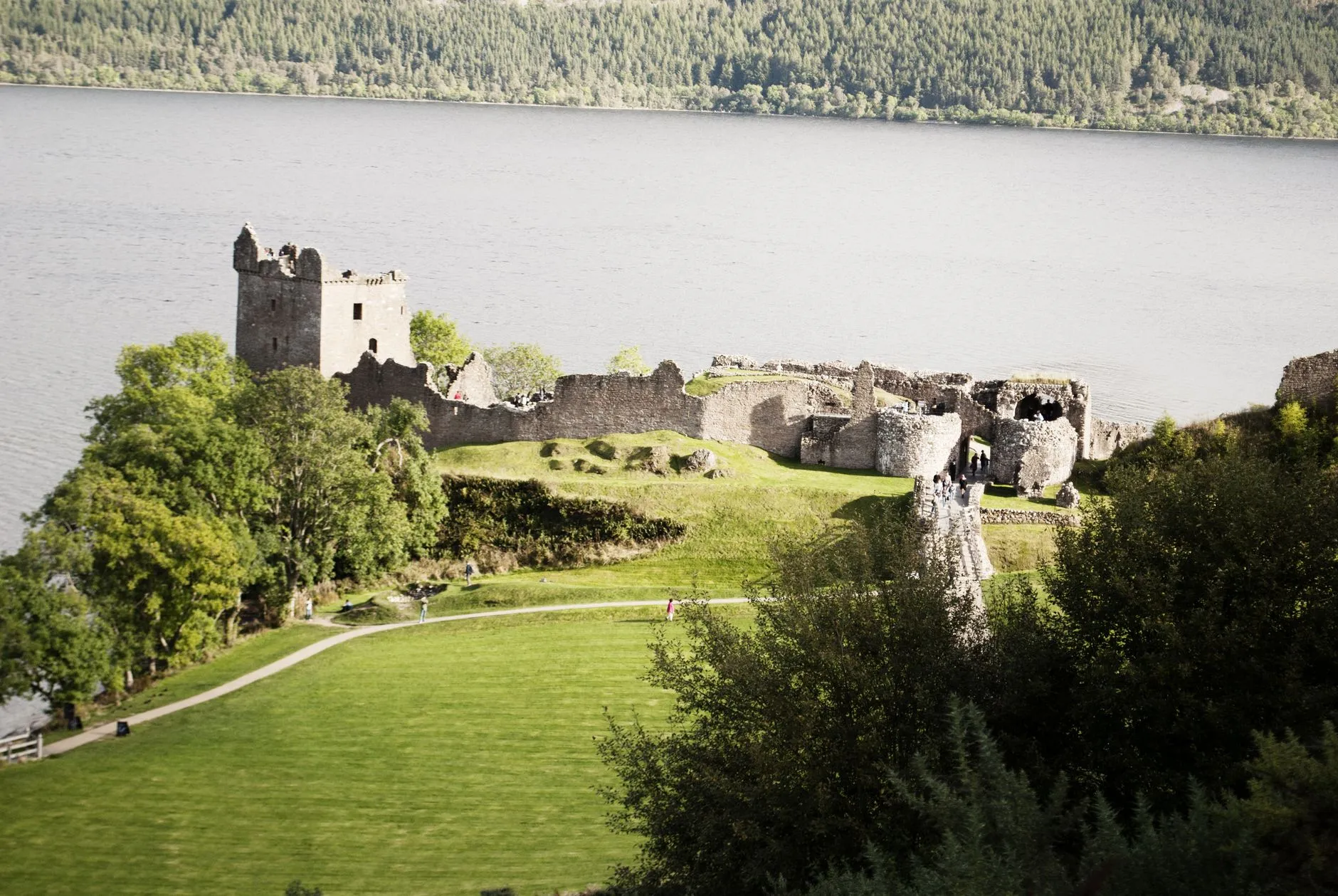
Now Loch Ness, and the honest version. It is genuinely near — the loch runs southwest from just outside Inverness — and flying here is a much better way to reach it than the Edinburgh day-coach that most visitors take. But it is one long, deep, dark, generally featureless body of water, and the drive down the eastern shore rewards you less than the region’s smaller glens do. Glen Affric, southwest of the airport, is the better half-day. Urquhart Castle, on the loch’s western shore, is the one stop on the water actually worth the ticket.
A word on seasonality, because it changes the answer. Inverness’s international schedule is thin and seasonal by design: TUI’s Majorca charter, a Lapland day trip run by a Highland operator in December, Gran Canaria and Tenerife charters in the spring, and the new Discover Airlines Frankfurt service every Saturday from 19 June to 11 September 2027 — the first direct link between the Highlands and Frankfurt, and the airport’s first proper hub connection outside Amsterdam. Aer Lingus is doubling Dublin to four flights a week for the autumn peak and again from 14 March 2027, which also opens a transatlantic connection through Dublin. Outside those windows, arriving here from continental Europe means Schiphol.
Finally, the thing nobody tells you: the airport’s old website is gone. The domain that used to serve Inverness Airport now redirects to a commercial flight-comparison site with no connection to the airport. HIAL’s own pages are the only authority for hours, parking and assistance — go there, not to whatever a search engine puts first. And before you book any of it, run the route through our flight price check: with one dominant carrier on each of the London pairings, the spread between a good fare and a bad one from this airport is wider than the distance justifies.
❓ Frequently Asked Questions
📊 2026 Summary Data Table
| Category | Detail |
|---|---|
| Airport | Inverness Airport (INV / EGPE), operated by Highlands and Islands Airports Limited (HIAL) |
| Location | About nine miles northeast of Inverness, off the A96 via Inverness Airport Way |
| Passengers 2025 | 821,139 — 21st busiest in the UK (Civil Aviation Authority) |
| Domestic vs international | 718,928 domestic / 102,211 international — 87% domestic |
| Biggest international route | Amsterdam, 97,102 passengers — 95% of all international traffic |
| Biggest domestic routes | London Gatwick (~229,000), London Heathrow (~176,000), London Luton (~146,000), Bristol (~92,000) |
| Terminals | One |
| Terminal hours | 04:15–22:45 daily; airfield 06:15–22:45 |
| Check-in advice | 90 minutes domestic, 2 hours international (HIAL) |
| Liquids rule | 100 ml containers, clear bag, removed from cabin baggage |
| Bus | Stagecoach services 1 (direct) and 13 (via Croy) to Inverness bus station; contactless; reduced Sundays; fare not published |
| Train | Inverness Airport station (IVA), ScotRail, Aberdeen line, ~11 min to Inverness — plus a ~20-min uncovered walk to the terminal |
| Taxi | Inverness Taxis, rank at the door, ~20 min to the city, 24/7, +44 1463 222222 |
| Parking | Free 15-minute drop-off; short stay to 48 h; long stay beyond; Blue Badge 20 min free; no public EV chargers |
| Lounge | Aspire Lounge — from £31.99 (~€37) for 3 hours through resellers; not listed on the airport’s own site |
| Currency | Pound sterling (£). ECB reference rate 7 Sep 2026: €1 = £0.85894 |
| Entry | UK Electronic Travel Authorisation, £20 (~€23), up to 6 months, covers UK + Jersey, Guernsey, Isle of Man; not needed on a British or Irish passport |
| Airlines | easyJet, British Airways, Loganair, KLM, Aer Lingus, TUI; Discover Airlines from 19 June 2027 |