Exeter Airport (EXT) Airport Guide 2026 — Devon’s Package-Holiday Runway
Exeter Airport sits five miles east of the city, five minutes off the M5 at EX5 2BD, and it is the mirror image of most British regional airports: 459,852 of its 572,260 passengers in 2025 flew internationally, and 47% of everyone who passed through was on a charter. This is a holiday airport with a scheduled timetable bolted on, and knowing that changes how you use it. There is no railway station at the airport — the nearest is three miles away and reachable only by taxi — so the bus, Stagecoach’s 4A, is the public-transport answer. There is a real Executive Lounge upstairs from the restaurant. Currency is the pound sterling, and Devon is what you came for.
Last verified: September 2026.
⚡ 2026 Quick Reference — Key Facts at a Glance
Stagecoach service 4A, Exeter Airport → Honiton Road Park & Ride → city centre → Exeter St David’s station. Roughly 25–35 minutes on the timetable the airport links. Service 43 runs to Pinhoe rail station. ⚠️ Limited service on Saturdays, Sundays and bank holidays
There is no station at the airport. Cranbrook is 3 miles (taxi only), Digby & Sowton 5 miles, Exeter Central 6 miles, Exeter St David’s 7 miles. Rail is a connection you reach, not a way in
Apple Taxis Exeter is the only airport-authorised private hire operator, working from the Taxi Desk in the Arrivals building. Journeys must be pre-booked — by phone on 01392 666666 or at the desk. Other firms may collect pre-booked passengers in Car Park 1 only
Car parks P1, P2, P3, all Park Mark accredited, a few minutes’ walk from the terminal. Prices only through the booking system. Blue Badge holders dropping off get up to 4 hours for the 30-minute rate — validate at the parking office in Car Park 2
Landside is generally open overnight for early arrivals, but security, shops and catering only open when check-in opens and close after the last departure
Ryanair (Alicante, Málaga, Faro) · TUI (Majorca, Tenerife, Lanzarote, Gran Canaria, Corfu, Crete, Rhodes, Zante, Kos, Ibiza, Menorca, Dalaman, Paphos) · KLM (Amsterdam, daily) · Loganair (Jersey, Edinburgh, Newcastle) · Aer Lingus (Dublin; Belfast on Saturdays) · Aurigny (Guernsey) · Skybus (Isles of Scilly)
100 ml containers, one transparent resealable bag per passenger, max 1 litre, about 20 × 20 cm. Liquids and large electricals out of the bag. Yogurt, soups, jams and saucy food count as liquids; solid sandwiches do not
Executive Lounge, up the stairs from the restaurant after security. Maximum stay 3 hours, smart/casual, groups capped at 6, no hen or stag parties. From £29.99 (~€35) through resellers; Priority Pass, Lounge Pass, Dragon Pass and Diners Club accepted
Pound sterling (£). ⚠️ If you fly to Guernsey or Jersey, the local pounds you get in change there are not spendable back in Britain — swap them before you fly home
UK system: an Electronic Travel Authorisation (ETA), £20 (~€23), covering the UK, Jersey, Guernsey and the Isle of Man for stays of up to six months. Not needed on a British or Irish passport
🏢 1. Two Buildings, One Runway, and a Timetable Built Around Holidays
Exeter is a two-building airport: a Main Terminal with check-in, security, the departure lounge and the gates, and a separate Arrivals building next door. That matters in exactly one situation, and the airport spells it out — if you are connecting here, you collect your bag, walk out of Arrivals, and walk into Departures to check in again, unless your luggage is through-checked. It is a two-minute walk, but nobody expects to leave a terminal mid-journey and the signage is the only thing telling you to.
The traffic mix is the most interesting number at this airport, and it is not close. Civil Aviation Authority figures for 2025 put Exeter at 572,260 passengers, the UK’s 24th busiest. Of those, 459,852 were international and only 112,408 domestic — the exact inverse of most regional fields. Then split the international half by how it was sold: 237,547 charter passengers within the EU and another 30,926 beyond it, against 191,379 international scheduled. Add the domestic charters and 268,977 of Exeter’s passengers, or 47% of the whole airport, travelled on a charter flight. Among international passengers alone, charters were 58%.
What that means in practice is that Exeter has two completely different personalities depending on the month and the hour. In summer, at 06:00, it is a TUI operation — check-in desks for Palma and Tenerife opening at 03:40 and 04:30, families, hold bags, a queue that fills the hall. By mid-afternoon in winter it is a quiet regional airport with a KLM Fokker-sized load to Amsterdam and an Aurigny turboprop to Guernsey. Set your expectations by which one you are flying, not by the airport’s size.
Growth here is real and the airport says so. Its own figure is more than 582,000 passengers between March 2025 and March 2026, a 32% increase on the previous rolling year — a different measuring window from the CAA’s calendar year, which is why the two numbers do not match. The single biggest driver is visible in the route data: KLM’s Amsterdam service carried 37,816 passengers in 2025 against 58 in 2024. That is a route launching, and it gives Exeter its first proper hub connection.
Timings. The airport asks you to be ready to board 30 minutes before departure and to allow 15–45 minutes for the security queue at busy times. For charter holiday flights, desks generally open 2.5 hours ahead and close 60 minutes ahead — the closing time is the one that catches people who assume a regional airport will wait. Smoking and vaping are banned everywhere in the airport, including outside the doors as far as the airport is concerned.
🛂 2. The UK’s Own Entry System — Not a European One
Exeter is unusual among British regional airports in that most of its passengers are crossing a border, so this section matters more here than it does at, say, Inverness. Only about one flight in five from Exeter is domestic.
The UK’s system is the Electronic Travel Authorisation, and it is nothing like the arrangements on the other side of the Channel. GOV.UK, read this month, is the source that counts. An ETA costs £20 — about €23 at the European Central Bank reference rate of 7 September 2026, €1 = £0.85894 — and it authorises travel to the UK, Jersey, Guernsey or the Isle of Man for up to six months. You normally need one instead of a visa if you are from Europe, the USA, Australia, Canada or certain other countries. Every traveller needs their own, including babies and children, although one person can apply on behalf of the group. Apply on GOV.UK or the official app and nowhere else — the government’s own warning is that other sites charge more and that you should avoid imitations of government services. An ETA authorises travel; it does not guarantee entry.
You do not need one if you hold a British or Irish passport, or if you have permission to live, work or study in the UK. You do need one if you transit a UK airport landside, meaning you pass through border control before continuing. GOV.UK does not print the validity period on the front of its ETA guidance — it tells you to look up your own expiry with the ETA checker, and that is what you should do rather than trusting a number from a travel site.
The document rule that catches Europeans is about identity cards. GOV.UK requires citizens of the EU, Switzerland, Norway, Iceland and Liechtenstein to travel on a valid passport or a valid Irish passport card. A national identity card is accepted only if you have settled or pre-settled status under the EU Settlement Scheme (or the Jersey, Guernsey or Isle of Man equivalent), an EU Settlement Scheme family permit, a frontier worker permit, S2 Healthcare Visitor status, or a validly pending settlement application. Otherwise, passport.
ePassport gates work by nationality. GOV.UK confirms that citizens of the EU, Switzerland, Norway, Iceland and Liechtenstein may continue to use the automatic gates, and that nationals of Australia, Canada, Japan, New Zealand, Singapore, South Korea and the United States may use the UK/EEA lanes and the gates too. Children have separate age rules set by the Home Office; check the current ones on GOV.UK rather than taking a figure from a guide.
Ireland, Jersey and Guernsey are a special case worth understanding before you book. The UK, Ireland, Jersey, Guernsey and the Isle of Man form the Common Travel Area, and Irish citizens travel to and live in the UK without a visa — which makes the daily Dublin service the least administrative international flight on the board. The Channel Islands are inside the ETA’s coverage, so a single authorisation covers a Guernsey or Jersey trip as well as the mainland.
Money, and one trap. The pound sterling is the currency, and Britain does not use the euro. But Exeter flies to Guernsey and Jersey, and both islands issue their own pounds, which circulate alongside sterling there and are not accepted by shops back in Britain. Spend or swap them before you leave the island. On the continental routes, decline any card terminal that offers to bill you in pounds instead of euros — that is dynamic currency conversion and the margin is not yours.
🚌 3. There Is No Station. Take the 4A
Answer the obvious question first: no, you cannot get a train to Exeter Airport. The airport publishes the distances itself and they are unambiguous — Cranbrook 3 miles (taxi), Digby & Sowton 5 miles (taxi), Exeter Central 6 miles, Exeter St David’s 7 miles. Cranbrook is a new town built next door to the airport with its own station on the Waterloo line, and it is still a taxi ride. If someone tells you Exeter Airport is rail-served, they are describing the connection at the far end, not the airport.
The bus is the 4A, and it is a genuine service rather than a token one. Stagecoach runs it between the airport and Exeter St David’s station by way of the Future Skills Centre, Honiton Road Park & Ride and Paris Street in the city centre. On the timetable the airport links, the run takes about 22 minutes at quiet times and 33–35 minutes in traffic, at roughly half-hourly intervals through the middle of the day, with an hourly Sunday pattern. ⚠️ That timetable is dated September 2023 and the airport’s own page warns of a limited service on Saturdays, Sundays and bank holidays — treat the shape as reliable and the exact times as something to confirm with Stagecoach on the day. Stagecoach does not publish the airport fare anywhere we could reach it, so we will not print one. Pay contactless on board.
Stagecoach also runs service 43 between the airport and Pinhoe rail station, which is the useful one if your onward train is on the Waterloo side rather than through St David’s.
The taxi arrangement here is stricter than at most airports and you should know it before you land. Apple Taxis Exeter is the only private hire company authorised to work the airport, from the Taxi Desk inside the Arrivals building and the adjacent stands, and journeys must be pre-booked — by telephone on 01392 666666 or in person at the desk. Other firms are not permitted to use the Arrivals stand at all; they may only drop off, or collect a pre-booked passenger, in Car Park 1. Do not expect to walk out and flag one down. Apple also runs a left-luggage office at Exeter St David’s station, which is quietly useful if you have a long gap between train and flight.
| Option | Journey time | Price | Notes |
|---|---|---|---|
| Stagecoach 4A to Exeter St David’s | ~22–35 min (September 2023 timetable) | Fare not published — contactless on board | Via Honiton Road Park & Ride and the city centre. Limited Sat/Sun/bank holiday service |
| Stagecoach 43 to Pinhoe station | Not published | Fare not published | The better option for Waterloo-line connections |
| Taxi — Apple Taxis Exeter | ~15 min to the city (5 miles) | Not published — confirm when booking | Pre-book only: 01392 666666 or the Taxi Desk in Arrivals. The only authorised operator |
| Train | — | — | ⚠️ No airport station. Cranbrook 3 mi · Digby & Sowton 5 mi · Exeter Central 6 mi · Exeter St David’s 7 mi |
| Car | ~5 min to the M5 | — | EX5 2BD. Five miles from the city centre |
| Car hire | — | Not published at the airport | Approved operators with desks at the airport; one of them trades seasonally, 2 June – 31 October |
| Parking P1 / P2 / P3 | A few minutes’ walk | Prices through the booking system only | Park Mark accredited, CCTV and patrols. Amend or cancel free up to 24 hours before arrival |
| Blue Badge drop-off | — | Up to 4 hours at the 30-minute rate | Use Car Parks P1 or P2; validate your ticket at the parking office in Car Park 2 |
| Bicycle / motorbike | — | Motorbike parking free | Arrange both with the Car Park Customer Service Office, 01392 365225. No helmet storage |
🛋️ 4. The Executive Lounge, and Its Unusually Specific House Rules
Yes, Exeter has a lounge, and it is the airport’s own rather than a franchise. The Executive Lounge is reached by the stairs in the restaurant, after security — not from the main concourse, which is why people miss it. A member of staff greets you at the door. It has runway views, comfortable seating, newspapers and magazines, unlimited free Wi-Fi, and unlimited tea, coffee and soft drinks with light snacks appropriate to the time of day.
The rules are published and they are more specific than most:
- Maximum stay three hours. Open from the first check-in of the day, closed after the last departure.
- Dress code smart/casual, and consideration for other users is a stated condition of entry.
- Groups are capped at six, and hen and stag parties are refused outright.
- Children are welcome; from age 2 they pay the adult rate, and under-2s are free.
- The airport asks guests to limit themselves to two alcoholic drinks, in support of the Civil Aviation Authority’s campaign against disruptive behaviour, and says the airline may be told about overindulgence.
- Food and drink are for consumption in the lounge only, not to carry onto the aircraft, and alcohol bought in the airport shops may not be drunk in there.
- Hot food can be ordered up from the ground-floor restaurant at your own expense.
Access and price. The lounge accepts Priority Pass, Lounge Pass, Dragon Pass and Diners Club, as well as bookings made through Holiday Extras, which lists it from £29.99 (about €35). Book on the airport’s own site or at the lounge reception desk subject to availability; it is a small room and it fills on charter mornings. The airport also lists a separate Fast Track Security product, sold when it is available — check the booking page rather than assuming it is on offer for your date.
Should you buy it? On a mid-afternoon KLM or Aurigny departure, no — the main departure lounge is quiet and you will be through it in forty minutes. On a 06:40 Palma departure with check-in opening at 03:40, three hours of unlimited coffee upstairs is close to the whole point of getting up.
🍽️ 5. Cove, Coastline, WHSmith — and What to Carry Out of Devon
The airport publishes its outlets, which makes planning easy. Landside, before security, there is Cove Café for coffee, pastries, cakes and savouries, and a WHSmith. Airside there is a second WHSmith, a World Duty Free, and the Coastline Café, which is the real one: cereal, pastries, porridge and hot bacon or sausage baps in the morning, then toasties, paninis and burgers later, plus a bar. Opening hours track the flight schedule rather than the clock, and everything shuts after the last departure.
Two details worth knowing if you are travelling with a small child. Coastline will warm a baby’s bottle — but the airport states plainly that formula and baby feed are not sold anywhere at the airport. Bring what you need. Coastline also has a children’s menu, which is not a given at this size of airport.
On duty free: World Duty Free runs a Reserve & Collect service with 10% off, orderable from 24 hours up to 30 days before you fly, and the online range is wider than what is on the shelf. If you actually want a particular bottle rather than whatever is stacked by the till, reserve it. And remember which side of the border you are on — a bottle bought here for a domestic hop to Edinburgh or Jersey is not duty free in any meaningful sense.
What is worth carrying out of Devon is dairy and baking, not souvenirs. Clotted cream is the county’s defining product and travels badly in a hold bag but well in a cool bag in the cabin, within the liquids rules — a sealed tub over 100 ml goes in the hold, so plan it. Devon cream tea is the ritual: scone, jam, cream, and in Devon the cream goes on before the jam, which is the opposite of the Cornish order and is not a joke to a Devonian. Beyond that: Devon cider from the orchards around the Exe valley, Sharpham and Quicke’s cheeses made in the county, Salcombe and Brixham crab and shellfish landed on the south coast, and fudge that outlasts everything else in the suitcase.
One security note that saves arguments at the belt. Exeter states it explicitly: solid food such as sandwiches goes through fine, but yogurt, soups, syrups, jams and anything with a lot of sauce is treated as a liquid. A jar of jam for someone at home belongs in the hold. Check what your ticket actually allows in the hold before you shop — our baggage checker covers it, and if you are on the two carriers that dominate this airport, the Ryanair and TUI allowances are very different animals.
💡 6. What Devon Is Actually For
Devon is a two-national-park county with a World Heritage coastline, and Exeter Airport sits between all of it and the M5. That is the honest summary, and it explains why the car hire desks matter here.
Dartmoor is the reason most first-time visitors come, and it is closer than it looks. It lies west of Exeter, on the far side of the city from the airport: high open granite moorland, tors and wild ponies, a National Park that feels far bigger than its map. Exmoor, north of the county on the Somerset border, is quieter, greener and better for red deer and dark skies. Neither is reachable on a bus timetable that will suit you. If you are flying in without a car, be realistic: you will see Exeter, the coast on the rail line, and not much else.
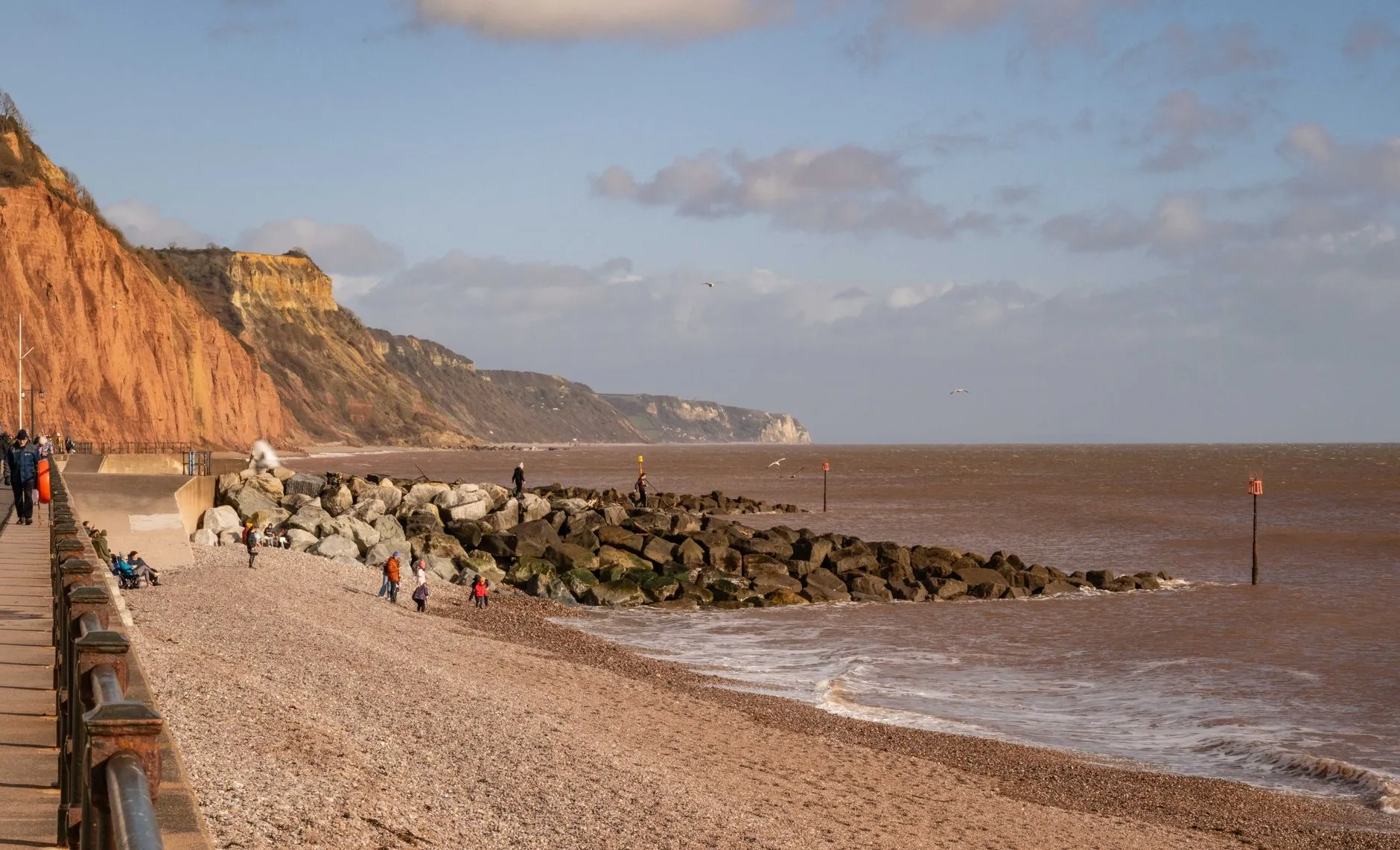
The coast is the other half, and it is properly world-class. The Jurassic Coast runs east from Exmouth into Dorset and was inscribed as a UNESCO World Heritage Site in 2001 for its rocks, fossils and landforms; it remains England’s only natural World Heritage Site. Exmouth, at the mouth of the Exe estuary and on the rail line from Exeter Central, is where the sequence starts, and the red cliffs there are the western end of it. Budleigh Salterton, Sidmouth and Beer follow eastward, all reachable in an afternoon with a car. On the south coast, Torquay and the English Riviera are the traditional bucket-and-spade end of the county, and north Devon — Croyde, Woolacombe, Saunton — has the surf.
Exeter itself deserves more than the hour most people give it. It is a UNESCO City of Literature, one of a global network that includes Edinburgh and Dublin — both of which, as the airport likes to point out, it flies to directly. There is a mural in the terminal by Rosetta Westbrook celebrating the county’s writers: Agatha Christie, born in Torquay, Michael Morpurgo, and Sarah Pearse. The city has a Gothic cathedral with a famously long unbroken vaulted ceiling, surviving stretches of Roman city wall, and a set of medieval water passages under the streets that you can walk through on a guided tour.
Two flights from this airport are genuinely unusual and worth knowing about. Skybus flies to St Mary’s in the Isles of Scilly, up to three times a day in season — a 28-mile archipelago off Cornwall with sub-tropical gardens, and the flight is far the least painful way to reach it. And Aurigny to Guernsey and Loganair to Jersey make the Channel Islands a genuine weekend from Devon, which is not true from most of Britain.
Finally, the strategic advice: think about who is selling you the flight. Because 47% of Exeter’s traffic is charter, a large part of the timetable is only bookable as part of a package, and the same beach can cost wildly different amounts depending on whether TUI or Ryanair is flying it that week. Alicante, Málaga and Faro are Ryanair scheduled routes you can book as seat-only; Tenerife, Lanzarote, Corfu and Rhodes are largely charter. Run both before you commit — our flight price check will tell you what the scheduled route is doing on your dates, which is the number that decides whether the package is a bargain or not.
❓ Frequently Asked Questions
📊 2026 Summary Data Table
| Category | Detail |
|---|---|
| Airport | Exeter Airport (EXT / EGTE), Devon, England |
| Location | Five miles east of Exeter city centre, five minutes from the M5. Postcode EX5 2BD |
| Passengers 2025 | 572,260 — 24th busiest in the UK (Civil Aviation Authority) |
| Airport’s own figure | More than 582,000 in the 12 months to March 2026, +32% on the previous rolling year |
| International vs domestic | 459,852 international / 112,408 domestic — 80% international |
| Charter share | 268,977 passengers, 47% of the airport; charters were 58% of all international traffic |
| Biggest routes 2025 | Palma 57,769 · Alicante 52,203 · Tenerife South 37,905 · Amsterdam 37,816 · Lanzarote 36,363 · Málaga 31,997 · Dublin 31,153 |
| Terminals | Main Terminal (departures) plus a separate Arrivals building — transfers walk between the two |
| Terminal hours | Landside generally open overnight; security, shops and catering open with check-in, close after the last departure |
| Check-in | Charter desks generally open 2.5 h before, close 60 minutes before. Be ready to board 30 min ahead; allow 15–45 min for security |
| Liquids rule | 100 ml containers, one clear resealable bag per passenger, max 1 litre, ~20 × 20 cm; liquids and large electricals out separately |
| Bus | Stagecoach 4A to Exeter St David’s via Honiton Road P&R and the city centre, ~22–35 min; 43 to Pinhoe station. Limited weekend and bank-holiday service. Fares not published |
| Train | No airport station. Cranbrook 3 mi · Digby & Sowton 5 mi · Exeter Central 6 mi · Exeter St David’s 7 mi |
| Taxi | Apple Taxis Exeter only, Taxi Desk in Arrivals, pre-book on 01392 666666 |
| Parking | P1 / P2 / P3, Park Mark accredited; prices via the booking system; free amendment or cancellation to 24 h before |
| Lounge | Executive Lounge, up the stairs from the restaurant airside. Max stay 3 h; groups max 6; no hen/stag; under-2s free. From £29.99 (~€35); Priority Pass, Lounge Pass, Dragon Pass, Diners Club accepted |
| Food & shops | Cove Café and WHSmith landside; Coastline Café, WHSmith and World Duty Free airside. No baby formula sold anywhere at the airport |
| Currency | Pound sterling (£). ECB reference rate 7 Sep 2026: €1 = £0.85894 |
| Entry | UK Electronic Travel Authorisation, £20 (~€23), up to 6 months, covers the UK plus Jersey, Guernsey and the Isle of Man; not needed on a British or Irish passport |