Strasbourg Airport (SXB) Airport Guide 2026 — Eight Minutes From the Trains
Strasbourg Airport is at Entzheim, about 10 km southwest of the cathedral, and it has the best airport rail link of any airport this size in Europe: a shuttle train up to five times an hour, eight minutes to Strasbourg’s main station, reached by a covered walkway straight onto the platform. It handled 1,302,008 passengers in 2025, of which 554,554 were international. Volotea bases aircraft here and flies more destinations from it than anyone else. There are 45 direct routes and no flight to Paris at all. France is in the Schengen area and France uses the euro — two separate facts, both of which matter at the border. Alsace is what you came for.
Last verified: September 2026.
⚡ 2026 Quick Reference — Key Facts at a Glance
Shuttle train, up to 5 times an hour, 8 minutes to Gare de Strasbourg. A covered pedestrian link runs from the terminal straight to the platform — no shuttle bus, no walk in the rain
€3.20 single, airport → Gare de Strasbourg (TER only). €4.60 for the combined ALSA + 24H EMS ticket: 24 hours of unlimited bus, tram, coach and TER across the Eurométropole, airport included. From €1.90 on the CTS app for an immediate-departure TER + tram/bus, valid one hour
Machines at the airport and on the station platform, cards accepted; or the CTS app
No airport bus at all. A taxi rank is marked on the terminal floor plan, but the airport publishes no operator, phone number or fare for it — the train is the answer here, and it is a good one
Five car parks. P1 drop-off: first 15 minutes free (max two passes per 24 h). P2 short stay €25 per 12–24 h, weekend package €35. P3 covered €32. P5 long stay: €64 for up to 7 days. 4 EV charging bays on P2
If you are using the TER station, you park free — on the station car park and on the airport’s own P2 and P3
Opens 2 hours before the first flight, closes 30 minutes after the last arrival. ⚠️ You cannot spend the night in the terminal — it is closed and secured
Volotea (the biggest, with a base here — 28 routes in 8 countries) · easyJet (11 routes) · Jet2.com · Lufthansa · Iberia · LOT · TAP · Vueling · Transavia · Aegean · Tarom · AnimaWings · Twin Jet · Air Algérie · Royal Air Maroc · Tunisair · Nouvelair
None. No pay-in lounge and no airline lounge. What you get instead are free espaces détente with power sockets — see section 4
Euro (€). France is in the eurozone; card payment is universal and the terminal has a CIC cash machine in arrivals
Schengen external border. The Entry/Exit System has been fully operational since 10 April 2026 — fingerprints and a facial image instead of a stamp. ETIAS is not running, no applications are being collected, and no launch date has been announced; the fee is fixed at €20
🏢 1. One Building, Two Boarding Halls, and a Hard Closing Time
Strasbourg is a single-terminal airport at RM 221 / Route de l’Aéroport, 67960 Entzheim, and it is bigger than most people expect: 1,302,008 passengers in 2025 on Eurostat’s figures, up from 1,227,404 in 2024. What is unusual is the shape of that traffic. 747,454 passengers flew domestically and 554,554 internationally — and of the international half, 257,599 were outside the EU. Nearly half of Strasbourg’s international passengers are not flying within Europe at all. That is the North African network: Algiers, Constantine, Casablanca, Marrakech, Tunis, Djerba, flown by Air Algérie, Royal Air Maroc, Tunisair, Nouvelair, Transavia and easyJet. It is the single most distinctive thing about this airport’s route map and almost nobody writing about it mentions it.
The terminal splits into a national boarding hall on the ground floor and a first-floor boarding area, which is where the shops and the bar sit. It is not a large building and you will not get lost in it.
Read the opening hours before you plan an early start or a late arrival. The airport’s rule is simple and absolute: the terminal opens two hours before the first flight of the morning and closes thirty minutes after the last arrival, and it states plainly that for security reasons you cannot spend the night there. Car park P3 closes at the same time as the airport; the outdoor car parks stay accessible and you pay at the exit barriers. If your inbound lands late and your outbound leaves early, you need a hotel, not a bench.
Practical facilities are better than the passenger count would suggest. Wi-Fi is free to all passengers. There are three children’s carousels — one in arrivals, one in departures, one in the ground-floor boarding hall — which is an oddly generous provision and a genuine relief on a delayed flight with a four-year-old. The information desk in the centre of the terminal will warm a baby’s bottle or a jar of baby food; baby-changing is in the arrivals toilets and in a dedicated space in departures. There is a CIC cash machine dispensing euros in the arrivals hall, a photocopier, a photo booth, and a postbox outside by the pedestrian crossing to P1. Stamps and envelopes are sold in Relay.
Car hire is on the floor plan with four operators in the building — Sixt, Hertz, Europcar and Enterprise — alongside travel-agency desks and, genuinely, a flight simulator you can book. Lost property is handled on 03 88 64 67 67; anything left on board the aircraft is the airline’s baggage service, not the airport’s. Damaged or missing hold bags go to Strasbourg Handling on 03 88 64 67 93.
🛂 2. A Schengen External Border, and a Currency Question That Is Separate
Two facts, and they are not the same fact. France is inside the Schengen area, so there is no routine passport control on a flight from another Schengen country — a Volotea hop from Milan or Palma lands you straight into the baggage hall. France is also inside the eurozone, so the currency is the euro. Countries can be one without the other, which is why we separate them.
Where Strasbourg does have a real external border is on its non-Schengen routes, and it has a lot of them: the UK services to Gatwick, Luton, Stansted, Manchester, Edinburgh and Bristol, and the whole North African programme to Algeria, Morocco and Tunisia. On those, you are crossing the external frontier of the Schengen area, and the rules below apply.
The Entry/Exit System is live and it is no longer new. The European Commission’s own timeline is that the EES began progressive operation on 12 October 2025 and reached full operability on 10 April 2026, across 29 European countries. It replaces the passport stamp: instead, the system records your name, travel document data, fingerprints and a facial image, and the date and place of each entry and exit, which is how overstays are now detected automatically. In practice, your first crossing after 10 April 2026 takes longer than your later ones — the biometric enrolment is the slow part, and afterwards the border check is a facial match against a record that already exists. Build in extra time on your first post-EES arrival, not on every one. This applies only to non-EU nationals crossing an external border; it has nothing to do with an intra-Schengen flight.
ETIAS: the status, and nothing more, because that is all there is. The European Commission’s official page says it in one line: the European Travel Information and Authorisation System “is currently not in operation and no applications for travel authorisations are collected at this point.” No launch date has been announced. What is settled is the price: Commission Delegated Regulation (EU) 2025/1411, in force since its publication in the Official Journal on 29 October 2025, fixes the travel authorisation fee at €20 per application, replacing the original €7. Under the parent regulation the fee is waived for applicants under 18 or over 70 at the time of application, and for family members of EU citizens exercising free-movement rights.
🚨 The scam warning matters more than the rules do right now. Because ETIAS is not running, nobody can sell you a valid one today. Any site charging you for an ETIAS in 2026 is selling you nothing. When it does launch, applications will go through an official EU website or app, and the price will be €20 or free — not €60 with a “service fee”.
Money. The euro is the currency and cards work everywhere, including on the ticket machines for the airport train. If a card terminal offers to charge you in your home currency rather than in euros, decline — that is dynamic currency conversion and the exchange margin goes to the machine’s operator. Note that if you fly on to Morocco or Tunisia from here, both countries restrict the import and export of their own currency, so change money at your destination rather than before you leave.
🚌 3. The Train, and Why There Is Nothing Else to Discuss
Strasbourg has solved the airport transfer problem more completely than almost any airport in Europe, and it did it with a suburban railway. The station sits beside the terminal, connected by a covered pedestrian link that takes you directly onto the platform. Trains run up to five times an hour and reach Gare de Strasbourg in eight minutes. There is no shuttle bus to wait for, no walk across a car park, and no possibility of missing the last one by much, because the service is dense.
The fares are simple and there are three of them. A TER single from the airport to Gare de Strasbourg costs €3.20, sold on the platform. The one most visitors should buy is the combined ALSA + 24H EMS ticket at €4.60: it covers one person for 24 hours from purchase, unlimited journeys on bus, tram, coach and TER across the whole Eurométropole of Strasbourg, including to and from the airport. Since a single tram ride in the city already costs a meaningful fraction of that, the combined ticket is the obvious buy on arrival — it pays for itself before dinner. If you have the CTS app, an immediate-departure fare from €1.90 covers the TER plus a tram or bus within the Eurométropole, but it must be used within the hour of purchase, so buy it on the platform and not the night before.
Tickets are sold from machines at the airport and at the station, and cards are accepted at both.
There is no airport bus, and there is no taxi page either. That is not an omission on our part: the airport’s transport section covers parking, car hire, the train shuttle and the station car park, and nothing else. A taxi rank does exist — the terminal floor plan marks one — but the airport publishes no operator, no phone number and no fare for it, so we will not print one. On a route the train covers in eight minutes for €3.20, that is a rational thing for an airport to leave out.
If you are driving, read the parking table, because the difference between the right car park and the wrong one is large. P1 is drop-off only in practice: the first 15 minutes are free, but you are limited to two passes per 24 hours and a third costs €5 on top of the hourly rate, and a full day there is €48. P5 for the same day is a fraction of that.
| Option | Journey time | Price | Notes |
|---|---|---|---|
| Shuttle train to Gare de Strasbourg | 8 minutes | €3.20 single (TER only) | Up to 5 departures an hour; covered walkway to the platform |
| Combined ticket ALSA + 24H EMS | as above | €4.60 | 24 h unlimited bus + tram + coach + TER across the Eurométropole, airport included. The one to buy |
| CTS app, immediate departure | as above | from €1.90 | TER + tram or bus in the Eurométropole; must be used within the hour |
| P1 — drop-off | — | Free under 15 min; 15–30 min €4.90; 12–24 h €48.00 | 114 spaces. Max 2 passes per 24 h, then +€5 each |
| P2 — short stay | — | 12–24 h €25.00; extra day €10; week €85; weekend €35 | 494 spaces. Weekend package runs Friday noon to Monday noon. 4 EV charging bays |
| P3 — covered | — | 12–24 h €32.00; week €104; weekend €44 | 1,338 spaces. ⚠️ Closes when the airport closes |
| P4 — long stay | — | €74.00 up to 7 days; extra day €8.50 | 316 spaces. Indivisible package |
| P5 — long stay | — | €64.00 up to 7 days; extra day €7.50; extra week €52.50 | 375 spaces. The cheapest long stay |
| TER station users | — | Free | Free parking on the station car park and on airport P2 and P3 |
| Bike / motorbike | — | Free | 8 spaces at the entrance to P1 |
| Travel-agency visitors | — | 2 hours free | Dedicated car park; the agent hands you the ticket |
Payment is at nine points: three automatic tills in the terminal, two on level −1 of P3, one at P1, two at P4 and one staffed desk. Cards work at every exit barrier.
🛋️ 4. There Is No Lounge — and the Free Alternative Is Better Than You’d Think
Strasbourg has no lounge. Not a pay-in one, not a card-access one, not an airline one. The strongest evidence is the airport’s own terminal floor plan, which is an itemised index of every facility in the building by category — bars and restaurants, shops, check-in, car hire, parking tills, business centre, baggage service, taxis, toilets, the train shuttle, the flight simulator and the services group — and there is no salon on it. The services page says the same by omission, and a cross-check against the European lounge index of one of the largest UK resellers finds Nice, Montpellier, Toulouse, Paris CDG and Orly, and no Strasbourg.
What the airport provides instead is a set of free espaces détente, and they are placed sensibly. There is one in the departures zone, one on the first floor of the arrivals hall, and more in the boarding lounges. Each has internet access, high tables and power sockets for laptops and phones. If you are working between flights, that is the whole functional core of a business lounge — a table, a socket, and Wi-Fi — for nothing.
Where you will feel the absence is food and quiet on a full charter morning. There is no separate room to escape to, and the ground-floor boarding hall is the busy one. If that matters to you, the mitigation here is not a lounge purchase but the eight-minute train: at an airport this well connected, arriving 75 minutes before a Schengen departure rather than two and a half hours is the rational move, and the time you save is worth more than a lounge would be.
One thing the airport does have that most of its size do not: a proper business centre. Four meeting rooms — Alpha, Bravo, Charlie and Delta — plus a conference room, most with a panoramic view over the runway, air conditioning, free Wi-Fi, projectors and video conferencing in Alpha. Rates run from €45 an hour for the smallest to €520 for a full day in the conference room, excluding VAT, and users get 50% off P2/P3 parking. That is aimed at the European institutions traffic rather than at passengers, but if you are flying in for a meeting and flying out again, you never have to leave the building.
🍽️ 5. Aelia, Bread & Co, and What Alsace Actually Tastes Like
The retail here was rebuilt recently and the airport is specific about what is where. In the public hall on the departures ground floor, before security, the new Relay shares a space with a fast-food counter called MINUTE — French and international press, a proper bookshop section running from current affairs to crime and science fiction, confectionery, tobacco, souvenirs and travel accessories. There is also a vending machine selling Racing Club de Strasbourg Alsace merchandise — scarves, flags, keyrings, hats — which is either charming or absurd depending on your view of football, and is genuinely the easiest place in the city to buy an RCSA scarf at 06:00.
Airside, on the ground floor in the national boarding hall, is the new walk-through Aelia duty free, laid out as a market of flavours rather than a corridor of perfume, with an expanded local range alongside the fragrance and cosmetics; you can earn and spend Flying Blue miles there. Next to it, Bread & Co is a bar with three terraces — pastries, viennoiseries, salads, hot and cold sandwiches, drinks, eat in or take away. There is a second Relay in the first-floor boarding lounge for the essentials you forgot, and a catering outlet on the ground floor of the arrivals zone for people meeting flights.
What to actually carry home is Alsatian, and Alsace has one of the most distinct regional larders in France. The wine is the headline and it is nearly all white: Riesling, Gewurztraminer, Pinot Gris, Sylvaner and Muscat, plus Crémant d’Alsace, the sparkling wine that most French people drink instead of Champagne. Buy it in a village on the wine road rather than at the airport — the growers sell direct and the range is incomparable. Remember the packing rule: wine goes in the hold, because anything over 100 ml will not clear security, and a case is heavy enough to blow a cabin-only fare. Check what your ticket includes with our baggage checker before you buy six bottles; if you are on the two carriers that dominate this airport, the Volotea and easyJet allowances are not the same shape at all.
The food to eat rather than carry: choucroute garnie — fermented cabbage with charcuterie, an entire meal and a serious commitment — tarte flambée (flammekueche), the thin cream-and-bacon tart that is Alsace’s answer to pizza and the best cheap dinner in Strasbourg, baeckeoffe, a slow-baked meat and potato pot, and kougelhopf, the fluted yeast cake that appears on every breakfast table. There is a Maison de la Choucroute at Meistratzheim, 20 minutes from the airport, if you want to see how it is actually made. Bretzels are sold on every corner and are a different, denser thing from the American version. The charcuterie and the cheeses — Munster above all, which is powerful and travels badly in a warm cabin — are the two things worth a cool bag.
💡 6. When to Fly to Strasbourg, and When Not To
Start with the thing the route map tells you and nobody says out loud: there is no flight between Strasbourg and Paris. The airport’s own destination map lists 45 direct destinations and nine charter routes, and neither Charles de Gaulle nor Orly appears on either. Paris is not even carried as a connecting destination on that map, which does list places as distant as Abidjan and Abu Dhabi — the airport simply does not present Paris as somewhere you reach from here by air. The high-speed line took that market completely, and it is not coming back. If you are going to Paris, you take the train from the station the airport’s shuttle reaches in eight minutes, and no amount of searching will find you a better answer.
So when should you fly here?
Fly to Strasbourg when Strasbourg or Alsace is the destination. That sounds obvious and it is not, because the region is genuinely well served: 45 direct routes from an airport of 1.3 million passengers is a lot, and the eight-minute train means the airport transfer costs you less time than it would at Gatwick. Volotea alone flies 28 routes across 8 countries from its base here and is the largest carrier by destination count; easyJet runs 11 routes, four of them to the UK.
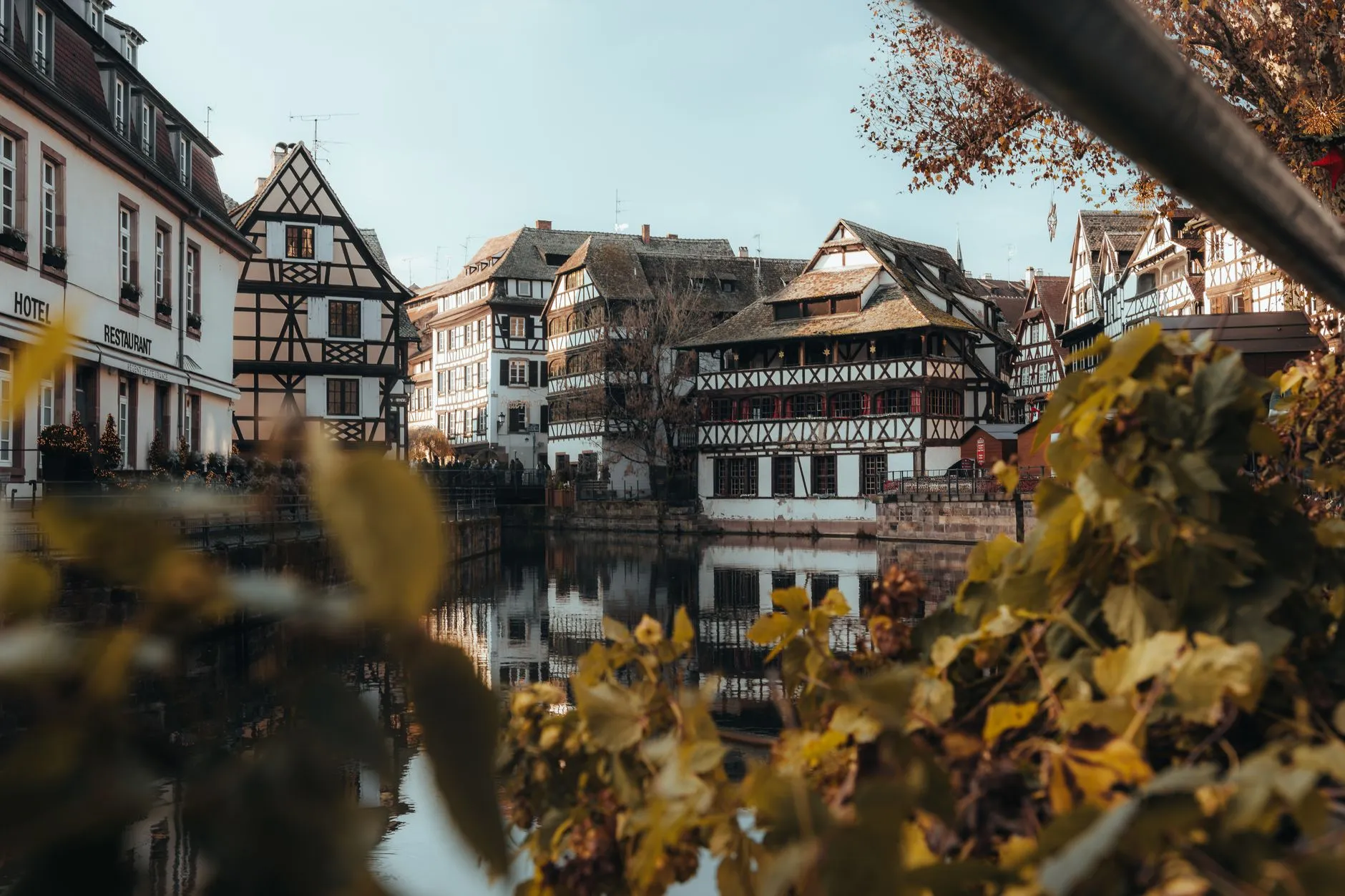
Fly here in winter, specifically, if you want the Christmas markets. This is where the airport’s own commercial strategy tells you something useful. easyJet opened Bristol from 20 November 2026, twice weekly on Mondays and Fridays, and the airline said out loud it was timed for the Christmas market season. Jet2.com and Jet2CityBreaks added Edinburgh, Manchester and London Stansted for winter 2026/27, two flights a week each. The markets themselves are not only in Strasbourg: the airport’s own events calendar lists them across Alsace from 20 November — Haguenau, Sélestat from 20 November to 27 December, Obernai from 27 November to 23 December, Bouxwiller. Book the flight before you book the hotel; the hotels go first.
Fly here if you are going to the Alsace wine road, the Vosges, or across the Rhine. Strasbourg sits on the German border — the Rhine is the border — so a hire car from this airport puts you in the Black Forest the same morning. The wine villages — Obernai, Ribeauvillé, Riquewihr, Eguisheim — run south along the foot of the Vosges and are the reason most people who come back, come back.
Now the honest half: when should you not fly here?
Do not fly here for a long-haul connection if you have a real alternative. Strasbourg’s hub links are Frankfurt and Munich on Lufthansa, Madrid on Iberia, Warsaw on LOT and Rome, and every intercontinental journey means a connection. That is a perfectly good arrangement for a business trip; it is a poor one for a family with three hold bags and a tight transfer.
Do not fly here if your destination is anywhere the TGV reaches faster door to door. The station the airport connects to is a high-speed station, and for a large slice of France and southwest Germany the train wins on total journey time once you count check-in, security and the transfer at the far end. Strasbourg is one of the few airports honest enough to make its own rail link the first thing on its access page.
And do not expect a big airport’s comforts. There is no lounge, there is no overnight terminal, and the building closes thirty minutes after the last aircraft lands. What you get instead is an airport you can arrive at 75 minutes before departure and still make comfortably — which, on balance, is the better deal. Before you book, run the route through our flight price check: with Volotea, easyJet, Transavia and the legacy carriers all overlapping on this small a field, the spread between the best and worst fare on the same day is wider here than the distances justify.
❓ Frequently Asked Questions
📊 2026 Summary Data Table
| Category | Detail |
|---|---|
| Airport | Strasbourg Airport (SXB / LFST), RM 221 / Route de l’Aéroport, 67960 Entzheim |
| Location | About 10 km southwest of Strasbourg cathedral |
| Passengers 2025 | 1,302,008 (Eurostat), up from 1,227,404 in 2024 |
| Domestic vs international | 747,454 domestic / 554,554 international |
| Inside vs outside the EU | International split 296,955 intra-EU / 257,599 extra-EU — nearly half of international traffic is outside the EU |
| Routes | 45 direct destinations, 9 charter routes. ⚠️ No flight to Paris |
| Biggest airline | Volotea — based here, 28 routes in 8 countries; holds the public-service delegation for Copenhagen |
| Terminal hours | Opens 2 h before the first flight; closes 30 min after the last arrival. Overnight stays not permitted |
| Train | Shuttle train up to 5×/hour, 8 minutes to Gare de Strasbourg; covered walkway to the platform |
| Train fares | €3.20 TER single · €4.60 combined 24-hour bus/tram/coach/TER ticket · from €1.90 on the CTS app for immediate departure |
| Bus / taxi | No airport bus. A taxi rank is on the floor plan, but no operator or fare is published |
| Parking | P1 drop-off (15 min free) · P2 €25/24 h, weekend €35 · P3 covered €32 · P4 €74/week · P5 €64/week, the cheapest. Free for TER station users on P2 and P3 |
| EV charging | 4 bays on P2 |
| Lounge | None. Free espaces détente with power sockets in departures, arrivals first floor and the boarding halls |
| Business centre | 5 rooms, most with runway views; from €45/hour, conference room €520/day excl. VAT |
| Shops & food | Relay + MINUTE (public hall) · Aelia duty free and Bread & Co (ground-floor boarding hall) · second Relay (first-floor boarding hall) |
| Currency | Euro (€) — France is in the eurozone. CIC cash machine in arrivals |
| Schengen | Yes. EES fully operational since 10 April 2026 — fingerprints and facial image replace the passport stamp, across 29 countries |
| ETIAS | Not in operation; no applications are being collected and no launch date has been announced. Fee fixed at €20 by Delegated Regulation (EU) 2025/1411; waived under 18 and over 70 |