Ohrid St. Paul the Apostle (OHD) Airport Guide 2026 — No Bus, Bring Denars
Ohrid St. Paul the Apostle Airport sits on the A2 about 9 km northwest of the old town, midway between Ohrid and Struga, 705 m above sea level. It is North Macedonia’s second airport after Skopje and it exists for one reason: to put tourists next to Lake Ohrid. Every single passenger here is on an international flight — Eurostat records zero domestic traffic at Ohrid, and Skopje logged all of 16 domestic passengers in 2025. The one fact to plan around: there is no scheduled bus to the airport, and the airport says so itself. Budget for a taxi. Currency is the Macedonian denar, entry runs on North Macedonia’s own rules rather than any EU system, and the lake outside is a mixed UNESCO property shared with Albania.
Last verified: September 2026.
⚡ 2026 Quick Reference — Key Facts at a Glance
None. The airport’s own site: “There is no regular shuttle bus for passengers” — only tour-operator coaches tied to charter flights
The concession is held by Mercedes taxi (dial 13666, or +389 70 269 192). The airport’s linked price list is a dead 2022 image — agree the fare before you load the bags
6 agencies at the airport, per the airport’s own transport page. The sane choice if the lake, Galičica and Sveti Naum are the trip
9 km northwest of Ohrid; OpenStreetMap road distances put both Ohrid and Struga town centres at roughly 14–15 km — a short drive either way
Macedonian denar (MKD). The European Commission’s InforEuro accounting rate this month is 61.47 MKD = €1
One — TAV primeclass VIP/CIP, €45 including 18% VAT, in a separate building to the left of the terminal
North Macedonia’s own rules. Most Western passports: up to 3 months, no visa. EU/EEA nationals may enter on a national ID card
UK government guidance: expiry date at least 90 days after your arrival date
Register with local police within 48 hours of arrival. Hotels do it at check-in; private rentals often do not
264,989 passengers in 2025 (Eurostat) — 100% international, 0 domestic. 2024 was 222,655
Single 01/19, 2,550 m asphalt, elevation 705 m. Narrow-bodies only
🏢 1. One Terminal, One Runway, and a Schedule That Empties in Winter
Ohrid is a small airport and it does not pretend otherwise. One terminal building, one asphalt runway (01/19, 2,550 m), an apron widely reported to hold nine aircraft, and a terminal rating usually quoted at 400,000 passengers a year — neither figure appears on the airport’s own site, so treat both as secondary — against 2025 traffic of 264,989. That is roughly two-thirds full on paper — but the paper is annual and the traffic is not.
Two structural numbers shape everything you will experience here. The first is the elevation: 705 m, which is high for a coastal-feeling lake resort and thins the air enough to matter on a hot afternoon. The second is the runway length: 2,550 m. Together they cap what can operate here at narrow-bodies. The heaviest regular visitor is a TUI Boeing 737-800 from Gatwick or Manchester; everything else is an A320-family aircraft, a 737, or — on Air Serbia’s Belgrade run — an ATR 72 turboprop. Do not expect a wide-body and do not expect a long-haul connection to be sold to you through here.
The traffic mix is the interesting part. I pulled Ohrid’s numbers from Eurostat’s airport dataset rather than trusting a secondary figure, and two things fall straight out. First, national transport is zero in every year — and Skopje, the country’s main airport, recorded just 16 domestic passengers across the whole of 2025 against 3.2 million international. North Macedonia effectively has no domestic air service, so every passenger through OHD is crossing a border. Second, the composition has flipped. Non-scheduled (charter) traffic fell from 36,901 in 2023 to 26,626 in 2024 to 14,863 in 2025, while scheduled traffic climbed from 228,159 to 250,126 over the same period. Ohrid used to be a charter airport with a few scheduled routes bolted on. It is now a low-cost scheduled airport with a charter rump.
Who actually flies here, from the airport’s own published timetable. The summer 2026 schedule (29 March – 25 October) lists nine operators:
- Wizz Air — the volume carrier by a distance. Basel/Mulhouse, Dortmund and Memmingen run right across the season; Bratislava, Katowice, Wrocław and Milan–Malpensa are listed as seasonal, and Stuttgart appears for a few weeks in April and May.
- Chair Airlines — Zürich, and the only route that genuinely runs all year.
- Edelweiss Air — Zürich, summer plus a scatter of Christmas and New Year dates.
- Austrian Airlines — Vienna, May to October.
- Air Serbia — Belgrade on the ATR 72, June to October.
- Turkish Airlines — Istanbul, mid-June to early October.
- TUI Airways — London–Gatwick on Wednesdays and Manchester on Sundays, late May to mid-September.
- TUI fly Netherlands — Amsterdam three days a week, May to September.
- GP Aviation — Basel–Mulhouse on a Boeing 737-400, July and August only.
That list is the airport’s own published summer schedule, and it is worth treating as a starting point rather than a guarantee: Wizz in particular revises its Ohrid list inside the season, so check the airline’s booking page for your own dates before you build a trip on a single route. Now compare the winter timetable, and the seasonality stops being an abstraction. Winter 2025/26 carried three operators: Chair to Zürich, Edelweiss to Zürich on a handful of holiday dates, and Wizz Air on Dortmund, Memmingen, Mulhouse, Vienna and a late-March Bratislava. That is it. If you are planning a February trip to Ohrid, your realistic options are Zürich, a Wizz base, or flying into Skopje and driving three hours. Check the airport’s own PDF timetable before you assume a summer route exists in your month — the winter schedule for 2026/27 was not yet published when I checked.
Airline fare classes are where Ohrid trips go wrong. Wizz Air, Chair and TUI all sell down to fares that carry a cabin bag and nothing else, and the difference between the headline price and the price with a suitcase is frequently larger than the fare itself on a route this short. Our Wizz Air baggage guide, Chair Airlines guide, TUI Airways guide and Austrian Airlines guide carry the current allowances, and the baggage checker puts them side by side.
Inside the building. There is an information desk immediately on your left as you enter, an ICE International currency exchange office, free WiFi provided with Makedonski Telekom, a 24/7 medical service, a luggage office and paid baggage custody if you want to leave something for the day. ATU runs the duty-free shop in the terminal. Arrivals is small and there is no arrivals hall lounge; people meeting flights wait outside the doors, which in July is genuinely pleasant and in January is not.
🛂 2. Entry Rules, Denars and the 48-Hour Registration
North Macedonia is not in the European Union and it is not in the EU’s border system. None of the EU entry machinery you may have read about applies at Ohrid. What you get here is an old-fashioned passport control with a physical stamp, run under North Macedonia’s own law — and one piece of paperwork that catches visitors out badly.
Visa-free entry. UK government guidance is explicit: you can visit North Macedonia for up to 3 months without a visa. The same short-stay treatment applies to the great majority of Western passports — EU and EEA nationals, and the usual list of visa-free countries. The Macedonian Ministry of Foreign Affairs adds a detail worth knowing if you are flying in from an EU country: nationals of EU member states do not need a visa and may enter on a valid national identity card rather than a passport. If you are an EU citizen connecting through Vienna or Zürich on your ID card, you are fine at Ohrid — but check what your airline will accept at check-in, because that is a separate question from what the border will accept.
Passport validity. UK government advice for North Macedonia is that your passport must have an expiry date at least 90 days after the date you arrive. That is more generous than the six-month rule you may be used to elsewhere, but airlines routinely apply their own blanket six months at the desk, so treat six months as the practical bar and 90 days as the published minimum. Separately, the Ministry of Foreign Affairs requires anyone applying for a short-stay “C” visa to hold a travel document valid at least three months beyond the intended stay — a different rule, for a different group of people, and the two get conflated constantly online.
The 48-hour registration, which is the real trap. North Macedonia requires foreign visitors to register with the local police in the town where they are staying within 48 hours of arrival. If you are in a hotel, the staff do this at check-in and you will never notice. If you have booked a private apartment or a room on the lakefront — which is exactly what most people do in Ohrid — the host may or may not do it, and the obligation is yours. UK government guidance is blunt about the consequences of skipping it: a fine, detention and a court hearing, or a restriction on returning to the country. It also tells you to keep the registration document with you until you leave, and that if you registered directly with the police rather than through a hotel, you must de-register 24 hours before departure. Ask your host, in writing, whether they are registering you. It takes one message.
If you hold neither an EU passport nor a visa-free one, there is a provision that saves a lot of people a lot of money. The Ministry of Foreign Affairs allows third-country nationals holding a valid multiple-entry EU/Schengen “C” visa, or temporary or permanent residence in an EU or Schengen state, to enter for no more than 15 days per entry, with the total not exceeding 90 days in any 180-day period, provided that visa is valid at least five days beyond the intended stay. The same treatment is extended to holders of valid multiple-entry British, American or Canadian visas, under an arrangement the ministry currently publishes as running to 31 December 2026. This is about the other document in your passport, not about North Macedonia belonging to anything. If it applies to you, print the ministry’s page and carry it.
Cash declaration. Declare foreign currency of €10,000 or more on entry. UK government guidance warns that if you do not, customs officers may detain you and seize the cash when you try to leave.
The denar, and why you should not turn up with only euros. North Macedonia uses the Macedonian denar (MKD), and it is not the euro. The denar has been held stable against the euro for many years — the European Commission’s InforEuro accounting rate for this month is 61.47 denars to €1, and a rough mental conversion of 60 denars to the euro will not embarrass you.
Here is the honest answer to the question everyone asks. Euros are widely understood in Ohrid, and in high season a hotel or a boat operator will often quote and take them. That is a tourist-market convenience, not the law and not the norm: restaurants, shops, the bus, the museum window and the taxi all work in denars, and paying euros there means accepting whatever rate the person in front of you fancies. Get denars. There is an ICE International currency exchange office in the terminal, and exchange offices (менувачница) all over the old town, which usually beat the airport rate. Cards work in hotels, larger restaurants and supermarkets, less reliably in the small lakefront places, and not at all at some monastery ticket desks — carry cash.
Two mechanical rules save real money. When a card terminal or an ATM offers to charge you in euros or pounds instead of denars, decline: that is dynamic currency conversion, the rate is set by the machine’s operator rather than your bank, and it is always worse. And prefer a bank-branded ATM to a standalone one, withdrawing once rather than several times against a per-transaction fee.
🚌 3. There Is No Airport Bus. Here Is What There Actually Is
This is the single most useful sentence in this guide, and it is the airport’s own: “There is no regular shuttle bus for passengers to Ohrid St. Paul the Apostle Airport; there is only organized shuttle bus transportation within the arranged tours/seasonal (charter) flights by the local travel agencies.” No municipal line, no branded airport express, no timetable to memorise. If you arrive expecting to find one, you will be standing outside a small terminal in Debarca municipality with a suitcase.
Taxi is the default. The airport publishes a taxi concession — Mercedes taxi, reachable on the short code 13666 or on +389 70 269 192 — and the cars meet arriving flights. The airport’s transport page links a price list, but that list is an image dated 2022 that no longer loads from their server, so I am not going to quote you a number the operator can no longer be held to. Agree the fare before the bags go in the boot, in denars, and if the meter is running make sure you saw it start. If you want a firm number in advance, email or ring the operator with your flight number — a company that runs an airport concession will quote you.
Pre-booked transfer is the better move for most people. Almost every hotel in Ohrid and Struga will send a car for a fixed price, and because the flights are so concentrated — a handful of arrivals a day, mostly in daylight — they are used to it. Book it when you book the room. This is not an airport where you improvise.
Rent a car if the trip is about the region. The airport’s own transport page states there are six rent-a-car agencies on site. Given that Galičica National Park, Sveti Naum at the southern end of the lake and the Prespa side all need a vehicle or an organised tour, and given the total absence of a bus, this is the option I would take for anything longer than a city break.
Onward to Skopje. It is a long drive — OpenStreetMap routing puts it at about 166 km and over three hours, because the route crosses mountains rather than running on motorway. Intercity coaches leave from Ohrid’s bus station in town, not the airport. If your trip is really about Skopje, fly to Skopje.
| Option | Where it goes | Time | What to know |
|---|---|---|---|
| Airport bus | — | — | Does not exist. Airport’s own words. Only tour-operator coaches tied to charters |
| Taxi (Mercedes, 13666) | Ohrid, Struga, anywhere | Short drive, ~14–15 km either way | Meets flights. Airport’s linked price list is a dead 2022 file — agree the fare first |
| Hotel / pre-booked transfer | Door to door | Same | The sane default. Arrange when you book the room |
| Rent-a-car (6 agencies on site) | Everywhere | — | The right call for Galičica, Sveti Naum and the Prespa side |
| Intercity coach to Skopje | From Ohrid bus station, not the airport | ~3 h+ by road | Get into town first. Ohrid–Skopje is a mountain drive, not a motorway run |
🛋️ 4. One Lounge, €45, and It Is Not Inside the Terminal
Ohrid has exactly one lounge and it is unusual enough to explain properly. TAV operates a primeclass VIP and CIP lounge, and it is not in the departures pier — it is in a separate building reached from the left-hand side of the terminal. The airport’s own page prices it at €45, 18% VAT included, and lists internet, television, newspapers and magazines, and refreshments available round the clock. Bookings and questions go to the primeclass team on +389 2 3148 367 or +389 72 236 467.
Is it worth €45? For a family on a summer Saturday when three narrow-bodies are turning at once and the airside snack bar is one small counter, possibly. For a Tuesday in April with one Wizz departure on the board, definitely not — you will have the terminal largely to yourself. What the price buys at Ohrid is space rather than luxury, and because the lounge is in its own building rather than airside, it is more of a pre-security waiting room than a departure-gate lounge. Ask how the timing works with security when you book, so you are not still landside when your gate closes.
If you carry a lounge programme card, do not assume it works here. Ohrid is a small TAV station and access is priced at the door. Plan on paying, or plan on the snack bar.
🍽️ 5. Trout, Ajvar, Pearls and a Very Small Snack Bar
Do not eat at the airport if you can avoid it. The published outlets are a snack bar in the arrivals hall on the landside, a second small snack bar airside past passport control and security, a summer bar outside the terminal under the shade, and a 30-seat restaurant. There is an ATU duty-free shop. That is the whole offer, and at a station of this size it is entirely reasonable — but it is a sandwich and a coffee, not a meal.
Eat in Ohrid instead, where the food is genuinely regional. Lake Ohrid trout is the dish the town is known for. UNESCO’s own description of the lake records 17 endemic species of fish, including two species of trout — the endemic Ohrid trout is one of the things the property is listed for, and it is not an ordinary farmed fish. Menus in Ohrid are not always precise about which trout is on the plate, and the price gap between the lake fish and a farmed one is large. Ask which you are being served before you order. Beyond the trout, the staples are Balkan and excellent: ajvar, the roasted red pepper relish that Macedonian households still make in autumn by the bucket; tavče gravče, baked beans in a clay pot; шопска / šopska salad under a snowdrift of white cheese; grilled meat in every form; and rakija, which is stronger than it looks.
For things to carry home, two are worth the suitcase space. Ajvar in jars, bought in a supermarket rather than a souvenir shop, is the best-value food souvenir in the country. And Ohrid pearls are the local speciality — jewellery sold from a handful of workshops in the old town, made to a family process rather than farmed from molluscs. That is the point to understand before you buy: these are not oyster pearls, the workshops that make them are few, and the identical-looking strings on the promenade stalls are a different product at a different price. Buy from a shop that will tell you who made them, and expect to pay accordingly.
Alcohol and tobacco allowances into the EU are the usual duty-free limits, and the ATU shop in the terminal is small. Do your shopping in Ohrid.
💡 6. What the Lake Is Actually For
The listing outside is bigger than most people realise, and it is worth being precise about what it covers, because “UNESCO lake” undersells it. The property is called the Natural and Cultural Heritage of the Ohrid region. It is a mixed World Heritage property — inscribed for its natural values in 1979, extended to cover its cultural values in 1980, and extended again in 2019 to take in the Albanian part of the lake, including the Lin Peninsula. It is shared between North Macedonia and Albania, meets four criteria — (i), (iii), (iv) and (vii) — and covers 94,728.6 hectares with a further 15,944.4 hectares of buffer zone.
So the listing is not “a pretty lake”. It is the lake and the town and the shoreline archaeology and the Albanian side, on both cultural and natural grounds at once. Ohrid is one of a very small number of sites in the world that carry both.
The lake itself is the natural half. Lake Ohrid is a deep tectonic lake that has existed continuously for roughly two to three million years, and its oligotrophic water holds over 200 species of plants and animals found nowhere else — flatworms, snails, crustaceans, algae and those 17 endemic fish. Swimming in it in August is one of the better things you can do in the Balkans; the water is startlingly clear and, at nearly 700 m of altitude, cold well into June.
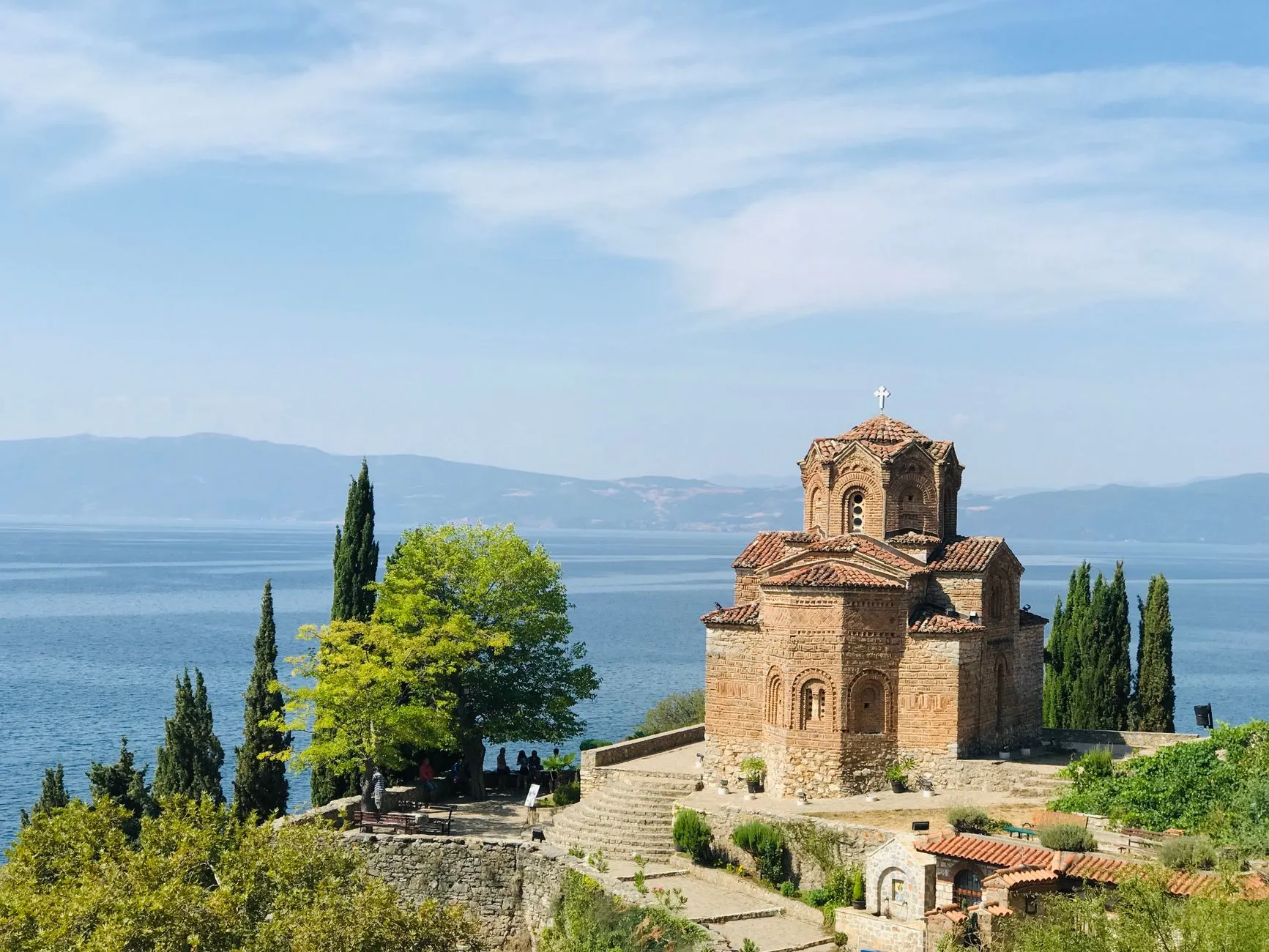
Ohrid town is the cultural half, and it is compact. The old town is stacked up a hill between the lakeshore and Samuel’s Fortress, and you can walk the essentials in a day. St John at Kaneo, the small church on the bluff above the water, is the postcard and deserves to be. St Sophia, an 11th-century church, holds some of the most important Byzantine frescoes in the region; UNESCO counts more than 2,500 m² of frescoes and over 800 icons across the property, dating from the 11th to the 14th centuries. Plaošnik and the monastery of St Pantelejmon sit further up, on a site where archaeologists have uncovered a string of early-Christian basilicas. The ancient theatre is Hellenistic and still used for concerts. Ohrid has a population of a little over 38,000 and the historic core is small enough that you will keep re-crossing your own path.
Sveti Naum is the day trip. The monastery stands on the lakeshore 29 kilometres south of Ohrid, at Ljubaništa, essentially on the Albanian border, above the springs that feed the lake. Go by boat from Ohrid’s harbour if the weather allows — the crossing is the point — or drive the lakeside road, which is beautiful and slow. Give it half a day.
Struga is not a suburb of Ohrid and should not be treated as one. It sits at the northern end of the lake where the Crn Drim river flows out, it is 14 km or so from the airport by road, and its life happens along the river rather than the shore. It is quieter, cheaper and more local than Ohrid, its beaches are better for actually swimming, and every August it hosts the Struga Poetry Evenings, an international festival that has been awarding its Golden Wreath since the 1960s to poets including Auden, Neruda, Ginsberg, Heaney and Brodsky. If Ohrid old town is booked out in high summer, Struga is the answer rather than the consolation.
Galičica is the mountain ridge between Lake Ohrid and Lake Prespa, protected as a national park, and it is the reason to have a car. The road over the top gives you both lakes in the same view. Prespa on the far side is emptier, higher and colder, and shares borders with Albania and Greece.
Practical planning notes. The season here is short and sharp: the timetable above tells you the airport effectively closes down between November and March. July and August are hot, full and expensive; late May, June and September are the sweet spot, with the lake warm enough to swim from about mid-June. The airport’s altitude and the surrounding mountains mean weather can move fast. And because the schedule is thin, a cancellation is not a two-hour problem — miss a Wednesday Gatwick and the next one is a week away, so build slack into anything connecting onward. Run your dates through our price checker before committing: on a route list this seasonal, moving a trip by two weeks changes the fare far more than it changes the weather.
❓ Frequently Asked Questions
📊 2026 Summary Data Table
| Category | Detail |
|---|---|
| IATA / ICAO | OHD / LWOH |
| Official name | Ohrid “St. Paul the Apostle” Airport (Аеродром „Св. Апостол Павле” Охрид) |
| Operator | TAV Airports (concession since 2008) |
| Location | Debarca Municipality, on the A2 ~9 km northwest of Ohrid, between Ohrid and Struga |
| Elevation | 705 m (2,313 ft) |
| Runway | Single 01/19 · 2,550 m asphalt · narrow-bodies only |
| Apron / terminal | One terminal · apron and 400,000-a-year capacity are widely quoted but not published by the airport itself |
| 2025 passengers | 264,989 (2025) — 100% international, 0 domestic (Eurostat). Skopje, for scale, carried 3,206,827 |
| 2024 passengers | 222,655 (Eurostat) |
| Scheduled vs charter 2025 | 250,126 scheduled / 14,863 non-scheduled — charter has collapsed since 2023 |
| Summer 2026 airlines | Wizz Air, Chair, Edelweiss, Austrian, Air Serbia, Turkish Airlines, TUI Airways, TUI fly Netherlands, GP Aviation |
| Winter 2025/26 airlines | Three — Chair (Zürich), Edelweiss (holiday dates), Wizz Air |
| Airport bus | None. Airport’s own statement. Tour-operator coaches on charters only |
| Taxi | Mercedes taxi concession — 13666 / +389 70 269 192. Linked price list is a dead 2022 file |
| Rent-a-car | 6 agencies on site |
| Lounge | TAV primeclass VIP/CIP, €45 incl. 18% VAT, separate building left of the terminal |
| Terminal services | Information desk, ICE currency exchange, ATU duty free, free WiFi (Makedonski Telekom), 24/7 medical, baggage custody, 2 snack bars + 30-seat restaurant |
| Currency | Macedonian denar (MKD) — 61.47 = €1 (EC InforEuro this month). Get denars; euros are a tourist convenience, not the norm |
| Border regime | North Macedonia’s own system — not an EU or EU-border state. Up to 3 months visa-free for most Western passports; EU/EEA national ID card accepted; passport valid 90+ days beyond arrival |
| Registration | Police registration within 48 hours of arrival. Hotels do it; private hosts often do not. De-register 24 h before leaving if you registered yourself |
| Cash declaration | Declare €10,000 or more on entry |
| UNESCO | Natural and Cultural Heritage of the Ohrid region — mixed, criteria (i)(iii)(iv)(vii), inscribed 1979/1980, extended into Albania 2019, 94,728.6 ha |
| Region | Ohrid old town, St John at Kaneo, St Sophia, Plaošnik, Samuel’s Fortress, Sveti Naum (29 km south), Struga, Galičica National Park, Lake Prespa |