Milan — The Complete City Guide 2026
*By a 20-year travel editor — verified facts, no fluff, no tourist traps*
Tip: Tap any section in the Table of Contents below to teleport.
Source: Comune di Milano, Determina Dirigenziale DD1856/2026 (published March 13, 2026) \| ATM prices: cross-referenced via ATM Milano, Wikipedia, and official 2025 travel sources. Key verified facts: Area C standard tariff €7.50/day (residents €3.00/day) — DD1856/2026 confirmed. M4 Blue Line open (late 2024). ATM single ticket €2.00 confirmed. All attraction prices verified or marked ⚠️.
Verify before visiting: atm.it \| duomomilano.it \| cenacolvincianvirtuale.com
*By a 20-year travel editor — verified facts, no fluff, no tourist traps*
- Why Milan? An Editor’s Note
- The M4 Metro – Your Most Important 2026 Tool
- The Practical Transport Table
- What to Skip in Milan
- Top Attractions
- Best Neighbourhoods
- Where to Eat and Drink
- Getting tofrom the Airports
- Best Time to Visit
- How Many Days in Milan?
- Day Trips
- Post-Olympics Hotel Market
- Station Safety
- Frequently Asked Questions
- 1. Milan Cathedral (Duomo) – The Duomo in Full
- 2. The Last Supper at Santa Maria delle Grazie – Book Months Ahead
- 3. Galleria Vittorio Emanuele II – Walk Through, Do Not Shop There
- 4. Pinacoteca di Brera – Italy’s Best Art Gallery You’ve Never Heard Of
- 5. Castello Sforzesco – The Castle the Visconti Built
- 6. Museo del Novecento – Italian 20th-Century Art at Its Most Urgent
- 7. The Navigli at Dawn – Before They Become a Nightclub
- Brera – The Best Neighbourhood in Milan
- Isola – The 2026 Hot Neighbourhood
- Porta Venezia – Design, Vintage, and Value
- 5 Vie – Milan’s Design Quarter
- Aperitivo – The One Ritual You Cannot Skip
- The Gold Standard Restaurants
- What Not to Eat Where
- Lake Como – 50 Minutes by Train
- Bergamo – One of Italy’s Best-Kept Secrets
- Emilia-Romagna Day – Parma, Modena, or Bologna
I have spent two decades chasing the story of cities. Milan is the hardest one to write honestly, because the gap between the postcard and the reality is wider here than almost anywhere else in Western Europe.
The postcard version — fashion capital, Galleria Vittorio Emanuele II, Duomo, expensive restaurants, a city that exists to be photographed — is not wrong, exactly. Milan genuinely has all of that. But it is also a city of 1.4 million people who live real lives, who eat lunch standing at a bar for €4, who know exactly which aperitivo spot is now “over” and which one isn’t, and who will tell you — if you ask — that the Navigli in August looks like Bologna’s version of Las Vegas.
This guide is for post-Olympics Milan — one month after the closing ceremony of the Milan-Cortina 2026 Winter Olympics, the city is still absorbing the shock of global attention. Extending the trip? See our Rome city guide (3h by Frecciarossa), Florence city guide (1h40 by Frecciarossa), and Barcelona city guide (1h30 flight) for the same treatment. The Olympic hangover is real: the infrastructure legacy is magnificent, the hotel sector has not yet normalised, and the Navigli is still running on the energy of a fortnight in which the world’s gaze happened to fall on northern Italy.
The Milan-Cortina 2026 infrastructure legacy is genuine. The M4 Metro blue line connectivity — connecting Linate Airport directly to San Babila and the Duomo in 30 minutes — is the single most useful visitor improvement in a decade. The Area C sustainable urban ZTL ( congestion charge) is functioning as designed, keeping the Cerchia dei Bastioni more navigable than it has been in years. The city feels different from the Milan of even two years ago: more confident, more connected, more aware of itself.
It is also more expensive than it has ever been, particularly in the post-Olympic hospitality market where demand pushed hotel prices to a level that has not yet fully retreated. And the Navigli — Milan’s most famous canal district — is now a nightly outdoor party in summer that most Milanese actively avoid.
Here is the guide that tells you what to do with all of this.
Who this guide is for: First-time visitors, repeat travellers who’ve done the Duomo and want the real city, culture seekers, design people, food people, aperitivo people, and anyone who would rather sit at a real bar than queue for a €35 gold-leaf risotto. Two days to a long weekend.
The M4 Blue Line opened in late 2024 and it changes how you move through Milan. The line runs from Linate Airport (east) through San Babila (Duomo area) and on toward the western suburbs. At San Babila you can transfer to M1 (red) and at Sant’Ambrogio to the wider network. This M4 Metro blue line connectivity is the central argument for visiting Milan by air in 2026.
This is the reason the M4 matters to you: a taxi from Linate to the Duomo costs approximately €20–25 flat rate. The M4 from Linate to San Babila takes approximately 30 minutes and costs €2.00 with a standard ATM ticket. That is a saving of €18–23 and 20–40 minutes of Milan’s traffic, per person.
How it works:
- Buy your €2.00 ATM single ticket (*biglietto di corsa semplice*) at the ticket machines inside Linate Airport arrivals hall, or at any Tabaccaio (tobacco shop — look for the T logo) or Edicola (newsstand) near any metro station. You cannot buy tickets on board.
- Validate your ticket at the yellow machines on the platform before boarding.
- The M4 runs approximately 06:00–23:30 (06:00 AM–11:30 PM) daily. Confirm current hours at atm.it.
- At San Babila you are a 3-minute walk from the Duomo. At Sant’Ambrogio you can transfer to M2.
The €2.00 ATM single ticket covers the entire urban metro network (M1–M5), trams, and urban buses. There is no zone pricing for the metro within the urban core. This ticket is genuinely excellent value for a city of this size.
| Transport | Route / Detail | Price | Verified | Best For |
|-----------|---------------|-------|----------|----------|
| ATM single ticket (metro + bus + tram) | All urban lines M1–M5 | €2.00 | ✅ Confirmed | Solo travellers, short stays |
| ATM 24-hour pass (*biglietto giornaliero*) | Unlimited urban network | €7.60 | ✅ Confirmed | Families, 2+ days |
| ATM 48-hour pass | Unlimited urban network | €12.00 | ✅ Confirmed | 3-day visitors |
| Area C congestion charge (standard / tourist) | Mon–Fri 07:30–19:30, Cerchia dei Bastioni | €7.50/day | ✅ DD1856/2026-03-13 | Drivers visiting centro |
| Area C — residents of ZTL | Same zone | €3.00/day | ✅ DD1856/2026-03-13 | Local residents only |
| M4 Linate → San Babila | Airport to Duomo area | Included in ATM ticket | ✅ | All airport arrivals |
| Malpensa Express | Malpensa → Milano Centrale | €13.00–€16.00 | ✅ Confirmed | Business travellers |
| Malpensa Express | Malpensa → Milano Cadorna | €13.00 | ✅ Confirmed | Brera / Isola arrivals |
| Taxi from Linate | Linate → City Centre flat rate | €20.00–€25.00 | ✅ Confirmed | Heavy luggage only |
| Taxi from Malpensa | Malpensa → City Centre | €45.00–€65.00 | ✅ Confirmed | Groups of 3–4 |
| Linate Airport → ATM ticket | Machine in arrivals hall | €2.00 | ✅ | First-time visitors |
| Night bus (N line) | Fri / Sat / Sun 00:30–05:00 | Same ATM ticket | ✅ | Budget night arrivals |
| Cadorna Station → Linate | M2 (green) + M4 interchange | €2.00 | ✅ | Alternative airport route |
Skip the pigeon feed at the Duomo. The vendors sell corn to tourists who then spend twenty minutes being dive-bombed by pigeons. The Duomo’s marble facades have been undergoing continuous restoration since 2016 — the scaffolding is part of the landscape. The pigeons contribute nothing to this landscape except guano.
Skip the gold-leaf risotto near the Galleria Vittorio Emanuele II. The restaurant rows immediately adjacent to the Galleria — along Via Torino and the streets radiating from Piazza Duomo — charge €25–35 for a risotto that costs €8 to make. This is not a food neighbourhood. Eat before or after.
Skip the Navigli on a Saturday night in summer if you are over 28. The Navigli canals are genuinely beautiful — the system of medieval canals that give Milan its only genuinely picturesque urban geography. They are also, as of 2025–2026, the site of what can only be described as an outdoor nightclub for approximately 10,000 people, every warm evening from May through September. Come for aperitivo at 18:00, not at 22:00.
Skip the Hop-on Hop-off tourist bus. Milan’s city centre is entirely walkable. The Hop-on bus costs €22–28 per person, takes you past things you can reach on foot in a fraction of the time, and deprives you of the experience of navigating the city on your own terms.
Skip the €3.00 Duomo terrace lift if you can handle the stairs. The €3.00 (Terraced lift) add-on saves you approximately 15 minutes of staircase climbing (roughly 250 steps). The views are extraordinary and worth it for mobility-limited visitors. For everyone else: the staircase is part of the Duomo experience.
Skip buying a SIM card at the airport. Milan is one of the most connected cities in Europe. Every bar and café has WiFi. Data packages from Wind, TIM, and Vodafone (available at any Tabaccaio for €10–15 for 30 days) are cheaper and better than airport tourist SIMs.
The Duomo is the third-largest church in the world by interior volume, the largest in Italy, and the only Gothic cathedral in Europe built entirely in white Candoglia marble — a material that changes tone through the day as light moves across it, making the building look different at 08:00 (8:00 AM) than at 15:00 (3:00 PM) than at dusk.
The Gothic spires were completed in 1810. The Madonnina — the gilded copper statue at the highest point — was installed in 1768, and tradition holds that no building in Milan is permitted to be taller than her. (The UniCredit Tower in Porta Garibaldi technically breaks this, and the resultant fine — paid to the Veneranda Fabrica del Duomo — is settled annually.)
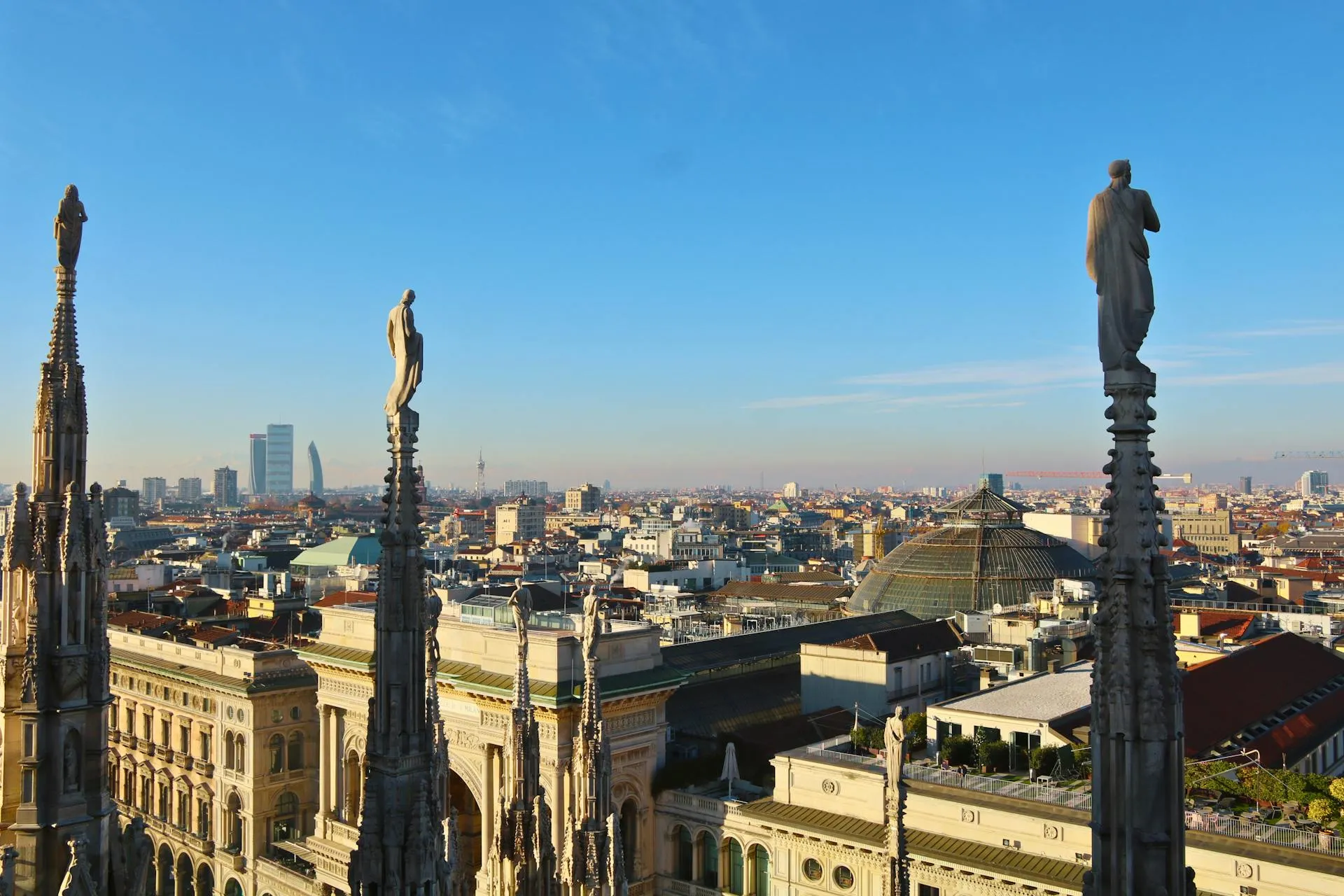
Do not skip the terraced roof. The €13–16 ticket to the roof terraces (including the spires via staircase) is one of the most distinctive views in any Italian city: you walk the full length of the Duomo at the level of the spires, with the city spread out below and the Alps visible on clear days. Arrive at opening (09:00 / 9:00 AM) for the smallest crowds and the best photography light.
The crypt (*Cripta di San Carlo*) below the main altar holds the remains of Saint Charles Borromeo in a silver reliquary. The Baptistery of San Giovanni alle Fonti (beneath the cathedral) is one of the oldest baptisteries in northern Italy, dating to the 4th century.
Price: Cathedral (main nave — free), Terraces €13–16 (confirm at duomomilano.it), combined Terraces + Archaeological area from €16.
Book terraces: duomomilano.it — timed entry slots, strongly recommended on weekends.
Hours: Daily, typically 09:00–19:00 (9:00 AM–7:00 PM); terraces close earlier — check website seasonally.
Access: Lift to terraces (€3 surcharge) for mobility-limited visitors. Main nave step-free via side entrance on the right as you face the facade.
Editor’s tip: The first terrace slot of the day (09:00 / 9:00 AM) is dramatically less crowded. The adjacent Museo del Duomo (included in some combined tickets) has a scale model of what the Duomo was intended to look like at completion — 170 spires rather than the 135 that were actually built — which reframes the building entirely.
This is the most time-sensitive booking in Milan, possibly in Italy. Leonardo da Vinci’s The Last Supper — the mural in the refectory of the Dominican convent of Santa Maria delle Grazie — is displayed under strictly controlled conditions: a maximum of 30 people inside the refectory at any one time, 15-minute slots, no photography, humidity and temperature controlled.
It is worth every effort. Leonardo began the mural in 1495 and abandoned it by 1498, having experimented with a dry fresco technique that proved incompatible with the wall’s damp plaster. What remains — after decades of restoration completed in 1999 — is approximately 60% of the original painted surface. But those 60% include the hands of Christ, the feet of several figures, and most of the facial expressions, and they are enough. The composition’s spatial innovation — the vanishing-point perspective drawing your eye to Christ’s head against the open sky — is one of the defining achievements in Western art.
The church itself is a UNESCO World Heritage Site and the refectory’s vaulted ceiling is painted with a Gaudí-esque Crowning of the Virgin by Innocenzo da Petriano.
Price: €15 standard | Free: EU citizens aged under 18 or over 65 (with valid ID — book the free slot separately).
Book: cenacolvincianvirtuale.com — book 2–4 weeks ahead minimum. Same-day tickets released at 14:00 (2:00 PM) daily — check the site. No exceptions.
Hours: Tue–Sun. Closed Mon. 30-person strict capacity.
Access: Refectory on ground level. Contact the site directly for full mobility access details.
Editor’s tip: If you cannot get a Last Supper slot, the Brera Pinacoteca and Mantegna’s Dead Christ (Room 14, first floor) is one of the three most emotionally arresting paintings in Milan. Painted from below, as if seen from the foot of the cross — radical for its time and still devastating now.
Italy’s oldest active shopping arcade (opened 1867) is one of the few things in Milan that is genuinely free and genuinely worth 30 minutes. The four-storey glass-and-iron atrium — octagonal central hall with four radiating arched galleries — is an engineering achievement. Giuseppe Mengoni fell to his death from the scaffolding during construction in 1877, the year before it opened.
The four mosaics at the northern entrance depict the coats of arms of the four major Italian maritime republics — Venice, Genoa, Pisa, Amalfi — Milan’s quiet joke about its own landlocked irrelevance to the sea, encoded in the floor of its most famous building.
Price: Free. Restaurants and shops individually priced.
Hours: Always open (shops vary).
Access: Fully flat and wheelchair accessible throughout.
Editor’s tip: Come early morning or late evening — around 08:00 (8:00 AM) or 20:00 (8:00 PM) — when the tourists have not arrived and the Galleria is simply a beautiful empty room.
The Pinacoteca di Brera is the main public gallery for paintings in Milan, housed in the 18th-century Palazzo Brera. The collection was assembled from Napoleon’s systematic stripping of churches across Northern Italy in the early 1800s — what he sent back to Milan was remarkable.
The standout works: Piero della Francesca’s Brera Madonna (Montefeltro Altarpiece, 1472–1474) — commissioned by Federico da Montefeltro, who kneels in full armour at the Virgin’s feet. The architectural perspective of the apse, the sleeping Christ child, and the ostrich egg suspended from the shell semi-dome over the Virgin’s head are its defining details. One of the most important paintings in the history of Italian Renaissance perspective. (Earlier editions of this guide wrongly listed The Baptism of Christ here — that painting is in the National Gallery, London.) Andrea Mantegna’s *Lamentation of Christ* — the dead Christ supported by two angels, painted on a stone slab that looks cold enough to touch. Tintoretto’s *Miracle of the Slave* — chaos and drama that was revolutionary in 1548.
The Pinacoteca opens at 08:30 (8:30 AM) — earlier than almost any other major gallery in Milan. An 08:30 arrival means you have the Piero della Francesca and the Mantegna to yourself for the first hour.
Price: €15 standard | €2 under-18s | Free: first Sunday of the month.
Hours: Tue–Sun 08:30–19:00 (8:30 AM–7:00 PM) | Closed Mon.
Book: pinacotecabrera.org
Access: Lift to all floors. The Baroque library (Biblioteca di Brera) is on the upper floor and separately accessible.
The Sforza Castle is a medieval fortification built in the 15th century by Francesco Sforza on the remnants of a 14th-century predecessor. Laid siege by the French, the Spanish, and Napoleon, then rebuilt by architect Luca Beltrami in 1891–1905 in a deliberate neo-medieval style.
Inside: several of Milan’s civic museums under one roof, including the Museo d’Arte Antica (including Michelozzo’s Pietà Rondanini — Michelangelo’s last work, left unfinished at his death in 1564), the Museo Egizio (one of the most significant Egyptian collections in Europe after Turin), and the Museo della Musica (instruments including a violin by Antonio Stradivari).
The Parco Sempione — the largest park in central Milan, stretching behind the castle — is free, open, and used by Milanese for running and dog-walking. Genuine urban green space, not a tourist site.
Price: €10 combined ticket covers all museum sections. Castle courtyard and Parco Sempione are free.
Hours: Castle park 07:00–19:30 (7:00 AM–7:30 PM); museums Tue–Sun 09:00–17:30 (9:00 AM–5:30 PM).
Access: Castle and park fully flat and accessible. Museums have lift access to all floors.
Editor’s tip: Come for the museum, stay for the park. The view from the castle’s northern rampart — looking north over Parco Sempione to the silhouetted towers of Milan — is the best free panorama in the city.
The Museo del Novecento is housed in the Palazzo dell’Arengario on Piazza del Duomo, the fascist-era building whose construction (1938–1955) destroyed an entire block of medieval Milan. The irony of the building housing a museum of avant-garde art is not lost on the curators.
The permanent collection spans Italian 20th-century art from Giacomo Balla’s Futurist masterworks through Umberto Boccioni’s *The City Rises*, Valori Plastici, Mario Sironi, and into Arte Povera. The 8th floor gives a panoramic view of the Duomo through floor-to-ceiling windows — framing the Gothic cathedral and 20th-century art together, which is itself a statement about what Milan is.
Price: €5 standard | Free under-18s and over-65s.
Hours: Tue–Sun 10:00–18:30 (10:00 AM–6:30 PM) | Closed Mon.
Book: museodelnovecento.com
Access: Fully accessible. Lift to all floors.
Editor’s tip: The combination of the Duomo (just outside, in the piazza) and the Museo del Novecento (8th-floor view of the Duomo, plus the permanent collection) makes for an efficient morning: Duomo terraces early, then the Novecento before the afternoon crowds.
The Navigli are a system of interconnected canals dating to the medieval period, originally built for irrigation and transport. The Naviglio Grande and Naviglio Pavese are the two main surviving canals, connected by the Darsena — the old port basin in the southeast of the city.
The Navigli is at its best in the early morning (08:00–10:00 / 8:00–10:00 AM) or late afternoon (17:00–18:30 / 5:00–6:30 PM), when the light falls across the water and the bars are setting up for the evening rather than packed with it.
The Darsena di Milano was reopened as a public space on 26 April 2015 — eighteen months of renovation finished just in time for Expo 2015 — after decades of being filled in. It is better described as “an outdoor terrace that happens to have a body of water in it” rather than a romantic canal view — but it is pleasant in good weather.
Price: Free.
Hours: Always open. Best: 08:00–10:00 (8:00–10:00 AM) or 17:00–19:00 (5:00–7:00 PM).
Access: Flat and accessible along the main canal walkways.
Editor’s tip: Aperitivo in the Navigli is a genuine Milanese tradition and should not be skipped entirely — only skipped at the wrong time. The bars along Via Aselli and Via Garibaldi (south side of Naviglio Grande) are more established and less expensive than the central tourist zone. Come at 18:30 (6:30 PM), have a Negroni (€7–9), eat the free food, and leave before 20:30 (8:30 PM).
Brera is the neighbourhood that most visitors who return to Milan choose to stay in, and the one most experienced travellers cite as their favourite in Italy. The Pinacoteca anchors it at the south; the rest is a grid of cobbled streets, independent boutiques, art galleries, wine bars, and restaurants that feel genuinely local even in high season.
The Brera Art District (*Distretto Culturale di Brera*) includes over 40 galleries within a few blocks. Most open Tue–Sun and free. The serious ones are identifiable by the quality of what is visible from the street.
The neighbourhood’s other anchors: Casa Manzoni (the house where Alessandro Manzoni wrote I Promessi Sposi, now a museum); Orto Botanico di Brera (the botanical garden, free, attached to the Brera Academy, open mornings); the Biblioteca di Brera (public library with a remarkable Baroque reading room).
Restaurants in Brera range from the legendary (Piz, Via Nirone 7 — Milanese pizza by the slice at a standing counter, €3–6 per slice, genuinely exceptional, open for lunch only, Tue–Sat, closes when sold out) to the excellent (Osteria LAnghirano, Via Fatebenefratelli — authentic Emilian food in a small, local room, €25–35 per person).
Why stay here: The most walkable, most characterful neighbourhood. Central enough to reach everything in 15 minutes. Quiet enough to sleep. Expensive enough to mean the bars and restaurants are chosen by quality rather than volume.
Isola is the neighbourhood that Milanese who have been priced out of Brera have moved to. North of the Giardini Pubblici Indro Montanelli and immediately adjacent to Porta Garibaldi station, Isola has been the subject of a sustained urban regeneration programme since the early 2000s that has made it one of the most dynamic neighbourhoods in northern Italy.
The signature landmark is the Bosco Verticale (Vertical Forest) — two residential towers designed by Stefano Boeri Architetti (completed 2014), planted with approximately 800 trees, 4,500 shrubs, and 15,000 perennial plants across their facades. They are extraordinary living architecture that changes with the seasons.
Beyond the towers, Isola has a critical mass of independent food and drink. VL Resto & Bar (Via Pola) is the most celebrated address — contemporary Italian, excellent cocktail list, terrace in summer. Isola delle Travi (Via Borsieri) is the local aperitivo — standing-room-only, excellent wine by the glass, generous free food spread. Birrificio Isola brews craft beer on-site.
Why stay here: If you want to see where Milan is going, not where it’s been. More affordable than Brera. Excellent metro connections at Porta Garibaldi and Garibaldi FS. Quieter at night.
Porta Venezia is the eastern gate of the historic city. Its present neoclassical form — two lodges flanking a broad road — faces onto the Giardini Pubblici Indro Montanelli, Milan’s largest central park, which houses the Museo Civico di Storia Naturale and the Planetarium.
Porta Venezia has become Milan’s primary design and vintage quarter. Corso Como — running north from Porta Garibaldi — is lined with concept stores and the legendary 10 Corso Como (independent bookshop, gallery, and café founded by Carla Sozzani in 1991). The streets between Corso Buenos Aires and Via Leopardi are dense with vintage clothing shops.
Why stay here: Significantly cheaper than Brera. More design-focused than Isola. Direct metro access (M1 red line, M5 purple line at Gerusalemme) to the centre in 8 minutes. The Giardini Pubblici is excellent for morning running.
The 5 Vie (Five Streets) district — between the Duomo and Castello Sforzesco — is the neighbourhood that most visitors for design events know intimately, and most general tourists never find.
The district is Milan’s primary design and antiquities quarter. The Triennale di Milano (Viale Alemagna 6) is Italy’s foremost design institution, hosting rotating exhibitions year-round. The Museo Poldi Pezzoli (Via Manzoni 17) houses one of the finest small collections of European paintings and decorative arts in the world, hung in a palazzo that is itself a work of art.
Sant’Ambrogio — the church at the southern edge of 5 Vie (4th century founding) — has a 9th-century crypt and an extraordinary 4th-century marble sarcophagus. The Sant’Ambrogio market (Piazza Sant’Ambrogio, Tue–Sat mornings) is the most authentic produce market still operating in the city centre.
Why stay here: Design-oriented travellers. Quieter and more sophisticated than the Navigli. Excellent central position.
The Milanese aperitivo is not happy hour. It is a genuine Italian tradition: the pre-dinner ritual of bere un aperitivo — a Negroni, a Spritz, an Aperol — accompanied by a free buffet of food. The quality of the buffet is inversely related to the price of the drink: the more expensive the bar, the more elaborate the food.
Good aperitivo rules:
- Arrive 18:30–19:30 (6:30–7:30 PM). The food is freshest and the bar is not yet full.
- A Negroni or Spritz costs €7–11 at most bars. The food spread should be substantial.
- Do not arrive planning to eat a full meal from the buffet and then skip dinner.
- The best aperitivo in Brera: L’Artibar (Via San Marco 32) and JUST (Via Tortona 7). In Isola: Isola delle Travi.
- In 5 Vie: Terrazza Triennale (rooftop, exceptional city views, aperitivo from €12, food excellent).
- Never order cappuccino after 11:00 (11:00 AM) in Milan. This is a rule Milanese apply to themselves as much as to tourists.
Piz — Via Nirone 7, Brera. Milanese pizza by the slice from a standing counter. €3–6 per slice. Open for lunch only, Tue–Sat, closes when sold out. Genuinely exceptional, completely indifferent to its own reputation.
Osteria LAnghirano — Via Fatebenefratelli 23, Brera. Emilian cuisine in a small, formal room. €25–35 per person for lunch. Book for dinner.
Tartufando — Via della Spiga 26, Quadrilatero della Moda. Seasonal white truffle dishes. €60–120 per person. If you are going to eat truffle in Milan, this is where.
Marchesi 1824 — Via Santa Maria alla Porta 15/a, 5 Vie. Historic Milanese pastry and espresso bar, open since 1824. The hot chocolate in winter is a solid half-litre of dark chocolate in a cup. Breakfast only. Counter service.
Trattoria del Baghìn — Via Palermo 21, 5 Vie. Traditional Milanese in a room that feels genuinely old: white tablecloths, formal service, the risotto alla Milanese (saffron, correct) and ossobuco (correct). €35–45 per person. Book.
Triennale di Milano — Viale Emilio Alemagna 6, 5 Vie. Italy’s foremost design institution. triennale.org Rotating exhibitions. Aperitivo on the rooftop terrace (from €12, food excellent) is one of Milan’s most civilised evening experiences.
Near the Duomo and Galleria: No exceptions. Cross the canal to Navigli or take the metro to Brera. The restaurants within the Cerchia dei Bastioni near the Duomo charge €25–35 for pasta that costs €3 to make. The Galleria restaurants charge €40 for a risotto that is not even good risotto.
The morning pastry trap: Milanese croissant (*brioche*) and cappuccino at a standing bar counter costs €3–4. At a table service café in the centre, the same order costs €8–14. The standing bar counter is not a lesser experience — it is the correct experience.
| Airport | Distance | Best Transport | Price | Time | Best For |
|---------|-----------|---------------|-------|------|----------|
| Milan Linate (LIN) | 7 km east | M4 Blue Line to San Babila | €2.00 ATM ticket | 30 min | All visitors |
| Milan Malpensa (MXP) | 50 km northwest | Malpensa Express to Centrale | €13.00–€16.00 | 52–60 min | Business travellers |
| Milan Malpensa (MXP) | 50 km northwest | Malpensa Express to Cadorna | €13.00 | 52 min | Brera / Isola arrivals |
| Milan Bergamo (BGY) | 60 km northeast | Shuttle bus to Centrale | €8.00 | ~70 min | Budget / Ryanair arrivals |
Milan Linate (LIN): M4 Blue Line is the correct answer. Available 06:00–23:30 (6:00 AM–11:30 PM). Buy the €2.00 ATM ticket from the machine in arrivals. Validate at the platform. Taxi flat rate €20–25 — save it for when you have heavy luggage.
Milan Malpensa (MXP): The Malpensa Express (no stops, direct to Centrale or Cadorna, every 30 minutes) is the correct transport. Do not take a taxi unless you are splitting it between four people — the €45–65 fare makes no sense for one or two on a train that takes the same time. Buy tickets at the station machines.
Milan Bergamo (BGY): Ryanair’s secondary hub. The Orio Shuttle (or Terravision, or FlixBus) is the budget option at €8. Allow 70–90 minutes to Centrale.
Practical note: ATM tickets (€2.00 single, €7.60 day pass) are available at Linate Airport in the arrivals hall ticket machines, and at every metro station. There are occasional plain-clothes inspectors on the metro who fine you €50 on the spot for an unvalidated ticket. Validate everything.
April through June is the optimum window for Milan. The weather is cooperative (15–25°C), the Navigli canal walks are pleasant in the evening light, the aperitivo culture is fully operational, hotel prices are high but not peak-season, and the gardens are in bloom. May is the single best month.
September through October is excellent and significantly cheaper. The summer tourist pressure has eased, the city returns to its working rhythm, the Triennale design exhibitions fill the autumn calendar, and Milan Fashion Week (September) means the city is at its most visually impressive — though hotel prices spike during fashion events.
November through March is cheap, quiet, and genuinely cold. Milan’s winter (0–8°C, grey skies, darkness by 17:00 / 5:00 PM) is not a romantic destination in the way that Florence in winter can be. The museums and galleries are all open, the restaurants are better and cheaper, and the Navigli aperitivo is intimate. January is the cheapest month for hotels. Bring a proper coat.
July–August is expensive, hot (30–35°C), and the worst time to visit Milan’s city centre. Many independent restaurants close for 2–3 weeks in August. Avoid August unless you have a specific reason.
Fashion Week (September, approximately 17–23): Hotel prices spike 40–60% above normal. Book months ahead or avoid Milan during this week.
Salone del Mobile / Milan Design Week (April, approximately 7–13): The world’s largest furniture and design fair. Hotel prices spike to fashion-week levels. The Fuorisalone events across the city (including in Brera and 5 Vie) are extraordinary if you can access them.
Two days (minimum): Duomo (terraces) in the morning of Day 1, Museo del Novecento late morning, Pinacoteca di Brera afternoon, aperitivo in Brera, dinner at Piz or Trattoria del Baghìn. Day 2: Last Supper slot (early morning), Castello Sforzesco, Navigli at dawn or late afternoon, 5 Vie in the evening. This covers Milan’s essential statement.
Three days (recommended): Add the Brera galleries on a free morning, a full Isola afternoon exploring the Bosco Verticale and neighbourhood bars, and a morning at the Triennale. This is the pace at which Milan reveals itself as a city of considerable depth.
Four days (comfortable): Add a Lake Como day trip, a morning exploring Porta Venezia and the vintage quarter, and a full evening at the Navigli aperitivo. A fourth day also allows you to try — and potentially fail to book — The Last Supper twice.
One day (the surgical strike): Duomo terraces early (09:00 / 9:00 AM), Last Supper if you have a confirmed slot, Pinacoteca di Brera for two hours, aperitivo in Brera by 18:30 (6:30 PM), dinner. Achievable and impressive, but leaves nothing to chance.
The most accessible and most spectacular of the Lombardy day trips. Take the Trenord regional train from Milano Centrale to Varenna-Esino (€5–8, regionale service) or the faster LeNord service from Milano Cadorna (closer to Brera and Isola) to Varenna or Bellagio. Journey time: 50–60 minutes.
Varenna is the most walkable arrival point — a small lakeside town with a medieval castle (*Castello di Vezio*, open, with views across the lake), a lakeside promenade, and boat connections to Bellagio and Menaggio. Bellagio is the “pearl of the lake” — dramatically sited on the promontory where the three branches of the lake meet. Cernobbio (40 minutes) is where Milan’s wealthy keep their second homes.
Practical note: Trains from Milano Centrale to Varenna run approximately every 2 hours on regionale services. Check trenord.it or italotreno.it for schedules. The direct Trenord regionale is significantly cheaper (€5–8) than Italo or Frecciarossa (€15–25) for the same route.
Editor’s tip: Come in the evening. Take the 17:00 or 18:00 (5:00 PM or 6:00 PM) train from Varenna back to Milan — the lake at sunset, the lights coming on across the water as the train climbs the hillside, is one of the most unexpectedly beautiful sequences in European rail travel.
50 minutes by train from Milano Centrale. Bergamo is two cities: the Città Alta (Upper Town) — a walled Renaissance hilltop city with cobbled streets, the Piazza Vecchia (considered one of Italy’s most beautiful squares), and the Campanone (medieval bell tower, 52-metre climb, extraordinary 360° views across the Alps and the Po Valley); and the Città Bassa (Lower Town) — the modern commercial city.
The upper city (*Città Alta*) is a UNESCO World Heritage Site and genuinely one of the most beautiful small urban environments in northern Italy. Come for a full day. The Accademia Carrara (art gallery with Bellotti, Raffaello, and Tiepolo) is one of the most significant small galleries in Italy.
Train: Regionale Trenord from Milano Centrale to Bergamo — €3.40–5.00 one way, approximately every 60–90 minutes. Journey 50–55 minutes. The funicular from the lower to upper city (approximately €3) runs every 10–15 minutes.
Milan is at the northern edge of the Food Valley — the region responsible for Parma ham, Parmigiano-Reggiano, balsamic vinegar (Modena), and some of the best pasta in Italy.
Parma — 75 minutes by Frecciarossa from Milano Centrale. UNESCO heritage city, birthplace of Verdi. A full day.
Modena — 55 minutes by Frecciarossa. UNESCO heritage city. The Acetaia Leonardi (traditional balsamic vinegar producers, open for tastings and tours by appointment) is an extraordinary experience.
Bologna — 65 minutes by Frecciarossa. The food capital of Italy by common consent. Tagliatelle al ragù (the original bolognese), mortadella (the real thing), tortellini in brodo — all at their best in their home city. One of Europe’s great food cities, and a 65-minute train ride from Milan.
The Milan-Cortina 2026 Winter Olympics had a significant short-term impact on the post-Olympic hospitality market. Pre-Olympic infrastructure investment — new hotels, renovation of existing properties, the M4 metro connection to Linate — has improved the accommodation landscape overall. But post-Olympic pricing has not yet fully normalised.
Where to book and where to avoid:
| Area | Quality | Post-Olympic Price Level | Notes |
|------|---------|--------------------------|-------|
| Brera | Boutique / luxury | High (€180–400/night) | Best location, prices held post-Olympics |
| Porta Venezia | Mid-range boutique | Moderate (€100–180/night) | Best value recovery zone |
| Isola / Garibaldi | Modern / business | Moderate (€90–160/night) | Excellent metro connections |
| Duomo / Centro Storico | Luxury / flag | Very high (€200–500/night) | Olympic premium still visible |
| Navigli | Boutique / trendy | High (€150–300/night) | Premium holds due to nightlife demand |
| Porta Garibaldi / Centrale | Budget / business | Low-moderate (€70–130/night) | Best value, 15–20 min metro to centre |
Daily Spend Block:
| Style | Daily Budget (excl. Hotel) | What it Gets You |
|------|--------------------------|-----------------|
| The Scrappy Local | €45–60 | Standing coffee, Piz lunch, Aperitivo dinner, M4 Metro. |
| The Design Voyager | €120–180 | Sit-down lunch in Brera, museum entries, mid-range dinner. |
| The Olympic Splurge | €350+ | Private Last Supper tour, white truffle dinner, taxis. |
Booking strategy: The weekday rate in Milan (Mon–Thu) is typically 20–40% lower than Friday–Saturday night rates in Brera and the Navigli. If your trip is flexible on days, Monday–Thursday accommodation is significantly better value.
Cancellation policy: Book with free cancellation until 24–48 hours before arrival. The post-Olympics market is still finding its level.
Stazione Centrale and Piazza Duca d’Aosta (directly outside the main entrance) require specific awareness after 22:00 (10:00 PM). This is the primary crime risk for visitors in central Milan — not violent crime, but pickpocketing, bag-snatching, and aggressive begging, particularly targeting travellers with luggage or distracted by phones.
The Pro Move for exiting Stazione Centrale after 22:00:
- Exit through the Galleria delle Carrozze (the underground arcade exit on the south side of the station, toward Via Vitruvio / Porta Venezia direction) rather than the main Piazza Duca d’Aosta entrance.
- If you must use the main entrance, keep your bag on the side away from the road, phone in a zipped pocket, and walk with purpose toward the metro entrance — do not stop to check your phone or open your bag on the platform stairs.
- If arriving late at night (after 23:00 / 11:00 PM), take the M2 green line (Porta Garibaldi or Moscova exits are safer mid-neighbourhood stations) rather than standing on the piazza.
- The area around Piazza Duca d’Aosta — directly in front of the station — is patrolled by police but the ticket inspectors and informal security present during the day are not there at night.
Otherwise: Milan is safe. The Navigli at night in summer has the standard risks of any crowded outdoor drinking area (watch your drink, watch your phone). Rush-hour metro (08:00–09:00 and 18:00–19:00 / 6:00–7:00 PM) is when pickpockets are most active on the M1 red line between Duomo and Cadorna. Standard urban precautions apply and are sufficient.
Milan Tourist Tax (Tassa di Soggiorno) — 2026 Rates
Milan raised its imposta di soggiorno for 2026 ahead of the Winter Olympics. The new rates took effect 1 January 2026 (Comune di Milano redetermined them for the Olympic year). It is charged per person per night and capped at 14 consecutive nights. Booking platforms do not include it in the quoted rate.
- 4- and 5-star hotels: €10.00 per person per night
- 3-star hotels: €7.40
- 2-star hotels: €5.00
- 1-star hotels: €4.00
- B&Bs, short-term rentals, Airbnb, room rentals: €9.50
- Holiday homes: €7.00
- Youth hostels, campsites, outdoor facilities: €3.00
Exemptions: minors under 18; students up to age 26 (with valid ID).
Example: a couple staying 5 nights in a 4-star Milan hotel pays €100 in tassa di soggiorno (2 × €10 × 5) on top of the room rate. Five nights at a €9.50 Airbnb for the same couple is €95. Source: Comune di Milano — imposta di soggiorno informazioni.
Do I need a visa to visit Italy?
Italy is in the Schengen Area. EU/EEA citizens: no visa, freedom of movement. US, UK, Canada, Australia, New Zealand, Japan, South Korea and most other Western passports: visa-free for up to 90 days in any 180-day period. ETIAS, the EU’s new visa-waiver travel authorisation (not a visa), has a current target launch of a date not yet announced with a grace period before it becomes mandatory in 2027. Expect around €20, valid three years. ETIAS is separate from the UK’s ETA, which only applies to travel to Britain.
What is the best metro ticket for visitors?
The ATM 24-hour pass (€7.60) is the best value for most visitors. It covers all metro lines (M1–M5), trams, and urban buses for 24 hours — a second day of sightseeing with two metro journeys already pays for itself versus two single tickets at €2.00 each. Available at all metro station ticket machines, Tabaccai, and Edicole.
Is Milan expensive?
Milan is the most expensive city in Italy for accommodation and premium dining. It is average for transport (the €2.00 metro ticket is excellent value), coffee (€1.20–2.00 at a standing bar counter), and casual food (pizza by the slice at Piz: €3–6). Budget travellers can eat well in Milan if they know where to go: standing bars, markets, Piz, aperitivo.
Do I need to speak Italian?
It helps but is not required. English is widely spoken in hotels, restaurants, galleries, and shops in central Milan. In Tabaccai, small family restaurants, and local neighbourhoods, Italian is appreciated. A few phrases — Buongiorno, Grazie, Per favore, Un caffè, per favore, Il conto, per favore — go a very long way.
Is Milan safe?
Yes, for a city of its size. Standard urban precautions apply: watch bags on the metro during rush hour (pickpocketing is the primary risk, not mugging), be aware of your surroundings in the Navigli at night in peak season. Stazione Centrale after 22:00 requires specific awareness (see Station Safety section). The Navigli after dark in summer requires the same attentiveness as any crowded outdoor drinking area.
How far in advance should I book The Last Supper?
2–4 weeks minimum for standard visits. The slots fill fastest for weekend mornings. Book immediately upon confirming your dates. Same-day tickets are released at approximately 14:00 (2:00 PM) daily — worth checking but not reliable as a primary strategy.
What is the dress code in Milan?
Milan is one of the world’s fashion capitals and visitors dress accordingly. This does not mean you need formal clothing — it means the Milanese do not wear sportswear, athleisure, or beachwear outside the gym or the park. Dress casually but considerately: clean shoes, coordinated layers, no flip-flops. You will not be refused entry to a restaurant for wearing jeans. But the Milanese notice.
Is the Duomo terrace worth it?
Yes. The €13–16 ticket to the terraced roof (scale up from the main nave, which is free) is one of the most distinctive urban views in Italy. You walk at the level of the Gothic spires, with the Alps visible on clear days. The staircase (approximately 250 steps) is included; the elevator (accessible) costs €3 extra. Book the 09:00 (9:00 AM) terrace slot.
How do I pay for things in Milan?
Contactless card payment is accepted everywhere in central Milan — restaurants, bars, shops, metro ticket machines. Cash is not required. For the ATM single ticket at the machine: cards are accepted at all ticket machines. Tabaccai and Edicole vary — cash is always accepted there.
What is Area C and do I need to worry about it?
Area C is the sustainable urban ZTL (Area C) congestion charge covering the Cerchia dei Bastioni (the historic city walls). If you are driving into central Milan, you need to pay €7.50/day (standard tariff — confirmed from Comune di Milano DD1856/2026, published March 13, 2026) Mon–Fri 07:30–19:30. Residents of the ZTL are charged €3.00/day. If you are using the metro and bus network, it does not affect you. Police cameras enforce it automatically — fines escalate rapidly, reaching €22.50 by day 7 and €150 by day 60 if unpaid.
When is the Navigli aperitivo best?
18:30–20:30 (6:30–8:30 PM), Tuesday through Thursday, in the shoulder season (April–June and September–October). The summer weekend Navigli is genuinely crowded, genuinely energetic, and genuinely not for people who want to hear themselves think.
What is the best area to stay in Milan?
Brera for first-time visitors who want walkability and character (€180–400/night). Isola for design-focused travellers who want the new Milan (€90–160/night). Porta Venezia for the best value recovery zone (€100–180/night). Porta Garibaldi / Centrale for strict budget travellers who don’t mind a 15-minute metro ride (€70–130/night).
Milanese Food Extended
Classic Dishes
Cotoletta alla Milanese: The original breaded cutlet — bone-in veal, butterflied thin, fried in clarified butter. Don Carlos at Grand Hotel et de Milan is the benchmark.
Risotto alla Milanese: Saffron-infused risotto, golden and creamy. Traditionally served with ossobuco. Antica Trattoria della Pesa does both excellently.
Ossobuco: Braised veal shank with gremolata. The marrow is the prize. Ask for a spoon.
Panettone: Milan’s Christmas cake, now year-round. Cova and Marchesi are the historic makers.
Aperitivo Culture
Milan invented the aperitivo ritual — pay for a drink, help yourself to a buffet. The Navigli area does it best, 6-9pm.
Nottingham Forest: Molecular cocktails, theatrical presentations. The experience spot.
Rita: Navigli classic. Generous buffet, good spritz, local crowd.
Romantic Milan
Sunset Spots
Duomo Terraces: Rooftop views at golden hour. Book the lift online to skip queues.
Navigli Canals: Stroll along the waterways as bars light up. Most romantic after dark.
Terrazza Aperol: Overlooking the Duomo, orange Aperol Spritz ambiance. Tourist-heavy but the view is unbeatable.
Romantic Dining
Enrico Bartolini al Mudec (★★★): Three Michelin stars, retained in the 2026 Italy guide. Creative Italian at the Museum of Cultures. €200+ tasting menus. Milan’s only three-star room (Lombardy has 64 starred restaurants in the 2026 guide — two new one-stars, Procaccini and Abba, were added this year).
Seta (★★): Two Michelin stars at the Mandarin Oriental, retained in 2026. Chef Antonio Guida — southern Italian technique with Japanese influence, intimate and refined. One of Milan’s hardest bookings.
Ratanà: Cesare Battisti’s modern Milanese osteria in a former railway warehouse across from Bosco Verticale — Michelin-Guide-listed but not starred; Battisti famously sits adjacent to the starred scene rather than inside it. Modern Milanese cooking, excellent risotto. €60-100. (Earlier editions of this guide listed Ratanà at one star in error.)
Romantic Stays
Bulgari Hotel: Private garden, spa, jewel-box rooms. From €800.
Palazzo Parigi: Grand palace hotel, extensive gardens, Michelin restaurant. From €600.
Milan with Kids
Attractions
Museo Nazionale della Scienza e della Tecnologia: One of Europe’s largest science museums. Leonardo da Vinci galleries, submarines, trains. Half-day minimum. €10-15.
Acquario Civico: Liberty-style aquarium in Sempione Park. Small but beautiful. €5.
MUBA: Children’s museum with rotating interactive exhibitions. Book sessions online. €8-12.
Parks & Outdoor
Parco Sempione: Castle gardens with playgrounds, paths, and the Arco della Pace. Picnic territory.
Idroscalo: “Milan’s Sea” — artificial lake for swimming, kayaking, playgrounds. South of the city.
Day Trip for Families
Gardaland: Italy’s largest theme park, 90 minutes from Milan. Roller coasters, water rides, Legoland Water Park attached. Full day. From €45.
🌍 See the bigger picture: our Italy travel guide covers regions, when to go, and getting around.
Cheapest Flights to Milan
We track flight deals to Milan from 14 cities worldwide. Here are the best recent fares:
- New York to Milan from $431
- Houston to Milan from $476
- San Francisco to Milan from $506
- Charleston to Milan from $529
- San Antonio to Milan from $531
- New Orleans to Milan from $531
- Cincinnati to Milan from $545
- Detroit to Milan from $550
- Los Angeles to Milan from $597
- Toronto to Milan from C$632
- Tampa to Milan from $684
- Sacramento to Milan from $743
- Brisbane to Milan from A$1027
- Perth to Milan from A$1210
Flight Deals from Milan
Looking for cheap flights departing Milan? Here are deals to 15 destinations:
- Milan to Astana, Kazakhstan from €297
- Milan to New York, USA from €356
- Milan to New Delhi, India from €368
- Milan to Zanzibar, Tanzania from €413
- Milan to Toronto, Canada from €420
- Milan to Hong Kong from €429
- Milan to Phuket, Thailand from €445
- Milan to Seoul, South Korea from €448
- Milan to Singapore from €460
- Milan to Chengdu, China from €462
- Milan to Krabi, Thailand from €464
- Milan to Kuala Lumpur, Malaysia from €466
- Milan to Johannesburg, South Africa from €485
- Milan to Nairobi, Kenya from €488
- Milan to Shanghai, China from €506
Prices are based on recent deals and may no longer be available. Browse all flight deals