Marseille, France — City Guide 2026
The Complete City Guide 2026
Marseille — The Complete City Guide 2026
Marseille is the oldest city in France, the most diverse, the most misunderstood, and — once you know where to look — the most rewarding. It is not Paris. It is not trying to be. This is a Mediterranean port city with 2,600 years of Greek, Roman, North African, and French history sedimented into its limestone cliffs, its chaotic markets, and its attitude. The bouillabaisse is simmered for hours from fish caught that morning. The calanques — turquoise fjords cutting into white limestone — are a 20-minute bus ride from the centre. The pastis flows from noon. And Notre-Dame de la Garde watches over it all from the highest hill, gold and white against an absurdly blue sky.
Last verified: April 2026. Every price, opening hour, and booking link in this guide has been checked against official sources. Marseille charges a tourist tax of €0.88–€4.40 per night depending on accommodation class. Calanques National Park requires advance booking for the most popular trails in summer (June–September). Verify at the listed URLs before travelling.
Why Marseille? An Editor’s Note
I first went to Marseille in 2012, on a two-day stopover between flights, expecting not much more than a bowl of bouillabaisse and a view of the port. What I found instead was a city that upended every expectation I had about France. Marseille is not elegant in the Parisian sense. It is not manicured or museum-perfect. It is loud, sun-blasted, multilingual, chaotic, and alive in a way that the polished cities of northern Europe are not. The Vieux-Port smells of diesel and fish. The streets around Noailles market smell of cumin and fresh mint. The calanques — five minutes from tower blocks — smell of salt, pine, and heated limestone.
The city has been France’s gateway to the Mediterranean, to North Africa, and to the East for 26 centuries. It was founded as Massalia by Greek traders from Phocaea around 600 BC — making it older than Paris by half a millennium. Every wave of immigration has left a layer: Greek, Roman, Italian, Armenian, North African, West African, Comorian, Vietnamese. The result is the most ethnically diverse city in France and one of the most exciting food cities in Europe. You can eat bouillabaisse for lunch in the Vieux-Port, couscous for dinner in Noailles, and Armenian lahmacun for a midnight snack in Le Panier — all within walking distance.
The other secret is the landscape. Marseille is the only major European city with a national park on its doorstep. The Calanques — a chain of narrow, steep-sided inlets carved into white limestone cliffs — run along the coast southeast of the city for 20 kilometres. The water is Caribbean-turquoise, the cliffs are 300 metres high, and in spring the maquis scrubland fills the air with wild rosemary and thyme. You can hike to a calanque in the morning, swim in water so clear you can see the bottom at ten metres, and be back in the Vieux-Port for pastis and bouillabaisse by sunset.
This guide covers everything: the landmarks, the food, the calanques, the neighbourhoods tourists skip, and the day trips worth taking. For other French cities, see our Paris guide. For similar Mediterranean port cities, try Naples, Lisbon, or Athens.
Table of Contents
- Top Attractions in Marseille
- Calanques National Park — The Complete Guide
- Bouillabaisse & Marseille Food
- Pastis, Wine & Drinking Culture
- Marseille’s Neighbourhoods
- Where to Stay — By Budget & Style
- Getting Around Marseille
- Best Time to Visit
- Day Trips from Marseille
- Marseille with Kids
- Safety & Practical Information
- Best Views & Sunset Spots
- Free Things to Do in Marseille
- Hidden Gems & Insider Tips
- 2026 Travel Notes & Changes
- Frequently Asked Questions
Top Attractions in Marseille
1. Notre-Dame de la Garde — The Soul of Marseille
Notre-Dame de la Garde (“La Bonne Mère” to locals) is a 19th-century basilica perched on the highest natural point in Marseille (154 metres), crowned by a 9.7-metre gilded statue of the Virgin and Child. It is not the oldest or the most architecturally significant church in Provence, but it is the spiritual heart of the city. Marseillais of every faith and background consider La Bonne Mère their protector — the interior walls are covered with hundreds of ex-votos: paintings, model ships, plaques, and photographs left by sailors, soldiers, immigrants, and ordinary people giving thanks for prayers answered or loved ones saved.
The views from the terrace are the best in Marseille: 360 degrees over the Vieux-Port, the Îles du Frioul, Château d’If, the red rooftops of Le Panier, the coast stretching south to the Calanques, and on clear days, Mont Ventoux 100 km to the north. The basilica itself is a riot of Byzantine-Romanesque style: polychrome marble, gold mosaics, and striped stone arches.
Price: FREE. Hours: Apr–Sep: 07:00–19:15 / Oct–Mar: 07:00–18:15. Getting there: Bus 60 from Vieux-Port (free with RTM pass) or a steep 30-minute walk from the harbour. Le Petit Train tourist road-train runs from the Vieux-Port (€9 adults, €5 children).
2. Vieux-Port (Old Port) — 2,600 Years of Harbour Life
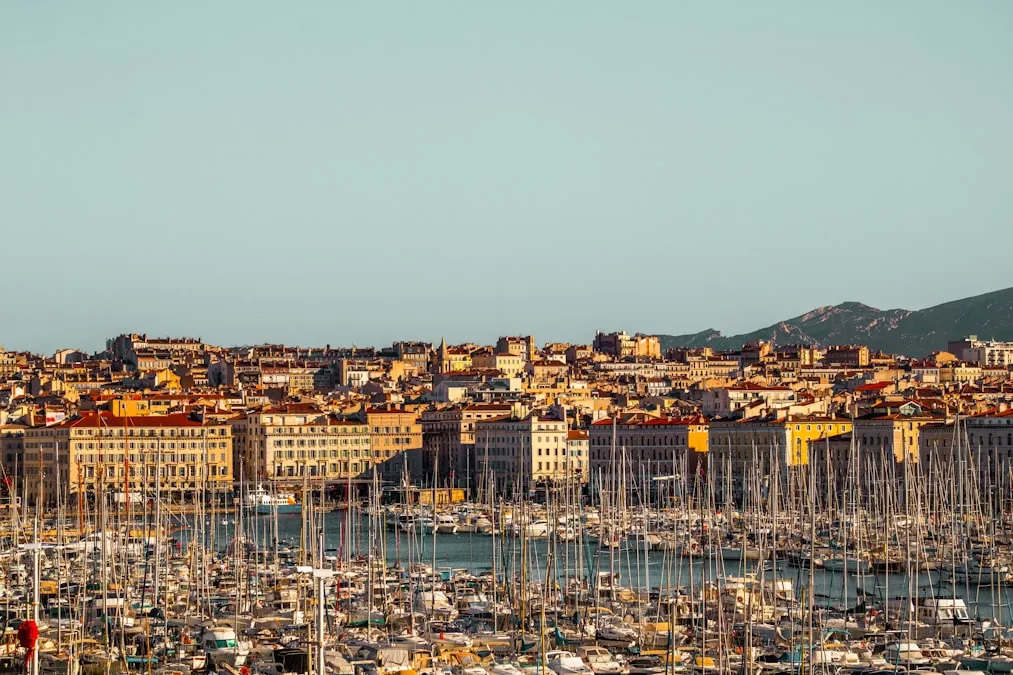
The Vieux-Port is where Marseille began. Greek traders from Phocaea sailed into this natural inlet around 600 BC and founded Massalia. Twenty-six centuries later, it is still the beating heart of the city: a rectangular harbour lined with cafés, restaurants, and fishing boats, with the morning fish market at the quai des Belges drawing chefs and locals every day. Norman Foster’s polished-steel canopy (2013) reflects the port and the sky like an upside-down mirror — stand underneath and look up for a disorienting experience.
The port is the social hub of Marseille. Every major event, march, celebration, and festival converges here. The ferry to Château d’If and the Îles du Frioul departs from the quai des Belges. Boat trips to the Calanques leave from the same area. The restaurants lining the eastern quay (quai de Rive Neuve) serve bouillabaisse with harbour views.
Price: Free. Fish market: daily from ~08:00 (best before 10:00). Ferry crossing: The free ferry shuttle across the port (navette) runs every few minutes — Marseille’s shortest and most charming “boat ride.”
3. MuCEM (Musée des Civilisations de l’Europe et de la Méditerranée) — France’s Most Dramatic Museum
MuCEM opened in 2013 when Marseille was European Capital of Culture, and it immediately became one of the most important museums in France. The building itself — designed by Rudy Ricciotti — is a dark concrete cube wrapped in a latticed concrete résille (lace screen) that filters Mediterranean sunlight into shifting geometric patterns. It sits on the waterfront next to the 17th-century Fort Saint-Jean, connected to it by a vertiginous footbridge suspended high above the sea.
The permanent collection explores Mediterranean civilisations through agriculture, religion, trade, and conflict. Temporary exhibitions are consistently excellent. But even if you skip the exhibitions, the building, the terraces, the rooftop restaurant (with views across to the Îles du Frioul), and the walk across the footbridge to Fort Saint-Jean are worth the visit.
Price: €9.50 (permanent + temporary exhibitions) / €5 reduced (18–25) / Free under 18. Temporary exhibitions only: €11. Fort Saint-Jean gardens and rooftop terraces: FREE. First Sunday of each month: all exhibitions free. Hours: May–Oct: 11:00–19:00 (Jul–Aug: 10:00–20:00, Fri until 22:00). Nov–Apr: 11:00–18:00. Closed Tuesdays. Website: mucem.org
4. Château d’If — The Count of Monte Cristo’s Prison
The Château d’If is a 16th-century fortress on a tiny island 1.5 km offshore from the Vieux-Port, made world-famous by Alexandre Dumas’s The Count of Monte Cristo (1844). In the novel, Edmond Dantès is unjustly imprisoned here for 14 years before his dramatic escape. In reality, the fortress served as a prison from the 17th to 19th centuries, holding political and religious prisoners. The cells, the views from the ramparts, and the knowledge that you’re standing where Dumas set his masterpiece make it an atmospheric visit.
Price: €6 (fortress entry) / Free under 18 and EU residents under 26. First Sunday of each month: free. Ferry: Frioul If Express from Vieux-Port, €10.80 return (Château d’If only) or €16.20 combined with Îles du Frioul. Family rate (2 adults + 2 children): from €85. Boats depart hourly, journey 20 minutes. Buy tickets online to skip queues. Hours: Apr–Sep: 10:00–18:00 / Oct–Mar: 10:00–17:00. Closed Mondays (Oct–Mar).
5. Le Panier — Marseille’s Oldest Quarter
Le Panier is the historic hilltop quarter above the north side of the Vieux-Port, and it is the oldest continuously inhabited area in France. The Greeks settled here in 600 BC. For centuries it was the immigrant quarter — Italian, Corsican, and later North African families packed into narrow streets that climb steeply from the waterfront. During World War II, the Nazis dynamited the lower section of Le Panier (deeming it a hiding place for resistance fighters), and the area was largely rebuilt in the 1950s.
Today it is a gentrifying but still gritty mix of street art, craft workshops, boutiques, cafés, and washing lines strung between balconies. The Vieille Charité — a stunning 17th-century almshouse with a Baroque chapel and two museums — sits at its heart. The street art is some of the best in southern France.
Price: Free to wander. Vieille Charité museums: €6–€10. Getting there: Walk uphill from Vieux-Port métro or from the Hotel de Ville area.
6. La Vieille Charité — Baroque Beauty in Le Panier
La Vieille Charité is a 17th–18th-century former almshouse designed by the royal architect Pierre Puget (born in Marseille). It was built to house the city’s poor and beggars, who were rounded up off the streets. The architecture is exceptional: three storeys of arcaded galleries surrounding a courtyard, centred on a chapel with an elliptical dome — one of the finest examples of Italian Baroque architecture in France. After falling into disrepair, it was restored in the 1980s and now houses the Musée d’Archéologie Méditerranéenne (Mediterranean archaeology, including Egyptian antiquities) and the Musée d’Arts Africains, Océaniens et Amérindiens (MAAOA).
Price: Permanent collections: FREE / Temporary exhibitions: €6 / Free under 18. Courtyard: FREE. Hours: Tue–Sun 09:00–18:00. Closed Mondays. Address: 2 Rue de la Charité.
7. Cathédrale de la Major — France’s Largest Cathedral Outside Paris
La Major is a massive Romano-Byzantine cathedral built between 1852 and 1893 in striped green and white marble. It was deliberately built to impress — at 142 metres long with a 70-metre central dome, it is one of the largest cathedrals in France. The interior is a forest of marble columns, mosaics, and striped arches that feel more Middle Eastern than European. It sits on the waterfront between Le Panier and the MuCEM/Fort Saint-Jean area, forming a dramatic visual counterpoint to the modern museum architecture.
Price: FREE. Hours: Tue–Sun 10:00–18:30 (varies seasonally). Address: Place de la Major.
8. Fort Saint-Jean — Where Medieval Marseille Met the Sea
Fort Saint-Jean stands at the mouth of the Vieux-Port, guarding the harbour entrance since the 12th century (the current structure is largely 17th century, built by Louis XIV — with its guns pointing inward at the city, a reminder that the Sun King trusted Marseille’s loyalty about as far as he could throw a cannon). It is now part of the MuCEM complex, connected to the museum by the dramatic footbridge, and its gardens, ramparts, and terraces are free to explore.
Price: Gardens and terraces: FREE. MuCEM exhibitions accessed from inside: €11. Hours: Same as MuCEM. Best for: The rooftop walk, the herb garden (planted with Mediterranean species: lavender, rosemary, thyme), and the views across the port entrance.
9. Palais Longchamp — Palace of Water
Palais Longchamp is a grandiose 19th-century monument built to celebrate the arrival of water in Marseille via the Canal de Marseille (the city suffered chronic water shortages until 1849). It is a sweeping colonnade connecting two wings — the Musée des Beaux-Arts (fine art: Rubens, Puget, Provence landscapes) on one side and the Muséum d’Histoire Naturelle (natural history, excellent for children) on the other — with a central cascade fountain and formal gardens behind.
Price: Gardens and colonnade: FREE. Musée des Beaux-Arts: permanent collection FREE (temporary exhibitions €8) / Muséum d’Histoire Naturelle: €8 / Free under 18. First Sunday free. Free until 13:00 on Sundays. Hours: Tue–Sun 10:00–18:00. Closed Mondays. Métro: Longchamp Cinéma Palais (Line 1).
10. Vallon des Auffes — A Fishing Village Inside a City
The Vallon des Auffes is a tiny fishing port tucked into a rocky inlet below the Corniche Kennedy road, hidden from the main road by a stone viaduct. It is one of the most photogenic spots in Marseille: a handful of colourful pointus (traditional Provençal fishing boats) bobbing in a miniature harbour, surrounded by fishermen’s houses built into the limestone, with the Mediterranean stretching beyond. Two restaurants — Chez Fonfon and L’Éperon — serve some of the best bouillabaisse in Marseille from terraces perched above the water.
Price: Free to visit. Getting there: Walk along the Corniche Kennedy from the Vieux-Port (25 min) or bus 83. Look for the steps down through the viaduct — easy to miss.
11. Musée d’Histoire de Marseille — 26 Centuries Under Your Feet
The Marseille History Museum, located in the Centre Bourse shopping centre behind the Vieux-Port, is built directly on top of the ancient Greek harbour and Roman dockyard. The exhibition descends chronologically from the 6th century BC Greek colony to the modern city, with actual archaeological remains visible below glass floors. The highlight is the hull of a 3rd-century Roman merchant ship found during construction — one of the best-preserved ancient vessels in the Mediterranean. Outside, the Jardin des Vestiges preserves the ancient harbour wall and dock installations in a sunlit archaeological garden.
Price: Permanent collection FREE / Free under 18. First Sunday free. Hours: Tue–Sun 09:00–18:00. Closed Mondays. Address: 2 Rue Henri Barbusse.
12. Corniche Kennedy — Mediterranean Promenade
The Corniche Kennedy is a 5 km coastal road running south from the Vieux-Port to the Plage du Prado, carved into the limestone cliffs above the sea. It passes the Vallon des Auffes, the Monument aux Morts de l’Armée d’Orient, the Endoume neighbourhood, and a series of rocky beaches and swimming spots. The road features the longest bench in the world (3 km, built in 1953). On hot summer days, Marseillais of all ages dive from the rocks along the Corniche into the deep blue water below — a quintessential Marseille experience.
Price: Free. Getting there: Walk from the Vieux-Port (25 min to Vallon des Auffes) or bus 83. Best for: Sunset walk, cliff-diving watching, swimming from the rocks.
| Attraction | Price | Free Entry | Time Needed |
|---|---|---|---|
| Notre-Dame de la Garde | Free | Always | 1–1.5 hours |
| Vieux-Port | Free | Always | 1–2 hours |
| MuCEM | €9.50 | 1st Sunday / under 18 | 2–3 hours |
| Château d’If | €6 + €10.80 ferry | 1st Sunday (fort only) | Half day |
| Le Panier | Free | Always | 1–2 hours |
| La Vieille Charité | Free (perm.) / €6 temp. | Courtyard free | 1–1.5 hours |
| Cathédrale de la Major | Free | Always | 30 min |
| Fort Saint-Jean | Free | Always | 45 min |
| Palais Longchamp | Free (perm.) / €8 temp. | 1st Sunday / under 18 | 1–2 hours |
| Vallon des Auffes | Free | Always | 30–60 min |
| Musée d’Histoire | Free (permanent) | Always | 1–1.5 hours |
| Corniche Kennedy walk | Free | Always | 1.5–2 hours |
| Cosquer Méditerranée | €18 | — | 1–1.5 hours |
| FRAC | €5 | Sundays | 45 min |
Bonus: Cosquer Méditerranée — A 27,000-Year-Old Cave, Replicated
Cosquer Méditerranée (opened 2022) is an immersive replica of the Cosquer Cave — a real prehistoric cave whose entrance is submerged 37 metres below sea level near the Calanques. The original cave, discovered by diver Henri Cosquer in 1985, contains 500+ paintings and engravings of horses, bison, seals, and hand stencils dating back 27,000 years. Since the original is inaccessible, this replica recreates the cave in extraordinary detail. You board a small pontoon boat that glides through the replica, surrounded by prehistoric art illuminated in the limestone darkness. It is one of the most unique museum experiences in Europe.
Price: €18 adult / €11 ages 10–17 / €6 ages 6–9 / Free under 5 (children under 3 cannot enter the cave tour). Hours: Varies seasonally (10:00–18:30 winter, up to 09:00–21:00 peak summer). Duration: 35-minute pontoon ride + galleries. Book: grotte-cosquer.com — book online, slots sell out in summer.
Calanques National Park — The Complete Guide
The Parc National des Calanques is a 20 km stretch of limestone cliffs, turquoise inlets, and Mediterranean scrubland running from Marseille’s southern suburbs to Cassis. It is the only national park in Europe located adjacent to a major city, and it is staggeringly beautiful: white rock plunging into water so clear it looks digitally enhanced, pine trees clinging to cliff faces, and hiking trails through aromatic maquis. The park was established in 2012 and receives over 3 million visitors a year.
Access & Booking (2026 Rules)
Summer restrictions (June 1–September 30): The most popular calanques require advance booking via the official app (Mes Calanques) or website. Access can be restricted or completely closed on high fire-risk days (“jours rouges”) — the Préfecture announces closures the evening before. Check calanques-parcnational.fr before setting out.
Year-round: Access is free. No entry fee. Parking is extremely limited and many access roads close in summer. Use public transport or the shuttle buses provided.
Rules: No camping, no fires, no dogs (except on lead on certain trails), no picking plants, no drones. Bring all rubbish out. Carry at least 1.5 litres of water per person.
Best Calanques to Visit
| Calanque | Difficulty | Walk Time (from trailhead) | Swimming | Best For |
|---|---|---|---|---|
| Calanque de Sormiou | Easy–moderate | 30–45 min | Yes (sandy beach) | Families, first-timers. Two restaurants on the beach. |
| Calanque de Morgiou | Easy–moderate | 30 min | Yes (rocky) | Quieter alternative to Sormiou. Small harbour with café. |
| Calanque de Sugiton | Moderate | 30–40 min | Yes (rocks & pebbles) | Dramatic cliffs, turquoise water. Most iconic photos. |
| Calanque d’En-Vau | Hard | 1.5–2 hours | Yes (pebble beach) | The most spectacular. Vertical cliffs, crystal water. Worth the effort. |
| Calanque de Port-Miou | Easy | 10 min (from Cassis) | Limited | Boat moorings, easy walk from Cassis. Gateway to En-Vau. |
| Calanque de Port-Pin | Easy–moderate | 30 min (from Port-Miou) | Yes (small sandy beach) | Pine-fringed cove, good for swimming. Between Port-Miou and En-Vau. |
Getting to the Calanques
- From Marseille: Bus 21 from Castellane or Rond-Point du Prado to Luminy campus (for Sugiton and Morgiou trailheads). Bus 23 to Sormiou (limited summer service). Bus B1 to Callelongue (southernmost tip, trailhead for Marseilleveyre).
- From Cassis: Walk from Cassis port to Port-Miou (10 min), then onward to Port-Pin (30 min) and En-Vau (60 min further).
- Boat tours: From Vieux-Port, multiple operators run half-day tours (€25–€35) that cruise along the calanques with swimming stops. Croisières Marseille Calanques and Icard Maritime are reliable operators. From Cassis, boats run to En-Vau and back (from €18, 1 hour).
- Kayak: Sea kayak tours from €35–€55 (half day). Paddle into calanques inaccessible on foot.
Bouillabaisse & Marseille Food
Bouillabaisse — Marseille’s Sacred Dish
Bouillabaisse is not a fish soup. Marseillais will correct you firmly on this point. It is a specific dish, with specific rules, governed by the Charte de la Bouillabaisse Marseillaise (a charter signed by restaurant owners to protect the dish’s integrity). Authentic bouillabaisse must contain a minimum of four species of fresh rockfish (rascasse/scorpionfish, araignée de mer/spider crab, John Dory, conger eel, and others), simmered in a broth of tomatoes, saffron, fennel, garlic, and olive oil. It is served in two stages: the broth first, with croutons, rouille (saffron-garlic-chilli mayonnaise), and grated Gruyère; then the whole fish on a separate platter.
Genuine bouillabaisse costs €55–€90 per person and must be ordered 24–48 hours in advance. Any restaurant offering “bouillabaisse” for €15 on a tourist menu is serving fish soup — not the real thing.
Where to Eat Bouillabaisse
- Chez Fonfon — Vallon des Auffes. Charter signatory. From €42–€53/person. Four generations since 1952. Terrace over the water. Book 2+ days ahead. The gold standard.
- Chez Michel — Rue des Catalans. Charter signatory. From €55/person. Legendary since 1946. Waterfront terrace with fish tank. The most traditional.
- L’Épuisette — Vallon des Auffes. Michelin-starred. Chef Guillaume Sourrieu. From €80/person. Rocks-edge terrace. Spectacular.
- Le Miramar — Quai du Port, Vieux-Port. Founding Charter member. From €55–€65/person. Old Port views. Quality is genuine.
Essential Marseille Dishes
- Panisse — Thick chickpea-flour fritters, sliced and fried golden. Sold at markets and street stalls. Marseille’s street food. Dip in aioli. €3–€5.
- Navettes — Orange-blossom-scented boat-shaped biscuits, baked since 1781 at the Four des Navettes (Rue Sainte, the oldest bakery in Marseille). Crunchy, subtly perfumed, and utterly addictive. €1.50 each or €12–€15/dozen.
- Pieds-paquets — Sheep’s tripe and trotters slow-cooked in white wine and tomatoes. A classic Provençal working-class dish. Rich, gelatinous, deeply flavoured. Not for the squeamish.
- Aïoli — The dish, not just the sauce: salt cod, boiled vegetables (carrots, potatoes, green beans, chickpeas, eggs), and a generous bowl of garlic mayonnaise. Traditionally a Friday dish. Served as a communal feast.
- Soupe de poissons — The everyday version of bouillabaisse: blended fish broth served with croutons, rouille, and Gruyère. Every café in Marseille serves it. €8–€14.
- Tapenade — Black olive paste with capers, anchovies, and olive oil. Spread on toast, served with apéritifs. Invented in Marseille in 1880.
- Couscous — Marseille has the best couscous in France, thanks to its North African community. The restaurants around Noailles market serve it from €12–€18. Order the couscous royal (with lamb, merguez, and chicken).
- Chichi frégi — A large spiral doughnut flavoured with orange blossom water, fried and rolled in sugar. Sold at L’Estaque beach and market stalls. A Marseille original.
Markets
- Marché de Noailles (La Plaine side) — The most extraordinary market in France outside Paris. A chaotic, fragrant, multilingual street market in the North African quarter: pyramids of spices, fresh mint, figs, olives, whole lamb carcasses, live snails, Tunisian pastries, €1 espressos from hole-in-the-wall cafés. This is Marseille distilled to its essence. Open Mon–Sat mornings.
- Marché des Capucins — Around the Canebière end of Noailles. Fish, cheese, charcuterie. More European-traditional than Noailles. Good for picnic supplies.
- Marché aux Poissons (Vieux-Port) — The morning fish market on the quai des Belges. Fishermen sell direct from their boats. Arrive before 10:00.
Pastis, Wine & Drinking Culture
Pastis is to Marseille what sherry is to Seville or Guinness to Dublin: the city’s soul in a glass. This anise-flavoured spirit (45% ABV) was created by Paul Ricard in Marseille in 1932 as a successor to the banned absinthe. It is served neat with a carafe of cold water — you add water yourself until the clear spirit turns milky gold (the louche effect). The ratio is personal: purists add 5 parts water, others prefer it stronger. A pastis at a bar costs €2.50–€4.00.
- Ricard — The original, founded in Marseille. Sweeter, more liquorice-forward.
- Pastis 51 — Pernod’s version. Slightly drier.
- Henri Bardouin — The connoisseur’s pastis: 65 plants and spices. More complex than Ricard. Available at La Maison du Pastis in Le Panier.
- Un p’tit jaune — What locals order (“a little yellow one”). The default aperitif at any time of day.
Provençal Wine
Marseille sits at the heart of Provence’s wine country, and three appellations produce exceptional wines within day-trip distance:
- Cassis AOC — White wine from the coastal town of Cassis (30 min by train). Mineral, saline, perfect with seafood. Clos Sainte Magdeleine (clifftop vineyard overlooking the sea) is the most famous domaine. Tasting from €10.
- Bandol AOC — Mourvèdre-based reds: powerful, age-worthy, the best in Provence. Also excellent rosé. Domaine Tempier is the benchmark. 45 min by train to Bandol.
- Côtes de Provence — Primarily rosé (80% of production). The default summer wine of the South of France. Available everywhere from €3/glass.
Marseille’s Michelin-Starred Restaurants — 2026
Marseille quietly holds two three-star restaurants — placing it in the same rarefied category as Paris and Lyon despite its scruffy reputation. The 2026 Michelin Guide France retains both, plus a strong list of one-stars.
Three Stars (★★★)
AM par Alexandre Mazzia — 9 rue François Rocca, 8e: Chef Alexandre Mazzia’s deeply personal tasting-menu restaurant — intensely Mediterranean with a strong Japanese green-tea influence. Third star awarded in 2021 and retained every year since. Tasting menus from €290. Reservations open three months out and fill in minutes — this is the single hardest booking in Marseille.
Le Petit Nice — Anse de Maldormé, 7e: Gérald Passédat’s cliffside restaurant overlooking the Mediterranean with a view of Château d’If and the Planier lighthouse. Seafood tasting menus, three stars since 2008. Tasting from €320+. Book weeks ahead.
One Star (★, selection)
L’Épuisette — Vallon des Auffes: Chef Guillaume Sourrieu, starred since 2003. Rocks-edge terrace in the tiny fishing cove of Vallon des Auffes — one of the most atmospheric dining rooms in France. The Michelin-recognised benchmark for serious bouillabaisse (served per the Bouillabaisse Charter). From €80 per person; tasting menus higher.
Une Table, au Sud — Quai du Port, 2e: Chef Ludovic Turac (ex-Le Bristol, Guy Savoy) in a first-floor room overlooking the Vieux-Port. Contemporary southern French. Tasting menus €85-135.
Note: Marseille also hosts several more starred rooms beyond the four flagships above. For the full current list, consult the Michelin Guide France 2026 Marseille selection. Saisons, previously mentioned in some travel guides, is permanently closed.
Marseille’s Neighbourhoods
Le Panier
Oldest quarter in France. Narrow streets, pastel buildings, street art, craft shops, La Vieille Charité. Gentrifying rapidly but retains its rough charm. Best for: Morning wandering, street art, pastis at La Maison du Pastis. Stay here if: You want character over comfort.
Vieux-Port & Centre
The tourist hub. Harbour, fish market, restaurants, ferry departures. The Canebière boulevard runs east from the port — Marseille’s main artery. Best for: First-timers, transport connections, bouillabaisse restaurants. Watch out for: Tourist-trap restaurants on the quay — walk one block back for better food.
La Joliette & Les Docks
The redeveloped port district north of Le Panier. MuCEM, Fort Saint-Jean, the Cathédrale de la Major, and the Docks shopping/restaurant complex (converted 19th-century warehouses) are all here. Modern, waterfront, and photogenic. Best for: MuCEM, architecture, waterfront dining.
Cours Julien & La Plaine
Marseille’s bohemian quarter. Cours Julien is a pedestrianised square surrounded by bars, record shops, vintage boutiques, and street art. La Plaine (Place Jean Jaurès) hosts a huge open-air market (Tue, Thu, Sat). This is where young, creative Marseille goes out. Best for: Nightlife, street art, vinyl shopping, brunch, LGBTQ+ scene.
Endoume & Corniche
Residential neighbourhood along the coast south of the Vieux-Port. The Corniche Kennedy promenade, Vallon des Auffes, and Plage des Catalans are here. Beautiful, quiet, local. Best for: Sunset walks, swimming, bouillabaisse at Fonfon.
Noailles
The North African quarter, centred on Rue d’Aubagne and the streets around Marché de Noailles. Chaotic, colourful, and the most exciting food neighbourhood in Marseille. Spice stalls, Tunisian patisseries, couscous restaurants, mint tea. Best for: Food, market culture, seeing the real multicultural Marseille. Note: Busy, noisy, not picture-postcard pretty — but utterly authentic.
Where to Stay — By Budget & Style
| Area | Budget | Best For | Avg. Double Room |
|---|---|---|---|
| Vieux-Port | €€€ | First-timers, transport hub | €120–€200 |
| Le Panier | €€ | Character, boutique hotels | €90–€160 |
| La Joliette | €€€ | MuCEM, modern, waterfront | €110–€190 |
| Cours Julien | €€ | Nightlife, young travellers | €70–€120 |
| Endoume/Corniche | €€ | Beach, quiet, residential | €80–€140 |
| Noailles | € | Budget, food lovers | €50–€90 |
Getting Around Marseille
From the Airport
Navette/shuttle bus: €10 single / €16 return. Departs every 10–15 min from Marseille-Provence Airport to Gare Saint-Charles (main train station). Journey: 25 minutes. The best option for most visitors.
Train: Free shuttle bus from airport to Vitrolles-Aéroport-Marseille-Provence station, then regional train to Saint-Charles (€5.40, 20 min). Cheaper but slower with the transfer.
Taxi: Fixed rate €55–€60 to city centre. 30–45 min depending on traffic.
City Transport
- Métro: 2 lines (M1 blue, M2 red). Single ticket: €1.70. 10-trip carnet: €13.40. Day pass (24h XL): €5.20. 3-day pass (72h XL): €10.80. Covers métro, tram, and buses. Marseille CityPass: €24 (24h) / €31 (48h) / €39 (72h) — includes unlimited transport, museums, Petit Train, and more.
- Tram: 3 lines. Same tickets as métro.
- Bus: Extensive network. Same tickets. Bus 83 along the Corniche is the best scenic bus ride in the city.
- Ferry (navette maritime): Free shuttle across the Vieux-Port (Quai de l’Hôtel de Ville → Place aux Huiles). Also paid ferries to Pointe Rouge, L’Estaque, Les Goudes (€2 with RTM pass).
- Le Vélo bike sharing: First 30 minutes free. Week pass €5. Stations throughout the city. Marseille’s hills make cycling challenging in places.
Best Time to Visit
| Season | Temp | Crowds | Verdict |
|---|---|---|---|
| April–May | 16–24°C | Moderate | ⭐ Best overall: Warm, wildflowers in calanques, no summer restrictions, uncrowded. |
| June–August | 25–32°C | High | Great for swimming & beaches. Calanques require booking. Hot but less extreme than Seville. |
| September–October | 20–28°C | Moderate | ⭐ Excellent: Warm sea, no crowds, calanques unrestricted, vendange (harvest) season. |
| November–March | 8–15°C | Low | Mild winter (300 days of sunshine!). Mistral wind can be bitter. Budget season. |
Day Trips from Marseille
1. Cassis — Wine, Cliffs & Calanques
Cassis is a pastel-coloured fishing port 30 minutes east of Marseille, sheltered by Europe’s highest sea cliff (Cap Canaille, 394 metres). The town produces its own white wine (Cassis AOC — minerally, citrusy, perfect with the local sea urchins), and it is the gateway to the three most accessible calanques: Port-Miou, Port-Pin, and En-Vau. The harbour is lined with restaurants, and the atmosphere is quintessentially Provençal.
Getting there: Train from Marseille Saint-Charles, 20 min, from €5.40. Then shuttle bus or 30-min walk downhill to the port. Also bus M8 from Castellane (50 min). Wine tasting: Clos Sainte Magdeleine (clifftop vineyard, tastings from €10, book ahead).
2. Aix-en-Provence — Cézanne’s City of Fountains
Aix is the elegant counterpart to Marseille’s chaos: tree-lined boulevards, 17th-century hôtels particuliers, fountains at every corner (over 200), and a vibrant market scene. Cézanne was born here and painted Mont Sainte-Victoire from his studio on the Chemin de Lauves (now a museum). The Cours Mirabeau — a boulevard of plane trees, cafés, and moss-covered fountains — is one of the most beautiful streets in France.
Getting there: Bus from Marseille Gare Saint-Charles, 30–40 min, €6.10 (frequent departures). Train: 35 min, from €8. Cézanne’s Atelier: €7. Musée Granet: €8 (€12 with temporary exhibition).
3. Avignon — Popes, Bridges & Theatre
The city of the Popes: Avignon’s Palais des Papes is the largest Gothic palace in the world, built when the papacy relocated here from Rome in the 14th century. The walled old town, the Pont d’Avignon (four remaining arches of the famous bridge), and the annual theatre festival (July) make it a compelling day trip.
Getting there: TGV from Marseille Saint-Charles, 35 min, from €15 (book ahead on sncf-connect.com). Also regional train, 1h 20 min, from €13. Palais des Papes: €12 / €10 reduced. Pont d’Avignon: €5.50 / €4 reduced.
4. Arles — Van Gogh & Roman Ruins
Arles is a UNESCO World Heritage city where Roman ruins and Van Gogh’s legacy intersect. The Roman amphitheatre (still hosting bullfights), the Theatre, and the necropolis of Les Alyscamps are extraordinary. Van Gogh painted 300 works here in 1888–1889, including Starry Night Over the Rhône. The LUMA Arles tower (2021), designed by Frank Gehry, adds a contemporary art centre to the mix.
Getting there: Train from Marseille, 50 min, from €14. Amphitheatre: €9. LUMA Arles: €16 / €12 reduced. Van Gogh trail: Free (follow the markers through town).
5. Les Baux-de-Provence & Carrières de Lumières
Les Baux is a medieval hilltop village perched on a limestone ridge in the Alpilles. The ruined castle offers views across Provence to the sea. Below the village, the Carrières de Lumières (previously Cathédrales d’Images) is an immersive art experience: digital projections of famous paintings covering the walls, floors, and ceilings of an old bauxite quarry, set to music. The 2026 show features Monet (verify at carrieres-lumieres.com).
Getting there: Car only (45 min from Marseille). No direct public transport. Carrières de Lumières: €16 / €13 reduced / €11 children. Les Baux castle: €12 / €8.50 reduced.
6. Îles du Frioul — Islands Off the Coast
The Frioul archipelago — four islands 4 km offshore from the Vieux-Port — is Marseille’s island escape. The main islands (Pomègues and Ratonneau, connected by a causeway) have rocky coves, clear swimming water, a few cafés, and the ruins of a quarantine hospital. It feels surprisingly wild for somewhere 20 minutes from a city of 900,000.
Getting there: Ferry from Vieux-Port (Frioul If Express), €11 return. 20 min. Tip: Combine with Château d’If (€17 combined ticket). Bring food and water — supplies on the island are limited and expensive.
Marseille with Kids
- Plage du Prado — Marseille’s main family beach. Shallow water, lifeguards, grass areas, playgrounds. Free. Bus 83 from Vieux-Port.
- Plage des Catalans — Closest beach to the centre (10 min walk from Vieux-Port). Small, sandy, great for a quick swim. Free.
- Le Petit Train — Tourist road-train from Vieux-Port to Notre-Dame de la Garde (€9 adults / €5 children) or to Le Panier (€7 / €4). Kids love it.
- Muséum d’Histoire Naturelle (Palais Longchamp) — Dinosaurs, minerals, Provençal wildlife. €6, free under 18. Engaging for ages 4–12.
- Boat trip to Château d’If — The ferry ride + island fortress + Count of Monte Cristo story captivates older children (8+).
- Calanque de Sormiou — The most family-friendly calanque: gentle walk, sandy beach, two restaurants. Bring swimwear and sun protection.
- Parc Borély — 17-hectare park south of the Prado beach. Lake with rowing boats, playgrounds, botanical garden, skate park. Free.
- Frioul Islands — Ferry + island exploration + swimming in clear water = a kid-approved adventure. Pack a picnic.
Safety & Practical Information
Visa & ETIAS
France is in the Schengen Area. EU/EEA citizens: no visa, freedom of movement. US, UK, Canada, Australia, New Zealand, Japan, South Korea and most other Western passports: visa-free for up to 90 days in any 180-day period. ETIAS, the EU’s new visa-waiver travel authorisation (not a visa), has a current target launch of a date not yet announced with a grace period before it becomes mandatory in 2027. Expect around €20, valid three years. ETIAS is separate from the UK’s ETA, which only applies to travel to Britain.
Marseille has a reputation for being rough, and it is not entirely undeserved — but the tourist areas are generally safe. The drug-related violence that makes headlines is concentrated in the northern suburbs (cités in the 13th–16th arrondissements) and does not affect tourist areas. Petty crime (pickpocketing, phone snatching) is more common than in other French cities.
- Safe areas: Vieux-Port, Le Panier (daytime), La Joliette/MuCEM, Endoume, Corniche, Prado, Cours Julien (daytime/evening). These are all fine day and night.
- Exercise caution: Gare Saint-Charles area at night, some streets around Noailles after dark, Porte d’Aix area. Not dangerous but keep your wits about you.
- Avoid: Northern suburbs (13e–16e arrondissements) — no tourist reason to go there.
- Emergency: 112 (pan-European) / 15 (medical) / 17 (police).
- Tipping: Service is included in restaurant bills (service compris). Rounding up or leaving €1–€2 is appreciated but not expected. Never tip at cafés for just coffee.
- Tap water: Safe to drink everywhere. Ask for a carafe d’eau (free) at restaurants.
- Language: French. English is spoken in tourist areas but less widely than Paris. Learning bonjour, merci, s’il vous plaît, and l’addition (the bill) makes a significant difference. Starting any interaction without bonjour is considered rude.
- Sunday closures: Most shops close on Sunday. Restaurants open. Markets close by 13:00.
Best Views & Sunset Spots
- Notre-Dame de la Garde terrace — The definitive Marseille view. 360 degrees. Free. Best at sunset.
- MuCEM/Fort Saint-Jean rooftop — Sea, harbour entrance, Cathédrale de la Major. Free. Go at golden hour.
- Pharo Palace gardens — Public park on the headland opposite Fort Saint-Jean, with the entire Vieux-Port spread below. Free. Locals’ favourite sunset picnic spot.
- Corniche Kennedy — The 5 km promenade. Walk south from Pharo for constantly changing sea views. Free.
- Place de Lenche — Le Panier. Former Greek agora, now a small square with café terraces overlooking the port. Sunset drinks here are unbeatable.
- Hôtel Dieu rooftop bar (Les Fenêtres) — InterContinental hotel above the Vieux-Port. Cocktails €14–18. The most glamorous view in the city.
- Frioul ferry at sunset — Take the last ferry back from the islands and watch Marseille’s skyline, crowned by La Bonne Mère, turn gold from the water.
Free Things to Do in Marseille
- Notre-Dame de la Garde — Free. Best views in the city.
- Vieux-Port fish market — Free to browse. Daily mornings.
- Free ferry across the Vieux-Port — Marseille’s 3-minute commuter crossing.
- Le Panier street art walk — Free. Changing murals throughout the quarter.
- Fort Saint-Jean gardens & MuCEM terraces — Free (exhibitions extra).
- Cathédrale de la Major — Free.
- La Vieille Charité courtyard — Free (museums extra).
- Corniche Kennedy walk — Free. 5 km of Mediterranean promenade.
- Jardin des Vestiges — Free. Ancient Greek harbour ruins.
- Pharo Palace gardens — Free. Best sunset picnic spot.
- Parc Borély — Free. 17 hectares with botanical garden.
- Palais Longchamp gardens — Free.
- Calanques National Park — Free (booking may be needed in summer).
- Plage des Catalans & Plage du Prado — Free beaches.
- All museums on first Sunday of the month — MuCEM, Beaux-Arts, History Museum, Château d’If, all free.
- Noailles market walk — Free to explore. The sensory experience of Marseille.
Hidden Gems & Insider Tips
- Savon de Marseille — Marseille has been making olive-oil soap since the 14th century. The last traditional savonneries offer factory tours and sell authentic soap (72% olive oil, stamped). Savonnerie du Midi (Chemin de Sainte-Marthe) runs free guided tours — book online. Avoid tourist-shop soap (often made in China). Authentic bars start at €3.
- L’Estaque — A former fishing village on Marseille’s northwest coast where Cézanne, Braque, and Dufy painted. Bus 35 from Vieux-Port (30 min). Eat chichi frégi (orange-blossom doughnut) at the waterfront stall. Completely off the tourist trail.
- Cours Julien street art — The pedestrianised streets around Cours Julien have the best urban art in southern France. International artists paint large-scale murals that change regularly. Walk Rue Pastoret, Rue Crudère, and Rue Vian. Free.
- Friche la Belle de Mai — A former tobacco factory in the Belle de Mai neighbourhood, now a massive cultural space: galleries, theatre, skate park, rooftop bar, restaurant, street art. The rooftop (Le Toit Terrasse) has panoramic views and hosts events. Often free. A 10-minute walk from Gare Saint-Charles that most tourists never take.
- Les Goudes — A tiny fishing village at the end of the road, at the very edge of Marseille where the city meets the Calanques. Take bus B1 to the terminus, eat at one of the two restaurants on the harbour, and swim from the rocks. This is the village that Marseillais themselves escape to on weekends.
- Cité Radieuse — Le Corbusier’s revolutionary 1952 housing block, still occupied by residents. A UNESCO World Heritage site. The rooftop (free) has an art gallery (MAMO) and views of the mountains. The architecture shop on the ground floor sells design books and Corbusier prints. Bus 21 from Castellane.
- Basilique Saint-Victor — The oldest church in Marseille, built over a 5th-century crypt that contains some of the oldest Christian tombs in France. The crypt is atmospheric and ancient in a way that the more famous buildings are not. €3 for the crypt.
2026 Travel Notes & Changes
- Tourist tax: €0.88–€4.40 per person per night, depending on accommodation star rating. Applied at checkout.
- Calanques booking: The Mes Calanques app/website is mandatory for the most popular trails June–September. Book up to 7 days ahead. Fire-risk closures can cancel your booking same-day — have a Plan B (boat tour or beach).
- Saison Méditerranéenne 2026: May 15–October 31 — a massive cultural season celebrating Mediterranean cultures, centred in Marseille. Over 200 events across France. Grand opening in Marseille with performances at MuCEM, Pharo, La Joliette, and Friche la Belle de Mai. If you’re visiting May–October, check the programme.
- Festival de Marseille: June 15–July 15, 2026. Dance, theatre, music, cinema. Solidarity tickets from €1.
- Municipal museums free: All permanent collections at Marseille’s municipal museums (History, Beaux-Arts, Cantini, La Vieille Charité) are now free year-round. Only temporary exhibitions are charged.
- Cosquer Méditerranée: Opened 2022, this immersive prehistoric cave replica is now one of Marseille’s top attractions. €18 adult.
- Musée Cantini: Closed March 30–May 7, 2026 for new permanent collection installation.
- MuCEM expansion: Continued programming of the J4 building and Fort Saint-Jean spaces. Current exhibition: “Bonnes Mères” (from March 2026). Check mucem.org for full schedule.
- Metro Line 2 extension: Ongoing works extending the red line. Some station closures/disruptions possible — check rtm.fr.
- 300 days of sun: Marseille averages 2,800 hours of sunshine per year — more than any other major French city. Even in winter, sunny days are common.
- Cycling infrastructure: Marseille continues to expand bike lanes, particularly along the waterfront. Le Vélo stations being upgraded. The city is still hilly — electric bikes recommended for anything beyond the centre and Corniche.
Frequently Asked Questions
How many days do I need in Marseille?
Three days minimum: Day 1 for the Vieux-Port, MuCEM, Le Panier, and Notre-Dame de la Garde. Day 2 for the Calanques (hiking or boat tour). Day 3 for a day trip (Cassis or Aix-en-Provence). Five days allows Calanques hiking, Cassis wine, Avignon or Arles, and deeper neighbourhood exploration.
Is Marseille safe for tourists?
The tourist areas (Vieux-Port, Le Panier, Joliette, Corniche, Prado) are safe day and night. Drug-related violence is in the northern suburbs and does not affect visitors. Use normal big-city precautions: don’t flash phones, watch bags in crowds, avoid deserted streets late at night.
Do I need to book the Calanques in advance?
June–September: yes, for the most popular trails (Sugiton, Sormiou). Use the Mes Calanques app. October–May: no booking needed, just turn up. The park can close entirely on high fire-risk days in summer.
Is bouillabaisse worth the price?
If you go to a Charter restaurant (Chez Fonfon, Chez Michel, Miramar), yes. It is a full multi-course seafood experience, not just a bowl of soup. Budget €55–90 per person. If you want the flavour without the price, order “soupe de poissons” at any café (€8–14) — it is the everyday version and still delicious.
Best time to visit Marseille?
Late September for warm sea, no crowds, unrestricted calanques, and golden light. April–May for hiking and wildflowers. Avoid August if you dislike crowds. Winter is mild and sunny but the Mistral wind can be cold.
Is there a tourist tax?
Yes: €0.88–€4.40 per person per night depending on your accommodation’s star rating. Applied at checkout.
Can I swim in the Calanques?
Yes, and you should. The water is crystal-clear and 20–25°C in summer. Sormiou has a sandy beach. Most others have pebble beaches or rock access. Bring water shoes and sun protection. No lifeguards.
Is Marseille walkable?
The centre (Vieux-Port, Le Panier, La Joliette, Noailles) is walkable but hilly. The Corniche and Calanques require more walking or transport. A 3-day RTM pass (€10.80) covers métro, bus, tram, and ferries — the best deal in the city.
Guide written by AiFly’s travel editors. Last verified April 2026. Prices and hours change — always check official websites before visiting.
Explore more: Paris · Seville · Barcelona · Lisbon · Palma de Mallorca · Naples · Rome · Athens · Tenerife · Munich · Madrid
🌍 See the bigger picture: our France travel guide covers regions, when to go, and getting around.
Cheapest Flights to Marseille
We track flight deals to Marseille from 1 city worldwide. Here are the best recent fares:
Flight Deals from Marseille
Looking for cheap flights departing Marseille? Here are deals to 4 destinations:
Prices are based on recent deals and may no longer be available. Browse all flight deals