Mykonos — The Complete Island Guide 2026
The morning ferry from Chora’s Old Port to Delos crosses five kilometres of sea in twenty-five minutes. On one side, the season is six months long; on the other, the island has been uninhabited for around twelve hundred years. Eighty-five square kilometres of windmills, fishing boats and beach clubs; a three-and-a-half-square-kilometre uninhabited sanctuary five kilometres south-west — a guide to all three.
€80–€600+/day budget (peak)
Avg 17.8°C; July 26°C, January 9°C
🇬🇷 EU / Schengen / EUR €
Climate Resilience Fee €2–€15/night
EES active 10 Apr 2026 · ETIAS Q4 2026
Why Mykonos? An Editor’s Note
Just before half past eight on 2 July 2024, a motorcycle pulled alongside a parked car at the corner of Kritis and Eikostis Pemptis Martiou streets in Psychiko, a leafy northern suburb of Athens, and fired at least eight times through the side window — police later recovered fifteen shell casings. The driver was a fifty-four-year-old surveyor named Panagiotis Stathis. The plans on the seat next to him concerned beach-side construction permits in the Cyclades, including a folder of files on Mykonos. In November 2025 an Athens Mixed Jury Court convicted the gunman by a six-to-one majority — life imprisonment plus six years and a €7,500 fine — and his accomplice to nine years; the trial files on who paid the €100,000 contract fee were forwarded to a separate prosecutor’s office and remain open. The Greek Supreme Court Prosecutor has a coordinated organised-crime investigation underway across Mykonos and the wider Cyclades.
The point of opening with that is not to put a reader off Mykonos. The reader has paid for a flight, and the island they are about to land on is one of the most desired summer destinations in the Mediterranean and also one of Europe’s smallest islands with an active organised-crime presence in its real-estate market. Naming it is the first honest thing this guide can do.
Mykonos in 2026 is at least three islands held in the same eighty-five square kilometres, and a morning ferry between two of them.
The first is the six-month Mykonos — the brand. From early May to late October, the population swells from around eleven thousand permanent residents to a peak the Hellenic Statistical Authority does not officially try to count; cruise traffic alone added 1.5 million passengers in 2025 across roughly nine hundred ship arrivals, and JMK records around two million summer movements on top. Sun-loungers at Nammos Beach Club rent for €100 to €150 a pair. Helicopters land daily at the inland heliport. Greece’s MyCoast app, introduced in 2024, lets any beachgoer photograph an illegal umbrella and report it directly to the inspectorate; it generated more than 1,000 complaints in five days nationwide and €350,000 in fines on launch, with Mykonos contributing thirty-three of them in its first summer. The fully-protected sunbed-free beach list has gone from 198 in 2024 to 238 in 2025 to 251 for 2026. The brand layer, finally, is being measured.
The second is the twelve-month Mykonos — the working Cycladic island underneath. Around 10,704 permanent residents per the 2021 census, most living in Chora, in Ano Mera seven kilometres east, or in scattered farming hamlets like Marathi, Maou and Kalafatis. The street layout of Chora — the deliberately confusing alleys now sold as a feature in marketing copy — was built that way under Ottoman rule from 1537, when Hayreddin Barbarossa took the Cyclades from Venice, specifically to disorient pirates. Whitewashed walls were a sanitation rule and a thermal-reflection trick before they were a colour palette. The 16th-century Kato Mili windmills above Little Venice ground imported wheat using the same Meltemi wind that now defines beach-club opening hours. The patron church is the icon at Panagia Tourliani Monastery, founded in 1542 by refugee monks from Paros. On 22 October 1822, the Mykonians repulsed an Ottoman naval landing under Manto Mavrogenous, an aristocratic Trieste-born financier who had equipped two ships at her own expense and would later be granted the rank of Lieutenant General by Ioannis Kapodistrias. The square at the heart of Chora bears her name. The island had a working calendar of saints and storms for four centuries before it had a calendar of DJ residencies.
The third is Delos — five kilometres south-west by morning ferry, a sacred uninhabited rock of three and a half square kilometres that was, in turn, the mythological birthplace of Apollo and Artemis, the seat of the Delian League’s treasury under fifth-century Athenian hegemony, the largest free-port slave market in the Hellenistic Mediterranean (the geographer Strabo claimed up to ten thousand sales in a single day, almost certainly hyperbole, but slaves were the island’s first commodity), the site of two state-mandated ritual purifications by Athens, and finally the target of an 88 BCE invasion by the forces of Mithridates VI of Pontus that killed an estimated twenty thousand Italian residents. Delos has been continuously without permanent civilian population for around twelve hundred years. UNESCO inscribed it on the World Heritage List in 1990, citing the way the ruins still convey “the image of a great cosmopolitan Mediterranean port.”
The morning ferry from Chora’s Old Port to Delos is the through-line; the rest of this guide is organised around the order in which a careful visitor should encounter the three.
Who this guide is for: travellers who have read about Mykonos’s reputation and still want to come, who can absorb the budget below, who are willing to take a 09:00 ferry on an empty stomach, and who do not want their visit to consist entirely of being photographed in front of a windmill.
Who this guide is not for: anyone whose Mykonos itinerary is built around a specific Instagram location and who is not interested in why that location costs what it costs.
What to skip: the south-coast lounger strip at Paradise Beach, Super Paradise, and the Nammos / Psarou complex on a peak July or August day. The water is good, the prices are not, and the noise compresses any sense of the actual island. The genuine alternatives — Fokos, Agios Sostis, Houlakia — are listed below with directions and costs.
Table of Contents
- Why Mykonos?
- Top Attractions
- Neighbourhoods
- Where to Stay
- Where to Eat
- Drinking and the LGBTQ Inheritance
- Getting Around
- Best Time to Visit
- Month-by-Month Weather
- Daily Budget Breakdown
- Sample Itineraries
- Best Day Under €60
- Windy Day / Hot Day Plan
- Day Trips
- Safety and Practical Information
- Visa and Entry Requirements
- Hidden Mykonos
- Romantic Mykonos
- Mykonos with Kids
- What’s New in 2026
- Frequently Asked Questions
- Explore More Aifly Guides
Top Attractions
1. Chora — The Defensive Labyrinth
The capital is officially Chora (“the town”) but signs and timetables just say Mykonos. The disorientation of the alley grid is not aesthetic: when the Ottomans took the Cyclades from Venice in 1537 under Hayreddin Barbarossa, the Aegean entered three centuries during which piracy was an active threat, and the street layout was built and rebuilt with a single defensive logic — pirates landing on the harbour beach would lose orientation within minutes and end up in dead-end courtyards held by defenders who knew which alleys connected to which. The whitewash served three purposes: sanitation (lime kills bacteria), thermal reflection (white walls run several degrees cooler than unpainted stone in July), and identification at sea. The blue woodwork came later, in the 19th century, partly a national-romantic aesthetic following Greek independence.
The neighbourhoods you will walk are Matogiannia (the central commercial heart, anchored on the square of Agia Kyriaki where most of the late-night life still concentrates — see Drinking section for the Pierro’s history that made the square the LGBTQ scene’s point of origin), Alefkandra (the western seafront, called “Little Venice” because its 16th–18th century captains’ houses were built straight onto the rocks at the waterline so cargo could be unloaded directly from boats, bypassing harbour tax), and the Kastro quarter directly behind Little Venice on the rise toward the windmills (the oldest stone houses in town, including some pre-Ottoman fragments).
Editor’s tip. Walk the alleys at 06:30 or 07:00 before the first cruise tenders dock. By 11:00 the same alleys carry roughly 4,000 day-trippers and the experience is materially different.
Tip — Don’t pay a tour to “find” Little Venice.
Little Venice is a 200-metre stretch of seafront facing west, immediately downhill from the Kato Mili windmills. From any point in Chora, walk towards the windmills you can see on the skyline. Little Venice is at their feet — no guide or paid map is required.
Price: Free.
Hours: Always open.
Access: Walking only; cobblestone, awkward for wheeled luggage.
2. Delos — The Sacred Sanctuary, by Morning Ferry
This is the most important attraction on Mykonos and the one most visitors miss — a separate island five kilometres south-west, reachable only by ferry from Chora’s Old Port, and the most extensively excavated archaeological site in Greece outside Athens. UNESCO inscribed it in 1990. The site is ninety minutes minimum and four hours preferable.
The mythological frame is that Apollo and Artemis were born on Delos to the goddess Leto. The historical frame is darker. From the 6th century BCE Athens used the island as the seat of an interstate league; under the tyrant Peisistratus, a partial purification removed graves visible from the sanctuary. In 426 BCE, during the sixth year of the Peloponnesian War, Athens ordered a full purification per Thucydides 3.104: every grave was opened, all bones reburied on neighbouring Rheneia, and from then on it was forbidden to be born or die on Delos — pregnant women and the dying were ferried across. Four years later the entire civilian population was expelled to Adramyttium in Asia Minor. By the Hellenistic period Delos had become a free port and the central transhipment hub for the Mediterranean slave trade — Strabo’s claim of ten thousand sales a day is unverifiable hyperbole, but the volume was great enough that human cargo became the island’s primary commodity. In 88 BCE, at the start of the First Mithridatic War, forces loyal to King Mithridates VI of Pontus invaded and killed approximately twenty thousand of the island’s Italian and Roman residents; pirate raids in 69 BCE finished what was left. Delos has not had a permanent civilian population since around the 8th century AD.
The site you walk today contains the Sanctuary of Apollo (three temples on the east side, including the 5th-century BCE Temple of the Athenians), the Sacred Lake (drained in 1925 to control malaria — the lake where Leto was said to have given birth survives only as a circle of stones around a single palm), the Terrace of the Lions (seven 7th-century BCE marble lions facing the lake; the originals are in the museum, the ones outside are casts), the Hellenistic theatre (capacity for several thousand spectators, the lower seating section in 26 rows), and the residential quarters above the theatre — the House of the Dolphins, House of the Masks, House of Cleopatra and Dioscurides, and the House of the Trident — with floor mosaics still in situ, exposed to the sky, no glass between you and the work. The on-site Archaeological Museum of Delos holds the original lions, a Naxian sphinx attributed to the island’s sanctuary dedications, and a remarkable collection of household objects from 2nd-century BCE merchant houses.
Tip — Take the 09:00 ferry, the 17:00 boat is for the desperate.
The ferry from Chora’s Old Port runs four times daily from 1 April to 30 November, typically 09:00, 10:00, 11:30 and 17:00, returning at 12:00, 13:30, 15:00 and 19:30 (verify against current schedule before travel). The 09:00 boat puts you on the site by 09:30, before the heat is at its worst, with early light still favourable on the white marble. Take the 13:30 return after a four-hour visit. The 17:00 outbound is unforgiving in July.Tip — Bring water, a hat, and sun-cream.
The site has no shop, café or shade; the on-site museum has running water but no food. Bring a one-litre bottle per person and apply sun-cream before you board.
Price: €20 entry (combined site + museum, on-site only — booth at the dock takes cards). Ferry from Mykonos €25 round-trip adult, €12 ages 6–12, under-6 free.
Hours: Site 08:00–20:00 from 1 April to 31 October, 08:00–16:00 in November, closed 1 December to 31 March.
How to get there: Walk to Chora’s Old Port, immediately north of the main town, and look for the wooden ticket booths next to the wooden boats. Online booking via the official Delos Tours adds a €4 fee but allows refundable cancellation up to 24 hours.
Access: Hilly and uneven; wheelchair access is essentially impossible.
3. Kato Mili — The Windmills
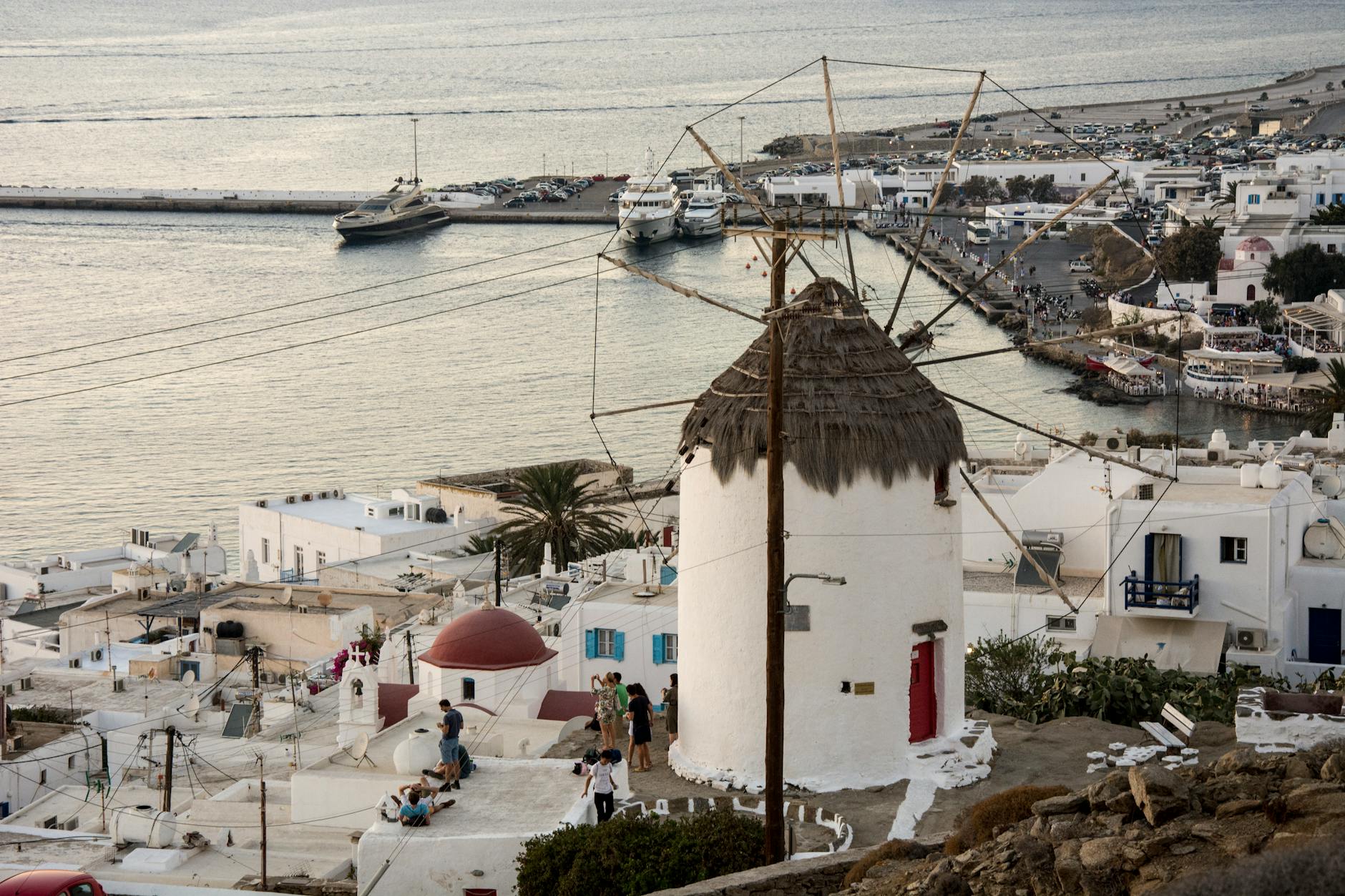
The seven whitewashed windmills on the ridge above Little Venice are the single most-photographed object on Mykonos, built by Venetian and Capodistrian families from the 16th century onwards to grind imported wheat and barley using the Meltemi wind that blows from the north-west across the Aegean from late May through September. Sixteen windmills survive on the island; the seven of Kato Mili (“Lower Mills”) are the famous row above Chora, with another nine scattered between Ano Mera, the Boni complex, and the older cluster above the New Port at Tourlos. Each is a three-storey cylindrical stone tower with a pointed wooden roof and twelve triangular canvas sails (now permanently furled) on rotating arms. The interior of the southernmost mill, Boni Mill, is open to the public as part of the Agricultural Museum of Mykonos and is the only one of the sixteen where the milling mechanism survives in something close to its working state.
Tip — Sunset at the windmills is a known crush.
Every guidebook says it. Every visitor follows it. Between 19:30 and 20:30 from June through September the path between Little Venice and the windmills is shoulder-to-shoulder. Go the opposite end of the day — 06:45 to 07:30, with first light coming up behind the mills from the east, the alleys empty, and a coffee at any of the early-opening kafeneia in Matogiannia for €3.
Price: Free (exterior); €2 for Boni Mill (Agricultural Museum).
Hours: Always accessible exterior; Boni Mill open daily 16:00–20:00 in summer (verify against current schedule before travel).
Access: Three-minute uphill walk from Little Venice on paved alleys.
4. Little Venice (Alefkandra)
Little Venice is the western seafront of Chora, where 16th- to 18th-century captains’ houses were built directly onto the rocks at the waterline so cargo could be hoisted into wooden balconies, bypassing the harbour and its tax. The wooden balconies are largely 20th-century reconstructions; the originals were repeatedly damaged by winter storms.
The strip is now seafront bars and restaurants charging €18–€25 for a cocktail at sunset. Walk it at 17:30 or 18:00 before the sunset crowd compresses; once the crowd thickens around 19:30 in July and August, retreat one street back to the kafeneia in Matogiannia for a fraction of the price.
Tip — Skip the famous bars, drink in the alleys.
Caprice and Galleraki have the prime sea-view tables and prices to match. The walk-up bars one street back, on the upper side of Mitropoleos, charge half the rate, get the same wind, and you will hear yourself think.
Price: Free to walk; €18–€25 cocktails at the seafront; €5–€8 in the streets behind.
Hours: Always.
Access: Mostly flat paved seafront; bars often have steps.
5. Panagia Tourliani Monastery, Ano Mera
The Tourliani is the only monastery on Mykonos and the patron church of the island. It was founded in 1542 by monks from the Katapoliani monastery on Paros who had fled their home island during a wave of pirate raids and rebuilt their community in the inland village of Ano Mera, seven kilometres east of Chora, where the elevation gave a defensive view back to the coast. The monastery was thoroughly restored in 1767 and the gilded wood-carved Baroque altarpiece (iconostasis) inside the catholicon dates to 1775 — designed and built by Florentine artists, one of the most remarkable Baroque carvings still in situ in the Aegean. The icon of the Virgin in the centre, said by tradition to have been painted by the evangelist Luke, is the venerated piece around which the August festival turns.
The panigiri (saint’s day festival) on 15 August for the Dormition of the Theotokos is the most attended community event of the Mykonian year and draws visitors from across the Cyclades. Free traditional food is served from a long table in the monastery courtyard — psaria sti scharra (grilled fish), kakavia (fish stew), louza (dried pork) and the Mykonian kopanisti cheese — and the donation tin near the kitchen is the only honest way to participate. A secondary feast on 23 August (Apodosis of the Dormition) is almost as well-attended and significantly less crowded.
Tip — Take the KTEL bus to Ano Mera, not a taxi.
The KTEL from Fabrika Square to Ano Mera costs €1.80 one-way and runs roughly every thirty to sixty minutes through the day. A taxi is €25–€40 in season. The bus drops at the village square fifty metres from the monastery gate and makes the village visible for what it actually is — a working hamlet with a butcher, a baker, two cafés and a sequence of small tavernas.
Price: Free entry. Donation tin near kitchen at festivals.
Hours: 09:00–13:00 and 16:00–19:00 daily. Closed 13:00–16:00 for the afternoon rest.
Access: Courtyard and church accessible to wheelchair users; the icon room and ossuary involve a step.
6. Archaeological Museum of Mykonos
The Archaeological Museum sits on a low rise above the Old Port and houses the best material excavated from Rheneia — the small uninhabited island next to Delos where the bones from the 426 BCE purification were reburied. The collection is not large but it is unusually concentrated. The single most important object is the Mykonos Vase, an early Archaic pithos (storage jar) of around 670 BCE, found in 1961 during well-digging in a private house in central Chora and used secondarily as a burial urn. It is 1.34 metres tall and bears the earliest known surviving narrative depiction of the Trojan Horse — a wheeled wooden structure with seven small windows and the faces of armed Greek warriors looking out, several centuries before any literary fixing of the story. The fact that the most famous artefact on Mykonos is a representation of a moment from a different war altogether is a useful reminder that the island has been on the route since the Bronze Age. The museum also holds funerary stelae from Rheneia, household pottery and votive offerings from Delos, marble fragments from the smaller Cycladic sanctuaries, and a small numismatic display.
Price: €4 (combined ticket with the smaller museums on Delos available; check at the entrance).
Hours: Summer (April–October) Wednesday–Monday 08:30–20:00, closed Tuesdays. Winter (November–March) 08:30–15:30. Verify against current schedule before travel.
Access: Step-free entrance. Display rooms mostly accessible; upper gallery has stairs.
7. Folklore Museum, Lena’s House and the Agricultural Museum
Three small museums maintained largely by the Mykonos Folklore Society, all free or near-free and all genuinely useful for understanding the working-island layer.
The Folklore Museum occupies a 19th-century captain’s house at the foot of the Kastro hill, by the seafront end of the Paraportiani church complex. The collection is a careful record of pre-tourism domestic life — looms, kitchen tools, wedding chests, marine instruments, a complete reconstruction of a fisherman’s bedroom — and the upper-floor view across Little Venice from inside an actual captain’s house tells you more about the island’s vernacular architecture than any walking tour. Open April to October, 16:30–20:30 daily except Sundays.
Lena’s House (Lena Skrivanou’s House), three streets back from the Folklore Museum in the Tria Pigadia (“three wells”) quarter, is a fully preserved late-19th-century middle-class Mykonian house — a frozen domestic interior with hand-embroidered linens, a parlour with the original furniture, the sewing room and a kitchen with copper pans hung in the order they were used. Free entry; small donation appreciated. Open April to October 18:30–21:30 except Sundays.
The Agricultural Museum of Mykonos, set up around the Boni windmill on the slope above Chora at the southern edge of town, is an outdoor museum with a working threshing floor, dovecote, well, oven and wine-press, plus the most carefully restored windmill on the island. Established after the 1st Symposium of the Folklore Museums of Greece in 1984. Open 16:00–20:00 daily in summer; €2 for the windmill interior, exterior free.
Tip — Three museums for under €10 in a single afternoon.
Folklore + Lena’s House + Agricultural Museum can be done as a 16:30–20:30 walking circuit for under €10 total with a coffee break in between, and they are the densest accessible record of pre-1960s Mykonos available to a casual visitor.
Access: Folklore Museum and Lena’s House have one or two interior steps each but are otherwise accessible. The Agricultural Museum is outdoor and largely flat.
8. Manto Mavrogenous Square and the Defence of 22 October 1822
The central square of Chora, immediately above the Old Port, is named for Manto Mavrogenous (1796/1797 – July 1848), the Trieste-born aristocrat who led the Mykonian defence of the island during the Greek War of Independence. The bust at the centre of the square is the standard memorial.
She was the daughter of a Mykonian-descended merchant in the Habsburg port of Trieste; her father was a member of the Filiki Eteria, the secret society that organised the 1821 revolution. When the war began she returned to Mykonos at her own expense, equipped and crewed two ships from her inheritance, and used them against the Algerian and Ottoman corsairs that had been preying on the Cyclades for centuries. On 22 October 1822 an Ottoman force attempted a landing to occupy Mykonos as a Cycladic base; the Mykonians under her leadership repulsed it in a single day. She subsequently raised a flotilla of six ships and an infantry corps of sixteen companies of fifty men, and fought at the Battle of Karystos on Euboea in late 1822. After the war, Ioannis Kapodistrias — the first Governor of independent Greece — awarded her the rank of Lieutenant General and granted her a residence in Nafplio, then the capital. She died in poverty on Paros in 1848, having spent her family fortune on the war. The square is now framed on three sides by cafés and souvenir shops; it is easy to walk through it without noticing what it is named for. Read the plinth.
Price: Free. Hours: Always open. Access: Flat paved square; fully accessible.
9. Agios Sostis and Kiki’s Tavern
Agios Sostis is a long sandy cove on the north coast, 7.5 kilometres from Chora, that has remained essentially undeveloped, with no facilities except the small whitewashed church that gives the beach its name and a single taverna at the far end. The water is clean, the sand is golden, and the swim is sheltered by a low headland from the worst of the Meltemi. There is no bus service to the beach itself; the closest KTEL drops at the Agios Sostis stop on the Ano Mera–Panormos road and the walk in is twelve minutes downhill.
The reason most travellers know the name is Kiki’s Tavern, a wood-panelled grill room above the cove run by the same family for over thirty years. It has no electricity and no signage, takes no reservations or cards, and runs a strict cash-only, queue-from-noon system. The kitchen is wood-fired. The menu is short — grilled lamb chops, fish, pork, Greek salad, feta, tzatziki, retsina by the half-litre. A two-person lunch with wine is around €60–€80. The wait is forty to ninety minutes from late June through August. The food is some of the best straightforward grilled meat in the Cyclades.
Tip — Arrive at 12:30, eat at 13:30, swim at 15:00.
The queue forms at noon. Arrive at 12:30, put your name on the slate, walk down to the cove for a forty-minute swim, return at 13:15 to find a table assigned. After lunch, the cove is at its best between 15:00 and 16:30 when the wind drops and the day-tour boats have left for Mykonos.
Price: Beach free; lunch at Kiki’s €40–€60 per person with wine.
Hours: Beach always; Kiki’s daily 13:00–19:00 from May through October. Closed November–April. Verify against current schedule before travel.
Access: Soft sand; the path down from the road is unpaved and steep in places. Kiki’s has a couple of steps to the dining room.
10. Fokos Beach — The Honest Alternative
Fokos is the beach that the south-coast lounger strip pretends to be: a wide sandy crescent on the north coast with no road in and no beach club at the cove. The track from Ano Mera is unpaved and rough, best taken in a 4×4 or a hardy rental, and the walk from the parking turnout is fifteen minutes on a clear path. Fokos Taverna is the only structure — family-run, cash only, no booking, open 13:00–19:00 in summer (verify against current schedule before travel) — and otherwise the cove is rocks at either end and a swimming line that runs with current when the Meltemi is high. The beach is sometimes nude; it is not exclusively so, and Mykonian families share it without issue. Bring a light wind layer — Fokos faces north and gets the full Meltemi from late June through August.
Tip — Don’t drive a small rental.
The track to Fokos is graded but uneven. A standard small rental car will manage in dry weather but will scrape on the rough sections. A scooter is fine in summer. After rain, the track is a four-by-four-only proposition.
Price: Free beach; €25–€35/person at Fokos Taverna with wine.
Hours: Beach always; Taverna 13:00–19:00 May–October.
Access: Track and beach unsuitable for wheelchair users.
11. The Mykonian Kafeneia and Houlakia
The traditional Mykonian kafeneio — a single-room café where the men of the village drink coffee, ouzo and small meze through the afternoon — is largely extinct in central Chora and survives in the inland villages and on the western edge of the Old Port. Café Niko’s at Megali Ammos and the row of three small kafeneia at the New Port end of Chora are working kafeneia where a Greek coffee costs €2.50, an ouzo with a small plate of olives is €4, and the clientele are local. They are also exactly where the Mykonian fishermen meet at dawn before the first cruise tenders dock.
Houlakia Beach, four kilometres west of Chora on the road past the old slaughterhouse, is a cove of polished colourful swimming pebbles rather than sand — millennia of wave action on Mykonos’s underlying granite and metamorphic rock, weathered to glassy smoothness. Swim shoes are a serious help, but the water is glassy in any wind direction except westerly, the sea floor drops cleanly into deep water within a few metres, and the cove is essentially never crowded.
Tip — Pebble beaches are the Mykonian secret.
The famous golden-sand beaches all sit on the south coast, where the Meltemi blows them straight into the visitor’s face from late June onwards. Houlakia, on the lee side, is calm when the south is rough. The pebbles are uncomfortable for sun-bathing and excellent for swimming.
Price: Free.
Hours: Always.
Access: Houlakia reached by an unpaved track from the coast road. No facilities.
12. Kalafatis and Spilia
Kalafatis is the largest east-coast bay and the only one developed for water sports without the south-coast lounger logic. The bay holds a long sandy crescent, a single long-established 4-star resort (the Aphrodite Beach Hotel, fronting one of the island’s Blue-Flag-certified beaches; verify current certification status before booking), a windsurfing school, a small kiteboarding outfit, a diving operation, and a row of taverna restaurants. The water on the Aegean east coast is reliably calmer than the south in mid-summer because the Meltemi blows offshore here — Kalafatis is one of the better windsurfing schools in the Cyclades for that reason.
Spilia Seaside Restaurant, fifteen minutes’ walk south from the main Kalafatis beach along the coast path, is a kitchen built into a sea-cave (spilia in Greek) with one of the most distinctive dining rooms in the Aegean. Tables are set in the cave mouth on a flagstone floor with the sea water lapping below. The kitchen does serious Greek-Mediterranean seafood — sea-urchin pasta, lobster spaghetti, raw fish carpaccio — at €70–€110 per person with wine. It is one of the few high-end Mykonos kitchens that can be defended as worth the price.
Tip — Book Spilia twelve hours ahead, sit at the cave-mouth table.
The cave-mouth tables (numbered 1–4) are the only ones where the spectacle works; the inland tables are an ordinary terrace. Specify the cave-mouth on booking and arrive at 19:30 for sunset.
Price: Beach free; lessons €60–€120/hour; Spilia €70–€110/person with wine.
Hours: Beach always; Spilia 13:00–17:00 lunch and 19:00–24:00 dinner, 1 May to 15 October.
Access: Soft sand. Spilia involves a steep coastal walk from the parking; the cave-mouth tables involve four steps down.
Neighbourhoods
Chora — Matogiannia, Alefkandra (Little Venice), Kastro
Commercial and residential core. Matogiannia is the central commercial alley network — gold shops, designer boutiques, the Pierro’s square (see Drinking section), late-night bars. Alefkandra (Little Venice) is the western seafront. Kastro is the small medieval quarter on the rise behind, including the Paraportiani church complex (five small churches structurally fused into one whitewashed organism, possibly the most-photographed building on Mykonos after the windmills). Stay here for the immersive version of the island and accept the noise.
Tourlos and Agios Stefanos — Above the New Port
Two kilometres north of Chora on the coast road, the area around Tourlos (the New Port) and Agios Stefanos beach is a calmer base for visitors who want a quick taxi or bus into Chora but do not want to sleep with the music. Mid-range hotels, a quiet swimming beach, and the one-way ferry-watching view of cruise ships docking at the New Port. This is among the coastline parcels caught up in the planning disputes referenced in the Editor’s Note — the price pressure here is part of what makes the file contested.
Ano Mera — The Inland Working Village
Seven kilometres east of Chora, around the Tourliani Monastery (see Top Attractions #5). The only inland village on the island. A real village square with a butcher, a baker, a chemist, two cafés open from 06:30, and a sequence of tavernas. Stay here for the working-island version of Mykonos. Bus to Chora is €1.80 every thirty to sixty minutes.
Platis Gialos and Psarou — South Coast Packaged
The two south-coast bays that anchor the brand layer. Platis Gialos is more accessible, with a regular bus to Fabrika and a row of mid-range hotels. Psarou is smaller, more expensive, and home to Nammos Beach Club — the canonical south-coast lounger at €100–€150 per pair plus €350 minimum spend on bottle service. Stay here for the brand version of Mykonos and accept the cost.
Kalafati and Agia Anna — East Coast Residential
The east-coast bays beyond Kalafatis. Quieter, family-friendly, with the Aphrodite Beach Hotel as the anchor and a row of small villa rentals. Stay here for water sports, calm water, and a forty-minute drive into Chora.
Ornos and Agios Ioannis — Coast and Sunset
Ornos is the bay immediately south-west of Chora — short walk or €1.80 bus ride. Agios Ioannis, on the headland between Ornos and Kapari, is the location of the famous Shirley Valentine taverna (which still operates). Both are good mid-range bases.
Where to Stay
Mykonos is genuinely expensive in summer. Nothing reasonable in town runs under €120 per night in July, and the comfortable mid-range starts at €250. Off-season (November–March) prices fall by 60–70%, but most hotels close.
Budget — €80–€150 per night peak
- Hotel Tagoo (Tagoo, west of Chora) — old-school Greek family hotel, sea view, no pool, fan rooms, breakfast included. Walking distance to Chora. From €110 in shoulder, €140 in peak.
- Geranium Residence (Mykonos Town) — pension-style rooms in a Mykonian house, central, basic bathrooms. From €100 shoulder, €130 peak.
- Hotel Lefteris (Mykonos Town, Apollonos street) — small family hotel near Mavrogenous square. €120–€160.
Below €80 in July is not a serious option. Hostels exist (Paraga Beach Hostel) but cost €60+ for a dorm bed in season.
Mid-Range — €200–€450 per night peak
- Belvedere Hotel (School of Fine Arts, Chora) — boutique design hotel with pool, central but quiet, restaurant by Matsuhisa Mykonos. €280–€500.
- Mykonos Theoxenia (Kato Mili, immediately below the windmills) — the building that defined design hotels in Greece, originally 1965, restored. €350–€500.
- Pietra e Mare (Kalafati) — east-coast resort hotel, pool, beach access. €250–€400.
Luxury — €600–€3,000+ per night peak
- Cavo Tagoo (Tagoo, west of Chora) — clifftop infinity-pool hotel, Buddha-Bar Beach restaurant. From €700 shoulder, €1,200+ peak.
- Bill & Coo Suites and Lounge (Megali Ammos) — Relais & Châteaux, three pools, six restaurants. €800–€2,500.
- Santa Marina Resort (Ornos) — Marriott Luxury Collection, private beach, three pools. €700–€2,500.
- Four Seasons Resort Mykonos — opens late summer 2026 at Kalo Livadi Bay on the south coast. 94 rooms, suites and villas designed by Nicos Valsamakis Architects and Wimberly Interiors. The first Four Seasons in the Cyclades. Opening rates not yet published; expect €1,200–€3,500 per night peak.
Where NOT to stay
Paradise Beach in July or August — the beach-club noise runs from 14:00 to 04:00 and abatement orders are not enforced. Super Paradise for the same reason. The cluster of older hotels behind the airport are quiet but the trip into anywhere takes thirty minutes by taxi at €25 each way and the savings disappear.
Climate Resilience Fee
A per-room-per-night surcharge introduced 1 January 2024 (Law 5073/2023) and substantially raised on 1 January 2025; the 2025 rates continue unchanged for 2026. Paid on departure, in cash or to the hotel:
- 1–2★ hotel: €2.00/night
- 3★ hotel: €5.00/night
- 4★ hotel: €10.00/night
- 5★ hotel: €15.00/night
Off-peak (November–March) rates are 67–75% lower. A four-night stay at a 5★ adds €60. Build it into the budget.
Where to Eat
The framing for eating on Mykonos is that the island has, as of the 2026 Michelin Guide selection, zero stars. The Greece guide currently lists 12 stars — all in Athens — and the 2026 expansion (announced for the second half of 2026) adds Santorini and Thessaloniki, not Mykonos. The high-end restaurants here operate without the Michelin frame, which means menus, prices and chef changes are not externally validated. A €350-per-head tasting menu may be excellent or it may be exactly what the location can charge.
The working-island layer has a serious food culture: the soft sour cheese kopanisti (three protected producers on the island), the dried pork louza (cured tenderloin with savory and pepper, found nowhere else in this form), the local almond biscuit amygdalota, the spiral cheese pie kalathaki, and grilled fish — barbouni (red mullet), tsipoura (sea bream), fagri (red porgy) — caught by the Old Port fishermen and handled at the surviving traditional tavernas.
Budget — €15–€30 per head
- Joanna’s Niko’s Place (Megali Ammos) — family-run, traditional menu, moussaka €11, fish soup €9, grilled fish by weight. A reasonable first-night dinner.
- M-eating (Mykonos Town, Kalogera street) — the more polished version of working-Mykonos cooking, contemporary takes, around €25/head with wine.
- Niko’s Taverna (Old Port) — the fish you watch them unload from the morning boats. Cash only. €20–€30 with wine.
- Lefkes (Ano Mera village square) — taverna at the heart of the inland village, louza €6, kopanisti €4, octopus €14.
- Bakaliko (Mykonos Town, Drafaki) — modern Greek bistro, great for a substantial lunch under €25.
Mid-Range — €40–€80 per head
- Kounelas (Old Port, Mykonos Town) — fish taverna run by the same family since the 1960s, the proof that traditional Mykonos cooking did not disappear under the brand. Grilled barbouni by weight, fried kalamari, octopus, fresh salads. €35–€55 with wine.
- Kiki’s Tavern (Agios Sostis) — see Top Attractions #9. €40–€60 with wine.
- Fokos Taverna (Fokos Beach) — see Top Attractions #10. Cash only.
- Rakomelo (Mykonos Town, Lakka neighbourhood) — small meze-bar with the best raki list on the island. Eight or nine plates between two for €60.
Special Occasion — €80–€200+ per head
- Spilia Seaside (Kalafatis) — see Top Attractions #12. €80–€110 with wine.
- Buddha-Bar Beach (Cavo Tagoo) — reliably good Pan-Asian on a clifftop terrace. €90–€140.
- Matsuhisa Mykonos (Belvedere Hotel) — Nobu group, sushi and Pan-Asian, the most reliably good fine-dining kitchen on the island even though it is not Michelin-starred. €120–€200.
- Kyma (Anax Resort, Agios Ioannis Diakoftis) — contemporary Greek-Mediterranean kitchen on a terrace facing the sunset, well-curated Greek wine list. €120–€200.
Fish by weight, and what to avoid
At any traditional taverna the fish is ordered by selecting it from the chiller, weighing it, and quoting the price per kilo (typically €60–€90/kg in 2026 for the better species). This is normal and not a tourist trap; it is how Mykonians order fish. Avoid beachfront restaurants on the south coast with no posted prices, and any restaurant whose menu has photographs of the dishes — the local convention is no photos, and a Chora menu with photos is reliably tourist-targeted. The €25 “complete Greek breakfast” offered at central tourist cafés is the same yoghurt with honey that costs €4 at any kafeneio one street back.
Drinking and the LGBTQ Inheritance
Mykonos has been one of Europe’s primary LGBTQ destinations since the early 1970s. The catalyst was Pierro’s — a bar opened in 1972 in the square of Agia Kyriaki in Matogiannia by a Mykonian fisherman, Andreas Koutsoukos, in partnership with the Italian painter Pierro Aversa. Pierro’s was the first openly LGBTQ-friendly venue on the island and the defining location for the gay scene through the 1970s and 1980s. In 1978, despite Greece having decriminalised same-sex acts in 1951, Koutsoukos’s licence was revoked for a month under separate public-decency provisions then still applied to gay venues; the bar reopened. The drag shows ran for 33 consecutive years. Pierro’s closed at the end of the 2005 season, and the square still bears the unofficial name Plateia Pierrou.
The current scene concentrates around Lakka (the small square uphill from Matogiannia) and Pliroforion street, with Jackie O’ (waterfront) and Babylon (Old Port) as the largest contemporary venues, Elysium Hotel (Kalogera street) running the cabaret tradition, and Super Paradise Beach still hosting the historically gay south-coast beach club. Xlsior, the international gay festival, launched in 2009 and runs for six days in late August (the 2026 edition is 20–25 August), drawing up to 30,000 attendees.
Cocktail bars cluster at Little Venice (€18–€25 a drink, sunset crush 19:30–20:30 from June through September) and the higher-end versions are in the cliffside hotels (Cavo Tagoo, Bill & Coo, Belvedere). The cheaper everyday drinking is in the kafeneia behind Matogiannia — Greek coffee €2.50, ouzo €4, raki €4 with olives — and at the surviving working-island bars (Veranda Bar, Skandinavian Bar, the small upstairs places along Mitropoleos).
Tip — The two-bar rule for Mykonos sunsets.
Cocktails at Little Venice are part of the Mykonos experience and the price is the price. Have one, take the photograph, then walk three minutes inland to the Matogiannia kafeneia and have the second drink for a quarter of the cost.
Mykonian Wine
There is essentially no significant wine production on Mykonos itself. The nearest wine region is Tinos (twenty minutes by ferry north), which has had a serious revival in the 2010s — Domaine T-Oinos (founded by Alexander Avatangelos and Gerard Margeon with consultant Stéphane Derenoncourt) and Vaptistis are the two anchor estates, both producing minimal-intervention wines from indigenous Aegean varieties. Tinos wines are widely available at the better tavernas on Mykonos.
Coffee
The Mykonian morning runs on Greek coffee from a briki (small long-handled pot) at €2.50, freddo espresso at €3.50–€4, or freddo cappuccino at €4–€4.50. Avli tou Thodori (Old Port end of Chora) and Mama Pizza Roma (despite the name — also a serious coffee bar) open at 06:30 and serve the dawn shift before the cruise tenders dock.
Getting Around
From the airport (JMK)
Mykonos Island National Airport sits four kilometres south-east of Chora. Three legitimate options:
- KTEL bus: €1.80, every 30–60 minutes from 08:15 to 22:15, terminates at Fabrika Square (Southern Bus Station). 15–20 minutes. Cash only.
- Taxi: €17–€25 fixed-route to Chora, €4 airport surcharge included, 10 minutes. Only thirty to forty legal taxis operate on the entire island; queues can run 30+ minutes in peak arrival windows.
- Pre-booked transfer: €25–€45 for a private car. Useful at peak arrival hours.
Local KTEL bus network
Two stations:
– Fabrika (Southern Bus Station, central Chora) — services to airport, New Port, Platis Gialos, Ornos, Agios Ioannis, Psarou, Paradise, Paraga, Super Paradise.
– Old Port (Northern Bus Station) — services to Ano Mera, Tourliani Monastery, Kalafatis, Elia, Panormos.
Single ticket €1.80 to most destinations, €2.20–€2.80 to the further ones. Cash only, paid to the driver. Frequency every 30–60 minutes in summer; less frequent and earlier final services in shoulder season.
Taxi
Only thirty to forty legal taxis on the island. Fixed-route fares apply in season — meter is rarely run. Standard chart: Chora ↔ Airport €17–€25; Chora ↔ New Port €15–€25; Chora ↔ South-coast beaches €20–€35; Chora ↔ Ano Mera €25–€40; Chora ↔ Kalafatis or Elia €30–€45. Meter rates when run: base fare €1.80, daytime €0.90/km, night €1.25/km, airport surcharge €4, port surcharge €1.07, luggage over 10 kg €0.40/piece. Always agree the price before getting in. Beat is partly active but coverage is patchy; ride-hailing apps are not, as a general rule, accepted.
Rental car / scooter
A small rental runs €40–€80 per day in shoulder, €80–€150 per day in July and August, plus €15–€25/day for parking near Chora. Scooters are €20–€40. Roads are narrow, south-coast traffic is severe in summer, parking in Chora is largely impossible (drop the car at one of the two outer car parks), and the unpaved tracks to Fokos and the north-coast beaches require a 4×4. For a four-day visit largely based in Chora, bus + occasional taxi is cheaper than a rental and removes the parking problem.
Ferry
- Old Port (Chora) — small boats to Delos and the day-trip Cycladic routes.
- New Port (Tourlos) — large car ferries to Athens (Piraeus and Rafina), Santorini, Crete, Naxos, Paros, Tinos, Syros, Andros. Booking via Ferryhopper or OpenSeas in advance is recommended in July and August.
Walking
Chora is entirely walkable and parts are walking-only. Carry a paper map or download an offline Google map — the deliberate disorientation of the alleys defeats GPS regularly.
Best Time to Visit
The sweet spots are late May to mid-June and mid-September to early October. In both windows, daytime temperatures are 22–27°C, the sea is warm enough to swim, the Meltemi is moderate, prices are 30–50% below peak, and cruise traffic is significantly lighter. Most hotels, restaurants and beach clubs are open from 1 May.
July and August are the brand-layer peak. Daytime temperatures 28–32°C, Meltemi at full strength (sometimes 7 Beaufort, gusts 9), every restaurant requires a reservation, prices are at maximum, the crowd is dense at every photogenic location from 11:00 to 21:00. If your visit must be in July or August, go for the LGBTQ event calendar (Xlsior 20–25 August 2026), the full beach-club opening, or the genuinely consistent weather.
April and early May are unstable — the sea is cold (16–18°C), most beach tavernas are still closed, and a number of restaurants reopen only on 1 May. November to March is closed-island season — most hotels, restaurants and beach businesses shut, the ferry to Delos does not run after 30 November, and a visit becomes a residential one.
Tip — The first weekend of October is the unofficial best time.
Air 24–26°C, sea 24°C and warmer than the air, most beach clubs still open at half-capacity, hotel rates 40% below peak, light Meltemi, day-cruise traffic essentially gone. Six clear days every year that are not in any guidebook for a reason — the locals would prefer to keep them.
Month-by-Month Weather
| Month | High / Low (°C) | Rain (mm) | Notes |
|---|---|---|---|
| January | 13 / 9 | 51 | Closed-island season. Cold sea (15°C), windy. |
| February | 13 / 9 | 41 | Cold, wet. Same closure. |
| March | 14 / 10 | 32 | First mild days. Hotels start announcing reopening dates. |
| April | 17 / 12 | 17 | Reopening month. Sea 16°C, swimming brave only. EES live since 10 April 2026. |
| May ⭐ | 21 / 15 | 11 | Sweet spot opens. Sea 18–20°C. Restaurants fully open from 1 May. |
| June ⭐ | 25 / 19 | 5 | The strong shoulder. Sea 21–23°C. Meltemi starting. |
| July | 27 / 21 | 1 | Brand peak. Sea 23–25°C. Strong Meltemi. Cruise capacity full. |
| August | 28 / 22 | 4 | Brand peak continues. Hottest. Xlsior 20–25 August. |
| September ⭐ | 25 / 19 | 14 | Sweet spot resumes. Sea 24°C (warmest of the year). Lighter Meltemi. |
| October ⭐ | 21 / 16 | 56 | Last full month. Sea 22°C. First weekend of October the best week of the calendar. |
| November | 18 / 13 | 170 | Wettest month. Most businesses close mid-November. |
| December | 14 / 10 | 88 | Closed island. |
Source: Hellenic National Meteorological Service climate normals; mean annual 17.8°C, ~385 mm rainfall, 300+ sunshine days. ⭐ marks the four months when the island is at its best.
Daily Budget Breakdown
| Category | Budget | Mid-Range | Luxury |
|---|---|---|---|
| Accommodation (per room) | €100–€140 | €250–€450 | €700–€2,500+ |
| Meals & Drinks (per person) | €40–€60 | €80–€140 | €200–€400+ |
| Transport (per day) | €5–€15 (bus) | €25–€60 (taxi/rental) | €100–€200 (car + transfers) |
| Activities (per person) | €20–€50 | €60–€120 | €150–€400 |
| Climate Resilience Fee (per room) | €2 | €5–€10 | €15 |
| Daily total (single) | €80–€150 | €200–€400 | €600–€1,500+ |
| Daily total (couple) | €140–€250 | €350–€700 | €1,000–€3,000+ |
Mykonos is the most expensive island in the Aifly fleet. The numbers above assume peak-season (July–August) pricing; shoulder costs run 30–50% below peak across all tiers.
Sample Itineraries
3-Day Essential Mykonos
Day 1 — Arrival, Chora, the Working Layer
12:00 — Arrive Mykonos (JMK), taxi or KTEL to Chora.
13:30 — Check in. Lunch at Joanna’s Niko’s Place (Megali Ammos), €25.
15:30 — Walk Matogiannia and the alleys before the heat peaks. End at Manto Mavrogenous Square (see Top Attractions #8).
17:00 — Folklore Museum + Lena’s House (combined visit, 90 minutes, €5; see Top Attractions #7).
19:00 — Cocktail one street back from Little Venice (€8–€12).
21:00 — Dinner at Kounelas on the Old Port (€40 with wine).
Day 2 — Delos, the Sacred Layer
07:30 — Coffee at the Old Port kafeneia.
09:00 — Ferry to Delos, four hours on site (see Top Attractions #2; €20 + €25 ferry RT).
13:30 — Return ferry. Lunch at the Old Port (€20).
15:30 — Beach: walk or bus 15 minutes to Houlakia (free pebble cove, calm in lee of north wind).
19:30 — Sunset at the Kato Mili windmills (free).
21:00 — Dinner at M-eating in Chora (€30 with wine).
Day 3 — Ano Mera and the North Coast
09:00 — KTEL to Ano Mera (€1.80). Coffee in the village square (€2.50).
09:45 — Tourliani Monastery (free, 45 minutes; see Top Attractions #5).
11:00 — Walk or taxi to Agios Sostis (€25 from Ano Mera).
12:30 — Lunch at Kiki’s Tavern (see Top Attractions #9; cash only, €45).
15:00 — Swim at Agios Sostis.
17:30 — Bus back to Chora.
20:00 — Final dinner at Spilia Seaside Restaurant (see Top Attractions #12; €90 with wine, book the cave-mouth table 24h ahead).
Day 4–5 add-ons
- Day trip to Tinos — twenty-minute ferry. Panagia Evangelistria (the Lourdes of Greece, the most important Marian pilgrimage in the country), the Tinos wine country (Domaine T-Oinos at Tarambados, Vaptistis at Falatados), and the marble villages of Pyrgos and Volax. €15 ferry + €40 lunch + €30 transport on Tinos.
- Day trip to Naxos — fifty-minute ferry, the largest Cycladic island, the Portara of Naxos (a single marble doorway from a 6th-century BCE temple to Apollo, never completed), the inland village of Apeiranthos, and the Naxos cheese country (Graviera Naxou). €25 ferry + €60 day costs.
- Slow day in Chora — start at the Archaeological Museum (€4; see #6), spend the afternoon at the Mavrogenous Square kafeneia, visit the Paraportiani church complex, and end with a second slow walk through the alleys at 18:00 when the light comes in low.
Best Day Under €60
This is the budget-leaderboard entry for the most expensive island in the Aifly fleet. A defensible target on Mykonos is €60 per person, including the day’s transport, lunch, the Delos site, and the Delos ferry. It cannot be done significantly cheaper without dropping Delos itself, which defeats the day.
| Stop | Cost |
|---|---|
| Greek coffee + tiropita at the Old Port kafeneio | €4.50 |
| Ferry round-trip Mykonos – Delos | €25.00 |
| Delos site + museum entry | €20.00 |
| Bottled water for the site (1.5 L) | €2.00 |
| Lunch at the Old Port on return — fish soup + bread + half-litre retsina | €18.00 |
| KTEL bus to Houlakia (free walk-in cove) for afternoon swim | €1.80 |
| Greek coffee on return | €2.50 |
| Total per person | €73.80 |
Below €60 if you skip the Delos museum (€10) and split a single bottle of water — €63.80. Below €50 only if you skip Delos entirely, which is the wrong trade. Mykonos’s “best day” is €60+ per person, and a visitor who has not paid that price has not seen the island. Compare: Cairo $3.50, Bogotá $6, Kuala Lumpur €8.50, Munich €12, Santiago $13, Nicosia €32.60, Lanzarote €33.50, Sicily/Sardinia/Crete €35–€40, Santorini €52. Mykonos is the most expensive Best Day in the fleet.
Windy Day / Hot Day Plan
The Meltemi blows from the north and north-west across the Aegean from late June through September; on a high-Meltemi day the south-coast beaches are unswimmable, the ferry to Delos may be cancelled, and the open-air dining rooms are uncomfortable.
- 09:00 — Coffee inside Matogiannia. Avoid the seafront kafeneia.
- 09:45 — Archaeological Museum of Mykonos (€4, indoor, two hours; see Top Attractions #6).
- 12:30 — Lunch in the alleys behind Mitropoleos — try Bakaliko (€20 with wine).
- 14:00 — Swim at Houlakia or Megali Ammos on the western lee — both glassy when the south is rough.
- 17:00 — Folklore Museum + Lena’s House combined visit (€5, 90 minutes, indoor; see #7).
- 19:30 — Dinner at Rakomelo (small meze-bar in the Lakka neighbourhood, indoor terrace, €30).
Hot-afternoon plan in July: same architecture, with the museum block running 14:30–17:30 to escape the heat peak, and dinner moved to 21:00.
Day Trips
Tinos — 20 minutes by ferry
The Marian pilgrimage island. The Panagia Evangelistria in Tinos Town, built in 1823 on the spot where a miraculous icon was found, is Greece’s most important Marian shrine — known throughout the Orthodox world as “the Lourdes of Greece” — and draws tens of thousands of pilgrims for 15 August; by tradition many complete the final stretch from the harbour to the church on their knees on a red carpet. The interior wine country at Tarambados and Falatados has had a serious revival; Domaine T-Oinos, founded by Alexander Avatangelos and Gerard Margeon with consultant Stéphane Derenoncourt, plants Assyrtiko on granitic sand and Mavrotragano on schist and is the most established of the new-wave Tinian estates. The marble villages at Pyrgos and Volax are the working centre of Cycladic marble carving, with workshops still operational. €15 ferry + a full day.
Naxos — 50 minutes by ferry
Largest of the Cyclades, the most agricultural, the most affordable. The Portara of Naxos — a single marble doorway from an unfinished 6th-century BCE temple to Apollo, on a small islet at the harbour mouth — is among the most photographed objects in the Aegean for a reason. The mountain village of Apeiranthos is the best-preserved Cycladic interior settlement on any island. Graviera Naxou is the highest-rated Greek hard cheese and is sold at every cheese shop on the island. €25 ferry, full day.
Paros — 45 minutes by ferry
The transit hub of the central Cyclades. The marble villages at Marpissa and Lefkes are the inland counterpart to Naxos’s Apeiranthos. Naoussa harbour is a working fishing village that has resisted the Mykonos pattern. €20 ferry, full day.
Syros — 90 minutes by ferry
The administrative capital of the Cyclades and the only one with a permanent year-round economy outside tourism. Ermoupoli is a 19th-century neoclassical city carved into the slopes of two hills (the Catholic hill and the Orthodox hill), with an opera house — the Apollon Theatre, opened on 20 April 1864, designed by Pietro Sampò drawing on La Scala among other Italian theatre models — and a working shipyard. The most underrated Cycladic capital. €25 ferry, full day.
Rheneia — 30 minutes by private boat
The neighbouring island of Delos, where the bones of the 426 BCE purification were reburied. Now uninhabited but with the largest Hellenistic necropolis in the Aegean and a series of unsupervised, untouched sandy coves. Private-boat-only access; no scheduled ferry. A four-person caïque charter from Mykonos’s Old Port runs €250–€350 for the day — the serious Aegean alternative to the south-coast beach clubs.
Safety and Practical Information
Personal safety
Mykonos is on the visitor-experience surface one of the safer Mediterranean islands; petty theft, violence against tourists and pickpocketing are all rare. The serious caveat is the documented organised-crime presence centred on the high-margin coastal real-estate market, present since the late 2010s. The 2 July 2024 contract killing of surveyor Panagiotis Stathis in Athens, prompted by his work on Mykonos planning files, was the highest-profile incident; the gunman and accomplice were convicted in November 2025 (life imprisonment plus six years for the gunman, nine years for the accomplice), but the financial backers of the contract remain officially unidentified. Greek police have deployed a permanent organised-crime unit on Mykonos, and the Supreme Court Prosecutor has a coordinated investigation underway across the island and other Cyclades. None of this affects ordinary visitor safety. It does mean a visitor who walks into a beach-bar planning dispute is dealing with a more serious operating environment than a typical tourist island.
Currency and cards
Greece is in the eurozone (EUR). Major credit cards are accepted at hotels, mid-range restaurants and most attractions. Cash is still required at: Kiki’s Tavern, Fokos Taverna, the KTEL bus, traditional kafeneia, the Old Port fishing-boat tavernas, the Folklore Museum, Lena’s House. Carry €100–€200 in cash per day in season.
Language
Greek is the national language. English is universally spoken in the tourism industry and widely spoken in the working-island layer. Useful phrases:
Yia sas (formal hello/goodbye); Yia sou (informal); Efcharistó (thank you); Parakaló (please / you’re welcome); Énan kafé ellinikó, parakaló (one Greek coffee, please); Ton logariasmó, parakaló (the bill, please).
Connectivity
4G universal across Mykonos and Delos; 5G in Chora and along the south coast. Wi-Fi included at all hotels. EU roaming applies for European numbers; outside the EU, local SIMs from Cosmote, Vodafone or Wind are available at the airport and Chora (€15 for 30 GB).
Tipping
In restaurants, 10% is generous and 5% is standard. The bill (o logariasmós) includes service in name, so tipping is appreciated rather than expected. Round up taxi fares. €2–€5 per bag for porters at the larger hotels.
Tourist information
The official Mykonos tourist information point is in Manto Mavrogenous Square, Chora — open daily 09:00–14:00 and 17:00–21:00 in summer.
Emergency numbers
- 112 — European emergency (police, fire, ambulance, coastguard)
- 100 — Greek police direct
- 166 — Greek ambulance direct
- 108 — Greek coastguard
Visa and Entry Requirements
Greece is in the European Union, the eurozone, and the Schengen Area. Mykonos’s airport (JMK) and ports are external Schengen borders for non-Schengen arrivals.
EU/EEA citizens: free movement, no visa required, ID card sufficient.
UK / US / Canada / Australia / New Zealand citizens: visa-free for stays up to 90 days within any 180-day period in the Schengen Area.
EES (Entry/Exit System): live since 10 April 2026 at JMK and all Greek Schengen border crossings. Records biometric data (facial image and fingerprints; under-12s exempt from fingerprints) on first entry. First entry takes longer at the border; subsequent entries are faster.
ETIAS: expected to launch Q4 2026 with at least a six-month transition during which travellers will be asked to apply but will not be refused entry without an authorisation. Once mandatory, ETIAS requires a €20 pre-authorisation valid for three years (free for under-18s and over-70s). Apply on travel-europe.europa.eu; ignore commercial intermediaries.
Tip — Don’t confuse ETIAS with EES. EES is the biometric border system Greece is already running. ETIAS is the pre-authorisation visitors will need to apply for in advance, expected later in 2026. Neither requires action now for short summer visits if your nationality already qualifies for visa-free Schengen entry.
Hidden Mykonos
The Old Port fishing-boat dawn
The Old Port (Chora’s harbour) is, between 06:00 and 07:30, a working fishing harbour. Boats come in with the night’s catch, fish are sold direct from the deck to the surviving traditional tavernas (Kounelas, Niko’s), and the kafeneia at the harbour end serve the fishermen’s morning. Sit at one of the kafeneia between 06:30 and 07:15 and watch the day before the cruise tenders dock.
The Paraportiani church complex
Five small Byzantine and post-Byzantine churches structurally fused into a single whitewashed organism on the Kastro promontory above Little Venice. The base church dates to the 14th century; the four others were built around it between the 16th and 17th centuries. Free, always accessible — interiors usually closed and the surface architecture is the point.
The Lakka neighbourhood at 22:00
Lakka is the small square uphill from Matogiannia, three minutes from Mavrogenous Square. By 22:00 the cruise crowd has gone, the alleys are quiet, and Rakomelo and the small wine bars around the square serve until 02:00 with locals at the tables — the closest the brand-layer Mykonos gets to a working-island late evening.
The eastern coast walking path
A coastal track runs from Kalafati north along the eastern shore through small uninhabited coves toward Panormos. Unpaved, signposted in places, and connects swimming beaches that are almost never used. Allow three hours each way; bring water.
The deserted villages of Maou and Ftelia
Two small inland farming hamlets in the centre of the island, between Ano Mera and the north coast. Ftelia has a Late Neolithic settlement (~5000 BCE) being slowly excavated. Maou is essentially a single working farmhouse with a dovecote tower. Neither is in any major guidebook; the walking-circuit between them, returning to Ano Mera for lunch, is one of the best inland walks on the island.
Ftelia kite and windsurfing centre
On the north shore at Ftelia bay, the kite and windsurfing centres are the working venues for Mykonos’s Meltemi-driven board-sport scene. The wind here is the most consistent on the island, particularly through July and August when the south coast is unswimmable. Confirm current rates with the operator on the day.
Romantic Mykonos
- Sunset at the Boni Mill — the Kato Mili windmills are shoulder-to-shoulder at 19:30–20:30 in July; walk five minutes uphill to the Boni Mill instead, where the same view is available without the crowd.
- Dinner at Spilia Seaside — see Top Attractions #12; book the cave-mouth table for sunset, arrive at 19:30. €90/person with wine.
- Sunrise at Agios Sostis — the beach is empty at 06:30, the sun rises directly into the cove from the east, and Kiki’s is closed. Walk down with a thermos of coffee from the Ano Mera bakery (€8 a flask).
- Hotel pick: Cavo Tagoo or Bill & Coo, both with private clifftop pools. €700–€2,500/night peak.
- Late-evening walk in the alleys — start at Mavrogenous Square at 23:00, walk Matogiannia, end at the windmills under the night-time floodlighting. Free.
Mykonos with Kids
Mykonos is workable with children but expensive and requires a careful base location. The family-friendly bays on the east coast (Kalafatis, Elia, Agia Anna) are calm, sandy, and have direct waterfront tavernas. Chora is loud at night and not designed for stroller traffic.
Recommended plan: stay at a family hotel on Kalafati or Elia (Aphrodite Beach Hotel at Kalafatis is the most-established option), use the bus or a small rental for day trips into Chora, and take the Delos ferry on a calm-Meltemi day with closed-toe shoes for the children — the site is unfenced and wheel-friendly only on the central paths.
The Aegean Maritime Museum (Tria Pigadia neighbourhood, Chora, €4) is a small but engaging children’s museum about Aegean shipping. The Delos Archaeological Museum has tactile reproductions of Cycladic figurines for younger visitors. The Boni Mill demonstrates the milling mechanism in a 15-minute walking tour suitable for ages 6+. Children’s menus exist at most mid-range tavernas; expect €8–€12 for pasta or grilled chicken and chips. Kounelas, Joanna’s Niko’s Place and Lefkes (Ano Mera) are reliably welcoming.
What’s New in 2026
- Four Seasons Resort Mykonos opens at Kalo Livadi Bay on the south coast in late summer 2026 — 94 rooms, suites and villas designed by Nicos Valsamakis Architects and Wimberly Interiors, with four restaurants (Corbu, Alef, The Beach, Kafeneo). The first Four Seasons in the Cyclades.
- EES live at JMK since 10 April 2026, ETIAS expected Q4 2026 — see Visa and Entry Requirements.
- Sunbed-free beach list expanded to 251 beaches for 2026 (up from 238 in 2025 and 198 in 2024). Mykonos’s sheltered north-coast beaches (Fokos, Agios Sostis, Panormos) have been on the list since 2024.
- Mykonos cruise tax of €20 per passenger continues for 2026; cruise traffic has nonetheless grown 16–17% year-on-year, and a daily-passenger cap is under government discussion but has not been formally proposed for Mykonos as of April 2026 (Santorini retains its 8,000/day cap).
- Climate Resilience Fee unchanged from 2025 — see Where to Stay.
- Stathis murder trial verdict November 2025; the financial backers of the contract remain officially unidentified — see Safety and Practical Information.
- MyCoast app integrated into a wider digital tourism reporting framework for 2026 (download from the Greek Ministry of National Economy and Finance website).
🌍 See the bigger picture: our Greece travel guide covers regions, when to go, and getting around.
Frequently Asked Questions
How many days do I need on Mykonos?
Three days is the working minimum that includes Delos. Four to five is the comfortable version — adds a day trip to Tinos or Naxos and a slow day at Agios Sostis or Kalafati. A week is the version where the budget pressure starts to show without delivering proportionally more island. If you have a week and an open budget, consider three days on Mykonos plus four on Naxos or Tinos rather than seven on Mykonos.
Is Mykonos really that expensive?
Yes. A four-night July stay at a comfortable mid-range hotel for two with two restaurant dinners and the Delos day will run €1,500–€2,500 all in. The cheapest viable July budget for two for four nights is around €1,000 staying in budget pensions and eating at the traditional tavernas. See Best Day Under €60 and Daily Budget Breakdown.
When does Mykonos open and close?
Beach businesses run roughly 1 May to 31 October; the Delos ferry runs 1 April to 30 November — see Best Time to Visit. November to March is closed-island season.
What’s the best day for Delos?
The 09:00 ferry, four hours on site, return on the 13:30 boat — see Top Attractions #2. Check the previous evening that the Meltemi forecast is below 5 Beaufort, since the ferry cancels in higher winds.
Is Mykonos safe?
Yes for ordinary visitor experience — see Safety and Practical Information. The organised-crime presence is centred on the coastal real-estate market, not casual visitors.
Should I rent a car?
For a four-day visit based in Chora, no — bus + occasional taxi is cheaper and removes the parking problem. For a longer visit using the east-coast bays as a base, yes — €60–€90/day in shoulder season. For Fokos or the unpaved north-coast tracks, you need a 4×4.
What about cruise day-trippers?
Mykonos receives roughly 4,000 cruise day-trippers on a heavy day in July and August, concentrated in Chora between 11:00 and 16:00. The genuine island is the morning before they arrive (06:30–10:30), the late afternoon after they depart (16:30 onwards), and any beach more than 4 km from the New Port. The unwritten rule of a Mykonos visit in season: avoid central Chora during the cruise window.
Is Mykonos LGBTQ-friendly?
Yes, and has been continuously since 1972 when Pierro’s opened — see Drinking and the LGBTQ Inheritance for the current venues and Xlsior dates.
Is the food good?
Yes, if you know where — see Where to Eat. The traditional tavernas serve Mykonian and Cycladic cooking at fair prices; the high-end places are reliably good but operate without Michelin validation (Mykonos has zero stars in the 2026 selection).
What’s the weather like in [month]?
See Month-by-Month Weather. May, June, September and October are the four good months; July and August are the brand-layer peak.
Do I need cash?
Yes — €100–€200 per day per person in cash for the traditional tavernas, the KTEL bus, the kafeneia, Kiki’s, Fokos Taverna, the Folklore Museum and Lena’s House. Cards work everywhere else.
Explore More Aifly Guides
🇬🇷 Corfu Island Guide 2026 — Venetian arcades, the Spyridon procession, four annual feast days
🇬🇷 Santorini Island Guide 2026 — caldera, three catastrophes, and the Akrotiri storerooms
🇬🇷 Crete Island Guide 2026 — Minoan palaces, Battle of Crete, the Lasithi plateau
🇬🇷 Rhodes Island Guide 2026 — Knights’ fortifications, Lindos acropolis, Anatolian crossroads
🇬🇷 Cyprus Island Guide 2026 — divided capital, Aphrodite’s coast, Troodos painted churches
🇪🇸 Ibiza Island Guide 2026 — Phoenician necropolis, Dalt Vila, the housing pressure under the brand
Cheapest Flights to Mykonos
Flight deals are inserted by the Aifly autoposter pipeline.