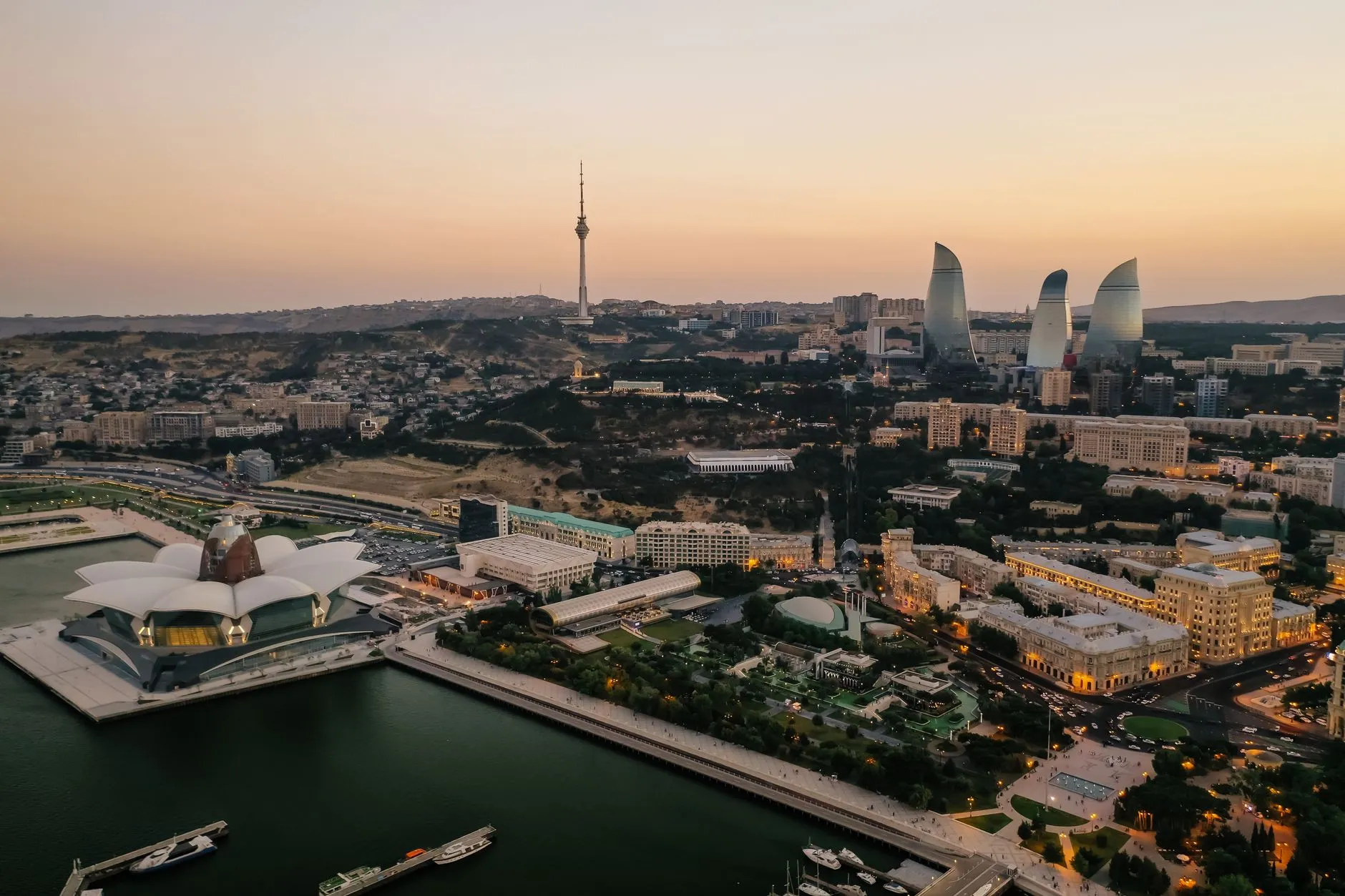
Azerbaijan — Complete Travel Guide 2026
Azerbaijan is the strangest, most underrated doorway in the Caucasus: a place where flame-shaped skyscrapers blaze above a thousand-year-old walled city, where a hillside has burned on its own for centuries and Zoroastrians once worshipped the fire, where the world’s densest field of mud volcanoes bubbles in a semi-desert an hour from a Zaha Hadid masterpiece. It’s oil-rich, ambitious, a little authoritarian, and almost empty of foreign tourists outside the capital. Most visitors never leave Baku — and Baku alone is worth the trip — but the country’s soul is up in the silk-road towns and the remote stone villages of the high Caucasus, and getting there is half the reward.
Quick Reference
The eastern South Caucasus, on the western shore of the Caspian Sea — wedged between Russia, Georgia, Armenia and Iran, where Europe blurs into Asia. “The Land of Fire.”
Baku Heydar Aliyev (GYD) — the main hub, ~25 km north of the city; Ganja (GNJ) is the small secondary gateway in the west
Azerbaijani manat (AZN) — roughly €1 ≈ 1.85 AZN in 2026
Azerbaijani (a Turkic language, close to Turkish); Russian is widely understood; English in Baku’s tourism trade
E-visa required in advance for most visitors via the official ASAN/e-visa portal — about $25 (~€23) standard, issued in ~3 working days; apply before you fly
April–June and September–October are ideal; July–August is hot and sticky on the Caspian; the high mountains have a short summer
Flame-shaped towers over a medieval walled city, burning hillsides and fire temples, mud volcanoes, Caspian caviar, and the wild high Caucasus
Baku for almost everything; Sheki for the Silk Road northwest; Quba/Laza for the mountains — most people base in Baku and day-trip
Editor’s Note — two countries in one
Azerbaijan is really two places stitched together, and you should know which one you’re booking. There’s Baku: gleaming, oil-funded, fast, faintly surreal — a Dubai-of-the-Caspian of glass towers and marble boulevards grafted onto a genuinely ancient Persian-Turkic core, run by a government that likes order and isn’t shy about it. And there’s everywhere else: empty mountains, Silk Road towns frozen in amber, shepherds’ villages clinging to ridgelines, where the manat goes twice as far and the welcome is warmer and less polished.
Baku is the draw, and it’s a real one — I’d put its Old City, its Flame Towers skyline and its Heydar Aliyev Center against any capital in the region. But the capital is also where the country is most managed: shiny, controlled, slightly stage-set. The soul is in the highlands — in Khinalug, a village so old and so high it feels geologically separate from the rest of the planet, and in Sheki, where the khans’ palace still glows with hand-cut stained glass. The travellers who only do Baku leave thinking Azerbaijan is a glossy city-break. The ones who rent a driver and head north come back evangelists.
The honest comparison is with Georgia next door. Georgia is looser, cheaper to enter (visa-free), wired for backpackers, and frankly easier. Azerbaijan is more bureaucratic — you need the e-visa before you fly, the police presence is heavier, the border zones with Armenia are sensitive, and there’s a faint sense of being on someone’s best behaviour. None of that should stop you. It just means Azerbaijan rewards a little planning where Georgia rewards none.
💡 Don’t do Baku-only. The capital is excellent for three or four days, but the country’s best material — the mountains and Sheki — is a day-trip or an overnight away and most package itineraries skip it. Carve out at least one overnight to Sheki or Quba. It’s the difference between “nice city break” and “wow, where was that?”
Should You Go? Who it’s for — and isn’t
Azerbaijan is for the curious traveller who likes a place that hasn’t been flattened into a checklist yet. It’s superb for architecture and design people (a medieval walled city, Soviet brutalism, and some of the most ambitious 21st-century buildings anywhere, all in one skyline), for off-the-beaten-track hunters who’ve “done” the obvious Europe and want a real crossroads, for history nerds drawn to Zoroastrian fire temples, Silk Road caravanserais and a Caspian oil saga, and for mountain people who’ll trade comfort for a stone village above the clouds.
It’s also a genuinely good-value trip within a cheap flight of Europe — Wizz Air’s Baku base means Central Europe to the Caspian for the price of a weekend in Spain, and once you’re there the regions are inexpensive.
Who it’s not for: anyone wanting a beach-and-cocktails escape (the Caspian shore is industrial and the sea isn’t the point), anyone allergic to a bit of bureaucracy and visible policing (you’ll fill in an e-visa, and you’ll see uniforms), and travellers who want a free-and-easy, no-rules vibe — this is a controlled country and it feels like one. It’s a Muslim-majority but staunchly secular society, so alcohol flows freely in Baku and dress is relaxed in the capital; it is not, however, a party destination, and outside Baku people are more conservative. If you need everything in English and on rails, Azerbaijan will frustrate you. If a little friction is part of the appeal, it’s one of the most rewarding trips in the region.
Getting There — GYD, the e-visa, and getting around
Nearly everyone arrives at Baku Heydar Aliyev International (GYD), a slick modern airport about 25 km north of the city — the wooden-cocoon terminal is itself a piece of design worth a look. The small Ganja airport (GNJ) in the west handles a handful of regional and budget routes but won’t feature in most trips.
The airline picture got dramatically better for European travellers in the last few years. National carrier Azerbaijan Airlines (AZAL) has expanded hard, flying close to 40 destinations and connecting Baku directly to Berlin, Frankfurt, Milan, Rome, London, Paris, Vienna, Warsaw, Prague, Budapest and Barcelona, among others. The game-changer, though, is Wizz Air, which runs a Baku base and floods the market with cheap fares from Central and Eastern Europe — Budapest, Vienna, Warsaw, Prague, Milan, and new routes like Bratislava — turning what used to be an expensive long-haul-feeling trip into a budget weekend. Add Turkish Airlines and AJet (frequent via Istanbul, the easiest one-stop from almost anywhere), Pegasus (cheap via Istanbul-Sabiha), Qatar Airways (via Doha, the smart connection from further afield), plus Air Astana, LOT and Lufthansa, and you’ve got real choice.
The visa is the one thing you must not forget. Most visitors — including UK, EU, US, Canadian, Australian and many other nationalities — need an e-visa arranged before departure through the official ASAN/e-visa system. It’s quick and cheap: the standard e-visa runs about $25 (≈ €23) — a $20 state fee plus a $5 service charge — gives you up to 30 days, and is issued within roughly three working days. There’s an urgent option (issued in about three hours) for around $60 (≈ €56) if you’ve left it late. Apply only through the official portal (evisa.gov.az); the web is full of copycat agency sites that charge a fat markup for the same document. Print the PDF or have it on your phone — you’ll need it at check-in and at the border.
⚠️ No e-visa, no boarding. This is not a visa-on-arrival country for most travellers. Airlines check for the e-visa at check-in, and without it you won’t be let on the plane. Apply a week ahead through the official site — not a lookalike agency that charges €60–80 for the same $25 document.
Getting around: Baku itself runs on a clean, cheap metro (flat fare on the rechargeable BakıKart, a few cents a ride), plus buses and abundant taxis — use the Bolt app to skip the haggling. Between cities, the gritty-but-cheap marshrutka (shared minibus) network covers everywhere, and there are intercity trains (an overnight sleeper to Sheki-ish railheads and a slow but scenic run north). For the mountains, though — Khinalug, Laza, the back roads — the honest answer is to hire a car with a driver for the day, typically €60–100 depending on distance; the roads are rough, signage is thin, and a local driver who knows the switchbacks is worth every manat. There’s also an overland route to Georgia (the Red Bridge / Lagodekhi crossings), making a combined Azerbaijan–Georgia trip very doable by marshrutka or shared taxi.
Baku — the walled city and the glass towers
Baku is the show, and it’s a genuinely great one because it layers a real ancient city under all the oil-boom dazzle. Start in İçərişəhər, the UNESCO-listed walled Old City — a compact medieval maze of honey-coloured stone inside intact 12th-century walls, full of caravanserais-turned-restaurants, carpet shops, and quiet courtyards. Its two set-pieces are the Maiden Tower (Qız Qalası), a mysterious cylindrical monument on the seafront whose original purpose nobody fully agrees on (climb it for the rooftop-and-Caspian view), and the Palace of the Shirvanshahs, the elegant 15th-century royal complex of the medieval Azerbaijani dynasty — together they’re the UNESCO core and an easy, atmospheric half-day on foot.
Then look up. The Flame Towers — three blue-glass skyscrapers shaped like tongues of fire, lit at night with a giant LED flame-and-flag animation — are the city’s signature, a deliberate nod to the Land of Fire and the single best skyline in the Caucasus after dark. Out on a hill across town sits the Heydar Aliyev Center, Zaha Hadid’s white, fluid, column-free masterpiece — a building that pours like liquid and is reason enough on its own for an architecture lover to come to Azerbaijan. Down at sea level, the Caspian Boulevard (Bulvar) is a long, beautifully kept seafront promenade of parks, fountains and tea houses where the whole city strolls in the evening. Make time too for the Azerbaijan Carpet Museum — a building shaped like a rolled-up carpet, holding the country’s great craft tradition — and just wander the elegant oil-baron-era streets of the centre, all belle-époque mansions paid for by the first oil boom a century ago.
💡 See the Flame Towers light up after dark. They run an LED flame/flag show in the evening; the classic vantage is from up at the Highland Park / Martyrs’ Lane terrace, which also gives you the whole bay. Old City by day, Bulvar and the towers by night.
The Absheron Peninsula & the Land of Fire
The semi-desert peninsula around Baku is where Azerbaijan earns its nickname, and it’s an easy, extraordinary day out. Yanar Dağ — “Burning Mountain” — is exactly that: a hillside where natural gas seeps from the ground and has burned continuously, a wall of flame licking out of the rock, best seen at dusk. Nearby, the Ateşgah Fire Temple at Suraxanı is a 17th–18th-century pentagonal fire-worship shrine built over a natural gas vent, used by Zoroastrian and Hindu pilgrims who came to worship the eternal flame; it’s a haunting, genuinely ancient link to the fire-cult that gave the country its identity.
South of the city, Qobustan (Gobustan) is the unmissable pairing. The Gobustan Rock Art Cultural Landscape is a UNESCO World Heritage site holding some 6,000 prehistoric petroglyphs — hunters, dancers, boats and animals carved into the rocks over thousands of years, with a slick modern museum to make sense of them. And a short, bumpy 4WD ride away bubble the mud volcanoes: cold, grey cones of clay that gloop and burp methane mud, an alien moonscape you can walk right up to. Azerbaijan has an outsized share of the world’s mud volcanoes — hundreds of them — and Gobustan’s are the accessible, photogenic best. Most people do Gobustan + the mud volcanoes + Yanar Dağ + Ateşgah as a single full-day tour out of Baku; reckon on roughly €40–70 per person for an organised small-group day, or hire a driver for similar and go at your own pace.
⚠️ You need a 4WD (and a local) for the mud volcanoes. The track out to the volcano field is rough dirt, and ordinary taxis won’t or can’t do it. Tour operators at the Gobustan museum run jeep transfers; arrange it there rather than trying to reach them in a hire car.
The North — Quba, Khinalug & the high Caucasus
Head north and Azerbaijan changes completely. The mountains of the Greater Caucasus rise green and dramatic, and the road trip up here is the most rewarding thing in the country after Baku. Quba (Guba) is the regional hub — an apple-and-carpet town that’s the launchpad for the high country, and the base for visiting Qırmızı Qəsəbə (Red Village), often described as the world’s only all-Jewish town outside Israel, home to the Mountain Jews of the Caucasus.
The prize is Xınalıq (Khinalug). Perched above 2,300 m, it’s one of the highest and oldest continuously inhabited villages in Europe — a cluster of flat-roofed stone houses stacked up a ridge, where people still speak their own ancient Khinalug language, found nowhere else on Earth. The drive up is a spectacular, hair-raising climb through a gorge that opens into high pasture, and the village itself feels like arriving in a different century. Stay overnight in a simple homestay if you can — the night sky and the morning light are the whole point.
Further along the range, the scenery around Laza is pure alpine drama — waterfalls spilling off cliffs into a green valley — and the modern Şahdağ (Shahdag) and Tufandağ (Tufandag, above Gabala) resorts offer cable cars and winter skiing for those who want it. You can do Quba and Khinalug as a long day-trip from Baku, but it’s a much better overnight; a car-and-driver for the round trip runs roughly €90–130 given the distance and the mountain roads.
💡 Khinalug deserves a night, not a dash. It’s a 3-hour-plus drive each way from Baku and the village is at its most magical at dawn and dusk, when the day-trippers have gone. A homestay bed is basic and cheap (~€20–30 with home-cooked dinner and breakfast), and it turns a tiring out-and-back into the best night of the trip.
Sheki & the Northwest — the Silk Road town
If you only make one overnight outside Baku, make it Şəki (Sheki), a gorgeous old Silk Road town tucked into the wooded foothills of the northwest, about 4–5 hours from the capital. This is the Azerbaijan of caravan trade, hand-crafts and cobbled lanes, and it’s the most charming town in the country.
The jewel is the Palace of the Sheki Khans (Xan Sarayı), an 18th-century summer palace and part of a UNESCO World Heritage ensemble. From outside it’s a modest two-storey building; inside it’s breathtaking — every wall painted with hunting scenes, flowers and battles, and the windows filled with şəbəkə, intricate stained-glass lattices assembled from thousands of pieces of coloured glass and carved wood without a single nail or drop of glue. Watching a craftsman still make şəbəkə in the old town is a highlight in itself. Around it, the restored caravanserai — a fortress-like Silk Road inn where you can now sleep among the merchants’ arches — and a knot of workshops, the old upper town, and a famously sweet local specialty: Sheki halva, a layered, syrup-soaked pastry quite unlike the Middle Eastern kind, sold fresh from the bakeries.
Sheki pairs beautifully with the surrounding northwest — the resort town of Gabala (Qəbələ) with its cable car and lakes, and the multi-faith village of Kiş with its ancient round-towered Albanian church just up the hill. A Sheki guesthouse runs roughly €25–45 a night and the town is made for slow wandering.
The History & Culture You Should Understand
A little background turns Azerbaijan from a pretty skyline into a place that makes sense.
The fire. Long before oil, Azerbaijan’s land literally burned — natural gas seeping up and igniting at the surface. That gave rise to ancient fire worship, and the region was a heartland of Zoroastrianism, the Persian religion that reveres fire as sacred. The Ateşgah temple and Yanar Dağ are living relics of that, and “Azerbaijan” is itself often glossed as “the Land of Fire.” It’s not marketing — it’s the oldest thread in the country’s identity.
The oil. Baku sat on one of the first great oil fields of the industrial age; by around 1900 it was pumping a vast share of the entire world’s oil, minting the Nobel and Rothschild fortunes and building the grand belle-époque centre you walk through today. A second boom after independence — Caspian offshore oil and gas piped west — paid for the Flame Towers, the Hadid center and modern Baku. The whole city is, in a real sense, built on petroleum.
The Soviet century. Azerbaijan spent the 20th century inside the USSR, which is why Russian is still a lingua franca, why Soviet apartment blocks ring the cities, and why the country emerged in 1991 both industrially developed and politically authoritarian. It’s a secular state with a Shia-Muslim majority that wears its religion lightly — mosques and minarets, yes, but also bars, miniskirts in Baku and a firmly secular public life.
Nagorno-Karabakh — soberly. You should understand this and then largely set it aside. For three decades Azerbaijan and neighbouring Armenia fought over Nagorno-Karabakh, an Armenian-majority enclave inside Azerbaijan’s borders. In a swift September 2023 offensive Azerbaijan retook full control of the region, and almost the entire ethnic-Armenian population left; a peace agreement with Armenia has since been negotiated and initialled but, as of 2026, remains in a long, slow path to full signature, with the shared border still being demarcated and sensitive. For an ordinary traveller this has no day-to-day effect — Baku, the Caspian, Gobustan, the northern mountains and Sheki are all far from any of it. The practical rule is simply: stick to the normal tourist regions, and don’t try to visit Karabakh or approach the closed military frontier with Armenia.
Food — plov, kebabs, pomegranate & tea
Azerbaijani cooking is a delicious, under-the-radar fusion of Persian, Turkic and Caucasus traditions, built on saffron, herbs, lamb, and the country’s beloved pomegranate (it appears as juice, as sour narsharab syrup over fish and kebabs, and as a national symbol).
The dish to seek out is plov (pilaf) — but not a side dish; here it’s the showpiece, fragrant saffron rice steamed under a golden crust, served with meat, dried fruit, chestnuts and herbs, in dozens of regional versions. Dolma — vine leaves or vegetables stuffed with spiced lamb and rice — is a national obsession (so much so it’s UNESCO-listed). The grills are superb: kebabs of lamb, chicken and minced lülə, charred over coals and eaten with flatbread, raw onion and sumac. For a cheap, perfect street/lunch food, get qutab — thin folded pancakes filled with pumpkin, greens or minced meat, blistered on a griddle. On the coast and in Gabala, look for river trout and Caspian fish dressed with narsharab, and in autumn the markets overflow with the famous pomegranates, persimmons and quince.
And then there’s tea (çay). Azerbaijan runs on it — strong black tea served in tulip-shaped armudu glasses, taken not with milk but with jam, sliced lemon, and little sweets, in tea houses (çayxana) that are the social heart of every town. There’s wine, too, increasingly good, from the northern regions around Gabala and Ganja, plus local cognac and the ever-present Caspian caviar (real but pricey). Don’t leave without sitting an hour in a çayxana over endless refills — it’s the most Azerbaijani thing you can do.
Costs & Money
Azerbaijan is solid value, especially once you leave the capital. Baku is the priciest part — comparable to a cheaper European city for restaurants and hotels — but the regions are noticeably cheaper, and even Baku is gentle on the wallet by Western standards. The currency is the manat (AZN), roughly €1 ≈ 1.85 AZN in 2026.
A rough on-the-ground daily budget (excluding flights):
- Budget: ~€30–45/day — guesthouses and homestays, marshrutkas, plov-and-kebab local restaurants and street qutab, metro in Baku.
- Mid-range: ~€60–110/day — a comfortable Baku hotel, the odd day with a hired driver, restaurant meals, paid sites and a tour.
- Comfortable: €130+/day — a good central Baku hotel, private drivers for the mountains and Sheki, the better restaurants.
Sense of individual prices: a hearty plov or kebab dinner with drinks runs roughly €8–15; a pot of tea in a çayxana a euro or two; the Gobustan + mud-volcano + fire-temple day-tour €40–70 per person; a full day with a car and driver €60–100; the e-visa ~€23; a Sheki guesthouse €25–45 and a Khinalug homestay ~€20–30 with meals; a mid-range central Baku hotel €50–90 a night. Cards are widely accepted in Baku, but carry cash for the regions, marshrutkas, homestays and markets, where it’s often the only option. ATMs are everywhere in cities, scarcer in the mountains, so draw manat before heading north. Tipping is modest — round up, leave ~10% in better restaurants — and appreciated.
Practical Information
Entry & visa: most travellers need an e-visa arranged in advance via the official ASAN/e-visa portal (evisa.gov.az) — about $25 (≈ €23) standard, ~3 working days, 30-day stay; an urgent ~3-hour option costs around $60. Use only the official site, not lookalike agencies. Your passport should be valid well beyond your stay. Citizens of Turkey and a handful of other countries get simpler entry, but for the big Western markets the e-visa is mandatory — sort it before you fly.
Safety: Azerbaijan is a very safe country for tourists in practical terms — violent crime against visitors is rare, the streets feel orderly (a heavy, visible police presence is part of why), and petty theft is uncommon by European-city standards. The honest caveats are political, not criminal: the frontier with Armenia and the Nagorno-Karabakh region are off-limits and sensitive — don’t approach the closed border zones or try to visit Karabakh. Photographing military or government sites is unwise. And it’s a controlled state, so behave accordingly: this isn’t the place for protest tourism or provocative political talk.
The Armenia-stamp question (the real rule). Contrary to a common worry, a plain Armenian visa or entry stamp does not automatically bar you from Azerbaijan — you may face extra questions at the border, but ordinary travel in Armenia isn’t a problem for entry. The genuine red line is evidence of having visited Nagorno-Karabakh / Artsakh (an Artsakh stamp, telling photos, receipts or guide documents): that can get you refused entry, fined and banned. Of the two countries, Armenia is the more relaxed about an Azerbaijani stamp — so if you’re doing both, the conventional order is to visit Azerbaijan and then Armenia, and to simply never go to Karabakh. Don’t overthink a normal Armenia stamp; do take the Karabakh rule seriously.
Connectivity: cheap local SIM cards (Azercell, Bakcell, Nar) with generous data are easy to buy at the airport or in town with your passport — far better value than roaming. Wi-Fi is standard in city hotels and cafés.
Language & feel: outside Baku’s tourism trade, English is limited — Russian is the more useful second language, and a few words of Azerbaijani go a long way. The overall vibe is controlled but welcoming: orderly, hospitable, a touch formal, and far less hassly than many destinations. Dress is relaxed in Baku; cover up a little more in the conservative regions and at mosques.
When to Go
Azerbaijan’s seasons split sharply between the low Caspian and the high mountains.
April–June: the best all-round window. Spring brings green hills, comfortable city temperatures, wildflowers in the Caucasus, and the mountain villages opening up after winter. Ideal for combining Baku, Gobustan and the north.
July–August: hot and humid in Baku and on the Absheron — the Caspian summer is sticky, and the lowland sites are draining at midday. It’s the right time, though, to escape up into the mountains, where Khinalug, Laza and Gabala are cool and at their alpine best. City sightseeing is best saved for early and late in the day.
September–October: arguably the finest time of all. The summer heat breaks, the light turns golden, and it’s harvest season — the markets pile high with pomegranates, persimmons and grapes, and the wine country around Gabala and Ganja is at its peak. Comfortable everywhere, lowland and highland alike.
November–March: Baku is mild but grey and windy (it’s nicknamed the “City of Winds”), the Caspian is bleak, and the high villages are snowed in or hard to reach — but it’s ski season at Shahdag and Tufandag, and the city’s museums, Old City, tea houses and restaurants make a perfectly good cold-weather break with low prices and no crowds.
Frequently Asked Questions
Cheapest Flights to Azerbaijan
We have tracked 1,254 fares to Azerbaijan from 102 cities. As of June 2026, here is what a good price looked like from each — the lowest fare we recorded, and a “great-deal” benchmark to judge a quote against. These are tracked observations, not live prices: by the time you read this they will have moved, so treat them as a yardstick, not a quote.
| From | Lowest fare we tracked | Great-deal benchmark |
|---|---|---|
| Tbilisi (TBS) | €63 | €90 |
| Antalya (AYT) | €104 | €149 |
| Malaga (AGP) | €110 | €157 |
| Turin (TRN) | €113 | €162 |
| Lisbon (LIS) | €115 | €164 |
| Basel (BSL) | €123 | €176 |
| Izmir (ADB) | €126 | €180 |
| Varna (VAR) | €130 | €185 |
| Copenhagen (CPH) | €132 | €287 |
| Zurich (ZRH) | €138 | €198 |
| Bordeaux (BOD) | €141 | €201 |
| Stockholm (ARN) | €144 | €205 |
| Bilbao (BIO) | €144 | €205 |
| Marseille (MRS) | €148 | €211 |
Recent deals we have posted to Azerbaijan:
These are fares aifly tracked to this destination, not live quotes — they have changed since and several of the deals above may have expired. Browse current flight deals →