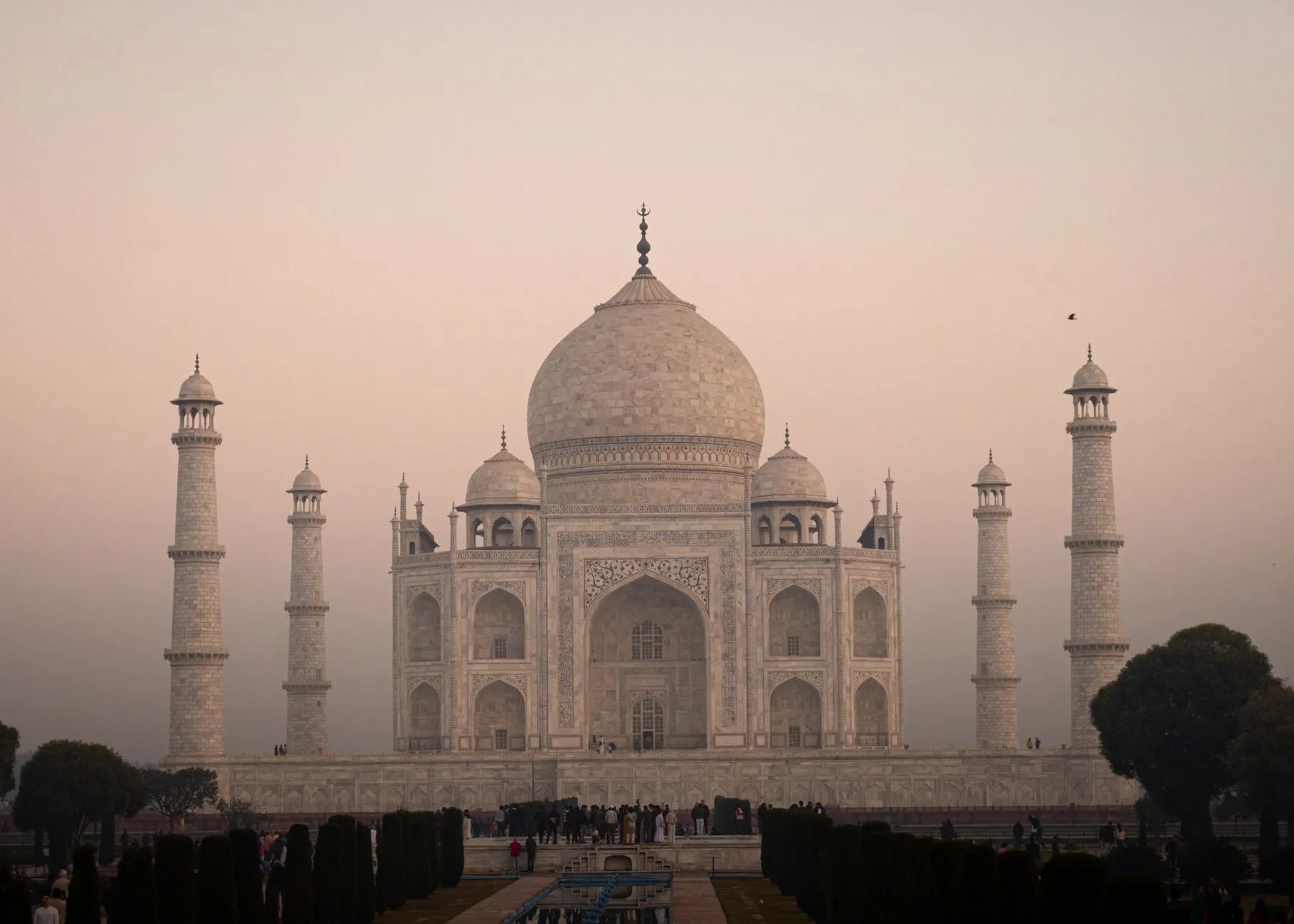
India — Complete Travel Guide 2026
You don’t “do” India. You pick a region, surrender, and let it overwhelm you. This is the most intense, exhausting, beautiful, frustrating and rewarding country on earth, and anyone who tells you they “saw India” in two weeks saw a slideshow. The Taj Mahal floating over the Yamuna at dawn; Rajasthan’s honey-coloured forts and lake palaces; Kerala’s silent backwater channels; the white wall of the Himalaya behind a Tibetan monastery; the smoke and bells and burning ghats of Varanasi — each of those is its own trip, in its own corner of a country the size of a continent. Come with a plan, a soft stomach, an open mind and a willingness to slow down, and India will give you the journey of your life. Come trying to tick boxes and it will eat you alive.
Quick Reference
South Asia — the subcontinent, sprawling from the Himalaya to the tropical south; a country of 1.4 billion people and staggering, almost incomprehensible diversity
Delhi (DEL) is the main international hub; Mumbai (BOM); Bengaluru (BLR); Chennai (MAA); Kolkata (CCU); Hyderabad (HYD); Kochi (COK) for Kerala
Indian rupee (INR) — extremely cheap on the ground; carry cash for the small stuff, UPI/cards in the cities
Hindi and English are the two official languages; 22 scheduled languages; English is widely used in tourism, business and signage
e-Visa required in advance for most Western tourists via the official portal indianvisaonline.gov.in — the e-Tourist visa comes in 30-day, 1-year and 5-year tiers
October–March (cool, dry) for most of the country; May–September for the Himalaya; avoid the April–June heat and the June–September monsoon
The Taj Mahal, Rajasthan’s forts and palaces, Kerala’s backwaters, the Himalaya, Varanasi’s ghats, the food, and an intensity that nowhere else on earth matches
Pick ONE region — the Golden Triangle (Delhi/Agra/Jaipur), the south (Kerala/Tamil Nadu), or the Himalaya — and go slow. Trying to do all of India in one trip is the classic mistake
Editor’s Note — the hard truth first
Let me save you the burnout that ruins most first India trips. India is not a country you “see.” It is overwhelming by design — the noise, the crowds, the smells, the touts, the traffic that obeys no law you recognise, the sensory assault that hits the moment you step out of arrivals at Delhi. People who arrive expecting a tidy two-week highlights reel try to string together the Golden Triangle and Varanasi and Goa and Kerala, spend half the trip on trains and in airports, and fly home shattered, ill and quietly relieved. Don’t be that person.
The single best decision you can make is to pick one region and go deep. First-timers: do the Golden Triangle (Delhi–Agra–Jaipur), maybe with a Rajasthan tail. Want gentler and more relaxing: the south (Kerala and Tamil Nadu) is calmer, cleaner, cooler-tempered and far easier on the nerves. Want mountains and cool air: the Himalaya. Each is a complete, satisfying trip. Combining two is ambitious for two weeks; combining three is a mistake.
And let me be frank about the things the brochures won’t say. You will see real, confronting poverty — slums beside flyovers, beggars at traffic lights, people sleeping on pavements. Handle it like a guest: with respect, without gawping, and without the saviour complex. You will be hassled — touts, “helpful” strangers, rickshaw drivers quoting triple, the relentless commerce of the bazaar. It’s tiring, rarely dangerous, and you learn to deflect it with a flat, friendly “no, thank you” and a refusal to break stride. And yes, “Delhi belly” is real — most visitors get an upset stomach at some point; it’s almost a rite of passage, manageable with sensible eating, bottled water and a stocked medical kit (more below). None of this is a reason not to go. It’s a reason to go prepared, to go slow, and to give India the time and patience it demands. Do that and the rewards are out of all proportion to the effort.
⚠️ Don’t over-schedule. The number-one cause of a miserable India trip is cramming. Distances are vast, transport eats days, and the country itself is tiring. Plan fewer places, longer stays, real rest days. “Less, but properly” beats “everything, badly” every single time.
Should You Go? Who it’s for — and isn’t
India is for the curious traveller who wants to be changed, not just entertained — someone happy to trade comfort and predictability for intensity, colour and a culture five thousand years deep. It’s extraordinary for history and architecture lovers (Mughal tombs, Rajput forts, South Indian temples, colonial relics, ancient cave art), for spiritual seekers (yoga, Buddhism, the Ganges, the ashrams), for food obsessives (there is no cuisine on earth more varied), and for photographers, who could spend a lifetime on a single street. It’s the best-value place on the planet to travel well, where a few euros a day buys experiences money can’t replicate elsewhere.
It’s a brilliant second big trip for an adventurous traveller, and a deep-end first one for the right person — but go in clear-eyed. It is not a switch-off beach holiday (Goa aside, and even Goa has texture). It is not for travellers who need everything orderly, clean and on time — India runs on chaos and improvisation. Solo women can and do travel India safely and have wonderful trips, but it requires more awareness than most destinations — persistent staring and low-level hassle are common, and the cultural norms are conservative (the women’s-travellers section below handles this honestly and fairly, neither sugar-coating nor scaremongering). And it’s not for anyone unwilling to get sick once, get lost, get overcharged, and laugh about it later. If chaos sends you into a spiral, the south is the soft landing; if you thrive on it, the whole subcontinent is yours.
Getting There & Around
Most travellers arrive through Delhi (DEL) — Indira Gandhi International, the country’s biggest hub and the gateway to the Golden Triangle, Rajasthan and the north — or Mumbai (BOM), the financial capital and the door to the west and Goa. Bengaluru (BLR), Chennai (MAA), Hyderabad (HYD) and Kochi (COK) are the southern gateways, and Kolkata (CCU) serves the east. India is superbly connected to the Gulf hubs (Emirates via Dubai, Qatar Airways via Doha, Etihad via Abu Dhabi), to Europe (Air India and several European flag carriers fly nonstop to Delhi and Mumbai), and across Asia. Gulf one-stops are usually the cheapest from Europe and North America; nonstops cost more but save a day each way.
Once you’re in, distances are the whole problem — Delhi to Kerala is further than London to Moscow. Two things solve it:
Cheap domestic flights. India has a fierce low-cost airline market led by IndiGo (by far the biggest and most reliable), with Air India, Akasa Air and SpiceJet filling in. A flight that would be a 24-hour train often costs €40–80 booked a couple of weeks out, and for big hops (Delhi–Kochi, Mumbai–Varanasi, Delhi–Leh) it’s the sane choice. Book ahead; fares climb close to departure and around festivals.
The railways — and this is the one to romanticise. Indian Railways is one of the world’s great experiences: a 68,000-km network carrying tens of millions of people a day, where the journey is the destination. An overnight sleeper across Rajasthan, a chai handed through the window at a dawn platform, the toy trains climbing into the hills — these are core India memories, not just transport. Book in advance through the official IRCTC site/app (foreigners can register; it’s fiddly but worth it) and travel in AC chair car, 3AC or 2AC for comfort. For shorter intercity hops or a region with no rail, a car with driver is the unsung hero — astonishingly cheap (a full day with driver runs roughly €25–45 depending on region and car), endlessly flexible, and far smarter than self-driving.
⚠️ Do not self-drive in India. Indian roads are a contact sport governed by horn, nerve and cow. The lane markings are decorative. For the price of a European rental you can hire a car with a driver who knows the rules of the road (such as they are), parks, navigates and waits while you sightsee. Trains, planes and cars-with-driver — never a steering wheel of your own.
The Golden Triangle — Delhi, Agra & Jaipur
This is the classic first-timer route, and it’s classic for good reason: three cities, a tidy loop, and a crash course in Mughal and Rajput India. Give it five to seven days, not three.
Delhi is the violent, wonderful introduction — two cities in one. Old Delhi is Mughal India at full volume: the red sandstone Red Fort, the magnificent Jama Masjid (India’s largest mosque, climb the minaret for the view), and the glorious chaos of Chandni Chowk, best explored by cycle-rickshaw, where the street food is a destination in itself. New Delhi is the calmer, leafy, Lutyens-era capital — the colonnaded sweep of Rajpath, India Gate, and the sublime Humayun’s Tomb, the Mughal garden-tomb that was the dress rehearsal for the Taj. Don’t miss the soaring 12th-century Qutub Minar or the moving Gandhi memorial at Raj Ghat. Delhi rewards a couple of unhurried days — we cover it properly in the dedicated Delhi city guide, so use that for the detail and keep this trip’s Delhi time to the highlights.
Agra, four hours by fast train (the Gatimaan/Vande Bharat) or car, is home to the obvious one. The Taj Mahal is one of those rare sights that survives its own fame — a tomb of impossible white-marble symmetry built by Shah Jahan for his wife, breathtaking at sunrise when the crowds are thinnest and the light turns it gold then pearl. Entry for foreign visitors is around ₹1,300 (about €14.50) including the small extra for the mausoleum interior; it’s closed every Friday for prayers, so plan around that. Don’t skip the Agra Fort, the vast red Mughal palace-fortress a couple of kilometres away, or the exquisite little “Baby Taj” (Itimad-ud-Daulah) across the river. Agra itself is scrappy; most people come, see the Taj at dawn, and move on — which is the right call.
Jaipur, the “Pink City,” completes the triangle — Rajasthan’s capital, washed terracotta-pink and laid out on a grand 18th-century grid. The honeycombed Hawa Mahal (Palace of Winds), the working City Palace, the astonishing Jantar Mantar observatory of giant stone instruments, and above all the hilltop Amber (Amer) Fort with its mirrored halls — Jaipur is a feast, and the gateway to the rest of Rajasthan. The bazaars are some of India’s best for textiles, jewellery and blue pottery.
💡 See the Taj at sunrise, full stop. Gates open around dawn; be in the queue before they do. You’ll get the soft light, the relative quiet, and the marble shifting colour as the sun comes up — the difference between a crowded photo-op and a genuinely moving hour. And remember: closed Fridays.
Rajasthan Beyond the Triangle
Jaipur is the doorway, not the destination. Rajasthan — the desert state of maharajas, forts and palaces — is India’s most romantic region, and if you have time for a tail beyond the triangle, point it here. The cities each wear a colour and a character.
Udaipur, the “City of Lakes,” is the soft, swooning one — a white palace city wrapped around Lake Pichola, with the fairy-tale Lake Palace (now a hotel) floating on the water, the colossal City Palace climbing the shore, and rooftop cafés made for sunset. It’s the most beautiful city in India and the one travellers fall hardest for. Jodhpur, the “Blue City,” is fiercer and more dramatic — a sea of indigo-washed houses crowded beneath the magnificent Mehrangarh Fort, one of the great forts of the world, rising sheer off a rock cliff. Jaisalmer, far out toward Pakistan, is the desert jewel — a living golden-sandstone fort still inhabited, rising from the Thar Desert like a mirage, and the launchpad for camel safaris into the dunes at Sam, where you can sleep out under the stars. Add Pushkar (the holy lake town and its famous camel fair) and Bikaner (fort, and the surreal rat temple), and you have a region that could fill a fortnight on its own.
The way to do Rajasthan is a loop by car with driver or a mix of trains and drivers, lingering two or three nights per city, and splashing out for at least one night in a heritage hotel — a converted fort or palace, often astonishingly affordable by European standards (genuine palace rooms from well under €100 in many towns). It’s the most “India of the imagination” the country offers.
Mumbai & the West
Mumbai is India at maximum velocity — the financial capital, the home of Bollywood, the city of 20-odd million dreamers where colonial grandeur, Art Deco seafronts, slum ingenuity and new-money glass towers all jostle on a narrow peninsula. The Gateway of India on the harbour, the riot of the Victoria Terminus (CST) railway station, the Marine Drive sweep at dusk, the bazaars and the world-famous Dharavi — Mumbai is exhausting and exhilarating and unlike anywhere else in the country. We cover it in depth in the dedicated Mumbai city guide; keep this trip’s Mumbai time to a couple of days of energy and architecture, then use the city as a springboard.
From Mumbai, two big detours. Goa, a short flight or overnight train south, is India’s beach state — a former Portuguese colony with a distinct Catholic-Latin character, palm-backed sands, whitewashed churches, seafood-and-feni cuisine, and a laid-back rhythm that ranges from the package north (Calangute, Baga) to the bohemian, quieter south (Palolem, Agonda). It’s the place to decompress mid-trip, not the place to understand India — but as a beach break with character, it’s superb. And inland, near Aurangabad, lie the Ajanta and Ellora caves — UNESCO-listed rock-cut temples and monasteries hewn from cliff faces over centuries, the Buddhist murals of Ajanta and the staggering monolithic Kailasa temple at Ellora ranking among India’s greatest artistic achievements, and far less visited than they deserve.
The South — Kerala, Tamil Nadu & Karnataka
If the north overwhelms you, the south is the cure. South India is greener, gentler, cleaner, cooler-tempered and easier in almost every way — the touts are softer, the food is lighter, the pace is slower, and the sensory volume drops by half. For many travellers it’s the better India, and for nervous first-timers it’s the smart first India.
Kerala is the headline — the lush tropical sliver along the southwest coast, and India’s most relaxing region. Its signature is the backwaters: a labyrinth of palm-fringed lagoons and canals around Alleppey (Alappuzha) and Kumarakom, best experienced on an overnight houseboat (a converted rice barge, kettuvallam) drifting past village life with a private cook aboard — a splurge by Indian standards but unforgettable, from roughly €120–200 a night for the boat. Add the tea-carpeted hill country of Munnar, the spice plantations and wildlife of Thekkady/Periyar, the laid-back beaches of Varkala (clifftop) and Kovalam, the spice-trading port city of Kochi (COK) with its Chinese fishing nets, synagogue and Portuguese-Dutch old town, and the famous Kathakali dance-drama and Ayurvedic traditions. Kerala alone is a complete, restorative two-week trip — see our full Kerala guide for the deep dive.
Tamil Nadu, next door, is the temple state — colossal, living Hindu temple-cities where ritual has run unbroken for centuries: the towering gopurams of Madurai’s Meenakshi Temple, the shore temples of Mahabalipuram, the bronze-casting and silk town of Thanjavur (Tanjore), the French-colonial calm of Puducherry (Pondicherry), and the cool colonial hill station of Ooty reached by another toy train. Karnataka holds the south’s single most jaw-dropping sight: Hampi, the boulder-strewn ruins of the vast Vijayanagara Empire, a UNESCO landscape of temples and palaces scattered across a surreal moonscape of giant rocks and paddy — one of India’s most magical places and still gloriously under-touristed. Mysore’s palace and Bengaluru’s modern energy round out the state.
💡 First-timer who wants India without the gauntlet? Fly south. Kerala and coastal Tamil Nadu are markedly calmer, cleaner and easier than the north — gentler touts, milder hassle, lighter food, slower pace. You still get temples, backwaters, hill stations and astonishing food, with a fraction of the sensory beating.
Varanasi & the Spiritual North
Varanasi (Benares) is the spiritual heart of India and the most intense place in an intense country — one of the oldest continuously inhabited cities on earth, the holiest city in Hinduism, where the faithful come to bathe in the sacred Ganges and, ultimately, to die and be cremated on its banks. The ghats — the riverfront stairs — are the stage: at dawn, pilgrims wade in to pray as the sun rises over the river; at the Manikarnika and Harishchandra ghats, open-air cremations burn around the clock. This is not a spectacle and must never be treated as one — no photographs of the cremations, ever, keep a respectful distance, and absorb it quietly. At dusk, the elaborate Ganga Aarti fire ceremony at Dashashwamedh Ghat draws crowds for an hour of bells, lamps and chanting. A dawn boat ride along the ghats is the essential experience. Varanasi is confronting, profound and unforgettable — give it two nights and let it work on you.
A few hours away, two gentler counterpoints. Rishikesh, where the Ganges spills clean and green out of the Himalayan foothills, is the yoga capital of the world — ashrams, riverside cafés, suspension bridges, white-water rafting, and the place the Beatles came to meditate; it’s the soft, leafy face of Indian spirituality. And the Buddhist circuit threads the eastern plains: Bodh Gaya (where the Buddha attained enlightenment under the Bodhi tree) and Sarnath (near Varanasi, where he gave his first sermon) are pilgrimage sites of deep significance and surprising serenity.
⚠️ Cremations are not tourist attractions. At Varanasi’s burning ghats, never photograph the fires or the families, keep your distance and your voice down, and politely refuse the “guides” who offer to take you close for a fee or who solicit “donations” for wood. Respect here is non-negotiable.
The Himalaya
For mountains, cool air and an India that feels like another country entirely, head north to the high country — and note that the Himalaya runs on the opposite season to the plains: summer (May–September) is the time to go, when the rest of India bakes and the monsoon floods the lowlands.
Ladakh, reached by a spectacular flight into Leh or the epic road over the world’s highest passes, is the showpiece — a high-altitude desert of Tibetan-Buddhist monasteries, prayer flags, ochre mountains and the impossible blue of Pangong Lake, at 3,500m and up. It’s stark, otherworldly and humbling; allow days to acclimatise to the altitude before you exert yourself. Himachal Pradesh is the green, accessible alpine state: Manali for mountains and adventure, Dharamshala / McLeod Ganj — the home-in-exile of the Dalai Lama and the Tibetan government, a moving, monk-filled hill town wrapped in pine and cloud — and the remote, lunar Spiti Valley for serious mountain travel. The old British hill stations — Shimla (with its toy train up from Kalka) and Mussoorie — offer cool-air colonial nostalgia.
In the east, Darjeeling is the legendary tea town beneath Kanchenjunga, India’s third-highest peak, reached by the UNESCO-listed Darjeeling Himalayan “toy train” chugging up through the tea gardens. And tiny, immaculate Sikkim, tucked between Nepal and Bhutan, is one of India’s cleanest, calmest and most beautiful states — Buddhist monasteries, monk-built towns, and trekking under the high peaks (note Sikkim and parts of Ladakh require inner-line permits, easily arranged but worth checking before you go).
💡 The Himalaya is a summer trip — and altitude is real. Go May–September, when the passes are open and the plains are unbearable. In Ladakh especially, take altitude seriously: fly in and rest, hydrate, don’t trek hard on day one, and watch for headaches and breathlessness. Acute mountain sickness doesn’t care how fit you are.
Food — the best reason to come
Here is the most important thing to understand: there is no such thing as “Indian food.” What gets served as “a curry” in Europe is a flattened cartoon of a culinary universe that changes utterly every few hundred kilometres. India is the world’s greatest food country, and eating your way across it is reason enough to go.
The north is the food the West thinks it knows — the tandoor (clay oven) cuisine of the Punjab and the Mughal kitchens: butter chicken, dal makhani, rich gravies, the smoky char of tandoori meats and fresh naan and roti to mop them up. The south is a different planet — rice, coconut, curry leaves and tamarind, lighter and often fierier: the crisp fermented dosa (a giant savoury rice-and-lentil crêpe) with sambar and chutney, idli, the banana-leaf thali of a dozen little dishes, fish curries on the coasts, and a deep tradition of pure-vegetarian cooking that makes India the best country on earth to be a vegetarian. Bengal does fish and sweets; Gujarat does an elaborate vegetarian thali; Goa does Portuguese-spiced pork and seafood; Kashmir does its own aromatic feast.
Then there’s the street food — and this is some of the best eating in the country, if you’re sensible about where: Delhi’s chaat and parathas, Mumbai’s vada pav and pav bhaji, the kati rolls and kachoris and jalebis. The thali — an all-you-can-eat platter of rice, breads, dal, vegetables, pickles and curd — is the great-value everyday meal, often under €3 and endlessly refilled. And tying it all together is chai: sweet, milky, cardamom-spiced tea handed over at every station, stall and street corner for a few cents — the social glue of the entire country, and the drink you’ll order ten times a day.
On food safety, don’t be paranoid but be smart: eat at busy places with high turnover (a crowded street stall is often safer than an empty restaurant), favour food that’s cooked hot and fresh in front of you, be wary of pre-cut fruit, salads washed in tap water and ice of unknown origin, and ease your stomach in over the first few days. Vegetarian is generally a safer bet than meat off the beaten track. Get this roughly right and you’ll eat like royalty for pennies.
Costs & Money
India is one of the cheapest countries on earth to travel well, and that value is a real part of the appeal — your money goes absurdly far, especially outside the top hotels.
A rough daily on-the-ground budget (excluding international flights):
- Backpacker / budget: ~€15–25/day — guesthouses and hostels (a clean budget room from €8–15), local restaurants and thalis, trains in sleeper or chair class, public transport. India is genuinely doable on a shoestring.
- Mid-range: ~€40–70/day — comfortable hotels and heritage stays, the odd domestic flight, a car-with-driver day, AC train classes, restaurant meals and paid sights. This is the sweet spot for most travellers and still cheap.
- Comfortable / boutique: ~€100–200+/day — heritage palace hotels, houseboats, private drivers throughout, the best restaurants. You can live like a maharaja for what a mid-range trip costs in Europe.
A sense of individual prices: a thali or street meal €1.50–3; a sit-down restaurant dinner €6–12; a domestic flight booked ahead €40–80; a full day with car and driver €25–45; a Kerala houseboat €120–200 a night; a budget room €8–15; a chai a few cents; the Taj Mahal around €14.50 for foreigners; most monuments €3–13.
Two money realities to know. Dual pricing is normal and legal at major monuments — foreigners pay considerably more than Indians (the Taj is the headline example), so factor it in; it’s still cheap by world standards. And baksheesh — tipping — greases everything: round up for restaurant staff (~10% where there’s table service), tip your driver and guide at the end (a few euros a day each), and small notes smooth countless small interactions. ATMs are everywhere in cities and towns (carry some cash buffer for rural areas and small vendors), cards work in mid-range-and-up hotels and shops, and India’s UPI mobile-payment system is ubiquitous — but for street stalls, rickshaws, temples and the countryside, cash is king, so keep a stash of small notes.
Practical Information
Visa — the one bit of homework. Most Western tourists (UK, EU, US, Canada, Australia and many more) need an e-Visa arranged in advance — there’s no visa-on-arrival for ordinary tourism. Apply only through the official government portal, indianvisaonline.gov.in (ignore the swarm of look-alike commercial sites that charge a fat markup). The e-Tourist visa comes in three tiers: a 30-day double-entry visa, a 1-year multiple-entry visa, and a 5-year multiple-entry visa. Standard fees are roughly US$25 for the 30-day (dropping to US$10 if you travel April–June), US$40 for the 1-year, and US$200 for the 5-year — though the 5-year fee is set nationality by nationality (US passports pay US$160, UK passports US$484), plus a small card-processing surcharge. The 1-year and 5-year visas cap your total stay at 180 days per calendar year. Apply a week or two before you fly, upload a passport photo and passport scan, and carry your printed e-Visa approval — it’s a straightforward, fully online national e-Visa with no embassy visit required.
“Delhi belly” — water, food, and a kit. The single most common traveller complaint is an upset stomach, and a little discipline prevents most of it: drink only bottled or filtered water (check the seal), skip ice and tap water and pre-washed salads when you’re unsure, eat freshly cooked hot food, and ease in slowly over the first few days. Pack a medical kit: oral rehydration salts, an anti-diarrhoeal (loperamide), a course of antibiotics for travellers’ diarrhoea (ask your doctor), paracetamol, and hand sanitiser. See a travel clinic well ahead — routine vaccinations plus typhoid and Hepatitis A are standard advice, and antimalarials matter for some regions. Most stomach trouble is mild and passes in a day or two; rest, rehydrate, and don’t panic.
Women travellers — honest and fair. Plenty of solo women travel India and have superb, safe trips — but it asks for more awareness than most destinations, and it’s only fair to say so plainly. Expect persistent staring and low-level hassle, especially in crowded northern cities and tourist areas; it’s wearing rather than dangerous, and the south is markedly easier than the north. The sensible playbook is the one experienced women swear by: dress conservatively (cover shoulders and knees; a scarf is endlessly useful), project confidence, avoid isolated areas and empty train carriages after dark, use women-only carriages on trains and metros where they exist, book reputable accommodation and pre-arranged transport for arrivals and night moves, and trust your instincts to leave any situation that feels off. Pre-booked drivers and trusted female-friendly guesthouses make a real difference. None of this should put you off — it should just make you prepared.
Touts, scams & the hassle. The commerce is relentless and mostly harmless: rickshaw drivers quoting triple, “the place you wanted is closed, but my cousin’s shop…”, commission-hungry “helpful” strangers, the gem and carpet hard-sells. Agree fares before you ride (or insist on the meter / use Uber-Ola), book trains and tickets yourself online, ignore unsolicited “official” helpers at stations and airports, and learn to walk on with a flat “no, thank you.” It’s not a danger; it’s a tax on your patience.
Trains & SIM. Book trains in advance via IRCTC (foreign-traveller registration is fiddly but works; or use a reputable booking agent), and consider the foreign-tourist quota on popular routes. A cheap local SIM (Airtel or Jio) with masses of data is easy to buy with your passport and visa copy at the airport or a phone shop — vastly cheaper than roaming and essential for Ola/Uber, maps and UPI.
Festivals. Time your trip around one if you can. Holi (the spring festival of colour, usually March) and Diwali (the autumn festival of lights, October/November) are the famous two — joyous, overwhelming, and unforgettable — alongside countless regional festivals. They also mean crowds, booked-out transport and higher prices, so plan ahead.
Heat & monsoon. The plains are brutally hot April–June (45°C+ in places) and the southwest monsoon (roughly June–September) brings heavy rain and disruption to most of the country. Both are best avoided for the lowlands — which is exactly when the Himalaya comes into its own. Plan your region to your season (see below).
When to Go — region by region
India runs several climates at once, so “the best time” depends entirely on where you’re going.
The plains & the north (Delhi, Agra, Rajasthan, Varanasi): October to March is prime — cool, dry, clear, comfortable for forts and cities and the Golden Triangle. December–January can be genuinely cold (and foggy) in the far north, but it’s the right season. Avoid April–June (savage heat) and the monsoon (July–September).
The south (Kerala, Tamil Nadu, Karnataka): also best November to March — pleasantly warm and dry, ideal for backwaters, temples and beaches. The south’s monsoon (Kerala gets it from June) and the post-monsoon humidity make the wet months sticky and storm-prone, though Kerala is gorgeously green then if you don’t mind rain.
The Himalaya (Ladakh, Himachal, Sikkim, Darjeeling): the opposite season — May to September. Summer opens the high passes and brings the only comfortable mountain weather, exactly when the plains are unbearable. Ladakh in particular is a short summer window. Avoid winter (snowbound) and, in the foothills, the monsoon (landslides).
Goa & the beaches: November to February for the dry, sunny, mellow peak; the resorts largely shut and the rains take over from June.
In short: plan north or south for the cool dry winter; save the Himalaya for summer; and never take the plains in May or the monsoon. Match the region to the season and India is sublime; ignore it and you’ll spend your trip melting or sheltering from rain.
Frequently Asked Questions
Cheapest Flights to India
We have tracked 25,946 fares to India from 309 cities. As of June 2026, here is what a good price looked like from each — the lowest fare we recorded, and a “great-deal” benchmark to judge a quote against. These are tracked observations, not live prices: by the time you read this they will have moved, so treat them as a yardstick, not a quote.
| From | Lowest fare we tracked | Great-deal benchmark |
|---|---|---|
| Baku (GYD) | €164 | €234 |
| Istanbul (IST) | €201 | €287 |
| Batumi (BUS) | €216 | €308 |
| Istanbul (SAW) | €224 | €320 |
| Helsinki (HEL) | €231 | €516 |
| Budapest (BUD) | €247 | €353 |
| Bratislava (BTS) | €261 | €373 |
| Ankara (ESB) | €265 | €379 |
| Iași (IAS) | €267 | €381 |
| Prague (PRG) | €267 | €382 |
| Izmir (ADB) | €270 | €385 |
| Kayseri (ASR) | €279 | €398 |
| Tbilisi (TBS) | €280 | €458 |
| Vienna (VIE) | €281 | €402 |
Recent deals we have posted to India:
- Perth to Hyderabad, India from A$791
- London to Hyderabad, India from £386
- Paris to Hyderabad, India from €478
- Athens to Hyderabad, India from €451
- Cheap Flights London to Bangalore 2026 — From 300 EUR
- Prague to Kolkata, India from €466
- Vienna to Kolkata, India from €463
- Nice to Kolkata, India from €458
- Perth to Chennai, India from A$508
- Athens to Bangalore, India from €377
These are fares aifly tracked to this destination, not live quotes — they have changed since and several of the deals above may have expired. Browse current flight deals →