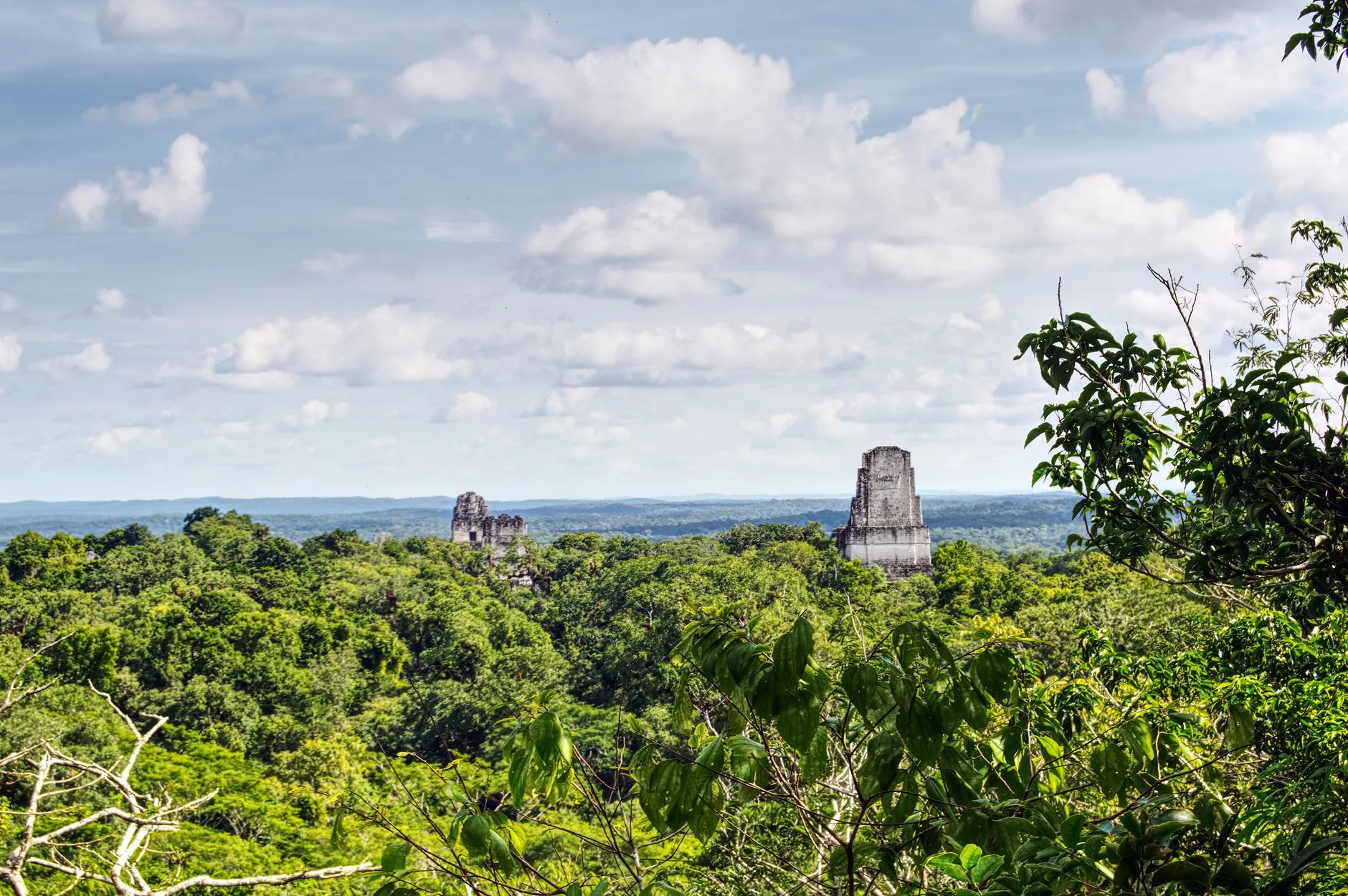
Guatemala — Complete Travel Guide 2026
Guatemala is the most beautiful and culturally rich country in Central America, and it spends most of its life being overlooked. While the world flies past it to the beaches of Costa Rica and the cenotes of Mexico, Guatemala quietly holds the greatest Maya city ever built rising out of the rainforest at dawn, a cobblestoned Spanish colonial jewel ringed by three volcanoes, a sapphire lake walled in by indigenous villages where women still weave the patterns of their towns, and a living Maya civilisation that never went away. This is not a country you lie down in. It’s one you travel through, eyes open — and it rewards that effort more richly than almost anywhere else within a flight of the US.
Quick Reference
Central America, wedged between Mexico to the north and Belize, Honduras and El Salvador to the east and south — a wall of volcanoes with a long Pacific coast and a small Caribbean one, and the beating heart of the Maya world
Guatemala City — La Aurora (GUA), the only real international hub; Flores — Mundo Maya (FRS) for Tikal and the north
Guatemalan quetzal (GTQ) — named after the iridescent national bird, the symbol of freedom
Spanish (official), plus 20-plus living Maya languages (K’iche’, Kaqchikel, Q’eqchi’, Mam and more); English is limited outside tourist towns
Visa-free for most Western tourists for up to 90 days under the CA-4 agreement; passport valid 6 months beyond entry
November–April is the dry season (“verano”); May–October is the green/rainy season; the highlands are spring-like all year
Tikal’s jungle pyramids, colonial Antigua under its volcanoes, Lake Atitlán, living Maya culture, fire-and-ash Acatenango, and some of the best coffee on earth
Antigua for colonial-city-plus-volcanoes; Lake Atitlán for the Maya highlands; Flores for Tikal — most people do all three
Editor’s Note — Central America’s underrated heavyweight
Here is the honest case for Guatemala: it is the cultural and scenic heavyweight of Central America, and it is criminally underrated next to its neighbours. Costa Rica sells you sloths and zip-lines at European prices; Belize sells you a reef; the Mexican Riviera sells you a wristband. Guatemala sells you something harder to package and far more rewarding — a country where the Maya are 40-plus percent of the population and present, where a colonial city sits in the saddle of an active volcano, where you can stand alone on top of a 1,500-year-old temple above an unbroken jungle canopy at sunrise. Per quetzal spent, nowhere in the region comes close.
But I’m not going to sell you a fairy tale, because the country’s reputation is the other half of the story. Guatemala carries a genuine safety stigma — earned, in places and at times, and wildly out of date in others. The honest version: the established tourist trail — Antigua, Lake Atitlán, Tikal/Flores, the highland markets — is well-travelled, well-policed at the tourist level, and visited safely by hundreds of thousands of people a year. Petty crime is real, certain roads and certain neighbourhoods of the capital are best avoided, and you do not wander off-grid casually. Travel it with normal big-trip street-sense and you’ll be fine. Travel it expecting an all-inclusive resort coast and you’ve come to the wrong country.
💡 Guatemala is active travel, not a resort. There is no beach-bubble version of this trip. The payoff is volcanoes, ruins, lakes and markets, reached by shuttle van and the odd boat. Come for that, and it’s one of the best-value adventures in the Americas. Come for a sunbed and you’ll be baffled.
Should You Go? Who it’s for — and isn’t
Guatemala is for the traveller who is interested — in ancient history, in living culture, in landscapes that make you stop the van. It’s superb for Maya-history obsessives (Tikal alone justifies the flight, and Guatemala has the deepest concentration of major Maya sites anywhere), for hikers and volcano-baggers (Acatenango is a bucket-list overnight, and you can summit Pacaya in an afternoon), for language learners (Antigua and Xela are two of the cheapest, best places on earth to study Spanish one-on-one), and for anyone who travels to feel somewhere genuinely different rather than a familiar comfort in a warmer climate.
It’s also a strong pick for the budget-minded. Few countries this rewarding stretch a euro this far — a comedor lunch for under €4, a private Spanish tutor for a week for the price of a single group lesson back home, an entire dawn at Tikal for under €20.
Who it’s not for: anyone who wants a switch-off beach holiday (Guatemala’s Pacific coast is black-sand surf-and-turtle country, not a resort strip, and the Caribbean fringe at Lívingston is a slow, niche detour — go to Belize or Mexico if the beach is the point). It’s not for the nervous traveller who needs everything smooth and signposted — chicken buses, shuttle delays, language gaps and a real-world safety calculus are part of it. And it’s not for the time-poor: the distances feel short on a map and take forever on switchback mountain roads.
Getting There & Around
Getting in. One airport does the heavy lifting: Guatemala City — La Aurora (GUA), in the capital. The cheapest, most frequent way in from the US is to connect: American (Miami, Dallas, seasonally Chicago), United (Houston, Chicago), Delta and Avianca all run plenty of one-stops, and Copa funnels the whole Americas through its Panama City hub — superb for connections from across Latin America and useful from many US cities too. Note that Spirit collapsed in May 2026, so the old ultra-cheap US nonstops it ran are gone; Avianca, Volaris and Wingo absorbed much of that flying, and they remain the budget kings into Guatemala. From Europe there is exactly one nonstop: Iberia from Madrid (seasonal); everyone else routes via the US (Miami is the classic), Mexico City, or Panama with Copa.
There’s also a second international-ish airport up north at Flores — Mundo Maya (FRS), the gateway to Tikal, served by short domestic hops from the capital (TAG Airlines) and a few regional flights — the time-saver if you want to bolt Tikal onto a tight trip without the long overland haul.
Getting around is the part nobody warns you about properly. Guatemala is small but slow — mountain roads turn 120 km into four hours.
- Tourist shuttle vans are the spine of independent travel here. A dense, cheap network of minibuses links every traveller town — the airport, Antigua, Panajachel (Atitlán), Chichicastenango, Xela, Lanquín (Semuc Champey), Flores — booked through any guesthouse the day before. Antigua–Atitlán runs around €12–18; Antigua–Lanquín or Flores is an all-day haul for €25–45. Slow and cramped, but they go where you need and take the navigation off your hands.
- Chicken buses — the retired, gloriously repainted American school buses — are the real Guatemalan experience and almost free. Worth doing once for a short, daytime highland hop; also crowded, chaotic, a known pickpocket spot, and best avoided after dark.
- Private driver is the smart upgrade for two or more. Roughly €60–110 a day buys a car, a driver who knows the roads and the safe stops, and total freedom of schedule — often barely more than stacking shuttles once you split it.
- The Flores flight (GUA–FRS, ~1 hour, often €80–150 each way) saves an otherwise brutal 8–10 hour overland day to Tikal.
- Driving yourself is doable on the main circuit but not the relaxed default it is elsewhere — mountain roads, aggressive bus drivers, vague signage and the security calculus mean most independent travellers stick to shuttles and drivers. If you do hire, drive only in daylight.
⚠️ Don’t drive Guatemalan highways after dark. This is the one near-universal local rule. Highway robbery on intercity roads at night is the specific risk, and it’s why shuttles, buses and tours all run in daylight. Plan your travel days to arrive before sunset.
Antigua — the colonial jewel under the volcanoes
If Guatemala has a single must-see town, it’s Antigua — and it’s the easiest, most seductive place in the country, so most people start here. A UNESCO World Heritage city, it was the grand Spanish colonial capital until a catastrophic 1773 earthquake levelled it and the government decamped to modern Guatemala City, freezing Antigua in time. The result is a perfect grid of cobblestone streets, ochre-and-pastel walls, and the romantic ruins of baroque churches and convents toppled by that quake and never rebuilt — all of it sitting in a bowl beneath three volcanoes: the perfect cone of Agua, and the twin Acatenango and the perpetually-erupting Fuego.
Spend your days getting genuinely lost in it. Climb to the Cerro de la Cruz for the postcard view down the street-grid to Volcán de Agua. Stand in the roofless nave of the Santa Clara or La Recolección ruins. Cross the iconic yellow Santa Catalina arch. Drift through the courtyards of converted convents (the Santo Domingo complex is now a lavish hotel-museum worth a wander). And drink the coffee — Antigua sits in one of the world’s premier coffee valleys, and the third-wave café scene is genuinely world-class.
Antigua is also Guatemala’s great Spanish-school town. Dozens of academies offer one-on-one immersion — typically four to five hours a day of private tuition, often with a homestay — for prices that startle Europeans and North Americans: a full week of 20 hours of private lessons plus a host-family room and meals runs roughly €180–280. People come for a week and stay a month.
And then there’s Semana Santa. Antigua’s Holy Week processions are among the most spectacular in the Americas — vast wooden floats carried by purple-robed bearers over elaborate, ephemeral alfombras (carpets) of dyed sawdust and flower petals laid across the cobbles, only to be trampled by the procession an hour later. It’s overwhelming, beautiful, and the single busiest week of the year — book months ahead or avoid it deliberately.
💡 Antigua is the perfect soft landing — use it as a base. Days 1–3 here let you acclimatise, eat well, arrange a Spanish course or a volcano trek, and day-trip Pacaya, before you head deeper into the highlands. It’s the safest, most comfortable town in the country and the logistics hub for everything south.
Acatenango — the volcano that erupts all night
This deserves its own section because it’s the experience most people leave Guatemala raving about. Acatenango (3,976 m) is the volcano you climb; Fuego, its near-neighbour across a saddle, is the one that puts on the show — in near-continuous Strombolian eruption since 2002, it spits glowing lava and ash every 15–30 minutes, all night, and from a base camp high on Acatenango you watch it happen across a few kilometres of dark air, the orange bursts reflecting off the cloud.
It’s an overnight trek, and it is genuinely hard: roughly 1,500 vertical metres in 5–6 hours up loose volcanic scree at real altitude, to a camp around 3,600–3,750 m, where you sleep in tents or basic cabins, freeze, eat a hot dinner, and watch the fireworks. Many people also do a pre-dawn push to Acatenango’s summit, or a separate “lava trek” onto Fuego’s flank, for a closer look. A certified guide is mandatory (CONRED/INGUAT rules), and you book through an Antigua operator: budget runs around €55–90 all-in (gear, food, guide, park fees), mid-range comfort-camps €90–140, premium glamping more. It’s cold up top whatever the season — operators lend jackets and gloves but bring layers.
⚠️ Acatenango is a serious high-altitude hike, not a stroll. Loose scree, thin air at nearly 4,000 m, sub-zero nights and a genuine fitness demand. Don’t underestimate it because it’s a tourist staple — break in your boots, hydrate, and pick a reputable operator with proper camp gear. Dry-season (Nov–Apr) nights give the clearest Fuego views.
Lake Atitlán — the highlands’ sapphire crater
Aldous Huxley called it “the most beautiful lake in the world,” and standing on its shore at dawn it’s hard to argue. Lake Atitlán fills a vast collapsed volcanic caldera, walled by three more volcanoes (San Pedro, Tolimán, Atitlán) and ringed by a dozen Maya villages, each with its own character, dress and dialect — and the only way between most of them is by boat. This is the second pillar of almost every Guatemala trip, two to four hours by shuttle from Antigua.
You arrive at Panajachel (“Pana”), the gateway town — busy, a bit scruffy, full of shuttle agencies, a long craft-market street and the boat docks. It’s not the prettiest village but it’s the hub. From the docks, the little lanchas (public boats, a euro or two a hop) fan out to the others:
- San Marcos La Laguna — the yoga, retreat and hippie heart of the lake, all crystal shops, vegan cafés, meditation centres and a lovely cliff-jump nature reserve. Divisive but undeniably beautiful and relaxed.
- San Pedro La Laguna — the backpacker party-and-Spanish-school village, livelier and cheaper, with another batch of good-value language academies right on the water.
- Santa Cruz and Jaibalito — quieter, steeper, hike-in lakeside escapes with some of the best small lodges.
- Santiago Atitlán — the largest and most traditionally Maya town, across the water, famous for its devotion to Maximón (a syncretic folk-saint who smokes, drinks and is moved between households — you can visit him) and for some of the most powerful traditional weaving on the lake.
Spend your time boat-hopping, hiking the shoreline trails, kayaking at dawn before the wind (“Xocomil”) gets up in the afternoon, and visiting the morning markets. It’s the place on this trip you’ll most want to slow down and stay longer than you planned.
💡 Base in one village, day-trip the rest by boat. San Marcos for calm and yoga, San Pedro for budget and buzz, Santa Cruz/Jaibalito for serenity. The public lanchas run all day for pocket change — agree the fare before you board, as a small “gringo tax” is standard.
Tikal & the Maya World — pyramids over the jungle
This is the headline, and it lives up to it. Tikal was one of the most powerful city-states of the Classic Maya world, and its great temples — steep-sided limestone pyramids rising up to 70 metres — punch up through one of the largest tracts of rainforest left in Central America. The magic is the setting: there’s almost nothing built in Tikal’s vast national park except the ruins and the jungle, so howler monkeys roar, toucans and parrots crash overhead, coatis cross the trails, and from the top of Temple IV you look out over an unbroken green canopy with the crowns of distant temples breaking through it like islands. (Yes — it’s the view that opened the original Star Wars as the rebel base on Yavin 4.)
Do it at dawn if you can. The sunrise ticket (250 GTQ, ~€30, vs the standard 150 GTQ / ~€18 day entry) gets you in before 6am to climb a temple in the dark and watch mist burn off the canopy while the jungle wakes up — it’s the single best few hours in the country. Tickets are cash-only in quetzales (or pre-bought online via the Ministry of Culture); a guide is well worth it for the archaeology and the wildlife-spotting.
The base for Tikal is Flores, a tiny, photogenic island town on Lake Petén Itzá connected to the mainland by a causeway — cobbled, colourful and laid-back, with sunset boat trips and a string of cafés, about an hour from the ruins. You can also stay at the handful of lodges inside the park gates to nail the sunrise.
And Tikal is only the start of the Petén’s Maya world:
- Yaxhá — a stunning, far quieter site on a lake an hour from Flores, with a temple you can climb for a knockout sunset over the water and the jungle. Many travellers rate it their favourite because it’s empty.
- El Mirador — the remote mega-site deep in the jungle, home to La Danta, by volume one of the largest pyramids on earth. There’s no road: reaching it is a hardcore multi-day jungle trek (typically 5–6 days round-trip on foot and by mule) or an expensive helicopter day-trip. A genuine expedition for the committed only — but for those who go, it’s the trip of a lifetime.
- Across the borders lie Copán (Honduras) and Caracol (Belize), making the Petén a hub for a wider Maya circuit if you have time.
💡 The Flores flight saves you a day each way. Overland from Antigua/Atitlán to Tikal is an 8–10 hour grind. A €80–150 hop from Guatemala City to Flores turns the Petén into a comfortable two-night side-trip instead of a four-day expedition. If you’re tight on time, fly.
Chichicastenango & the Highlands
The western highlands are the cultural core of Maya Guatemala, and the gateway to them is the most famous market in Central America. Chichicastenango (“Chichi”), high in the K’iche’ Maya country, holds a vast, thronging market every Thursday and Sunday — a maze of stalls spilling over the town selling textiles, masks, pottery, produce, copal incense and tourist crafts, while inside the 16th-century Santo Tomás church Maya prayer-men swing incense and lay offerings on the steps in ceremonies that blend Catholic and ancestral Maya ritual seamlessly. It’s a sensory overload and a real working market, not a show put on for visitors — go early, watch your bag in the crush, and barter gently.
Beyond Chichi, the highlands open up:
- Quetzaltenango (Xela) — Guatemala’s second city, at 2,300 m, a handsome, cool, unflashy university town that’s the other great Spanish-school base (cheaper and far less touristy than Antigua), and the launchpad for highland hikes, hot springs (Fuentes Georginas) and the surrounding Mam and K’iche’ villages.
- Nebaj and the Ixil Triangle — deep, traditional, beautiful highland country off the standard trail.
- The weaving towns — places like San Antonio Aguas Calientes, Zunil and Santiago Atitlán, where you can watch backstrap-loom weaving and buy directly from co-operatives, keeping the money where it belongs.
This is the Guatemala of patterned huipiles and cortes (the woven blouses and wrap-skirts whose colours and designs identify a woman’s home town), of cool pine-clad mountains and steep market towns, and of a Maya culture worn openly every day.
Semuc Champey & the Wild Interior
For the off-grid adventure chapter, head to Semuc Champey, deep in the lush Alta Verapaz interior near the village of Lanquín. It’s a natural wonder that’s genuinely worth the effort to reach: a 300-metre staircase of turquoise limestone pools, formed where the Cahabón River dives underneath a natural bridge of rock while a calmer turquoise stream cascades over the top in a series of swimmable terraced pools. Climb to the El Mirador viewpoint for the postcard shot down the whole staircase, then spend the afternoon pool-hopping in the cool water.
The full Lanquín experience usually bundles the K’anba or Lanquín caves (candle-lit river-cave swims and tubing — adventurous and not for the claustrophobic) and tubing the Cahabón. The catch is the journey: Lanquín is a long, rough shuttle ride from Antigua, Atitlán or Flores (count on the better part of a day on bumpy roads), and the accommodation is rustic riverside hostels and eco-lodges with patchy power and Wi-Fi. That remoteness is exactly the appeal — it’s the wildest, most beautiful corner most travellers reach, and it filters out the crowds.
⚠️ Semuc Champey is a real journey on rough roads. Don’t slot it in as a quick hop — it’s a long, jolting shuttle day each way, and the lodges are deliberately off-grid. Give it at least two nights or it isn’t worth the travel. Bring cash; Lanquín is cash-only and ATM-free.
The Living Maya Culture You Should Understand
You cannot understand Guatemala without understanding that it is a Maya country. Over 40% of the population is indigenous, the descendants of the people who built Tikal — and unlike much of the Americas, that heritage is not a museum exhibit here. It’s spoken, worn and lived. There are more than 20 distinct Maya languages in daily use (K’iche’, Q’eqchi’, Kaqchikel, Mam are the largest), each tied to a region; in many highland villages, Spanish is the second language.
You’ll see it most visibly in the traje — traditional dress. The intricate woven huipil (blouse) and corte (skirt), made on backstrap looms, carry patterns, colours and motifs specific to each town, so a Maya woman’s clothing announces exactly where she’s from. Buying a textile directly from a weaving co-operative isn’t just a souvenir — it’s supporting a living craft and putting money straight into indigenous hands.
You’ll also meet syncretic religion — a centuries-deep blend of Catholicism and Maya spirituality. It’s most striking in the cofradías (religious brotherhoods) and in figures like Maximón (San Simón), the cigar-smoking, rum-drinking folk-saint of Santiago Atitlán and Zunil, tended in a private house and moved each year — a vivid survival of pre-Columbian belief inside a Catholic frame. The incense and offerings on the church steps at Chichicastenango are the same story.
Handle the recent past with knowledge and tact. Guatemala endured a 36-year civil war (1960–1996) whose violence fell hardest on the Maya highlands; it’s a living memory for the older people you meet, and a subject to approach with respect rather than as a sightseeing curiosity. The country today is peaceful for travellers, but that history shapes the places you’ll visit — the museums in the capital and the memory sites in the Ixil region tell it honestly if you want to learn.
💡 Always ask before photographing people, and pay for the privilege if you’re invited to. Maya communities — especially women and children in traditional dress — are not photo props. A smile, a few words, a small purchase from their stall: that’s the etiquette, and it’s the difference between being a guest and being a nuisance.
What to Eat & Drink
Guatemalan food is a quiet, soulful blend of Maya and Spanish traditions, built on the ancient trinity of maize, beans and squash, and far more interesting than its low profile suggests. Eat in comedores — the simple, family-run local diners where a hot, filling meal of the day costs a few euros.
The dishes to chase:
- Pepián — the closest thing to a national dish: a rich, dark, toasted-seed-and-chilli stew (often chicken), deeply spiced, of pre-Columbian Maya origin. Order it first.
- Kak’ik — a fiery red turkey soup from the Q’eqchi’ Maya of Alta Verapaz, spiced with achiote and coriander; a regional treasure around Cobán.
- Jocón — a green chicken stew tangy with tomatillo and coriander.
- Tamales and chuchitos — masa steamed in leaves with a meat-and-sauce centre, the everyday and festive staple; paches are the potato-based highland version.
- Tapado — a coconut-milk seafood stew from the Garífuna Caribbean town of Lívingston, a completely different cuisine in the country’s far east.
- Street food — tostadas piled with guacamole, black bean or salsa; rellenitos (sweet fried plantain stuffed with bean and chocolate); elote loco (loaded grilled corn); fresh tortillas patted out in front of you.
And drink the country’s two great exports. Guatemalan coffee — especially the Antigua, Cobán and Huehuetenango beans — is among the best in the world, and you’re at the source: drink it everywhere, tour a finca, buy a kilo to take home. And rum: Guatemala’s Ron Zacapa is a globally celebrated sipping rum, aged in the highlands; Botran is the everyday bottle. Local beers (Gallo, Cabro) are fine and cheap. The tap water is not safe to drink — bottled or filtered (“agua pura”) only, available everywhere.
Costs & Money
Guatemala is one of the best-value destinations in the Americas, and that’s a core reason to come — the quetzal works hard for a euro and prices off the tourist track are genuinely low.
A rough daily on-the-ground budget, excluding flights:
- Backpacker / budget: ~€25–40/day — hostel dorms or cheap guesthouses, shuttle vans and chicken buses, comedor meals and street food.
- Mid-range: ~€55–95/day — comfortable boutique hotels or good guesthouses, the odd private driver or organised tour, restaurant dinners, the paid sites.
- Comfortable: ~€110+/day — the best lodges (Atitlán, inside Tikal park, Antigua’s converted convents), private transport throughout, guided everything.
A sense of individual prices: a comedor meal of the day €3–5; a nicer restaurant dinner in Antigua €10–18; a great coffee €1.50–3; a chicken-bus hop between towns a euro or two; a tourist shuttle between towns €12–45 depending on distance; a dorm bed €8–15, a private guesthouse double €25–55; Tikal entry ~€18 (sunrise ~€30); an Acatenango overnight trek €55–140; a week of private Spanish lessons with homestay €180–280.
Money mechanics: ATMs are common in Antigua, the capital, Pana, Xela and Flores but scarce or absent in places like Lanquín and small villages — carry plenty of cash for the rural legs. Cards work in tourist hotels and better restaurants but not in markets, comedores, chicken buses or on the lanchas. Tipping is appreciated but modest — round up at comedores, ~10% at sit-down restaurants, a few quetzales for shuttle drivers and a fair tip (~€8–15) for a good Tikal or trekking guide.
💡 Stock up on cash before the rural stretches. Lanquín/Semuc Champey, the smaller Atitlán villages and the road to Tikal are cash-only and short on ATMs. Withdraw a comfortable buffer in Antigua, Pana, Flores or the capital before you head off-grid, and keep small notes for boats, buses and markets.
Practical Information
Entry & visa. Most Western tourists — US, Canadian, UK, EU, Australian, NZ passport-holders — enter visa-free and receive a tourist permit of up to 90 days on arrival, no advance paperwork. Crucially, this is a CA-4 permit: Guatemala, El Salvador, Honduras and Nicaragua share one 90-day clock, so hopping between those four does not reset it — only leaving the CA-4 region (to Mexico, Belize or beyond) for 3+ months resets the counter. You can extend once at the immigration institute (IGM) in Guatemala City before your time runs out. Carry a passport valid six months beyond entry, and technically proof of onward travel and funds (rarely checked, occasionally is).
Safety — the honest version. Guatemala has a real crime problem in absolute terms, but it concentrates well away from the tourist trail, and the established route is travelled safely by huge numbers every year. What that means in practice: Antigua, Lake Atitlán, Flores/Tikal and the highland markets are well-policed at the tourist level and broadly safe with normal precautions. The real cautions — don’t travel intercity roads after dark (highway robbery is the specific risk), keep valuables out of sight in markets and on chicken buses (pickpocketing and bag-snatching are common), avoid most of Guatemala City beyond the airport and a couple of safe zones (Zona 10/14), use registered taxis or Uber in the capital rather than hailing, and don’t hike volcanoes or trails without a guide (there have been robberies of unguided hikers). Check your government’s current advisory, stick to the established regions, and you’re on solid, sensible ground.
Shuttle vs chicken bus. For comfort and security, the tourist shuttle vans are the default for intercity travel — door to door, daylight only, no navigation. Chicken buses are the cheap, authentic, slightly riskier alternative best saved for short daytime highland hops.
Altitude. The highlands are high — Guatemala City and Antigua sit around 1,500 m, Atitlán 1,560 m, Xela 2,300 m, and Acatenango’s camp nearly 3,700 m. Most people feel only mildly puffed, but take the first day or two easy and respect the altitude on the volcano treks.
Volcanoes. Fuego is in constant eruption and Pacaya is active too — that’s the attraction, and it’s managed: you climb with certified guides under CONRED/INGUAT rules, and access closes when activity demands. Follow the guides, not your own curiosity.
Health & water. No mandatory vaccines for most travellers, but routine jabs plus hepatitis A and typhoid are sensible; there’s a low malaria/dengue risk in the lowland Petén and coast (bring repellent). Never drink the tap water — bottled/filtered only, including the ice in cheaper places.
Connectivity & SIM. Cheap local SIMs from Tigo or Claro with generous data are easy to buy with your passport at the airport or in town — far better than roaming, and the best coverage on the tourist circuit. Wi-Fi is standard in hotels and cafés (patchy in Lanquín and remote lodges). An eSIM is a fine alternative if your phone supports it.
When to Go
Guatemala runs on a two-season rhythm, and the highlands politely ignore both.
November–April (dry season, “verano”): the prime window and high season. Reliably clear, sunny days, the best Fuego views from Acatenango, dry trails, and the festival calendar (Semana Santa in Antigua falls in March/April — spectacular but the single busiest week; book far ahead or sidestep it). The trade-off is more crowds and higher prices, especially over Christmas–New Year and Easter.
May–October (green/rainy season, “invierno”): don’t write it off. The rain is usually a heavy afternoon/evening downpour, not all-day grey — mornings are often clear, the landscape is at its lushest, the crowds thin, and prices ease. The catches: the September–October peak of the wet season can bring genuine washouts and the odd landslide closing mountain roads, and Acatenango’s Fuego views are cloudier. Great value for the flexible.
The highlands year-round: Antigua, Atitlán and the highland towns sit in an “eternal spring” — warm sunny days, cool nights, no real summer or winter. You’ll want a fleece for evenings (and serious layers for Acatenango or any high camp) in any month.
In short: come November–April if you can for the clearest volcano views and the festivals; come in the green season for lush landscapes, fewer people and lower prices, dodging the September–October wettest weeks.
Frequently Asked Questions
Cheapest Flights to Guatemala
We have tracked 341 fares to Guatemala from 33 cities. As of June 2026, here is what a good price looked like from each — the lowest fare we recorded, and a “great-deal” benchmark to judge a quote against. These are tracked observations, not live prices: by the time you read this they will have moved, so treat them as a yardstick, not a quote.
| From | Lowest fare we tracked | Great-deal benchmark |
|---|---|---|
| Amsterdam (AMS) | €486 | €695 |
| Paris (CDG) | €570 | €815 |
Recent deals we have posted to Guatemala:
- Orlando to Guatemala City, Guatemala from $277
- Miami to Guatemala City, Guatemala from $259
- Orlando to Guatemala City, Guatemala from $267
- Fort Lauderdale to Guatemala City, Guatemala from $283
- Austin, Texas to Guatemala City from $267
- New Orleans to Guatemala City from $271
- Tampa, Florida to Guatemala City from $275
These are fares aifly tracked to this destination, not live quotes — they have changed since and several of the deals above may have expired. Browse current flight deals →