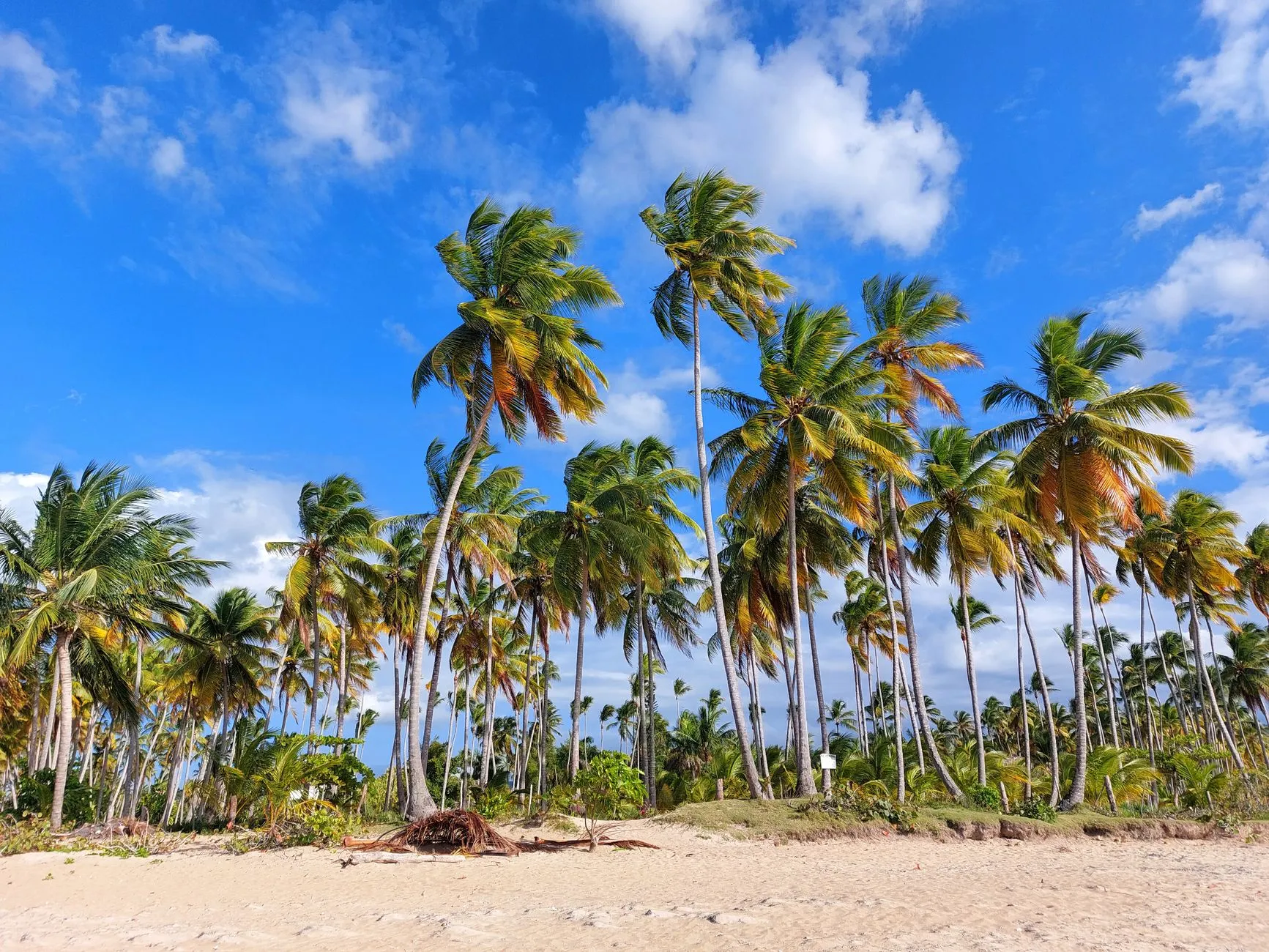
The Dominican Republic — Complete Travel Guide 2026
Most people meet the Dominican Republic as a wristband and a swim-up bar in Punta Cana, and then go home thinking they’ve seen it. They haven’t. This is the oldest European city in the Americas, the Caribbean’s only white-water rafting, a 3,101-metre mountain you can climb, and a bay where thousands of humpback whales come to breed every winter — and almost none of that is on the east-coast beach strip the package brochures sell.
Quick Reference
The eastern two-thirds of Hispaniola, Greater Antilles, Caribbean (sharing the island with Haiti)
PUJ Punta Cana (east/resorts) · SDQ Santo Domingo (capital) · POP Puerto Plata (north coast) · LRM La Romana (southeast) · AZS Samaná (peninsula)
Dominican peso (DOP); US dollars widely accepted in resort zones
Spanish
Free online E-Ticket migration form required before travel; tourist card now bundled into the airfare; visa-free for most Western tourists
December–April (dry season); mid-Jan–March for whales in Samaná; Jun–Nov is hurricane season
All-inclusive beaches, the oldest European city in the Americas, merengue & bachata, humpback whales, kitesurfing
Punta Cana/Bávaro for resorts; Santo Domingo for culture; Samaná or the north coast to actually explore
Editor’s Note: The DR Is a Whole Country, Not a Beach Strip
Here’s the thing the all-inclusive marketing buries: the Dominican Republic is a genuinely varied country, the kind where you can stand on a Caribbean beach in the morning and need a fleece in a pine-forest mountain town by dinner. It has a 500-year-old UNESCO colonial quarter, a peninsula of jungle and waterfalls, a north coast that’s the windsurfing capital of the Americas, and an interior cordillera with the highest peaks in the entire Caribbean. The beaches are excellent. They’re also the least interesting thing about the place.
The DR closed 2025 with a record 11.6 million visitors — its best tourism year ever — and the vast majority of them never left the resort gates. That’s a choice, and for some travellers it’s the right one. But it means three decisions shape your trip more than which hotel you pick:
- Which region (and therefore which airport)? PUJ, SDQ, POP, AZS and LRM serve completely different parts of the country, and getting between them is a long drive. Fly into the wrong one and your “two-hour transfer” becomes five.
- All-inclusive or independent? The resort bubble is genuinely good value and genuinely sealed off. Exploring means a rental car, some Spanish, and a higher tolerance for the real country.
- How far are you willing to drive? The roads are better than you’d expect, but the distances are bigger than you’d think.
Get those three right and the DR rewards you out of all proportion. Get them wrong and you’ll spend your week behind a buffet, wondering what the fuss is about.
Should You Go? Who It’s For — and Who It Isn’t
Go if you want a Caribbean trip with range: lie on a beach for three days, then drive into the mountains or explore a colonial city for the rest. Go if you kitesurf, dive, hike, or whale-watch — the DR does all four at a world level. Go if you want all-inclusive value without flying to the Pacific. Go if you’re a couple or family wanting a low-stress beach week with the option of adventure.
Think twice if you want a tiny, polished, boutique island where everything is walkable and nothing requires logistics — that’s not the DR, which is a big, busy, sometimes chaotic country of 11 million people. Think twice if you expect every beach to be pristine year-round (sargassum is real — more below). Think twice if you won’t leave the resort and then feel cheated that you “didn’t see the country” — that’s on you, not the DR.
The resort-bubble trap: An all-inclusive in Punta Cana is a perfectly good holiday, but it is not “the Dominican Republic” — it’s an international resort that happens to be in it. If you want the actual country — the food, the merengue, the colonial history, the mountains — you have to physically leave the gate. Plan at least a couple of days outside the wristband.
Getting There — Which Airport for Which Trip
This is the single most important planning decision, so get it right before you book the flight. The DR has multiple international gateways, and they are far apart.
- PUJ — Punta Cana is the busiest by a mile and the gateway to the east-coast all-inclusive strip (Punta Cana, Bávaro, Uvero Alto, Cap Cana). If your trip is “beach resort,” this is your airport. It’s also the right entry for La Romana/Bayahibe (~1.5 hours west) if LRM has no convenient flight.
- SDQ — Santo Domingo (Las Américas) serves the capital and the south. Fly here for the Zona Colonial, city culture, and as a launchpad for Samaná (~2 hours northeast on the toll highway) or the southeast.
- POP — Puerto Plata (Gregorio Luperón) is the north-coast gateway: Cabarete (~25–30 min), Sosúa, Puerto Plata, and the closest big airport to the Jarabacoa mountains (~2 hours south).
- AZS — Samaná (El Catey / Presidente Juan Bosch) serves the Samaná Peninsula directly — ~20–30 min to Las Terrenas, ~40 min to Samaná town. Flights are fewer and more seasonal, but if Samaná is your trip, this beats a long drive from SDQ.
- LRM — La Romana is small but handy for Casa de Campo, Bayahibe and Saona/Catalina in the southeast; many charter and a few scheduled flights use it.
Don’t underestimate the drive times. Santo Domingo to Punta Cana is ~2.5 hours; SDQ to Puerto Plata is ~3.5–4 hours; Punta Cana to Samaná is the better part of a day. Booking a hotel in Samaná and a flight into PUJ “because it was cheaper” can cost you a five-hour transfer each way. Match the airport to the region.
Entry — the E-Ticket. Every traveller must complete the free online E-Ticket migration form before arriving, at the official government site eticket.migracion.gob.do. It bundles immigration, customs and health declarations into one QR code (one form now covers a family of up to seven). Fill it out once you have your flight details — it can be done well in advance, but it must be done before you check in for your flight, as the airline will ask for the QR code. The old paper tourist card is now included in your airfare, so there’s nothing extra to buy at the airport. Most Western tourists (EU, UK, US, Canada and many others) enter visa-free for tourism; bring a passport valid for your stay.
Avoid the copycat E-Ticket sites. The real form is completely free at eticket.migracion.gob.do. There’s a cottage industry of lookalike sites that charge €20–50 to “process” it for you. They’re not official and they’re not necessary — go straight to the government domain.
The Regions — Honest Character & Drive Times
The East — Punta Cana & Bávaro (the resort hub)
This is the DR most people fly into: a 50-km ribbon of all-inclusive resorts along the east coast, fronted by genuinely beautiful palm-lined beaches (Bávaro, Cabeza de Toro, Uvero Alto) and backed by golf courses and shopping. It’s polished, easy, family-friendly and excellent value, and it’s also the most sealed-off, least “Dominican” part of the country — an international resort zone that happens to sit on Hispaniola. It’s the right base for a no-stress beach week or a first Caribbean trip, and the springboard for Saona Island day-trips.
We keep the resort detail brief here because Punta Cana has its own dedicated page — see our full Punta Cana guide for resorts, beaches, excursions and the sargassum picture in depth. The short version for this country-wide guide: it’s the beach-holiday hub, it’s good at what it does, and it is one region — spend your curiosity on the rest of the country.
Santo Domingo — the Capital and the Real Country
If you do one non-beach thing in the DR, make it Santo Domingo’s Zona Colonial (Ciudad Colonial), a UNESCO World Heritage site since 1990 and the oldest continuously inhabited European-founded city in the Americas. Founded on the Ozama river in the 1490s and laid out on its now-famous grid by Governor Ovando in 1502 — the template later copied across the New World — it’s a dense, walkable warren of coral-limestone streets stacked with genuine “firsts”:
- The Catedral Primada de América (Basílica Santa María la Menor), the oldest cathedral in the Americas, begun in the early 1500s and finished around 1540, with a golden Gothic-Baroque façade fronting Parque Colón.
- The Alcázar de Colón, the first fortified European palace in the Americas (1511–14), built for Diego Columbus, Christopher’s son, and now a museum of period rooms.
- The Fortaleza Ozama and its coral-stone Torre del Homenaje, the oldest European military structure in the New World, anchoring the southern end of…
- Calle Las Damas, the oldest paved street in the Americas, where you can still walk the route the colonial court promenaded.
Beyond the monuments, this is where you meet the actual country: the energy of Calle El Conde, the casinos and seaside sprawl of the Malecón (the long oceanfront Avenida George Washington), and merengue spilling out of bars at night. It’s loud, hot, alive and a complete antidote to the resort strip. SDQ airport is ~30 minutes from the Zona Colonial.
The Zona Colonial empties after dark. It’s safe and heavily patrolled by day — wander freely — but the tourist core thins out around 6 pm and the surrounding neighbourhoods aren’t all the same. At night, use Uber rather than walking unfamiliar streets, and don’t flash a phone or watch on a quiet block.
La Romana & Bayahibe — the Southeast
About 1.5 hours west of Punta Cana (or east of Santo Domingo) sits the southeast: less developed, more characterful, and the launchpad for two of the DR’s best day-trips. Bayahibe is a low-key former fishing village that’s quietly become the country’s best dive base — calm, friendly, refreshingly un-resorty, and, handily, largely sargassum-free — and the departure point for boats to Saona Island and Catalina Island, both part of the Cotubanamá (Parque Nacional del Este) protected area. Catalina’s wall dive, dropping past pillar coral from shallow reef to 40-plus metres, is one of the best in the country. Saona is the postcard: a 30-minute speedboat (or two-hour catamaran) ride to white sand, palms, and the famous piscina natural, a shallow offshore sandbar where you wade in waist-deep turquoise water dotted with starfish. Catalina is the diver’s pick, with a vibrant reef wall.
Inland sits Casa de Campo, one of the Caribbean’s biggest luxury resorts, and its set-piece: Altos de Chavón, a meticulously built 1970s replica of a 16th-century Mediterranean hill village above the Chavón river, with cobbled lanes, a 5,000-seat Roman-style amphitheatre (opened in 1982 with a Frank Sinatra concert, and still a working venue) and big views over the river gorge. It’s frankly a bit Disney — but it photographs beautifully and the setting is real. LRM airport sits ~10 minutes from Casa de Campo and Bayahibe; otherwise it’s an easy drive from PUJ.
The Samaná Peninsula — the Green Northeast
If the east coast is the DR’s beach, Samaná is its soul — a long, green, mountainous finger in the northeast that feels like a different, slower country. The toll highway (Autovía del Nordeste / DR-7) cut the old four-and-a-half-hour slog from Santo Domingo to under 2.5 hours, making this far more accessible than it used to be; or fly straight into AZS, 20–30 minutes from the action.
Las Terrenas is the peninsula’s hub — a boho-chic beach town with a strong French and Italian expat scene (the first foreigners arrived in the 1970s; today thousands of expats from 20-plus countries live here). That means French bakeries, real Italian restaurants and proper coffee alongside the beach shacks of the Pueblo de los Pescadores, a strip of painted ex-fishing huts now turned into bars. It’s walkable, sociable and a world away from a mega-resort. Las Galeras, at the eastern tip, is the quiet alternative — a sleepy village that’s the gateway to the wildest beaches, several reachable only by boat or on foot, including Playa Rincón (regularly ranked among the world’s best) and the Robinson-Crusoe Playa Frontón.
Don’t miss the El Limón waterfall (Salto El Limón), a 40-metre cascade into a swimmable green pool in the hills (~25 min from Las Terrenas), reached on foot or by horseback through cacao and coffee plantations; or Cayo Levantado (“Bacardi Island”), a palm islet off Samaná town reached by boat taxi. And then there are the whales — see below; they’re the reason to time a trip here for winter.
Puerto Plata & the North / Amber Coast
The north coast — the “Amber Coast,” named for the fossil-rich amber mined here (yes, the Jurassic Park mosquito-in-amber connection is real DR amber) — is the DR for people who want to do things. Cabarete is the headline: a scruffy-cool beach town that’s the kitesurfing and windsurfing capital of the Caribbean, blessed with near-constant afternoon trade winds (250–300 kitable days a year). Its Kite Beach and Bozo Beach draw a young international watersports crowd; the windiest, most reliable months run May–August, with a strong second season December–April. Sosúa, next door, has a calmer crescent bay with reef just metres offshore — one of the DR’s best beginner dive and snorkel spots — and a genuinely odd backstory: it was settled in the 1940s by some 800 German and Austrian Jewish refugees the DR took in when almost nowhere else would, who built farms and a synagogue that still stands.
Around them: the 27 Charcos de Damajagua, a brilliant canyoning trip where you hike up a jungle river then jump (drops up to ~8 m) and slide down a chain of limestone waterfalls and pools (the “27” is generous — you can do a 7-, 12- or full-27 circuit; ~40 min from Puerto Plata); the Teleférico, the only cable car in the Caribbean, running since 1975 up Mount Isabel de Torres to a Christ statue (a small Corcovado lookalike) and botanical gardens above the city; the Fortaleza San Felipe and the faded Victorian gingerbread architecture of Puerto Plata’s old town; and the Amber Museum, where the Jurassic Park mosquito-in-amber gimmick gets its due (the film’s amber-mine scene is set in the DR). POP airport serves the whole coast — ~8–15 min to Sosúa, ~25 min to Cabarete.
The north coast gets less sargassum than the east. The seaweed that plagues Punta Cana’s east-facing beaches in summer largely spares the north and the protected bays — so if your trip falls in the bad sargassum months and clean water matters, the Amber Coast (and the sheltered coves of Samaná and the southwest) are smarter bets than Bávaro.
The Interior Mountains — Jarabacoa & Constanza
Here’s the DR almost no tourist sees, and the one that surprises everyone who does: the Cordillera Central, a genuine alpine interior of pine forest, cool air and rushing rivers. Jarabacoa, the “city of eternal spring,” is the adventure base — it’s home to the only commercial white-water rafting in the entire Caribbean, on the Class II–IV rapids of the Río Yaque del Norte (the Caribbean’s longest river), plus waterfalls (Salto de Jimenoa, Salto de Baiguate), canyoning and paragliding. From near here you climb Pico Duarte, at 3,101 m (10,174 ft) the highest peak in the entire Caribbean — a serious 2–3 day trek with mandatory guides and mules, not a day hike.
Higher and cooler still is Constanza (~1,200 m), a fertile mountain valley locals call the “Switzerland of the Caribbean” — it grows the country’s strawberries, flowers and vegetables, and winter nights can drop below freezing, with the nearby Valle Nuevo high plateau (over 2,200 m) colder still. Astonishing for a country most people picture as one big beach. Pack a fleece. This is the DR’s antidote to itself: pine instead of palm, woodsmoke instead of suncream, and not a wristband in sight.
Yes, it gets cold. Travellers who assume “Caribbean = always hot” turn up in the mountains in shorts and shiver. Jarabacoa is mild; Constanza and the high cordillera can be genuinely cold at night. If you’re heading inland, bring warm layers — and if you’re climbing Pico Duarte, proper cold-weather gear.
The Beaches & the Sargassum Reality
The DR’s beaches are world-class — but in recent years they’ve come with an asterisk, and you should understand it before you book. Sargassum is a brown seaweed that drifts in from the Atlantic and piles up on east-facing shores, where it rots, smells and ruins the swim. It is real, it is seasonal, and it is geographic.
- Worst on the east coast (Punta Cana, Bávaro) — those beaches face the Atlantic currents that carry it. The heavy season historically runs roughly April/May through August/October, though 2025 was a record-breaking sargassum year across the whole Atlantic and 2026 forecasts point to another heavy one, with blooms arriving earlier than usual.
- Lighter on the north coast (Cabarete, Sosúa, Puerto Plata) and in sheltered bays.
- Cleanest months broadly November–March (the low-sargassum window, which conveniently overlaps the dry season).
Resorts on the worst-hit east coast deploy barriers and beach-cleaning crews, so a good resort can keep its beach usable even in a bad month — but it’s variable day to day. If pristine water is non-negotiable, travel in the dry season (Dec–Mar), choose the north coast or a sheltered Samaná/southwest cove, and check recent sargassum reports for your specific resort before you commit.
Whale-Watching in Samaná & the Wildlife
This is one of the great wildlife spectacles of the Atlantic, and it’s the single best reason to time a DR trip for deep winter. Each year thousands of North Atlantic humpback whales migrate to Samaná Bay and the offshore Silver Bank to mate and give birth, in one of the largest seasonal concentrations of humpbacks anywhere on Earth. You watch 40-tonne animals breach, tail-slap and sing within sight of the boat.
The official 2026 season ran January 15 to March 31, with February through early March the peak — over 95% of tours report sightings in that window. Trips depart from Santa Bárbara de Samaná (Samaná town), and the whole bay is a regulated marine sanctuary: boats keep a minimum distance (50 m from adults, more around calves), no more than three boats per whale group, idle speed near the animals, and swimming with the whales is prohibited in Samaná Bay (in-water encounters are only legal far offshore at the Silver Bank, by permit). Pick a licensed operator and a calm-sea morning. It is genuinely unforgettable — and it’s only on for about ten weeks a year, so build the trip around the dates, not the other way round.
When to Visit — Month by Month
- December–April — peak/dry season. The best weather: warm, sunny, low humidity, little rain, and the lowest sargassum risk. Also the priciest and busiest — and the only time for whales (mid-Jan to late March). The sweet spot for most trips.
- January 15 – March 31 — whale season in Samaná, peaking February.
- May & November — shoulder. Often the best value-to-weather ratio: mostly good weather, fewer crowds, lower prices. May can begin the sargassum on the east coast.
- June–November — hurricane season (the DR’s wet season). Real storm risk peaks August through October; September–October are statistically the most active. They’re also the cheapest months by far, with east-coast resort rates dropping 40–50%. Sargassum on the east coast is usually at its worst across summer.
Hurricane season is a gamble, not a guarantee. Most trips in September–October pass without a storm and you bank a huge discount — but the risk is real, so take travel insurance that covers weather disruption, and watch the forecast. If certainty matters more than savings, pay up for the dry season.
What to Eat & Drink
Skip the resort buffet for at least a few meals — Dominican home cooking is hearty, cheap and genuinely good. Start with la bandera (“the flag”), the national lunch: white rice, red beans and stewed meat, named for the colours of the flag and eaten by half the country every day. For breakfast there’s mangú con los tres golpes — mashed boiled green plantain topped with pickled red onions, served with “the three hits” of fried Dominican salami, fried cheese and fried egg. Mofongo is the other plantain classic: fried green plantain mashed with garlic and crackling (chicharrón) into a dense, savoury mound, often filled with seafood or pork.
The Sunday-and-celebration dish is sancocho, a deep, soulful stew of meats and root vegetables (the showpiece sancocho de siete carnes uses seven kinds of meat). On the coast, find a beach shack and order the fresh catch grilled whole with tostones (fried plantain). To drink: a cold Presidente beer (the national lager, ordered ice-cold — bien fría) and excellent Dominican rum (Brugal, Barceló, Ron Bermúdez), plus strong local coffee and fresh tropical juices.
Getting Around — the Right Airport, Long Drives & the Guagua
The DR’s highway network is better than its reputation — the Santo Domingo–Samaná and Santo Domingo–coast autopistas are modern and fast — but the country is large and the distances catch people out (see the airport section). Your options:
- Rental car is the only practical way to actually explore (mountains, hidden beaches, multiple regions). Expect ~€30–55/day, more in peak season. Driving is, let’s say, enthusiastic — lanes are suggestions, motoconchos appear from nowhere, speed bumps are unmarked, and you should never drive at night on rural roads. Carry pesos for highway tolls (booths are cash, often peso-only).
- Long-distance buses are excellent value and comfortable: Caribe Tours and Metro run modern coaches between Santo Domingo, Santiago, Puerto Plata, Sosúa, Samaná, Jarabacoa and more for a few euros (typically €3.50–9 one-way). They blast the air-con — bring a jacket. Arrive an hour early for a seat.
- Guaguas (battered shared minibuses) and carros públicos (shared sedans) are how Dominicans get around — dirt cheap (often well under €2 a hop), atmospheric, slow, and packed. Great for short local trips and a slice of real life; you’ll change vehicles at major towns for longer journeys.
- Motoconchos (motorbike taxis) cover the last mile everywhere for pocket change. Cheap and ubiquitous, but no helmets and real risk — use judgement, and avoid them at night.
- Resort transfers and private drivers are the painless (pricier) option if you’d rather not drive; Uber works in Santo Domingo and some larger towns.
Where to Stay — by Region & Budget
- The east (Punta Cana/Bávaro) — all-inclusive country, from solid family resorts to genuine luxury at Cap Cana. Best for a self-contained beach week; see the Punta Cana guide for specifics.
- Samaná & Las Terrenas — the boutique/independent end: small beach hotels, expat-run guesthouses, villas. Where to go if you want character over a buffet.
- Santo Domingo — boutique hotels in restored colonial buildings inside the Zona Colonial put you on foot among the history; the Malecón has the big international chains and casinos.
- The north coast (Cabarete/Sosúa) — watersports-focused guesthouses, kite-camp hotels and apartments; livelier and younger than the east.
- The mountains (Jarabacoa/Constanza) — rustic eco-lodges and mountain cabins, often with rafting/adventure packages. Cool nights, woodsmoke, a fleece.
Costs & Budget
The DR spans the full range — backpacker to barefoot-luxury — depending entirely on which DR you choose.
- All-inclusive resort (east coast): the headline value. Per-person package rates dive in the off-season; the property covers food and drink, so on-the-ground spending is minimal.
- Independent travel: comfortable mid-range runs roughly €60–120/night for a good guesthouse or small hotel outside the mega-resorts; budget rooms can be far less.
- Eating local: a la bandera lunch at a comedor is a few euros; a beach-shack fish plate with a Presidente, around €8–15; resort and tourist-strip restaurants cost far more.
- Getting around: intercity Caribe Tours/Metro buses €3.50–9; guaguas under €2; car hire €30–55/day plus fuel and tolls; Saona/Catalina day-trips around €60–90 per person.
Carry Dominican pesos for buses, tolls, comedores and rural areas (where cards and dollars won’t help); resorts and tourist businesses happily take USD and cards, but you’ll pay a premium and get worse change than paying in pesos.
Practical Information
- Entry: complete the free E-Ticket at eticket.migracion.gob.do before you fly (QR code required at check-in); the tourist card is bundled into your airfare; most Western tourists are visa-free for tourism with a valid passport.
- Money: Dominican peso (DOP). USD widely accepted in resort/tourist zones; cards work in cities and resorts; carry pesos for everywhere else. ATMs are common but use ones inside banks or resorts.
- Safety: the DR sits at a “Level 2 — exercise increased caution” advisory. Tourist zones are well-patrolled; the real risks are petty theft, motorbike snatch-grabs and the usual nighttime caution in cities. Don’t flash valuables, use Uber/registered taxis after dark, keep car doors locked, and don’t wander unfamiliar urban areas alone at night. Common sense, not fear.
- Water: don’t drink the tap water. Stick to bottled or filtered water (resorts provide it); it’s the single most common way visitors get sick.
- Tipping: a 10% service charge is often added to restaurant bills; an extra 5–10% for good service is normal, plus small tips for drivers, guides and housekeeping.
- Connectivity: good 4G/LTE in towns and resorts (a local Claro or Altice SIM/eSIM is cheap); patchy in the deep mountains.
- Health: no special vaccines required for most travellers; bring strong mosquito repellent (dengue is present) and reef-safe sunscreen.
Tap water, every time. This is the one that gets people. Don’t drink from the tap, be wary of ice in very local spots, and brush your teeth with bottled water if your stomach is sensitive. Resorts and decent restaurants are fine; it’s the casual roadside places where caution pays.
Frequently Asked Questions
Cheapest Flights to The Dominican Republic
We have tracked 2,082 fares to The Dominican Republic from 110 cities. As of June 2026, here is what a good price looked like from each — the lowest fare we recorded, and a “great-deal” benchmark to judge a quote against. These are tracked observations, not live prices: by the time you read this they will have moved, so treat them as a yardstick, not a quote.
| From | Lowest fare we tracked | Great-deal benchmark |
|---|---|---|
| Madrid (MAD) | €382 | €546 |
| Seville (SVQ) | €394 | €563 |
| Dublin (DUB) | €411 | €587 |
| Venice (VCE) | €411 | €587 |
| Milan (LIN) | €430 | €614 |
| Nice (NCE) | €438 | €625 |
| Frankfurt (FRA) | €444 | €634 |
| Porto (OPO) | €446 | €637 |
| Milan (MXP) | €448 | €640 |
| Brussels (BRU) | €454 | €649 |
| Lyon (LYS) | €455 | €650 |
| Paris (CDG) | €456 | €652 |
| Budapest (BUD) | €462 | €660 |
| Mallorca (PMI) | €465 | €665 |
Recent deals we have posted to The Dominican Republic:
- Montreal to Punta Cana, Dominican Republic from C$451
- Orlando Sanford to Punta Cana, Dominican Republic from $232
- Belfast to Punta Cana, Dominican Republic from £199
- Montreal to Punta Cana, Dominican Republic from C$438
- Amsterdam to Punta Cana, Dominican Republic from €485
- Toronto to Punta Cana, Dominican Republic from C$375
- Madrid to Punta Cana, Dominican Republic from €517
- Amsterdam to Punta Cana, Dominican Republic from €460
- Madrid to Santo Domingo, Dominican Republic from €572
These are fares aifly tracked to this destination, not live quotes — they have changed since and several of the deals above may have expired. Browse current flight deals →