Mexico — Complete Travel Guide 2026
Most people fly into an all-inclusive on the Riviera Maya, spend a week behind a wristband, and go home convinced they have “done Mexico.” They have done a resort that happens to be in Mexico. The real country — vast, ancient, regionally fierce, and home to one of the planet’s great cuisines — starts the moment you leave the beach strip and head for Oaxaca’s markets, the Yucatán’s limestone sinkholes, the pastel silver towns of the Bajío, or the highland fog of Chiapas. This guide is about that Mexico.
Quick Reference
North America, between the United States, the Caribbean and the Pacific
Mexico City (MEX) & Felipe Ángeles (NLU); Cancún (CUN); Guadalajara (GDL); Monterrey (MTY); Los Cabos (SJD); Oaxaca (OAX); Mérida (MID); Puerto Vallarta (PVR)
Mexican peso (MXN). Roughly 20 pesos to €1 in 2026
Spanish, plus 68 living Indigenous languages (Nahuatl, Maya, Zapotec, Tzotzil and more)
No tourist visa for UK, EU, US, Canada, Australia & most Western nationalities. A digital immigration form (FMM/FMMd); stays of **up to 180 days at the officer’s discretion
November–April (dry season). Day of the Dead around 31 Oct–2 Nov is the headline event
Mole and mezcal, Maya and Aztec ruins, cenotes, colonial silver cities, Pacific surf, Baja’s desert coast — and, yes, the beaches
Oaxaca, Mérida, San Miguel de Allende, Mexico City, San Cristóbal de las Casas — pick a region, not a resort
Editor’s Note: The Resort Is Not the Country
I want to be blunt, because the marketing isn’t. Cancún’s hotel zone and the polished stretch of Riviera Maya south to Tulum are a genuinely beautiful coastline wrapped in an industry designed to keep you from ever needing to engage with Mexico at all. The buffet is “Mexican night.” The mariachis are on a schedule. The tequila is sweetened. You can have a lovely, easy, sunburnt week and never once eat a real taco or hear an Indigenous language spoken on the street.
Mexico is the size of Western Europe with the cultural depth to match, and it does not have a single character any more than “Europe” does. The Yucatán is not Oaxaca is not Baja is not Chiapas — different food, different climate, different ancestry, different pace, sometimes different languages. The mistake isn’t visiting the Caribbean coast; it’s beautiful, and I’ll point you to where it’s worth it. The mistake is thinking the wristband is the whole story.
If you take one thing from this guide: base yourself in a region, not a hotel. Pick Oaxaca, or the colonial Bajío, or inland Yucatán, learn it for a week, eat where the locals eat, and you’ll come home with a country instead of a tan.
Should You Go? Who Mexico Is For — and Who It Isn’t
Mexico is for the curious eater above all. If your idea of a good travel day is following the smell of a comal to a market stall and ordering the thing the woman next to you is having, this is one of the best countries on earth, and absurdly affordable for what you get. It’s for ruin-hunters, for festival-chasers, for surfers, for design-and-craft people, for slow travellers who want to settle into one town and let it unfold. It rewards a little Spanish, a flexible plan, and a willingness to take the bus.
It is not an ideal fit if you need everything to run on Swiss time, if street food makes you anxious, or if you genuinely cannot relax without a sealed, all-inclusive perimeter — in which case, be honest with yourself, book the resort, and enjoy it for what it is. It’s also not a country to treat as one undifferentiated risk zone. As I’ll explain in the safety section, the tourist heartland is calm and the danger is concentrated in specific states most travellers have no reason to enter. Reading “Mexico” as a single threat is as useless as reading “Europe” as one.
Solo travellers, including solo women: Oaxaca, Mérida, Mexico City’s central neighbourhoods, San Miguel de Allende and San Cristóbal are all very doable solo. Normal city common sense, not fortress paranoia.
Entry: No Visa, the Immigration Form & the 180-Day Question
The good news is that entry is genuinely simple for most readers. Citizens of the UK, the EU, the US, Canada, Australia, New Zealand and most of Latin America do not need a tourist visa for Mexico. You arrive with a passport (valid for the duration of your stay), you clear immigration, and you’re in.
What you do need is the Forma Migratoria Múltiple (FMM) — the tourist permit. Mexico has been digitising this for a couple of years now, and as of 2026 paper forms are no longer handed out on planes; arrivals are processed through the digital FMMd system. At the big air-arrival airports the permit is largely integrated into your entry and the fee is bundled into your airfare, so in practice many flyers barely notice it. If you cross by land or arrive somewhere that still requires a separate permit, you complete it online (you can do this up to 30 days ahead) and the fee runs around 980 pesos (≈ €50). Keep whatever digital or stamped record you’re given until you leave.
Now the part that trips people up: the 180 days are not automatic. Mexico’s tourist permit can be valid for up to 180 days, and for years officers rubber-stamped the maximum. They no longer do. The number of days is at the immigration officer’s discretion, and increasingly they write a real figure — 30, 60, 90 — based on your answers, your onward ticket, and the vibe. If you’re planning a long stay, have a return or onward flight and an address ready, be polite, and ask clearly for the time you need. Don’t assume you’ll get six months.
Don’t overstay. Mexico’s overstay fines are real and you’ll pay them at the airport on the way out, often after a stressful queue. If the officer gives you fewer days than you wanted, plan around that number — don’t argue, don’t ignore it.
Getting Around: Flights, Buses, Driving & the Maya Train Reality
Mexico is enormous, so how you move is the difference between a relaxed trip and a logistical grind.
Domestic flights are the workhorse for long hops. Volaris, VivaAerobus and Aeroméxico criss-cross the country, and fares are often startlingly cheap if you book ahead — Mexico City to Oaxaca, Mérida or Los Cabos can land around €40–90. The catch is the budget-airline catch: brutal baggage fees and a fondness for delays. Travel hand-luggage-only where you can and read the bag rules before you click.
Long-distance buses are Mexico’s quiet triumph, and I mean that. The premium lines — ADO in the south and east, ETN and Primera Plus in the centre and Bajío — run comfortable, punctual, genuinely pleasant coaches with reclining seats and air-con, on routes Europeans would expect a train for. Cancún–Mérida, Oaxaca–Puerto Escondido, Mexico City–San Miguel: the first-class bus is cheaper than flying, drops you in the actual town centre, and is the backbone of any overland trip. Book the better classes (ADO GL/Platino, ETN) for the longest legs; book online or at the station the day before in busy season.
Take the first-class bus at least once. It quietly reframes how you think Mexican travel works — and it puts you in the centre of town, not at an airport 40 minutes out.
Driving makes sense for exactly two kinds of trip: the Yucatán (flat, well-signed, cenote-hopping, easy) and Baja (the whole point is the road). Elsewhere, in cities especially, a car is more hassle than help. If you rent, buy the Mexican liability insurance (it’s legally required and not optional in practice), stick to daytime driving on toll roads (cuotas), and keep some cash for tolls.
The Maya Train (Tren Maya) deserves a clear-eyed paragraph, because the hype outruns the reality. It opened in stages and has been running its full loop — 34 stations across roughly 1,550 km, from Cancún airport down through Mérida, Campeche and into Palenque, Chiapas — since 2025. On paper it’s transformative; in practice, in 2026, it’s a flawed novelty more than a workhorse. Most stations sit well outside the towns they’re named for, so you arrive and then need a taxi or shuttle for the last leg, which erodes the time saving. Reliability has been patchy, schedules thin, and it bleeds money. Is it worth riding? As an experience between, say, Mérida and Campeche or out to Palenque, sure — it’s scenic and cheap. As the spine of your itinerary, not yet. For now the ADO bus is still the more dependable way to actually get places.
Oaxaca: The Soul of the Country
If I could send you to one region and nowhere else, it would be Oaxaca (wa-HA-ka), and it would not be close. This is the heartland of Mexican food, craft and ceremony — a highland city of low ochre buildings ringed by Zapotec and Mixtec villages, each with its own market day, weaving tradition or mezcal palenque.
The city of Oaxaca is walkable, beautiful and built around eating. Spend a morning lost in the Mercado 20 de Noviembre and the sprawling Mercado de Abastos; eat tlayudas (a vast crisp tortilla folded over beans, Oaxacan string cheese and meat — the region’s signature) and a bowl of one of the seven moles; drink hot chocolate beaten with water at a cocoa grinder’s stall. Climb to Monte Albán, the Zapotec mountaintop city, for one of the great archaeological views in Mexico. Out in the valleys, Teotitlán del Valle weaves naturally dyed wool, San Bartolo Coyotepec makes the black pottery, and the mezcal villages around Santiago Matatlán will pour you small-batch espadín and wild tobalá straight from the still.
Then there’s the Oaxacan coast, which is a different planet from the highlands: Puerto Escondido for serious surf and a scruffy, surf-town charm; Mazunte and Zipolite for hammock-and-turtle bohemian beach life (Zipolite is famously clothing-optional and proud of it); Huatulco for cleaner, calmer bays. The drive or short flight down from the city links two completely different Mexicos in one trip.
Mezcal is not “smoky tequila.” It’s an entire agave universe — espadín, tobalá, madrecuixe, each tasting of its village and soil. Drink it slowly, neat, with a slice of orange and sal de gusano. The good stuff is made by families, not factories, and Oaxaca is its home.
And then there’s Day of the Dead. Oaxaca is the place to witness Día de Muertos — but read the festival section below, because the timing and the crowds both matter.
The Yucatán Beyond Cancún
Here’s the reframing that changes everything: the Yucatán Peninsula is one of Mexico’s safest, easiest regions, and the best of it is inland, an hour or two from the beach circus. Yucatán state carries the country’s lowest travel-advisory rating. Rent a car, base in a colonial city, and let the coast be a day trip rather than the whole point.
Mérida is the capital and a genuinely lovely city — grand, walkable, with a Sunday when the centre closes to traffic and fills with music, food stalls and dancing. Yucatecan food is its own cuisine: cochinita pibil (achiote-marinated pork slow-cooked in banana leaf), sopa de lima, papadzules, panuchos. Use Mérida as a base and fan out.
Valladolid is the smaller, prettier base — a butter-and-pastel colonial town with a cenote in its centre, perfectly placed for the ruins and sinkholes. From either town you reach Chichén Itzá (go at opening, before the tour buses and the gauntlet of souvenir sellers; foreigner admission now runs in the region of 600–700 pesos / ≈ €30–35 once the state and federal fees are combined) and the quieter, arguably more atmospheric Uxmal, which I’d rank above Chichén for sheer architecture and lack of crowds. Ek Balam is smaller still and you can usually have it half to yourself.
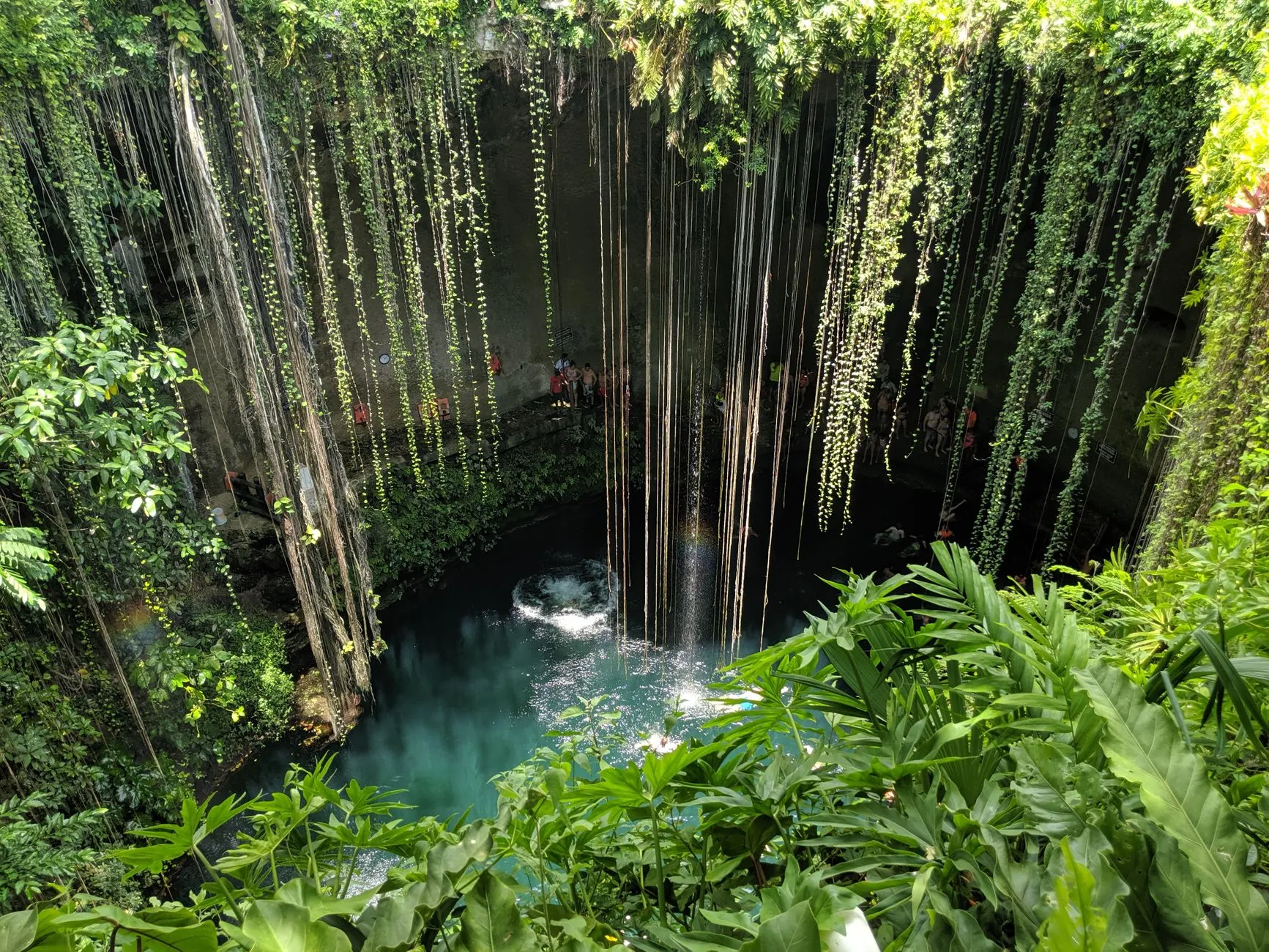
The cenotes are the Yucatán’s miracle — thousands of freshwater limestone sinkholes, some open and jungle-fringed, some cathedral-dark caverns reached by a ladder through a hole in the ground. Skip the giant, packaged ones near the resorts and seek out the village-run cenotes around Valladolid, Homún and Cuzamá; entry runs roughly 100–350 pesos (≈ €5–17). Swimming in one at the right hour is among the best things you can do in Mexico.
Wear biodegradable sunscreen or none at all in cenotes — the village ones often ban regular sunblock to protect the water, and they’re right to. Shower the chemicals off first.
For the Caribbean beaches themselves — Cancún, Playa del Carmen, Tulum, Cozumel, Isla Mujeres, Bacalar’s lagoon — I’ll send you to aifly’s dedicated Cancún & the Riviera Maya guide, which covers that coast properly. My only editorial nudge: Tulum has priced and hyped itself into a caricature; Bacalar’s seven-colour lagoon, further south and far calmer, is where I’d spend the beach-and-water days now.
The Colonial Bajío: Mexico’s Silver Cities
In the central highlands sits the Bajío, the heartland that financed the Spanish empire with silver and then sparked the war for independence. It’s a string of impossibly photogenic colonial cities at a mile and a half of altitude, with cool evenings, baroque churches, and some of the country’s best small-city living.
San Miguel de Allende is the famous one — cobbled, pink-spired, beloved by artists and a large American and Canadian expat community. It is unquestionably gorgeous and unquestionably has been discovered; it can feel more like a beautiful theme-park version of itself than a working Mexican town, and prices reflect the foreign money. Go, it’s worth it, but stay two or three nights, not your whole trip.
Guanajuato, an hour away, is the one I’d choose. A university town crammed into a ravine, painted every colour, threaded with tunnels and alleyways and staircases, alive with students rather than tour groups. It’s romantic, eccentric (the mummy museum, the callejoneadas — roving student serenades), and far less manicured than San Miguel. Querétaro is the underrated third — a handsome, prosperous colonial city with a superb centre, increasingly a wine-and-cheese-route hub, and almost no foreign crowds.
The Bajío is a week of its own: San Miguel for the looks, Guanajuato for the soul, Querétaro for the wine country, all linked by quick first-class buses. Pack a jacket — at this altitude the nights are genuinely cool, even in “hot” Mexico.
The Pacific & Baja California
Two very different coasts, both worth your time and both routinely overshadowed by the Caribbean.
The central Pacific is warm-water, jungle-backed and laid-back. Puerto Vallarta is the established resort city — walkable, characterful, with a genuinely lovely old town (Zona Romántica) and a long-standing reputation as one of Mexico’s most welcoming, openly LGBTQ-friendly destinations. Just north, Sayulita is the surf-and-boho village that boomed (charming but busy now), and San Pancho next door is its quieter, more grown-up sibling. The whole Riviera Nayarit stretch rewards a slow week. Further south you’ve already got the Oaxacan coast covered above.
Baja California Sur is the desert-meets-sea peninsula, and it’s a category of its own. Los Cabos (Cabo San Lucas + San José del Cabo) is the glossy, golf-and-marina resort end — fine if that’s the holiday, with the famous arch and serious sport fishing. But the soul of Baja is La Paz: a relaxed waterfront city on the Sea of Cortez (which Jacques Cousteau called “the world’s aquarium”), and the launch point for swimming with whale sharks in winter, kayaking the islands, and the unreal sandbars of Balandra beach. Between November and April, whale watching in the lagoons of Baja brings grey whales close enough to touch. Baja is also a road-trip in its own right — the long highway down from the US border is a genuine adventure for those with time.
Best of the Pacific by season: surf and warm water late spring to autumn; whale watching and calm seas December to April. La Paz over Cabo if you want Mexico rather than a resort with a Mexican postcode.
Chiapas: Highland Mexico & Jungle Ruins
Mexico’s southernmost state is its most distinctly Indigenous, its most mountainous, and one of its most rewarding for travellers willing to go a little further. This is highland fog, Tzotzil and Tzeltal Maya towns, and jungle ruins that beat almost anything for atmosphere.
San Cristóbal de las Casas is the base: a cool, colonial highland town at 2,200 m, with a backpacker-and-artisan energy, superb markets, and surrounding Maya villages where the religious life is a startling, syncretic blend of Catholic and pre-Hispanic — San Juan Chamula’s church, candlelit and pine-strewn with no pews, is unlike anywhere else (and a place to be respectful: photography inside is forbidden, and that rule is enforced seriously). From San Cristóbal you reach the Sumidero Canyon and the waterfalls of Agua Azul and Misol-Ha.
Then there’s Palenque — for my money the most beautiful Maya site in Mexico. Where Chichén Itzá is grand and exposed, Palenque is a temple-city half-swallowed by rainforest, howler monkeys roaring in the canopy, mist hanging in the ruins at dawn. Go early, stay nearby, and give it a full slow morning. It’s also the Chiapas terminus of the Maya Train, if you want to test that line on a scenic leg.
Chiapas runs cool and wet at altitude — pack layers and a rain shell even in the dry season. And budget more transit time: this is the part of Mexico where distances on the map lie, thanks to mountain roads.
Mexico City & the Riviera Maya: Where Most People Already Go
Two destinations get the lion’s share of arrivals, and both have their own dedicated aifly guides — so I’ll keep this brief and just frame why they matter.
Mexico City is, I’d argue, one of the great cities of the world right now — a high-altitude megalopolis of staggering food, world-class museums (the Anthropology Museum alone justifies a trip), leafy neighbourhoods like Roma and Condesa, Frida Kahlo’s Coyoacán, the Aztec-and-baroque historic centre, and Teotihuacán’s pyramids an hour out. It is also far safer in its central districts than its reputation suggests. Don’t skip it for the beach. Full detail in aifly’s Mexico City guide.
The Riviera Maya — Cancún, Playa del Carmen, Tulum, Cozumel, Bacalar — is the Caribbean coast everyone pictures, and it’s genuinely beautiful when you choose the right base and get off the resort strip. The dedicated Cancún & Riviera Maya guide covers it in depth.
The Food: One of the World’s Great Cuisines
Let’s be unambiguous: Mexican cuisine is one of the half-dozen greatest food cultures on the planet, recognised by UNESCO, and it is almost nothing like the cheese-blanketed “Mexican” food sold abroad. It is a cuisine of corn, chillies and centuries — regional, technical, and at its best at a market stall or a grandmother’s comal, not a white-tablecloth restaurant.
Real tacos are a revelation and a religion: tacos al pastor (spit-roasted pork shaved off the trompo, with pineapple, a Mexico City obsession), carnitas, suadero, barbacoa on weekend mornings, fish tacos on the coasts. They cost 15–25 pesos each (under €1.25), they’re eaten standing up, and the salsa is yours to fear or love. Beyond tacos:
- Mole — Oaxaca’s seven moles and Puebla’s mole poblano, complex sauces of chillies, spices, nuts and sometimes chocolate, built over hours. Not sweet, not “chocolate sauce.” Profound.
- Tlayudas — the Oaxacan “pizza,” a giant toasted tortilla. Eat one from a charcoal grill at night.
- Cochinita pibil — the Yucatán’s achiote-and-citrus slow-roast pork, served with pickled red onion. Order it on a panucho.
- Chiles en nogada — a patriotic late-summer dish (poblano stuffed with picadillo, walnut cream, pomegranate); seasonal, August–September.
- Tamales, esquites, elotes, pozole, cemitas, marquesitas — the street-food canon, region by region.
And the drinks: mezcal above all (see Oaxaca), tequila done properly (sipped, not slammed), pulque in the central highlands, Mexican craft beer, agua fresca by the litre, and chocolate the way it was invented here.
The single best food advice for Mexico: eat at the busy stall with the queue of locals and the high turnover. Fresh, fast, watched — it’s usually safer and always better than the half-empty tourist restaurant with laminated menus in four languages.
Money & What Things Actually Cost
Mexico is one of the best value-for-richness destinations on earth, especially away from the resort coast. The peso trades around 20 to the euro in 2026, which makes the mental maths easy: 100 pesos ≈ €5, 1,000 pesos ≈ €50.
Rough real-world costs:
- Street tacos: 15–25 pesos each (€0.75–1.25)
- Comida corrida (set lunch, soup + main + drink at a local fonda): 80–130 pesos (€4–6.50)
- Mezcal in a good mezcalería: 80–150 pesos a pour (€4–7.50)
- Mid-range hotel: €40–80 a night; boutique in Oaxaca or San Miguel €100–180
- First-class bus, Cancún–Mérida: roughly 450–650 pesos (€22–32)
- Cenote entry: 100–350 pesos (€5–17)
- Chichén Itzá admission (foreigners): ~600–700 pesos (≈ €30–35) combined
Cash still rules outside the big tourist zones — markets, taquerías, village cenotes, small buses. Cards are widely accepted in cities, hotels and the resort coast. Use ATMs attached to actual banks (BBVA, Santander, Banorte), decline the machine’s “conversion” offer (always choose to be charged in pesos), and watch for sky-high standalone-ATM fees in tourist areas. The infamous tourist tax in Quintana Roo — Visitax, roughly €15 per person, now actually enforced at Cancún airport checkpoints — is covered in the practical section; pay it online before you fly out of that state.
Always choose to pay in pesos, never in your home currency, when a card machine or ATM asks. “Dynamic currency conversion” quietly skims a few percent every single time.
When to Go — and Day of the Dead
The broad rule: the dry season runs roughly November to April, and that’s the sweet spot for most of the country — warm, mostly rain-free, comfortable. May is hot and dry; June to October is the rainy/hurricane season, which mostly means dramatic afternoon downpours inland (often fine for travel and far greener and cheaper) but real hurricane risk on the Caribbean and Pacific coasts, peaking August–October. Highland regions (Oaxaca, the Bajío, Chiapas, Mexico City) stay temperate year-round thanks to altitude, with cool nights even in summer.
The festival you build a trip around is Día de Muertos — the Day of the Dead. The core dates are 31 October to 2 November (1 November for departed children, 2 November for adults), but the celebration swells across the final week of October with marigold-strewn altars, candlelit cemetery vigils, sand tapestries and neighbourhood comparsas. Oaxaca is the place to experience it — arrive around 30 October and stay through 3 November for the full arc. Book flights and rooms months ahead; this is the single busiest, most expensive window in Oaxaca, and prices reflect it. It is also a real, living act of remembrance, not a costume party — engage respectfully.
Other timing notes: Semana Santa (Easter week) empties the cities and packs the beaches with domestic holidaymakers — gorgeous tradition, crowded coasts, book ahead. Guelaguetza in Oaxaca (July) is a spectacular Indigenous dance festival. Independence celebrations peak the night of 15–16 September.
If you can only go once, and you love food and culture more than beaches, go to Oaxaca for Day of the Dead — but book it half a year out, or accept paying a heavy premium.
Safety, Handled Like an Adult
This is where Mexico is most misunderstood, so let me be precise rather than either alarmist or naïve. Mexico’s violence is real but intensely geographic — concentrated in specific states tied to organised crime and cartel territory, and overwhelmingly not directed at tourists. The country does not have a single uniform safety level; the only useful map is the state-by-state one.
As of 2026, the US State Department’s “Do Not Travel” (Level 4) list is six states: Colima, Guerrero, Michoacán, Sinaloa, Tamaulipas and Zacatecas. Note that Guerrero includes Acapulco and Taxco — which is exactly why those onetime classics have fallen off most itineraries. Several other states sit at “Reconsider Travel.”
Now the part that matters more: the tourist heartland is calm. Yucatán state carries the lowest advisory rating in the country — Mérida is routinely cited among the safest cities in the Americas. Oaxaca, Mexico City, the Bajío (Guanajuato/Querétaro for the cities), Baja California Sur (La Paz, Los Cabos), Chiapas’s highland tourist towns, and the core Riviera Maya are all places ordinary travellers visit in huge numbers without incident, sitting at the “exercise normal/increased caution” levels you’d apply to any big city. The advisories even within a flagged state often carve out the tourist zones (in Oaxaca, the city, Monte Albán, Puerto Escondido and Huatulco carry no specific restriction; the cautions apply to particular highways and the Isthmus).
The practical playbook is the same common sense you’d use in any large country: avoid driving at night on intercity roads, use registered taxis or apps (Uber/DiDi work well in cities), don’t flash wealth, keep an eye on your drink, use the toll roads, and check the current state-by-state advisory before you fix a route. Petty theft and scams are the realistic everyday risk for tourists, not cartel violence — guard against the former and don’t lose sleep over the latter in the regions above.
The honest summary: read Mexico by state, not as a country. Steer clear of the six Level-4 states (most travellers have no reason to be there), and the Yucatán/Oaxaca/CDMX/Bajío/Baja Sur core is as safe as plenty of European holidays.
Overrated, Water, Tipping & the Practical Stuff
What I’d skip or rethink. Tulum has become a victim of its own Instagram — beach clubs at New-York prices, persistent power and water issues, and a town strip that lost the magic; the ruins are still fine at opening, but as a base I’d choose Valladolid or Bacalar. Acapulco and Taxco are off the table for now (Guerrero is Level 4). The mega-packaged “eco-parks” and cenote complexes near Cancún are overpriced and overrun — go village-run instead. And resist the urge to cram the whole country into ten days: Mexico punishes the checklist tour. Two regions done well beats six done from a bus window.
Water. Don’t drink the tap water — full stop, everywhere, including the nice hotels. Drink bottled or filtered (agua purificada); most hotels and rentals provide a garrafón. Ice in established restaurants and bars in tourist areas is generally made from purified water and fine; the real risks are raw, unwashed produce and food that’s been sitting out. Eat hot, fresh, busy. Travel with rehydration salts and basic stomach meds just in case.
Tipping. Tip 10–15% in restaurants (check it isn’t already added on the resort coast), round up for taxis, 20–50 pesos a day for hotel housekeeping, a few pesos for the grocery baggers and parking attendants who don’t earn a wage. It matters here.
Connectivity & odds and ends. A local eSIM (Telcel has the best coverage) or a cheap Telcel SIM keeps you online cheaply. Mexico uses US-style plugs (Type A/B, 127V), so EU/UK travellers need an adapter. Spanish goes a very long way and a little effort is warmly received; English is common in tourist zones, scarcer in villages. And budget for the small mandatory taxes — Visitax (~€15) if you fly out of Quintana Roo, paid online before departure, now genuinely checked at the airport.
One final practical rule: carry small-denomination peso cash for street food, markets, village cenotes and rural buses; keep a card for cities and hotels; and never let the tap water touch your toothbrush in the first few days while your stomach adjusts.
Frequently Asked Questions
Cheapest Flights to Mexico
We have tracked 1,283 fares to Mexico from 76 cities. As of June 2026, here is what a good price looked like from each — the lowest fare we recorded, and a “great-deal” benchmark to judge a quote against. These are tracked observations, not live prices: by the time you read this they will have moved, so treat them as a yardstick, not a quote.
| From | Lowest fare we tracked | Great-deal benchmark |
|---|---|---|
| Sandefjord Torp (TRF) | €319 | €456 |
| Copenhagen (CPH) | €321 | €459 |
| Amsterdam (AMS) | €330 | €471 |
| Gothenburg (GOT) | €351 | €502 |
| Treviso (TSF) | €364 | €520 |
| Dublin (DUB) | €371 | €530 |
| Bilbao (BIO) | €373 | €533 |
| Cologne (CGN) | €378 | €540 |
| Oslo (OSL) | €381 | €544 |
| Mallorca (PMI) | €382 | €545 |
| Madrid (MAD) | €393 | €561 |
| Prague (PRG) | €404 | €577 |
| Dusseldorf (DUS) | €421 | €601 |
| Warsaw (WMI) | €429 | €613 |
Recent deals we have posted to Mexico:
- Zürich to Cancún, Mexico from CHF 540
- Prague to Cancún, Mexico from €576
- Venice to Cancun, Mexico from €570
- Denver to Cancún, Mexico from $195
- Vienna to Cancún, Mexico from €567
- Glasgow to Cancun, Mexico from £400
- Berlin to Cancún, Mexico from €538
- Oslo to Guadalajara, Mexico from €636
- Stockholm to Guadalajara, Mexico from €600
- Geneva to Guadalajara, Mexico from CHF 558
These are fares aifly tracked to this destination, not live quotes — they have changed since and several of the deals above may have expired. Browse current flight deals →