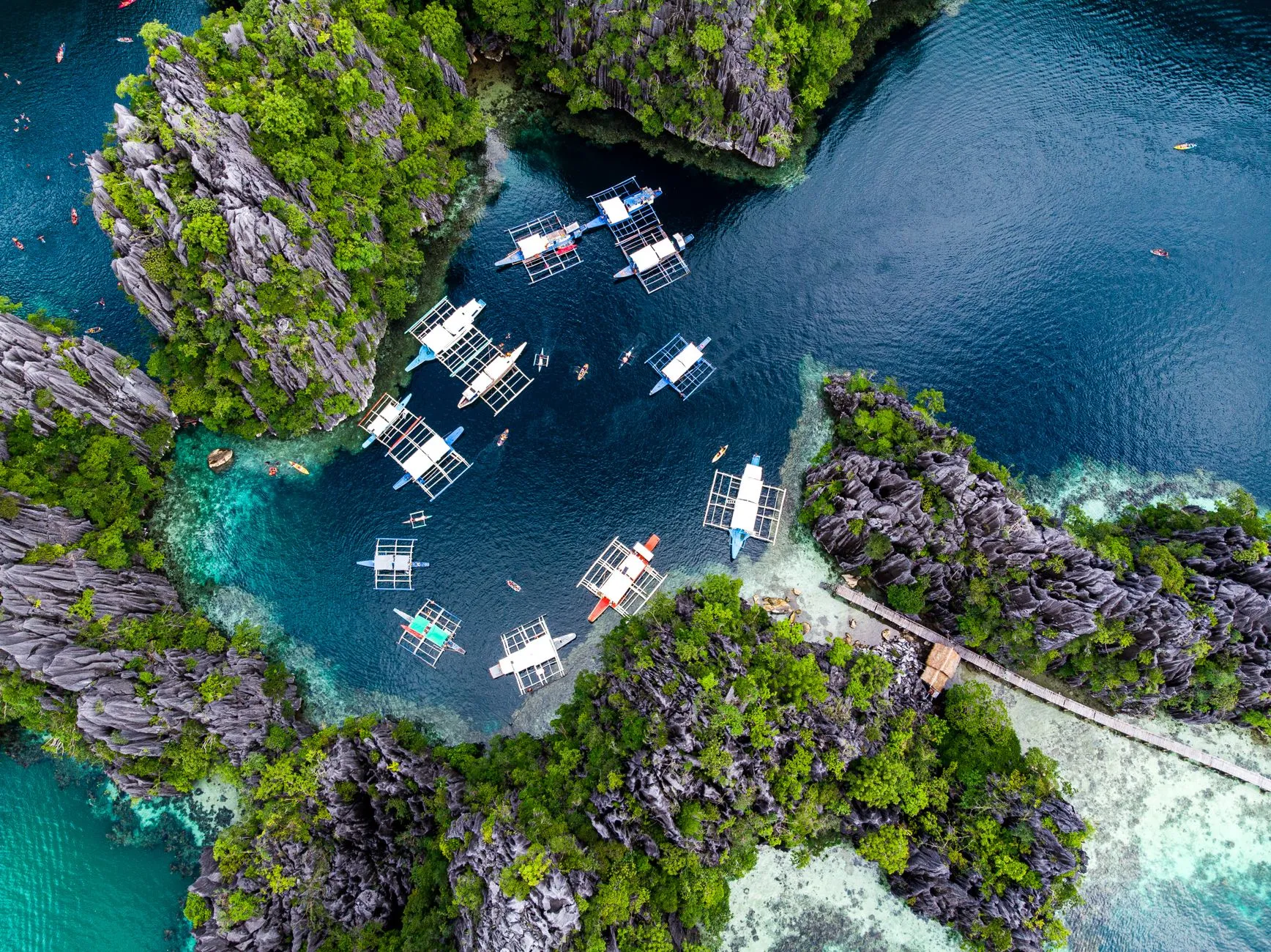
The Philippines — Complete Travel Guide 2026
The Philippines is the most beautiful place in Southeast Asia that most people underrate, and the reason is simple: it punishes the greedy itinerary. This is not Thailand, where everything is an hour apart on a good road — it’s 7,640 islands stitched together by budget flights, bangka boats, and tricycles, and the single best decision you’ll make is to do less. Pick two or three islands, go deep, and let the cliché-defying lagoons of Palawan and the genuinely warm welcome do the rest.
Quick Reference
Southeast Asia, an archipelago of 7,640+ islands between the South China Sea and the Pacific
Manila (MNL), Cebu (CEB), Puerto Princesa/Palawan (PPS), Kalibo for Boracay (KLO)
Philippine peso (PHP) — roughly €1 ≈ ₱65 in 2026
Filipino (Tagalog) + English (widely, genuinely spoken) + dozens of regional languages
Visa-free for most Western tourists (30 days, extendable); free eTravel registration required before arrival
Dry season, roughly November–May; avoid the July–September typhoon peak
El Nido & Coron lagoons, Boracay’s White Beach, Siargao surf, Bohol’s tarsiers, wreck diving, warm hospitality
Pick 2–3: Palawan (lagoons), Cebu/Bohol (diving + day trips), Siargao (surf-and-chill), Boracay (the beach), or North Luzon (rice terraces)
Editor’s Note — Read This Before You Book Anything
Here is the mistake nearly every first-timer makes: they try to “see the Philippines” in ten days. El Nido, then Coron, then Cebu, then Bohol, then Boracay, then Siargao. On a map it looks doable. In reality, almost none of those legs is a direct hop — you fly back through Manila or Cebu, you lose a half-day to airport queues and a two-hour van transfer on each end, and you spend your holiday in departure lounges instead of in the water.
So make the three decisions that matter, in this order.
First, pick your region — not your bucket list. The country breaks into rough zones: Palawan (the headline lagoons — El Nido and Coron), the Visayas (Cebu as a hub for Bohol, Moalboal, Malapascua), Boracay (one famous beach), Siargao (surf island, off in the Pacific east), and North Luzon (the mountain rice terraces, a completely different, cooler Philippines). Trying to combine more than two of these zones in under two weeks means you’re flying, not travelling.
Second, accept the transfer reality. Inter-island flights are cheap and frequent but funnel through Manila (MNL) and Cebu (CEB). El Nido has a small airport but most people fly into Puerto Princesa (PPS) and ride 5–6 hours north by van. Boracay has no airport — you fly to Caticlan (the closer one) or Kalibo (KLO, cheaper, ~2 hours away) and then take a boat. Building in buffer time isn’t optional; it’s the whole game.
Third, time it right. The dry season (roughly November to May) is when the boats run, the lagoons are calm, and the islands look like the postcard. June to November is typhoon season; July to September is the riskiest stretch. More on that below — but if your only option is the wet months, lean toward Cebu and the Visayas, which sit in a sheltered belt.
Do this: Choose ONE airport region for the first half of your trip and ONE for the second, with a single transit through Manila or Cebu between them. A 10-day trip = Palawan + Cebu/Bohol, full stop. A 14-day trip can add Siargao or Boracay. Anything more is a transfer marathon.
Should You Go? Who It’s For — and Who It Isn’t
Go if you want the best island scenery in Asia — limestone karst lagoons, ribbon sandbars, walls of soft coral — and you don’t mind a bit of friction getting to it. Go if you dive or want to learn (the Philippines is world-class and cheap for it). Go if you’d rather have a beach to yourself than a beach with a beach club. Go if you value being made to feel genuinely welcome — Filipino hospitality is not a tourism-board slogan, it’s the actual texture of the place, and the near-universal English makes it the easiest country in the region to travel as a foreigner.
Think twice if you want everything seamless and on time. Boats get cancelled by weather, “two hours” becomes four, and the rhythm is island-time, not Swiss-rail. Think twice if you need nightlife and infrastructure on a Bangkok or Bali scale — outside Boracay and a couple of Siargao bars, evenings are mellow. And think twice about the rainy months if your trip is short and you can’t be flexible: a single typhoon can ground your inter-island flight and erase two days.
Caution: If your travel dates are locked and your itinerary is tight, the wet season is a real gamble. A grounded flight or a cancelled boat can collapse a multi-island plan with no slack in it. Build in a spare day, or pick a single-island trip you can’t be knocked off.
Getting There & Entry — MNL, CEB, PPS, KLO
Almost every long-haul arrival from Europe lands at Manila (MNL / Ninoy Aquino International), usually via a Gulf or Asian hub. MNL is functional but chaotic and notoriously congested, spread across four terminals that aren’t airside-connected — leave generous time for any onward domestic connection, and if your inter-island flight leaves from a different terminal, treat it like a separate airport. Cebu (CEB / Mactan) is the calmer, more pleasant second gateway and an increasingly good place to start if you can route through it — it puts you next to the Visayas without the Manila scrum, and 2026 has seen Cebu Pacific add new direct international links from Cebu (Bangkok–Don Mueang and Hanoi among them). Puerto Princesa (PPS) is your way into Palawan, and Kalibo (KLO) is the budget gateway for Boracay.
A word on Manila itself: it’s the gateway, not the destination. Most island-bound travellers see it only as a transit point, and that’s a defensible choice — the traffic is brutal and the chaos is real. But the capital rewards a day or two if you have them, between the walled Spanish core of Intramuros, the food and bars of Poblacion, and the sunsets over Manila Bay. If you’re building in a Manila stopover, read our full Manila city guide — here we keep moving, because the reason you came is the islands.
On entry, the Philippines is refreshingly simple. Most Western nationals (UK, EU, US, Canada, Australia and many more) get visa-free entry for 30 days for tourism, extendable in-country through the Bureau of Immigration if you want longer. You need a passport valid for at least six months and an onward or return ticket.
The one thing you must do before you fly: register for eTravel at etravel.gov.ph, within 72 hours of arrival. It has replaced the old paper arrival card. It’s free, it’s instant — you fill in the form and a QR code is generated on the spot, which you show at immigration. There is no approval wait and no fee.
Avoid the scam: eTravel is free and only at etravel.gov.ph. Any site charging you for an “eTravel card” or “eTravel pass” is a third-party reseller, not the government. Ignore them.
Palawan — El Nido & Coron, the Headline Act
If you only do one region, do Palawan. This long, skinny island and its satellites hold the scenery that made the Philippines famous: sheer limestone towers rising straight out of jade water, hidden lagoons you enter by kayak through a crack in the rock, sandbars that appear at low tide and vanish at high.
El Nido is the postcard. Its island-hopping runs on four standardised, government-regulated boat tours — A, B, C and D — and every operator charges roughly the same regulated rate (around ₱1,400–1,600 per tour in 2026, beach lunch usually included). Tour A is the classic and the busiest: the Big Lagoon (you’ll often need to rent a kayak to paddle into it), the Small/Secret Lagoon, Shimizu Island for lunch, and Seven Commandos Beach. Tour C is the connoisseur’s pick — the dramatic Hidden Beach, Matinloc Shrine and Helicopter Island, with the best snorkelling. If you have two days, do A and C. Budget separately for the environmental fee (an “Eco-Tourism Development Fee,” around ₱400, valid ten days) plus, increasingly, a per-lagoon entrance fee of about ₱400 at the headline lagoons — these are paid on the day and not bundled into the tour price.
Coron, a short flight or a longer ferry away, is El Nido’s quieter, grittier, arguably more interesting twin. Its signature is the cluster of WWII Japanese shipwrecks sunk in 1944 — some of the best, most accessible wreck diving in the world, with several wrecks shallow enough for snorkellers to glimpse. Above water, Kayangan Lake (often called the cleanest lake in the country) is the iconic image — a steep boardwalk climb delivers the viewpoint everyone photographs, then you swim in the impossibly clear water below. Barracuda Lake is a strange, brackish, thermocline-layered dive that divers love.
Insider tip: El Nido is for lagoon-and-beach hopping; Coron is for divers and for people who want fewer crowds. They’re not interchangeable. If you have the time and the dry-season weather, the multi-day expedition boat between El Nido and Coron (3–5 days, sleeping on uninhabited islands and beaches) is the single most special thing you can do in Palawan — and it solves the transfer problem by making the transfer the holiday.
Down in Puerto Princesa, the famous Underground River (a UNESCO subterranean river you tour by paddle-boat through a vast cave system) is a worthy half-day, but note the bureaucracy: it runs on a strict daily cap (around 900 visitors) and a “no permit, no entry” rule. Book a permit or a packaged tour in advance — turning up on spec doesn’t work. DIY from Sabang runs roughly ₱900 in fees; a packaged tour from the city is around ₱2,400 with transfers, guide and lunch.
Cebu & Bohol — The Visayas Hub (and the Oslob Question)
Cebu is the country’s second city and the most efficient base for the central Visayas: from here you can string together turtles, sardines, sharks, waterfalls and a neighbouring island without ever flying. Cebu City itself is workmanlike — most travellers use it as a launchpad and head straight south or across to Bohol.
Moalboal, three hours south of Cebu City, is the standout. Its sardine run — a swirling, shimmering tornado of millions of fish — sits a short swim off Panagsama Beach, free to snorkel, no boat required, and it’s there year-round. Sea turtles graze the same reef. Pair it with Kawasan Falls canyoneering nearby: a half-day of leaping off cliffs into turquoise pools and scrambling down a river gorge to the famous three-tiered falls (around ₱1,500 with guide and gear — go with a reputable outfit and a life vest). To the north, Malapascua is the only place in the world with near-reliable dawn dives on thresher sharks, the ones with the scythe tails.
Bohol, an easy fast-ferry from Cebu (about two hours), is the family-friendly all-rounder. The Chocolate Hills — over a thousand near-identical grassy mounds that turn cocoa-brown in the dry season — are genuinely odd and worth the viewpoint. The Philippine tarsier, one of the world’s smallest primates with eyes too big for its skull, lives here; see it at a proper sanctuary (the Philippine Tarsier Foundation’s, near Corella) where the animals are wild and undisturbed, not at a roadside operation where they’re handled and stressed by selfie-takers. Add the Loboc River lunch cruise, the man-made mahogany forest, and Panglao’s beaches and diving off Balicasag, and Bohol fills two or three easy days.
Then there’s Oslob, and you should know exactly what it is before you go. The whale sharks at Oslob are guaranteed because they are fed — fishermen hand-feed them shrimp every morning to keep them in the bay year-round for tourists. It is not a wild encounter. Conservation bodies including WWF have repeatedly criticised it: the feeding alters the animals’ natural migration and feeding behaviour and risks their health, and the crush of swimmers gets too close.
Never treat Oslob as ethical wildlife tourism. The animals are baited to perform. If swimming with whale sharks is on your list, go to Donsol (Sorsogon) instead — there they’re wild, drawn by natural plankton blooms (roughly November–May, peak February–April), encounters follow strict WWF guidelines with a trained Interaction Officer aboard, and sightings are not guaranteed. That uncertainty is the point: it’s a real animal in the real ocean.
Boracay — One Famous Beach, and the New Rules
Boracay is the Philippines’ most famous resort island and the reason is White Beach: four kilometres of powder-fine white sand and shallow turquoise water, with a strip of bars and restaurants behind it. In 2018 it was so overrun that the government shut the entire island for six months to clean it up, and the rehabilitation rules that came out of that closure still govern the place — and they make Boracay better.
What that means for you in 2026: no parties, drinking, smoking, sandcastles, masseuses, hawkers or fixed beach furniture on the sand of White Beach itself — the beach is kept clean and uncluttered, and the action moves to the bars set back behind it. Single-use plastics are banned (fines start around ₱2,500). You must have a confirmed booking at a Department of Tourism–accredited hotel to get clearance at the jetty port — turning up without one is a problem. There’s an environmental fee (around ₱300) plus a terminal fee (around ₱100) on arrival via Caticlan. And there’s a soft daily visitor cap (in the region of 19,000) to keep the island from tipping back over the edge.
Boracay is busiest and best in the dry, Amihan months (roughly November–May) when White Beach is calm; in the Habagat wet season the action flips to the other side of the island (Bulabog), which is also the kitesurfing hotspot.
Do this: Stay in Station 2 or 3 (3 is quietest and best value; Station 1 is the priciest, widest sand). Walk the beach path at sunset, and time a meal at D’Mall away from the touristy beachfront menus. White Beach is genuinely one of the world’s great beaches now that it’s protected — but it’s a beach holiday, not an adventure, so pair it with Palawan if you want range.
Siargao — The Surf-and-Chill Island
Out in the Pacific east, Siargao is the antidote to Boracay: a teardrop island of coconut palms, dirt roads, hammocks and surf, that went from secret to scene over the past decade and somehow kept its soul. Its fame is Cloud 9, a heavy, hollow reef break that draws surfers from around the world (best swell roughly August to November), with a long boardwalk out over the reef so non-surfers can watch the action. Boards rent for around ₱200 an hour or ₱500 a day, and there are gentle beginner waves nearby (Jacking Horse) where you can take a first lesson.
But Siargao isn’t only for surfers. The island-hop to Naked Island (a bare white sandbar), Daku and Guyam is a classic lazy day (₱800–1,500 a head). Sugba Lagoon, on the west side, is the jewel — a tricycle to Del Carmen, then a 45-minute boat through mangrove channels to an emerald lagoon ringed by jungle, where you swim, kayak (transparent kayaks for a fee) and jump off the platform; small entrance and environmental fees apply (around ₱100 + ₱50). Add Magpupungko tide pools at low tide, a thriving café-and-coworking scene in General Luna, and the all-day moped freedom, and Siargao is the easiest island to lose a relaxed week on.
Crucially for the nervous traveller: although Siargao sits geographically off Mindanao, it is specifically exempted from the Mindanao security advisories — it’s a well-established, safe, mainstream tourist island, reached on a quick Cebu Pacific or PAL flight (under two hours from Manila on an ATR turboprop, or via Cebu).
North Luzon — The Rice Terraces, a Different Philippines
If you’ve had enough of beaches and want the Philippines almost nobody on a two-week beach trip ever sees, head into the Cordillera mountains of North Luzon. It’s cool, green, misty and culturally distinct — the homeland of the Ifugao people, who carved the Banaue and Batad rice terraces into near-vertical mountainsides over two thousand years ago. The amphitheatre of terraces at Batad, in particular — reached by a van or jeepney from Banaue and a short hike down — is one of the most jaw-dropping man-made landscapes in Asia, and far less visited than it deserves.
Nearby Sagada is the bohemian mountain town: hanging coffins in limestone cliffs, cave explorations (the Sumaguing “cave connection”), pine forests, sunrise over a sea of clouds at Kiltepan, and strong local coffee. The catch is the journey — there are no flights here. It’s an overnight bus from Manila to Banaue (Coda Lines or Ohayami, roughly 8–9 hours, around ₱700–780, leaving Manila in the evening and arriving at dawn), then local jeepneys and vans onward, with Banaue to Sagada another ~3 hours.
Plan for this: the rice terraces are a commitment — figure on a minimum of three to four days for the round trip from Manila, and treat them as the focus of a trip, not a side-quest you bolt onto an island holiday. The reward is solitude, mountain air, and scenery that has nothing to do with the rest of your photos. Go in the dry season; the terraces are greenest before the late-season harvest and the mountain roads are safest when it’s not pouring.
The other two “if you have time” mountains-and-volcanoes options: Mayon in the Bicol region, the near-perfect cone of a still-active volcano (and your gateway to Donsol’s ethical whale sharks and the surf at the Caramoan peninsula); and Camiguin, a tiny, sweet, under-touristed volcanic island off northern Mindanao with hot and cold springs, a sunken cemetery and a white sandbar. Neither is a first-trip priority, but both reward a repeat visit.
Island-Hopping & Getting Around — The Honest Logistics
This is where expectations meet reality, so let’s be clear about each layer.
Inter-island flights are the backbone. Three carriers fly the domestic network — Cebu Pacific (the biggest budget operator), Philippine Airlines (PAL) (the flag carrier, expanding its A320 domestic fleet in 2026), and AirAsia Philippines. Fares are genuinely cheap if you book ahead, but the network is hub-and-spoke through Manila and Cebu — there are few direct island-to-island flights, so getting from, say, El Nido to Siargao almost always means backtracking through a hub and losing most of a day. Budget-airline baggage and rebooking rules are strict; weigh your bag and read the fare conditions.
Ferries connect the islands the planes don’t, and some routes (Cebu–Bohol, Caticlan–Boracay) are the only way. Fast ferries (2GO, OceanJet) are comfortable on the popular routes; smaller bangka boats handle the island-hops and short crossings. Weather cancels boats — in rough seas or a storm warning the coast guard suspends sailings, and that’s not negotiable.
On the ground, you’ll meet the full menu: the tricycle (a motorbike with a sidecar — the local taxi for short hops, agree the fare first), the jeepney (the flamboyant shared minibus, dirt cheap, an institution), shared vans (the workhorse for longer overland legs like Puerto Princesa to El Nido), and, on the relaxed islands, a rented scooter for total freedom. Grab (the ride-hailing app) works in the bigger cities.
The transfer trap, spelled out: that 45-minute flight is rarely 45 minutes door to door. Add the airport-arrival buffer, the van or boat transfer on each end (El Nido is ~5–6 hours by van from Puerto Princesa; Boracay is a flight plus a boat), and the hub backtrack. Two island regions in ten days is sane. Four is a slideshow of departure lounges. Plan the transfers, not just the destinations.
When to Visit — Month by Month
The Philippines has two broad seasons driven by the monsoons, plus a typhoon belt that overlaps the wet one.
The dry season — roughly November to May — is when you want to go. It’s governed by the Amihan, the cool, dry northeast monsoon, and it’s peak postcard: calm seas, reliable boats, clear lagoons. December to February is the sweet spot — warm (around 24–31°C), comfortable, the least humid. March to May heats up and gets hazy but stays dry and is prime beach-and-dive season; it’s also when domestic crowds peak around the long summer holidays.
The wet season — roughly June to October — runs on the Habagat, the warm, wet southwest monsoon. It’s not constant rain — mornings are often fine with afternoon downpours — and prices and crowds drop, so a flexible traveller can do well. But it overlaps with the danger window.
Typhoon season is roughly June to November, peaking July to September. A typhoon can ground flights, cancel ferries and flood roads for days. The east and north (Siargao, Bicol, North Luzon, Eastern Visayas) take the brunt; the central Visayas (Cebu, Bohol) and Palawan sit in relatively sheltered belts and stay drier longer, which is exactly why they’re the smart wet-season picks.
Caution: Watch the forecast in the wet months and never plan a tight multi-island itinerary in August. If a typhoon warning goes up, assume your boat and possibly your flight are off, and have a slack day. The shoulder months — late May/June and October/November — are the value sweet spot: fewer people, lower prices, mostly fine weather, just the edge of the rains.
What to Eat
Filipino food is the great underdog of Southeast Asian cuisine — less obviously “exotic” than Thai, sweeter and more sour and more comforting, built on garlic, vinegar, soy and citrus. Start with adobo, the unofficial national dish: meat (usually chicken or pork) braised slow in soy, vinegar, garlic and bay until it’s glossy and deep — every family swears theirs is the real one. Then sinigang, a tamarind-soured soup that’s tangy and savoury and the dish Filipinos abroad miss most. And lechon — whole roast pig with shatteringly crisp skin, the centrepiece of every fiesta, and Cebu’s is rightly considered the best in the country.
By the coast, eat kinilaw, the Filipino ceviche — raw fish “cooked” in vinegar and kalamansi with chilli, ginger and onion, brighter and fresher than its better-known Latin cousin. For breakfast, order a silog (garlic rice + fried egg + a cured meat like tapa or longganisa). And for dessert, the gloriously chaotic halo-halo (“mix-mix”) — a tall glass of shaved ice, evaporated milk and a rummage of sweet beans, jelly, fruit, coconut, purple-yam ube ice cream and leche flan, all stirred together. It’s the perfect tropical-afternoon reset.
Eat where the locals eat: a carinderia (the no-frills neighbourhood eatery, point at what’s on the steam table) gives you a plate of rice and a viand for a couple of euros, half what the mall chains charge for less character.
Where to Stay — By Island & Budget
The Philippines runs the full range, from ₱10-a-night hostel dorms to over-water luxury, and the right call depends entirely on which island and what trip.
- El Nido / Coron: El Nido town is backpacker-and-midrange and walkable; for quiet and views, the beaches outside town (Corong-Corong, Nacpan) or the offshore resort islands are the splurge. Coron town is functional and cheap; the high-end resorts sit on their own islands.
- Cebu / Bohol: skip Cebu City for sleeping if you can — base in Moalboal (dive-town guesthouses) or on Bohol’s Panglao (everything from hostels to resorts on Alona Beach). Both have good midrange value.
- Boracay: remember you need a DOT-accredited booking to get in. Station 3 is the best value and quietest; Station 1 the priciest with the widest sand; Station 2 is the lively, central middle.
- Siargao: General Luna is the hub — surf hostels, boutique bungalows, cafés. It books out in the August–November surf-and-dry peak, so reserve ahead.
- North Luzon: simple guesthouses and homestays in Banaue, Batad and Sagada — basic, often family-run, sometimes without hot water at altitude, and exactly right for the setting.
Across the board, a clean private room in a guesthouse runs roughly €15–35 in 2026; midrange beach hotels €40–90; and the famous island resorts climb from there to whatever you’ll pay for an over-water villa.
Costs & Budget — Genuinely Good Value
The Philippines is one of Asia’s better-value destinations once you’ve absorbed the international airfare — the on-the-ground cost of living is low and the splurges are optional.
- Shoestring backpacker: roughly €25–40 a day — hostel dorm, carinderia meals, public transport and self-guided beaches. Eating mostly local, food alone is comfortable at €12–20 a day.
- Comfortable midrange: roughly €55–100 a day — private guesthouse room, restaurant meals, a daily tour or dive, the odd taxi.
- Treat-yourself: €150+ a day opens up resort stays, private island-hop boats and the upmarket dive operations.
Carry cash. ATMs exist in the towns but can run dry, charge fees and have low withdrawal limits, and the islands and small eateries are cash-only — stock up with pesos before you head somewhere remote. The biggest single cost is usually the string of inter-island flights and transfers, which is the financial argument, again, for doing fewer islands properly.
Practical Information
Entry: Visa-free 30 days for most Western tourists (extendable in-country); passport valid six months; onward/return ticket. Register for free eTravel at etravel.gov.ph within 72 hours of arrival and save the QR code — it replaces the paper arrival card. (Don’t pay any third-party “eTravel” site.)
Money: Philippine peso (PHP), roughly €1 ≈ ₱65 in 2026. Cards are accepted in cities, hotels and bigger restaurants; everywhere else is cash. Bring pesos to the islands. Tipping is appreciated but not obligatory — round up, or 10% where there’s no service charge; tip dive guides and boat crews who look after you.
Connectivity: A local eSIM or SIM (Globe or Smart) is cheap and the data is fine in towns and resorts, patchy on remote islands and boats. Buy one at the airport or online before you go.
Water & health: Don’t drink the tap water — stick to bottled or filtered, which is everywhere and cheap, and skip ice only at the most basic roadside stalls (it’s fine at proper places). Mosquito repellent for dengue, reef-safe sunscreen, and a basic first-aid kit for the boats. No special vaccinations are required for most travellers, but check current advice.
Safety: The tourist islands — Palawan, Cebu, Bohol, Boracay, Siargao, North Luzon — are safe, easygoing and used to foreigners; ordinary petty-theft caution is enough. The real caveat is Mindanao: foreign governments (UK, US and others) advise against travel to much of central and western Mindanao and the Sulu archipelago over kidnapping and security risks. Note two things: this is not the whole south — Siargao, Dinagat, Davao City and Davao del Norte are specifically excepted and are mainstream, safe destinations — and that a strong offshore earthquake struck near Sarangani in southern Mindanao in June 2026, so if any trip near the affected area is on your radar, check current local advisories first. For the islands in this guide, none of that touches you.
Avoid: the broad “do not travel” zones of central/western Mindanao and the Sulu islands. They are not on a normal Philippines island-hopping route, and nothing in this guide asks you to go there. Stick to the established tourist islands and the only thing you’ll have to manage is the weather.
Frequently Asked Questions
Cheapest Flights to The Philippines
We have tracked 1,321 fares to The Philippines from 116 cities. As of June 2026, here is what a good price looked like from each — the lowest fare we recorded, and a “great-deal” benchmark to judge a quote against. These are tracked observations, not live prices: by the time you read this they will have moved, so treat them as a yardstick, not a quote.
| From | Lowest fare we tracked | Great-deal benchmark |
|---|---|---|
| Milan (MXP) | €350 | €500 |
| Copenhagen (CPH) | €361 | €516 |
| Warsaw (WAW) | €361 | €634 |
| Athens (ATH) | €393 | €561 |
| Budapest (BUD) | €408 | €583 |
| Paris (CDG) | €439 | €627 |
Recent deals we have posted to The Philippines:
- Budapest to Cebu, Philippines from Ft 227003
- Cheap Flights Tokyo to Cebu 2026 — From 300 EUR
- Cheap Flights Kuala Lumpur to Cebu 2026 — From 300 EUR
- Cheap Flights Tokyo to Manila 2026 — From 300 EUR
- Cheap Flights Singapore to Manila 2026 — From 300 EUR
- Cheap Flights Singapore to Cebu 2026 — From 300 EUR
- Cheap Flights Manila to Cebu 2026 — From 300 EUR
- Amsterdam to Manila, Philippines from €464
- Vienna to Manila, Philippines from €454
- Amsterdam to Manila, Philippines from €415
These are fares aifly tracked to this destination, not live quotes — they have changed since and several of the deals above may have expired. Browse current flight deals →