Senegal — Complete Travel Guide 2026
Senegal is the easiest first step into West Africa: a stable, French-speaking democracy where you can land in the morning, eat the world’s best rice-and-fish for lunch, and watch the sun drop behind fishing pirogues by dinner. It runs on teranga — a hospitality so reflexive that strangers will feed you before you can pay — but it also runs on hustle, so the same warmth comes wrapped in market touts and self-appointed “guides.” Come for the music and the food, stay for the birds and the light, and decide early whether you’re doing the cultural north (Dakar, Saint-Louis, the delta) or the green, beachy south (the Casamance) — because the two are a long, lovely country apart.
Quick Reference
West Africa’s Atlantic coast, the westernmost point of the continent
Blaise Diagne International (DSS), Diass — ~45 km southeast of Dakar
West African CFA franc (XOF) — pegged to the euro at ~655.957/€
French (official); Wolof is the everyday lingua franca
Visa-free up to 3 months for UK, EU, US, Canada and 60+ nationalities
November to mid-February — dry, warm, green, prime birding
Mbalax music, Gorée Island, thieboudienne, teranga, the pink lake, the birds
Dakar (city + Gorée), Saint-Louis (north), Saly/Somone or the Sine-Saloum (coast & delta), Cap Skirring (the Casamance south)
Editor’s Note — Read This First
Most people overplan Senegal. They try to cram Dakar, Saint-Louis, the Sine-Saloum, the pink lake and the Casamance into ten days and spend half the trip in a sept-place taxi. Don’t. Senegal rewards picking a lane.
There are really two trips here. The northern cultural loop — Dakar and Gorée, then up the coast to Saint-Louis for the faded colonial grandeur and the Djoudj birds, with a swing through the Sine-Saloum Delta on the way back — is the classic, and it’s superb. The southern beach-and-culture trip is the Casamance: Cap Skirring’s beaches, the lush Diola villages, a slower, greener Senegal that feels almost like a different country. Trying to do both overland in one go means days lost to a road that loops through The Gambia. If you want both, fly the Dakar–Ziguinchor hop (about an hour) rather than driving.
My honest default for a first trip of 8–12 days: Dakar (3 nights, including Gorée and the Lac Rose), the Sine-Saloum (2 nights in an eco-lodge), and Saint-Louis (2–3 nights, more if your dates hit the May jazz festival). Add the Petite Côte beaches at either end if you want a soft landing.
The single best decision you’ll make is hiring a car and an English- or French-speaking driver-guide for the inter-city legs. It costs more than the bush taxis but turns Senegal’s biggest friction — the roads, the negotiating, the orientation — into someone else’s job. For a multi-day northern loop, budget roughly €60–90 a day for the car, driver and fuel.
Should You Go? Who It’s For — and Who It Isn’t
Senegal is for the traveller who wants culture with a pulse rather than a checklist of “sights.” It’s for music lovers, for birders (genuinely one of the planet’s great winter birding destinations), for history-minded travellers who can hold the weight of Gorée, for beach people who like their sand with a side of fishing village, and for anyone who’s curious about West Africa but wants a first trip that’s manageable, safe and welcoming.
It is not a Big Five safari destination — the reserves here are charming “safari-lite,” not the Serengeti. It is not a polished, frictionless resort country outside a handful of Petite Côte hotels; expect dust, hassle, power that occasionally blinks, and a fair amount of negotiating. And it’s not for travellers who can’t tolerate heat: from April the temperatures climb hard, and the June–October rains bring humidity and mosquitoes.
If you need everything to run on time and nobody to ever ask you for money, Senegal will test you. If you can roll with a country that is generous, chaotic, proud and deeply human all at once, you’ll love it.
Getting There — DSS, the Transfer & Entry
Almost everyone arrives at Blaise Diagne International Airport (DSS), the modern hub that replaced the old in-city Léopold Sédar Senghor airport in 2017. It’s a clean, capable airport — and it sits about 45 km southeast of Dakar at Diass, which is the one logistical surprise that catches first-timers out. Allow an hour to central Dakar in light traffic, and a good deal more in the daily snarl.
For the transfer you have a few options. A pre-arranged hotel transfer or a metered ride-hailing car (Yango and Heetch both operate from DSS) is the painless choice — expect roughly €25–40 to central Dakar, more at night. Negotiated airport taxis run higher and you’ll haggle; agree the price before you get in. The shiny new TER commuter train is the wildcard: Phase 1 already links Dakar to Diamniadio, and the airport extension (Phase 2) has been due to open around the first half of 2026, so by the time you read this it may finally connect DSS to the city for a couple of euros — check locally, because it would be transformative for budget arrivals. Don’t bank on it yet.
Entry is refreshingly simple. UK, EU, US, Canadian and 60-plus other nationalities get visa-free entry for up to 3 months as tourists — no advance visa, no fee. Your passport should be valid for at least six months beyond arrival, and you may be asked to show proof of onward travel and an accommodation booking, so have those handy. There’s no automatic vaccine wall at the door, but read the health section below before you fly: yellow fever matters here.
Yellow fever caution: A vaccination certificate is officially required only if you’re arriving from a country with yellow fever transmission risk (including a layover in one). But because yellow fever is present in Senegal, the jab is strongly recommended regardless, and you’ll need the certificate to enter many onward countries. Get vaccinated at least 10 days before travel and carry the yellow card — losing it is a genuine hassle.
Dakar & Gorée Island
Dakar is loud, salt-aired and gloriously alive — a peninsula city of crashing surf, traffic, mosques, markets and music that doesn’t so much charm you as grab you by the collar. Give it two or three days and a thick skin.
Start with the geography. The tip of the Cap-Vert peninsula — Les Almadies and Ngor — is the breezy, beachy, slightly upmarket end, full of surf breaks, fish restaurants and rooftop bars. A short pirogue paddle offshore, tiny Île de Ngor is the perfect lazy afternoon: a car-free islet of sand coves and painted houses where you do nothing but swim and eat grilled fish. Downtown (the Plateau) is the colonial-era core, with the Marché Kermel, the IFAN museum and the grand if shabby boulevards. For markets with the volume turned to eleven, Marché Sandaga and the textile-and-everything sprawl beyond it are an assault and a delight — go with someone, hold your bag, and treat the inevitable “guide” as a guide if he’s useful and a polite no if he isn’t.
Looming over the whole city is the African Renaissance Monument, a 49-metre bronze colossus on one of the Mamelles hills — bombastic, controversial, expensive, and worth the climb for the view and the conversation it provokes. And then there’s the music. Dakar is the home of mbalax, the hurtling, sabar-drum-driven Senegalese pop that Youssou N’Dour carried to the world; if you can catch a live show at his club Thiossane or any neighbourhood venue on a weekend, do — it’s the city’s beating heart.
Then there’s Gorée, which is a different register entirely.
Gorée Island is a 20-minute ferry from the downtown terminal, a tiny car-free island of bougainvillea, pastel houses and cobbled lanes — and one of the most emotionally heavy places you can visit on the continent. This was a hub of the Atlantic slave trade, and the Maison des Esclaves (House of Slaves) with its “Door of No Return” stands as a memorial to the millions of Africans torn from this coast. Historians debate the precise numbers that passed through this particular house, but that debate misses the point: Gorée is a place of mourning and remembrance, a UNESCO World Heritage site that has drawn Mandela, two popes and Obama to stand at that doorway. Go quietly. Listen to the guides in the museum, let the weight settle, and don’t reduce it to a photo op.
At Gorée, mind the tone. This is a memorial, not an attraction. Skip the loud selfies at the Door of No Return, give the small museum your full attention, and budget a tip for the official guides who do the difficult work of telling this history. The island is also lovely and peaceful — but the lightness should come after the gravity, not instead of it.
Saint-Louis & the Djoudj Birds
Drive four or so hours north of Dakar and you reach Saint-Louis (Ndar), and the gear-change is total. Where Dakar is a roar, Saint-Louis is a sigh. The historic centre sits on a slender island in the Senegal River — barely two kilometres long, a few hundred metres wide — and it’s a UNESCO World Heritage site of crumbling French-colonial townhouses, wrought-iron balconies, faded shutters and a pace set by the river. It was the capital of French West Africa, and it has the bones of a once-grand city wearing its age beautifully.
The magic is the contrast between the elegant island and the Guet Ndar fishing quarter on the spit beyond it — a teeming, vivid community where hundreds of brightly painted pirogues launch into the Atlantic and the whole place smells of salt, smoke and fish. Walk the bridge, get lost, watch the boats come in at dusk.
In May, Saint-Louis becomes the centre of African music for the Saint-Louis International Jazz Festival — the continent’s most storied jazz gathering, born in 1993, with the 2026 edition running mid-May across the island’s squares and clubs. If your dates are flexible, plan around it; book accommodation months ahead, because the town fills.
Just outside the city are two of the trip’s natural highlights. The Langue de Barbarie is a thin sandbar national park where the river meets the ocean — pirogue trips, nesting birds and turtles, and that great Atlantic horizon. And an hour north, near the Mauritanian border, is the headline act: the Parc National des Oiseaux du Djoudj, a UNESCO-listed wetland that is one of the most important bird sanctuaries on Earth. Hundreds of thousands of migratory birds — vast clouds of pelicans, flamingos, cormorants and ducks that have flown down from Europe — gather here in the northern winter. A dawn pirogue through the Djoudj in January, gliding under a sky of wings, is the kind of thing you remember for the rest of your life.
Djoudj is seasonal. The great migratory congregations peak roughly November to April, with the spectacle at its fullest December–February. Come in the rains and you’ll see a fraction of it. Go early in the morning, go by pirogue, and bring binoculars — this is a world-class site that rewards the effort.
The Lac Rose & the Sine-Saloum Delta
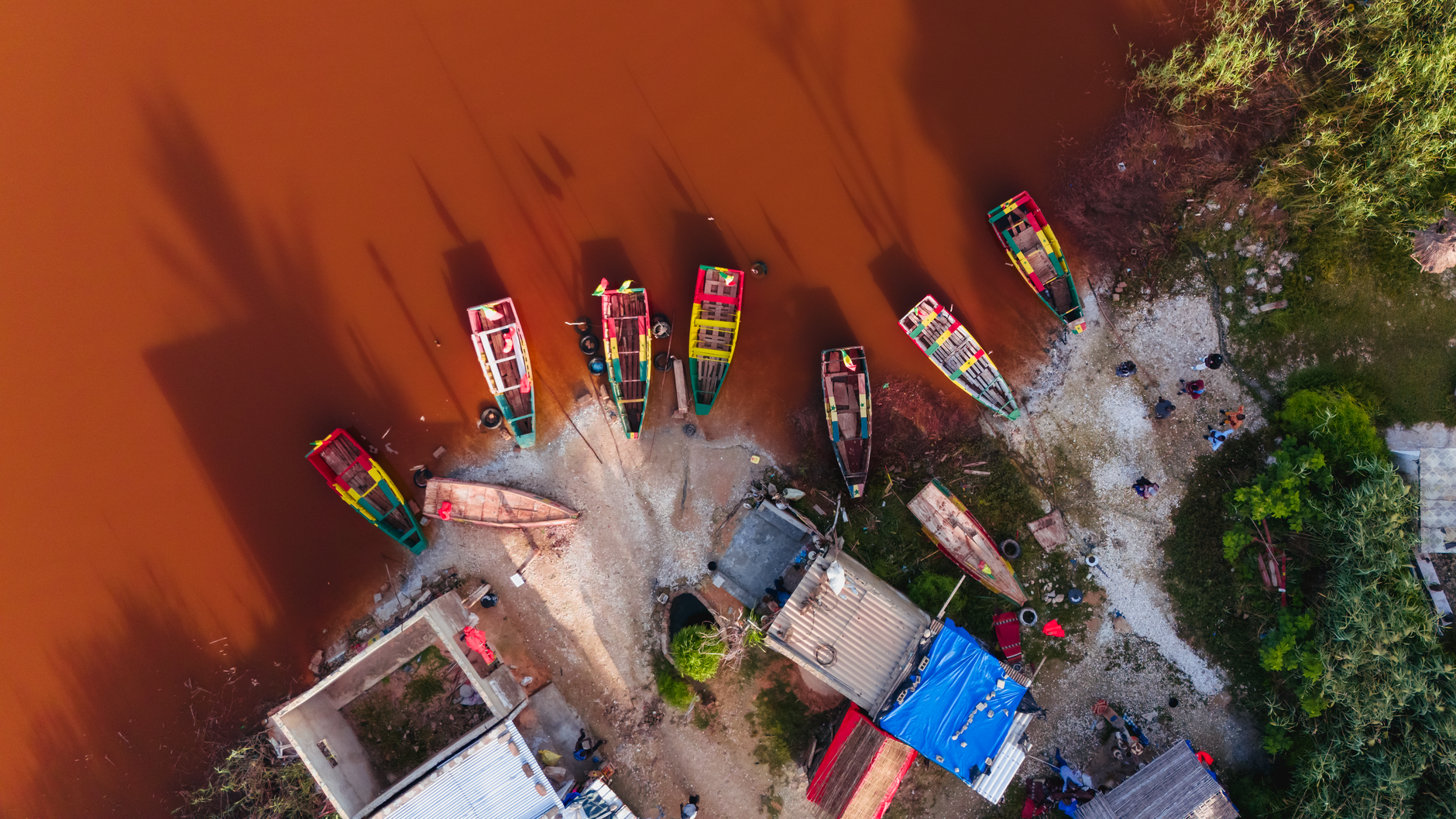
Forty-odd kilometres northeast of Dakar lies Lac Rose (Lake Retba), the famous pink lake — a shallow, hyper-saline lagoon separated from the Atlantic by a ribbon of dunes, where Dunaliella salina algae can turn the water a startling bubblegum pink. Two honest caveats. First, the colour is fickle: it’s strongest in the dry season (roughly late January to early March) and in strong midday sun, and a 2022 flood washed much of the colour out for a while — it has been recovering since, but don’t expect Instagram-saturated pink every day of the year. Second, it’s a working place: this is one of West Africa’s great artisanal salt sites, where over a thousand workers wade in to hand-rake some 20,000 tonnes of salt a year, slathered in shea butter against the brine. The salt-harvesting culture is as much the draw as the colour. It makes an easy half-day from Dakar; manage your colour expectations and you won’t be disappointed.
South of the Petite Côte, the Sine-Saloum Delta is, for many travellers, the soul of the trip. Where two rivers fan into the Atlantic, you get a vast labyrinth of mangrove channels (bolongs), sandy shell islands, baobab-studded villages and some of the richest birdlife in West Africa — a UNESCO World Heritage site and Ramsar wetland of some 180,000 hectares, with pelicans, flamingos, herons and the world’s largest nesting colony of royal terns, plus dolphins and the occasional manatee.
You come here to slow down. The classic experience is a pirogue trip at dawn or dusk through the mangroves — silent, mirror-still water, fish jumping, birds everywhere, the light doing impossible things. Bases like the island village of Mar Lodj and the towns of Toubacouta and Ndangane anchor a range of eco-lodges, from simple riverside camps to genuinely lovely water’s-edge places. Don’t miss Joal-Fadiouth, an extraordinary island built entirely of clam shells and joined to the mainland by a wooden footbridge, with a mixed cemetery where Christians and Muslims are buried side by side — a small, moving emblem of Senegal’s religious tolerance. Two nights minimum; three if you can.
The Casamance — Senegal’s Green South
Below The Gambia (which slices Senegal almost in two) lies the Casamance, and it feels like another country — lusher, greener, wetter, slower, with rice paddies, palm groves, sacred forests and a distinct Diola culture. This is Senegal’s beach-and-jungle south, and it’s wonderful.
The headline is Cap Skirring: long, near-empty Atlantic beaches backed by palms, a string of low-key lodges and beach hotels, and a laid-back rhythm that’s a world away from Dakar’s roar. From there you can explore the Diola villages, paddle the bolongs around Ziguinchor (the regional capital), and drink in a culture of mask traditions, palm wine and animist sacred groves that coexist with Islam and Christianity. The food is superb and the welcome is genuine.
Now the honest part. The Casamance has lived for decades under a low-level separatist conflict — the MFDC independence movement — that has simmered since the 1980s. It is, in practice, largely dormant: a de facto ceasefire has held since 2012, tourist areas around Cap Skirring and Ziguinchor are calm, and thousands of travellers visit each year without incident. But it isn’t fully resolved. The genuine residual risk is landmines and unexploded ordnance in rural and border areas, and the occasional banditry on remote back roads.
Casamance, done sensibly: stick to Cap Skirring, Ziguinchor and the main road between them; don’t wander off into unmarked rural tracks, border zones or the forest on foot without a trusted local guide; and travel by day. Crucially, fly into Ziguinchor (the hour-long hop from Dakar, or the ferry) rather than driving the long overland route through The Gambia. Do that, and the Casamance is one of the most rewarding corners of the country.
The Petite Côte & the Reserves
For travellers who want beach time and a soft introduction without committing to the deep south, the Petite Côte — the coast running south from Dakar — is the easy answer. Saly is Senegal’s main resort town, a slightly faded but functional strip of beach hotels, restaurants and watersports, an hour or so from the airport and a comfortable base for day trips. Quieter and prettier is Somone, set on a protected coastal lagoon that’s a haven for spoonbills, herons and kingfishers — pirogue paddles, mangrove birding and a calmer, more boutique feel.
This is also where you do Senegal’s safari-lite. The Réserve de Bandia, about an hour from Dakar near Saly, is a 3,500-hectare baobab-studded park where you’ll see giraffes, zebras, several antelope species, giant tortoises, monkeys, crocodiles and a couple of resident white rhinos (note: just two, and they don’t always show) — all imported and managed rather than truly wild, but a genuine thrill and a gorgeous landscape, especially for families. For something wilder and more immersive, Fathala, down near the Sine-Saloum, offers overnight stays, walking safaris and bigger game.
Manage your safari expectations. Bandia and Fathala are reserves, not the open savannahs of East or Southern Africa — the animals are stocked and the scale is modest. Taken on their own terms — a baobab-forest drive, a giraffe at sunset, a rhino if you’re lucky — they’re a delight. Don’t fly to Senegal for the safari; do it as a half-day bonus.
When to Visit — Month by Month
Senegal has two seasons: a long dry one and a short, intense wet one. Get the timing right and the country is glorious; get it wrong and you’ll fight heat, humidity and mosquitoes.
November to mid-February — go now. This is the sweet spot: dry, sunny, warm days around 25–28°C, cool nights, low humidity, and the landscape still green from the rains. The Djoudj and Sine-Saloum birding is at its peak, the Lac Rose colour is firming up by late January, and travel is easy. December and January are prime, and busiest, so book ahead.
Late February to May — hot and dry. Still rain-free and good for travel, but the heat ramps up steadily, especially inland, with April and May genuinely fierce. The upside: this is festival season — the Saint-Louis Jazz Festival in mid-May is a highlight worth braving the warmth for. The pink is often at its strongest in this window too.
June to October — the rains. The wet season brings heavy, dramatic afternoon storms, lush green countryside, high humidity and the highest malaria risk of the year. Some rural dirt roads wash out, the Casamance gets properly wet, and the migratory birds have left. It’s the cheapest, emptiest time and the landscape is at its most beautiful, but it’s the trade-off-iest season — best for the heat-tolerant and the flexible. The rains arrive later and lighter in the north (Saint-Louis) than the south (Casamance).
Heat warning: From April onward, the sun is no joke — plan strenuous activity for early morning, hydrate constantly, and don’t underestimate the inland heat around Tambacounda or the dry interior. Coastal Dakar stays comparatively breezy thanks to the Atlantic.
What to Eat & Drink
Senegalese food is one of the great unsung cuisines of Africa — bold, savoury, built on fish, rice, peanuts, onions and citrus — and eating well here is effortless and cheap.
The national dish is thieboudienne (ceebu jën) — and it’s a masterpiece. Fish stuffed with herb paste, simmered with a battery of vegetables in a deep tomato-and-fermented-fish sauce, served over rice cooked in that same broth, often with a crackle of crusty toasted rice (xooñ) scraped from the bottom of the pot. It’s the lunch everyone eats, ideally from a shared communal bowl, with the right hand. Have it at least once at a no-frills local place, not a hotel.
After that, work through the canon. Yassa — chicken or fish marinated in lemon, mustard and a mountain of slow-caramelised onions — is the dish you’ll crave back home. Mafé is a rich, sticky peanut-butter stew, a legacy of Senegal’s groundnut history. Dibi is the street-food star: charcoal-grilled lamb or beef with raw onion and bread, eaten standing up at a smoky roadside grill at night. On the coast, eat the grilled fish — it doesn’t get fresher.
To drink: skip the soft drinks and go local. Bissap is a tart, deep-red hibiscus juice served ice-cold; bouye is a creamy, slightly chalky baobab-fruit drink; and the ritual you’ll be invited into again and again is attaya — strong, sugary green tea poured in three rounds from a great height to build the foam, each glass said to mean something different (bitter as death, sweet as love, gentle as friendship). It’s not really about the tea; it’s about the hour you spend sitting with people while it brews. Accept the invitation.
Getting Around
Senegal’s transport is half the adventure and, occasionally, half the ordeal. Here’s the honest hierarchy.
Car and driver — the standard, and what I’d recommend. Hiring a vehicle with a local driver (often guide too) is how most independent travellers cover the country, and it’s worth every franc: no haggling at every stage, no orientation stress, and a built-in local who knows the lodges, the bird spots and the back routes. Roughly €60–90 a day for car, driver and fuel, depending on the vehicle and route. Self-driving is possible but rarely worth it given the traffic, the checkpoints and the navigation.
Sept-places — the local way. These are battered Peugeot estate wagons that wait at gares routières until seven passengers fill them, then barrel off to the next town. They’re cheap (a few euros for an inter-town leg), authentic, and the genuine pulse of Senegalese travel — but slow, cramped, hot, and you’ll wait around for the car to fill. There’s an art to it: turn up early, expect to pay a small extra for big bags, and embrace the chaos. Great for budget travellers and the curious; trying for anyone in a hurry.
The TER and BRT — Dakar’s new transit. Dakar’s modern TER commuter train (Dakar–Diamniadio, with the airport extension long promised for around 2026) and the new BRT bus line are cheap, clean and a real improvement for getting around the capital and its sprawl — but neither yet reliably serves the airport or the tourist sights, so treat them as a bonus rather than a plan. For getting around Dakar itself, ride-hailing (Yango, Heetch) is the sanity-saving option; ordinary taxis have no meters, so agree the fare first.
Taxi rule: Never get in a Dakar taxi without agreeing the price, and expect an inflated opening quote for an obvious foreigner — counter at roughly half and settle in the middle. In-town hops are usually a couple of euros. Ride-hailing apps remove the haggling entirely and are often cheaper.
Where to Stay — by Area & Budget
Accommodation spans simple guesthouses (auberges) to a handful of genuinely lovely boutique and eco-properties; there’s little international-chain polish outside Dakar and Saly, and that’s fine.
Dakar: Base around the breezy Almadies/Ngor end for beaches, surf and restaurants, or the Plateau for the colonial core and ferry access to Gorée. Options run from backpacker guesthouses to a few smart business hotels and characterful riads. Gorée itself has a clutch of atmospheric small guesthouses if you want to overnight on the island after the day-trippers leave — a quietly magical thing to do.
Saint-Louis: Stay on the island in one of the restored colonial townhouses turned boutique hotels — full of character, and you’ll want to be in the heart of it, especially during the jazz festival.
The Sine-Saloum & the delta: This is eco-lodge country, and the lodges are the experience — riverside camps and water’s-edge lodges around Toubacouta, Mar Lodj, Ndangane and Palmarin, ranging from rustic-and-cheap to lovely-and-mid-priced. Pick one with its own pirogue and birding guides.
The Petite Côte: Saly for resort-style beach hotels and an easy base; Somone for quieter, more boutique lagoon-side places.
The Casamance: Cap Skirring has the beach lodges and bungalow hotels; for a deeper experience, the Diola-run campements villageois (community guesthouses) in the surrounding villages are simple, warm and a real cultural immersion.
Costs & Budget
Senegal is mid-priced for Africa — cheaper than you’d fear in the cities, with the big-ticket items being domestic logistics rather than food. Because the CFA franc is pegged to the euro, prices are stable and easy to reckon: just think in euros.
- Shoestring: ~€35–55 a day — guesthouses and auberges, sept-place taxis, eating thieboudienne at local gargotes, the odd shared excursion.
- Comfortable mid-range: ~€80–140 a day — boutique hotels and eco-lodges, a shared car-and-driver, restaurant meals, organised pirogue and reserve trips.
- Higher-end: ~€180+ a day — the best lodges, a private car and driver throughout, internal flights to the Casamance, guided birding.
A plate of thieboudienne at a local spot might be €2–4; a good restaurant dinner €10–20; a Gorée ferry ticket a few euros; a half-day Bandia safari or a guided delta pirogue typically €20–40 per person depending on group size. The two costs that move your budget are the driver-and-car (€60–90/day) and any domestic flight to the Casamance. Carry cash — CFA in small notes — because card acceptance thins out fast outside Dakar’s hotels and supermarkets.
Practical Information
Entry & visa: Visa-free for up to 3 months for UK, EU, US, Canadian and 60-plus other nationalities; passport valid six months beyond arrival; be ready to show onward travel and accommodation. No visa fee, no e-visa faff for these nationalities.
Money: The West African CFA franc (XOF), pegged to the euro at the fixed ~655.957/€ — which makes budgeting painless for European visitors (1,000 CFA ≈ €1.50). ATMs are reliable in Dakar, Saint-Louis and Saly and patchier elsewhere; carry plenty of cash for the delta, the Casamance and small towns, and keep small notes for taxis and tips.
Health — take this seriously. Malaria is present countrywide, year-round, and highest in the June–October rains — take prophylaxis (talk to a travel clinic), cover up at dusk, and use repellent and nets. Yellow fever is present; the vaccine is strongly recommended and the certificate is required if you arrive from a risk country and often needed for onward travel. Make sure routine jabs plus typhoid and hepatitis A are up to date. Drink bottled or filtered water, not the tap.
Health double caution: Don’t skip the malaria conversation with a travel doctor — Senegal is a genuine malaria zone and prophylaxis matters, especially if you’re heading to the delta, the Casamance or travelling in the rains. And carry your yellow-fever card; replacing it on the road is a real headache.
Safety: Senegal is one of West Africa’s safest, most stable countries, and violent crime against tourists is rare. The real risks are petty theft and scams in Dakar’s crowded markets and around the ferry terminal, and the faux-guides — friendly young men who attach themselves to you, “help,” and then expect payment. A firm, polite “non merci” works; if someone is genuinely useful, a small tip is fair. Watch your bag and phone in crowds. The Casamance carries the separate caveat covered above.
Tipping: Modest tips are appreciated but not obligatory — round up restaurant bills, tip the Gorée and Djoudj guides who do real work, and a small note for hotel staff and drivers goes a long way.
Cultural & dress respect: Senegal is roughly 95% Muslim, but easygoing and tolerant. Dress modestly away from beach resorts — shoulders and knees covered in towns and villages, more conservatively still if visiting a mosque (where non-Muslims may not be admitted). Always greet before you transact (a “Salaam aleikum” or “bonjour, ça va?” opens every door), eat and pass things with the right hand, and ask before photographing people. The teranga is real and reciprocal: a little courtesy is repaid tenfold.
Connectivity: A local Orange or Free SIM (or eSIM) is cheap and gets you usable 4G in the cities and most towns; coverage thins in the deep delta and remote Casamance. Hotels and lodges generally have Wi-Fi of variable speed.
Frequently Asked Questions
Cheapest Flights to Senegal
We have tracked 4,828 fares to Senegal from 143 cities. As of June 2026, here is what a good price looked like from each — the lowest fare we recorded, and a “great-deal” benchmark to judge a quote against. These are tracked observations, not live prices: by the time you read this they will have moved, so treat them as a yardstick, not a quote.
| From | Lowest fare we tracked | Great-deal benchmark |
|---|---|---|
| Lyon (LYS) | €121 | €173 |
| Marseille (MRS) | €129 | €184 |
| Toulouse (TLS) | €143 | €204 |
| Madrid (MAD) | €149 | €213 |
| Bordeaux (BOD) | €166 | €237 |
| Shannon (SNN) | €169 | €242 |
| Mallorca (PMI) | €169 | €242 |
| Barcelona (BCN) | €172 | €246 |
| Bologna (BLQ) | €174 | €249 |
| Bilbao (BIO) | €181 | €258 |
| Venice (VCE) | €181 | €258 |
| Dubrovnik (DBV) | €185 | €264 |
| Basel (BSL) | €185 | €265 |
| Malaga (AGP) | €186 | €266 |
Recent deals we have posted to Senegal:
- Milan to Dakar, Senegal from €261
- Seville to Dakar, Senegal from €232
- Valencia to Dakar, Senegal from €261
- Nantes to Dakar, Senegal from €205
- Brussels to Dakar, Senegal from €353
- Nuremberg to Dakar, Senegal from €577
- Nice to Dakar, Senegal from €348
- Reykjavik to Dakar, Senegal from €568
- Barcelona to Dakar, Senegal from €250
- Venice to Dakar, Senegal from €350
These are fares aifly tracked to this destination, not live quotes — they have changed since and several of the deals above may have expired. Browse current flight deals →