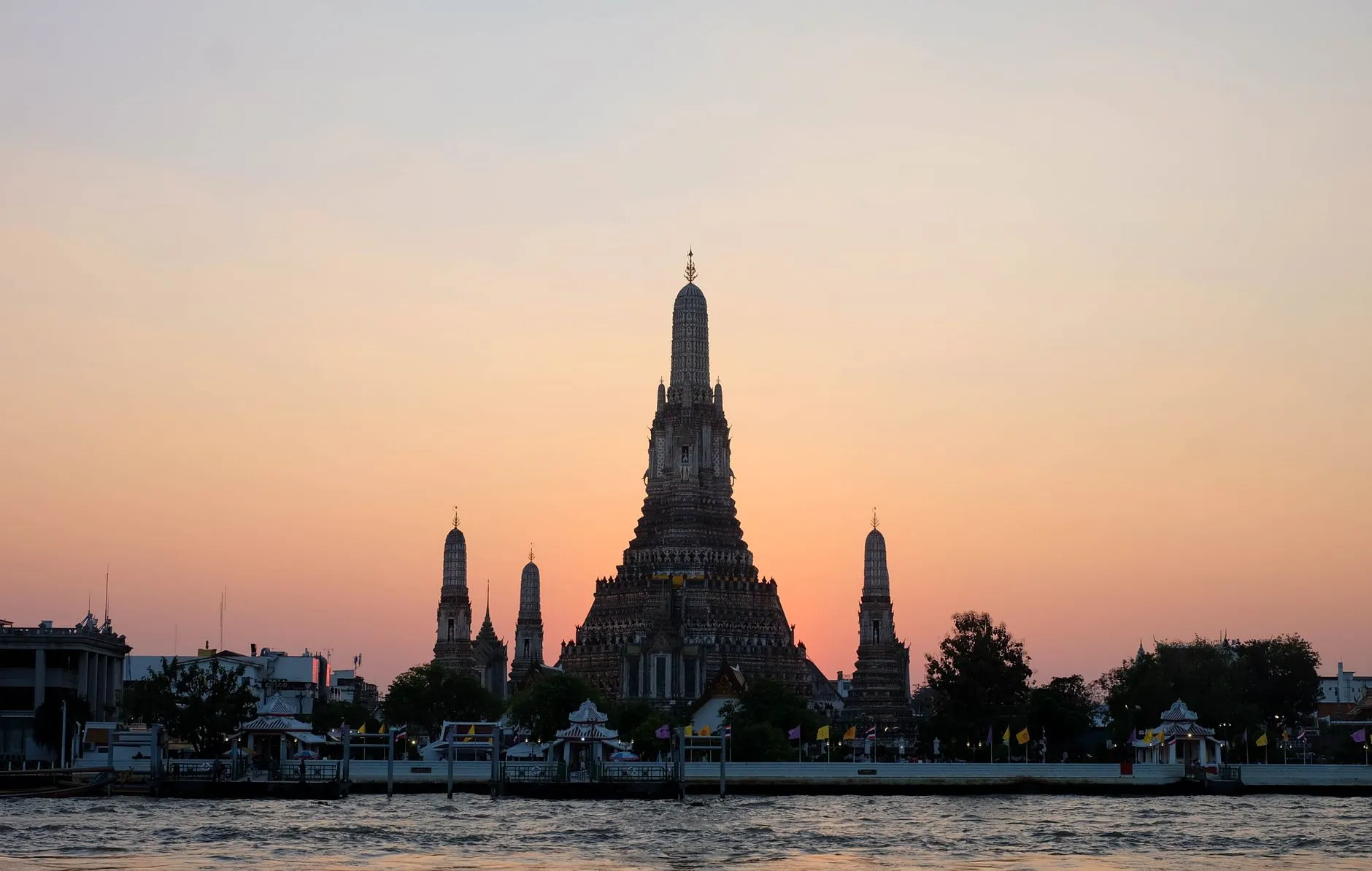
Thailand — Complete Travel Guide 2026
Thailand is the country that makes Southeast Asia look easy: a €2 bowl of noodles that beats most restaurants back home, sleeper trains into mountains, and two separate island coasts so you can almost always find sunshine somewhere. The catch is that it rewards a plan — get the season wrong and you’ll watch the rain from the wrong beach — so the real question isn’t whether to come, but which Thailand you want and when.
Quick Reference
Southeast Asia, between Myanmar, Laos, Cambodia and Malaysia; two coasts (Andaman & Gulf)
BKK Bangkok-Suvarnabhumi + DMK Don Mueang, HKT Phuket, CNX Chiang Mai, USM Koh Samui, KBV Krabi
Thai baht (THB); roughly €1 ≈ 38 THB in 2026
Thai (English widely used in tourist areas; written script unreadable to visitors)
Visa-free 30 days per entry for eligible nationalities from 15 September 2026, 60 days up to 14 September (verify your allowance) + mandatory free TDAC online before arrival
Nov–Feb (cool, dry) nationwide; Andaman islands Nov–Apr, Gulf islands roughly Jun–Sep — **opposite seasons
Street food, temples, beaches & islands, the north’s mountains, value for money
Bangkok (gateway), Chiang Mai (north), Krabi/Phuket (Andaman), Koh Samui (Gulf)
Editor’s Note — Read This First
Most people try to do everything in ten days and end up doing none of it well. Thailand is bigger and slower than the brochures suggest. Bangkok to Chiang Mai is an overnight train; Chiang Mai to the southern islands is a flight and a ferry. Pick a shape.
Three honest options. North-and-temples: Bangkok, then Chiang Mai and the mountains — culture, cool air, elephants, cooking schools, no beaches. Islands-and-beaches: Bangkok briefly, then straight to one coast — Andaman or Gulf, never trying to bounce between both in a short trip. The classic both: Bangkok → north → fly south to the islands, which needs at least two weeks to not feel like a transit lounge.
The single decision that will make or break a beach holiday is which coast, in which month — because the Andaman and the Gulf have opposite rainy seasons (more on that below, and it’s the most important paragraph in this guide). Get that one right and almost everything else is forgiving.
Don’t try to “see all of Thailand” in 10 days. A week of north plus a week of one island coast beats a frantic loop through both. Distances are long and the islands are worth lingering on. Add days, not destinations.
Should You Go? Who It’s For — And Isn’t
Thailand suits almost everyone, which is exactly why it can disappoint the unprepared. It’s superb for first-time Asia travellers (easy, friendly, well-trodden), for food obsessives, for divers and beach people, for backpackers stretching a budget, and for families — it’s genuinely child-friendly. It’s a brilliant value destination: you eat and sleep well for a fraction of European prices.
It’s a poorer fit if you want pristine, empty, undiscovered beaches in high season — the famous spots (Maya Bay, Railay, Phi Phi) are busy, and pretending otherwise is dishonest. It’s frustrating if you hate heat and humidity (March to May is brutal), or if you came only for the full-tilt party scene and end up somewhere serene, or vice versa. And the “two coasts” rule is unforgiving: arrive in the wrong monsoon and the sea is grey and the boats don’t run.
Getting There — The Airports & Entry
Bangkok has two airports and they are not interchangeable. Suvarnabhumi (BKK) handles most full-service and long-haul flights east of the city; Don Mueang (DMK), north of the city, is the low-cost hub (AirAsia, Thai Lion, Nok). If you’re connecting onward, check which airport your second flight leaves from — crossing the city between them takes well over an hour in traffic.
Beyond Bangkok you can often fly straight to where you actually want to be: HKT Phuket and KBV Krabi for the Andaman, USM Koh Samui for the Gulf (a small Bangkok Airways-dominated airport — pricier, but it saves the ferry), and CNX Chiang Mai for the north. For many itineraries, landing at BKK, spending a night or two, then taking a cheap domestic hop south is smarter than overland slogs.
Entry — the two things that matter. First, the TDAC (Thailand Digital Arrival Card): every foreign visitor must complete it online, free, within 72 hours before arrival via the official Thai immigration portal — you get a QR code that immigration scans. Do it yourself on the official site; ignore copycat sites that charge a “service fee.” Second, the visa-free stay. From 15 September 2026 the visa-exempt stay for tourism is 30 days per entry, cut from 60 days by four Interior Ministry notifications published in Thailand’s Royal Gazette on 31 August 2026. Arrivals up to 14 September 2026 still get 60 days, and a stay already stamped in a passport stands. The eligible list shrank too, from 93 nationalities to 60 countries and territories, with a separate 15-day scheme for two more.
Verify your nationality’s visa-free allowance before you book — the rules change on 15 September 2026. The 60-day stamp becomes 30 days per entry from that date, and the eligible list was trimmed. Check your government’s travel advisory or the Thai embassy site, carry six months’ passport validity, and have proof of onward travel.
Bangkok — The Gateway
Bangkok is loud, hot, golden and slightly unhinged, and most people either love it for two days or two weeks — rarely in between. The Grand Palace and Wat Pho’s reclining Buddha, the river ferries on the Chao Phraya, the rooftop bars, Chinatown’s evening food chaos, the BTS Skytrain gliding above the gridlock: it’s a city that runs on contradiction. For the deep dive on neighbourhoods, scams, the temples worth your time and where to eat, read our full Bangkok city guide.
For the purposes of this trip, treat Bangkok as the hinge: arrive, recover from the flight, eat extraordinarily well for a night or two, then push on. Don’t feel obliged to “do” it exhaustively before the rest of the country — the north and the islands are where most people’s best days happen.
The North — Chiang Mai, Chiang Rai, Pai
The north is the antidote to the islands: cooler, greener, slower, soaked in the old Lanna Kingdom culture, and far cheaper than the coast. If you only have time for Bangkok-plus-one-region and you don’t need a beach, make it here.
Chiang Mai is the hub — a moated old city studded with temples (Wat Phra Singh, Wat Chedi Luang), wrapped in night markets, and famous for its Sunday Walking Street, when Ratchadamnoen Road closes to traffic and fills with craft stalls and food carts. Up the mountain, Wat Phra That Doi Suthep gives the city its postcard view. Chiang Mai is also Thailand’s cooking-school capital — a half-day class with a market tour (commonly around €30–40) is one of the best-value things you’ll do in the country.
The elephants. Chiang Mai is the centre of Thailand’s elephant-sanctuary scene, and here the ethics actually matter. The genuinely ethical model is observe-feed-bathe with no riding and no performing; the pioneer is Elephant Nature Park, founded by the campaigner Saengduean “Lek” Chailert, where a full-day visit runs around €65 (≈2,500 THB). Plenty of camps slap “sanctuary” on the sign while still offering rides and shows.
Choose a genuinely ethical elephant experience: no riding, no shows. Riding harms the animals and the chair damages their spines; “sanctuaries” that still offer rides or circus tricks aren’t sanctuaries. Pick a no-riding, observation-and-bathing camp like Elephant Nature Park — and book direct.
Pai, three winding hours north of Chiang Mai (or as a leg of the legendary Mae Hong Son Loop — ~600 km, 1,800-odd curves, best over 3–4 days by motorbike or car), is the north’s bohemian valley: hot springs, waterfalls, a backpacker scene that’s been “discovered” for two decades. It’s lovely; it’s also no longer secret, so go for the road and the scenery more than for solitude.
Chiang Rai, further northeast, is a day trip or overnight from Chiang Mai and home to two of Thailand’s most photographed modern temples. The dazzling white Wat Rong Khun (the White Temple) is not an ancient site at all — it’s a contemporary artwork by Chalermchai Kositpipat, still being built, surreal and slightly nightmarish up close (entry rose to 200 THB / ≈€5 in January 2026). Nearby, the Blue Temple (Wat Rong Suea Ten) is free and electric-blue inside. From here you can run up to the Golden Triangle, where Thailand, Laos and Myanmar meet across the Mekong, with its opium-trade museum and river views.
The Andaman Coast & Islands — Limestone, Karst & Turquoise
The Andaman, Thailand’s west coast, is the one on the postcards: sheer limestone karsts rising straight out of jade water, longtail boats, sea caves. Its season is roughly mid-November to April — that’s when the sea is calm and the sky is blue.
Phuket is the big gateway and Thailand’s largest island, with an international airport and every register from Patong’s neon to quiet northern beaches. We cover it in depth — beaches, where to stay, what to skip — in our full Phuket guide, so here we’ll point you onward.
Krabi province is, for many, the better base than Phuket — same spectacular scenery, more relaxed. Ao Nang is the main beach town and ferry hub; from its pier a longtail or a ten-minute boat reaches Railay, a peninsula cut off by cliffs and reachable only by sea, with world-class rock climbing and two beaches (East is mangrovey, West is the beautiful one). Railay has no roads — that’s the appeal.
Koh Phi Phi is the famous one — the cliffs of Maya Bay (of The Beach), now under visitor caps and seasonal closures to let the reef recover. Phi Phi Don, the inhabited island, is gorgeous and unapologetically a party island; day-trippers swarm it from Phuket and Krabi. Stunning, crowded, loud at night — go knowing that.
Koh Lanta is the quiet alternative and the local favourite: long flat beaches, a laid-back old town, far less frenzy. Ferries connect it to Phi Phi, Krabi and Ao Nang in high season (roughly an hour or two), and it largely shuts down in the May–October rains. If your idea of an Andaman island is a hammock rather than a foam party, this is it.
The Gulf Islands — Samui, Phangan, Tao
The Gulf of Thailand islands sit on the other coast, off the east of the peninsula, and crucially run on a different and partly opposite weather pattern to the Andaman. Their reliable window is roughly June to September, when the Andaman is wet — and their worst rains come October to December.
Koh Samui is the developed one: an airport (USM), proper resorts, Chaweng’s strip, plus quieter corners like Bophut’s Fisherman’s Village. Comfortable, well-connected, a little pricier.
Koh Phangan, a 30-minute ferry from Samui, is two islands in one. Most of the year it’s serene — yoga, empty north-coast beaches, jungle. Then, on each full moon, Haad Rin beach hosts the Full Moon Party, tens of thousands of people, buckets of cheap spirits and body paint until dawn (2026 dates fall on the full-moon nights, shifting if they clash with a Buddhist holy day). You can have either Phangan — the calm one or the chaotic one — but on full-moon week, book ahead and know which you’re signing up for.
Koh Tao is the smallest and the diving capital — one of the cheapest places on earth to learn to scuba dive, with shallow reefs, pinnacles and the occasional whale shark; best underwater conditions are roughly May to August. It’s reached by Lomprayah and other catamarans from Samui (well under two hours via Phangan).
The Andaman and Gulf have OPPOSITE rainy seasons — this is the trap. Going in November? Phuket and Krabi are at their best while Samui is heading into its wettest month — choose the Andaman. Going in July or August? The Andaman is rainy but Samui, Phangan and Tao are sunny — choose the Gulf. Pick the coast to match your month, not the other way around.
The Ancient Capitals — Ayutthaya & Sukhothai
Before Bangkok there were other capitals, and their ruins are among the most atmospheric sights in the country — temple spires and headless Buddhas where a city of a million people once stood.
Ayutthaya, about 80 km north of Bangkok, was the Siamese capital for four centuries until the Burmese sacked it in 1767. Today it’s a UNESCO-listed historical park of brick prang towers and ruined wats — Wat Mahathat (with the famous Buddha head wrapped in fig-tree roots), Wat Chaiwatthanaram on the river, Wat Phra Si Sanphet. It’s an easy day trip from Bangkok by train, minivan or organised tour (figure on a long full day), and best explored by rented bicycle in the cool of the morning. Dress respectfully — knees and shoulders covered.
Sukhothai, far older (13th–14th century, Thailand’s first capital and the cradle of its art and script), sits much further north and is genuinely worth the detour for history lovers — its historical park is greener, calmer and less visited than Ayutthaya, with serene seated Buddhas reflected in lotus ponds. It’s not a Bangkok day trip; treat it as a stop on the way north (it’s roughly between Bangkok and Chiang Mai by bus) or a side trip in its own right. Rent a bike and give it half a day.
Isaan & Kanchanaburi — Off the Trail and the River Kwai
Isaan, the vast northeastern plateau bordering Laos and Cambodia, is the Thailand most tourists never see — and the one many returning travellers love most. It’s the country’s agricultural heartland and the birthplace of its most addictive food (som tam, grilled meats, sticky rice). Khmer temple ruins like Phanom Rung, sandstone and silk villages, river festivals, and a warmth that comes precisely because tourism is thin. There’s little polish here and less English — which is the point. If you’ve done Thailand twice and want something real, go east.
Kanchanaburi, a couple of hours west of Bangkok, is a more accessible side trip with a heavy history: the Bridge over the River Kwai and the Death Railway built by Allied POWs and forced labour under the Japanese in WWII, at appalling human cost. The bridge, the moving war cemeteries, the Hellfire Pass memorial and the scenic surviving railway are sobering and well worth a day or two; nearby the Erawan Falls‘ seven-tiered turquoise pools are one of Thailand’s best waterfall swims.
When to Visit — Month by Month
Thailand has three broad seasons, but the all-important wrinkle is that the two coasts don’t share them.
Cool & dry — November to February. The best all-round window: comfortable temperatures, low humidity, blue skies over most of the country, and the Andaman islands at their peak. It’s also high season, so prices and crowds are up and you book ahead. December–January is peak-peak.
Hot — March to May. Increasingly fierce heat inland (40°C is common; April is the hottest), the air thick. The north can be hazy from agricultural burning in March. Songkran, the Thai New Year water-festival, drenches the country in mid-April — chaotic, joyous, and not a quiet time to travel. Good for shoulder-season island prices early on.
Rainy — roughly June to October (Andaman) / October to December (Gulf). The southwest monsoon brings the Andaman’s wet season from about May to October (September–October wettest); the rain often falls in short, heavy afternoon bursts rather than all day, and it’s low season with low prices. The Gulf islands flip the calendar: their driest, best months are around June to September, and their heaviest rains land October to December. This is why a single “best time for the islands” doesn’t exist — it depends entirely on which coast.
There is no single “best time for Thailand’s beaches” — there’s a best coast for each month. Nov–Apr: Andaman (Phuket, Krabi, Phi Phi, Lanta). Jun–Sep: Gulf (Samui, Phangan, Tao). Plan the islands around this, not your flight dates.
What to Eat
Thai food is regional, and eating your way across the country is half the trip. Forget the idea that it’s all pad thai — the north tastes nothing like the south.
The classics you’ll find everywhere. Pad thai (central Thailand: stir-fried rice noodles, tamarind, peanuts — the gateway dish), green curry (gaeng keow wan, creamy and basil-fragrant), massaman (a mild, Muslim-influenced southern curry with potato, peanuts and warm spices — many travellers’ favourite), tom yum (hot-and-sour shrimp soup), and mango sticky rice in season.
The north — eat khao soi. The signature dish of Chiang Mai: egg noodles in a golden coconut-curry broth, topped with a tangle of crispy fried noodles, pickled mustard greens, shallots and lime. Its roots trace to Yunnanese Muslim traders who brought it down the caravan routes. Try sai oua (herby grilled Northern sausage) and nam prik noom (roasted green-chilli dip) too.
Isaan — fierce and fermented. Som tam (green papaya pounded with chilli, lime, fish sauce and palm sugar in a mortar — order it mild unless you mean it), grilled chicken (gai yang), larb (minced-meat salad), all eaten by hand with sticky rice. This is the food that conquered the rest of the country.
Street food. It’s a national institution and broadly safe — the busy stalls have ferocious turnover, so nothing sits around. A plate from a hawker stall runs roughly €2–4. Follow the local queues, eat where it’s busy, and don’t be shy of the night markets.
Getting Around — Honestly
Domestic flights are the time-saver and often startlingly cheap. AirAsia (from DMK) has the widest network, with Nok, Thai Lion, Thai Vietjet, Bangkok Airways and Thai Airways competing on the busy routes; booked a few weeks ahead, a Bangkok–Chiang Mai or Bangkok–Krabi hop can cost under €40. (A note for 2026: rising fuel costs have led carriers to trim some schedules, so book early and don’t assume every route runs daily.)
The overnight sleeper trains are a genuine experience, not just transport. The flagship Bangkok–Chiang Mai route has modern sleeper carriages (trains 9 & 10) with curtained berths; the journey is around 12–13 hours, a 2nd-class sleeper costs roughly €25, and you wake up in the mountains having saved a night’s hotel. First-class cabins are limited and sell out fast — book ahead online.
Buses and minivans reach everywhere the trains and planes don’t, cheaply, if slowly — fine for shorter hops (Bangkok–Ayutthaya, Krabi–Koh Lanta with its car ferries). Overnight VIP buses cover the long hauls but vary in comfort.
Island ferries are how you reach the beaches: Lomprayah and other catamarans link the Gulf islands (Samui–Phangan ~30 min, on to Tao under two hours); Andaman boats connect Krabi/Ao Nang/Railay/Phi Phi/Lanta in high season. Schedules thin out dramatically in each coast’s low season — check before you commit.
On the ground, Grab (the regional Uber) is your friend in the cities — fixed, app-shown prices, no haggling, no scams; use it over metered taxis where you can. Songthaews (shared pickup trucks with bench seats) are the cheap local workhorses — flat fares of 30–40 THB around Phuket and Chiang Mai. Tuk-tuks are fun once but routinely overcharge tourists; agree the price first, and know that in many cities Grab is cheaper.
Skip the tuk-tuk haggle — use Grab in the cities. Tuk-tuks quote tourists two to four times the fair price and some run “gem shop” or tailor detours for commission. Grab shows a fixed fare up front. Save the tuk-tuk for the novelty ride you’ve agreed a price on.
Where to Stay — By Region & Budget
Thailand’s accommodation is exceptional value, and the spread is enormous. Backpacker: hostel dorms run roughly €8–20, simple guesthouse doubles €15–30. Mid-range: a comfortable, pretty hotel or boutique with a pool is commonly €40–80 a night — the sweet spot where Thailand feels luxurious for the money. Luxury: world-class resorts on the islands climb to €200+ but often deliver service that costs three times as much in Europe.
By region: Bangkok — base around the Skytrain (Sukhumvit/Silom) for ease, or Old City/Rattanakosin for temples and river. Chiang Mai — inside or just outside the old-city moat for walkability; Nimmanhaemin for cafés and a younger scene. Krabi — Ao Nang for convenience, Railay for the car-free cliffs, Koh Lanta for quiet. Gulf — Samui’s Bophut or Lamai for calm, Chaweng for action; Phangan’s north for serenity, Haad Rin for the party. Island prices run 25–50% above the mainland in high season — factor it in.
Costs & Budget
Thailand remains one of the best-value destinations in the world, and the gap with Europe is huge. As a rough rate guide, €1 ≈ 38 THB in mid-2026 — handy for converting any baht price you see.
- Shoestring backpacker: roughly €25–30 a day — dorm bed, street food, local transport, the odd beer.
- Comfortable mid-range: roughly €60–80 a day — a nice hotel with a pool, restaurant meals, occasional taxis and tours.
- Luxury: €150+ a day and the sky’s the limit on island resorts.
A street-food meal is €2–4; a beer €2–3; an hour-long massage €6–10; a cooking class €30–40; the long domestic flight under €40. The islands are markedly pricier than the mainland — budget extra for Phuket, Phi Phi and Samui. (One thing not to budget for yet: a much-discussed 300-baht tourist fee has been approved in principle but repeatedly delayed and is still not being collected — if it ever launches it’ll likely be bundled into airfares, so treat it as a heads-up, not a current cost.)
Practical Information
Entry. Complete the TDAC online (free, official portal, within 72 hours of arrival) — non-negotiable. Confirm your visa-free allowance for your nationality before booking (30 days per entry from 15 September 2026, down from 60 days for arrivals up to 14 September, and the eligible list was trimmed). Carry six months’ passport validity and proof of onward travel.
Money. The baht is cash-friendly: ATMs are everywhere (with a per-withdrawal fee, usually ~220 THB, so take out larger amounts), cards work in hotels and malls, street stalls and markets are cash-only. Notify your bank, and carry small notes for tuk-tuks and stalls.
Safety & scams. Thailand is generally very safe for travellers, but the classic tourist scams persist: jet-ski “damage” demands at the beach (rent only from reputable operators, photograph the ski first, or skip it), gem and tailor “special deals” (always a con), the “this temple is closed today, let me take you to a better one” tuk-tuk routine (it isn’t closed), and rigged taxi meters (use Grab). Watch your drinks at the full-moon and party scenes, and be cautious renting motorbikes without a proper licence and insurance — accidents are the leading cause of tourist injury here.
Never accept the “the temple is closed, I’ll take you somewhere better” tuk-tuk pitch — and photograph any jet-ski before you ride it. The temple is open; the detour ends at a gem shop. The jet-ski “scratch” was there before you. These two scams catch thousands of visitors a year.
Water, health, respect. Don’t drink the tap water — bottled is cheap and universal, and use it for brushing teeth where advised. Thai food is mostly safe at busy stalls; bring any chronic medication with you. Dress modestly at temples (shoulders and knees covered, shoes off), and treat images of the Buddha with respect. Crucially, the monarchy is protected by strict lèse-majesté laws — never insult or joke about the royal family, in person or online; it’s a serious criminal offence.
Respect the monarchy and the temples — the rules are real, not decorative. Lèse-majesté (insulting the royal family) is a serious crime in Thailand with prison sentences; don’t joke about it anywhere. At temples, cover shoulders and knees, remove your shoes, and don’t pose disrespectfully with Buddha images.
Connectivity. A local SIM or eSIM (AIS, True, dtac) is cheap and gives you fast data nationwide — essential for Grab, maps, ferry bookings and the TDAC. Buy at the airport or any phone shop; tourist data packages are inexpensive.
Frequently Asked Questions
Cheapest Flights to Thailand
We have tracked 11,591 fares to Thailand from 236 cities. As of June 2026, here is what a good price looked like from each — the lowest fare we recorded, and a “great-deal” benchmark to judge a quote against. These are tracked observations, not live prices: by the time you read this they will have moved, so treat them as a yardstick, not a quote.
| From | Lowest fare we tracked | Great-deal benchmark |
|---|---|---|
| Oslo (OSL) | €278 | €397 |
| Rome (FCO) | €300 | €574 |
| Istanbul (IST) | €311 | €444 |
| Vienna (VIE) | €317 | €453 |
| Gdansk (GDN) | €318 | €455 |
| Madrid (MAD) | €336 | €541 |
| Stockholm (ARN) | €337 | €481 |
| Baku (GYD) | €344 | €491 |
| Mallorca (PMI) | €347 | €496 |
| Brussels (BRU) | €354 | €506 |
| Istanbul (SAW) | €356 | €508 |
| Zurich (ZRH) | €359 | €513 |
| Warsaw (WAW) | €361 | €634 |
| Munich (MUC) | €363 | €519 |
Recent deals we have posted to Thailand:
- London, UK to Krabi, Thailand from £313
- London or Manchester, UK to Krabi, Thailand from £324
- Warsaw to Krabi, Thailand from €486
- Milan to Krabi, Thailand from €417
- Prague to Krabi, Thailand from €416
- Copenhagen to Krabi, Thailand from €416
- Barcelona to Krabi, Thailand from €416
- Vienna to Krabi, Thailand from €415
- Brussels to Krabi, Thailand from €372
- Amsterdam to Krabi, Thailand from €371
These are fares aifly tracked to this destination, not live quotes — they have changed since and several of the deals above may have expired. Browse current flight deals →