Azores — The Complete Archipelago Guide 2026
Nine volcanic islands, 1,400 kilometres out in the Atlantic, at the place where the North American, Eurasian and African tectonic plates meet. This guide covers the three island groups — São Miguel and Santa Maria in the east, Terceira, Graciosa, São Jorge, Pico and Faial in the centre, Flores and Corvo in the west — with the attention most single-city guides give to a single district. Three registers: the rock, the ocean, and the leaving.
€90–250/day budget
Oceanic temperate: 14–23 °C
🇵🇹 EU / Schengen / EUR €
São Miguel tax €2/night · max 3 nights
EES active · ETIAS Q4 2026
Why the Azores? An Editor’s Note
Fajã is not a word that translates. It is an Azorean word for an Azorean landscape — a flat coastal platform formed where a chunk of cliff has fallen into the sea, or where a lava flow has run off a volcano’s flank into the Atlantic and cooled into a shelf. Most fajãs are a hectare or two. Some are the size of small villages. On São Jorge — the longest and narrowest of the nine islands, a 54-kilometre ridge of volcanic rock rising to 1,053 metres and falling on both sides to cliffs of 400–500 metres — there are more than forty of them, strung like loose beads along the base of the cliff. People live in some. A handful have no road access and must be reached on foot. One of them, Fajã da Caldeira de Santo Cristo, is the only place in the Azores where clams are legally farmed — a licensed quota of fifty kilograms a month, harvested by hand.
The word has no English cognate because the landform has no English analog. English has cliffs and beaches and plateaus; it has no single word for the thing that happens when a cliff collapses gently enough, or a volcano spills politely enough, that a shelf of arable flat ground ends up at sea level.
The archipelago sits 1,400 kilometres west of Lisbon, at the junction of the North American, Eurasian and African tectonic plates. Nine islands, one autonomous region of Portugal, 2,346 square kilometres of Atlantic rock whose total land area is smaller than Luxembourg’s. Its story can be read on three registers, and a visitor who reads only one — who flies to Ponta Delgada, photographs Sete Cidades from Vista do Rei at midday with forty other people, eats the geothermal stew at Furnas on a Sunday afternoon, and goes home — will have met about a third of the place.
The Rock. Volcanic geology still in motion. Six major eruptions in written history; the last on land, the thirteen-month Capelinhos event on Faial, ended on 24 October 1958. In March 2022 the ground under São Jorge started shaking and did not stop for months — cumulative tremors passed twenty-five thousand and micro-event counts ran past forty thousand before the swarm quieted. A 2024 paper in Nature Communications confirmed it was a failed magmatic eruption: a dike ascended from the upper mantle, stalled roughly sixteen hundred metres below the surface, and retreated. The islands are not finished forming. Everything Azorean — the black-sand beaches, the vineyards walled with lava blocks, the villages built on fields of cooled pyroclast, the hot springs in Furnas that will cook a pork stew in six hours at ninety-something degrees — is a surface laid on top of that ongoing geology.
The Ocean. The 1,400-kilometre isolation that shapes every other fact. Horta marina on Faial has been the mid-Atlantic stopping point for every small boat crossing the North Atlantic since the 1960s; its breakwater is painted with thousands of crew messages in thirty languages, a tradition that is effectively enforced folklore — boats that don’t paint arrive home with bad luck, according to generations of sailors who half-believe it. Peter Café Sport, the bar on the waterfront, has served those sailors since 1918. The Azores High — the high-pressure cell that parks over the archipelago and ridges east across the North Atlantic every summer — is why European holidays in August are reliably dry. And Azorean whale-watching grew directly out of a whaling industry that only closed in 1987. The same families who hunted sperm whales from open boats into the 1980s now put tourists on twelve-metre RIBs and take them out to the same grounds — twenty-eight cetacean species recorded in Azorean waters, roughly a third of the world’s total. The Azores became the second Whale Heritage Site in Europe in February 2023. The fishermen did not stop knowing where the whales were. They stopped killing them.
The Leaving. The demographic fact that shapes contemporary Azorean identity. Population on the islands today is roughly 230,000 — about 170,000 on São Miguel, 53,000 on Terceira, 435 on Corvo. The Azorean-American diaspora in Rhode Island and southeastern Massachusetts alone is larger than the total archipelago, by most estimates. The accelerating trigger was Capelinhos. When the eruption started on 27 September 1957 and displaced roughly two thousand villagers on Faial, Senator John F. Kennedy of Massachusetts co-sponsored, with Senator John O. Pastore of Rhode Island, the Azorean Refugee Act of 2 September 1958 — an emergency act of the US Congress authorising the admission of 1,500 heads of household from the Azores outside the normal quota. It was the first crack in what became, over two decades, the transplantation of roughly a fifth of the then-population to North America. Fall River, Massachusetts; New Bedford; Taunton; Bristol, Rhode Island — the diaspora settlements are sometimes, half-jokingly, called the ninth, tenth, eleventh and twelfth Azorean islands. Ponta Delgada has direct year-round flights to Boston and Toronto because of this, not in spite of it. Every Azorean village you will walk through has at least one family who has a cousin in New England.
The trap. The Azores’ commercial tourism has concentrated, hard, on three or four images — the Sete Cidades twin lakes photographed from the Vista do Rei viewpoint, the cozido stew hauled steaming out of the Furnas caldera, the Ponta Delgada gate arches at Portas da Cidade, and a drone shot of the Capelinhos lighthouse. All four of those images are worth the visit. None of them, at midday, with a coach tour, is worth the memory. Sete Cidades at 07:00 in low cloud — walked, not driven, from Vista do Rei along the crater rim to Boca do Inferno — is a different place from Sete Cidades at 12:30 with a tour bus disgorging forty photographers who all take the same picture. The cozido at Tony’s in Furnas on a Wednesday lunchtime is a different meal from the cozido at a Sunday resort hotel where three hundred people have the same fixed menu. Time matters here.
Who this guide is for. Travellers who are giving the Azores at least five days — ideally ten — and who are prepared to slow down to the weather. An Azorean itinerary is weather-contingent: the morning a ferry cancels for swell is the morning a museum day is obvious; the week blue whales are sighted off Pico is the week Pico climbs are a mistake. Travellers who accept that will have the best trip of their lives. Travellers who want a guaranteed beach vacation should go to Madeira, or to the Algarve, or to the Canaries — all of which have more tourism infrastructure, more reliable weather, and, incidentally, roughly an order of magnitude more visitors.
Who this guide is not for. If you need reliable English in every shop, you will struggle outside the main tourist areas — Portuguese is the working language in villages and on the secondary islands. There is no nightlife beyond a café that stays open past midnight. And if you cannot accept a cancelled ferry or a fogged-in Pico summit attempt without recalibrating, an Azorean trip will frustrate you. The Azores have been a tourist destination at scale only since about 2015, when Ryanair started serving PDL. The infrastructure is still catching up.
Table of Contents
- Top 11 Attractions Across the Archipelago
- The Nine Islands — How They Differ
- Where to Stay — By Budget
- Where to Eat
- Drinking — Tea, Wine and the Azorean Café
- Getting Around — Flights, Ferries, Cars
- Best Time to Visit
- Month-by-Month Weather
- Daily Budget Breakdown
- Sample Itineraries — 3, 7 and 10 Days
- Best Day Under €20 on São Miguel
- Rainy Day Plan
- Day Trips from Ponta Delgada
- Whales, Dolphins and Ethics of the Watch
- Safety and Practical Information
- Visa and Entry Requirements 2026
- What’s New in 2026
- Frequently Asked Questions
- Explore More aifly Guides
Top 11 Attractions Across the Archipelago
1. Sete Cidades (São Miguel) — the walk, not the photo
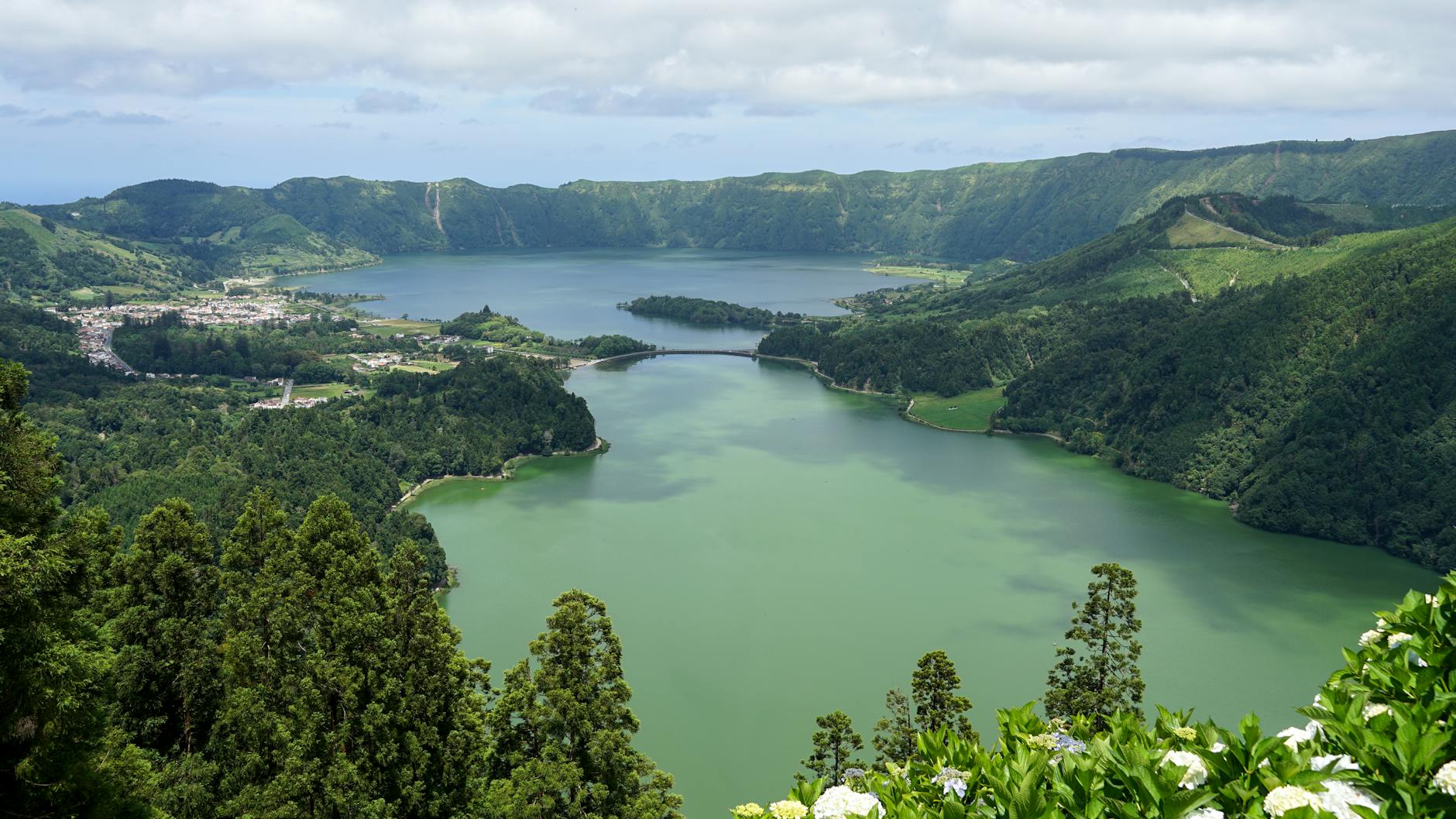
The twin crater lakes at Sete Cidades — one called Lagoa Azul, the other Lagoa Verde, traditionally described as blue and green though the exact colours are a function of depth, algae bloom and whatever the weather has done that week — sit inside a five-kilometre-wide caldera on the western end of São Miguel. The standard photograph is taken from the Vista do Rei viewpoint on the crater rim road. The photograph is fine. The landscape is better.
What almost no tour does is the crater-rim walk from Vista do Rei north and west to Boca do Inferno — roughly four kilometres one way, two hundred metres of elevation change, forty-five minutes to an hour, sunrise to early morning for preference. The path runs along the edge of the caldera with both lakes visible below and, on a clear day, Ponta Delgada and the ocean spread out to the south. Boca do Inferno — “mouth of hell” — is the viewpoint at the end, looking almost straight down onto both lakes with a small side-crater called Caldeira Seca in the foreground. It is one of the top three viewpoints in the archipelago.
Walk it before nine in the morning if you can. The crater holds weather that drifts in and out; a view that is gone at 11:00 is often back at 07:30. There is no admission fee. Parking at Vista do Rei is free. The abandoned Monte Palace hotel on the rim — a failed luxury project from 1989 that was open for eighteen months before going bankrupt and has been left as a concrete shell ever since, currently being slowly stabilised after years of graffiti tourism — is a separate drive-to viewpoint half a kilometre away. It is no longer safe to enter, but the shell itself, seen from outside against the crater, is its own picture. Do not climb the fencing.
- Price: free
- Hours: all day, all year; weather-dependent visibility
- How to get there: rental car from Ponta Delgada, 45 min west on the ER1-1A
- Editor’s tip: If you have only one sunrise on São Miguel, give it to Sete Cidades on the crater rim, not to Lagoa do Fogo. The rim walk is less known, less crowded, and the two lakes side by side are the landscape that defines the island.
2. Caldeira Velha (São Miguel) — the bookable hot spring
Caldeira Velha is a small thermal complex set in laurel forest on the northern slope of the Lagoa do Fogo crater. It is the best-maintained of the accessible thermal baths on the island — a ferruginous waterfall cascading into a bathing pool of around 28 °C, a smaller 35 °C pool, and an interpretation centre explaining the geothermal system underneath the whole centre of São Miguel.
It is also, since the post-2020 visitor cap, one of the trickier things to book on the island. Entry is time-slotted: one hundred tickets per hour-and-a-half slot, capacity 250 at any one time, maximum two-hour stay. In high summer, slots sell out four to five days in advance. Book online only, on the official ticketing site (parquesnaturais.azores.gov.pt). Do not turn up without a ticket in July or August expecting to queue in.
- Price: €10 adult / €5 junior + senior / free under 6 (verify against current schedule before travel)
- Hours: summer 09:00–21:00, winter 09:30–17:30 (verify before travel)
- How to get there: rental car, 35 min NE of Ponta Delgada; no direct bus
- Editor’s tip: Book the 09:00 slot in summer. The pool is empty for the first fifteen minutes and the steam rising through the laurel forest at that hour is the picture you were hoping for.
3. Furnas and Cozido das Furnas (São Miguel)
Furnas is a caldera town of about 1,500 permanent residents sitting inside a slightly larger crater on the east of São Miguel. The caldera floor is a field of active fumaroles — roughly twenty named vents around Lagoa das Furnas, where sulphurous steam rises continuously and the ground is hot enough, in places, to poach an egg on. The town itself is arranged around a smaller set of hot springs in the centre, most of them on the grounds of the Terra Nostra Park, which is the best-known ornamental garden in the Azores.
The defining meal of the Azores is the cozido das Furnas — a slow-cooked stew of pork, beef and chouriço with cabbage and root vegetables, sealed in a tall pot at a restaurant in town, driven out to the caldera at dawn, buried in the cooking ground, and hauled out again six hours later by the restaurant’s own staff with shovels. There is a designated cooking field at the lake’s edge where you can see forty or fifty cozido pots at various stages of the morning burial. The cooking is geothermal, not smoke-flavoured: the result is an extremely long-braised stew with no added liquid, everything melted together, served with a bread side that mops up what the cabbage does not.
Tony’s (Rua Dr. Frederico Moniz Pereira, founded 1984) is the original. Restaurante Terra Nostra inside the Terra Nostra Garden Hotel is the other benchmark. Both require booking at least a day ahead in summer. The cozido must be ordered in advance; it takes six hours to cook. Walking in at 13:00 asking for cozido will not work.
- Price: cozido €15–25 per person, portions for two to three; Terra Nostra Park garden entry separately charged
- Hours: lunch service typically from 12:00–15:00 on cooking days (check with restaurant)
- How to get there: rental car, 45 min east of Ponta Delgada; day tours run from PDL
- Editor’s tip: Arrive at Tony’s by 12:30, not 14:00. The best pots are out by 13:00 and the 14:00 service is scraping the bottom of the second batch. Pair it with the Caldeira das Furnas cooking-field walk at 09:00 — see the pots being buried, then eat what came out of the one you passed.
4. Mount Pico (Pico Island) — Portugal’s highest peak
At 2,351 metres, Mount Pico is the highest point in Portugal — higher than any point on the mainland, more than twice the elevation of the next-highest Azorean summit. It is a stratovolcano, currently dormant but not extinct, and it dominates Pico island so completely that the island is effectively a cone rising out of the ocean. On a clear morning from Faial — eight kilometres across the Canal — Pico looks implausibly vertical.
The summit climb is a serious day. It is roughly 1,120 metres of ascent over about 3.9 kilometres from the base camp at Casa da Montanha (1,231 m); the final push is a scramble up the Piquinho cone, the small internal peak inside the summit crater. Total time: five to eight hours round trip. Weather turns fast — the summit can be clear at 06:00 and fogged-in at 09:00. It is a mandatory-guide climb for anyone without serious mountain experience, and even for experienced climbers registration with Casa da Montanha is compulsory. There have been multiple fatalities on Pico in the last decade, almost all of them hikers who got separated from their group in cloud.
The climb is worth doing, carefully, in summer. The view from the Piquinho at sunrise covers five islands on a clear day — Faial, São Jorge, Graciosa, Terceira, and sometimes São Miguel on the horizon.
- Price: registration fee ~€15 for the climb, official guide ~€80–120 per person for a group of four (verify against current schedule before travel)
- Hours: Casa da Montanha open daily; climb window typically May–October, weather-dependent
- How to get there: Ferry Horta (Faial) → Madalena (Pico), 30 min, €4–5; then 20 min drive to Casa da Montanha
- Editor’s tip: Overnight at the summit is permitted but requires a second registration; the reward is sunrise above the ocean with no other climbers in the crater. If you do a day climb, start at 03:00–04:00 to beat the afternoon cloud that almost always rolls in by 11:00.
5. Pico Vineyard Landscape (Pico Island) — UNESCO 2004
On the ocean-facing coast of Pico, running for tens of kilometres, is a landscape unlike any other in Europe: rectangular plots of volcanic soil walled off from the sea wind by chest-high basalt block walls, each plot the size of a single vine. The walls are built dry, without mortar, from blocks hand-quarried from the surrounding lava fields. Inside each walled plot — a currais — grow one, two, or at most four vines. The whole landscape is effectively a mosaic of small black-walled boxes running down to the Atlantic.
The Landscape of the Pico Island Vineyard Culture was inscribed as a UNESCO World Heritage Site in 2004 — 987 hectares of core protected zone plus an additional 1,924 hectares of buffer. The technique dates to the fifteenth century. The grape is Verdelho (the local variant, not Madeira’s). The wine, revived from near-extinction in the 1990s by the Azores Wine Company and a handful of small producers, is on the Verdelho-Arinto dos Açores-Terrantez axis — dry, mineral, volcanic, closer to Atlantic Spanish albariño than to anything from mainland Portugal.
The best way to see it is to drive the coast road from Madalena south along the Criação Velha section to Santa Luzia, with stops at the Lajido interpretation centre and at the Azores Wine Company winery for a tasting. Plan a half day.
- Price: Lajido interpretation centre ~€5; winery tastings €10–20 depending on flights
- Hours: Lajido 09:30–17:30 Tue–Sun; winery check ahead
- How to get there: see Mount Pico for ferry; vineyards start five minutes south of Madalena
- Editor’s tip: Do the vineyards on a weather day that doesn’t allow Mount Pico. The landscape is better in flat overcast light than in the full midday sun that washes out the black-on-black of lava walls and soil.
6. Angra do Heroísmo (Terceira) — UNESCO 1983
Angra do Heroísmo is the old capital of Terceira and one of the two UNESCO-listed sites in the Azores. It was the obligatory port of call for every Portuguese ship crossing between Europe and the Americas for nearly four centuries — the Spanish treasure fleet, the East Indies fleet, and every returning Atlantic convoy — and the town’s defensive architecture (Fortaleza de São João Baptista on Monte Brasil, Fortaleza de São Sebastião above the harbour) reflects that strategic weight. Angra served as Portugal’s provisional capital during the Liberal Wars and was where the Azorean autonomy statute was negotiated in the 1970s. The Festas Sanjoaninas in June draw more than two hundred thousand visitors annually.
The UNESCO inscription in 1983 came four years after the 1 January 1980 earthquake that destroyed sixty per cent of the historic centre. The rebuilding — mostly of seventeenth-to-nineteenth-century townhouses — was done building-by-building with original stonework where possible, and the whole town has since been cited as a model for post-disaster heritage reconstruction. A visitor walking the Rua Direita today is walking through a rebuild that finished, in most cases, in the early 1980s.
The principal things to do: walk the old centre (two hours minimum, free), climb Monte Brasil for the harbour view (90-minute round trip, free), see the Museum of Angra (€3) and the cathedral, and eat alcatra — the Terceiran pot-roasted beef in red wine and bay leaf baked for hours in a clay pot — at a working-class restaurant in the town (€14–18).
- Price: walking the town is free; Museum of Angra €3
- Hours: town always; museum Tue–Sun 09:30–17:00
- How to get there: Flights from PDL to TER ~€60–120 one-way; ferry not practical from main islands
- Editor’s tip: Go during the Festas Sanjoaninas (19–28 June 2026, fiftieth anniversary of the Azorean autonomous regime) if you can accept crowds; go any other week for the town itself. The 1980 earthquake is not memorialised as visibly as one might expect — look for the small plaques at the corners of the rebuilt buildings.
7. Algar do Carvão (Terceira) — into the volcano
Algar do Carvão is a lava tube and extinct vertical vent, 583 metres above sea level on central Terceira, that descends ninety metres straight down into a basalt chamber with stalactite-like silica formations and a permanent rain-fed pool at the bottom. Visitors descend via a stair-and-walkway system to the base; the chamber is thirty metres across, and on a clear day the sky at the top, seen from the floor, is a small green circle cut into the rock because of moss growing on the rim.
It is one of the most visually unusual interior spaces in the archipelago. Accessibility is limited; the stairs are steep and not wheelchair-friendly.
- Price: €10 adult
- Hours: seasonal; summer daily 14:30–17:15; winter reduced, check Montanheiros ahead (verify against current schedule before travel)
- How to get there: rental car from Angra, 30 min inland
- Editor’s tip: Pair it with Gruta do Natal (smaller lava tube nearby, often combined ticket) and the Furnas do Enxofre mineral terraces for a full half-day geology loop on central Terceira.
8. Capelinhos Volcano and Interpretation Centre (Faial)
On 27 September 1957, a submarine eruption began off the western tip of Faial, two hundred metres from the Capelinhos lighthouse. Over the next thirteen months — until 24 October 1958 — it built a new landmass, then reconnected it to the island, then partly buried the lighthouse and the village of Capelo under a thick blanket of ash and pyroclast. Approximately two thousand villagers lost their homes. The lighthouse keeper kept a logbook through the eruption that survives in the interpretation centre.
The Azorean Refugee Act of 2 September 1958, co-sponsored by Senator John F. Kennedy of Massachusetts and Senator John O. Pastore of Rhode Island, was the US Congress’s emergency response — an authorisation to admit 1,500 heads of household from the Azores outside the normal immigration quota. It was the crack that became the Great Azorean Emigration of the 1960s and 1970s: roughly 250,000 Azoreans settled in the Rhode Island–Massachusetts corridor between 1921 and 1977, with the bulk of them arriving in the two decades after Capelinhos. The US diaspora of Azorean origin today is, by most estimates, more than four times the population of the archipelago.
The Capelinhos Interpretation Centre, opened 2008, is built into the hillside below the half-buried lighthouse. It is a small museum by mainland standards but its content is the clearest presentation of an Azorean catastrophe available anywhere. Walk the ash landscape afterwards — the ejecta fields extend a kilometre inland — and then walk to the viewpoint at Ponta dos Capelinhos for the lighthouse at half-height.
- Price: €10 adult · free for Azores residents
- Hours: Tue–Sun 10:00–17:30 (hours vary seasonally; check Parques Naturais dos Açores)
- How to get there: rental car from Horta, 35 min west via the ER1-1 coast road
- Editor’s tip: Read the logbook. The centre reproduces pages from the keeper’s daily entries in Portuguese with English translations; the shift from “activity continues to the west” to “family evacuated this morning” takes place over eleven days in February 1958.
9. Peter Café Sport and the Horta Marina (Faial)
Henrique Azevedo, who the family still calls Peter, opened a small waterfront bar in Horta in 1918. It served sailors, harbour workers and fishermen. In 1960 his grandson took over; through the 1960s and 1970s, as small-boat ocean sailing exploded and Horta became the unavoidable Atlantic stopover between Bermuda and Europe for virtually every amateur transatlantic crossing, Peter Café Sport became the place every transatlantic sailor stopped at. The walls are floor-to-ceiling painted with the burgees and crew messages of some sixty thousand transatlantic boats. The Scrimshaw Museum upstairs — whale-ivory engravings collected since the 1980s — is one of the best private collections in the Atlantic.
The bar still works as a bar. Order a gin (the local Gin do Mar is fine), sit outside if the weather allows, and watch boats come in from the Caribbean or head out for the Mediterranean crossing.
- Price: beer €2–3, gin €5–7, scrimshaw museum €3
- Hours: bar typically 08:00–01:00; museum afternoons
- How to get there: walk from Horta ferry terminal (5 min)
- Editor’s tip: The tradition of painting a square of the marina wall with your boat’s name is not a tourist gimmick — every sailor who crosses the Atlantic and stops in Horta is expected to do it, and not doing it is considered bad luck for the onward crossing. If you arrive by ferry, read the walls; do not paint. That’s for sailors.
10. Fajã da Caldeira de Santo Cristo (São Jorge) — the lagoon you hike to
On the north coast of São Jorge, under a 400-metre cliff, is a small lagoon separated from the Atlantic by a narrow rocky bar, and this lagoon is the only place in the Azores where clams — Ruditapes decussatus — are legally farmed. The quota is fifty kilograms a month, harvested by hand by licensed local fishermen. The fajã itself is about four hundred hectares and holds a population of fewer than forty permanent residents. It is a Biosphere Reserve.
There is no road. Access is by a three-kilometre hiking path descending from the village of Serra do Topo — ninety minutes on the way down, slightly more on the way up — or by quad-bike shuttle from the village (one family runs this; €40 return). The hike is not difficult but the descent is sustained and the return climb is the hard part. The reward is a black-sand beach, a village of six or eight houses with a single café that serves clams and white wine.
- Price: the hike is free; quad shuttle ~€40 return; clams-and-wine lunch ~€15
- Hours: daylight; plan for a full half-day
- How to get there: Fly HOR (Faial) or fly PDL → SJZ (São Jorge), then drive to Serra do Topo
- Editor’s tip: This is a weather hike. The descent path is steep and can be slippery after rain. Go on a forecast-confirmed dry day. Bring cash — the café at the bottom does not reliably take card.
11. Poço da Ribeira do Ferreiro (Flores) — the wall of waterfalls
On Flores, the westernmost inhabited island of the Azores — and, by some measures, the westernmost point of Europe — is a cliff face inside a small valley where more than twenty separate waterfalls run parallel down a hundred-and-fifty-metre wall of basalt into a single lake. It is one of the Azores’ signature images. It is also, unusually, not a photographed-to-death site, because Flores is difficult to get to (flights only from Faial or Terceira, and weather cancels them often), and the hike in is fifteen to twenty minutes from a trailhead that is itself an hour’s drive from the airport.
Swimming is not permitted — the lake is inside a protected area. The photograph is free. The hike is free. You will almost certainly have it to yourself for at least part of the visit.
- Price: free
- Hours: daylight; no gate
- How to get there: Flights SATA from PDL via HOR or TER; rental car on Flores
- Editor’s tip: If you go to Flores, give it three days minimum — the island is small enough to circle in a day, but the weather cancels activities often enough that a two-day trip will leave you frustrated. Three days builds in a weather buffer.
The Nine Islands — How They Differ
Most visitors to the Azores go only to São Miguel — it is the largest, most populous, and the only island with a genuinely deep tourism infrastructure. For a first trip, that is a reasonable choice: São Miguel has ten days of worthwhile activity in it. A second trip adds a second island. A third adds a third. The archipelago is not a single experience.
São Miguel (PDL, ~170,000 residents) — the largest island and the entry point for most visitors. Sete Cidades, Lagoa do Fogo, Furnas, Ponta Delgada old town, Gorreana tea, whale-watching out of Ponta Delgada (see attractions #1–3). Five to ten days well spent. The only Michelin-Keyed hotel in the Azores is here (WHITE, 2026).
Pico (PIX, ~13,900 residents) — the climbers’ island and the wine island (see attractions #4 and #5; whale-watching out of Lajes do Pico). Two to three days.
Faial (HOR, ~14,300 residents) — Horta marina and the Caldeira (a 400-metre-deep ring-wall crater that is the highest point on the island); Capelinhos and Peter Café Sport are attractions #8 and #9. Two days. Pairs logically with Pico via the thirty-minute ferry.
São Jorge (SJZ, ~8,200 residents) — the fajãs and the cheese; see attraction #10 for Santo Cristo. The most difficult-to-visit of the central group because access to the good fajãs is by foot, not road. Two to three days.
Terceira (TER, ~53,000 residents) — Angra do Heroísmo and Algar do Carvão (attractions #6 and #7), plus the bullring culture (tourada à corda, a running-of-the-bulls street variant distinct from mainland Portugal). The Festas Sanjoaninas in June are a highlight. Two to three days.
Santa Maria (SMA, ~5,500 residents) — the oldest Azorean island geologically, the only one with white-sand beaches (volcanic islands normally produce black or grey sand), a small red-desert interior landscape. Quiet, under-touristed. The Festival Maré de Agosto in August draws a small world-music crowd. One to two days.
Graciosa (GRW, ~4,100 residents) — Furna do Enxofre, a sulphurous cave inside the Caldeira reached via 183 steps, plus the Termas do Carapacho thermal complex. Very quiet. One day if transiting; two if you are committed.
Flores (FLW, ~3,700 residents) — the waterfall island; see attraction #11 for Poço da Ribeira do Ferreiro, plus the Rocha dos Bordões basalt columns and the north-coast lagoons. Biosphere Reserve since 2009. Three days if the weather cooperates.
Corvo (CVU, 435 residents) — the smallest and northernmost. The island is essentially a single volcano with a population on its southern flank. Biosphere Reserve since 2007. Visited by day trip from Flores or occasionally by small-boat charter. One day is enough; a second if you are committed to seeing the crater from the rim.
Where to Stay — By Budget
Budget (€60–95 per night, double)
On São Miguel: Azor Hostel & Pousada de Juventude (central Ponta Delgada, €25 dorms / €60 doubles, clean, social, fine for solo travellers); Casa d’Avó Beatriz (small family-run B&B in Furnas, €75–85, breakfast included, local feel); small turismo rural houses across the north coast through Sunset Lab or the regional tourism site at €70–90 for an apartment-style unit. On Terceira: Angra Garden pension-style rooms (€70), or small B&Bs in Praia da Vitória (€60–80). On Faial: Residencial São Francisco in Horta (€65–85, breakfast).
Mid-range (€120–200)
São Miguel: Furnas Boutique Hotel (€150–220, one of the best mid-range hotels in the archipelago; thermal spa on premises; steps from Terra Nostra Park). Azor Hotel (Ponta Delgada, €160–220, rooftop pool, best mid-range in the capital). Pedras do Mar (Ribeira Grande, €170–230, north-coast seawater pool, quiet). Octant Furnas is another strong pick in the Furnas valley. On Pico: Aldeia da Fonte (€130–180, clay-path cottages on a cliff, excellent restaurant). On Faial: Faial Resort Hotel (€140–180).
Luxury (€250+)
WHITE São Miguel — the first and only Azorean hotel in the 2026 Michelin Guide Key list. Boutique, thirty-something rooms, on the Ponta Delgada waterfront, €350–600 depending on season. The Key recognition is the Michelin Guide’s hotel-equivalent of the star system; WHITE earned one in the 2026 ceremony at Funchal.
Azor Hotel (already mentioned, with the top suites in the €280–380 range); Terra Nostra Garden Hotel (Furnas, €260–400, access to the famous iron-red thermal pool included — this is the hotel that built and still owns Terra Nostra Park); Senhora da Rosa (São Miguel, Michelin Guide-listed though not Keyed, €280–380, houses Restaurant Magma).
Where NOT to stay
Avoid the high-density Avenida Roberto Ivens / Avenida Infante Dom Henrique strip hotels in Ponta Delgada if you want a sense of the city — they are functional airport-adjacent business hotels, and while the price can be good in shoulder season, the experience is not Azorean. The old town (west of Portas da Cidade) is where you want to be. Avoid the airport-road cluster.
São Miguel tourist tax
Since 1 January 2025, São Miguel charges a municipal tourist tax of €2 per person per night, capped at three nights (maximum €6 per person). All six municipalities of São Miguel — Ponta Delgada, Ribeira Grande, Lagoa, Vila Franca do Campo, Povoação, and Nordeste — apply it. Azores residents are exempt. It is collected at check-in and continues into 2026. No comparable tax on the other islands at the time of writing.
Where to Eat
The Azorean kitchen is a conservative one — the island tradition, through poverty and emigration, has been to do a small range of ingredients extremely well, rather than to chase novelty. The most Azorean meal you will eat is the prato do dia at a working-class tasca in a village: a fish or pork main, rice, fries, a wedge of island cheese, a glass of local wine or kima (the passion-fruit soda), for €8 to €12. After that comes cozido das Furnas, and then grilled local fish — bodião, cherne, garoupa, salmonete — at a waterfront restaurant on any island, with grilled limpets (lapas grelhadas) to start.
Budget eats (€8–15)
São Miguel: Cais 20 (Ponta Delgada harbour, grilled fish, €12–15); Restaurante Alcides (central PDL, classic prato do dia, €9–12, local crowd, cash-preferred); A Tasca (traditional sharing plates, €14–18 per person if you share two-to-three plates, queue beyond 20:00 in summer). Pico: Tasca O Petisca (Madalena, €10–15). Terceira: O Forno (Angra, alcatra for €14–16).
Mid-range (€20–35)
São Miguel: Anfiteatro (Ponta Delgada marina, Azorean contemporary, €35–50 per person with wine, reliably good); Louvre Michaelense (pastry café with a serious lunch menu, €22–28). Pico: Aldeia da Fonte (hotel restaurant open to non-guests, €30–40). Faial: Genuíno (Horta harbour, owned by a world-circumnavigating former whaler, €30–40; menu leans to the boats that come in that morning).
Fine dining (€60–120)
The headline name is Magma at Senhora da Rosa on São Miguel — tasting menu €90–130 depending on courses, the most serious Azorean fine-dining on the islands. Chef’s lens is modernist-but-restrained; the ingredients are all Azorean (Pico wine, São Jorge cheese, local fish, Furnas geothermal-steamed greens). It is the guide-listed hotel restaurant that most Michelin watchers expected to earn a star in 2026. It did not — the 2026 Portugal ceremony did not award a star to any Azorean restaurant — but the food is at the level you would expect from a contender.
Other serious options: Quinta dos Sabores (intimate farm-to-table, €65–85, booked well ahead) and A Tasca das Furnas in Furnas, a more atmospheric rather than fine-dining pick.
The traditional dishes
- Cozido das Furnas — geothermal stew, see attraction #3. €15–25.
- Alcatra — Terceiran pot-roasted beef in red wine, bay leaf, garlic, baked in a clay pot for 4–6 hours. €14–18.
- Lapas grelhadas — grilled limpets, garlic butter, lemon. Starter, €7–10. The spoon-out-the-shell move is standard.
- Morcela de Furnas — blood sausage made in Furnas, often served with a cooked pineapple slice (a genuinely traditional pairing in the Azorean rural kitchen). €4–6 as a starter.
- Queijo de São Jorge DOP — cow’s-milk cheese aged minimum 90 days; commercial releases at 3, 4, 7, 12, and occasional 24- and 30-month special editions. The 7-month is the standard; the 24-month is a different object. €15–25 per kilogram at origin on São Jorge, €20–35 per kilogram elsewhere.
- Bolo lêvedo — sweet griddle-cooked muffin from Furnas, slightly elastic, best at breakfast with butter or as a burger bun. €0.80–1.50.
- Massa sovada — Azorean sweet bread, enriched with milk and egg, sometimes cinnamon-scented; a fixture of every Festas do Espírito Santo.
Avoid
Tourist-strip hotel buffets at the Ponta Delgada marina — at least three operators push twenty-euro “traditional Azorean buffets” that deliver supermarket-grade cozido and microwaved lapas. They are clearly marked by the menus propped out on the sidewalk in four languages. Skip. The real tascas are two streets inland, cheaper, and have menus only in Portuguese.
Drinking — Tea, Wine and the Azorean Café
Tea
The Azores are the only commercial tea-growing region in Europe — a single climatic accident of the oceanic island belt sitting close enough to the subtropical latitude that Camellia sinensis can be cultivated. Two plantations operate on São Miguel. Gorreana, founded in 1883, is the oldest tea plantation in Europe; entry and tour are free, the black and green tea tasting is also free. Porto Formoso, founded 1883, smaller and more tucked-away. A tea tour at either takes about forty minutes. Leaf tea from Gorreana sells at €4–6 for a 100 g pack in the plantation shop; expect to pay €8–10 for the same tea in a supermarket in Lisbon.
Coffee and the café
Azorean coffee culture is continental Portuguese — espresso-strong, served short, a bica or a café is the default, a meia de leite is the milky option. The café itself is a social institution; every village has at least one, and they open at 06:30 for the morning boat crews. In Ponta Delgada, Louvre Michaelense (near Portas da Cidade) is the historic café in the city — opened 1885, original tilework, serves a functional lunch as well. Mimo and A Tasca run more contemporary coffee programs. In Horta, everything circles back to Peter Café Sport. In Angra, Café Atlântico on the waterfront.
Wine
The Azorean wine scene is small but ascendant. The axis runs across three grape varieties, all primarily on Pico: Verdelho (the local version, not Madeira’s), Arinto dos Açores, and Terrantez do Pico — the last of which was nearly extinct in the 1990s and has been rescued by a handful of producers. The resulting wines are dry, mineral, lean, and distinctly Atlantic — more albariño than alvarinho, to compare with something you might know. The Azores Wine Company and Czar Wines are the two most-visible producers; Insula is the co-op label that gets into supermarkets. A bottle at origin on Pico runs €15–30; a serious single-vineyard Verdelho from Azores Wine Company’s Arinto dos Açores run is €35–55. All are available by tasting flight (€10–20) at the winery, which is five minutes south of Madalena.
Beyond Pico, the Biscoitos-region wines on Terceira are a small parallel tradition. Graciosa has a wine history. The other islands do not produce commercially at scale.
Kima, licor de maracujá and other oddities
Kima is the Azorean passion-fruit soda, made by the Melo Abreu brewery in Ponta Delgada since the late 1960s. It is the everyday soft drink across the islands and the accompaniment to most prato-do-dia lunches. €1.50–2 a can. Licor de maracujá is the local passion-fruit liqueur, served in small glasses after dinner as a digestif, sweet but not cloying. Aguardente de figo (fig aguardente) turns up on São Jorge and Terceira — a clear brandy, sharp, an acquired taste.
Getting Around — Flights, Ferries, Cars
To the Azores
The main entry airport is João Paulo II (PDL) on São Miguel. Direct flights from mainland Europe year-round: Lisbon (TAP, Azores Airlines, Ryanair — multiple daily, €40–180 round trip depending on season), Porto (multiple daily, similar price range), Madeira/Funchal (Azores Airlines, weekly), Frankfurt (Lufthansa/Eurowings, seasonal summer), Amsterdam (TUI Fly, seasonal), Paris (Azores Airlines, Transavia, seasonal), London Stansted (Ryanair, year-round). From North America: Boston (Azores Airlines, year-round, 4.5 h), Toronto (Azores Airlines, year-round), and recently Newark and Oakland as seasonal routes via SATA Azores Airlines. A direct seasonal SATA route Delta JFK–PDL was trialed in 2025 and remains listed for summer 2026 at the time of writing (verify).
Terceira has direct mainland service (Lisbon, Porto), and seasonal North American service (Boston, Toronto). Santa Maria and Faial have limited direct continental service; in practice, most visitors to the central or western groups transit PDL.
Between the islands
Flights are operated exclusively by SATA Air Açores, the inter-island carrier (distinct from SATA/Azores Airlines on the mainland routes). One-way tourist fares run €60–120 depending on route and season. The government-subsidised Azores Fare scheme caps resident one-way fares at approximately €35 / €61 round trip — tourists do not qualify. Book on azoresairlines.pt.
Ferries are operated by Atlânticoline. The critical route for most visitors is the Faial–Pico crossing (Horta to Madalena), 30 minutes, five sailings a day in summer, roughly €4–5 foot passenger one way, cars extra (verify against current schedule before travel). In summer, the Triangle route (Faial–Pico–São Jorge) operates. The Eastern (São Miguel–Santa Maria) and Western (Flores–Corvo) lines are summer-heavy and weather-dependent; winter schedules drop to minimal service, and swell cancellations in the off-season are frequent. The rule: ferry-plan with a weather buffer; a flight backup is prudent for Flores/Corvo.
On each island
Rental car is the practical default on São Miguel, Terceira, Pico and Faial. Expect €25–50 per day for a compact, booked ahead in summer. Parking is free at most attractions outside Ponta Delgada; street parking in PDL old town is metered. Driving is easy — small roads, few cars, European standards.
Public bus exists on São Miguel (EMP and the municipal services) and connects the main villages to Ponta Delgada, but the schedule is shaped around residents commuting, not tourists moving between attractions. Usable for Gorreana or Furnas as a day trip from PDL; not usable to do Sete Cidades sunrise. On smaller islands, public bus is minimal.
Ponta Delgada airport transfer: Aerobus (ANC) runs a circular route, €8, every forty minutes, 05:00 to midnight, twenty-one stops (verify against current schedule before travel). Taxi: €6 day, €7 night, 5 minutes. For a single traveller the Aerobus wins; for two or more the taxi is cheaper per head and faster.
Ride-hailing
Bolt operates in Ponta Delgada and increasingly on Terceira; supply is uneven and surge pricing is real in the evening. Uber is not meaningfully present. Taxis are plentiful and honest; the rate card is posted inside every cab.
Best Time to Visit
The narrow answer: May to early July for the blue-whale migration and the late-spring wildflowers, or mid-September to mid-October for the quieter post-summer shoulder with warm ocean and still-stable weather. The broader answer: the Azores are a year-round destination, but the experience is different in each season.
Spring (April–June): the best whale-watching window. Blue, fin and sei whales — the largest cetaceans, only in Azorean waters as migratory species — are in the archipelago from roughly April to June. Resident species (sperm whales, common and bottlenose dolphins, Risso’s dolphins) are present year-round. May temperatures run 15–19 °C. Festa do Santo Cristo in Ponta Delgada — the largest festival in the archipelago — is on 8–14 May 2026.
Summer (July–September): the stable weather window. Highs 22–24 °C, lows 18–20 °C, long days, lowest rainfall (July averages around 27 mm on São Miguel). Peak tourism, peak prices, peak crowds at Sete Cidades and Caldeira Velha. Festas Sanjoaninas in Angra on 19–28 June; Semana do Mar in Horta in early August; Festival Maré de Agosto on Santa Maria in late August. Most ferry routes at full operation; the Triangle runs.
Autumn (October–December): the rain starts. October is often still summery; by late November and into December, the islands are wet and windy. December is the wettest month on São Miguel (~149 mm of rain). Prices drop. Ferries cancel frequently. The advantage: if you want the islands empty, this is the season, and there are still plenty of clear-weather days for the traveller who can wait for them.
Winter (January–March): cool (lows 11–13 °C, highs 16–18 °C), wet, empty. Capelinhos and Algar do Carvão are closed or on reduced hours. Some restaurants on smaller islands close entirely for the off-season. Whale-watching continues but migratory species are absent. Hiking is possible on clear days. Pico summit is closed to non-experienced climbers.
Month-by-Month Weather
Ponta Delgada figures (IPMA, Portuguese meteorological service, 30-year averages). The other islands follow the same pattern with minor local variations.
| Month | High °C | Low °C | Rain days | Notes |
|---|---|---|---|---|
| January | 17 | 12 | 17 | Wettest-cool; ferries often disrupted |
| February | 16 | 11 | 15 | Low season; some restaurants closed |
| March | 17 | 11 | 17 | Shoulder beginning; Easter variable |
| April | 18 | 12 | 15 | Wildflowers; whale watching begins |
| May ⭐ | 19 | 14 | 14 | Peak whale migration; Santo Cristo festival |
| June ⭐ | 21 | 16 | 10 | Excellent; Sanjoaninas on Terceira |
| July ⭐ | 23 | 18 | 8 | Driest month; peak summer stability |
| August | 24 | 19 | 9 | Warmest; peak tourism; Semana do Mar |
| September ⭐ | 23 | 18 | 11 | Quietest of the warm months; ideal |
| October | 21 | 16 | 15 | Transition; still warm on clear days |
| November | 19 | 14 | 19 | Rainy; whale residents only |
| December | 17 | 13 | 18 | Wettest month; New Year’s in Ponta Delgada |
Annual average rainfall at Ponta Delgada: ~1,016 mm. Source: IPMA (Instituto Português do Mar e da Atmosfera) and ClimatesToTravel 30-year normals.
Daily Budget Breakdown
Per person, double occupancy, using the euro. São Miguel-weighted; other islands run slightly cheaper on accommodation, slightly more expensive on inter-island transport.
| Category | Budget | Mid-range | Luxury |
|---|---|---|---|
| Accommodation | €30–45 | €70–100 | €175+ |
| Meals & drinks | €20–30 | €40–60 | €90–150 |
| Transport (car + fuel or local bus/ferries) | €15–25 | €20–35 | €35–60 |
| Activities (entry fees, whale watching) | €5–15 | €15–30 | €40–80 |
| Daily total per person | €70–115 | €145–225 | €340–500+ |
Budget (€70–115/day): double room in a hostel or small pension outside central Ponta Delgada, one prato-do-dia lunch plus a cheap dinner, bus or shared car, at most one paid attraction per day. Viable for solo or couple travellers on São Miguel with advance planning.
Mid-range (€145–225/day): mid-range hotel (Octant Furnas, Pedras do Mar, Faial Resort), two sit-down meals including one good one, rental car (€30–40/day shared between two), one or two paid attractions or a half-day whale-watching trip.
Luxury (€340–500+/day): WHITE or Terra Nostra Garden Hotel, Magma dinner (€90–130/person with wine pairings), rental car upgrade or private driver, full-day private whale watching or private Mount Pico climb.
Sample Itineraries — 3, 7 and 10 Days
3-Day Essential (São Miguel only)
Day 1 — West São Miguel. 06:30 pick up rental car in Ponta Delgada. 07:30 arrive Vista do Rei at Sete Cidades; walk the crater rim to Boca do Inferno (~45 min) while the light is good. 09:30 back at Vista do Rei, drive down to the Sete Cidades village for coffee. 10:30 on to the Lagoa do Fogo viewpoint (25 min drive). 12:30 lunch in Ribeira Grande. 14:30 Caldeira Velha (pre-booked ticket; see #2). 17:00 back to Ponta Delgada. Evening: walk Portas da Cidade → Igreja Matriz → Campo de São Francisco (~90 min), dinner at A Tasca.
Day 2 — Furnas and the east. 08:30 depart. 10:00 arrive Furnas; park at Terra Nostra Park entrance. 10:30 walk the caldera cooking ground; watch the morning cozido pots being buried. 12:30 cozido lunch at Tony’s (reservation mandatory; see #3). 14:30 Terra Nostra Park and thermal pool. 17:00 drive the north coast back via Nordeste (Miradouro da Ponta do Sossego, miradouro after miradouro). 19:30 back to Ponta Delgada.
Day 3 — Whales and the north. 08:30 Futurismo half-day whale-watching tour from Portas do Mar (~3 h, €70). 13:00 lunch in Ponta Delgada. 15:00 drive to Gorreana Tea Plantation (free tour and tasting). 17:00 continue to Arruda’s pineapple plantation (free). 19:00 back to Ponta Delgada. Dinner at Anfiteatro.
7-Day — São Miguel + Pico/Faial
Days 1–3 as above. Day 4: morning flight PDL → HOR (~45 min), afternoon Horta old town, Peter Café Sport (see #9). Day 5: Capelinhos (see #8) and the Caldeira de Faial (the 400-metre ring crater), dinner at Genuíno. Day 6: early ferry Horta → Madalena (30 min). Mount Pico climb with guide (see #4; full day, 03:30 start for sunrise summit, back by afternoon); alternative for non-climbers: Pico vineyard landscape drive (see #5) + Azores Wine Company tasting + Lajes do Pico whale-watching. Day 7: morning flight PIX or HOR → PDL, afternoon departure.
10-Day — Three islands + slower pace
Days 1–3 on São Miguel (as above). Days 4–6 on Faial + Pico (cross via Horta ferry; climb Pico). Days 7–8 on São Jorge (fly HOR → SJZ or PDL → SJZ); Fajã dos Cubres, Fajã da Caldeira de Santo Cristo (see #10), São Jorge cheese tasting at a creamery. Days 9–10 back on São Miguel: Nordeste day, one attraction missed on days 1–3, departure.
Best Day Under €20 on São Miguel
A working Ponta Delgada + near-city day, car not required.
- 07:30 — breakfast at Mimo or any neighbourhood café. Bica + bolo lêvedo with butter. €3
- 08:30 — walk Portas da Cidade, Igreja Matriz de São Sebastião, Campo de São Francisco — Ponta Delgada’s baroque centre, all free, ~90 min. €0
- 10:30 — Ananases A. Arruda pineapple plantation. Walk from centre (~25 min) or bus #103 (€1.20). Free entry, free tour of the greenhouses, see the three-year pineapple crop cycle. €1.20
- 12:30 — walk back to centre or get the Aerobus (€1.50). Mercado da Graça for lunch: a prato do dia at one of the market-floor stalls is €7–9. €8
- 14:30 — Aerobus or a €6 taxi to Gorreana Tea Plantation (30 min east). Free factory tour, free black and green tea tasting, buy a 100 g pack to take home for €5. Bus option: EMP #103 runs but is slow. For this day, assume bus each way, €1.20 + €1.20. €2.40
- 17:30 — Aerobus back or EMP bus; walk the harbour promenade at golden hour.
- 19:30 — Restaurante Alcides for a cheap working dinner — fish or pork, rice, salad, kima, €9–12.
Total: €23.60 with tea pack / €18.60 without.
This is a genuinely workable day under €20 if you skip the take-home tea pack. The Azores are not a cheap destination — imported everything adds a coastal-island markup — but Ponta Delgada specifically delivers a workable budget day.
Rainy Day Plan
Rain is not hypothetical here. November–March averages four to six wet days a week; even in summer, the weather drifts in and out. A wet-day plan is essential.
Comfortable version (~€55): Morning at the Carlos Machado Museum in Ponta Delgada (Azorean cetology and natural history, €3 admission, 2 h); lunch at A Tasca (€20 with wine); afternoon at Terra Nostra Garden Hotel thermal pool (day pass for non-guests ~€20–30; the iron-red thermal pool is excellent in the rain); dinner indoors.
Budget version (~€15): Carlos Machado Museum (€3); Louvre Michaelense for coffee and lunch (€12); afternoon indoor walking tour of Ponta Delgada churches (free — there are at least six historic churches within a ten-minute walk of the centre). A €15 rainy day that is not wasted is a good outcome.
On Faial in the rain: Peter Café Sport, the Scrimshaw Museum upstairs, and the Capelinhos Interpretation Centre (indoor). On Terceira: Angra’s churches and the Museum of Angra. On Pico: the Whaling Museum at Lajes (€3, excellent small museum on the industry that closed in 1987).
Day Trips from Ponta Delgada
For visitors staying only on São Miguel, the feasible day trips are within the island — no realistic day trip to another Azorean island unless you fly very early and return very late, and the frequent flight cancellations make this a bad plan.
Sete Cidades and west São Miguel: see itinerary Day 1 above. Full day with sunrise on the crater rim.
Furnas, Ribeira Grande and the north coast: full day. Cozido at Tony’s, Terra Nostra Park, drive back via the north coast viewpoints (see itinerary Day 2).
Nordeste: the easternmost tip of São Miguel. Quiet, terraced, a series of village miradouros (Ponta do Sossego, Ponta da Madrugada) looking straight down onto the cliffs. Half-day minimum, better as a full day with Furnas.
Vila Franca do Campo and the islet: the original capital of São Miguel, destroyed by the 1522 earthquake. The Ilhéu de Vila Franca — a small volcanic islet 500 metres offshore with a near-perfect circular caldera pool open to the ocean — is reachable by ferry from June to September (~€10 round trip). Half-day.
Lagoa do Fogo: a separate half-day or morning, weather permitting. Hike down to the lake (steep, 90 min round trip) or just do the two viewpoints on the ER1-1A ridge road.
Ponta Delgada-to-Angra day trip (Terceira): possible but tight. SATA flights PDL–TER around 40 min; morning flight out, evening flight back, one day in Angra. Expect to pay €150–200 for the round-trip flight. It is practical only if you cannot extend the trip to two or three days.
Whales, Dolphins and the Ethics of the Watch
The Azorean whale-watching industry grew directly out of the whaling industry that closed in 1987. The families, the small harbours, and in some cases the boats are the same. This is a fact that the industry itself is frank about — tour operators at Futurismo and Cetáceos Azores include the whaling history in their introductory talks, and the Whaling Museum at Lajes do Pico is an important stop if you take the ethics seriously.
The protocol that operators follow — formally under the World Cetacean Alliance’s Whale Heritage Site framework, to which the Azores were admitted in February 2023 as the second WHS in Europe — limits approach distance, engine speed, and boat numbers around a single animal. Operators who violate the code lose licensure. The system is not perfect; it is better than almost anywhere else in the North Atlantic.
What you will see: resident sperm whales year-round (the Azores have one of the most stable sperm-whale populations in the Atlantic), common and bottlenose dolphins year-round, Risso’s dolphins year-round. Migratory April–June: blue whales, fin whales, sei whales — the giants — pass through the archipelago. Sightings rate at Futurismo, according to the operator’s published figure, exceeds 98% over recent years; operators rebook you free of charge if no sighting occurs.
Tour choices:
– Futurismo (Ponta Delgada, Lajes do Pico) — the largest operator, half-day three-hour tours at €70 adult, also full-day and speciality blue-whale trips April–June
– Cetáceos Azores (Ponta Delgada)
– Espaço Talassa (Lajes do Pico) — smaller, boat-limited, the more intimate option
– Picos de Aventura (Ponta Delgada)
Editor’s position: the morning tour is cheaper, calmer seas, and typically a better sighting experience than the afternoon tour. If you are prone to seasickness, the afternoon is worse. A three-hour tour is enough for a first time; a full-day tour is worth it only in the April–June giants window.
Safety and Practical Information
Safety on all nine islands is very high. The islands have almost no serious crime; petty theft exists in Ponta Delgada central in summer at the levels of any European city, but is not a pervasive concern. The most dangerous thing most visitors encounter is the ocean: Azorean north-coast swimming is rough even in summer, swells arrive without warning, and several tourist deaths in the last decade have been from swimmers caught off rocks by unexpected waves. Read the warning signs at every beach and do not swim at unguarded cliffs.
Geological risk: the islands are seismically and volcanically active. Minor earthquakes are routine across the archipelago; a significant event occurs every few decades. The 2022 São Jorge crisis remains the most recent major event; the islands as a whole have active geothermal and fumarolic systems (Furnas, Ribeira Grande, Algar do Carvão, Furna do Enxofre) that are safe to visit at the maintained paths and viewpoints but hazardous off-path. Do not enter steam vents; do not swim in unmarked hot streams; do not ignore barrier tape.
Currency is the euro. ATMs (Multibanco) are widely available on São Miguel, Terceira, Pico, Faial, and in the main towns of the other islands. Cards are accepted almost everywhere except small village tascas and the occasional fajã restaurant — carry €100–200 in cash for the smaller islands. Contactless is routine.
Language: Portuguese is the first language; Azorean dialect (especially on São Miguel — micaelense) is a famously distinct variant that even mainland Portuguese speakers have to slow down to follow. English is usable in all tourism-facing settings on São Miguel and Terceira and increasingly on Pico and Faial. On Graciosa, São Jorge, Flores and Corvo, expect Portuguese-only in smaller villages; a phrasebook matters.
Connectivity: 4G coverage is excellent on São Miguel, Terceira, Pico and Faial; 5G is rolling out in PDL. Remote corners of Flores, Corvo, São Jorge and parts of Pico have dead zones. Wi-Fi is near-universal in hotels and cafés.
Tipping: the continental Portuguese standard applies — round up small bills, 5–10% on a sit-down meal if service was good, no tip expected on a café bica.
Emergency number: 112.
Tourist information: visitazores.com (official regional tourism board); individual municipal sites (visitpontadelgada.pt, driveterceira.com, visithorta.pt, visitpico.com). All have English versions.
Visa and Entry Requirements 2026
Portugal is in the Schengen Area — the Azores are fully Schengen. EU/EEA and Swiss citizens enter with a valid national ID card.
EES (Entry/Exit System) went fully operational on 10 April 2026, replacing passport stamps with biometric registration (fingerprint and face) for all non-EU short-stay visitors crossing a Schengen external border. First-day rollout produced 2–4 hour queues at major EU airports; member states are permitted to partially suspend EES for up to 90 days plus a possible 60-day extension if operational issues arise. Plan for longer queues at PDL on the first few visits; the system is settling in.
ETIAS (European Travel Information and Authorisation System) is confirmed for launch in Q4 2026. It is a pre-travel authorisation (€20, valid three years or until passport expiry) required for all visa-exempt non-EU nationals (UK, US, Canada, Australia, Japan, and most other visa-waiver countries). It is not a visa — it is an electronic pre-screen, like ESTA for the US. As of April 2026 it has not yet launched; the launch date will be announced “several months prior” per EU Council. The 90-days-in-180 rule continues to apply regardless.
UK, US, Canadian, Australian passports: 90-day visa-free entry (90/180 rule), will require ETIAS once operational. Passport must be valid for at least three months beyond departure date.
What’s New in 2026
WHITE São Miguel receives the only Azorean Michelin Key 2026 (see Where to Stay). No Azorean restaurant received a star in 2026 — the archipelago remains, as in every preceding Michelin year, without a starred restaurant.
São Miguel tourist tax continues into 2026. The €2-per-night-capped-at-three-nights municipal tax, live since 1 January 2025, remains in effect across all six São Miguel municipalities.
EES fully operational since 10 April 2026 (see Visa section).
Festas Sanjoaninas 2026: the fiftieth anniversary of Azorean autonomy (see attraction #6). Expect additional programming beyond the regular tourist draw on 19–28 June.
São Jorge seismic monitoring continues. Civil Protection has maintained enhanced monitoring since the 2022 crisis (see Editor’s Note). Tourism is unaffected, but travellers to São Jorge should carry the Civil Protection app notifications.
Delta/Azores Airlines trans-Atlantic routes. Direct-SATA service to Newark, Oakland and potentially New York JFK in summer 2026 — routes vary year-on-year, verify at booking.
Azorean tourism continues to grow. 2024 posted a record 4.2 million overnight stays; 2025 reached 4.5 million (+4.5% YoY), continuing to outpace mainland Portugal’s +2.2%. A 2024 resident-sentiment survey recorded 24% of Azoreans disagreeing with the sustainability of the current tourism trajectory — quiet but real overtourism pushback, especially on São Miguel.
Frequently Asked Questions
How many days do you need in the Azores?
Minimum five for São Miguel alone. Seven to ten for São Miguel plus Pico/Faial. Ten to fourteen for a three-island trip with weather buffer. Three-day visits are common but compress the experience uncomfortably.
Is the Azores expensive?
Moderate. A mid-range seven-day trip runs €1,000–1,600 per person excluding flights. A budget trip is possible at €600–900 per person with hostels, prato-do-dia lunches, and public bus plus one inter-island flight. The luxury end (WHITE, Magma, private whale-watching) is in the €2,500+ range for a week.
What’s the cheapest day I can have on São Miguel?
See Best Day Under €20 above — €15–25 per person, bus-assisted, no rental car.
Do I need a rental car?
On São Miguel, strongly yes — the attractions are spread over a 60-km-long island and buses don’t map to tourist itineraries. On Pico, Faial and Terceira, yes. On São Jorge, yes (and comfortable shoes). On Flores and Corvo, probably yes on Flores, unnecessary on Corvo (the island is small enough to walk).
Is the Azores safe for solo travellers?
Yes. Very safe. The one caution is rough-water swimming on exposed north coasts — know your limits.
When is the best whale-watching?
April to June for migratory giants (blue, fin, sei whales). Year-round for resident sperm whales and dolphins. See Whales section for tour selection.
Can I climb Mount Pico without a guide?
Practically no — see attraction #4. Registration at Casa da Montanha is mandatory either way; hire a guide unless you have meaningful mountain experience.
What’s the rainy day plan?
See the Rainy Day Plan section above. The museum-pool-café loop on São Miguel can fill a full wet day.
Do I need to speak Portuguese?
On São Miguel and Terceira, in tourist settings, no. On the smaller islands, a phrasebook is useful. The Azorean dialect (micaelense) is famously distinct and even mainland Portuguese speakers slow down for it.
What’s the single most-missed attraction on São Miguel?
The pre-dawn Sete Cidades crater rim walk from Vista do Rei to Boca do Inferno — see attraction #1.
The Azorean diaspora in New England is larger than the population of the Azores themselves.
Explore More aifly Guides
- 🇵🇹 Madeira Island Guide 2026 — Funchal, levadas, Madeira wine, and the Portuguese Atlantic
- 🇪🇸 Gran Canaria Island Guide 2026 — Guanche heritage, Maspalomas dunes, Las Palmas
- 🇪🇸 Lanzarote Island Guide 2026 — Timanfaya, Manrique, La Geria wine
- 🇪🇸 Fuerteventura Island Guide 2026 — desalination economy, dune-beach ecology
- 🇬🇷 Santorini Island Guide 2026 — Akrotiri, caldera geology, 2025 earthquake swarm
- 🇮🇹 Sardinia Island Guide 2026 — Costa Smeralda, nuraghi, Michelin stars
Cheapest Flights to the Azores — see the live deals section below for current Ryanair, TAP, Azores Airlines and Delta fares.
🌍 See the bigger picture: our Portugal travel guide covers regions, when to go, and getting around.
Flight Deals from Azores
Looking for cheap flights departing Azores? Here are deals to 2 destinations:
Prices are based on recent deals and may no longer be available. Browse all flight deals