Canberra Airport (CBR) — Airport Guide 2026
Virgin Australia has flown direct from CBR to Bali since 22 June 2026 — the change most likely to matter to anyone planning around this terminal.
Quick Reference
CBR / YSCB
8 km from Civic (city centre); 10–15 min off-peak
Single building; Qantas and Virgin concourses flanking a central atrium
~2.83 million total — 2.80M domestic, 37,290 international
Nadi (Fiji Airways), Doha via Melbourne (Qatar Airways), Denpasar (Virgin Australia, since 22 Jun 2026)
Qantas, QantasLink, Virgin Australia, Jetstar, Link Airways, FlyPelican
ETA subclass 601 (AUD 20) or eVisitor subclass 651 (free) — applied before you fly
Australian dollar (AUD); AUD 1 ≈ USD 0.72 ≈ EUR 0.62 (late May 2026)
Rapid 3 (R3), under 20 min, MyWay+ AUD 3.41 adult peak
~AUD 25–35, 11–15 min, metered
Uber and DiDi, ground-level pickup at arrivals; ~AUD 20–30
None — light rail does not serve the airport
Qantas Club (Level 2) + Virgin Australia Lounge (Level 3), both domestic-coded
Food-and-drink credit at City Hill Coffee, Capital Brewing Co Taphouse and Noodles XO; no dedicated lounge
CBR Duty Free, Level 3 international departures only
Yes, terminal-wide
Not expected
000
🏢 Terminal Layout & the International Add-On
Canberra Airport is a single building. The Qantas and QantasLink concourse opened in November 2010; the Virgin Australia, Jetstar and Link Airways side followed in March 2013. Both flank a central atrium that handles retail and most of the food. The terminal replaced a cramped 1980s building, and the result — tall glass, natural light, short gate walks — is one of the more comfortable mid-size airports in Australia. You will not be hiking twenty minutes to a gate.
Everything operational sits on Level 2: check-in, a single central security screening point, departure gates, most shops and cafes. Arrivals exit to the ground floor.
The single screening point is a genuine constraint at the morning peak, roughly 06:00–08:00, when the Sydney and Melbourne business shuttles all push off within the same hour. If you’re on one of those flights, factor in the queue.
The international section is, literally, an add-on. Scheduled overseas service to Fiji first ran in July 2004; the current customs, immigration and biosecurity facilities were completed in 2016 — which is when the airport earned the “international” label with any conviction. International passengers check in on Level 2 alongside everyone else, clear the same central security, then go upstairs to Level 3 for the international departures lounge and the duty-free counter. International arrivals come down to a Border Force checkpoint on the ground floor and exit beside arrivals Gate A.
With 37,290 international travellers across all of 2024 — fewer passengers than a single wide-body carries in a week — the Level 3 international area opens around scheduled departures and closes otherwise. There is no permanent international transit experience.
🌴 Denpasar (Bali) — Virgin Australia, flying since June 2026
Virgin Australia has flown direct CBR–Denpasar since 22 June 2026. It is a change of carrier rather than a first: Batik Air launched the same city pair in June 2024 and no longer appears on the airport’s airline list. Qatar Airways resumed its Doha routing (via Melbourne) in December 2025; Fiji Airways has flown Nadi since 2023. That brings the international roster to three carriers and three destinations.
🛂 Entry Requirements
Australia operates authorisation-before-boarding, with no exceptions for turn-up-and-stamp entry. New Zealand passport holders aside, every non-citizen needs an electronic travel authorisation granted before the airline will accept them at check-in.
🇦🇺 ETA — subclass 601
For around 34 eligible passports including the US, UK, Canada, Japan, Singapore, Malaysia and South Korea. Apply through the official Australian ETA app published by the Department of Home Affairs — not the third-party sites that add a markup and provide nothing extra. The process: scan your passport’s NFC chip, take a selfie, pay the AUD 20 service charge (≈ USD 14 / EUR 12). Approval is usually immediate; allow up to a day for occasional manual review. Valid for up to three months per visit across a 12-month period.
🇪🇺 eVisitor — subclass 651
For most European passports (EU member states and a handful of others). Applied free via the ImmiAccount online portal. Same three-months-per-visit terms as the ETA.
🛂 Visitor Visa — subclass 600
For everyone else — a slower, paid online application. Sort it weeks ahead, not days.
⚠️ Warning — No Arrival Fix
There is no counter at Canberra Airport where you can sort this on arrival. Arrive without a valid authorisation and the airline will not board you at the originating city. Apply before you book transport.
🦘 Biosecurity
Australia’s biosecurity controls are strict and enforced. Declare all food, plant material, wood and animal products on the incoming passenger card — the detector dogs at the arrivals checkpoint are working animals, not a photo opportunity. Undeclared items get confiscated and can draw a fine. No vaccinations are required for entry from most countries; standard up-to-date routine jabs are the sensible baseline.
There is no tourist tax or arrival levy at CBR beyond the ETA’s AUD 20 app charge.
🚆 Getting Into the City
The city centre (Civic, around City Hill) is 8 km away and 10–15 minutes by car outside the peak. CBR is among the closest capital-city airports to its own CBD in Australia — a genuine practical advantage.
🚌 Rapid 3 (R3) — AUD 3.41, under 20 min
Transport Canberra’s R3 bus runs from the terminal to the City interchange and on to Belconnen. Weekdays: every 15 minutes, early morning to mid-evening. Weekends: every 30 minutes. Tap a contactless Mastercard, Visa, phone or watch directly on the reader — buses no longer take cash. Or buy a ticket from the vending machine on the ground floor next to baggage claim. Your fare includes free transfers to any other bus or light rail service for 90 minutes. For a solo traveller with carry-on going to the city, this is a tenth of a taxi fare for barely more time.
One scheduling note: Transport Canberra is revising its network from 20 July 2026, which adjusts Rapid-route timetables (the R2 and R3 are being restructured). The airport link is staying, but check the current timetable on the Transport Canberra site before you rely on a specific departure.
🚕 Taxi & Rideshare — AUD 20–35
The taxi rank is on the ground level outside arrivals; a metered run to Civic is roughly AUD 25–35 (≈ USD 18–25 / EUR 15–22), 11–15 minutes. No fixed airport flat fee — the meter runs. Uber and DiDi both operate, with a designated rideshare pickup at ground level outside arrivals (separate from the taxi rank — follow the rideshare signs). Fares to the city run AUD 20–30; DiDi tends to undercut Uber on the same trip. Two people splitting a taxi is competitive with rideshare; one person solo, the bus is the obvious call.
Hire car desks (Avis, Budget, Europcar, Hertz, Thrifty and others) are in the terminal. A car earns its keep only if you’re heading outside Canberra — to the Snowy Mountains, the south coast, or the Murrumbateman wine country. For getting around the city itself, it is overkill.
⚠️ Warning — No Rail to This Airport
Canberra has a light rail line (Gungahlin to City), but it does not reach the airport. The long-delayed Stage 2 extension runs toward the Parliamentary Triangle and Woden — not east to CBR. There is no rail link planned for this corridor. If someone tells you to “take the tram from the airport,” they are wrong. The R3 bus is your answer.
⏱️ Layover Math
With only three international routes, genuine international layovers at CBR are rare, but the calculation is straightforward: 30 minutes each direction by bus or taxi, plus a 90-minute buffer to re-clear the single security point and reach the gate. That is a 2.5-hour minimum committed to transit alone. On anything under about 3.5 hours, stay in the terminal.
🛋️ Lounges
Canberra has two airline lounges. That is the complete picture.
🦅 Qantas Club, Level 2
Accessible to Qantas Club members, Gold and above frequent flyers, eligible oneworld status holders, and Business-cabin passengers on qualifying fares. Solid domestic standard: barista coffee, hot and cold food through the day, showers, work space. Single-visit passes are sometimes sold when space allows. It is a domestic lounge — good for what it is, not an international flagship.
🟣 Virgin Australia Lounge, Level 3
In the Virgin concourse, for Velocity status holders, Virgin lounge members and qualifying Business passengers. Comparable domestic standard: catered food, drinks, showers, work setup. A single-visit pass (around AUD 65) is sometimes available when flying Virgin — confirm in the app or at the desk on the day, as it is capacity-dependent.
☕ Priority Pass at CBR — a dining credit, not a lounge
There is no dedicated Priority Pass lounge here. What you get instead is a food-and-drink credit at three participating venues in the departures terminal: City Hill Coffee (05:00–20:30), Capital Brewing Co Taphouse (07:00–20:30) and Noodles XO (07:00–19:30). City Hill pours ONA Coffee, a respected local roaster, so the coffee is genuinely good — and it is the only one of the three open for the 06:00–08:00 shuttle bank — but you are getting a dining credit, not a lounge. Understand that distinction before you build expectations.
No Plaza Premium. No Aspire. No standalone international business lounge for the Qatar, Fiji or Bali flights. International premium passengers use the general Level 3 international departures area, or whatever airline-specific arrangements come with their fare. The trade-off for CBR’s low stress is a low lounge ceiling.
🍽️ Food Before You Fly
The terminal went through a food-and-retail refresh across 2024–2025, and the current line-up is better than the airport’s size suggests.
Named outlets:
- City Hill Coffee — sit-down cafe in departures, Level 2, pouring ONA Coffee; full breakfast/lunch/dinner menu; one of the three Priority Pass participating venues
- Airport Taproom / Capital Brewing Co — the terminal’s one bar, listed by the airport under both names and indexed by Priority Pass as Capital Brewing Co Taphouse. It pours Capital Brewing Co, the Fyshwick brewery and one of the ACT’s better-known independents; a Capital pale ale brewed a few kilometres from where you’re sitting is the most locally honest drink you’ll get airside
- Noodles XO — pan-Asian noodle and rice counter, the quickest hot meal pre-flight
- Bakers Cut — bakery-cafe for pastries, sandwiches and coffee
- Go! Convenience — ground-floor licensed convenience store in the arrivals baggage hall; books, newsstand, travel essentials
- News@CBR — newsagent and travel essentials
🍜 Prices — Modest Markup, Not a Robbery
A flat white airside runs AUD 5–6 (≈ USD 4 / EUR 3.50) versus AUD 4.50–5.50 at a Braddon or Kingston cafe. A counter meal at Noodles XO or a bakery lunch is roughly AUD 15–22 — a couple of dollars more than the same thing in town. The food is fine. If you have a hire car and time before a flight, the Braddon strip or the Kingston Foreshore will eat better and cheaper; airside, you are not being gouged.
🛍️ Duty-Free
One outlet: CBR Duty Free on Level 3, inside the international departures lounge. It opens around the international departures and closes otherwise. It is modest — liquor, fragrance, the standard duty-free categories — and it exists because of three routes, not as a shopping destination. Domestic passengers have no access to it. If you are on the Bali, Doha or Nadi flight it is there; do not plan your gift-buying around it.
Australia’s duty-free import allowances on arrival: 2.25 litres of alcohol and a limited tobacco allowance per adult. Declare anything over the threshold; the arrivals card is the moment to do it.
💡 The City & Day Trips
Canberra is a planned city built around Lake Burley Griffin, and the national institutions — clustered in or near the Parliamentary Triangle, 8–10 km from the airport — are almost all free to enter and within walking distance of each other. That combination is unusual enough to take seriously.
🏛️ In the City (reachable in 15–20 minutes from CBR)
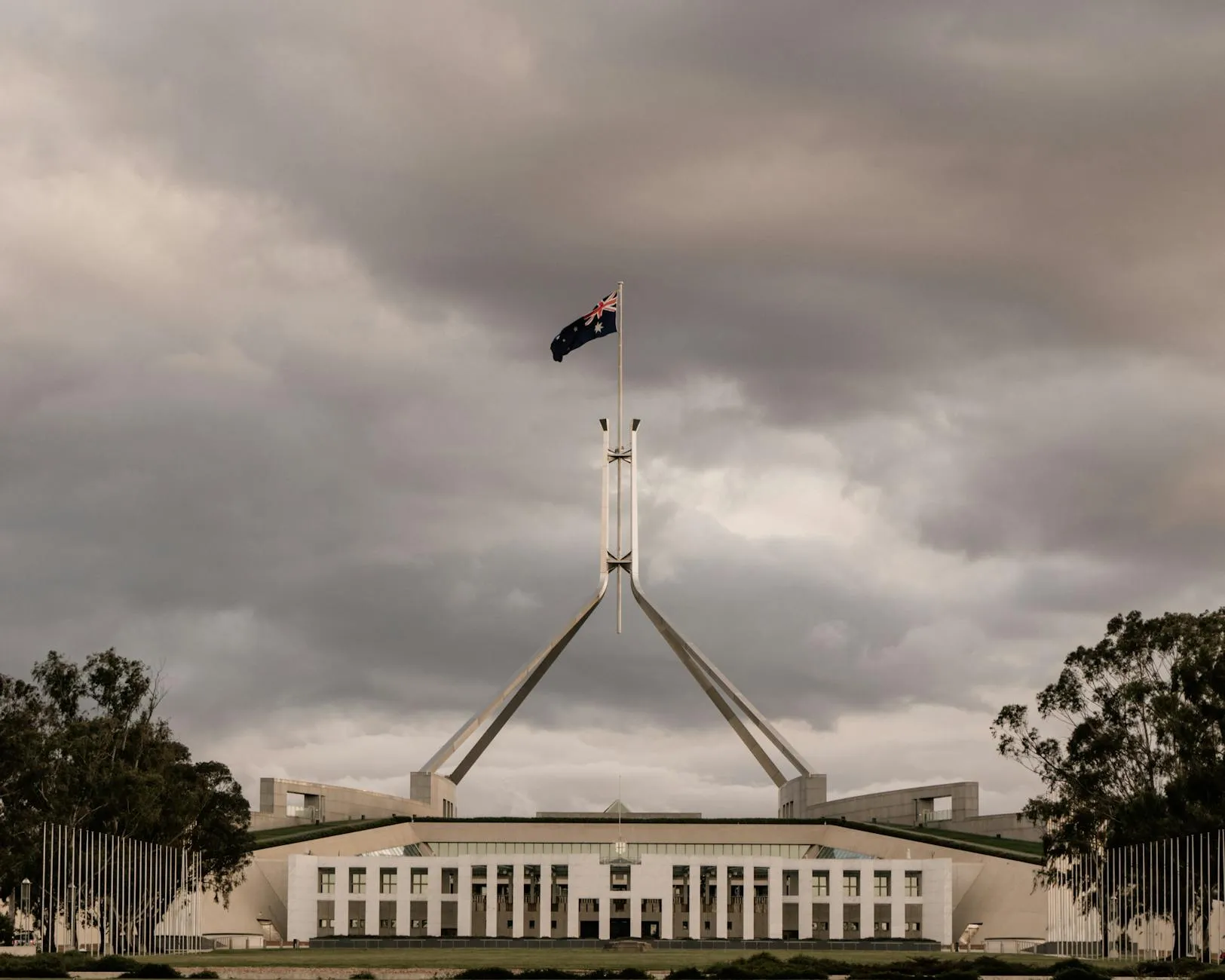
Parliament House — the working seat of federal government since 1988, built into Capital Hill with a grass roof you can walk on. Free entry with security screening at the door. When the House and Senate are sitting, the public can watch Question Time from the gallery — check the parliamentary sitting calendar before you go. The architecture alone justifies the detour.
Australian War Memorial — combined memorial and military-history museum at the foot of Mount Ainslie. Free, consistently rated the country’s standout museum. It is mid-way through a major redevelopment, so some galleries may be reconfigured — check what’s open before you plan around a specific exhibition. The daily Last Post ceremony at closing is the thing most people carry away.
National Gallery of Australia — the largest collection of Aboriginal and Torres Strait Islander art anywhere, plus Jackson Pollock’s Blue Poles. Free general entry.
National Portrait Gallery, National Museum of Australia, Questacon, the National Library — all free or low-cost, all on the lake’s edge, all walkable between each other.
Mount Ainslie lookout — a short drive or a 1–1.5 hour walk up from behind the War Memorial, giving the axial view straight down Anzac Parade to Parliament House. The postcard shot. Best at sunset.
🚗 Day Trips (car required)
Murrumbateman wine country — about 35–40 km north of the airport, roughly 35 minutes’ drive. The heart of the Canberra District cool-climate wine region, known for riesling and shiraz. Cellar doors are clustered enough to do several in an afternoon. A designated driver or tour is the practical approach.
Tidbinbilla Nature Reserve — roughly 40 km southwest, about 45 minutes. Wild kangaroos, koalas, and the easiest reliable platypus spotting near the capital. The Deep Space Communication Complex — a working NASA tracking station with a visitor centre — is nearby and worth pairing with it.
Cooma and the Snowy Mountains — Cooma is 117 km south on the Monaro Highway, about 1 hour 25 minutes. It’s the gateway to the Snowies; Jindabyne, the base for Thredbo and Perisher, is roughly 2 hours from Canberra. In winter (June–September) this is Australia’s main snowfield; in summer it’s hiking and Lake Jindabyne. Snowy Mountain Shuttles run from the airport to Thredbo if you’d rather not drive — book ahead.
The south coast — Batemans Bay and the NSW south-coast beaches are about 2.5 hours east over the Clyde Mountain. A long day trip, better as an overnight.
For a few hours before a flight, the Parliamentary Triangle is the realistic move: Parliament House, the War Memorial and one gallery fills a comfortable half-day, costs nothing, and is close to the airport.
🔧 Practical Notes
📶 Connectivity
Free wifi throughout the terminal — connect and accept the terms, no charge. For a local SIM or eSIM, the main networks are Telstra (best regional and alpine coverage), Optus and Vodafone, plus cheaper resellers like Boost, Amaysim and Aldi Mobile riding those networks. There is no full telco shop airside; buy an eSIM online before arrival or pick up a prepaid SIM at a supermarket or phone shop in town. Canberra coverage is solid; it thins in the Snowy Mountains backcountry if you head alpine.
💳 Currency & Cash
Tap-to-pay is universal across Canberra, including on buses and light rail. You can complete a full trip without handling a banknote. If you want cash, withdraw from a bank-branded ATM in town rather than the airport; the terminal’s currency exchange counter carries the usual poor spread. AUD 1 ≈ USD 0.72 ≈ EUR 0.62 as of late May 2026.
Australian notes — 5, 10, 20, 50 and 100 denominations — are polymer plastic and survive a washing-machine cycle (you may test this accidentally). Coins run 5c, 10c, 20c, 50c, $1 and $2. The $2 coin is smaller than the $1, which confuses everyone at least once.
☀️ Safety & Health
Canberra is among the lower-risk cities you will visit — low crime, well-lit streets, compact enough to navigate easily. In an emergency: 000. The realistic hazards here are environmental: strong UV (the sun burns faster than most visitors expect, including on cool clear days), summer heat, and occasional bushfire smoke in bad fire seasons, which can affect air quality and, rarely, cause flight disruption.
Tap water is safe to drink everywhere in Canberra; carry a refillable bottle and use the terminal fountains. Pharmacies stock well for non-urgent needs. Australia has reciprocal health-care agreements with some countries (UK, New Zealand and a few others) — check whether your passport is covered before assuming you are. Travel insurance otherwise.
🪙 Tipping
Not expected. Australian hospitality staff are paid a proper minimum wage, and tipping is genuinely optional rather than socially obligatory. Round up a restaurant bill or leave a few dollars for good service if you like, but no one will calculate a percentage or wait for it. Same for taxis and cafes.
❓ Frequently Asked Questions
📊 At a Glance — CBR 2026
| Feature | Detail |
|---|---|
| IATA / ICAO | CBR / YSCB |
| Distance to Civic | ~8 km / 5 mi |
| Drive time to city | 10–15 min off-peak |
| Terminal structure | Single building; Qantas and Virgin concourses around a central atrium |
| Qantas concourse opened | November 2010 |
| Virgin concourse opened | March 2013 |
| International facilities completed | 2016 |
| 2024 total passengers | ~2.83 million |
| 2024 international passengers | 37,290 |
| International routes | Nadi (Fiji Airways), Doha via Melbourne (Qatar Airways), Denpasar (Virgin Australia, since 22 Jun 2026) |
| Domestic carriers | Qantas, QantasLink, Virgin Australia, Jetstar, Link Airways, FlyPelican |
| Entry authorisation | ETA 601 (AUD 20 app) or eVisitor 651 (free); required pre-departure |
| Currency | AUD; AUD 1 ≈ USD 0.72 ≈ EUR 0.62 (late May 2026) |
| Bus to city | Rapid 3 (R3), under 20 min, MyWay+ AUD 3.41 adult peak |
| Taxi to city | ~AUD 25–35, 11–15 min, metered |
| Rideshare to city | Uber / DiDi, ~AUD 20–30, ground-level pickup |
| Rail link | None |
| Hire car | Avis, Budget, Europcar, Hertz, Thrifty + others; in terminal |
| Lounges | Qantas Club (Level 2) + Virgin Australia Lounge (Level 3), domestic-coded |
| Priority Pass | Dining credit at City Hill Coffee, Capital Brewing Co Taphouse and Noodles XO (no lounge) |
| Premium lounges | None — no Plaza Premium, Aspire or DragonPass |
| Duty-free | CBR Duty Free, Level 3 international departures only |
| Free wifi | Yes, terminal-wide |
| Tipping | Not expected |
| Tap water | Safe to drink |
| Emergency | 000 |
| Key 2026 change | Virgin Australia has flown Denpasar (Bali) since 22 June 2026 |