Innsbruck Airport (INN) — Airport Guide 2026
Quick Reference
Innsbruck Airport (Kranebitten)
INN / LOWI
Innsbruck, Tirol, Austria
Kranebitten, about 4 km west of central Innsbruck
One terminal, single 2,000 m runway; winter-dominated — more than half its traffic in ski season
Austrian Airlines (year-round to Vienna); seasonal winter scheduled and charter (Eurowings, British Airways, easyJet, Jet2, Finnair, plus Iberia, LOT and airBaltic on newer winter routes)
Austria — Schengen; EES live since April 2026, ETIAS expected, date not announced; euro
Euro (€)
Bus F to the centre and main station, ~€2.80, every 15 min, ~20 min
Shared/private transfers and ÖBB trains; most Tirol resorts under 2 hours
Tyrol Lounge (airside; Priority Pass; walk-in ~€45)
🛫 1. What Innsbruck Airport is
Innsbruck is the air link for Tirol and its ski country, and its character is overwhelmingly seasonal: more than half its traffic falls in the winter months, when northern-European skiers pour in for the resorts around the Inn Valley. In the off-season it is a quiet regional airport with little more than the year-round Austrian Airlines shuttle to Vienna; from December to April it transforms, with British, German, Scandinavian and other charters and scheduled flights crowding the Saturday changeover days.
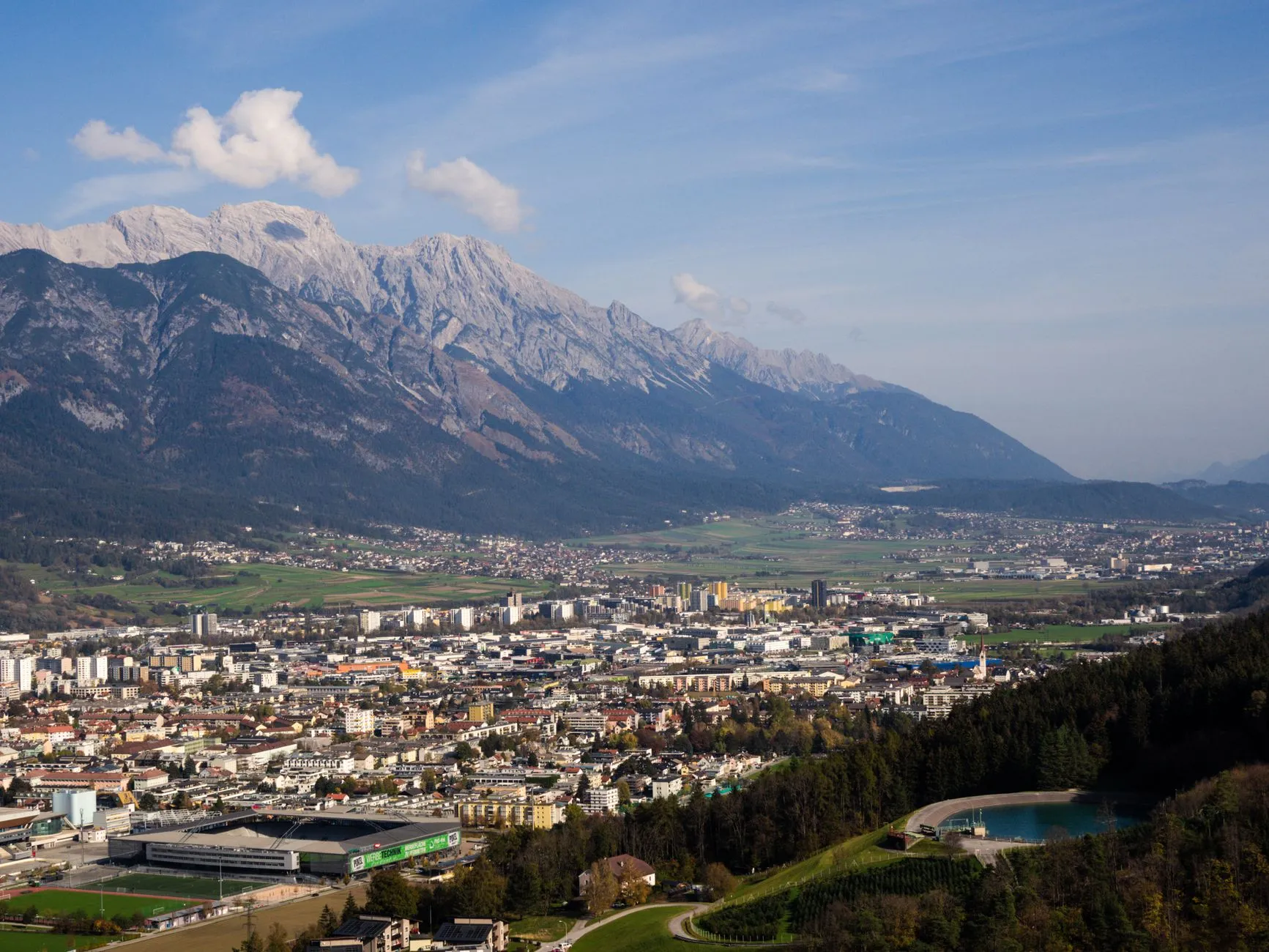
It is a small airport with a single 2,000-metre runway boxed into a steep Alpine valley, and that setting shapes everything about it — the size of aircraft it can take, the way pilots approach it, and how often winter weather disrupts it. The recent picture is one of steady winter growth, with the 2025/26 season running ahead of the year before and newer winter routes from carriers like Iberia, LOT and airBaltic widening the map of where you can fly in from.
For booking, the thing to understand is the rhythm: winter Saturdays are the peak, when the resort changeovers cluster every flight into a few busy hours, and prices and crowds reflect it. Midweek and shoulder-season flights are calmer and cheaper, and if your resort dates are flexible, avoiding the Saturday crush is the single easiest saving.
✈️ 2. The approach, and why your flight might divert
This is worth its own note, because it genuinely affects passengers rather than just interesting plane-spotters. Innsbruck has one of the more demanding commercial approaches in the Alps: aircraft thread into a narrow valley ringed by high mountains, the procedures are exacting, and crews need specific qualification to fly them.
The practical consequence is diversions. When heavy snow, low cloud or the foehn wind close in — which happens with some regularity in deep winter — flights that cannot complete the approach are sent to Munich or Salzburg, and you finish the journey by coach. It is not common on any given flight, but over a winter season it is routine enough that you should treat a tight onward connection or a same-day resort check-in with caution, and not book the last possible transfer. Build a little slack into a winter arrival.
None of this should put you off — the airport handles its winter load every year — but go in knowing the weather has a vote, especially in January and February, and keep your transfer arrangements flexible enough to absorb a late or diverted arrival.
🛂 3. The border: Austria, Schengen and EES
Austria is in the Schengen area and uses the euro, so an arrival from within Schengen has no passport control, while an arrival from outside it goes through the full external-border check.
The change to plan for is the Entry/Exit System (EES), live across the Schengen external border since April 2026. It matters here specifically because so much of Innsbruck’s winter traffic is UK charter flights — post-Brexit, those are external-border arrivals, so British skiers now face biometric registration (fingerprints and a photo) on entry, which can slow the queues on a packed winter Saturday. ETIAS, the separate pre-travel authorisation, has no announced launch date; check whether it applies to you by your travel date. Arrivals from elsewhere in Schengen are unaffected by either.
There is no visa to arrange for the short stays most skiers make, but at the winter peak the immigration hall is the bottleneck for non-Schengen arrivals, so a UK flight landing alongside three others can mean a wait. Allow for it before you assume you will make a fixed transfer time.
🚆 4. Getting into Innsbruck and out to the resorts
The airport sits only about 4 km from central Innsbruck, so reaching the city is quick and cheap — this is one transfer that is genuinely easy.
The Bus F runs from outside the terminal to the city centre and the main station (Hauptbahnhof) in about 20 minutes, every 15 minutes, for around €2.80 from the ticket machine. A taxi into town is a short, inexpensive ride. From the Hauptbahnhof you connect to the wider Austrian rail network, which is the key to the resorts — several of the big ones are on or near the train line.
For the ski resorts, the choice is between a transfer and the train. St Anton is about an hour away and sits on the main railway, so the train is a real option; Sölden is around 1h30 and Ischgl about 1h40, both more easily reached by road, with shared shuttle transfers starting from roughly €27 per person and private cars costing more. Most of the well-known Tirol resorts — Mayrhofen, Kitzbühel, Obergurgl, Hintertux, Lech among them — are under two hours. Book a shared shuttle ahead for the busy Saturdays rather than relying on turning up, and weigh the train for the rail-served resorts, where it can be cheaper and unaffected by road traffic.
The honest trap is the airport taxi for a long resort run, which is expensive against a pre-booked shared shuttle or the train; sort the resort transfer before you fly rather than improvising at the rank.
🛬 5. The terminal and the lounge
Innsbruck operates from a single compact terminal, and the experience splits by season: easy and quiet most of the year, genuinely busy on winter Saturdays when the resort changeovers stack departures and the check-in and security queues build. Leave more time than the airport’s size suggests on those peak days, and check your airline’s bag and boarding rules, since the charter operators can be strict.
There is one lounge worth knowing. The Tyrol Lounge is airside on the first floor near gates 11 and 12, open through the day, and accessible on Priority Pass or by paying around €45 at the door for a three-hour stay, with the usual drinks, snacks and quiet seating. On a crowded winter departure day it is a genuine refuge from the terminal crush; in the quiet season the walk-in price is steep for a short wait.
The food and shops are modest, geared to a quick coffee and a snack rather than a meal, so the eating worth doing is in Innsbruck itself. What is worth carrying home from Tirol is the edible local stuff — speck, mountain cheese, schnapps — bought in the city or resort rather than at the airport.
🌅 6. The reason to come: Tirol and Innsbruck
In winter the answer is obvious — the ski resorts are why the airport exists in that season, and the Inn Valley puts an unusual concentration of them within a short transfer. The range runs from the high, snow-sure glacier skiing at Sölden and Hintertux to the village charm of St Anton, Lech and Kitzbühel, so the resort you pick matters more than the airport you fly into.
What sets Innsbruck apart from a pure resort-strip airport is that the city it serves is genuinely worth time in its own right, summer or winter. Innsbruck hosted the Winter Olympics twice, and the mountains are part of the city — the Nordkette cable car climbs from the centre to a high alpine ridge in minutes. The old town has the late-Gothic Goldenes Dachl (Golden Roof), the Bergisel ski jump above the city is a Zaha Hadid landmark you can visit, and the Swarovski Crystal Worlds lie a short way out. It rewards a day or two at either end of a ski trip rather than a straight airport-to-slope dash.
In summer the valley shifts to hiking, cycling and mountain air, with the airport much quieter and fares lower. There is no separate aifly Innsbruck guide, so the short version is this: come in winter for the Tirol resorts, but give the city itself a day, because it is one of the few ski-region airports where the arrival point is a destination too.
❓ 7. FAQ
📋 8. At a glance
| Item | Detail |
|---|---|
| Airport | Innsbruck (INN / LOWI), Kranebitten, ~4 km west of central Innsbruck |
| Terminal | One terminal, single 2,000 m runway; winter-dominated (over half its traffic in ski season) |
| Recent change | Steady winter growth; newer winter routes from Iberia (Madrid), LOT (Warsaw) and airBaltic (Riga) |
| Carriers | Austrian (year-round Vienna); seasonal Eurowings, British Airways, easyJet, Jet2, Finnair and others |
| To the city | Bus F to the centre/main station, ~€2.80, every 15 min, ~20 min; ~4 km |
| To the resorts | Shared shuttles from ~€27 (Ischgl ~1h40, Sölden ~1h30); train for St Anton (~1h) and other rail-served resorts |
| Border | Austria — Schengen; EES live since April 2026, ETIAS expected, date not announced; euro |
| Currency | Euro (€) |
| Lounge | Tyrol Lounge (airside; Priority Pass; walk-in ~€45, 3-hour stay) |
| Worth your time | The Tirol ski resorts in winter — and Innsbruck itself, an Olympic city with the Nordkette and the Goldenes Dachl |
🔗 9. Explore More
- Vienna Airport (VIE) guide — Austria’s main hub, with the CAT rail link and the year-round connection to Innsbruck
- Munich Airport (MUC) guide — the usual diversion airport in bad weather, and a common alternative way into the Tirol resorts by train