Lille Airport (LIL) — Airport Guide 2026
Quick Reference
Aéroport de Lille (Lille–Lesquin)
LIL / LFQQ
Lesquin, about 7 km south-east of Lille, Hauts-de-France
One terminal, recently expanded (18,000 → 33,000 m²) toward a 3-million capacity; low-cost and leisure focused
easyJet, Ryanair, Volotea, Transavia, ASL Airlines France, Air Algérie — heavy on Maghreb and Mediterranean leisure
France — Schengen; EES live since April 2026, ETIAS expected, date not announced; euro
Euro (€)
Flibco shuttle to Lille-Flandres, €6.99 online / €9 on board, ~20 min; taxi €15–25
Lille is a TGV/Eurostar hub — the train often beats flying for Paris, Brussels and London
No major lounge to count on
🛫 1. What Lille Airport is
Lille-Lesquin is the airport for the Hauts-de-France region, about 7 km south-east of the city, and it is a low-cost and leisure airport rather than a full-service hub. Its busiest strands are the Mediterranean holiday routes and, distinctively, a strong network to the Maghreb — Air Algérie and ASL Airlines France run a spread of Algerian cities, and the budget carriers fly Morocco — reflecting the large North African community of the region. easyJet, Ryanair, Volotea and Transavia handle most of the rest.
The genuine recent change is the terminal. Lille has been through a major expansion that roughly doubled the building, from about 18,000 to 33,000 square metres, with new check-in halls and more boarding gates, lifting capacity toward three million passengers a year, and traffic jumped sharply in the years after. So the airport you pass through now is a noticeably bigger, more modern building than its reputation as a small regional field suggests.
For booking, this is mostly a point-to-point leisure airport: cheap fares to the sun and to North Africa, plus some domestic and short-haul European routes. The carriers are predominantly low-cost, so expect strict baggage rules and to pay for extras, and book ahead for the better fares on the popular summer and holiday routes.
🚄 2. The honest bit: should you even fly into Lille?
This is the most useful thing to know about Lille, and most airport guides will not tell you: for a lot of journeys, the airport is the wrong way to arrive, because Lille is one of the best-connected rail cities in Europe.
Lille-Europe station puts you on the TGV and Eurostar network: Paris in about an hour, Brussels in around 35 minutes, and London in roughly 1h20–1h30 by direct train. For those three cities in particular, the train is faster door-to-door than flying once you count airports and transfers, and far less hassle. If your trip is Lille to Paris, Brussels or London, the honest advice is to take the train and skip the plane entirely.
Where the airport earns its place is the routes the train cannot do cheaply or at all: the Mediterranean beaches, the Maghreb cities, and the budget short-hauls that would be a long overland slog. Think of Lille-Lesquin as the holiday-and-homeland airport, with the rail station as the better tool for the nearby capitals.
🛂 3. The border: France, Schengen and EES
France is in the Schengen area and uses the euro, so arrivals from within Schengen pass without border control, while arrivals from outside it go through the full external-border check.
The change to plan for is the Entry/Exit System (EES), live across the Schengen external border since April 2026. It is especially relevant at Lille because a real share of the airport’s international traffic comes from outside Schengen — the Algeria and Morocco routes — so those arrivals now face biometric registration (fingerprints and a photo) on entry, which can slow the immigration hall when a couple of Maghreb flights land together. ETIAS, the separate pre-travel authorisation for visa-exempt visitors, has no announced launch date. Arrivals from elsewhere in Schengen, and domestic flights, are unaffected by both.
For most European visitors there is no visa to arrange and the practical concern is queue time rather than paperwork. If you are arriving from North Africa or connecting onward on a tight margin, give the border more time than the airport’s modest size would suggest at the busier periods.
🚆 4. Getting into Lille
The airport is only about 7 km from the centre, roughly 15 minutes on a clear road, so this is a short and easy transfer.
The Flibco shuttle is the standard option: an express bus to Lille-Flandres, the central station, taking about 20 minutes and costing €6.99 booked online or €9 on board — book online for the lower fare. A taxi to the centre runs about €15–25 depending on traffic and drop-off. There is also a rail option via the nearby Lesquin station, reached by a short local connection, with frequent trains into the city, but for most arrivals the direct shuttle or a taxi is the simpler choice.
There is no rail station at the terminal itself, so the shuttle is the cheap mainstay. Because Lille-Flandres and Lille-Europe stations are close together in the centre, arriving by shuttle also drops you near the onward train network if you are continuing to Brussels, Paris or elsewhere by rail — which, as above, is often the smarter way to cover those legs.
🛬 5. The terminal and the lounge
The expanded terminal is brighter and more spacious than the airport’s old reputation, with the doubled retail and catering area giving you more than the bare minimum to fill a wait, though it remains a single building handling a low-cost schedule. Check your airline’s terminal and gate, follow the budget carriers’ bag and check-in rules, and leave more time at the summer and holiday peaks when the leisure flights cluster.
There is no major lounge to plan around at Lille. If you hold Priority Pass or expect a lounge to wait in, treat it as unavailable here and use the general seating and the cafés; this is a low-cost airport, and the comforts are sized to match.
The eating worth doing is the regional Flemish-French food, and it belongs in the city rather than the terminal — Lille’s cooking is one of the reasons to be here. What is worth carrying home is local and keeps well: maroilles, the pungent regional cheese, the merveilleux meringue cakes the city is known for, and a bottle of genièvre, the juniper spirit of the north, bought in town rather than at airport prices.
🌅 6. The reason to come: Lille
Lille is a genuine city to spend time in rather than a transfer point, and it surprises people who think of northern France as only somewhere to pass through. Its character is half-French, half-Flemish, and that shows in the architecture and the food alike.
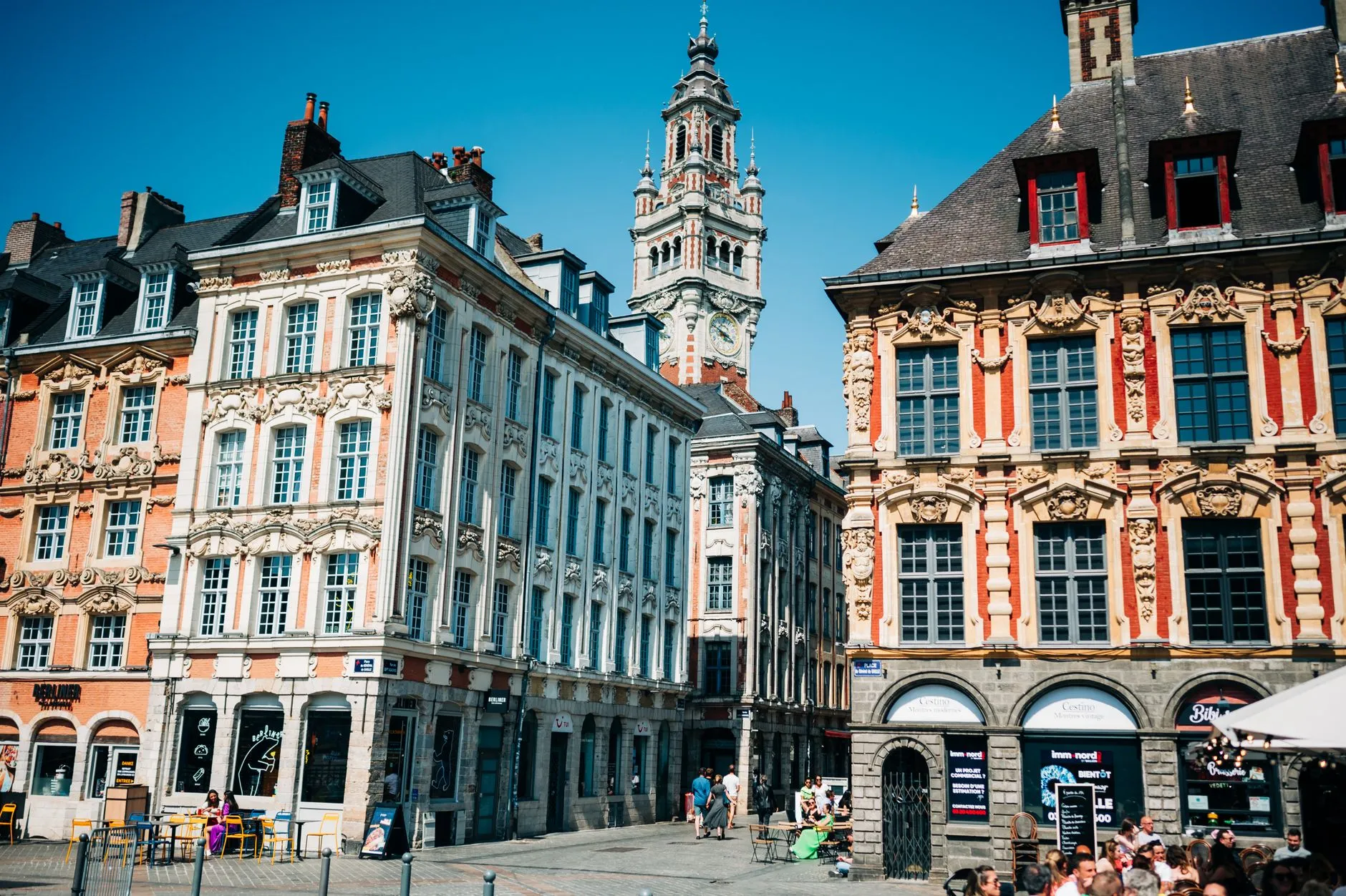
The heart of it is Vieux Lille, the old quarter of gabled brick-and-stone houses, good restaurants and small shops, and the grand Grand’Place at the centre. The Palais des Beaux-Arts is one of the largest art museums in France outside Paris, with a serious collection. The food is Flemish-French comfort cooking — carbonnade flamande, moules-frites, and the local beers — and it is done well and affordably across the city. Lille is also a short hop by train from Brussels, Bruges and Ghent, which makes it an easy base for the wider region.
The one date to know is the Braderie de Lille, on the first weekend of September: a vast city-wide flea market that is one of the largest in Europe, drawing huge crowds and famous for mountains of moules-frites. If you are travelling then, book accommodation well ahead and expect the city full; if you would rather avoid the crush, steer clear of that weekend. There is no separate aifly Lille guide, so the short version is to give the old town, the museum and the food a day or two, and use the trains for the cities around.
❓ 7. FAQ
📋 8. At a glance
| Item | Detail |
|---|---|
| Airport | Aéroport de Lille / Lille–Lesquin (LIL / LFQQ), ~7 km south-east of Lille |
| Terminal | One terminal, recently expanded (18,000 → 33,000 m²) toward a 3-million capacity; low-cost / leisure |
| Recent change | Major terminal expansion roughly doubling the building; sharp traffic growth after |
| Carriers | easyJet, Ryanair, Volotea, Transavia; strong Maghreb network on Air Algérie and ASL Airlines France |
| To the city | Flibco shuttle to Lille-Flandres, €6.99 online / €9 on board, ~20 min; taxi €15–25; ~7 km |
| Rail | Lille-Europe (city centre) is a TGV/Eurostar hub — train beats flying for Paris (~1h), Brussels (~35 min), London (~1h20) |
| Border | France — Schengen; EES live since April 2026 (relevant to the Algeria/Morocco routes), ETIAS expected, date not announced; euro |
| Currency | Euro (€) |
| Lounge | No major lounge to count on |
| Worth your time | Vieux Lille and the Grand’Place, the Palais des Beaux-Arts, Flemish-French food — and the September Braderie |
🔗 9. Explore More
- Paris Charles de Gaulle Airport (CDG) guide — the major hub about an hour from Lille by TGV, for long-haul connections
- Paris Beauvais Airport (BVA) guide — another budget airport of northern France, for comparing low-cost options