Islamabad International Airport (ISB) — Airport Guide 2026
PIA resumed flights to Europe from this terminal in January 2025 — the first Paris service in nearly five years — after the EU lifted its safety ban on the airline in November 2024, making ISB a genuinely different proposition for European passengers than it was twelve months ago.
Quick Reference
ISB / OPIS
1 May 2018; commercial ops from 3 May 2018
Fateh Jang, Punjab — ~25 km SW of Islamabad’s Zero Point and Rawalpindi’s Saddar
~30–35 km, 30–45 min by road
Single Y-shaped, ~180,000 m², 15 jet bridges + 10 remote stands, 42 immigration counters
2 parallel, each 3,658 m (12,000 ft)
~9 million (masterplan allows 25 million)
Pakistan Civil Aviation Authority
Pakistan International Airlines (PIA)
e-Visa in advance only via visa.nadra.gov.pk; VoA suspended 1 Jan 2026
PKR — ~279/USD, ~323/EUR (May 2026; volatile — verify before travel)
Rs.100 to airport station; ~06:15–22:00
~Rs.1,500–2,500 to F-sectors
Careem / Uber / inDrive, 24/7
CIP Lounge + Airline Lounge (Priority Pass / DragonPass / LoungeKey)
Yes, SMS-verified
US State Dept Level 3 “Reconsider Travel”; UK FCDO advises against all travel to Balochistan
🏢 Terminal & Layout
The old airport — Benazir Bhutto International, still called Chaklala by anyone who remembers it — ran out of room a decade before it closed. It sat inside Rawalpindi’s built-up fabric, shared a runway with a Pakistan Air Force base, and could not expand in any direction. The replacement was first planned for 2007. It opened on 1 May 2018, eleven years late, after contractor disputes and design changes that became a minor national saga. Prime Minister Shahid Khaqan Abbasi cut the ribbon; paying passengers arrived 3 May 2018.
The building is a single Y-shaped terminal covering roughly 180,000 m², designed by France’s Aéroports de Paris Ingénierie with Singapore’s CPG Corporation. Logic is straightforward: Level 2 (upper) is departures — check-in, security, emigration, the airside concourse; Level 1 (lower) is arrivals — 42 immigration counters, baggage belts, customs. Domestic and international share the same roof, which keeps transfers short, but the split needs to be tracked early. Follow the international/domestic fork before you reach the gate, not at it.
The hardware is comfortable for current traffic. Two parallel runways at 3,658 m (12,000 ft) each handle wide-bodies without weight penalties. Fifteen jet bridges plus ten remote stands serve the schedule — remote stands mean a bus to the aircraft is common on the cheaper carriers, so add ten minutes at boarding. Stated annual capacity is 9 million passengers, with the masterplan expandable to 25 million. In fiscal 2024–25 ISB overtook Karachi to become Pakistan’s busiest airport.
PIA operates the hub and the domestic network plus the restored European routes. Confirmed foreign carriers include Emirates, Qatar Airways, Etihad, Turkish Airlines, flydubai, Saudia, Gulf Air, Oman Air, China Southern and British Airways, alongside Pakistani operators Airblue and SereneAir. The Gulf banks — Dubai, Doha, Abu Dhabi, Istanbul — remain the practical connections to Europe, North America, and the wider network; the twice-weekly direct PIA European service is real but thin by comparison. The traffic mix is heavily diaspora and labour-migration. The early-hours Gulf departures fill with workers heading to the UAE, Qatar and Saudi Arabia, which is precisely why those banks run busiest and slowest on the emigration queue.
⏰ Arrive three hours before international departures
Emigration plus security moves slowly during the late-night Gulf bank — most flights to Dubai, Doha and Abu Dhabi depart between roughly 02:00 and 06:00, and there is no fast-track for economy class. Domestic departures need 90 minutes.
One structural issue worth knowing before you book: there is no airside transit corridor between international arrivals and domestic departures. A connection from, say, an inbound flight from Istanbul onto a domestic leg to Lahore means clearing immigration, collecting your bag, re-checking it, and going back through security upstairs. Budget for it; it is not a short process.
The building has moments where the eleven years of delays and contractor disputes show — some signage is inconsistent, a few promised facilities arrived late. It functions well, but it is a working airport rather than a showcase one.
🛂 Visa, Entry & Fees
The single most important update for 2026: Pakistan suspended both its Visa-on-Arrival and Visa-Prior-to-Arrival arrangements on 1 January 2026. There is no longer a counter at ISB where a visitor buys entry on landing. You need an approved e-Visa in your possession before you board.
Apply through the official NADRA-run portal, visa.nadra.gov.pk. That is the only site with any standing — the third-party “Pakistan visa” sites that rank well in search add a markup and have no official function.
Nationals of roughly 191 countries can apply. Tourist visa fees scale by nationality: broadly USD 5 to USD 100, with a flat USD 20 for nationalities not in a specific bracket. A short list — among them China, Japan, Iceland, Malaysia, the UAE and Saudi Arabia — pay no fee but must still apply through the portal. The headline fee is not the full bill: the portal adds statutory welfare and government levies (roughly 10% each), a fixed NADRA service charge of about USD 8, and a card-processing fee of around 2.2%. Pay by Visa or Mastercard on the portal. Check the live fee calculator before paying — the figures above are a May 2026 snapshot.
⚠️ Apply four weeks out, not one
Official processing is quoted as 7–10 working days, but applicants regularly report up to 20 business days. Do not book a non-refundable ticket against a same-week approval. Print the approval letter — you may be asked for it at check-in and on arrival.
There is no separate tourist or departure tax collected in cash at ISB; it is built into the ticket. Cash above the equivalent of roughly USD 10,000 must be declared at customs on both arrival and departure.
💉 Health requirements
Pakistan is not a yellow-fever country, but a yellow-fever vaccination certificate is required of arrivals aged one year and over coming from — or transiting more than 12 hours through — a country with risk of yellow-fever transmission. If your routing touches sub-Saharan Africa or parts of South America, carry the certificate. Routine cover (typhoid, hepatitis A, tetanus) is the standard travel-medicine advice for Pakistan. Do not drink the tap water; see Practical Notes.
💴 Currency
The Pakistani rupee (PKR, written Rs.) traded at roughly 279 to the US dollar and 323 to the euro in late May 2026. The rupee is managed and has been volatile for several years; every price in this guide is a May 2026 figure — recheck before travel.
Notes in circulation: Rs.10, 20, 50, 75 (a commemorative note that is legal tender), 100, 500, 1,000 and 5,000. The Rs.5,000 is the largest denomination; the State Bank confirmed in January 2026 that it survives the 2026 banknote redesign — years of discontinuation rumours ended with a cabinet approval on 14 January 2026 for a phased rollout through 2026, with old notes remaining legal during the changeover.
💵 Carry small notes
Pakistan runs largely on cash outside big hotels and chains. The Rs.5,000 note is often unbreakable at a dhaba, a market stall, or in a taxi. Withdraw at the airport ATM or change a working amount at the arrivals exchange counter; city exchange dealers in Blue Area typically offer a marginally better rate.
🚆 Getting Into the City
The terminal sits 25-plus kilometres out on motorway, so the transfer is a real leg of any itinerary.
Orange Line metro — Rs.100
The Orange Line runs the 25.6 km from the airport to Peshawar Morr interchange in about 45 minutes, with 14 stations and departures every 5–10 minutes from roughly 06:15 to 22:00. A single ride is Rs.100 (≈ USD 0.36); a rechargeable T-Cash card costs Rs.130 to issue and works across the Orange, Blue and Green lines. It is the cheap option and it genuinely reaches the airport.
The limitations are meaningful. Many international flights land or depart outside the 06:15–22:00 window — particularly the Gulf banks — so the metro simply does not run when you need it. And from Peshawar Morr you must change to the main Rawalpindi–Islamabad Metrobus to reach the city centre; this is not a single-seat ride. The US State Department’s 2026 advisory explicitly recommends avoiding the Rawalpindi–Islamabad Metro Bus on security grounds. That is stated plainly here so you can weigh it yourself; many Islamabad residents use both lines daily without incident.
🚌 Metro: daytime only, one change required
The Orange Line ends at Peshawar Morr, not at a city-centre station. The onward Metrobus to Blue Area or Centaurus is a separate service and fare. The US 2026 advisory flags that Metrobus on security grounds — it is a stated recommendation, not a generalised warning about the entire network.
Pre-paid taxi voucher — ~Rs.1,500–2,500
The booth inside the arrivals hall sells fixed-fare vouchers by destination zone, typically Rs.1,500–2,500 to the F-6/F-7 hotel area (≈ USD 5.50–9). The price is agreed before you enter the car, which removes every argument. Allow 30–45 minutes to central Islamabad outside rush hour. Confirm the zone and fare at the booth, not with the driver.
⚠️ Do not accept “taxi, sir?” inside the hall
The person approaching you near the baggage belts is not the pre-paid booth. They are the unmetered, over-quoted curbside car. The booth is twenty paces further — same ride, set price.
Careem / Uber / inDrive
Ride-hailing is established in Islamabad and available around the clock. Careem is the dominant local app; Uber and inDrive also operate. A run to F-6/F-7 typically lands in the same Rs.1,500–2,500 band, sometimes below it off-peak, with a tracked car and cashless payment. Surge applies around the late-night flight banks. Use the app’s designated pickup pin in the arrivals forecourt rather than following anyone who approaches inside the building.
Bykea
A Pakistani bike-and-car hailing app used widely across Islamabad and Rawalpindi for cheap short hops once you are in the city. Not the right tool from the terminal on arrival with luggage at 3 a.m. — verify on the app whether it serves the airport zone before assuming it does.
Hotel transfers
Pearl Continental, Marriott and Serena run reservation counters at the airport. They charge a premium over Careem for the certainty — reasonable on a first night, harder to justify after that.
🛋️ Lounges
Two lounges are confirmed on the main independent networks in 2026.
CIP Lounge — open 24 hours, accessible via Priority Pass, DragonPass and LoungeKey, and available as a paid walk-in. Seating, hot and cold buffet, Wi-Fi, washrooms. Standard in quality; a real improvement on gate-area chairs during a long overnight Gulf-bank wait.
Airline Lounge — also 24 hours, same Priority Pass / DragonPass / LoungeKey access, used by carriers for premium passengers and available to cardholders when capacity allows. Quality is comparable to the CIP; on the busiest late-night departures one can fill before the other.
🛋️ No branded Gulf-carrier lounges at ISB
There is no dedicated Emirates, Qatar Airways, Turkish Airlines or Etihad lounge listed on the major lounge networks here. Premium-cabin passengers are directed to the shared CIP and Airline lounges. The branded lounge experience waits at Dubai, Doha or Istanbul. There is also no airside transit hotel or sleep-pod facility — a long overnight connection means the lounge or the gate seats.
For a Priority Pass or DragonPass cardholder, the move is simple: clear emigration, find the CIP Lounge, and treat it as the only comfortable airside option that exists.
🍽️ Food Before You Fly
ISB’s food offer is a functional airport food court. The airport’s own listings name categories — coffee shops, refreshment counters, a food court, gift and duty-free stores — rather than named outlets, most running 24/7 to cover the night schedule. Naming a specific stall would be guessing; this guide does not do that.
Expect an international coffee chain, a fast-food counter, and a Pakistani/sub-continental hot counter. Airside prices carry the usual captive markup: a coffee running Rs.400–600 in the city reaches Rs.700–1,000 airside, and a plated meal priced at Rs.800–1,200 at a city dhaba will run Rs.1,800–2,500 inside the terminal.
The three dishes worth ordering, if the food court has them on a given day: chicken or beef karahi — meat cooked down in a wok-shaped pan with tomato, ginger and green chilli, served with naan from the tandoor; biryani (spiced rice with meat); and chapli kebab, a flat, spiced minced-beef patty native to Khyber-Pakhtunkhwa that turns up everywhere in Islamabad. Chai — milky, sugared, usually cardamom-spiced — is the one thing the airport does cheaply and well. If you want the genuine version of any of these, eat in the city before the airport; the terminal serves a competent, expensive shadow.
Duty-free
Pakistan is a dry country for the general public — alcohol is not sold to Muslims and is tightly controlled — so the duty-free hall is not the liquor-and-perfume operation of a Gulf hub. Expect perfume, cosmetics, chocolate, tobacco and gift items.
The genuinely good local buys here are Himalayan pink salt (mined at Khewra, south of Islamabad, sold in blocks and grinders), dried fruit and nuts from the northern areas, and packaged green tea (qahwa). None of these are duty-free bargains specifically — they are simply the things worth carrying out.
💡 Islamabad: What’s Within Reach
Islamabad is a planned city laid out in lettered sectors in the 1960s, backed by the Margalla Hills, and it reads as genuinely green and ordered to first-time visitors. The sights below are real. The caveat — and it is a substantial one — comes at the end of this section.
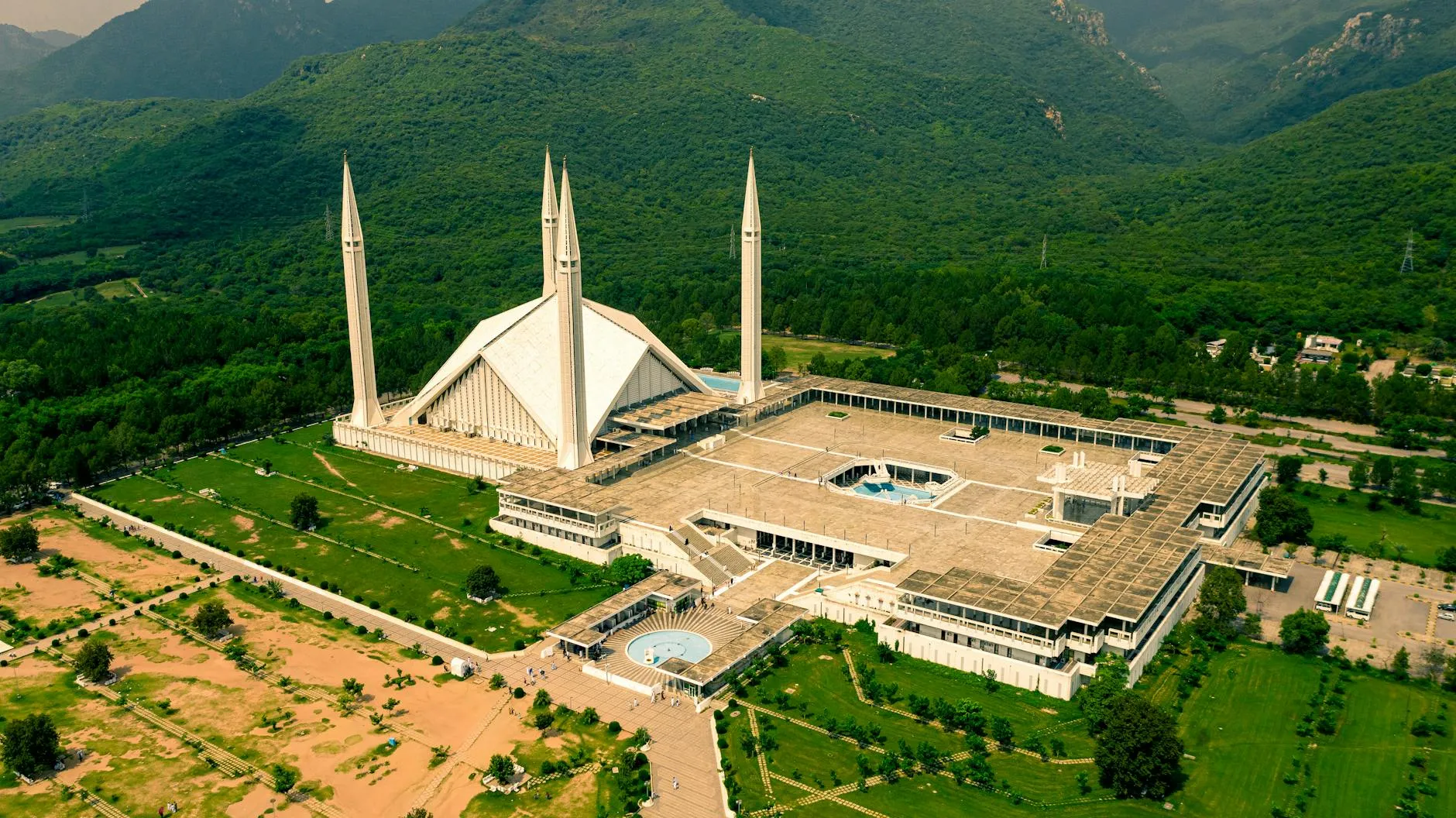
Faisal Mosque — ~35 minutes’ drive (≈30 km) from the airport, at the foot of the Margalla Hills in sector E-8. Designed by Turkish architect Vedat Dalokay and completed in 1986, its angular, tent-derived form holds tens of thousands of worshippers and is the city’s defining landmark. Entry is free; dress modestly and remove shoes.
Daman-e-Koh and the Margalla Hills — Daman-e-Koh is a viewpoint partway up the Margallas, roughly 40–45 minutes from the airport, looking down over the mosque, Rawal Lake and the city grid. The Margalla Hills National Park covers around 17,000 hectares. Trail 5 from the city side is the most-used; Trail 3 is the steeper climb and rewards it. Allow a half-day for a hike plus the drive.
Pakistan Monument and Lok Virsa — both on the Shakarparian hills near Zero Point, ~35–40 minutes from the airport. The Pakistan Monument is a granite flower-petal structure (each petal a province) with a museum tracing the independence movement; Lok Virsa is the national heritage museum, with reconstructed village scenes, costumes and crafts from across the country. A coherent half-day if you want the country’s story over its landscapes; the Shakarparian viewpoint also takes in the Margallas, Rawal Lake and both cities.
Saidpur Village — a restored pre-Islamabad settlement at the foot of the Margallas, ~40 minutes out, where stone houses, a temple and shrines sit alongside cafes and craft spaces. A short stop rather than a half-day; often paired with Daman-e-Koh on the same run.
Taxila — ~35 km from Islamabad, and conveniently on the airport side of the city. One of South Asia’s major Gandhara-era archaeological zones, a centre of Buddhist learning with stupas, monasteries and a museum. Budget a half-day including travel; it is the most layover-plausible option geographically.
Murree — the nearest hill station, roughly 60 km and at least 1.5–2 hours each way through hill traffic that worsens at weekends and in snow season. A full day from the airport, not a half-day.
⚠️ The layover maths does not work on short connections
The round trip to even the closest sight (Taxila or Faisal Mosque) is 60–90 minutes each way. On top of that: you now need an e-Visa issued in advance to leave the airport at all (visa-on-arrival ended 1 January 2026), and international re-entry wants a three-hour security buffer. A city excursion needs a layover of at least 8 hours plus a valid visa already approved before you depart. Murree needs an overnight. On anything shorter, the CIP Lounge is the honest answer.
🔧 Practical Notes
Connectivity
ISB has free Wi-Fi, but it is SMS-verified — you need a text message to get the password, which is awkward on arrival without a Pakistani number. The fix is a local SIM from the arrivals-hall kiosks. Jazz and Zong have the best coverage; a tourist SIM with 10–30 GB runs roughly Rs.500–1,000, and activation takes 15–30 minutes because your passport must be registered with the telecom regulator. Buy at the airport if you need data immediately; city shops run the same registration with less queue.
Bykea is the local Pakistani bike-and-car app for cheap city hops once you are settled — the genuinely local-priced alternative to Careem for short urban runs.
Safety
As of 2026, the US State Department rates Pakistan at Level 3 — “Reconsider Travel” — citing terrorism, armed conflict, crime and kidnapping. The UK FCDO advises against all travel to Balochistan province and warns of an ongoing terrorism risk across the country. The risk is concentrated in Balochistan and Khyber Pakhtunkhwa, but incidents have reached the capital: a suicide bombing outside Islamabad on 6 February 2026 killed at least 36 people, and a bombing near a district court in Islamabad’s G-11 sector in November 2025 killed 12. Islamabad itself is among the more secure and orderly Pakistani cities day-to-day — the Diplomatic Enclave and the F-sectors are heavily policed — but the advisory is current and accurate.
Scams and petty crime
The airport’s specific traps are routine: touts inside arrivals steering you to an unmetered car over-quoted by zone, and the usual “no meter” curbside negotiation. Use the pre-paid booth or your ride-hailing app. Petty theft exists; violent street crime against visitors in the F-sectors is uncommon. Keep your passport and visa printout accessible — hotel check-in and occasional checkpoints may ask for them.
Tipping
Tipping (locally baksheesh) is expected but modest: round up a taxi fare, leave 5–10% at a restaurant if service is not already added, give Rs.100–200 to a porter. Dress is conservative — cover shoulders and knees; women may want a scarf for mosque visits. Friday is the main prayer day; some services slow midday.
Water
Do not drink the tap water. Use bottled water for drinking and brushing teeth; it is cheap and widely available. Standard food hygiene precautions apply to street food; freshly griddled naan and chai from a clean counter carry low risk.
❓ FAQ
📊 At a glance — ISB 2026
| Feature | Detail (verified May 2026) |
|---|---|
| IATA / ICAO | ISB / OPIS |
| Opened | 1 May 2018 (replaced old Benazir Bhutto Intl / Chaklala) |
| Operator | Pakistan Civil Aviation Authority |
| Location | Fateh Jang, Punjab — ~25 km SW of Islamabad/Rawalpindi |
| Distance to F-6/F-7 hotels | ~30–35 km, 30–45 min by road |
| Terminal | Single Y-shaped, ~180,000 m², 2 levels |
| Gates | 15 jet bridges + 10 remote stands |
| Immigration counters | 42 |
| Runways | 2 parallel, each 3,658 m (12,000 ft) |
| Annual capacity | ~9 million (expandable to 25 million) |
| Hub airline | Pakistan International Airlines (PIA) |
| PIA European routes | Resumed Jan 2025 (EU ban lifted Nov 2024; UK ban lifted Jul 2025) |
| Visa | e-Visa in advance only; VoA suspended 1 Jan 2026 |
| Currency | PKR — ~279/USD, ~323/EUR (May 2026; volatile) |
| Orange Line metro | Rs.100 to airport station; ~06:15–22:00 |
| Airport taxi voucher | ~Rs.1,500–2,500 to F-sectors |
| Ride-hailing | Careem / Uber / inDrive, 24/7 |
| Lounges | CIP Lounge + Airline Lounge (Priority Pass / DragonPass / LoungeKey) |
| Dedicated airline lounges | None — shared CIP/Airline only |
| Free Wi-Fi | Yes, SMS-verified |
| Tourist SIM | Jazz / Zong, ~Rs.500–1,000, passport registration required |
| Tap water | Not safe — use bottled |
| Yellow fever | Certificate required if arriving from a risk country |
| Travel advisory (2026) | US Level 3 “Reconsider Travel”; UK FCDO against all travel to Balochistan |