New Ishigaki Airport (ISG) — Airport Guide 2026
New Ishigaki Airport replaced a short-runway predecessor in March 2013, moved to the Shiraho side of the island, and has since served as the main point of entry for the Yaeyama Islands — the archipelago in Japan’s far southwest that sits geographically closer to Taiwan than to Tokyo.
Quick Reference
ISG / ROIG
New Ishigaki Airport / Painushima Ishigaki Airport
Shiraho district, ~15 km from central Ishigaki, Okinawa Prefecture
One domestic terminal; separate seasonal international wing
Seasonal: Taipei Taoyuan & Kaohsiung (Tigerair Taiwan), Hong Kong (HK Express), Seoul Incheon (Jin Air)
Japanese yen (JPY, ¥) — ≈ ¥159/US$1, ≈ ¥186/€1 (May 2026)
Azuma Bus routes 4 & 10, ¥550, ~35–40 min, ~every 30 min, last ~21:45
~¥2,800, ~20 min (port ferry terminal ~¥3,500, ~25 min)
None on Priority Pass / DragonPass / LoungeKey
Japan visa-free entry, up to ~90 days (~70 eligible nationalities)
Not in force in 2026; targeted ~2028
ANA Ishigaki–Osaka (Itami): peak blocks only, 1 daily round-trip
✈️ Terminal & Carriers
ISG is a single passenger building with a domestic terminal and a quieter international wing that handles the seasonal Taiwan, Hong Kong and Seoul flights. You can walk it end to end in a few minutes. There is no airside transit maze.
The domestic operation is the main event. JAL flies the Tokyo Haneda trunk route; ANA flies Haneda, Osaka (Kansai) and Nagoya (Chubu). JTA (Japan Transocean Air, JAL’s Okinawa subsidiary) flies Osaka (Kansai) and Naha, and Solaseed Air flies Naha only. Peach runs the low-cost routes — Tokyo Narita, Osaka (Kansai) and Fukuoka, the island’s one Kyushu link — several of them seasonal. Two smaller operators matter for the Yaeyamas themselves: Ryukyu Air Commuter (RAC) flies Naha, Miyako and Yonaguni, and Daiichi Air flies Tarama and Hateruma, the only air link to Japan’s southernmost inhabited island. The single most-used route is the short hop to Naha on Okinawa’s main island — ANA, JTA, Solaseed and RAC all fly it, and many travellers reach Ishigaki via that connection rather than direct.
✈️ ANA Ishigaki–Osaka (Itami) runs in peak blocks only
ANA’s own route-change pages put Itami–Ishigaki at one daily round-trip off a baseline of zero round-trips, and only inside short peak windows: 29 April to 6 May and 17 July to 28 August 2026, then 18 December 2026 to 4 January 2027 and 12 to 27 March 2027. Outside those blocks there is no ANA Itami service, and the airport’s own route list carries ANA at Osaka (Kansai) rather than Itami. Check the dates before building an itinerary around Itami.
International service is seasonal and thin. Tigerair Taiwan runs Taipei Taoyuan and Kaohsiung; HK Express flies Hong Kong; Jin Air flies Seoul Incheon. They cluster into the warmer months, but the exact dates shift year to year. Check the live timetable before assuming a particular route is operating on your dates.
🛂 Border & Visa
ISG is a Japanese port of entry — international arrivals clear Japanese immigration at Ishigaki. Japan’s national entry rules apply; there is no separate island arrangement.
Visa-free entry
Around 70 nationalities qualify for visa-free short-stay entry, typically for up to 90 days. This covers most of Europe, the UK, the US, Canada, Australia, New Zealand, South Korea, Taiwan, Hong Kong and Singapore, among others. Entry requires no advance paperwork beyond a valid passport, an onward or return ticket and evidence the stay can be funded. UK, German and Irish nationals can apply once in Japan to extend a 90-day stay to six months, but the standard grant is 90 days. The visa-free permission covers tourism and short business visits; it does not allow paid work.
The list of eligible nationalities and the permitted stay duration can change. Confirm your passport against the current official Japanese list before booking rather than relying on what applied last year.
Visa and eVisa
If your passport is not on the visa-exemption list, or your purpose goes beyond a short-stay visit, a Japanese visa must be arranged before travel — through a Japanese embassy, consulate, visa centre, or Japan’s eVisa system where your nationality qualifies for it. There is no tourist visa-on-arrival at Ishigaki.
⚠️ JESTA does not apply to any 2026 trip
Japan’s planned electronic travel authorisation had its enabling legislation pass in 2026 but is not in force and will not affect any travel this year. The stated implementation target is around fiscal 2028, with a legal outer deadline of 31 March 2029. There is currently no application portal, no fee and no form to fill in. Eligible nationalities enter visa-free exactly as they have been doing — passport, onward ticket, no advance authorisation required. Ignore any article suggesting JESTA is already operational.
🚌 Getting Into Town
The airport is about 15 km from central Ishigaki, roughly a 20-minute drive. There is no train on the island. Buses, taxis and rental cars are the entire menu.
⭐ Azuma Bus routes 4 & 10
Azuma Bus routes 4 and 10 both run from the airport to the central bus terminal beside Ishigaki Port — the hub for ferries to the outer islands. The adult one-way fare is ¥550 (around US$3.50 / €3). The journey takes 35–40 minutes and buses run roughly every 30 minutes. The last departure from the airport is around 21:45; a late-evening arrival is a taxi trip.
Children under elementary-school age ride free; elementary-school children pay half. Route 10 takes a longer path past the ANA InterContinental and the Art Hotel — convenient if you are staying at either, slower if you are not.
A second operator, Karry Kanko, runs route 55 as a direct bus between the airport and the Ishigaki Port ferry terminal. The adult fare is ¥550 one way, ¥280 for a child — the same money as Azuma, but non-stop to the ferries. Airport departures go at :05 and :35 past the hour, from 09:35 to 19:05. Pay on board in cash or by contactless credit card; IC cards and QR payment are not accepted, and tickets can also be bought online in advance.
🚌 Bus: ¥550, ~35–40 min, last at ~21:45
Azuma routes 4 and 10 to the central bus terminal and port. Roughly every 30 minutes. The cheapest way into town, level with Karry Kanko’s direct port bus; the only problem is late arrivals and anyone who needs to get beyond where the bus goes.
🚕 Taxis
The taxi rank is outside the terminal. Fares run from roughly ¥2,800 to ¥7,100 depending on destination. The airport’s own published table gives ¥2,800 and about 20 minutes to the city hall in central Ishigaki, and ¥3,500 and about 25 minutes to the port ferry terminal, which is where most visitors are actually heading. Japanese taxis are metered; use the official rank and decline anyone offering a fixed-price ride outside it.
🚗 Rental car
For most visitors a rental car is the sensible choice on Ishigaki, because the beaches, reef viewpoints and Kabira Bay are spread around an island that the bus network reaches thinly. Several rental desks operate at or near the airport. On a layover with ambitions beyond a meal in town, a car is not optional — the alternative is timing everything around a bus that runs twice a day to the places worth seeing.
🛋️ Lounges
ISG has no lounge on the Priority Pass, DragonPass or LoungeKey networks. A card offering independent lounge access buys nothing here.
⚠️ No Priority Pass / DragonPass / LoungeKey lounge at ISG
What the airport does have is a paid Special Waiting Room in the domestic terminal — airside, second floor, north side, 24 seats. The posted rate is ¥5,500 per hour including tax, and the room is reservation-only: you book it through the airport’s paid-room reservation site, from a month ahead. There is no walk-up door price, and the airport publishes no opening hours for the room. That is a quiet rest area, not a catered lounge: seating and some calm, no showers, no hot food. Book it before you fly rather than counting on it during a tight connection. Business or first class on a mainline carrier may include the airline’s own departure handling, but no third-party card opens a lounge here.
For a domestic connection, the landside cafés and shops are adequate. Airside, the choice is the paid room or your gate.
🍜 Food Before You Fly
The Yaeyamas have their own food culture, distinct from mainland Japanese cooking, and the airport’s landside options do a serviceable version of the staples while the better versions wait in town.
The headline ingredient is Ishigaki beef (Ishigaki-gyū) — wagyu raised on the island, served as steak, over a rice bowl, or in a burger. It is the reason to eat a proper meal at the airport rather than grabbing a convenience-store onigiri at the gate. The everyday dish is Yaeyama soba: wheat noodles in a clear pork-and-bonito broth, typically topped with sōki (stewed pork rib), with a bottle of kōrēgūsu on the table — an awamori-and-chilli condiment that goes into the bowl. Awamori is Okinawa’s rice spirit, distilled across the Yaeyamas in island-specific labels; a bottle is the most practical edible souvenir.
🛍️ Souvenirs at the Terminal
The terminal shops carry the standard island package: chinsukō shortbread biscuits, kokutō (brown-sugar) sweets, Yaeyama-grown pineapple products and awamori. Anything food-related is cheaper in the town shops than airside, so buy during your stay and leave the gate for what you missed or what couldn’t travel in your bag beforehand. International departures during the seasonal Taiwan, Hong Kong and Seoul service add a small duty-free run.
💡 Layover Reality: Kabira Bay vs Town vs Staying Put
Ishigaki is a reef-and-beach island, not a city. The honest layover question is not “what can I see” but “is there enough time to get anywhere worth going and still make the flight back.” The two options are Kabira Bay and central Ishigaki, and only one of them is reachable without a car.
Kabira Bay — five to six hours minimum, car required
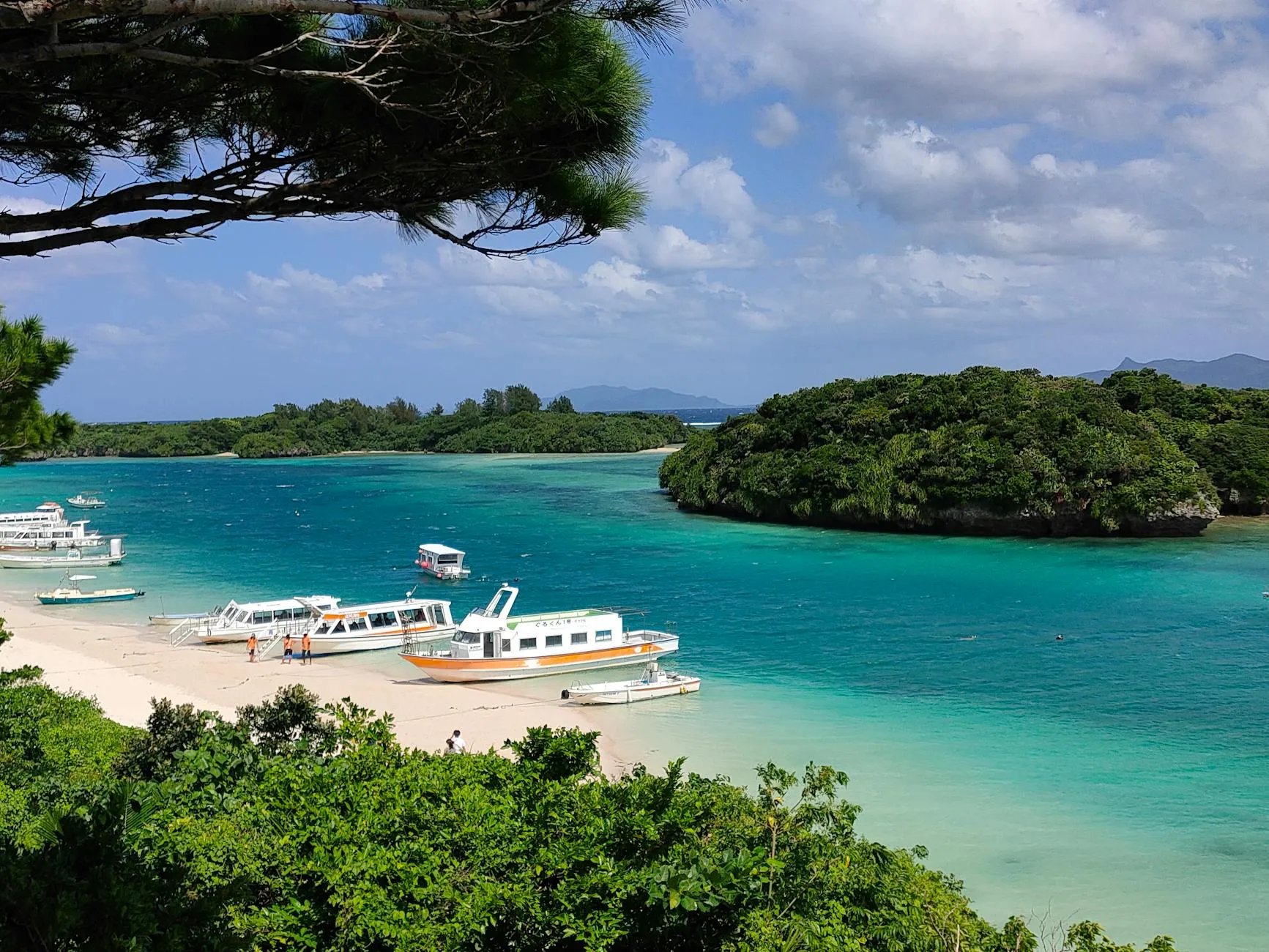
Kabira Bay (Kabira-wan) is the island’s signature view: a sheltered inlet of graded turquoise with small offshore islets, where glass-bottom boats run because swimming is restricted by the currents and the pearl-cultivation beds below. It is about 38 km from the airport — roughly 40 minutes by rental car or taxi each way.
⚠️ Kabira Bay bus: twice daily — do not plan a layover around it
A direct airport-to-Kabira service runs roughly at midday and mid-afternoon, ¥860 one way. The gaps between departures are long enough that missing a slot strands you for hours. Treat Kabira as car-or-taxi-only on a layover. A round trip is about 80 minutes of driving plus an hour or so at the bay, then the return to the airport and the pre-flight buffer: five to six hours of total layover time, minimum, with a car arranged in advance. On the bus, do not attempt it.
Central Ishigaki — viable from about four hours
The port area, the Euglena Mall covered arcade and the food streets around it make up the centre. Routes 4 or 10 take 35–40 minutes each way, so a layover of around four hours — with a confident buffer against the 21:45 last bus — is enough for a meal and a walk around. It is a working island town rather than a sightseeing district; set expectations accordingly.
💡 Under three hours: stay at the airport
The 15 km each way, the 30-minute bus frequency and the 21:45 cut-off leave no margin on a short connection. The terminal cafés and the landside dining are a better use of a tight layover than a half-trip that runs out of time.
📱 Practical Notes
Payment. Mainland Japan has largely gone cashless, but the Yaeyamas lag the cities. Cards and IC transit cards work at hotels, larger restaurants and the airport. Small shops, some bus services and the outer islands still run on cash. Carry more yen than you would in Tokyo. Convenience-store ATMs — 7-Eleven and Japan Post branches reliably accept foreign cards — cover any shortfall.
Connectivity. Japan’s mobile networks are unrestricted: no app-blocking, no filtered content. A travel eSIM or a rental pocket Wi-Fi unit picked up at a mainland airport covers the island; signal is reliable in town and along the main roads, thinner in remote coastal corners.
Currency. The yen was trading at roughly ¥159 to the US dollar and ¥186 to the euro in May 2026. Rates move; treat those as a guide. Airport exchange counters add a margin — withdraw yen from a convenience-store ATM rather than converting cash at a desk.
❓ Frequently Asked Questions
📊 At a Glance — ISG 2026
| Item | Detail |
|---|---|
| IATA / ICAO | ISG / ROIG |
| Opened | March 2013 (replaced the original Ishigaki Airport) |
| Location | Shiraho district, ~15 km from central Ishigaki, Okinawa Prefecture |
| Terminals | One domestic terminal + seasonal international wing (Taiwan / Hong Kong / Seoul) |
| Bus | Azuma Bus routes 4 & 10 → bus terminal / port, ¥550, ~35–40 min, ~every 30 min, last ~21:45 |
| Second bus operator | Karry Kanko route 55, direct airport↔port ferry terminal, ¥550, :05 and :35 past the hour, 09:35–19:05 |
| Taxi | Metered rank; ~¥2,800–7,100 islandwide; ~¥2,800 / ~20 min to the city centre, ~¥3,500 / ~25 min to the port ferry terminal |
| Rental car | Recommended for beaches, reef viewpoints and Kabira Bay |
| Currency | JPY (¥); ≈ ¥159/US$1, ≈ ¥186/€1 (May 2026) |
| Payment | Cash-reliant vs mainland; cards at hotels/airport; convenience-store ATMs accept foreign cards |
| Border | Visa-free entry (~90 days, ~70 nationalities) · Japanese visa / eVisa otherwise |
| JESTA | Not in force in 2026; targeted ~2028, legal deadline 31 Mar 2029 |
| Based carriers | ANA, JAL, JTA, Solaseed Air, Peach, RAC, Daiichi Air (domestic); Tigerair Taiwan, HK Express, Jin Air (seasonal) |
| Lounges | None on Priority Pass / DragonPass / LoungeKey; paid Special Waiting Room only (¥5,500/hr incl. tax, reservation only, airside domestic terminal) |
| 2026 change | ANA Itami–Ishigaki in peak blocks only, 1 daily round-trip (late Apr–early May, mid Jul–late Aug 2026, mid Dec–early Jan, mid–late Mar 2027) |
| Kabira Bay | ~38 km, ~40 min by car/taxi; direct bus twice daily only — needs ~5–6 hr layover + car |
| Layover verdict | Under ~3 hrs: stay airside · ~4 hrs: town by bus viable · ~5–6 hrs + car: Kabira Bay possible |